- Product Description Description
- Table of Contents TOC
- List of Table & Figure LOT
- Get Free Sample PDF Sample PDF
Market Size, 2025
$35.51 BnMarket Estimate, 2026
$38.54 BnMarket Forecast, 2034
$74.18 BnCAGR, 2026–2034
8.53%Asia Pacific Plastic Compounding Market Size
Asia Pacific Plastic Compounding market size was valued at USD 35.51 billion in 2025, and is expected to reach USD 74.18 billion by 2034 from USD 38.54 billion in 2026. The market's promising CAGR for the predicted period is 8.53%.
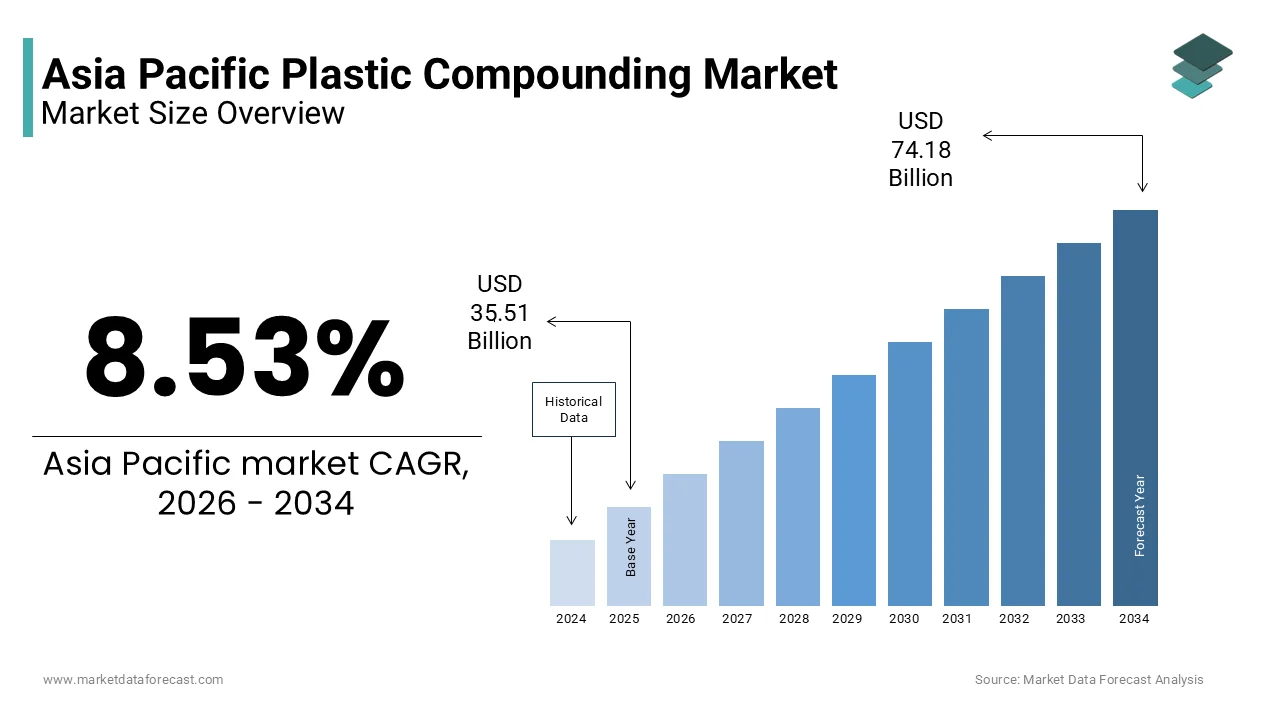
The Asia Pacific plastic compounding market refers to the industry involved in blending raw polymer resins with additives, fillers, reinforcing agents, and colorants to produce customized thermoplastic compounds that meet specific performance requirements across various end-use sectors. These compounded materials are extensively used in automotive, electronics, construction, packaging, and consumer goods industries, where enhanced mechanical properties, thermal resistance, and aesthetic appeal are essential.
A defining characteristic of this market is its role in enabling lightweighting initiatives and material efficiency improvements, particularly in transportation and electrical applications. According to the Plastics Industry Association of Japan, over 60% of automotive components produced domestically now utilize engineered plastic compounds to reduce vehicle weight and improve fuel efficiency.
MARKET DRIVERS
Rising Demand from the Automotive Industry
One of the primary drivers of the Asia Pacific plastic compounding market is the increasing demand from the automotive industry for lightweight, durable, and cost-effective materials. There is a growing shift toward replacing traditional metal components with reinforced plastic compounds in structural, interior, and under-the-hood applications as automakers strive to meet stringent emission norms and enhance fuel efficiency. Moreover, Japanese automakers such as Toyota and Honda have been actively integrating impact-modified ABS blends into seating systems and instrument clusters to improve crash resistance while reducing overall vehicle weight. As per the Japan Automobile Manufacturers Association, these materials contribute to an average weight reduction of 8–10% in modern compact cars.
Expansion of Consumer Electronics Manufacturing
Another significant driver shaping the Asia Pacific plastic compounding market is the rapid expansion of consumer electronics manufacturing in countries like South Korea, Taiwan, and Vietnam. The demand for high-performance engineering resins such as polycarbonate blends, nylon compounds, and flame-retardant ABS is rising due to their application in casings, connectors, heat sinks, and internal circuitry components. As per the Korea Electronics Industry Association, over 90% of smartphones and tablets manufactured in South Korea in 2023 utilized custom-engineered plastic compounds to achieve thin, lightweight designs without compromising durability or thermal management. In addition, the growing adoption of smart home devices and wearable technology in urban centers has spurred demand for miniaturized, high-impact-resistant compounds. According to the Industrial Development Bureau of Taiwan, more than 40% of new electronic product launches in 2023 featured injection-molded plastic housings designed using modified polyamide and PBT compounds.
MARKET RESTRAINTS
Regulatory Pressure on Plastic Waste and Recycling
A major restraint affecting the Asia Pacific plastic compounding market is the increasing regulatory pressure surrounding plastic waste management and recyclability standards. Governments across the region are implementing stringent policies aimed at curbing single-use plastics and promoting circular economy principles, which pose challenges for compounders reliant on non-recyclable or hard-to-process formulations.
For example, in Australia, the Department of Climate Change, Energy, the Environment and Water introduced the National Plastics Recycling Scheme in 2023, which is mandating that all plastic products sold must be either recyclable or compostable by 2026. A similar initiative was launched in Thailand, where the Ministry of Natural Resources and Environment proposed restrictions on multi-layer plastic composites used in industrial applications.
Additionally, in India, the Plastic Waste Management Rules were amended to require producers to ensure extended producer responsibility (EPR) compliance for all plastic goods, including compounded materials used in packaging and consumer electronics.
Volatility in Raw Material Prices
Another significant challenge restraining the Asia Pacific plastic compounding market is the volatility in raw material prices for base polymers derived from crude oil and natural gas feedstocks. Since compounding involves extensive use of polyolefins, engineering resins, and specialty additives, fluctuations in petrochemical prices directly impact production costs and profit margins.
Furthermore, environmental crackdowns on chemical manufacturing zones in China and India have led to periodic plant shutdowns, exacerbating raw material shortages. As per the China Petroleum and Chemical Industry Federation, over 20% of domestic resin suppliers faced temporary closures in 2023 due to non-compliance with emissions regulations. These supply-side instabilities make it difficult for compounders to maintain consistent pricing and long-term contracts, dampening investment confidence in the sector.
MARKET OPPORTUNITIES
Growth of Biodegradable and Bio-Based Plastic Compounds
An emerging opportunity in the Asia Pacific plastic compounding market is the growing demand for biodegradable and bio-based plastic compounds driven by environmental concerns and regulatory mandates. Compounders are increasingly turning to renewable feedstocks such as polylactic acid (PLA), polyhydroxyalkanoates (PHA), and starch-based polymers to develop sustainable alternatives as governments impose stricter restrictions on conventional plastics.
According to the Japan Bioindustry Association, PLA consumption in industrial applications grew by 14% in 2023, with compounders developing blends tailored for food packaging, disposable cutlery, and agricultural films. In South Korea, the Ministry of Environment mandated that 30% of government procurement items must incorporate bio-based plastics by 2026 by prompting local manufacturers to invest in compounding lines dedicated to green materials.
Increasing Adoption in Electric Vehicle Components
The expanding electric vehicle (EV) sector presents a significant opportunity for the Asia Pacific plastic compounding market in the development of high-performance, lightweight materials suited for EV interiors, battery enclosures, and charging infrastructure. According to the China Association of Automobile Manufacturers, the number of electric vehicles produced in China exceeded 7 million units in 2023, with over 40% of these models incorporating glass-filled polyamide compounds in battery trays and connector housings. In South Korea, LG Chem and SK Innovation have partnered with compounders to develop flame-retardant polypropylene blends specifically designed for EV battery modules.
MARKET CHALLENGES
Technological Complexity in Developing High-Performance Compounds
One of the foremost challenges confronting the Asia Pacific plastic compounding market is the technological complexity involved in formulating high-performance compounds that meet exacting specifications across different industries. Unlike commodity-grade plastics, engineered compounds require precise control over additive dispersion, melt flow, and interfacial adhesion to achieve desired properties such as impact resistance, UV stability, and flame retardancy.
According to the Korea Institute of Science and Technology, achieving uniform filler distribution in glass fiber-reinforced polyamides remains a persistent issue, often leading to variations in tensile strength and warpage after molding.
Moreover, as industries demand multifunctional materials such as those combining conductivity, thermal management, and anti-static properties the need for advanced formulation expertise increases. As per the Indian Institute of Technology Delhi, developing hybrid nanocomposites with consistent performance characteristics remains a costly and time-intensive process. These technical barriers hinder widespread adoption, which is especially among smaller-scale manufacturers seeking to compete with multinational players.
Intense Regional Competition and Pricing Pressures
The Asia Pacific plastic compounding market faces intense competition from both global leaders and regional players, which is resulting in downward pricing pressures that constrain profitability and limit investment in innovation. Countries such as China and India host a large number of domestic compounders offering cost-effective alternatives to international brands, leveraging lower labor and production costs.
While this competitive environment benefits end-users in terms of affordability, it poses challenges for established players striving to maintain margins amid rising input costs. Additionally, the influx of lower-cost options has raised concerns about quality consistency and regulatory compliance, particularly in regulated sectors such as automotive and medical devices. As a result, foreign suppliers must continuously innovate and differentiate their offerings to sustain market relevance in the face of growing regional competition.
REPORT COVERAGE
| REPORT METRIC | DETAILS |
| Market Size Available | 2025 to 2034 |
| Base Year | 2025 |
| Forecast Period | 2026 to 2034 |
| CAGR | 8.53% |
| Segments Covered | By Source, Product Type, Application, and Region |
|
Various Analyses Covered | Regional & Country Level Analysis, Segment-Level Analysis, DROC, PESTLE Analysis, Porter’s Five Forces Analysis, Competitive Landscape, Analyst Overview on Investment Opportunities |
| Regions Covered | India, China, Japan, South Korea, Australia, New Zealand, Thailand, Malaysia, Vietnam, Philippines, Indonesia, Singapore, and the Rest of Asia-Pacific |
| Market Leaders Profiled | LyondellBasell Industries N.V., Teijin Plastics, Kraton Polymers Inc., RTP Company, BASF SE, SABIC, The 3M Company, Polyplastics Asia Pacific Sdn Bhd, Melchers Malaysia, Helistrom Sdn Bhd, and others |
SEGMENTAL ANALYSIS
By Source Insights
The fossil-based plastic compounds dominated the Asia Pacific plastic compounding market with dominant share in 2025. One of the key drivers of this dominance is the continued reliance on polyolefins such as polyethylene and polypropylene in packaging, automotive, and construction applications. Additionally, fossil-based polymers offer superior performance characteristics in high-temperature and high-stress environments, making them indispensable in automotive under-the-hood components and electrical insulation materials. As per the Japan Chemical Industry Association, over 90% of wire and cable sheathing produced in Japan still relies on PVC and PE compounds derived from petroleum sources.
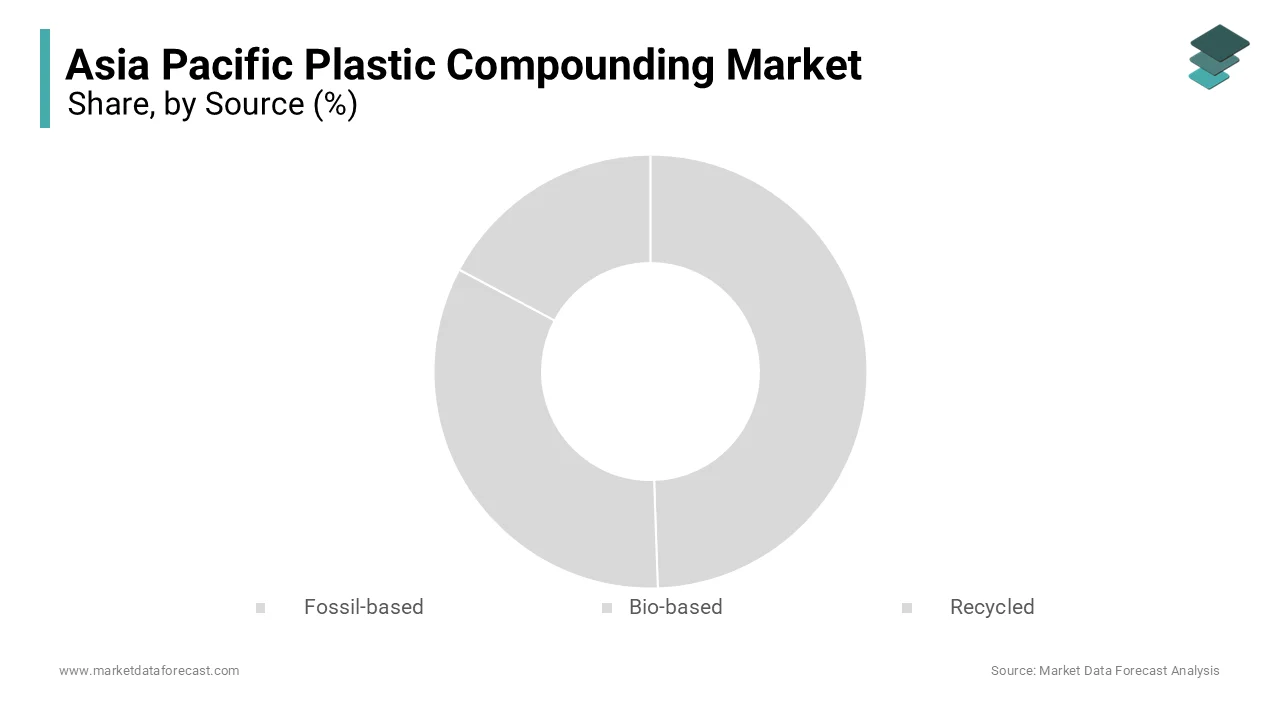
The bio-based plastic compounds segment is lucratively growing with a CAGR of 12.4% in the next coming years. This rapid expansion is driven by increasing government support for sustainable materials, growing consumer awareness, and stricter regulations targeting carbon emissions and plastic waste.
A primary growth catalyst is the rise in bio-polymer adoption in food packaging and disposable products. According to the Thailand Bioplastics Association, local PLA consumption increased by 16% year-on-year in 2023, with major retailers transitioning to compostable bags and containers made from starch-based compounds.
Moreover, automotive and electronics manufacturers in South Korea and Taiwan are increasingly integrating bio-based polyamides and polycarbonates into interior trim and electronic housings. As per the Korea Institute of Industrial Technology, over 25 new electric vehicle models launched in 2023 featured biocomposite parts designed to reduce lifecycle emissions.
By Product Type Insights
The Polypropylene (PP) held the 25.3% share of the Asia Pacific plastic compounding market in 2025. Its widespread use is attributed to its versatility, chemical resistance, and relatively low production cost, making it suitable for diverse applications ranging from automotive interiors to household appliances and packaging. Additionally, in China, the National Development and Reform Commission has promoted PP as a preferred material for reusable food containers and medical-grade packaging due to its high heat resistance and compliance with food safety standards. As per the China Plastics Processing Industry Association, domestic PP compound consumption in food packaging alone surpassed 3 million metric tons in 2023.
The Polyamide (PA) is esteemed to grow with a CAGR of 9.8% in the next coming years. A key growth driver is the demand for lightweight yet durable materials in electric vehicle powertrains and battery systems. In addition, the electronics industry in Southeast Asia is leveraging reinforced polyamide blends for connectors, switchgear, and heat-resistant housing components. As per the Malaysian Investment Development Authority, electronics exports incorporating PA-based compounds grew by 14% in 2023, reflecting broader regional integration of high-performance plastics.
By Application Insights
The automotive sector was the largest by capturing 32.4% of the Asia Pacific plastic compounding market share in 2025. According to the China Association of Automobile Manufacturers, over 70% of passenger vehicles produced in China in 2023 incorporated compounded polypropylene and thermoplastic olefin (TPO) in bumpers, instrument panels, and door modules to achieve weight savings without compromising durability. Similarly, Japanese automakers have been adopting glass fiber-reinforced polyamide compounds for under-the-hood components and transmission parts.
The medical devices segment is swiftly emerging with a CAGR of 11.6% in the next coming years. This rapid expansion is driven by increasing investments in healthcare infrastructure, rising demand for disposable medical equipment, and stringent regulatory requirements for sterilizable and biocompatible materials. A key growth driver is the surge in single-use diagnostic and surgical tools, particularly in countries like India and Indonesia where hospital infection control protocols are becoming more stringent. Moreover, in Japan, the Ministry of Health, Labour and Welfare has encouraged the use of gamma-sterilizable resins in implantable and wearable medical devices. As per the Japan Medical Device Promotion Council, compounded polyurethane and silicone blends are being increasingly adopted for catheters, drug delivery systems, and prosthetics.
REGIONAL ANALYSIS
China was the top performer in the Asia Pacific plastic compounding market with 36.8% of the share in 2025. One of the main growth drivers is the automotive industry, where Chinese automakers are increasingly adopting lightweight plastic compounds to meet national fuel efficiency targets. According to the China Association of Automobile Manufacturers, over 80% of new energy vehicles produced domestically in 2023 incorporated engineered plastic components in battery enclosures and structural parts. Additionally, the electronics manufacturing sector continues to be a major consumer of compounded materials, particularly in smartphone casings, connectors, and printed circuit boards.
India was next with 13.4% of Asia Pacific plastic compounding market share in 2025. A major growth factor is the Make in India initiative, which has attracted significant foreign direct investment into the automotive and electronics sectors. Furthermore, the growing demand for packaged food and home appliances has spurred the use of polypropylene and polyethylene compounds in rigid and flexible packaging applications.
Japan is likely to showcase healthy CAGR for the Asia Pacific plastic compounding market with its advanced polymer research and high-value manufacturing, Japan remains a leader in producing specialty compounds tailored for automotive, electronics, and medical applications.
One of the key strengths of Japan’s market is its focus on high-performance engineering resins, including modified polyamides, polycarbonates, and thermoplastic elastomers. According to the Japan Chemical Innovation Institute, over 40% of new polymer patents filed in 2023 originated from Japanese research institutions and corporate R&D centers.
Moreover, Japanese automakers continue to integrate lightweight plastic components into next-generation vehicle designs to meet stringent fuel efficiency targets. As per the Japan Automobile Manufacturers Association, lightweight thermoplastic compounds reduced component weight by up to 15% in 2023 models. With continuous investment in material science and sustainability initiatives, Japan maintains a strong competitive edge in the compounding domain.
South Korea plastic compounding market is esteemed to have significant growth opportunities in the next coming years with the robust demand from the electronics, automotive, and consumer goods industries. The country’s compact yet highly developed industrial ecosystem enables swift adoption of cutting-edge plastic materials in precision manufacturing and design-driven applications.
Another growth driver is the electronics sector, where Korean companies such as Samsung and LG rely heavily on compounded resins for smartphones, televisions, and home appliances.
Australia is lucratively to have significant growth rate in the Asia Pacific plastic compounding market with its strong regulatory framework and commitment to environmental responsibility. In addition, Australian researchers are developing innovative bio-based and recycled polymer blends tailored for niche applications such as marine infrastructure and medical devices. As per CSIRO, several pilot projects launched in 2023 demonstrated the feasibility of converting post-consumer plastic waste into high-value compounds suitable for injection molding and extrusion. With major brands such as Boral and Orora adopting circular economy principles, Australia continues to serve as a model for sustainable compounding innovation in the Asia Pacific region.
COMPETITIVE LANDSCAPE
The competition in the Asia Pacific plastic compounding market is shaped by a dynamic mix of multinational corporations and agile regional manufacturers striving to capture market share through technological differentiation and localized production strategies. As industries increasingly prioritize material efficiency, lightweighting, and sustainability, companies are under pressure to develop advanced compounds that offer superior mechanical properties, thermal resistance, and environmental compliance. The market sees intense rivalry not only in pricing but also in formulation expertise, particularly among producers of engineering resins and bio-based alternatives. Regulatory developments related to chemical safety and recyclability further influence competitive dynamics, compelling firms to invest heavily in compliance and eco-friendly innovations. Additionally, the growing presence of domestic compounders offering cost-effective solutions intensifies the market landscape, requiring global players to continuously innovate and adapt their offerings to maintain relevance and prominence in this fast-evolving sector.
KEY MARKET PLAYERS
LyondellBasell Industries N.V., Teijin Plastics, Kraton Polymers Inc., RTP Company, BASF SE, SABIC, The 3M Company, Polyplastics Asia Pacific Sdn Bhd, Melchers Malaysia, and Helistrom Sdn Bhd are the key players in the Asia Pacific plastic compounding market.
TOP PLAYERS IN THE MARKET
- One of the leading players in the Asia Pacific plastic compounding market is SABIC, a global leader in diversified chemicals and polymers. The company plays a pivotal role in supplying high-performance compounded materials tailored for automotive, electronics, and industrial applications. In the Asia Pacific region, SABIC has been instrumental in driving innovation through its extensive R&D centers in China and India, offering customized polymer solutions that align with evolving industry demands.
- Another key player is LyondellBasell, recognized for its strong portfolio of polyolefin-based compounds used across packaging, automotive, and consumer goods sectors. The company has been expanding its production capabilities in Southeast Asia to cater to growing demand for lightweight and recyclable materials with a strategic focus on sustainable compounding.
- BASF SE is also a major participant, known for its engineering plastics and thermoplastic elastomers designed for high-end automotive and electrical applications. BASF supports regional growth by collaborating closely with OEMs and material converters, ensuring performance-driven formulations that meet stringent safety and environmental standards across multiple industries.
TOP STRATEGIES USED BY KEY PLAYERS
A primary strategy adopted by leading companies in the Asia Pacific plastic compounding market is product innovation and development of specialty compounds , focusing on high-performance resins tailored for electric vehicles, medical devices, and advanced electronics.
Another significant approach is expanding manufacturing and technical service facilities across emerging markets by allowing firms to reduce lead times, enhance supply chain efficiency, and better serve localized customer needs in countries like India, Vietnam, and Indonesia.
RECENT HAPPENINGS IN THE MARKET
- In February 2025, SABIC launched a new line of flame-retardant polyamide compounds specifically designed for electric vehicle battery housings, targeting major automakers in South Korea and Japan. This initiative aimed at improving fire safety while reducing system weight in next-generation EV platforms.
- In June 2023, LyondellBasell expanded its existing facility in Shanghai to include a dedicated compounding line for polypropylene-based materials, reinforcing its ability to serve China’s growing demand for lightweight automotive and packaging applications.
- In October 2025, BASF entered into a collaborative agreement with an Indian medical device manufacturer to co-develop sterilizable thermoplastic compounds for single-use diagnostic tools, aligning with the country’s increasing focus on healthcare infrastructure modernization.
- In March 2023, Lotte Chemical established a regional distribution hub in Singapore to streamline logistics and ensure faster delivery of compounded PE and PP materials to customers across Southeast Asia, enhancing responsiveness and operational efficiency.
- In August 2025, Mitsui Chemicals introduced a new range of bio-based TPE compounds for use in Japanese consumer electronics, catering to premium brands seeking sustainable materials without compromising on performance or aesthetics.
MARKET SEGMENTATION
This research report on the Asia Pacific plastic compounding market has been segmented and sub-segmented based on the following categories.
By Source
- Fossil-based
- Bio-based
- Recycled
By Product Type
- Polyethylene (PE)
- Polypropylene (PP)
- Thermoplastic Vulcanizates (TPV)
- Thermoplastic Polyolefins (TPO)
- Polyvinyl Chloride (PVC)
- Polystyrene (PS)
- Polyethylene Terephthalate (PET)
- Polybutylene Terephthalate (PBT)
- Polyamide (PA)
- Polycarbonate (PC)
- Polyurethane (PU)
- Polymethyl Methacrylate (PMMA)
- Acrylonitrile Butadiene Styrene (ABS)
- Others
By Application
- Automotive
- Building & Construction
- Electrical & Electronics
- Packaging
- Consumer Goods
- Industrial Machinery
- Medical Devices
- Optical Media
- Aerospace & Defense
- Others
By Country
- India
- China
- Japan
- South Korea
- Australia
- New Zealand
- Thailand
- Malaysia
- Vietnam
- Philippines
- Indonesia
- Singapore
- Rest of Asia-Pacific