- Product Description Description
- Table of Contents TOC
- List of Table & Figure LOT
- Get Free Sample PDF Sample PDF
Market Size, 2025
$21.28 BnMarket Estimate, 2026
$22.80 BnMarket Forecast, 2034
$39.53 BnCAGR, 2026–2034
7.12%Executive Summary: Middle East Insurance Market
- Market Scope: Comprehensive regional Middle East insurance market analysis covering insurance types, distribution channels, country-level leadership frameworks, regulatory compliance, and demographic metrics.
- Market Valuation: Valued at USD 43.37 billion (2025 base year), estimated at USD 47.58 billion (2026), and projected to reach USD 99.86 billion by 2034, registering a high-growth CAGR of 9.71% (2026–2034).
- Primary Growth Drivers: Strict regulatory mandates, expanding commercial activities, and rising digitalization across financial services. Key financial, regulatory, and demographic highlights include UAE motor insurance compliance reaching nearly 100%, commercial policies growing by >10% annually, digital insurance platforms increasing by >40% in three years, insurance penetration remaining below 1% in less-developed markets (Iraq, Yemen), licensed GCC insurance brokers increasing by 10% annually, Saudi health insurance covering >90% of expatriates, Dubai’s expatriate population exceeding 85%, and >25 insurtech firms launching in Israel over five years.
Key Market Segment Metrics (2026–2034)
| Category | Leading Segment (2025 Position) | Fastest-Growing Segment |
|---|---|---|
| By Insurance Type | General Insurance (dominated type segment with 58.4% of the market in 2025) | Life Insurance (projected to expand at a CAGR of 9.2% from 2026 to 2034) |
| By Distribution Channel | Direct Insurers (led distribution channels with a 45.3% share in 2025) | Insurance Brokers & Agencies (forecasted to register an 8.7% CAGR) |
| By Service Innovation | Traditional Motor, Health, & Commercial Property Coverage Frameworks | AI-Driven Underwriting, Digital Insurtech Platforms, & Takaful Products |
| By Country / Region | Saudi Arabia (led geographically with 28.3% of the market in 2025), followed by the UAE (22.3%) | Expanding GCC Insurance Hubs & Emerging Digital Financial Ecosystems |
Major Market Players & Market Structure
Market Structure: Highly competitive Middle Eastern insurance landscape featuring major regional financial institutions and multinational corporations competing intensely on digital transformation, AI-driven underwriting accuracy, compliant takaful products, and strategic bancassurance partnerships.
Key Companies: Qatar Insurance Company, Sukoon Insurance, GIG Gulf, Bupa Arabia, Abu Dhabi National Insurance Company, Tawuniya, Orient Insurance, Oman Insurance Company, and MedGulf.
Asia Pacific Polyols Market Size
The Asia Pacific polyols market size was valued at USD 21.28 billion in 2025, and the market size is expected to reach USD 39.53 billion by 2034 from USD 22.80 billion in 2026. The market's promising CAGR for the predicted period is 7.12%.
The Asia Pacific polyols market encompasses a wide range of chemical compounds primarily used in the production of polyurethanes, which find extensive applications in industries such as construction, automotive, furniture, packaging, and insulation. Polyols are essential components in foam manufacturing, including flexible and rigid foams, and are derived from both petrochemical and bio-based sources. According to the International Energy Agency, Asia Pacific is one of the fastest-growing regions for chemical production, with increasing industrial activity driving demand for downstream materials like polyols. The region’s expanding manufacturing base, coupled with rising urbanization and infrastructure development, has significantly boosted the consumption of polyurethane products, thereby increasing the need for polyols. As per the United Nations Industrial Development Organization (UNIDO), industrial value added in the Asia Pacific region grew by 4.8% annually between 2015 and 2023, which is reflecting strong industrial expansion that supports polyol demand. Additionally, growing environmental awareness has led to increased research into bio-based polyols, particularly in countries like China, India, and Japan, where sustainability and circular economy principles are gaining traction. Moreover, government initiatives promoting energy-efficient building materials, lightweight automotive components, and green chemistry have further accelerated polyol adoption. In China, for instance, the Ministry of Industry and Information Technology emphasized resource efficiency and alternative feedstocks by encouraging manufacturers to adopt greener polyol production methods.
MARKET DRIVERS
Rapid Growth in Construction and Insulation Industries
One of the primary drivers of the Asia Pacific polyols market is the rapid expansion of the construction and insulation industries, particularly in emerging economies such as India, Indonesia, and Vietnam. Polyols are critical components in the production of rigid polyurethane foams used for thermal insulation in residential, commercial, and industrial buildings. In China, the Ministry of Housing and Urban-Rural Development mandated stricter energy efficiency standards for new buildings, leading to higher adoption of rigid foam insulation systems. As per data from the China Plastics Processing Industry Association, polyurethane insulation use in new commercial constructions rose by 18% in 2024, which is directly stimulating polyol demand. Similarly, in Southeast Asia, countries like Thailand and Malaysia are witnessing increased investments in cold chain logistics and refrigeration facilities, where polyurethane foams are extensively used. This trend is expected to continue, reinforcing the role of polyols as a key enabler of modern construction and energy conservation strategies across the Asia Pacific region.
Expansion of the Automotive and Transportation Sector
Another major driver fueling the Asia Pacific polyols market is the continued expansion of the automotive and transportation sector, where polyurethane foams derived from polyols are widely used in seating, dashboards, headliners, and interior trims. Additionally, polyurethane coatings and elastomers play a crucial role in vehicle durability and performance. As per the International Organization of Motor Vehicle Manufacturers, Asia Pacific produced over 55% of the world's automobiles in 2024, with China, India, and Thailand serving as key manufacturing hubs. In China, electric vehicle (EV) production surged in 2024, with the Ministry of Industry and Information Technology noting that over 9 million EVs were manufactured during the year, up from 6 million in 2023. These vehicles incorporate more lightweight and insulating materials to improve energy efficiency, increasing the use of polyurethane-based components sourced from polyols. Furthermore, the rise in demand for lightweight and fuel-efficient vehicles across South Korea and Japan has led to increased R&D into high-performance polyurethane formulations.
MARKET RESTRAINTS
Volatility in Raw Material Prices and Supply Chain Disruptions
A significant restraint affecting the Asia Pacific polyols market is the volatility in raw material prices, particularly for petroleum-derived feedstocks such as propylene oxide and glycols. Fluctuations in crude oil prices, geopolitical tensions, and supply chain disruptions have led to cost instability, impacting profit margins and production planning for polyol manufacturers. According to the U.S. Energy Information Administration, global crude oil prices experienced a swing of over $25 per barrel between early 2023 and late 2024, creating uncertainty for polyol producers reliant on petrochemical inputs. Additionally, trade restrictions and logistical bottlenecks have affected the availability of key raw materials. In 2024, container shortages at major ports in China and Vietnam delayed shipments of intermediate chemicals by causing temporary production halts for several polyol suppliers.
Stringent Environmental Regulations and Chemical Compliance Standards
Another key challenge facing the Asia Pacific polyols market is the increasing stringency of environmental regulations and chemical compliance standards imposed by national and regional authorities. Governments are enforcing tighter controls on emissions, waste management, and chemical safety, influencing the formulation and usage of polyols in various applications. In China, the Ministry of Ecology and Environment implemented new guidelines under the "14th Five-Year Plan" that require chemical manufacturers to reduce volatile organic compound (VOC) emissions, pushing companies to reformulate polyurethane systems using low-emission polyols. Similarly, in Japan, the Ministry of Economy, Trade and Industry (METI) introduced mandatory life-cycle assessments for polyurethane-based products, compelling manufacturers to invest in cleaner production technologies. In Australia, the National Industrial Chemicals Notification and Assessment Scheme (NICNAS) has tightened scrutiny on isocyanate-based polyurethane systems, indirectly influencing polyol formulation requirements.
MARKET OPPORTUNITIES
Rising Demand for Bio-Based and Sustainable Polyols
A promising opportunity within the Asia Pacific polyols market is the growing demand for bio-based and sustainable alternatives to traditional petrochemical-derived polyols. Industries are shifting toward plant-based polyols derived from soybean oil, palm oil, castor oil, and other natural sources. According to Frost & Sullivan, bio-based polyols accounted for 12% of total polyol consumption in Asia Pacific in 2024 with projections showing steady growth driven by government incentives and corporate sustainability goals. In China, the State Administration for Market Regulation encouraged the development of green polyurethane products, resulting in increased investment in bio-polyol R&D by domestic firms. Companies like BASF and Cargill expanded their bio-based polyol offerings in the region, capitalizing on this shift.
Growing Applications in Medical and Healthcare Products
Another emerging opportunity in the Asia Pacific polyols market lies in the medical and healthcare sector, where polyurethane-based products derived from polyols are increasingly used in devices, implants, wound care, and drug delivery systems. The biocompatibility, flexibility, and durability of polyurethanes make them ideal for long-term and disposable medical applications. According to a 2024 report by McKinsey Health Institute, medical device production in Asia Pacific grew by 9% year-over-year, driven by increased healthcare spending and pandemic-driven demand for protective equipment and ventilators. Polyurethane components used in catheters, hospital beds, and dialysis machines rely heavily on specialty polyols. In Japan, leading polymer manufacturers such as Mitsui Chemicals and DIC Corporation expanded their medical-grade polyol production lines to meet rising demand from hospitals and home healthcare providers.
MARKET CHALLENGES
Technological Complexity in Producing High-Performance Polyols
One of the foremost challenges in the Asia Pacific polyols market is the increasing complexity involved in developing high-performance polyols tailored for advanced applications in electronics, aerospace, and biomedical fields. These specialized polyols require precise molecular architecture, controlled reactivity, and enhanced durability, which necessitate advanced R&D capabilities and substantial capital investment. According to a 2024 industry white paper published by the Society of Chemical Industry, only a handful of companies in the Asia Pacific region possess the technical expertise to manufacture high-functionality polyols at scale, which is limiting accessibility for smaller manufacturers.
Regulatory Divergence Across Countries
Regulatory divergence across Asia Pacific countries poses a significant challenge for polyol producers aiming to standardize product offerings and streamline cross-border operations. Each country has distinct chemical registration, labeling, and safety evaluation protocols, complicating compliance efforts and delaying time-to-market for new products. For example, in 2024, China’s newly revised REACH-like regulation (MEP Order No. 7) required all polyol importers and manufacturers to undergo comprehensive chemical risk assessments, which is increasing administrative burden and compliance costs. Meanwhile, Japan’s Chemical Substances Control Law mandates rigorous pre-market evaluations for new polyurethane ingredients, making it difficult for foreign suppliers to enter the Japanese market without extensive documentation.
REPORT COVERAGE
| REPORT METRIC | DETAILS |
| Market Size Available | 2025 to 2034 |
| Base Year | 2025 |
| Forecast Period | 2026 to 2034 |
| CAGR | 7.12% |
| Segments Covered | By Product, Application, and Region |
|
Various Analyses Covered | Regional & Country Level Analysis, Segment-Level Analysis, DROC, PESTLE Analysis, Porter’s Five Forces Analysis, Competitive Landscape, Analyst Overview on Investment Opportunities |
| Regions Covered | India, China, Japan, South Korea, Australia, New Zealand, Thailand, Malaysia, Vietnam, Philippines, Indonesia, Singapore, and the Rest of Asia-Pacific |
| Market Leaders Profiled | The Dow Chemical Company, BASF SE, Vertellus, Huntsman Corporation, Lanxess AG, Mitsui Chemicals, Inc., Stepan Company, Koch Industries, Inc. (Invista BV), Tosoh Corporation, and Shell plc, and others |
SEGMENTAL ANALYSIS
By Product Insights
The polyether polyols segment was expected dominant share of the Asia Pacific polyols market in 2025. One key driver of this segment's dominance is the rapid expansion of the furniture and upholstery industry, particularly in China and India. According to the China National Furniture Association, the country’s furniture exports reached $78 billion in 2025 with polyurethane foams accounting for over 60% of cushioning materials used in seating and mattress production. Additionally, growing demand from the construction sector for spray foam insulation has reinforced polyether polyol consumption. In Japan and South Korea, government energy efficiency mandates have led to increased adoption of polyurethane-based insulation systems using polyether derivatives, ensuring sustained growth in both residential and commercial applications across the region.
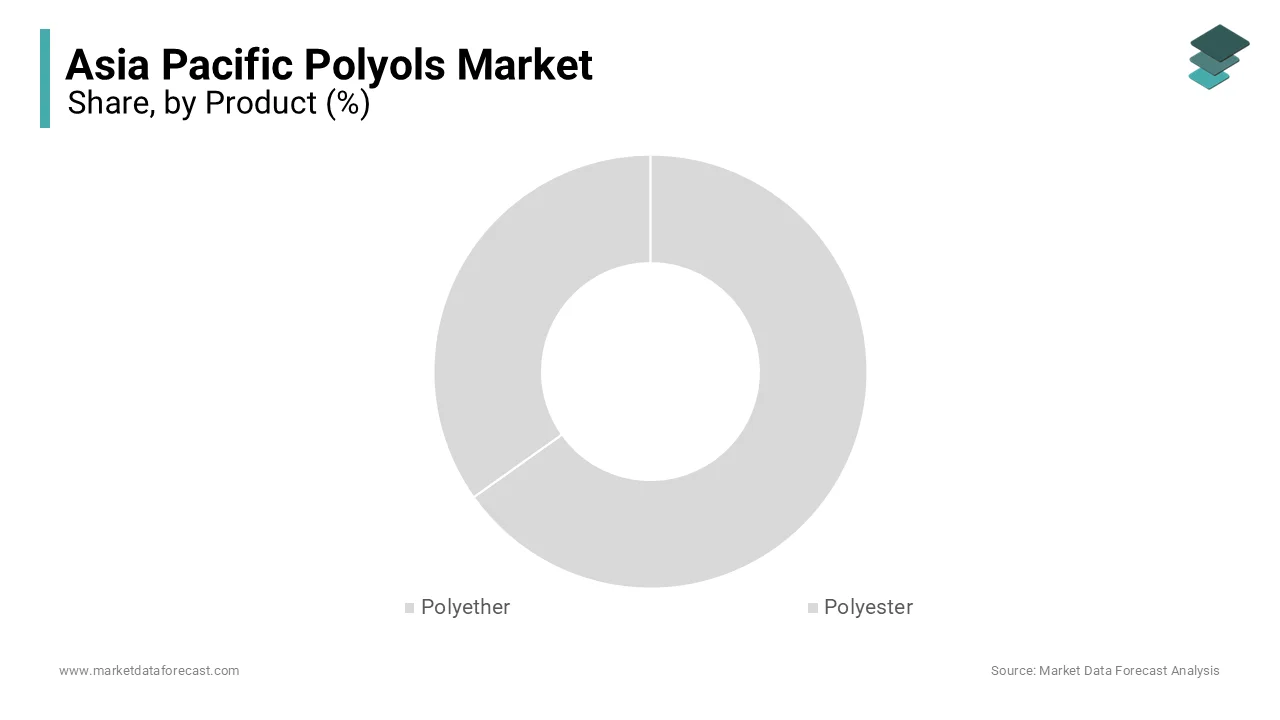
The polyester polyols segment is swiftly emerging with an expected CAGR of 6.3% in the next coming years. A major contributing factor is the expansion of the food and beverage cold storage infrastructure in Southeast Asia. According to the ASEAN Food Security Information System, refrigerated warehouse capacity in Indonesia and Thailand grew by 19% in 2025, necessitating high-performance insulation materials derived from polyester polyols. Moreover, increasing use in adhesives, sealants, and coatings (ASC) applications is fueling demand. In addition, bio-based polyester polyols are gaining traction, particularly in China and Australia, where regulatory support for sustainable chemistry is encouraging manufacturers to adopt plant-derived feedstocks.
By Application Insights
The rigid foam segment was the largest and held 52.3% of the Asia Pacific polyols market share in 2025 due to the extensive use of rigid polyurethane foam in thermal insulation for buildings, refrigeration units, and cold chain logistics, which require high energy efficiency and long-term durability. In China, the Ministry of Housing and Urban-Rural Development mandated that all new commercial buildings must meet Class A fire safety ratings, pushing manufacturers toward rigid polyurethane foam solutions that combine insulation with fire-resistant properties.
The flexible foam segment is likely to grow with a CAGR of 7.1% in the next coming years. A primary growth enabler is the booming automotive industry in India and Thailand, where flexible foam is extensively used in seat cushions, headrests, and interior trim components. According to the International Organization of Motor Vehicle Manufacturers, Asia Pacific produced over 55 million vehicles in 2025 with a rising share incorporating enhanced seating comfort features using polyurethane-based flexible foams. Furthermore, the healthcare sector is increasingly adopting flexible polyurethane foams for medical beds, patient positioning devices, and pressure-relief cushions.
REGIONAL ANALYSIS
China
China was the top performer in the Asia Pacific polyols market with 38.5% of share in 2025. One of the key growth drivers is the government-backed "Dual Circulation" strategy, which encourages domestic innovation and self-sufficiency in chemical production. The Ministry of Industry and Information Technology supported the development of green polyurethane technologies, which is prompting local producers to invest in low-emission polyol formulations. Additionally, China’s electric vehicle boom has significantly boosted polyol demand for automotive seating and insulation.
India
India was ranked second in the Asia Pacific polyols market by capturing 16.3% of share in 2025. The Pradhan Mantri Awas Yojana (PMAY) played a pivotal role in stimulating demand for polyurethane-based insulation materials. Simultaneously, the automotive sector witnessed a surge in flexible foam demand, particularly in two-wheeler and passenger car manufacturing. Additionally, the expansion of cold storage facilities under the Pradhan Mantri Kisan Sampada Yojana has further strengthened the demand for rigid foam systems based on polyols.
Japan
Japan polyols market growth is driven by the adoption of the advanced polyurethane product development. Companies such as Mitsui Chemicals and DIC Corporation have pioneered specialty polyols tailored for aerospace composites, biomedical implants, and electronic encapsulation, enhancing value-added consumption. Additionally, Japan’s aging population has spurred demand for medical-grade flexible foams and assistive devices, where polyols serve as essential raw materials. The Japanese Ministry of Health, Labour and Welfare reported that medical foam production increased by 14% in 2025, which is aligning with broader healthcare modernization efforts.
South Korea
South Korea polyols market growth is primarily driven by its advanced electronics and automotive industries, where polyurethane components are used in circuit potting, display panels, and lightweight structural foams. In the automotive sector, South Korean automakers such as Hyundai and Kia are integrating more polyurethane components into electric and hybrid vehicles to enhance weight reduction and occupant comfort.
Australia
Australia polyols market growth is characterized by stringent environmental regulations and a growing focus on sustainable polyol sourcing, particularly in construction and transportation sectors. A significant growth catalyst is the Australian Building Codes Board’s updated energy efficiency standards, which mandate improved insulation in new residential and commercial developments. According to the Green Building Council of Australia, over 60% of new constructions in 2025 included polyurethane-based insulation systems, which is directly influencing polyol demand. Moreover, the country’s push for eco-friendly materials has accelerated interest in bio-based polyols.
KEY MARKET PLAYERS AND COMPETITIVE LANDSCAPE
Major players in the market include The Dow Chemical Company, BASF SE, Vertellus, Huntsman Corporation, Lanxess AG, Mitsui Chemicals, Inc., Stepan Company, Koch Industries, Inc. (Invista BV), Tosoh Corporation, and Shell plc.
The competition in the Asia Pacific polyols market is marked by a dynamic mix of global chemical giants, regional producers, and emerging local players vying for dominance in a rapidly expanding industrial landscape. Established multinational corporations leverage their technological expertise, vast distribution networks, and brand recognition to maintain a strong presence, particularly in China, Japan, and South Korea. These firms benefit from long-standing relationships with end-use industries such as automotive, construction, and electronics, which form the backbone of polyol demand.
At the same time, regional players and national champions are gaining ground by offering cost-effective solutions tailored to local needs. In countries like India and Indonesia, domestic manufacturers are scaling up production capacities and adopting innovative sourcing strategies to remain competitive against global suppliers. The rise of bio-based polyols and stricter environmental regulations are also reshaping the competitive dynamics, compelling companies to invest in sustainable alternatives and cleaner production methods.
TOP PLAYERS IN THE MARKET
BASF SE (Germany-based, with strong APAC presence)
BASF is a global leader in polyol production and maintains a dominant position in the Asia Pacific market through its extensive product portfolio and localized manufacturing capabilities. The company offers both polyether and polyester polyols tailored for rigid and flexible foam applications across construction, automotive, and insulation sectors.
BASF has strategically expanded its footprint in China, India, and South Korea, establishing integrated production complexes that support regional supply chains. Its focus on innovation, including bio-based polyols and low-emission formulations, aligns with sustainability trends and regulatory developments in the region. BASF continues to influence formulation standards and drive technological advancements in polyurethane chemistry across Asia Pacific.
Covestro AG (Germany-based, with major operations in Asia)
Covestro plays a pivotal role in shaping polyol consumption in the Asia Pacific region through its high-performance polyurethane solutions designed for lightweighting, thermal efficiency, and durability. The company operates large-scale polyol production facilities in China and Japan, which is catering to growing demand from the automotive, electronics, and construction industries. A key strength of Covestro is its emphasis on sustainable development, including investments in carbon dioxide-based polyols and water-blown foam technologies. These innovations are gaining traction in markets like India and Australia, where environmental regulations are tightening.
Mitsui Chemicals (Japan-based regional leader)
Mitsui Chemicals is a leading player in the Asia Pacific polyols market, known for its advanced polymer technologies and strategic partnerships across industrial and medical applications. The company produces high-quality polyether and polyester polyols used in flexible seating foams, rigid insulation materials, and specialty adhesives. Mitsui’s competitive edge lies in its deep integration with Japanese automakers and electronics manufacturers, ensuring consistent demand for performance-driven polyurethane products. Additionally, Mitsui has been actively involved in developing bio-based alternatives, enhancing its relevance in sustainability-focused markets such as Australia and South Korea.
TOP STRATEGIES USED BY KEY MARKET PLAYERS
Expansion through Localized Production and Joint Ventures
Leading polyol manufacturers are strengthening their regional foothold by setting up new production units and entering joint ventures with local partners in high-growth markets like India and Southeast Asia. This strategy allows companies to reduce logistics costs, comply with domestic regulations, and cater to rising demand from downstream industries such as automotive and construction.
Development of Bio-Based and Sustainable Polyols
With increasing pressure to reduce carbon footprints, major players are investing heavily in renewable feedstocks and green chemistry. Companies are introducing plant-derived polyols that offer comparable performance to conventional variants while aligning with environmental policies and consumer preferences for eco-friendly materials in urbanized economies like Japan and Australia.
Enhanced R&D Focus on High-Performance Applications
To differentiate themselves in a competitive environment, key participants are directing resources toward advanced polyol formulations tailored for aerospace, medical devices, and electronic encapsulation. These high-value applications require superior durability, chemical resistance, and thermal stability by making innovation a critical lever for maintaining market in the Asia Pacific polyols sector.
RECENT HAPPENINGS IN THE MARKET
- In February 2024, BASF announced an expansion of its polyol manufacturing facility in Nanjing, China that aimed at meeting surging demand from the country's construction and refrigeration sectors. This move reinforced its supply chain resilience and enabled faster response to customer needs in East Asia.
- In May 2024, Covestro entered into a strategic collaboration with a leading Indian automotive supplier to co-develop lightweight polyurethane components using advanced polyol systems by positioning itself as a preferred materials partner in India’s growing electric vehicle ecosystem.
- In July 2024, Mitsui Chemicals launched a new line of bio-based polyester polyols at its Yokohama research center, targeting sustainable packaging and insulation applications with the company’s commitment to green chemistry and circular economy principles.
- In September 2024, LG Chem partnered with a South Korean refrigerator manufacturer to integrate high-efficiency polyurethane insulation systems based on custom-engineered polyether polyols, enhancing energy conservation in household appliances and strengthening its presence in the cold chain sector.
- In November 2024, Dow Inc. inaugurated a new technical service center in Singapore, focusing on polyol formulation support for polyurethane converters across Southeast Asia by improving customer engagement and accelerating product development cycles for regional clients.
MARKET SEGMENTATION
This research report on the Asia Pacific polyols market has been segmented and sub-segmented based on the following categories.
By Product
- Polyether
- Polyester
By Application
- Rigid Foam
- Flexible Foam
- Coatings
- Adhesives & Sealants
- Elastomers
- Other Applications
By Country
- India
- China
- Japan
- South Korea
- Australia
- New Zealand
- Thailand
- Malaysia
- Vietnam
- Philippines
- Indonesia
- Singapore
- Rest of Asia-Pacific