- Product Description Description
- Table of Contents TOC
- List of Table & Figure LOT
- Get Free Sample PDF Sample PDF
Market Size, 2025
$36.00 BnMarket Estimate, 2026
$74.40 BnMarket Forecast, 2034
$93.02 BnCAGR, 2026–2034
8.4%Asia Pacific Refrigerator Market Size
The Asia Pacific refrigerator market was valued at USD 36 billion in 2025 and is anticipated to reach USD 74.40 billion in 2026 to USD 93.02 billion by 2034, growing at a CAGR of 8.4%, during the forecast period from 2026 to 2034.
The refrigerator includes a wide range of products such as single-door, double-door, side-by-side, and smart refrigerators, catering to both urban and rural consumer segments. Refrigeration plays a crucial role in improving food safety, reducing wastage, and enhancing lifestyle standards, especially with rising disposable incomes and urbanization. This trend has directly influenced household appliance adoption, including refrigerators. Additionally, in Southeast Asia, ASEAN Economic Community initiatives have boosted cross-border trade and manufacturing investments, facilitating greater access to affordable refrigeration solutions.
MARKET DRIVERS
Rapid Urbanization and Changing Lifestyles
The rapid pace of urbanization and the corresponding shift in consumer lifestyles are driving the growth of the Asia Pacific refrigerator market. According to the United Nations, Asia’s urban population is projected to grow by 1.2 billion by 2050, with countries like India and Indonesia experiencing some of the highest urban growth rates. The rise of nuclear families and dual-income households has further increased the need for convenience-oriented appliances. Similarly, in Indonesia, the Central Bureau of Statistics noted that refrigerator ownership in urban households increased by 22% in 2023 compared to the previous five years.
Rising Disposable Incomes and Consumer Spending
The steady increase in disposable incomes and consumer spending power in emerging economies is escalating the growth of the Asia Pacific refrigerator market. According to the International Labour Organization, average wages in Asia have been rising, with countries like Vietnam and the Philippines experiencing annual wage growth rates exceeding 6% in 2023. This economic uplift has enabled a growing middle class to invest in durable goods such as refrigerators.
In China, the National Bureau of Statistics reported that per capita disposable income rose by 5.4% in 2023, contributing to higher consumer confidence and appliance purchases. E-commerce platforms such as JD.com and Flipkart have further facilitated refrigerator sales by offering flexible financing options and doorstep delivery, especially in tier-2 and tier-3 cities.
MARKET RESTRAINTS
High Initial Cost of Premium Refrigeration Units
The high initial cost of premium and smart refrigeration units, which limits affordability for lower-income groups, is limiting the growth of the Asia Pacific refrigerator market. According to the Asian Development Bank, nearly 40% of the population in developing Asia still lives on less than USD 5.50 per day, restricting access to expensive appliances. While entry-level models are available, the growing trend toward smart and energy-efficient refrigerators often comes with a significant price premium. These affordability challenges are slowing the penetration of advanced refrigeration technologies in rural and semi-urban areas across the region.
Regulatory and Environmental Compliance Pressures
The stringent regulatory and environmental compliance standards are another significant restraint growth of the Asia Pacific refrigerator market. Governments across the region are enforcing energy efficiency norms and refrigerant regulations to curb greenhouse gas emissions and promote sustainable consumption. According to the United Nations Environment Programme, several Asian countries have adopted the Kigali Amendment, which mandates the phase-down of hydrofluorocarbons (HFCs) used in refrigeration systems.
MARKET OPPORTUNITIES
Growth of Smart and Connected Refrigeration Systems
The increasing adoption of smart and connected refrigeration systems is a significant opportunity for the growth of the Asia Pacific refrigerator market. Consumers are showing a growing preference for appliances that offer remote monitoring, voice control, and AI-powered inventory management. The China Internet Network Information Center reported that in 2023, over 700 million Chinese consumers were using smart home devices, facilitating greater acceptance of connected appliances. In South Korea, LG Electronics and Samsung have led the market with AI-enabled refrigeration models that offer personalized settings and energy optimization.
Expansion of E-commerce and Direct-to-Consumer Sales Channels
The rapid expansion of e-commerce and direct-to-consumer sales channels is creating new growth opportunities for the Asia Pacific refrigerator market. Online retail platforms have made refrigerators more accessible to consumers in remote and semi-urban areas, where physical retail infrastructure is limited. In India, Flipkart and Amazon India reported record refrigerator sales during the festive shopping seasons, with online purchases accounting for over 30% of total appliance sales in 2023. In China, JD.com and Tmall saw a 25% year-over-year increase in refrigerator sales, driven by improved logistics and digital payment adoption. In Southeast Asia, platforms such as Shopee and Lazada have expanded refrigerator availability in Indonesia and Vietnam, where traditional retail networks are less developed.
MARKET CHALLENGES
Supply Chain Disruptions and Component Shortages
The ongoing disruption in global supply chains and shortages of components such as compressors, microchips, and refrigerants a challenging factors for the growth of the Asia Pacific refrigerator market. The semiconductor shortage, which began in 2021, has continued to impact the production of smart and energy-efficient refrigerators that rely on digital controls and sensors. According to the U.S. Chamber of Commerce’s 2023 supply chain report, 60% of electronics manufacturers in Asia faced delays in sourcing microchips and electronic components. In India, the Confederation of Indian Industry highlighted that compressor shortages led to a 10% reduction in refrigerator output in certain quarters of 2023. These supply chain challenges are affecting production schedules, increasing lead times, and limiting the availability of advanced refrigerator models across the Asia Pacific region.
Price Volatility of Raw Materials and Energy Inputs
The price volatility in raw materials and energy inputs will additionally hamper the growth of the Asia Pacific refrigerator market. Steel, aluminum, and copper, key components in refrigerator manufacturing, have experienced significant price fluctuations due to geopolitical tensions and global trade uncertainties. In China, the National Development and Reform Commission reported that energy prices, particularly electricity and natural gas, surged by 8% in 2023, raising operational expenses for refrigerator producers. These cost pressures are forcing manufacturers to either absorb the additional expenses or pass them on to consumers, thereby affecting market demand and pricing strategies across the region.
REPORT COVERAGE
| REPORT METRIC | DETAILS |
| Market Size Available | 2025 to 2034 |
| Base Year | 2025 |
| Forecast Period | 2026 to 2034 |
| Segments Covered | By Product Type, Distribution Channel, and By Country |
| Various Analyses Covered | Global, Regional & Country Level Analysis, Segment-Level Analysis, DROC, PESTLE Analysis, Porter’s Five Forces Analysis, Competitive Landscape, Analyst Overview on Investment Opportunities |
| Regions Covered | India, China, Japan, South Korea, Australia, New Zealand, Thailand, Malaysia, Vietnam, Philippines, Indonesia, Singapore, and the Rest of APAC |
| Market Leaders Profiled | Haier Smart Home Co. Ltd. (China), LG Electronics Inc. (South Korea), The Samsung Group (South Korea), The Whirlpool Corporation (U.S.), Voltas Limited (India), Electrolux AB (Sweden), Panasonic Corporation (Japan), Sharp Corporation (Japan), Hitachi, Ltd (Japan), Toshiba Corporation. (Japan), Godrej Group(India), Intex Technologies (India). |
SEGMENTAL ANALYSIS
By Product Insights
The top freezer refrigerator segment was the largest by occupying 38.2% of the Asia Pacific refrigerator market share in 2025, with its widespread adoption in developing economies such as India, Indonesia, and the Philippines, where cost-effective home appliances are in high demand. In India, the National Sample Survey Office reported that in 2023, over 60% of rural refrigerator users preferred top freezer models due to their lower price points and ease of maintenance. Similarly, in China, the China Household Electrical Appliances Association indicated that top freezer models accounted for nearly 35% of all refrigerator sales in tier-3 and tier-4 cities, where affordability remains a purchasing factor.
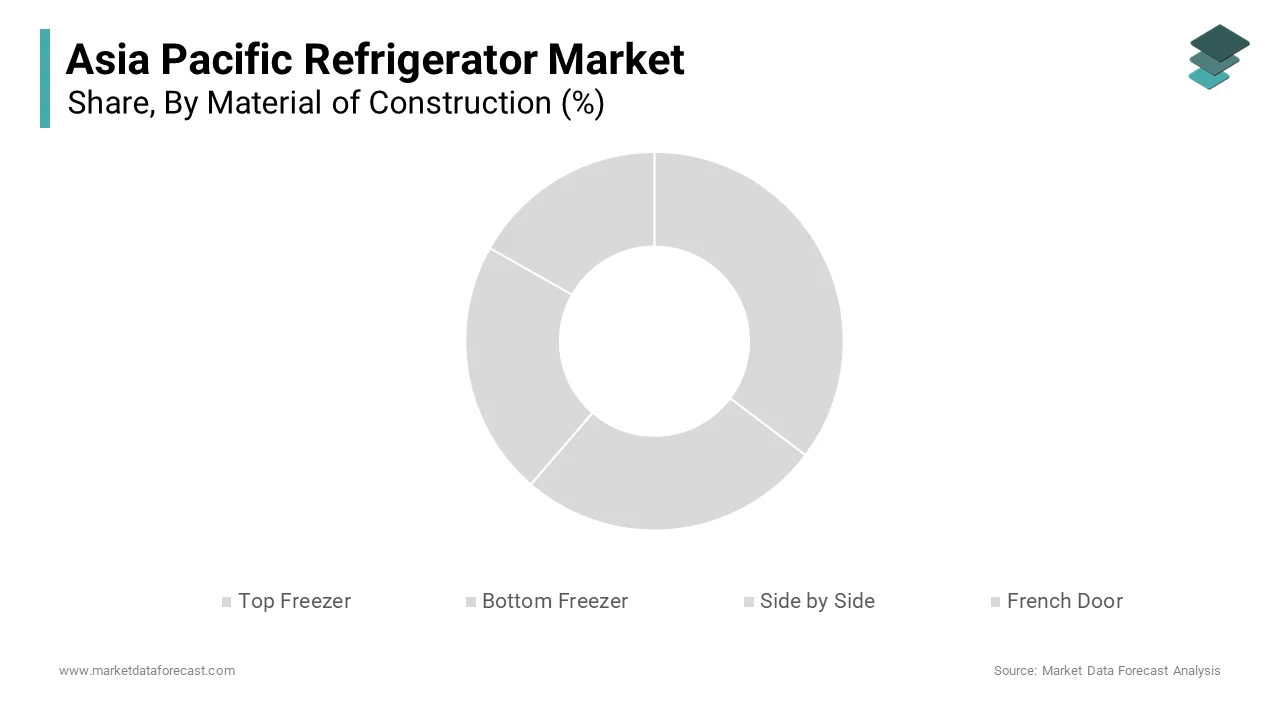
The French door refrigerator segment is projected to register a CAGR of 9.2% from 2025 to 203,3 with the increasing disposable incomes and lifestyle upgrades among the expanding middle and upper-middle classes. According to the International Labour Organization, average wages in countries like Vietnam and Malaysia grew by over 6% in 2023, enabling consumers to invest in high-end appliances. In South Korea, the Korea Trade-Investment Promotion Agency reported that French door refrigerator sales accounted for over 45% of total refrigerator purchases in 2023, driven by their sleek design, energy efficiency, and advanced cooling features.
By Distribution Channel Insights
The offline distribution channel dominated the Asia Pacific refrigerator market share in 2025 with the presence of well-established retail networks across countries like India, Indonesia, and the Philippines, where a large portion of the population prefers to inspect appliances before purchasing. According to the Indian Retailers Association, over 70% of refrigerator purchases in India were made through physical stores in 2023, with consumers valuing direct assistance from sales representatives and immediate product availability. Similarly, in China, the China Chain Store & Franchise Association reported that major appliance retailers such as Suning and GOME maintained a strong market presence, contributing to offline sales growth.
The online distribution channel is projected to grow with a CAGR of 11.4% from 2025 to 203,3, owing to the rise in smartphone penetration and internet accessibility across the Asia Pacific region. According to Statista, e-commerce sales in the region reached USD 3.5 trillion in 2023, with home appliances accounting for a significant share of online transactions. In India, Flipkart and Amazon India reported record refrigerator sales during the festive shopping seasons, with online purchases accounting for over 30% of total appliance sales in 2023.
SEGMENTAL ANALYSIS
China
China was the largest and held 35.4% of the Asia Pacific refrigerator market share in 2025 due to the country’s massive population, extensive urbanization, and well-developed manufacturing and distribution networks. According to the National Bureau of Statistics of China, household appliance sales grew steadily in 2023, with refrigerator purchases contributing significantly to overall white goods consumption.
The rising disposable income in tier-2 and tier-3 cities, where refrigerator penetration is promoting the growth of the Asia Pacific refrigerator market. The Ministry of Commerce of China reported that in 2023, per capita disposable income rose by 5.4%, supporting higher consumer confidence and appliance purchases. Additionally, the China Household Electrical Appliances Association indicated that smart refrigerator adoption increased by 18% in 2023, with major brands such as Haier and Midea leading the market with IoT-enabled models.
India
India held 20.3% of the Asia Pacific refrigerator market share in 2025, with the rapid urbanization, rising disposable incomes, and government initiatives promoting electrification and infrastructure development. The expansion of organized retail and e-commerce, which has made refrigerators more accessible to consumers in rural and semi-urban areas, is escalating the growth of the Asia Pacific refrigerator market. The Indian Retailers Association reported that refrigerator sales in tier-2 and tier-3 cities increased by 12% in 2023. Additionally, the Ministry of Power indicated that electricity access improved to over 98% of households in 2023, facilitating greater refrigerator adoption.
Japan
Japan refrigerator market is likely to grow with high refrigerator penetration, technological innovation, and a strong emphasis on energy efficiency. The country’s aging population and growing preference for energy-efficient appliances are escalating the growth of the Asia Pacific refrigerator market. The Ministry of Economy, Trade, and Industry reported that in 2023, over 60% of refrigerator sales were energy-star rated models. Additionally, the Japan Consumer Electronics Association noted that smart refrigerator adoption increased by 15% in 2023, driven by integration with home automation systems.
South Korea's
South Korea's refrigerator market growth is driven by the high consumer demand for premium, smart, and energy-efficient refrigerator models. According to the Korea Electronics Association, refrigerator sales in South Korea grew by 5% in 2023, with a strong emphasis on AI-enabled and IoT-connected appliances.
The country’s digital infrastructure and high smartphone penetration, which support smart home integration, are also opening up new opportunities for the growth of the market. The Korea Internet & Security Agency reported that in 2023, over 70% of households owned at least one smart home device, facilitating refrigerator connectivity. Additionally, the Korea Trade-Investment Promotion Agency noted that major manufacturers such as Samsung and LG Electronics introduced new AI-powered refrigerator models with voice control and food management features.
Indonesia
Indonesia's refrigerator market is likely to grow with the rapid urbanization, expanding middle-class populations, and improving electricity access across the archipelago. According to the Central Bureau of Statistics, refrigerator ownership in urban households increased by 22% in 2023 compared to the previous five years. The Indonesian Ministry of Trade reported that in 2023, online refrigerator sales grew by 18%, supported by platforms such as Tokopedia and Shopee. Additionally, the State Electricity Corporation indicated that national electrification reached over 99% in 2023, facilitating greater appliance adoption.
KEY MARKET PLAYERS
Haier Smart Home Co. Ltd. (China), LG Electronics Inc. (South Korea), The Samsung Group (South Korea), The Whirlpool Corporation (U.S.), Voltas Limited (India), Electrolux AB (Sweden), Panasonic Corporation (Japan), Sharp Corporation (Japan), Hitachi, Ltd (Japan), Toshiba Corporation. (Japan), Godrej Group(India), Intex Technologies (India). Are the market players that are dominating the Asia Pacific refrigeramarketarke?.
Top Players In The Market
Haier Smart Home Co., Ltd.
Haier is a dominant force in the Asia Pacific refrigerator market and a global leader in home appliances. The company has built a strong presence in the region by offering a wide range of refrigerator models, from entry-level to high-end smart variants. Haier’s success is rooted in its innovation-driven approach, customer-centric design, and extensive distribution network. The company has also been a pioneer in integrating IoT and AI technologies into refrigeration systems, setting new industry benchmarks. Haier’s ability to adapt to local market demands while maintaining global standards has made it a trusted brand across the Asia Pacific.
Samsung Electronics Co., Ltd.
Samsung is a key player in the Asia Pacific refrigerator market, known for its premium, technologically advanced refrigerator models. The company emphasizes design aesthetics, energy efficiency, and smart features that align with modern consumer lifestyles. Samsung’s refrigerators are equipped with digital inverter compressors, AI-based food management systems, and seamless integration with smart home ecosystems. Its strong R&D capabilities and branding strategies have enabled it to capture a significant share of the premium refrigerator segment in countries like South Korea, Japan, and Australia.
LG Electronics Inc.
LG Electronics is a major contributor to the Asia Pacific refrigerator market, offering a diverse product portfolio that caters to both budget-conscious and luxury-seeking consumers. The company is recognized for its linear and digital inverter technologies, which enhance energy efficiency and durability. LG has also been at the forefront of developing space-optimized and smart-connected refrigeration solutions. Its strategic partnerships with local distributors and focus on after-sales service have strengthened its regional market presence and consumer trust.
Top Strategies Used By Key Market Participants
- One of the primary strategies employed by leading refrigerator manufacturers in the Asia Pacific region is product innovation and technological advancement. Companies are continuously investing in research and development to introduce smart, energy-efficient, and feature-rich refrigerator models that align with evolving consumer expectations and regulatory standards.
- Another key strategy is expanding digital and omnichannel distribution networks. Major players are strengthening their online presence and collaborating with e-commerce platforms to improve product accessibility in emerging markets where digital adoption is rapidly growing.
- The customization and localization of product offerings are crucial strategies. Manufacturers are tailoring refrigerator designs, sizes, and functionalities to meet regional preferences and household structures by enhancing market penetration and consumer satisfaction across diverse Asia Pacific markets.
COMPETITIVE LANDSCAPE
The Asia Pacific refrigerator market is highly competitive, with a mix of global giants, regional champions, and local manufacturers vying for market share. Established players such as Haier, Samsung, and LG dominate the premium segment with their advanced technologies and strong brand equity, while local brands offer cost-effective alternatives to capture price-sensitive consumers. The market is witnessing a shift toward smart and energy-efficient appliances, driven by rising consumer awareness and government regulations promoting sustainability. Companies are increasingly focusing on digital integration, user-friendly features, and after-sales service to differentiate themselves in a crowded marketplace. Additionally, the expansion of e-commerce and direct-to-consumer models is reshaping distribution dynamics, allowing brands to reach consumers in previously underserved areas.
RECENT HAPPENINGS IN THE MARKET
- In January 2025, Haier launched a new line of AI-powered refrigerators in China equipped with food recognition and auto-replenishment features by enhancing user experience and reinforcing its leadership in smart home appliances.
- In March 2025, Samsung introduced an energy-efficient refrigerator series in India tailored for tier-2 and tier-3 cities, which combines affordability with advanced cooling technology to expand its market reach.
- In June 2025, LG partnered with a major Southeast Asian e-commerce platform to enhance online visibility and streamline refrigerator deliveries, strengthening its digital footprint in the region.
- In September 2025, a leading Japanese electronics retailer collaborated with Panasonic to offer bundled refrigerator and smart home appliance packages, which are driving cross-category sales and enhancing customer engagement.
- In November 2025, Whirlpool of India expanded its refrigerator manufacturing capacity in South India to meet rising demand and reduce lead times by supporting its regional growth strategy.
MARKET SEGMENTATION
This research report on the Asia Pacific refrigerator market is segmented and sub-segmented into the following categories.
By Product Type
- Top Freezer
- Bottom Freezer
- Side by Side
- French Door
By Distribution Channel
- Online
- Offline
By Country
- India
- China
- Japan
- South Korea
- Australia
- New Zealand
- Thailand
- Malaysia
- Vietnam
- Philippines
- Indonesia
- Singapore
- Rest of APAC