Asia Pacific Retort Pouches Market Size, Share, Trends & Growth Forecast Report By Type (Stand-up Pouches, Flat Pouches), Closure Type, And Country (India, China, Japan, South Korea, Australia, New Zealand, Thailand, Malaysia, Vietnam, Philippines, Indonesia, Singapore And Rest Of Asia-Pacific), Industry Analysis From 2025 To 2033
Asia Pacific Retort Pouches Market Size
The Asia Pacific Retort Pouches Market size was calculated to be USD 1.82 billion in 2024 and is anticipated to be worth USD 3.10 billion by 2033, from USD 1.93 billion in 2025, growing at a CAGR of 6.12% during the forecast period.
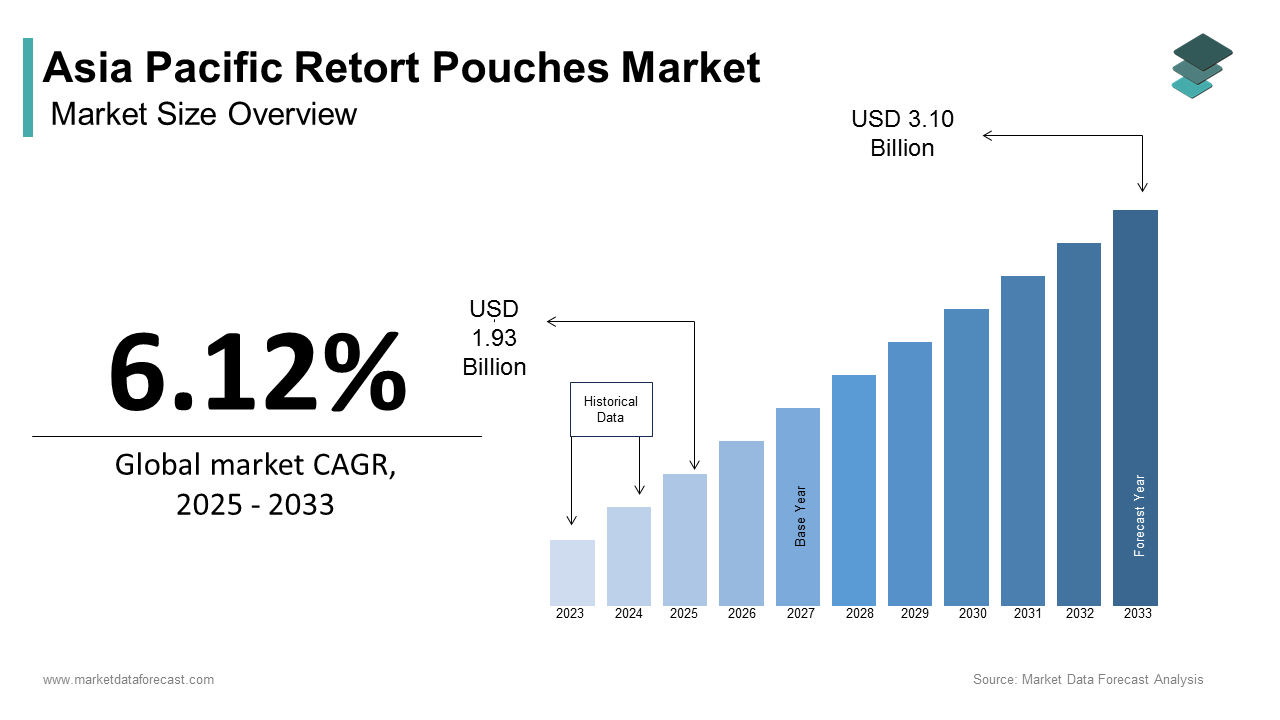
The retort pouches are specialized segment of flexible packaging solutions designed to preserve food and pharmaceutical products through high-temperature sterilization while maintaining freshness, flavor, and nutritional value. Retort pouches are multi-layered laminates composed primarily of polyester, aluminum foil, and polypropylene by offering excellent heat resistance and barrier properties against moisture, oxygen, and light.
Additionally, urbanization and rising disposable incomes have fueled the popularity of on-the-go meal options across India, Indonesia, and the Philippines. According to the United Nations Economic and Social Commission for Asia and the Pacific (UNESCAP), packaged food sales in the region grew by nearly 9% annually between 2019 and 2023. This shift in consumer behavior, combined with advancements in packaging technology, positions the Asia Pacific retort pouches market as a dynamic and evolving industry with strong future potential.
MARKET DRIVERS
Surge in Demand for Ready-to-Eat and Convenience Foods
One of the primary drivers of the Asia Pacific retort pouches market is the growing preference for ready-to-eat (RTE) and convenience food products among urban populations. Rapid urbanization, increasing female workforce participation, and busy lifestyles have significantly altered eating habits, leading consumers to seek easily prepared, nutritious, and long-lasting meal options. Retort pouches offer an ideal solution by preserving the texture and taste of food while eliminating the need for refrigeration or extensive cooking time. According to the Asian Development Bank (ADB), more than 55% of the population in Southeast Asia will live in urban areas by 2023, a figure that has been steadily rising over the past decade.
Expansion of Export-Oriented Food Processing Industries
Another key driver of the Asia Pacific retort pouches market is the rapid growth of export-focused food processing sectors, particularly in seafood, meat, and specialty cuisine segments. Countries such as Thailand, Vietnam, and Indonesia have established themselves as major global suppliers of processed seafood and ready-to-eat meals, many of which are packed in retort pouches due to their superior preservation capabilities and ease of transport.
As per the Food and Agriculture Organization (FAO), Southeast Asia accounted for nearly 40% of global fishery exports in 2023, with Thailand and Vietnam being among the top five shrimp exporters worldwide. Retort pouches have become the preferred packaging format for these products due to their ability to maintain product integrity without refrigeration, making them well-suited for international shipping. In addition to seafood, there is a growing demand for retort-packed ethnic dishes catering to overseas markets. For example, Korean kimchi and Japanese curry meals have gained popularity in North America and Europe, often exported in retort pouches to retain authenticity and flavor. The Korea Agro-Fisheries & Food Trade Corporation recorded a 17% increase in retort-packaged food exports in 2023 compared to the previous year.
MARKET RESTRAINTS
Environmental Concerns and Plastic Waste Regulations
A major restraint affecting the Asia Pacific retort pouches market is the increasing scrutiny around plastic waste and environmental sustainability. Retort pouches, despite their functional advantages, are typically composed of multiple layers of non-recyclable materials such as aluminum foil and laminated polymers, which makes them difficult to process in conventional recycling systems. This complexity poses challenges for waste management authorities and contributes to growing concerns about plastic pollution.
According to the United Nations Environment Programme (UNEP), only 9% of all plastic waste generated globally was recycled in 2023, with the majority ending up in landfills or incinerators. In response, several Asia Pacific governments have introduced stringent regulations to curb plastic usage. These regulatory pressures have prompted some companies to explore alternative materials such as bio-based films and mono-material structures; however, these substitutes currently lack the same thermal and barrier properties required for retort applications.
High Production Costs and Technical Complexity
Another significant challenge for the Asia Pacific retort pouches market is the relatively high cost of production and the technical expertise required to manufacture high-quality, leak-proof pouches that meet international safety standards. Unlike standard flexible packaging, retort pouches must withstand temperatures above 120°C during the sterilization process, necessitating advanced lamination techniques and specialized raw materials that add to overall manufacturing expenses.
According to the International Packaging Federation (IPF), the average production cost of a retort pouch is approximately 25–40% higher than that of conventional vacuum-sealed or stand-up pouches. This cost differential can be a deterrent for small-scale food processors and startups that operate on tight margins. Additionally, ensuring consistent quality control in retort pouch manufacturing remains a critical issue.
MARKET OPPORTUNITIES
Growth of Premium and Gourmet Meal Categories
One of the most promising opportunities for the Asia Pacific retort pouches market lies in the expanding premium and gourmet meal category, which caters to discerning consumers seeking high-quality, restaurant-style food in convenient formats. As disposable incomes rise and culinary preferences evolve, there is a growing demand for upscale ready-to-eat meals that offer both taste and convenience, which is creating a lucrative niche for retort pouch applications.
Retort pouches enable manufacturers to deliver these attributes by preserving the sensory qualities of gourmet dishes without compromising on shelf life or portability. In Australia, Woolworths and Coles reported a 22% increase in sales of premium retort-packed meals in 2023 indicating strong consumer acceptance. Furthermore, luxury food brands in Japan and South Korea have begun launching high-end retort-packed offerings, including wagyu beef stews, truffle-infused pasta, and artisanal soups. The Japan Food Export Promotion Council noted that exports of premium retort meals rose by 19% in 2023, with increased interest from European and Middle Eastern markets.
Integration with Smart Packaging Technologies
The incorporation of smart packaging technologies presents another significant opportunity for the Asia Pacific retort pouches market. Innovations such as time-temperature indicators, freshness sensors, and QR code traceability systems are increasingly being adopted to enhance food safety, transparency, and consumer engagement. These technologies align with the growing demand for real-time monitoring of perishable goods in the healthcare, defense, and premium food sectors.
As per the Global Smart Packaging Market Report published by Smithers Pira, the Asia Pacific region accounted for over 30% of global smart packaging investments in 2023, driven by digital transformation initiatives and government-backed food safety regulations. In Singapore, for instance, the Agency for Science, Technology, and Research collaborated with local packaging firms to develop intelligent retort pouches capable of detecting microbial contamination through embedded biosensors. These innovations are expected to enhance shelf-life accuracy and reduce food waste.
Moreover, in Japan, where food traceability is highly valued, companies like Mitsubishi Chemical Holdings have introduced retort pouches equipped with scannable NFC tags that provide detailed information on origin, storage conditions, and preparation instructions.
MARKET CHALLENGES
Limited Consumer Awareness and Misconceptions About Nutritional Value
The retort pouches face the challenge of limited consumer awareness and persistent misconceptions regarding the nutritional value of retort-packed foods. Many consumers associate retort-packaged meals with low-quality, heavily processed foods, rather than recognizing them as nutrient-retaining, safe, and convenient alternatives to fresh or canned meals. This perception gap hinders broader adoption among health-conscious demographics. According to the Asia-Pacific Consumers' Forum, nearly 40% of surveyed consumers in Indonesia and the Philippines in 2023 believed that retort-packed meals contained excessive preservatives and lacked essential nutrients. However, studies conducted by the National University of Singapore's Food Science Department demonstrated that retort processing preserves up to 90% of vitamins and proteins in certain food categories, comparable to or better than traditional canning methods. In response, some manufacturers have initiated efforts to reposition retort-packed products as healthy, ready-to-eat options.
Regulatory Hurdles and Compliance with International Standards
A significant challenge confronting the Asia Pacific retort pouches market is the complexity of adhering to varying international food safety and packaging regulations. Manufacturers exporting retort-packed products must comply with stringent standards set by bodies such as the U.S. Food and Drug Administration (FDA), the European Food Safety Authority (EFSA), and the Codex Alimentarius Commission. These requirements often dictate permissible material compositions, migration limits for packaging components, and sterilization validation protocols, which complicate product development and market entry strategies.
According to the World Trade Organization’s Technical Barriers to Trade (TBT) database, over 150 new packaging-related trade restrictions were introduced globally between 2021 and 2023, many of which directly impact retort pouches used in food exports. For instance, the European Union updated its Regulation (EU) No 10/2011 on plastic materials in contact with food, imposing stricter limits on mineral oil hydrocarbons and bisphenol compounds. Additionally, compliance with halal, kosher, and organic certification standards adds another layer of complexity, especially for companies targeting diverse religious and dietary preference-based markets. Navigating these regulatory landscapes demands continuous investment in quality assurance, testing infrastructure, and supply chain transparency are posing a formidable challenge for smaller players in the market.
REPORT COVERAGE
| REPORT METRIC | DETAILS |
| Market Size Available | 2024 to 2033 |
| Base Year | 2024 |
| Forecast Period | 2025 to 2033 |
| CAGR | 6.12% |
| Segments Covered | By Type, Closure Type, and Region |
| Various Analyses Covered | Global, Regional & Country Level Analysis; Segment-Level Analysis; DROC, PESTLE Analysis; Porter’s Five Forces Analysis; Competitive Landscape; Analyst Overview of Investment Opportunities |
| Regions Covered | India, China, Japan, South Korea, Australia, New Zealand, Thailand, Malaysia, Vietnam, Philippines, Indonesia, Singapore, Rest of Asia-Pacific |
| Market Leaders Profiled | Amcor Limited, Mondi Group, Sonoco Products Company, Sealed Air Corporation, Coveris Holdings S.A., Huhtamaki Oyj, ProAmpac, Winpak Ltd., Flair Flexible Packaging Corporation, Constantia Flexibles |
SEGMENTAL ANALYSIS
By Type Insights
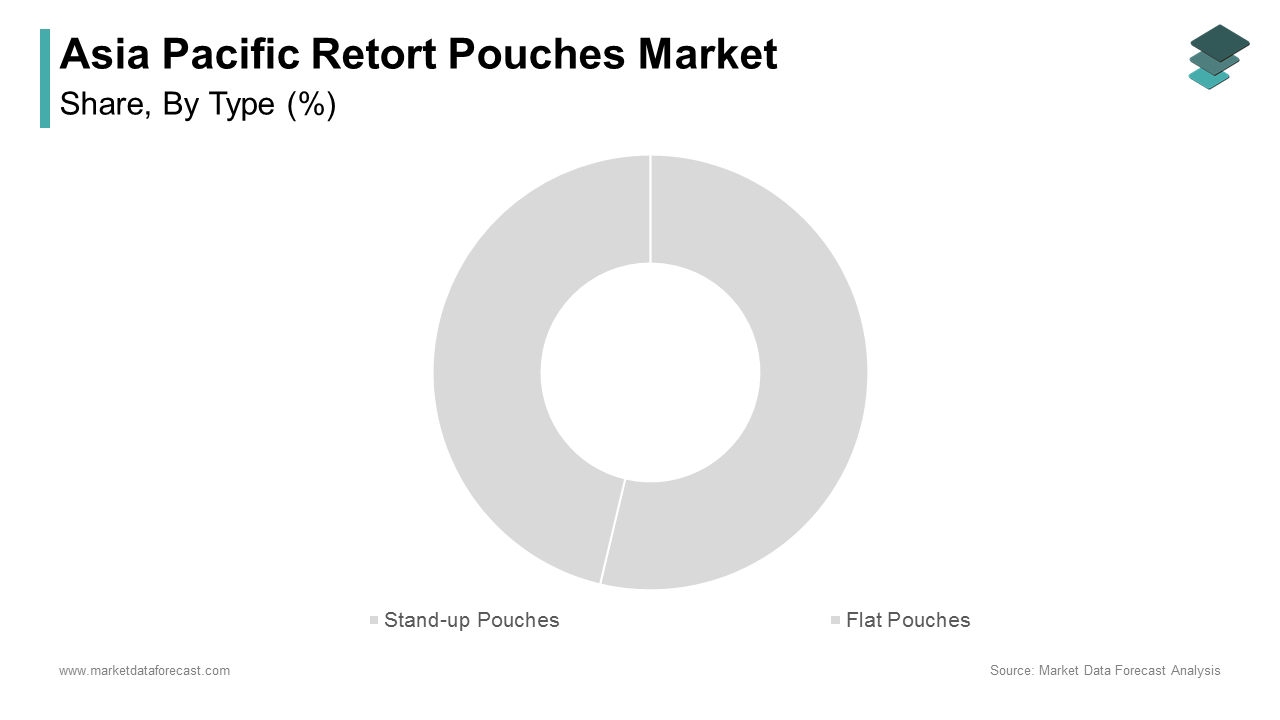
The stand-up pouches segment dominated the Asia Pacific retort pouches market by holding 63.3% of the total share in 2024. One key driver behind this segment’s leadership is the increasing demand for premium ready-to-eat meals among urban consumers who prioritize convenience without compromising on aesthetics or functionality. According to Euromonitor International, over 70% of new packaged food launches in Southeast Asia between 2021 and 2023 adopted stand-up pouch formats due to their upright structure, which enhances product visibility on retail shelves. Retailers and manufacturers alike favor this format as it allows for better branding opportunities and improved consumer engagement.
Another contributing factor is the integration of resealable features such as zippers and spouts into stand-up retort pouches by making them ideal for portion-controlled consumption and repeated usage. As per the Japan Packaging Institute, nearly 45% of retort-packed soups and sauces sold in Japanese supermarkets in 2023 were in resealable stand-up pouches, reflecting strong consumer acceptance.
The flat pouches segment is swiftly emerging with a CAGR of 8.9% from 2025 to 2033. This growth is largely attributed to their widespread adoption in institutional and military catering, where lightweight and stackable packaging solutions are preferred for logistical efficiency.
The expansion of government procurement programs for disaster relief and field rations in countries like India, Indonesia, and the Philippines will promote new opportunities for the growth of this segment. According to the National Disaster Risk Reduction and Management Council of the Philippines, over 1.8 million flat retort pouch-packed meals were distributed during flood relief operations in 2023. These pouches offer compact storage, easy transport, and long shelf life, making them ideal for emergency preparedness. Additionally, flat pouches are increasingly being used in bulk-packaged food exports, especially for seafood and processed meat products.
By Closure Type Insights
The tear notch closure type holds the largest market share accounting for approximately 52% of the Asia Pacific retort pouches market in 2023. This segment’s dominance is primarily due to its simplicity, cost-efficiency, and suitability for single-use applications, particularly in mass-consumption ready-to-eat meal categories. A key driver behind the popularity of tear-notch closures is their widespread use in value-oriented food segments, such as instant noodles, rice meals, and side dishes, which constitute a significant portion of retort-packaged foods in developing markets like India, Indonesia, and Vietnam. Another contributing factor is the high compatibility with automated filling and sealing lines enabling manufacturers to achieve faster production speeds and lower unit costs.
The zipper closures segment is likely to grow with a CAGR of 9.4% from 2025 to 2033. This rapid expansion is driven by increasing consumer demand for resealable packaging options that allow partial consumption and extended freshness retention.
Also, the rising popularity of premium and gourmet meal offerings in developed markets such as Australia, Japan, and South Korea, where consumers expect higher levels of convenience and product preservation is likely to gain huge traction over the growth of the segment. According to the Australian Institute of Food Science and Technology, zipper-closure retort pouches saw a 22% increase in supermarket placements in 2023, especially for high-end soups, stews, and ready-made sauces.
REGIONAL ANALYSIS
China was the top performer in the Asia Pacific retort pouches market with 31.3% of the share in 2024. As one of the world's leading producers and consumers of packaged food, China's vast domestic market and robust export infrastructure support extensive use of retort packaging across seafood, meat, and ready-to-eat meal categories.
A key driver of this position is the country’s massive food processing sector in provinces like Guangdong, Shandong, and Jiangsu, where large-scale retort-packaging facilities serve both local and international markets. According to the China General Administration of Customs, seafood exports packed in retort pouches grew by 13% in 2023 compared to the previous year, with key destinations including the United States, Europe, and Southeast Asia.
Japan was positioned second by capturing 17.6% of the Asia Pacific retort pouches market share in 2024. The country has a long-established tradition of retort-packaged meals, driven by cultural preferences for convenience, disaster preparedness initiatives, and advanced food technology. Another key factor is the popularity of premium retort meal offerings in retail and export markets. Companies like Toyo Seikan and Hayashibara have continuously innovated in flavor authenticity and packaging design, reinforcing Japan’s leadership in high-value retort products.
Australia's retort pouches market growth is likely to be driven by its emphasis on high-quality, shelf-stable food products tailored for remote communities, outdoor recreation, and defense logistics. The country’s relatively small population belies its high per capita consumption of premium retort-packaged meals.
A key driver behind Australia’s market strength is the extensive use of retort pouches in military and expeditionary food supplies. According to the Department of Defence, the Australian Army procured over 25 million retort-packed meal kits in 2023, leveraging their lightweight, non-perishable nature for deployment in training and field operations. These meals are also utilized by Antarctic research stations and mining expeditions operating in isolated regions.
Retail pouches market growth is steady growth fueled by expanding food processing industries and rising consumer demand for hygienic, long-lasting packaged meals. One of the main drivers of this growth is the government’s push for organized food processing and export competitiveness under initiatives like "Make in India" and the Pradhan Mantri Formalisation of Micro Food Processing Enterprises (PM FME) Scheme. According to the Agricultural and Processed Food Products Export Development Authority (APEDA), Indian seafood exports packed in retort pouches rose by 14% in 2023, with growing interest from Middle Eastern and African markets.
South Korea's retort pouches market growth is driven by its strong presence in global food exports and growing domestic demand for convenience meals. The country’s advanced food technology sector and strategic trade positioning make it a key player in retort packaging innovation. According to the Korea Agro-Fisheries & Food Trade Corporation (aT Center), retort-packaged food exports reached USD 900 million in 2023, with increasing demand from Western markets and Southeast Asia. These products are marketed for their authentic taste and extended shelf stability.
Another contributing factor is the adoption of retort pouches in institutional catering, including school lunches, hospital meals, and military provisions. The Ministry of National Defense reported that over 10 million retort-packed meals were supplied to armed forces in 2023 by emphasizing hygiene, nutrition, and ease of distribution.
LEADING PLAYERS IN THE ASIA PACIFIC RETORT POUCHES MARKET
One of the leading players in the Asia Pacific retort pouches market is Toyo Seikan Group Holdings, Ltd. a Japanese company known for its advanced packaging technologies and strong presence in both domestic and international markets. The company has been instrumental in developing high-barrier retort pouches that ensure extended shelf life while maintaining food integrity. Toyo Seikan’s focus on innovation and sustainable materials has positioned it as a preferred supplier to major food manufacturers across Asia and beyond.
Another key player is Amcor plc, an Australian multinational packaging company with a significant footprint in the flexible packaging sector. Amcor offers a wide range of retort pouch solutions tailored for ready-to-eat meals, seafood, and medical applications. The company emphasizes lightweight, durable, and eco-conscious packaging innovations by aligning with global sustainability trends and strengthening its competitive edge in the region.
Mondi Group, a global leader in sustainable packaging and paper, also plays a crucial role in the Asia Pacific retort pouches market. Mondi provides high-performance laminates designed for retort applications, catering to food safety and durability standards.
TOP STRATEGIES USED BY KEY MARKET PARTICIPANTS
A key strategy employed by leading players in the Asia Pacific retort pouches market is product innovation through material engineering and barrier technology advancements. Companies are investing heavily in R&D to develop retort pouches that offer superior protection against moisture, oxygen, and microbial contamination while maintaining structural integrity during high-temperature sterilization. These enhancements improve product longevity and food safety, making retort packaging more attractive to premium food brands and healthcare providers.
Another major approach is expanding regional production capabilities and forging strategic partnerships with local food processors. Collaborations with food manufacturers also enable customized packaging solutions tailored to specific product requirements and cultural preferences.
Adopting sustainable packaging practices has become a core priority for industry leaders. With increasing regulatory pressure and consumer awareness regarding plastic waste, companies are shifting toward mono-material structures, bio-based films, and recyclable components. These initiatives not only support environmental goals but also enhance brand reputation and long-term market positioning in the competitive retort pouch landscape.
KEY MARKET PLAYERS AND COMPETITION OVERVIEW
Major Players in the Asia Pacific retort pouches market include Amcor Limited, Mondi Group, Sonoco Products Company, Sealed Air Corporation, Coveris Holdings S.A., Huhtamaki Oyj, ProAmpac, Winpak Ltd., Flair Flexible Packaging Corporation, Constantia Flexibles.
The competition in the Asia Pacific retort pouches market is marked by a blend of global giants and agile regional players striving to capture market share through differentiation and localized strategies. Established international firms leverage their technological expertise, extensive distribution networks, and brand credibility to maintain dominance, particularly in developed economies like Japan, South Korea, and Australia. These companies continuously invest in research and development to refine pouch performance, enhance barrier properties, and introduce sustainable alternatives that align with evolving consumer expectations.
At the same time, regional manufacturers in countries such as China, India, and Thailand are gaining traction by offering cost-effective, locally adapted packaging solutions. Their ability to respond quickly to changing market demands and supply chain dynamics gives them a competitive edge in price-sensitive segments. The market is also witnessing increased collaboration between packaging firms and food processors to co-develop specialized retort pouch formats that cater to niche cuisines and premium meal categories.
Regulatory shifts, sustainability mandates, and rising consumer awareness are reshaping competitive priorities. As companies navigate these challenges, the battle for market leadership is increasingly defined by innovation, environmental responsibility, and the capacity to deliver scalable, high-quality retort pouch solutions tailored to diverse end-use applications across the region.
RECENT HAPPENINGS IN THE MARKET
- In March 2024, Toyo Seikan launched a new line of high-barrier, lightweight retort pouches designed specifically for export-oriented seafood processors in Southeast Asia. This initiative was aimed at improving shelf stability and reducing freight costs while meeting international food safety standards.
- In February 2024, Amcor announced a partnership with a leading Indian food processing company to develop customized retort pouches for traditional Indian cuisine targeting both domestic and overseas markets. This collaboration reflects Amcor’s commitment to supporting regional food brands with innovative packaging solutions.
- In January 2024, Mondi Group expanded its production facility in Shanghai to include a dedicated unit for retort-grade flexible laminates. This expansion was intended to meet the growing demand from Chinese and neighboring markets for high-performance retort packaging materials.
- In May 2024, Sonoco Products Company entered into a joint venture with a South Korean packaging firm to establish a retort pouch manufacturing plant in Busan. The move was designed to strengthen Sonoco’s presence in the Korean and broader Asian markets by enhancing local supply chain efficiency.
- In June 2024, Uflex Limited, an Indian multinational packaging company, introduced a compostable retort pouch prototype at a major food technology exhibition in Bangkok. This innovation represents Uflex’s strategic effort to align with global sustainability trends while expanding its footprint in the Asia Pacific region.
MARKET SEGMENTATION
This research report on the Asia Pacific Retort Pouches Market has been segmented and sub-segmented based on type, closure type, and region.
By Type
- Stand-up Pouches
- Flat Pouches
By Closure Type
- Zipper
- Tear Notch
- Spout
By Region
- India
- China
- Japan
- South Korea
- Australia
- New Zealand
- Thailand
- Malaysia
- Vietnam
- Philippines
- Indonesia
- Singapore
- Rest of Asia-Pacific
Frequently Asked Questions
1. What are retort pouches?
Retort pouches are flexible laminated food packaging materials that can withstand high-temperature processing, making them ideal for packaging ready-to-eat meals, soups, sauces, and pet foods.
2. Who uses retort pouches in the Asia Pacific region?
Retort pouches are widely used by food & beverage manufacturers, military and space food suppliers, and pet food producers across countries like China, Japan, India, and South Korea.
3. How do retort pouches benefit manufacturers and consumers?
They offer extended shelf life, reduced packaging weight, faster cooking times, and convenience in storage and transport, making them a cost-effective alternative to metal cans and glass jars.
4. Which factors are driving the growth of the Asia Pacific Retort Pouches Market?
Market growth is driven by rising demand for convenient packaged foods, urbanization, an increasing working population, and advances in food processing and packaging technologies.
Access the study in MULTIPLE FORMATS
Purchase options starting from
$ 2000
Didn’t find what you’re looking for?
TALK TO OUR ANALYST TEAM
Need something within your budget?
NO WORRIES! WE GOT YOU COVERED!
Call us on: +1 888 702 9696 (U.S Toll Free)
Write to us: sales@marketdataforecast.com