- Product Description Description
- Table of Contents TOC
- List of Table & Figure LOT
- Get Free Sample PDF Sample PDF
Asia Pacific Roofing Materials Market Size
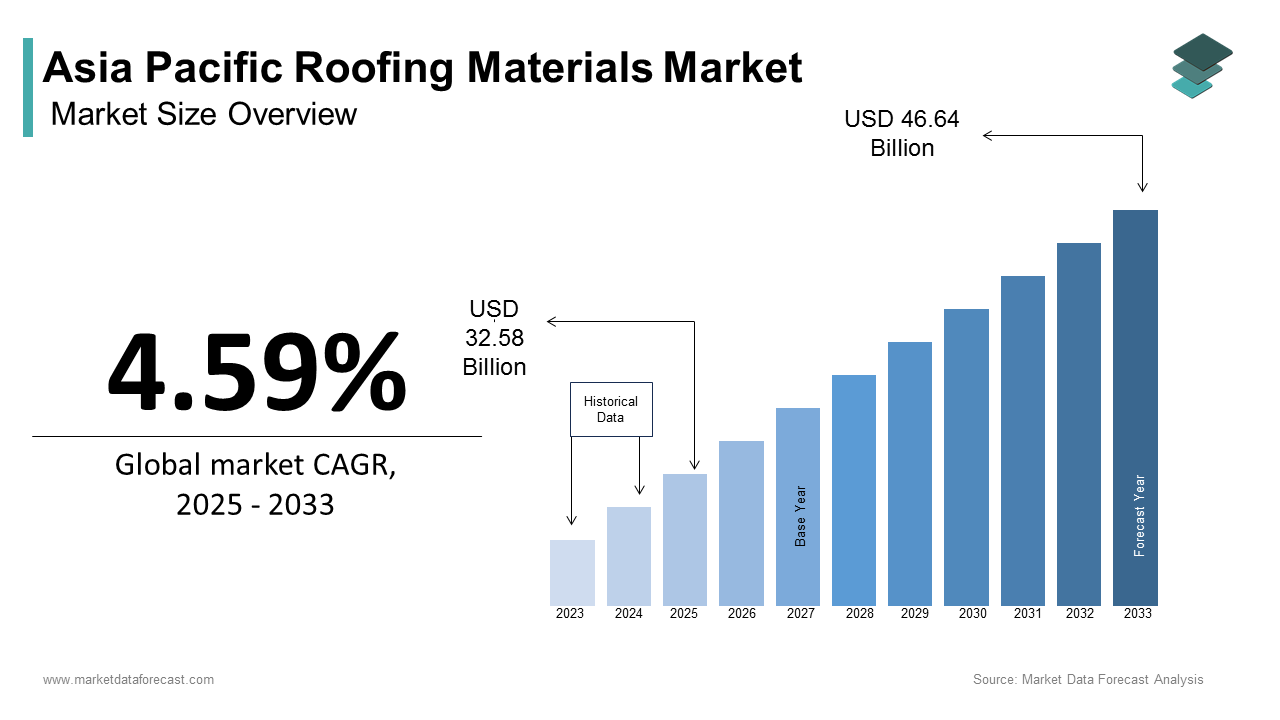
The Asia Pacific Roofing Materials Market size was calculated to be USD 31.14 billion in 2024 and is anticipated to be worth USD 46.64 billion by 2033, from USD 32.58 billion in 2025, growing at a CAGR of 4.59% during the forecast period.
The roofing materials are diverse range of products used in residential, commercial, and industrial construction for covering and protecting buildings from environmental elements. These materials include asphalt shingles, metal sheets, clay and concrete tiles, polymer-based composites, and green roofing solutions. The choice of roofing material varies based on regional climatic conditions, architectural preferences, cost considerations, and regulatory standards.
Asia Pacific has emerged as a major growth center for the roofing materials market due to rapid urbanization, increasing infrastructure investments, and rising disposable incomes. Countries such as China, India, Indonesia, and Vietnam are witnessing significant construction activity, especially in the housing and commercial sectors. Additionally, government initiatives aimed at improving rural housing and promoting disaster-resilient construction have further stimulated the use of durable and sustainable roofing products. In Japan and Australia, where extreme weather events are frequent, there is a growing adoption of impact-resistant and energy-efficient roofing systems.
MARKET DRIVERS
Rapid Urbanization and Housing Expansion
One of the most significant drivers of the Asia Pacific roofing materials market is the region’s ongoing urbanization and the corresponding surge in residential construction. Governments across countries like India, Indonesia, and the Philippines are prioritizing affordable housing projects to meet growing demand. According to the United Nations Economic and Social Commission for Asia and the Pacific (UNESCAP), the region's urban population is projected to increase by nearly 600 million people by 2030. Moreover, in China, despite a slowing real estate sector, the government continues to invest in public housing and urban renewal projects, particularly in second and third-tier cities. The China Association of Prefabricated Housing noted that modular and prefabricated construction methods are gaining traction, often incorporating lightweight composite roofing panels.
Rising Demand for Energy-Efficient and Sustainable Roofing Solutions
Another critical driver of the Asia Pacific roofing materials market is the growing emphasis on energy efficiency and sustainability in construction practices. Governments and private developers are increasingly adopting green building standards that promote the use of thermally efficient, eco-friendly, and long-lasting roofing options.
In Japan, companies like Sekisui House and Daiwa House have integrated solar-integrated roofing tiles into their residential offerings, aligning with the country’s renewable energy goals. According to the Japan Photovoltaic Energy Association, rooftop solar installations increased by 14% in 2023 compared to the previous year, reinforcing the trend toward multifunctional roofing materials. The roofing materials market is adapting to meet these evolving expectations with sustainability becoming a central theme in architecture and construction.
MARKET RESTRAINTS
Volatility in Raw Material Prices
A major restraint affecting the Asia Pacific roofing materials market is the fluctuation in prices of essential raw materials such as steel, aluminum, bitumen, and polymers. These commodities are subject to global supply chain dynamics, geopolitical tensions, and energy price movements making cost forecasting and budgeting challenging for manufacturers and contractors.
According to the International Energy Agency (IEA), crude oil prices experienced sharp volatility between 2021 and 2023, peaking above USD 120 per barrel before falling below USD 70. Since many synthetic roofing materials, including PVC membranes and modified bitumen shingles, rely on petroleum-based inputs, these fluctuations directly affect production costs. In China, where nearly 40% of the region’s roofing materials are manufactured, the National Development and Reform Commission observed a 15% year-on-year increase in resin import costs in 2022.
Lack of Skilled Labor and Standardized Installation Practices
Another significant constraint on the Asia Pacific roofing materials market is the shortage of skilled labor and the lack of standardized installation practices in emerging economies. While product innovation and material quality have improved, inconsistent application techniques can compromise performance, durability, and safety. As per the International Labour Organization (ILO), only about 35% of construction workers in South and Southeast Asia have received formal training in specialized trades, including roofing. In countries like Bangladesh, Cambodia, and Myanmar, informal labor dominates the construction sector, leading to variability in workmanship and project outcomes. The ASEAN Committee on Science and Technology found that improper installation was responsible for nearly 40% of premature roof failures in tropical climates, where heavy rainfall and high humidity place additional stress on structures.
MARKET OPPORTUNITIES
Growth of the Green Building Movement and Eco-Friendly Roofing Solutions
One of the most promising opportunities for the Asia Pacific roofing materials market lies in the expanding green building movement and the rising demand for eco-friendly roofing products. Governments, developers, and consumers are increasingly prioritizing sustainability, energy efficiency, and environmental responsibility in construction projects, creating a favorable environment for innovative roofing solutions. According to the World Green Building Council, over 20 countries in the Asia Pacific region have adopted green building certification systems such as LEED, and BREEAM, and local equivalents like Japan’s CASBEE and Singapore’s Green Mark Scheme.
Furthermore, companies are responding to this trend by introducing bio-based, recyclable, and energy-efficient roofing materials. In India, Tata BlueScope launched a line of pre-painted metal roofing sheets designed to reflect solar radiation and reduce indoor temperatures without air conditioning.
Increasing Adoption of Prefabricated and Modular Construction Techniques
Another growing opportunity for the Asia Pacific roofing materials market is the increasing adoption of prefabricated and modular construction methods, which streamline building processes and enhance material efficiency. In China, where government-backed initiatives encourage factory-built housing, companies like Broad Sustainable Building are pioneering fully modular homes that incorporate pre-engineered roofing panels designed for quick assembly and superior insulation.
MARKET CHALLENGES
Regulatory Compliance and Fire Safety Standards
A major challenge confronting the Asia Pacific roofing materials market is the tightening regulatory landscape concerning fire safety, emissions, and structural integrity. Governments across the region are implementing stricter building codes to enhance occupant safety and environmental protection, which requires manufacturers to adapt their formulations and testing procedures accordingly.
According to the International Code Council (ICC), several Asia Pacific countries have updated their national building regulations to include enhanced fire resistance requirements for roofing assemblies, particularly in densely populated urban areas. In South Korea, following a series of high-profile building fires, the Ministry of Land, Infrastructure, and Transport mandated that all new commercial and multi-family residential buildings must use Class A fire-rated roofing materials starting in 2023. The Australian Institute of Architects reported that many architects and builders faced delays in obtaining permits due to uncertainty around material classifications.
Impact of Climate Change and Extreme Weather Events
Another pressing challenge for the Asia Pacific roofing materials market is the increasing frequency and intensity of extreme weather events driven by climate change. Typhoons, cyclones, torrential rains, and prolonged heat waves pose significant risks to roofing structures, necessitating the development of more resilient and adaptive materials. According to the Intergovernmental Panel on Climate Change (IPCC), the Asia Pacific region has experienced a marked increase in severe weather events over the past decade, with coastal and island nations being particularly vulnerable.
REPORT COVERAGE
| REPORT METRIC | DETAILS |
| Market Size Available | 2024 to 2033 |
| Base Year | 2024 |
| Forecast Period | 2025 to 2033 |
| CAGR | 4.59% |
| Segments Covered | By Product, Application, and Region |
| Various Analyses Covered | Global, Regional & Country Level Analysis; Segment-Level Analysis; DROC, PESTLE Analysis; Porter’s Five Forces Analysis; Competitive Landscape; Analyst Overview of Investment Opportunities |
| Regions Covered | India, China, Japan, South Korea, Australia, New Zealand, Thailand, Malaysia, Vietnam, Philippines, Indonesia, Singapore, Rest of Asia-Pacific |
| Market Leaders Profiled | Saint-Gobain, Owens Corning, Wienerberger AG, CSR Limited, Boral Limited, Nippon Roof Co. Ltd., Etex Group, Monier Roofing, Tamko Building Products, Fletcher Building |
SEGMENTAL ANALYSIS
By Product Insights
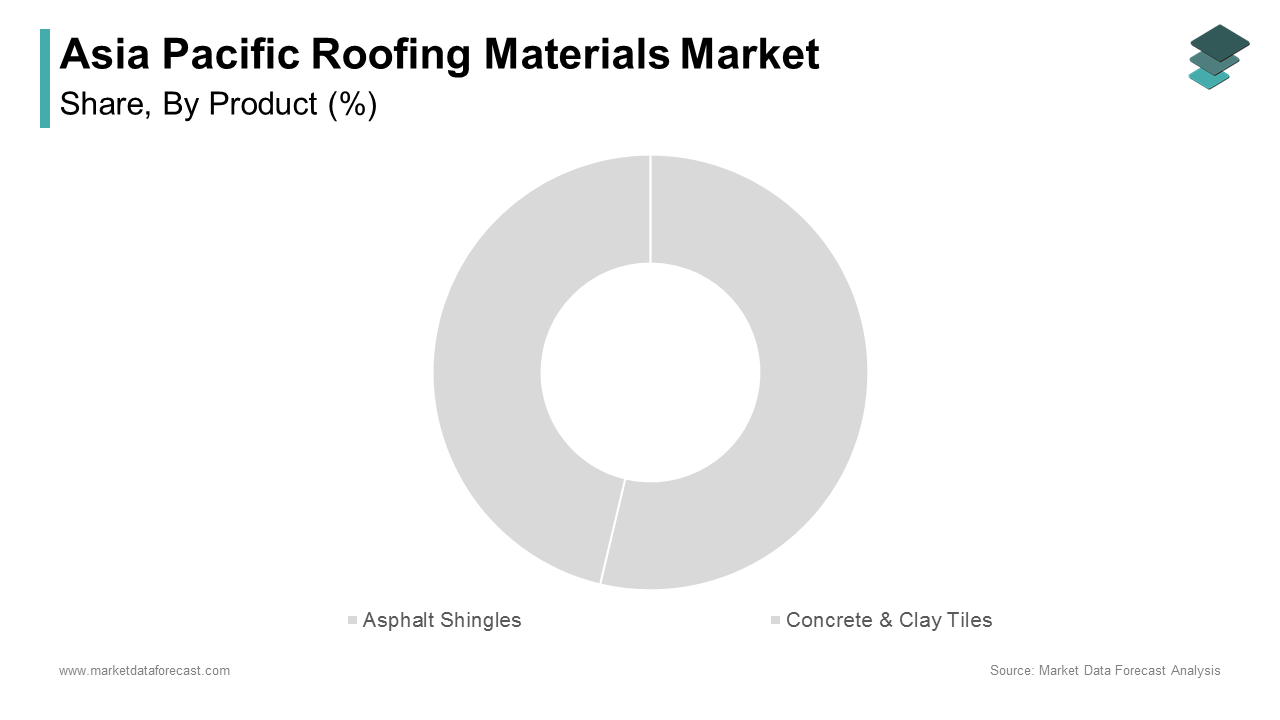
The concrete and clay tiles segment dominated the Asia Pacific roofing materials market by accounting for 54.3% of the share in 2024 due to their widespread use across residential and commercial buildings due to their durability, aesthetic appeal, and suitability for tropical and subtropical climates prevalent in much of the region. Another contributing factor is the growing focus on disaster-resilient infrastructure, particularly in typhoon-prone areas such as the Philippines and coastal China. As per the National Disaster Risk Reduction and Management Council of the Philippines, concrete and clay tiles were found to withstand wind speeds of up to 200 km/h better than lightweight alternatives, making them a preferred choice for public and private construction projects.
The asphalt shingles segment is lucratively growing with a CAGR of 8.3% from 2025 to 2033. A major driver is the expansion of affordable housing programs in urbanizing regions in China and Malaysia, where developers are seeking cost-effective yet durable roofing solutions. According to the Malaysian Construction Industry Portal, asphalt shingle usage in new mid-rise residential buildings increased by 17% in 2023 compared to the previous year, with contractors citing faster installation times and lower labor dependency. Additionally, technological advancements in cool-roof asphalt shingles have boosted their appeal among environmentally conscious consumers and regulators. In Australia, the Commonwealth Scientific and Industrial Research Organisation (CSIRO) reported that reflective asphalt shingles reduced indoor temperatures by up to 4°C during summer months, leading to growing inclusion in green building certifications.
By Application Insights
The residential application segment was attributed to holding the dominant share of the Asia Pacific roofing materials market in 2024. One of the primary reasons for the residential segment’s dominance is the large-scale implementation of affordable housing initiatives in countries like India, Indonesia, and the Philippines. According to the Ministry of Housing and Urban Affairs in India, over 12 million affordable housing units were sanctioned under the Pradhan Mantri Awas Yojana (PMAY) between 2015 and 2023, each requiring appropriate roofing systems. These projects often incorporate locally available materials such as concrete tiles, corrugated metal sheets, and fiber cement panels.
The non-residential application segment is likely to experience a significant CAGR of 7.9% from 2025 to 2033. One key driver is the surge in industrial and logistics facility construction in China, India, and Vietnam, where e-commerce expansion and manufacturing growth are fueling demand for large warehouses and distribution centers. Another major factor is the modernization of public infrastructure, including schools, hospitals, and government buildings, which increasingly incorporate sustainable and high-performance roofing materials. In Singapore, the Building and Construction Authority mandated that all new public buildings meet Green Mark certification standards, encouraging the use of solar-reflective and insulated roofing solutions. The non-residential roofing materials segment is gaining momentum across the Asia Pacific with ongoing urban development and stricter environmental regulations.
REGIONAL ANALYSIS
China was the top performer in the Asia Pacific roofing materials market with 33.2% of the share in 2024. China's vast residential and commercial development landscape drives significant consumption of both traditional and advanced roofing products.
A key driver behind China’s dominant position is the scale of its urbanization and infrastructure expansion in second and third-tier cities where government-led housing and industrial projects are accelerating. According to the National Bureau of Statistics of China, over 1.2 billion square meters of new residential floor space was completed in 2023, necessitating large volumes of roofing materials ranging from ceramic tiles to metal and polymer composites.
Another contributing factor is the country’s push toward energy-efficient and green building technologies supported by policy frameworks such as the 14th Five-Year Plan, which promotes the use of sustainable construction materials. The China Building Materials Federation noted that demand for cool-roof coatings and solar-integrated roofing panels grew by 19% in 2023, indicating a shift toward performance-driven roofing solutions.
India was ranked second by holding 22.3% of the Asia Pacific roofing materials market share in 2024. The country’s strong presence is driven by an unprecedented wave of housing construction, rural electrification programs, and increasing government support for durable and climate-resilient building materials.
One of the main drivers of India’s market position is the Pradhan Mantri Awas Yojana (PMAY), which has significantly boosted demand for affordable and standardized roofing solutions. According to the Ministry of Housing and Urban Affairs, over 12 million pucca houses were constructed under PMAY between 2015 and 2023, many of which used precast concrete tiles, fiber cement sheets, and galvanized iron (GI) sheets. These materials offer cost-effectiveness and resistance to monsoon rains by making them ideal for rural and semi-urban applications.
Japan's roofing materials market growth is lucratively growing with its emphasis on high-quality, earthquake-resistant, and weather-adaptive roofing systems. The country’s mature construction sector and frequent exposure to natural disasters make it a unique and highly regulated market for roofing materials. A key driver behind Japan’s market strength is the nationwide integration of disaster-resilient construction standards in response to frequent earthquakes, typhoons, and heavy snowfall. According to the Building Research Institute of Japan, over 40% of new residential constructions in 2023 included impact-resistant metal roofing or interlocking ceramic tiles designed to withstand extreme weather conditions. The Japanese Cabinet Office also mandates that emergency shelters and critical infrastructure be equipped with reinforced roofing materials.
Australia materials market is likelyd to have significant growth opportunities in the next coming years with a combination of residential construction, renovation activity, and increasing adoption of energy-efficient roofing solutions. The country’s well-developed construction sector and focus on sustainability shape the demand for high-performance materials.
Another key factor is the growing number of bushfire-prone zones, which has led to stricter regulations on fire-resistant roofing materials. The Bushfire Attack Level (BAL) compliance framework enforced by state authorities has resulted in increased use of Class A fire-rated roofing products such as steel, fiber cement, and composite tiles.
South Korea's roofing materials market growth is driven by its advanced construction industry, urban renewal programs, and increasing emphasis on smart city infrastructure. A significant driver of South Korea’s market position is the national Smart City initiative, which integrates digital infrastructure with sustainable building practices. According to the Ministry of Land, Infrastructure, and Transport, over 30 smart city projects were underway in 2023, incorporating energy-efficient and sensor-enabled roofing materials that contribute to overall building intelligence. These initiatives encourage the use of lightweight metal, photovoltaic-integrated tiles, and insulating membranes.
LEADING PLAYERS IN THE ASIA PACIFIC ROOFING MATERIALS MARKET
One of the leading players in the Asia Pacific roofing materials market is Owens Corning, a global manufacturer known for its innovative and energy-efficient building solutions. The company has a strong presence across the region, particularly in China, India, and Australia, where it supplies a wide range of roofing products including asphalt shingles, insulation panels, and fiber-reinforced composites. Owens Corning plays a pivotal role in promoting sustainable construction through its eco-friendly product lines and advanced thermal insulation technologies.
Another key player is Etex Group, a Belgium-based multinational with significant operations in Southeast Asia. Etex offers a diversified portfolio of roofing materials such as fiber cement sheets, clay tiles, and lightweight concrete panels. The company’s regional subsidiaries like Indo Acidatama in Indonesia and Boral Limited in Australia have enabled localized production and distribution, strengthening its competitive edge in both residential and commercial construction sectors.
CSR Limited, an Australian building materials giant, also holds a prominent position in the Asia Pacific roofing materials market. Known for its well-established brand, Colorbond, CSR specializes in metal roofing systems that combine durability, aesthetics, and climate resilience. The company contributes significantly to infrastructure development across Australia and New Zealand, offering high-performance roofing solutions tailored to extreme weather conditions and sustainability goals.
TOP STRATEGIES USED BY KEY MARKET PARTICIPANTS
A key strategy employed by leading companies in the Asia Pacific roofing materials market is product innovation and the development of sustainable roofing solutions. Firms are investing heavily in research and development to create materials that offer improved energy efficiency, reduced environmental impact, and enhanced durability. This includes the introduction of cool roofs, solar-integrated tiles, and bio-based composites that align with global green building standards.
Another major approach is expanding regional manufacturing capabilities and forming strategic partnerships with local distributors and construction firms. Collaborations with real estate developers and government housing agencies further enhance market penetration.
Adopting digital tools for customer engagement and supply chain optimization has become a core focus for industry leaders. Companies are leveraging data analytics, e-commerce platforms, and mobile applications to improve product visibility, streamline procurement processes, and provide tailored solutions to architects, contractors, and end consumers across the region.
KEY MARKET PLAYERS AND COMPETITION OVERVIEW
Major Players in the Asia Pacific roofing materials market include Saint-Gobain, Owens Corning, Wienerberger AG, CSR Limited, Boral Limited, Nippon Roof Co. Ltd., Etex Group, Monier Roofing, Tamko Building Products, and Fletcher Building.
The competition in the Asia Pacific roofing materials market is shaped by a blend of global conglomerates, regional manufacturers, and local producers vying for dominance in a rapidly expanding construction landscape. Multinational firms leverage their technological expertise, extensive distribution networks, and brand recognition to maintain their prominence positions, particularly in premium and specialized roofing segments. These companies continuously invest in R&D to develop innovative products that meet evolving sustainability and performance standards.
At the same time, regional and domestic players are gaining traction by offering cost-effective, locally adapted solutions tailored to specific climatic and architectural preferences. Their agility allows them to respond swiftly to changing market demands and regulatory shifts, making them formidable competitors in price-sensitive segments. Additionally, the market is witnessing increased collaboration between material suppliers and construction firms to co-develop customized roofing systems for large-scale infrastructure and housing projects.
Regulatory pressures, sustainability mandates, and rising consumer awareness are reshaping competitive priorities. As companies navigate these challenges, the battle for market growth is increasingly defined by innovation, environmental responsibility, and the ability to deliver scalable, high-quality roofing solutions tailored to diverse end-use applications across the region.
RECENT HAPPENINGS IN THE MARKET
- In March 2024, Owens Corning launched a new line of solar-reflective asphalt shingles designed specifically for tropical climates. This initiative was aimed at addressing heat management concerns in Southeast Asian cities and enhancing the company’s appeal to environmentally conscious homeowners and developers.
- In February 2024, Etex Group announced a joint venture with a leading Indian construction materials distributor to expand its fiber cement roofing business in South Asia. This move was intended to strengthen Etex’s supply chain and increase accessibility to affordable, durable roofing solutions in rural and semi-urban areas.
- In January 2024, CSR Limited commissioned a new high-tech metal coating facility in Queensland, Australia, dedicated to producing next-generation corrosion-resistant roofing panels. This expansion was designed to meet the growing demand for long-lasting and climate-adaptive roofing materials across Australasia.
- In May 2024, Boral Limited introduced a modular roofing system integrated with smart ventilation technology in Singapore. This innovation was developed in collaboration with urban planners and sustainability experts to support the country’s green building certification requirements and improve indoor comfort in high-density developments.
- In June 2024, Indo Acidatama, a subsidiary of Etex, inaugurated a state-of-the-art fiber cement roof tile plant in Central Java, Indonesia. The facility was established to cater to the rising number of low-cost housing and infrastructure projects in the region while ensuring compliance with national fire safety and durability standards.
MARKET SEGMENTATION
This research report on the Asia Pacific Roofing Materials Market has been segmented and sub-segmented based on product, application, and region.
By Product
- Asphalt Shingles
- Concrete & Clay Tiles
By Application
- Residential
- Non-residential
By Region
- India
- China
- Japan
- South Korea
- Australia
- New Zealand
- Thailand
- Malaysia
- Vietnam
- Philippines
- Indonesia
- Singapore
- Rest of Asia-Pacific