- Product Description Description
- Table of Contents TOC
- List of Table & Figure LOT
- Get Free Sample PDF Sample PDF
Market Size, 2025
$33.05 BnMarket Estimate, 2026
$35.10 BnMarket Forecast, 2034
$56.84 BnCAGR, 2026–2034
6.21%Asia Pacific Sealants and Adhesives Market Report Summary
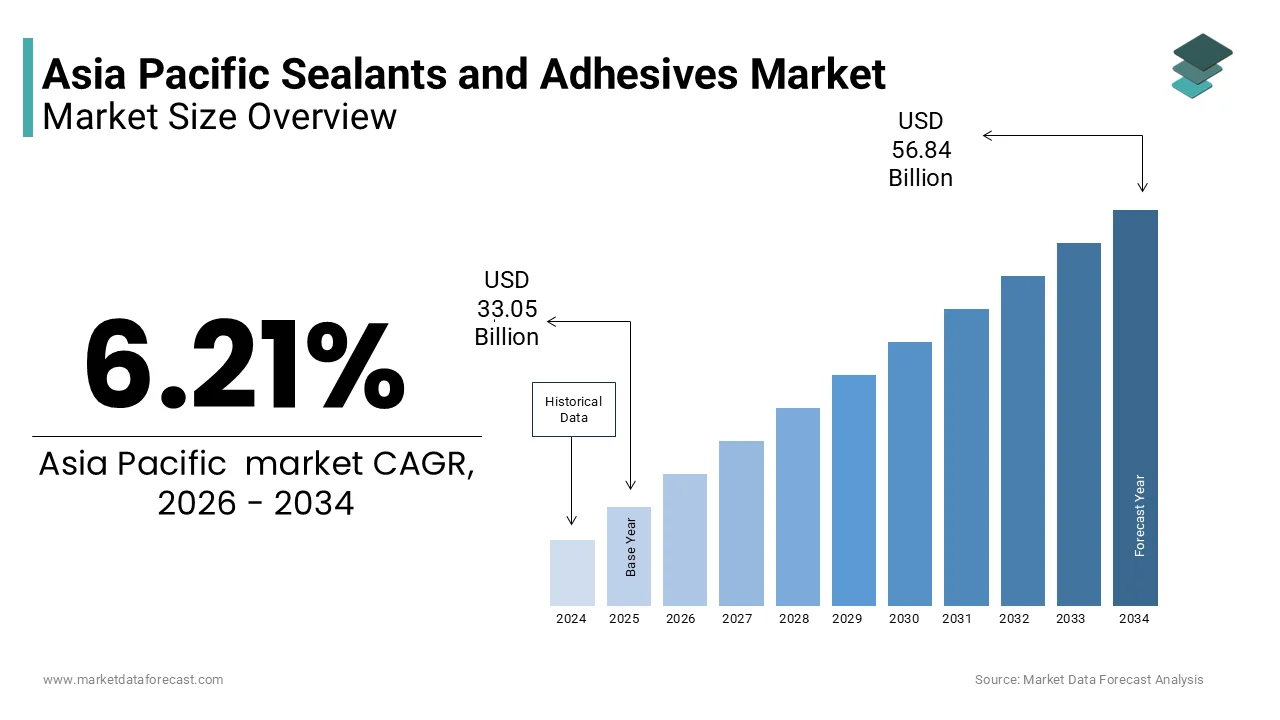
The Asia Pacific sealants and adhesives market was valued at USD 33.05 billion in 2025, is estimated to reach USD 35.10 billion in 2026, and is projected to reach USD 56.84 billion by 2034, growing at a CAGR of 6.21% during the forecast period from 2026 to 2034. The growth of the Asia Pacific sealants and adhesives market is driven by rapid urbanization, expanding construction activities, and increasing demand from the automotive, electronics, packaging, and manufacturing industries. Rising investments in infrastructure development, growing adoption of high-performance bonding materials, and advancements in sustainable adhesive technologies are further supporting market expansion. Additionally, increasing demand for lightweight materials and energy-efficient construction solutions is accelerating the adoption of advanced sealants and adhesives across the region.
Key Market Trends
-
Rising infrastructure development and construction activities are driving demand for high-performance sealants and adhesives across Asia Pacific.
-
Increasing adoption of lightweight materials in automotive and electronics manufacturing is supporting market growth.
-
Growing demand for environmentally friendly, low-VOC, and sustainable adhesive formulations is encouraging product innovation.
-
Advancements in reactive adhesive technologies are improving bonding strength, durability, and application efficiency.
-
Expanding packaging, industrial manufacturing, and consumer goods sectors are creating new growth opportunities.
Segmental Insights
-
Based on adhesives resin, the polyurethane-based adhesives segment dominated the Asia Pacific sealants and adhesives market by accounting for 34.6% of the market share in 2025. The segment's leadership is attributed to its superior bonding strength, flexibility, chemical resistance, and extensive use in construction, automotive, and industrial applications.
-
Based on adhesives technology, the reactive adhesives segment held the largest share of 38.4% of the Asia Pacific market in 2025. The segment's dominance is driven by its high-performance bonding capabilities, excellent durability, and suitability for demanding industrial applications.
-
Based on sealants resin, the silicone sealants segment accounted for 42.3% of the Asia Pacific sealants resin market in 2025. The segment's growth is supported by its excellent weather resistance, flexibility, thermal stability, and widespread use in construction, automotive, and electronics industries.
-
Based on end-user industry, the building and construction sector dominated the Asia Pacific sealants and adhesives market by accounting for 41.6% of the market share in 2025. The segment's leadership is driven by rapid urbanization, large-scale infrastructure development, and increasing residential and commercial construction activities.
Regional Insights
-
The Asia Pacific sealants and adhesives market is experiencing strong growth due to expanding industrialization, infrastructure investments, and increasing demand from construction and manufacturing industries.
-
China dominated the Asia Pacific sealants and adhesives market by accounting for 34.4% of the regional market share in 2025. The country's leadership is supported by its large construction industry, strong manufacturing base, expanding automotive production, and continuous investments in infrastructure development.
-
India remains a significant market due to rapid urbanization, increasing infrastructure projects, and growing demand for construction chemicals and industrial adhesives.
Competitive Landscape
The Asia Pacific sealants and adhesives market is highly competitive, with leading manufacturers focusing on product innovation, sustainable formulations, and advanced bonding technologies to strengthen their market positions. Companies are investing in research and development, expanding production capacities, and forming strategic partnerships to meet the growing demand across construction, automotive, electronics, packaging, and industrial applications. Key players operating in the Asia Pacific sealants and adhesives market include 3M, Arkema, Sika AG, H.B. Fuller Company, and Henkel AG & Co. KGaA.
Asia Pacific Sealants and Adhesives Market Size
The Asia Pacific sealants and adhesives market size was valued at USD 33.05 billion in 2025, and is expected to reach USD 56.84 billion by 2034 from USD 35.10 billion in 2026. The market's promising CAGR for the predicted period is 6.21%.
Sealants and adhesives are chemical formulations designed to bond, seal, or affix materials across industrial, construction, automotive, and consumer sectors. Characterized by evolving regulatory frameworks and rapid technological innovation, the region’s adhesion solutions landscape is shaped by urbanization, infrastructure expansion, and manufacturing intensification. As per the International Energy Agency, energy consumption in Asia Pacific’s industrial sector rose strongly between 2015 and 2022, reflecting heightened production activities that directly increase demand for high-performance bonding materials. Additionally, as per the United Nations Economic and Social Commission for Asia and the Pacific, over 54% of the region’s population now resides in urban centers, up from 47% in 2010, accelerating construction activity and associated material requirements. These macro-industrial and demographic dynamics underpin the functional necessity of advanced sealants and adhesives in modern manufacturing and building processes.
MARKET DRIVERS
The sustained expansion of the construction industry, particularly in emerging economies such as India, Indonesia, and Vietnam, is a pivotal driver of the Asia Pacific sealants and adhesives market. Governments across the region are investing heavily in infrastructure to support growing urban populations and economic development. According to the Asian Development Bank, developing Asia requires approximately $1.7 trillion annually in infrastructure investment through 2030 to maintain growth momentum, with current spending covering only about half of this need. This gap is being actively addressed through public-private partnerships and national development programs, fueling demand for structural adhesives and weatherproof sealants in residential, commercial, and transportation projects. For instance, India’s National Infrastructure Pipeline includes over 7,400 projects valued at $1.4 trillion, many of which involve high-rise construction and smart city development where traditional fastening methods are being replaced by advanced adhesive technologies for improved durability and energy efficiency.
The robust growth of the automotive manufacturing sector, especially in China, Thailand, and South Korea, where both internal combustion engine and electric vehicle (EV) production are expanding, is another significant driver. Adhesives play a critical role in lightweight vehicle design, enhancing fuel efficiency and structural integrity. As per the International Organization of Motor Vehicle Manufacturers, Asia accounted for over 58% of global vehicle production in 2023. Moreover, the shift toward electric mobility intensifies adhesive usage due to battery assembly, thermal management systems, and composite material bonding requirements. The Federation of Automobile Dealers Associations in India pointed out a 75% year-on-year increase in EV sales in 2023, signaling sustained demand for specialized adhesives in new energy vehicles across the region.
MARKET RESTRAINTS
The volatility of raw material supply chains, particularly petrochemical derivatives such as acrylics, epoxies, and polyurethanes is a major restraint in the Asia Pacific sealants and adhesives market. These materials are predominantly sourced from crude oil and natural gas, making them susceptible to geopolitical disruptions and price fluctuations. In Southeast Asia, where local refining capacity remains limited, manufacturers in countries like Thailand and Vietnam rely heavily on imports from Northeast Asia and the Middle East.
Environmental regulations and compliance burdens present another critical restraint, particularly as governments tighten emissions standards for volatile organic compounds (VOCs) in chemical products. Similarly, Japan’s Ministry of Health, Labour and Welfare enforces strict exposure limits for formaldehyde and isocyanates used in certain adhesive systems. Compliance requires costly reformulation, investment in water-based or bio-adhesive technologies, and upgraded manufacturing controls. This regulatory asymmetry across the region complicates standardization and increases operational complexity for multinational suppliers navigating diverse compliance landscapes.
MARKET OPPORTUNITIES
The adoption of bio-based and sustainable adhesives, driven by corporate sustainability mandates and consumer demand for eco-friendly products is a transformative opportunity. Major manufacturers are investing in renewable feedstocks like soy protein, lignin, and bio-acrylics to reduce carbon footprints. Besides, the rise of circular economy policies in South Korea and Australia incentivizes recyclable bonding solutions. Companies have introduced enzymatically degradable film adhesives in Taiwan and Malaysia, aligning with zero-waste manufacturing goals in electronics and packaging industries.
The proliferation of smart manufacturing and Industry 4.0 technologies, which demand precision adhesives capable of withstanding automated dispensing systems and high-speed production lines, is another strategic opportunity. The integration of robotics in electronics and semiconductor assembly, particularly in China, Japan, and Malaysia, necessitates adhesives with consistent rheology, rapid cure times, and thermal stability. According to the International Federation of Robotics, Asia installed over 250,000 industrial robots in 2023, representing 70% of global installations, with electronics being the largest application sector. These systems require adhesives that perform reliably under automated conditions, such as UV-curable acrylates and anisotropic conductive films. For instance, in semiconductor packaging in Taiwan, which produces over 60% of the world’s advanced chips.
MARKET CHALLENGES
The fragmentation of technical standards across national jurisdictions, complicating product certification and cross-border trade is a key challenge facing the Asia Pacific sealants and adhesives market. While countries like Japan and Australia adhere closely to ISO and ASTM benchmarks, others maintain divergent regulatory frameworks. This inconsistency increases time-to-market and compliance costs, particularly for small and medium enterprises lacking regulatory expertise. For example, flame retardancy standards for construction adhesives vary significantly between India’s BIS norms and Singapore’s SS 558, requiring separate testing protocols and reformulations, undermining regional scalability and supply chain efficiency.
The shortage of skilled technical personnel in R&D and application engineering, particularly in rapidly industrializing nations such as Vietnam, Bangladesh, and the Philippines, is another pressing challenge. The development and deployment of advanced adhesives require expertise in polymer chemistry, surface science, and failure analysis, fields where regional educational institutions produce insufficient graduates. As per the UNESCO Science Report 2023, the Asia Pacific region averages only 318 researchers per million inhabitants, significantly below the global average of 1,362, with pronounced deficits in specialty chemical domains. This talent gap hinders innovation cycles and technical support capabilities, limiting the ability of local formulators to compete with multinational corporations.
REPORT COVERAGE
| REPORT METRIC | DETAILS |
| Market Size Available | 2025 to 2034 |
| Base Year | 2025 |
| Forecast Period | 2026 to 2034 |
| CAGR | 6.21% |
| Segments Covered | By Adhesives Resin, Adhesives Technology, Sealants Resin, End-User Industry, and Region |
| Various Analyses Covered | Regional & Country Level Analysis, Segment-Level Analysis, DROC, PESTLE Analysis, Porter’s Five Forces Analysis, Competitive Landscape, Analyst Overview on Investment Opportunities |
| Regions Covered | India, China, Japan, South Korea, Australia, New Zealand, Thailand, Malaysia, Vietnam, Philippines, Indonesia, Singapore, and the Rest of Asia-Pacific |
| Market Leaders Profiled | 3M, Arkema, Sika AG, H.B. Fuller Company, and Henkel AG & Co. KGaA, and others |
SEGMENTAL ANALYSIS
By Adhesives Resin Insights
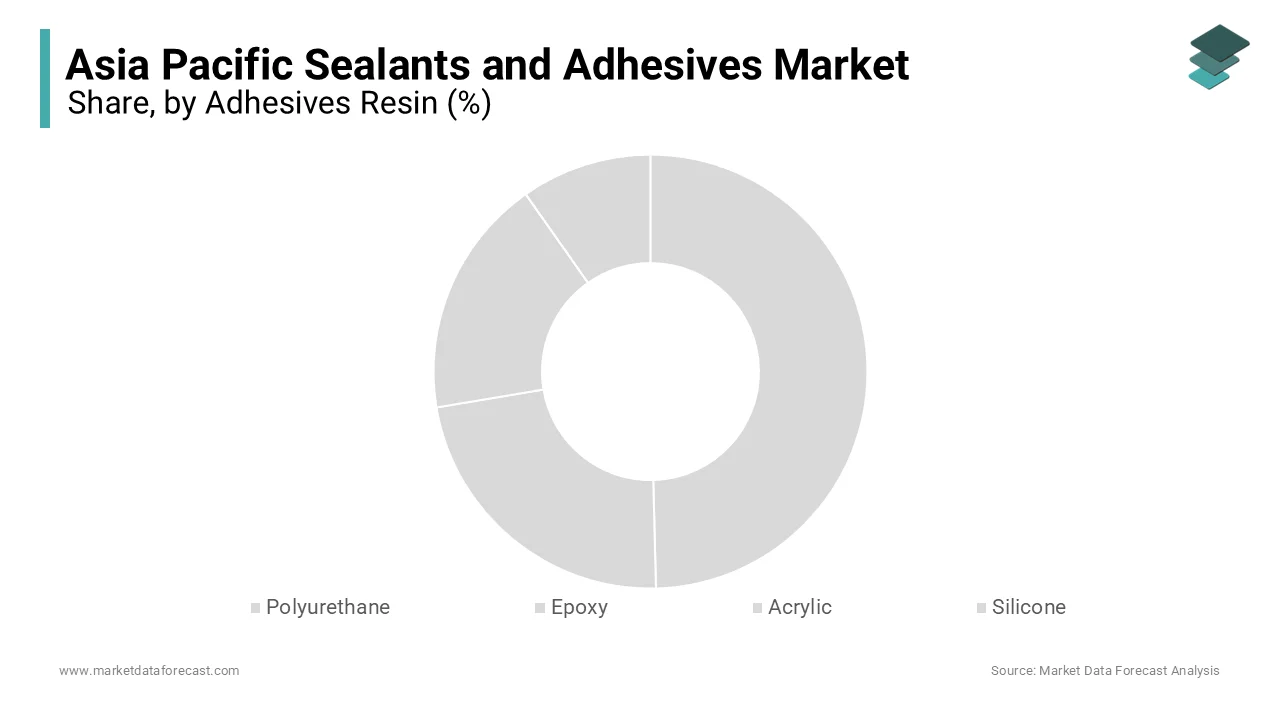
The polyurethane-based adhesives segment dominated the Asia Pacific adhesives resin segment by capturing an estimated 34.6% market share in 2025. This lead position is due to its exceptional versatility across high-performance applications, particularly in automotive and construction. The material’s superior flexibility, resistance to thermal cycling, and strong adhesion to diverse substrates such as metals, plastics, and composites make it indispensable in modern manufacturing. In the automotive sector, polyurethane adhesives are critical for structural bonding in lightweight vehicle designs. This shift toward fuel-efficient and electric vehicles, which require enhanced structural integrity, continues to elevate demand. A further pivotal factor reinforcing polyurethane’s dominance is its widespread use in insulation and energy-efficient construction. Rigid polyurethane foams, often bonded using reactive polyurethane adhesives, are integral to prefabricated building panels. These systems rely heavily on polyurethane adhesives for seamless panel joining and air-tight sealing. Moreover, the rise of modular construction in countries like Japan and Singapore, where up to 30% of new public housing units are now prefabricated, as per the Building and Construction Authority of Singapore, further amplifies demand for high-strength, moisture-resistant bonding solutions, solidifying polyurethane’s entrenched position.
The silicone adhesives segment is projected to register the highest CAGR of 7.8% from 2026 to 2034 in the Asia Pacific adhesives resin market. This accelerated growth is primarily driven by their critical role in the electronics and renewable energy sectors. Silicone adhesives offer unmatched thermal stability, electrical insulation, and resilience under extreme environmental conditions, making them ideal for semiconductor packaging, display assembly, and printed circuit board protection. With Asia Pacific producing around 70-80% of the world’s electronics, demand for reliable encapsulation and bonding materials has surged. A different catalyst for silicone’s rapid expansion is its growing application in photovoltaic (PV) module manufacturing. Solar panel assembly requires adhesives that can endure decades of UV exposure, temperature fluctuations, and mechanical stress. Silicone-based encapsulants and sealants are the preferred choice due to their long-term durability and optical clarity. As per the International Renewable Energy Agency, Asia Pacific commissioned 215 gigawatts of new solar capacity in 2023, representing nearly 80% of global installations. This synergy between renewable energy expansion and material performance is propelling silicone adhesives into a high-growth trajectory across the region.
By Adhesives Technology Insights
The reactive adhesives segment held the largest share of the Asia Pacific adhesives technology market at 38.4% in 2025. Their dominance is because of their ability to form strong, durable bonds through chemical curing mechanisms, making them essential in industries requiring structural integrity and long-term performance. Epoxy and polyurethane-based reactive systems are widely used in automotive assembly, aerospace components, and wind turbine blade manufacturing. The increasing adoption of multi-material vehicle platforms, where dissimilar substrates such as aluminum, carbon fiber, and high-strength steel must be joined without galvanic corrosion, is a key driver of this segment’s growth. Reactive adhesives provide uniform stress distribution and enhanced fatigue resistance. As per the International Aluminum Institute, aluminum content in Asian-produced vehicles rose from 120 kg per vehicle in 2018 to 165 kg in 2023, necessitating advanced bonding solutions. Additionally, in the wind energy sector, reactive adhesives are critical for bonding composite blade segments.
The UV cured adhesives segment is experiencing the most rapid expansion in the Asia Pacific market, with a projected CAGR of 8.2% in the coming years. This growth is fueled by the surge in high-speed, precision manufacturing, particularly in consumer electronics and medical device assembly. UV-curable formulations offer near-instant curing under ultraviolet light, enabling faster production cycles and reduced energy consumption compared to thermal curing methods. In semiconductor back-end facilities across Taiwan and Malaysia, UV adhesives are used in die attachment, underfilling, and encapsulation processes. An additional major factor accelerating adoption is the push for sustainable manufacturing. UV cured adhesives are typically solvent-free and emit negligible VOCs, aligning with tightening environmental regulations. Furthermore, in the medical sector, UV adhesives are preferred for bonding catheters, syringes, and diagnostic devices due to their biocompatibility and precision dispensing. As per the Asia Pacific Medical Technology Association, the region’s medical device market grew by 9.4% in 2023, creating robust demand for clean, reliable bonding technologies that support miniaturization and automation.
By Sealants Resin Insights
The silicone sealants segment represented the prominent part in the Asia Pacific sealants resin market by holding a 42.3% share in 2025 Council. Their dominance is attributed to superior performance characteristics, including exceptional weather resistance, flexibility across wide temperature ranges, and long-term durability in exterior applications. These properties make silicone sealants the preferred choice for glazing, curtain walling, and façade sealing in high-rise buildings. In China’s commercial construction sector, over 60% of new skyscrapers above 150 meters utilize silicone sealants for structural glazing, due to their ability to withstand wind loads and thermal movement without cracking. A further critical factor sustaining silicone’s growth is its widespread use in infrastructure projects requiring long service life and minimal maintenance. Railway stations, airports, and bridges increasingly rely on silicone sealants for joint sealing and waterproofing. Besides, in the renewable energy sector, silicone sealants are essential for sealing solar panel frames and wind turbine nacelles.
The polyurethane sealants segment is anticipated to grow at the highest CAGR of 7.5% from 2026 to 2034 in the Asia Pacific sealants resin market. This acceleration is driven by their increasing use in transportation and industrial applications where high elasticity and abrasion resistance are required. Polyurethane sealants are particularly effective in bonding and sealing truck and trailer bodies, railcar joints, and marine structures. In India’s commercial vehicle sector, over 70% of new truck manufacturers now use polyurethane sealants for floor and roof panel joining, due to their ability to absorb vibration and prevent water ingress. A different growth catalyst is the expansion of cold chain logistics and refrigerated transport, where polyurethane sealants are used in insulated panel assembly. These sealants provide excellent adhesion to metal-faced polyisocyanurate (PIR) and polystyrene foams, ensuring thermal continuity. Each refrigerated container requires approximately 15 meters of continuous sealant bead, with polyurethane being the dominant choice. Besides, in industrial flooring applications, especially in food processing and pharmaceutical plants, polyurethane sealants are favored for their chemical resistance and seamless finish, further broadening their application base across the region.
By End-User Industry Insights
The building and construction sector was the leading end-user of sealants and adhesives in Asia Pacific in 2025 by accounting for 41.6% of total demand in 2025. This dominance is driven by relentless urbanization and government-led infrastructure development across emerging economies. High-rise construction, in particular, relies heavily on structural glazing adhesives and weatherproof sealants, with silicone and polyurethane formulations being standard in curtain wall systems. An additional key factor is the proliferation of green building standards and energy-efficient construction practices. Countries like Singapore and Australia mandate high-performance building envelopes to reduce energy consumption. As per the Building and Construction Authority of Singapore, over 45,000 buildings have achieved Green Mark certification since 2005, all requiring advanced sealing and bonding solutions to meet air-tightness and insulation criteria. Further, prefabricated construction methods, which minimize on-site labor and improve quality control, are gaining traction.
The aerospace industry is emerging as the fastest-growing end-user segment and is projected to expand at a CAGR of 9.1% in the coming years. This growth is fueled by rising air travel demand, fleet modernization, and the expansion of regional aircraft manufacturing. Asia Pacific airlines are expected to double their passenger traffic by 2035, necessitating new aircraft deliveries and maintenance, repair, and overhaul (MRO) activities. Adhesives play a critical role in aircraft assembly, reducing weight and improving fuel efficiency compared to mechanical fasteners. A further driver is the localization of aerospace production. Additionally, MRO hubs in Singapore and Malaysia are expanding, with ST Engineering reporting an increase in aircraft maintenance contracts in 2023. These services require high-performance sealants for fuel tank sealing and composite repair, further boosting demand for aerospace-grade adhesion solutions across the region.
REGIONAL ANALYSIS
China Sealants and Adhesives Market Analysis
China stood as the preeminent force in the Asia Pacific sealants and adhesives market by commanding an estimated 34.4% share in 2025. The nation’s dominance is underpinned by its colossal manufacturing base, extensive infrastructure projects, and leadership in electronics and automotive production. With over 30 million vehicles manufactured annually, according to the China Association of Automobile Manufacturers, the domestic demand for structural and assembly adhesives remains unparalleled. Additionally, China’s Belt and Road Initiative has spurred construction activity across Eurasia, driving exports of Chinese-made adhesives and sealants. The country also leads in chemical production capacity, with state-backed investments in synthetic resin facilities enhancing self-sufficiency and reducing import dependency.
India Sealants and Adhesives Market Analysis
India has emerged as the second-largest market. The country’s growth is propelled by rapid urbanization, government-led infrastructure programs like the Bharatmala and Smart Cities Mission, and a burgeoning automotive sector. The National Highways Authority of India completed over 5,000 kilometers of highway construction in 2023, all requiring high-performance sealants for expansion joints and waterproofing. Furthermore, India’s electronics manufacturing sector, bolstered by the Production Linked Incentive (PLI) scheme, grew in 2023, as per the Ministry of Electronics and Information Technology, increasing demand for precision adhesives in smartphone and component assembly.
Japan Sealants and Adhesives Market Analysis
Japan is positioning it as a technologically advanced hub for high-performance adhesives. The country excels in specialty formulations for electronics, automotive, and aerospace applications. Japanese manufacturers such as Nitto Denko and ThreeBond are global leaders in pressure-sensitive adhesives and conductive films. Additionally, Japan’s stringent environmental regulations have accelerated the adoption of low-VOC and bio-based adhesives.
South Korea Sealants and Adhesives Market Analysis
South Korea accounts for a significant share of the regional market which is driven by its leadership in semiconductors, displays, and shipbuilding. The country’s electronics sector, which contributes over 12% of GDP, relies heavily on UV-cured and anisotropic conductive adhesives for chip packaging and display bonding. Moreover, South Korea’s Green New Deal policy mandates energy-efficient construction, increasing demand for high-performance sealants in retrofitting and new builds.
Vietnam Sealants and Adhesives Market Analysis
Vietnam has emerged as a high-growth market. Its rise is fueled by foreign direct investment in manufacturing, particularly from electronics and footwear exporters relocating from China. Foxconn, LG, and Samsung operate massive production complexes in northern Vietnam, driving demand for industrial adhesives. As per the Vietnam Leather and Footwear Association, the country exported $24 billion worth of footwear in 2023. Additionally, infrastructure spending has doubled since 2020, with the government allocating around $43-50 billion for transport projects, according to the Ministry of Transport, further stimulating sealant demand in construction.
COMPETITIVE LANDSCAPE
The competition in the Asia Pacific sealants and adhesives market is intense, characterized by technological differentiation, regional expansion, and strategic agility among global and local players. Multinational corporations such as Henkel, Sika, and 3M compete with regional powerhouses like Mitsui Chemicals, Wacker Chemie Asia, and KCC Corporation by offering high-performance, application-specific solutions. Price sensitivity in emerging markets coexists with demand for premium formulations in advanced manufacturing hubs, creating a bifurcated competitive landscape. Companies are differentiating through technical support, customization, and sustainability credentials. Local producers are gaining ground by offering cost-effective alternatives, while global firms maintain leadership in R&D and specialty applications. The rise of electric vehicles, smart infrastructure, and green building standards is reshaping competitive dynamics, favoring innovators who can align material science with evolving industrial requirements across the region.
KEY MARKET PLAYERS
The major players in the Asia Pacific sealants and adhesives market are
- 3M
- Arkema
- Sika AG
- H.B. Fuller Company
- Henkel AG & Co. KGaA
TOP PLAYERS IN THE MARKET
- Henkel maintains a dominant presence in the Asia Pacific sealants and adhesives market through its Loctite and Technomelt brands, delivering innovative solutions across automotive, electronics, and industrial sectors. The company has intensified its regional R&D investments, opening a state-of-the-art application development center in Shanghai in 2023 to tailor formulations for local manufacturing needs. Henkel has also expanded its sustainable product portfolio, launching bio-based reactive adhesives for electric vehicle battery assembly in collaboration with Chinese OEMs. Its strategic partnerships with electronics manufacturers in Vietnam and India have strengthened supply chain responsiveness. By integrating digital dispensing technologies with adhesive systems, Henkel is enhancing process efficiency for high-volume producers, reinforcing its reputation for technical excellence and customer-centric innovation across the region.
- Sika has solidified its position in Asia Pacific by focusing on high-growth applications in construction and transportation infrastructure. The company inaugurated a new sealants production facility in Chonburi, Thailand, in early 2025, increasing capacity to meet rising demand for silicone and polyurethane sealants in Southeast Asia’s urban development projects. Sika has also deepened its engagement in green building initiatives, supplying high-performance bonding solutions for over 500 certified sustainable construction projects across Australia, Japan, and Singapore. In the automotive sector, Sika’s acoustic damping and structural adhesives are now integrated into EV platforms produced by Hyundai, Geely, and Tata Motors. The company’s acquisition of a specialty construction chemicals distributor in Indonesia in late 2023 enhanced its last-mile delivery network, enabling faster service in emerging markets.
- 3M leverages its diversified technology base to deliver advanced adhesive tapes, films, and specialty sealants across Asia Pacific’s electronics, healthcare, and transportation industries. 3M has also expanded its manufacturing footprint in Guangzhou, China, to produce pressure-sensitive adhesives for consumer electronics and medical devices. The company is actively advancing sustainability by reformulating solvent-based products into water-based alternatives, aligning with regulatory shifts in India and Thailand. Additionally, 3M’s technical service teams collaborate directly with OEMs to optimize adhesive application processes, ensuring performance reliability in high-precision manufacturing environments across the region.
TOP STRATEGIES USED BY KEY MARKET PLAYERS
Key players in the Asia Pacific sealants and adhesives market are deploying a mix of innovation-driven expansion, sustainability integration, and localized production to strengthen their foothold. Companies are investing heavily in R&D centers across China, India, and Japan to develop region-specific formulations for automotive, electronics, and construction applications. Strategic acquisitions of regional distributors and specialty chemical firms are enhancing market access in high-growth Southeast Asian economies. Vertical integration through new manufacturing facilities is reducing dependency on imported raw materials and improving supply chain resilience. Additionally, firms are launching bio-based, low-VOC, and recyclable adhesive solutions to comply with tightening environmental regulations. Digital integration, including smart dispensing systems and predictive maintenance tools, is being adopted to offer value-added services and deepen customer engagement across industrial sectors.
RECENT HAPPENINGS IN THE MARKET
- In January 2023, Henkel opened a new Application and Technology Center in Shanghai, enhancing its capability to co-develop customized adhesive solutions with Chinese automotive and electronics manufacturers, thereby improving responsiveness and technical collaboration in one of the region’s largest markets.
- In June 2023, Sika acquired a leading construction chemicals distributor in Indonesia, strengthening its distribution network and enabling faster delivery of sealants and bonding systems for infrastructure and residential projects across the archipelago.
- In September 2023, 3M launched a new line of water-based pressure-sensitive adhesives at its Tokyo Innovation Hub, targeting environmentally regulated markets in Japan and South Korea while supporting sustainable manufacturing in electronics and packaging.
- In February 2025, Mitsui Chemicals started commercial operations at its expanded polyurethane resin plant in Rayong, Thailand, increasing output to meet rising demand for high-performance adhesives in automotive and industrial sectors across Southeast Asia.
- In April 2025, Wacker Chemie inaugurated a new silicone sealants production line in Chennai, India, to support the country’s rapid construction growth and reduce import reliance, positioning the company to capture expanding opportunities in green buildings and infrastructure development.
MARKET SEGMENTATION
This research report on the Asia Pacific sealants and adhesives market has been segmented and sub-segmented based on the following categories.
By Adhesives Resin
- Polyurethane
- Epoxy
- Acrylic
- Silicone
By Adhesives Technology
- Solvent-borne
- Reactive
- Hot Melt
- UV Cured Adhesives
By Sealants Resin
- Silicone
- Polyurethane
- Acrylic
By End-User Industry
- Aerospace
- Automotive
- Building and Construction
- Other
By Country
- India
- China
- Japan
- South Korea
- Australia
- New Zealand
- Thailand
- Malaysia
- Vietnam
- Philippines
- Indonesia
- Singapore
- Rest of Asia Pacific