- Product Description Description
- Table of Contents TOC
- List of Table & Figure LOT
- Get Free Sample PDF Sample PDF
Market Size, 2025
$2.14 BnMarket Estimate, 2026
$2.32 BnMarket Forecast, 2034
$4.45 BnCAGR, 2026–2034
8.47%Executive Summary: Asia Pacific Servo Drive Market
- Market Scope: Comprehensive regional market analysis covering drive types, voltage classes, end-user sectors, country-level leadership frameworks, and industrial automation/smart manufacturing metrics for the Asia-Pacific servo drive sector.
- Market Valuation: Valued at USD 2.14 billion (2025), estimated at USD 2.32 billion (2026), and projected to reach USD 4.45 billion by 2034, registering a robust CAGR of 8.47% (2026–2034).
- Primary Growth Drivers: Industrial automation expansion, smart manufacturing initiatives, automotive/electronics demand, IoT and AI production integration, high-precision motion control in semiconductor fabrication, and Industry 4.0 government support. Market challenges include high initial investment costs and technical integration complexities, while opportunities lie in renewable energy applications, smart city infrastructure, and precision engineering.
Key Market Segment Metrics (2026–2034)
| Category | Leading Segment Position | Fastest-Growing Segment |
|---|---|---|
| By Drive Type / Voltage / End-User | AC drive segment (dominated in 2025 due to energy efficiency) & Low voltage segment (held largest share in 2025 for robotics/CNC) & Industrial machinery and equipment (accounted for 34.3% in 2025) | DC drive segment (expected CAGR of 7.9% in niche textile/packaging) & Medium voltage segment (CAGR of 8.3% in steel/cement) & Semiconductor and electronics segment (fastest-growing at 9.1% CAGR) |
| By Region / Country | China (top performer capturing 33.3% share in 2025 supported by massive manufacturing base) | Japan (held second position with 15.3% share driven by leadership in robotics and precision engineering) |
Major Market Players & Market Structure
Market Structure: Highly fragmented Asia-Pacific servo drive landscape centering on high-performance model rollouts for robotics, regional R&D facility expansions for semiconductor applications, localized cost-effective manufacturing, and regional service center support networks.
Key Companies: Rockwell Automation, Anaheim Automation Inc., WEG, ABB, Nidec Motor Corporation, Siemens, Danfoss Drives, Fuji Electric, Schneider Electric, Yaskawa America, Inc. (Yaskawa Electric Corporation), Toshiba International Corporation, Mitsubishi Electric Automation, Inc., and Delta Electronics.
Asia Pacific Servo Drive Market Size
The Asia Pacific servo drive market was valued at USD 2.14 billion in 2025 and is anticipated to reach a valuation of USD 2.32 billion in 2026 and USD 4.45 billion by 2034, growing at a CAGR of 8.47%, from 2026 to 2034.
Servo drives are essential components that regulate the speed and position of servo motors, enabling accurate and dynamic control in applications ranging from CNC machines and packaging equipment to semiconductor manufacturing. Additionally, the United Nations Industrial Development Organization reported that manufacturing value added in the region increased by 5.8% in the same year, reflecting the rising demand for automation technologies. As per the International Energy Agency, industrial electricity consumption in the Asia Pacific rose by 4.7% in 2023, further reinforcing the adoption of energy-efficient and high-performance motion control systems such as servo drives.
MARKET DRIVERS
Surge in Industrial Automation and Smart Manufacturing
The rapid expansion of industrial automation and the adoption of smart manufacturing practices are enhancing the growth of the Asia Pacific servo drive market. Countries such as China, Japan, and South Korea are at the forefront of Industry 4.0, integrating advanced technologies like IoT, AI, and robotics into production systems. According to the United Nations Industrial Development Organization (UNIDO), manufacturing value added (MVA) in the Asia Pacific increased by 5.8% in 2023, indicating a strong industrial foundation that supports the integration of high-precision motion control systems. Servo drives are important in applications such as CNC machining, robotics, and automated assembly lines due to their ability to provide precise motor control and dynamic response.
Growth in Automotive and Electronics Manufacturing
The automotive and electronics manufacturing sectors are escalating the growth of the Asia Pacific servo drive market. These industries require high-precision, high-speed motion control systems to maintain efficiency and quality in production lines. According to the International Organization of Motor Vehicle Manufacturers, Asia Pacific accounted for nearly 56% of global vehicle production in 2023, with China, India, and Thailand witnessing notable growth in automotive manufacturing. Servo drives are extensively used in robotic welding, painting, and assembly lines to ensure consistent performance and accuracy. Additionally, the electronics sector, particularly in South Korea and Japan, remains a major consumer of servo drives due to the need for precision in semiconductor fabrication, printed circuit board assembly, and component handling. This growing integration of servo drives into automotive and electronics production processes is expected to sustain strong demand across the region.
MARKET RESTRAINTS
High Initial Investment and Maintenance Costs
The high initial investment and ongoing maintenance costs associated with advanced servo drive systems are restricting the growth of the Asia Pacific servo drive market. According to the World Bank, while economies like China and Japan have strong industrial bases, many Southeast Asian countries still struggle with limited capital availability for high-end automation equipment. For instance, Indonesia’s manufacturing sector investment grew by only 3.4% in 2023, as reported by the Central Bureau of Statistics, indicating a cautious approach toward adopting expensive motion control systems. Moreover, the complexity involved in maintaining and repairing these systems further increases operational costs. Servo drives often require specialized technical expertise and spare parts, which are not readily available in all regions.
Technical Complexity and Integration Challenges
The technical complexity and integration challenges associated with deploying these systems in existing industrial setups are hampering the growth of the Asia Pacific servo drive market. Servo drives require precise configuration and synchronization with motors, control systems, and software platforms, which can be a daunting task for manufacturers without adequate technical expertise. According to the National Institute of Standards and Technology (NIST), improper integration of servo drives can lead to performance inefficiencies, including reduced accuracy and increased energy consumption. In countries like Vietnam and the Philippines, where industrial automation adoption is still in its early stages, companies often face difficulties in integrating servo drives with legacy machinery. The Philippines Department of Trade and Industry reported that nearly 45% of manufacturers encountered integration issues when upgrading to advanced motion control systems in 2023.
MARKET OPPORTUNITIES
Expansion of Smart City and Infrastructure Projects
The increasing deployment of smart city and infrastructure projects across the Asia Pacific region presents a significant growth of the AsiPacificic servo drive market. Governments in countries such as Singapore, India, and South Korea are investing heavily in intelligent transportation systems, automated building controls, and energy-efficient infrastructure, all of which rely on precise motion control solutions. Servo drives are integral to applications such as automated traffic control systems, elevator and escalator control, and intelligent lighting systems. For example, the Singapore Urban Redevelopment Authority reported that smart building automation systems utilizing servo drives had improved energy efficiency by 18% in 2023. Additionally, in South Korea, Seoul’s Metropolitan Government integrated servo drives into its public transportation network to optimize train door control and improve passenger flow.
Rising Demand in Renewable Energy and Smart Grid Applications
The renewable energy sector offers promising growth for the Asia Pacific servo drive market in wind energy and solar tracking applications. Servo drives are increasingly being used in wind turbines to control blade pitch and yaw positioning, ensuring optimal energy capture and system efficiency. According to the International Renewable Energy Agency (IRENA), the Asia Pacific accounted for over 50% of global renewable energy capacity additions in 2023, with China and India leading in wind and solar installations. Additionally, according to South Korea’s Ministry of Trade, Industry, and Energy, smart grid projects incorporating servo-driven control systems grew by 9% in 2023, improving grid stability and power distribution efficiency.
MARKET CHALLENGES
Intense Market Competition and Fragmentation
The intense competition and market fragmentation among both global and regional players are hindering the growth of the Asia Pacific servo drive market. The presence of numerous manufacturers offering similar products leads to price wars and reduced profit margins. According to the Nikkei Asian Review, in 2023, over 200 companies in China alone were engaged in the production of servo drives, ranging from small-scale manufacturers to large multinational corporations. This saturation makes it difficult for new entrants to establish a foothold and for existing players to differentiate their offerings. Moreover, the lack of standardization across product specifications and performance metrics further complicates the market landscape, leading to customer confusion and slower adoption. Japanese and South Korean firms, despite their technological superiority, face challenges in maintaining market share due to the cost-effective alternatives provided by Chinese and Indian manufacturers.
Regulatory and Compliance Hurdles
The significant regulatory and compliance challenges can hinder the Asia Pacific servo drive market expansion. Each country in the region has its own set of standards and certification requirements for electronic and motion control devices, particularly in sectors such as automotive, industrial safety, and renewable energy. According to the International Electrotechnical Commission (IEC), as of 2023, there were over 20 different regulatory frameworks governing servo drive technologies across Asia Pacific nations. In China, the Ministry of Industry and Information Technology enforces strict electromagnetic compatibility (EMC) and safety standards, which can delay product launches by several months. Additionally, the need for frequent updates to meet evolving regulatory standards adds to the cost and effort required to maintain product compliance, which poses a significant challenge for sustained market growth.
REPORT COVERAGE
| REPORT METRIC | DETAILS |
| Market Size Available | 2025 to 2034 |
| Base Year | 2025 |
| Forecast Period | 2026 to 2034 |
| CAGR | 8.40% |
| Segments Covered | By Drive, Voltage, End-User, and By Country |
| Various Analyses Covered | Global, Regional & Country Level Analysis, Segment-Level Analysis, DROC, PESTLE Analysis, Porter’s Five Forces Analysis, Competitive Landscape, Analyst Overview on Investment Opportunities |
| Regions Covered | India, China, Japan, South Korea, Australia, New Zealand, Thailand, Malaysia, Vietnam, Philippines, Indonesia, Singapore, and the Rest of APAC |
| Market Leaders Profiled | Rockwell Automation (United States), Anaheim Automation Inc. (United States), WEG (Brazil), ABB (Switzerland), Nidec Motor Corporation (United States), Siemens (Germany), Danfoss Drives (Denmark), Fuji Electric (Japan), Schneider Electric (France), Yaskawa America, Inc. (United States), Toshiba International Corporation (United States), Mitsubishi Electric Automation, Inc. (United States). |
SEGMENTAL ANALYSIS
By Drive Insights
The AC drive segment held a dominant share of the Asia Pacific servo drive market in 2025, with the increasing adoption of AC servo drives in high-precision industrial applications such as robotics, CNC machines, and automated production lines. Unlike DC drives, AC servo drives offer superior energy efficiency, better speed control, and lower maintenance requirements, making them more suitable for modern industrial environments. According to the United Nations Industrial Development Organization (UNIDO), manufacturing value added in the Asia Pacific grew by 5.8% in 2023, which is reinforcing the demand for high-performance motion control systems.
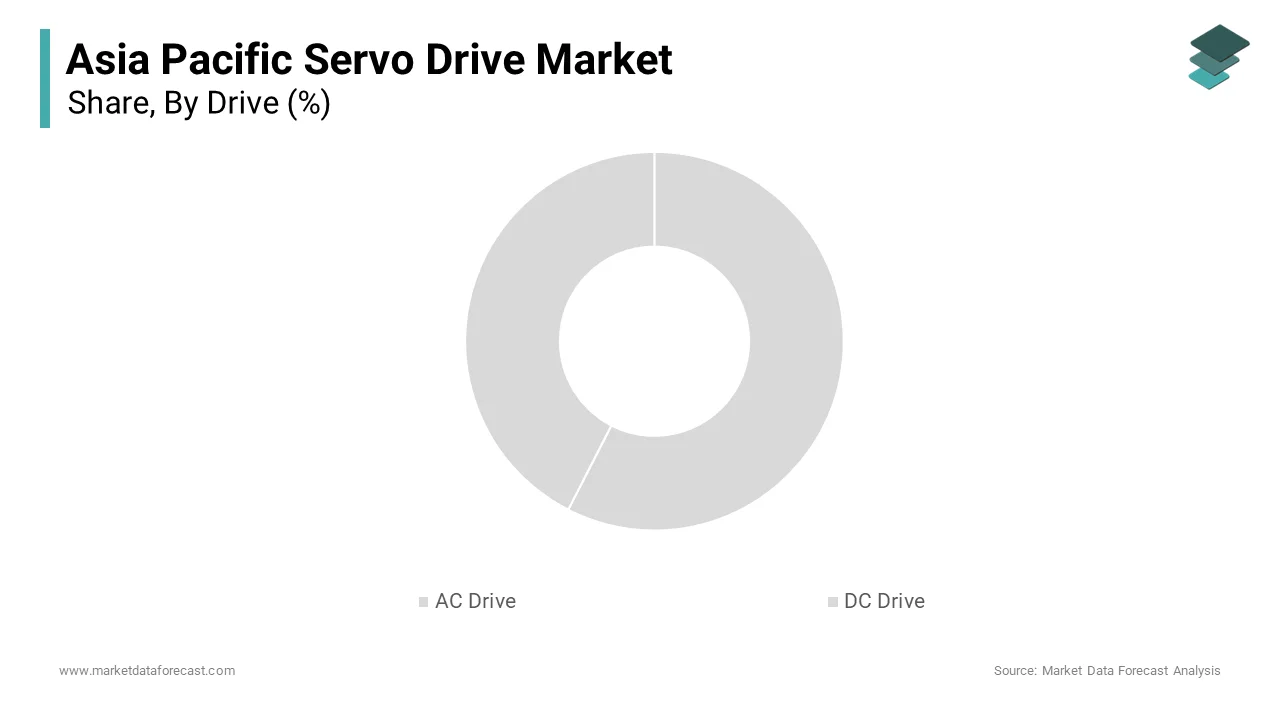
The DC drive segment is projected to grow with a CAGR of 7.9% during the forecast period, with the continued use of DC servo drives in niche applications that require high torque at low speeds, such as textile machinery, packaging equipment, and certain legacy industrial systems. Despite the broader shift toward AC drives, many small and medium enterprises (SMEs) in emerging markets like India and Indonesia still rely on DC servo drives due to their lower initial cost and ease of integration with older machinery. According to the Indian Ministry of Electronics and Information Technology, over 40% of SMEs in India continued to use DC-based motion control systems in 2023. Furthermore, the Vietnam Chamber of Commerce and Industry noted that DC servo drives remained a preferred choice for textile and footwear manufacturing units due to their high starting torque and reliability in variable-speed applications.
By Voltage Insights
The low voltage segment dominated the Asia Pacific servo drive market by capturing a dominant share in 2025, with the widespread use of low-voltage servo drives in precision-driven applications such as robotics, CNC machines, packaging equipment, and semiconductor manufacturing. These drives are preferred for their compact size, high efficiency, and compatibility with programmable logic controllers (PLCs) and automation software. Additionally, the China Association of Automobile Manufacturers reported that more than 80% of automotive production lines in China used low-voltage servo drives for robotic welding and assembly applications. As per the International Energy Agency, the adoption of energy-efficient industrial equipment, including low-voltage servo drives, contributed to a 4.7% increase in industrial electricity efficiency across the Asia Pacific in the same year.
The medium voltage segment is anticipated to grow with a CAGR of 8.3% during the forecast period, with the increasing deployment of medium-voltage servo drives in large-scale industrial applications such as steel rolling mills, paper processing, and heavy-duty conveyor systems, which require high power output and precise control. According to the Asian Development Bank, infrastructure investments in countries like India and Indonesia increased by 6.5% in 2023, supporting the adoption of high-capacity motion control systems. In India, the Ministry of Power reported that new industrial projects in the steel and cement sectors increasingly incorporated medium-voltage servo drives for improved process efficiency.
By End-User Insights
The industrial machinery and equipment segment accounted in holding Asia Pacific servo drive market by accounting for 34.3% of share in 2025, with the widespread use of servo drives in automated production lines, material handling systems, and precision manufacturing equipment. According to the United Nations Industrial Development Organization (UNIDO), manufacturing value added in the Asia Pacific grew by 5.8% in 2023, reflecting the increasing reliance on high-precision motion control systems. Additionally, the Japan Society of Mechanical Engineers noted that more than 80% of new industrial robots deployed in 2023 incorporated servo drives for positioning and speed regulation.
The semiconductor and electronics segment is estimated to grow with a CAGR of 9.1% during the forecast period, with the increasing demand for high-precision motion control in semiconductor fabrication, printed circuit board (PCB) assembly, and electronic component manufacturing. As Asia Pacific remains a global hub for electronics production, particularly in countries like South Korea, Japan, and China, the need for advanced servo drives capable of ensuring micron-level accuracy has surged. According to the Korea Electronics Association, South Korea’s electronics exports reached a record high in 2023, supported by increased automation in semiconductor fabrication plants. In Japan, the Ministry of Economy, Trade and Industry (METI) reported a 7.2% growth in semiconductor equipment shipments, many of which integrated servo drives for wafer handling and lithography processes.
COUNTRY ANALYSIS
China
China was the top performer in the Asia Pacific servo drive market by accounting for 33.3% the share in 2025, with the industrial base and rapid automation adoption being key drivers of this dominance. According to the China Association of Automobile Manufacturers, over 65% of new automotive production lines in 2023 integrated servo drives for robotic welding and assembly. The electronics manufacturing sector also plays a major role, with companies like Huawei and BYD incorporating servo drives into production equipment.
Japan
Japan was positioned second in the Asia Pacific servo drive market with 15.3% of the share in 2025. The country is a global leader in robotics and precision manufacturing, which fuels demand for high-performance servo drives. According to the Japan Society of Mechanical Engineers, more than 80% of newly deployed industrial robots in 2023 used servo drives for positioning and speed control. The Japan Robot Association also reported a 7.5% increase in robot shipments, reinforcing the demand for advanced motion control systems. Additionally, the Ministry of Economy, Trade, and Industry (METI) noted that semiconductor and electronics manufacturing accounted for over 40% of servo drive consumption in the country. The automotive sector remains a key consumer, with Toyota and Honda incorporating servo drives into automated assembly lines.
South Korea
South Korea's servo drive market is anticipated to have a significant CAGR with its advanced electronics and automotive manufacturing sectors. The Korea Electronics Association reported that South Korea’s electronics exports reached a record high in 2023, with semiconductor and display panel production heavily reliant on servo drives for precision control. The Ministry of Trade, Industry, and Energy also noted that automation investments in the automotive sector grew by 8.5%, with companies like Hyundai and Kia integrating servo drives into robotic assembly lines.
India
India servo drive market growth is likely to grow with the rapid industrialization and government initiatives promoting smart manufacturing. According to the Indian Ministry of Electronics and Information Technology, the domestic motion control market grew by 12% in 2023, with servo drives playing a key role in automation and process control. According to the Confederation of Indian Industry (CII), over 15,000 SMEs adopted automation technologies in 2023, many of which integrated servo drives for packaging, textile, and food processing applications. The automotive sector also contributes significantly, with the Society of Indian Automobile Manufacturers (SIAM) noting that over 60% of new passenger vehicles featured servo-driven automation systems.
Australia
Australia's servo drive market is likely to grow with its growing industrial and mining automation sectors. The Department of Industry, Science, and Resources noted that servo drives were increasingly deployed in autonomous mining equipment for precision control and positioning. In addition, the automotive and manufacturing sectors saw a 7% increase in servo drive integration in new production lines, according to the Federal Chamber of Automotive Industries. The country’s smart infrastructure initiatives in Sydney and Melbourne also contributed to growth, with servo drives being used in intelligent transport systems and automated building controls.
KEY MARKET PLAYERS
Rockwell Automation (United States), Anaheim Automation Inc. (United States), WEG (Brazil), ABB (Switzerland), Nidec Motor Corporation (United States), Siemens (Germany), Danfoss Drives (Denmark), Fuji Electric (Japan), Schneider Electric (France), Yaskawa America, Inc. (United States), Toshiba International Corporation (United States), Mitsubishi Electric Automation, Inc. (United States), are the market players that are dominating the Asia Pacific servo drive market.
Top Players In The Market
Yaskawa Electric Corporation is headquartered in Japan, is a global leader in motion control and automation technologies. The company has a strong presence in the Asia Pacific servo drive market due to its wide range of high-performance servo drives tailored for robotics, machine tools, and industrial automation. Yaskawa’s expertise in integrating servo drives with AI and IoT-based control systems has positioned it as a key innovator in the region. Its Sigma series of servo drives is widely adopted across manufacturing sectors, which is contributing significantly to global standards in precision and energy efficiency.
Mitsubishi Electric is another Japanese multinational that plays a pivotal role in the Asia Pacific servo drive market by offering advanced servo drive solutions that support high-speed, high-accuracy applications. The company's commitment to developing compact, energy-efficient, and intelligent servo drives has made them a preferred choice in automotive, semiconductor, and packaging industries.
Delta Electronics, based in Taiwan, is a key player in the Asia Pacific servo drive market, particularly in China and Southeast Asia. Known for its cost-effective yet high-performance servo drive solutions, Delta serves a wide range of industries, including textile, electronics, and factory automation. The company’s emphasis on localized manufacturing, customer support, and application-specific drive development has enabled it to capture a strong market position in emerging economies. Delta’s servo drives are widely used in automation systems that require high precision and reliability, which is making it a formidable global competitor.
Top Strategies Used By Key Market Participants
One of the most prominent strategies employed by key players in the Asia Pacific servo drive market is product innovation and technological advancement. Companies are continuously investing in R&D to develop high-precision, compact, and energy-efficient servo drives that meet evolving industrial demands. This includes integrating servo drives with smart technologies such as IoT, AI, and predictive maintenance capabilities to enhance performance and reduce downtime.
Another key strategy is strategic partnerships and collaborations with local manufacturers, system integrators, and automation solution providers. The expansion into emerging markets through localized production, sales offices, and service centers is crucial for market leaders. This allows companies to reduce operational costs, improve after-sales support, and respond more effectively to customer demands in countries like India, Vietnam, and Indonesia, where industrial automation is rapidly expanding.
COMPETITION OVERVIEW
The Asia Pacific servo drive market is highly competitive, characterized by the presence of both global and regional players striving to capture market share through technological differentiation and strategic market positioning. The region’s rapid industrialization, coupled with the increasing adoption of automation and robotics, has intensified competition among manufacturers. Leading global firms leverage their brand strength, extensive R&D capabilities, and established distribution networks to maintain dominance in technologically advanced markets such as Japan, South Korea, and China. At the same time, regional players are gaining traction by offering cost-effective, localized solutions that cater to the specific needs of small and medium enterprises. The market is also witnessing a shift toward integrated automation systems, prompting companies to develop servo drives compatible with smart control platforms and IoT-enabled industrial ecosystems. As a result, competition is not only based on product performance but also on system compatibility, service support, and customization capabilities.
RECENT HAPPENINGS IN THE MARKET
- In March 2025, Yaskawa Electric launched a new line of compact, high-precision servo drives designed specifically for integration into next-generation robotics and factory automation systems across Asia. The launch aimed to address the growing demand for miniaturized and high-performance motion control solutions.
- In February 2025, Mitsubishi Electric expanded its regional R&D facility in Shanghai, China, to accelerate the development of application-specific servo drives tailored for industrial automation and semiconductor manufacturing in the Asia Pacific region.
- In January 2025, eEltaElectronics partnered with a leading Indian automation equipment provider to co-develop cost-effective servo drive modules for use in textile and packaging machinery, enhancing its foothold in SME-driven industrial segments.
- In May 2025, Fji Electric entered into a strategic distribution agreement with a South Korean robotics integrator to expand its servo drive offerings across smart manufacturing and automotive assembly applications in the country.
- In June 2025, Siemens AG established a regional service and support center in Singapore to improve after-sales service, technical assistance, and customization capabilities for servo drives used in logistics, semiconductor, and smart infrastructure applications across Southeast Asia.
MARKET SEGMENTATION
This research report on the Asia Pacific servo drive market is segmented and sub-segmented into the following categories.
By Drive
- AC Drive
- DC Drive
By Voltage
- Low (up to 1kV)
- Medium (1kV-6.6kV)
- High (Above 6.6kV)
By End-User
- Automotive
- Healthcare
- Industrial Machinery & Equipment
- Semiconductors & Electronics
- Printing & Packaging Equipment
- Others
By Country
- India
- China
- Japan
- South Korea
- Australia
- New Zealand
- Thailand
- Malaysia
- Vietnam
- Philippines
- Indonesia
- Singapore
- Rest of APAC