- Product Description Description
- Table of Contents TOC
- List of Table & Figure LOT
- Get Free Sample PDF Sample PDF
Market Size, 2025
$215.37 MnMarket Estimate, 2026
$230.55 MnMarket Forecast, 2034
$397.62 MnCAGR, 2026–2034
7.05%Asia Pacific Side Channel Pumps Market Summary
The Asia Pacific side channel pumps market size was valued at USD 201.19 million in 2025 and is anticipated to reach USD 215.37 million in 2025 to USD 371.44 million by 2033, growing at a CAGR of 7.05% during the forecast period from 2025 to 2033.
Key Market Trends & Insights
- China was the largest contributor in the Asia Pacific Market in 2025.
- India was positioned second by capturing 16.2% of the Asia Pacific market in 2025.
- Japan side channel pumps market is likely to grow in the Asia Pacific market in 2025.
- South Korea is steadily growing and show case a strongest Asia Pacific market in 2025.
- Based on End-User, the petrochemical sector was the largest dominant Asia Pacific market in 2025
Market Size & Forecast
2026 Market Size: USD 230.55 Million
2034 projected Market Size: USD 397.62 Million
CAGR (2026 to 2034): 7.05%
China: Largest Market in 2026
India: Strongest Growth Region
 Download Free Sample Report
Asia Pacific Side Channel Pumps Market Size
The Asia Pacific side channel pumps market size was valued at USD 215.37 million in 2025 and is anticipated to reach USD 230.55 million in 2026 and USD 397.62 million by 2034, growing at a CAGR of 7.05%, from 2026 to 2034.
The side channel pumps are a specialized segment of kinetic pumps that operate on the regenerative principle, delivering consistent pressure and flow in low to medium capacity applications. These pumps are particularly valued for their ability to handle volatile, viscous, or mixed-phase fluids with minimal pulsation by making them ideal for precision-critical sectors such as pharmaceuticals, petrochemical processing, and semiconductor manufacturing. Their compact footprint and energy-efficient performance have driven integration across industrial automation and clean technology platforms.
MARKET DRIVERS
Expansion of Semiconductor Manufacturing Infrastructure Across East Asia
The rapid expansion of semiconductor fabrication facilities in Taiwan, South Korea, and Japan is significantly propelling the growth of the Asia Pacific side channel pumps market. These pumps are essential in maintaining precise vacuum levels required during photolithography, chemical vapor deposition, and dry etching processes, where even minor pressure fluctuations can compromise yield rates. Taiwan Semiconductor Manufacturing Company (TSMC) alone invested over USD 32 billion in 2023 to expand its 3nm and 2nm production lines across fabs in Hsinchu and Tainan, each requiring hundreds of side channel pumps per facility for vacuum support systems.
Rising Adoption in Pharmaceutical and Biotechnology Processing
The pharmaceutical industry is increasingly deploying side channel pumps in sterile fluid transfer, distillation, and solvent recovery systems, which is solely to level up the growth of the Asia Pacific side channel pumps market. In India, the pharmaceutical sector produced over 20 billion USD worth of formulations in 2023, with exports reaching more than 215 countries, as reported by the Indian Pharmaceutical Alliance. This growth is mirrored in China, where the National Medical Products Administration approved over 500 new drug applications in 2023. Side channel pumps are particularly favored in rotary evaporators and vacuum drying units, where contamination-free operation is non-negotiable.
MARKET RESTRAINTS
High Initial Procurement and Maintenance Costs Limiting SME Penetration
The widespread adoption of side channel pumps in the Asia Pacific is hindered by substantial upfront investment and specialized maintenance requirements, particularly among small and medium-sized enterprises (SMEs). The average cost of an industrial-grade side channel pump ranges between USD 4,500 and USD 12,000, depending on material composition and pressure rating, which exceeds the budgetary constraints of many regional manufacturers. According to the Asian Development Bank, SMEs constitute over 90% of all businesses in Southeast Asia and contribute approximately 40% to the region’s GDP, yet fewer than 15% have implemented advanced fluid handling systems due to capital limitations. In Indonesia, where 61 million SMEs operate, only 8% utilize energy-efficient industrial pumps, as revealed by the Ministry of Industry’s 2023 Industrial Competitiveness Survey. Additionally, maintenance complexity presents another barrier; these pumps require precision alignment and periodic inspection of impeller-volute clearances, tasks that demand skilled technicians. For example, lead times for replacement parts from European suppliers often exceed 12 weeks, disrupting production schedules.
Intense Competition from Alternative Pumping Technologies
Side channel pumps face escalating competition from rotary vane, screw, and diaphragm vacuum pumps, which offer comparable performance at lower acquisition costs and greater adaptability across diverse industrial applications. In China’s plastics industry, which consumed over 1.2 million vacuum pumps in 2023, rotary vane models remain the preferred choice for extrusion and thermoforming lines due to their tolerance for particulate-laden air streams, a condition that can damage the narrow flow channels of side channel pumps. Furthermore, advancements in dry screw pump technology have eroded one of the key advantages of side channel systems: oil-free operation. Atlas Copco’s ZS series dry screw pumps, for instance, achieved a market penetration of 22% in Japanese electronics manufacturing by 2023 by offering higher flow rates and lower noise levels. The Japan Society of Mechanical Engineers noted that dry screw pumps now cover up to 70% of high-vacuum applications previously served by side channel units. Additionally, diaphragm pumps have gained favor in chemical processing due to their inherent leak-proof design and resistance to corrosion.
MARKET OPPORTUNITIES
Integration with Smart Manufacturing and IIoT-Enabled Monitoring Systems
The integration of industrial automation and the Industrial Internet of Things (IIoT) presents a transformative opportunity for side channel pump manufacturers to enhance product value through predictive maintenance, remote diagnostics, and real-time performance optimization. As the Asia Pacific accelerates its transition toward smart factories, integrating sensors and digital twins into pumping systems enables operators to monitor vibration, temperature, and pressure differentials with sub-second latency. In Japan, over 60% of large-scale manufacturing plants had implemented IIoT-based asset management systems by 2023, according to the Ministry of Economy, Trade and Industry. This digital infrastructure allows side channel pumps to be embedded with condition-monitoring modules that detect cavitation, seal wear, or impeller imbalance before failure occurs. For example, Ebara Corporation launched its SmartPump series in 2023, featuring built-in IoT gateways that transmit operational data to cloud platforms for analytics, reducing unplanned downtime by up to 37% in pilot deployments across semiconductor fabs in Nagoya. Similarly, South Korea’s Smart Factory Promotion Act has facilitated the digital retrofitting of 32,000 industrial facilities since 2020, creating a fertile ground for intelligent pumping solutions. The Korea Institute of Science and Technology estimates that predictive maintenance adoption in industrial equipment will grow at 18.4% annually through 2027.
Growth in Green Hydrogen and Carbon Capture Infrastructure
Emerging clean energy projects in green hydrogen production and carbon capture, utilization, and storage (CCUS) are prompting new opportunities for the growth of the Asia Pacific side channel pumps market. In green hydrogen electrolysis, side channel pumps are employed in vacuum deaeration units to remove dissolved oxygen from ultrapure water before it enters proton exchange membrane (PEM) stacks, ensuring optimal efficiency and preventing membrane degradation. Australia’s National Hydrogen Strategy projects the deployment of 15 GW of electrolyzer capacity by 2030, requiring thousands of vacuum-assisted water purification systems. As per the Global CCS Institute, the Asia Pacific hosts 26 of the 74 large-scale CCUS facilities currently under development worldwide, with China planning to capture 60 million tons of CO₂ annually by 2025. In these systems, side channel pumps support vacuum swing adsorption (VSA) units and solvent regeneration columns in amine-based capture plants. For instance, the Shenhua CCUS project in Inner Mongolia utilizes side channel pumps in its vacuum desorption units, achieving 90% CO₂ recovery efficiency. Additionally, India’s National Green Hydrogen Mission aims to install 5 million tons of annual production capacity by 2030, spurring investments in auxiliary equipment.
MARKET CHALLENGES
Supply Chain Vulnerability for High-Precision Components
The production of side channel pumps relies heavily on high-precision components such as CNC-machined impellers, ceramic mechanical seals, and corrosion-resistant alloys, many of which are sourced from a concentrated group of suppliers in Europe and Japan. This dependency creates significant supply chain vulnerabilities, especially amid geopolitical tensions and logistical disruptions. For instance, 78% of high-grade duplex stainless steel used in pump casings is imported into India and Southeast Asia from Germany and Sweden, as reported by the International Stainless Steel Forum in 2023. Any disruption in these supply lines—such as port congestion or export restrictions—can delay manufacturing cycles by up to 14 weeks. The 2022 closure of the Port of Shanghai during lockdowns disrupted deliveries of pump components to Chinese OEMs, leading to a 23% drop in quarterly output, according to the China General Machinery Industry Association. Additionally, the fabrication of precision impellers requires specialized five-axis CNC machining centers, only 30% of which are domestically available in ASEAN countries. As per UNESCO’s Technical and Vocational Education Initiative, the Asia Pacific region faces a shortfall of 1.2 million precision manufacturing technicians by 2025.
Regulatory Fragmentation and Compliance Complexity Across National Markets
The significant regulatory divergence in industrial equipment standards is limiting the growth of the Asia Pacific side channel pumps market. While countries like Japan and South Korea adhere to ISO 5388 and JIS B 8370 for vacuum pump performance and safety, others, such as Indonesia and the Philippines, lack standardized certification frameworks, leading to inconsistent product approval processes. As per the Asia-Pacific Economic Cooperation (APEC) Industrial Equipment Harmonization Report 2023, only 44% of member economies have adopted mutual recognition agreements for industrial machinery testing, forcing manufacturers to undergo redundant certification procedures in each country. Additionally, environmental regulations vary widely; China’s GB 19155-2023 standard mandates energy efficiency levels equivalent to IE4 for all industrial pumps, while India’s Bureau of Energy Efficiency has yet to implement mandatory labeling for vacuum equipment. This inconsistency complicates product design and increases R&D costs. The International Electrotechnical Commission noted that 62% of pump manufacturers in the region spend over 18% of their annual budget on compliance management.
REPORT COVERAGE
| REPORT METRIC | DETAILS |
| Market Size Available | 2025 to 2034 |
| Base Year | 2025 |
| Forecast Period | 2026 to 2034 |
| CAGR | 7.05% |
| Segments Covered | By End-User, Country |
| Various Analyses Covered | Global, Regional, and Country Level Analysis; Segment-Level Analysis; DROC; PESTLE Analysis; Porter’s Five Forces Analysis; Competitive Landscape; Analyst Overview of Investment Opportunities |
| Regions Covered | India, China, Japan, South Korea, Australia, New Zealand, Thailand, Malaysia, Vietnam, Philippines, Indonesia, Singapore, and the Rest of APAC |
| Market Leaders Profiled | Flowserve Corporation, SERO PumpSystems GmbH, KSB SE & Co. KGaA, Inoxpa India Pvt. Ltd, CIRCOR Industrial, SPECK Pumpen, Garbarino Pumps, Aqua Group, Manvac Technik Limited, Emmecom (Asia) Pte. Ltd., Dev Engineers, Gardner Denver |
SEGMENTAL ANALYSIS
By End-User Insights
The petrochemical sector was the largest and held a dominant share of the Asia Pacific side channel pumps market in 2025, owing to the refining and chemical processing infrastructure, where side channel pumps are handling volatile hydrocarbons, maintaining vacuum in distillation columns, and supporting flare gas recovery systems. Their ability to operate oil-free and manage low-flow, high-head conditions makes them particularly suited for auxiliary processes in ethylene crackers and aromatic plants. China alone accounts for over 40% of global ethylene production capacity, with its National Development and Reform Commission confirming the commissioning of 12 new mega-refineries between 2021 and 2023, each integrating hundreds of side channel pumps for vacuum degassing and solvent recovery. These facilities rely heavily on side channel pumps for boiler feed and LPG transfer due to their resistance to vapor lock and pulsation-free flow. As per the ICCA, Asia Pacific’s petrochemical production capacity reached 382 million metric tons in 2023, representing 56% of global output.
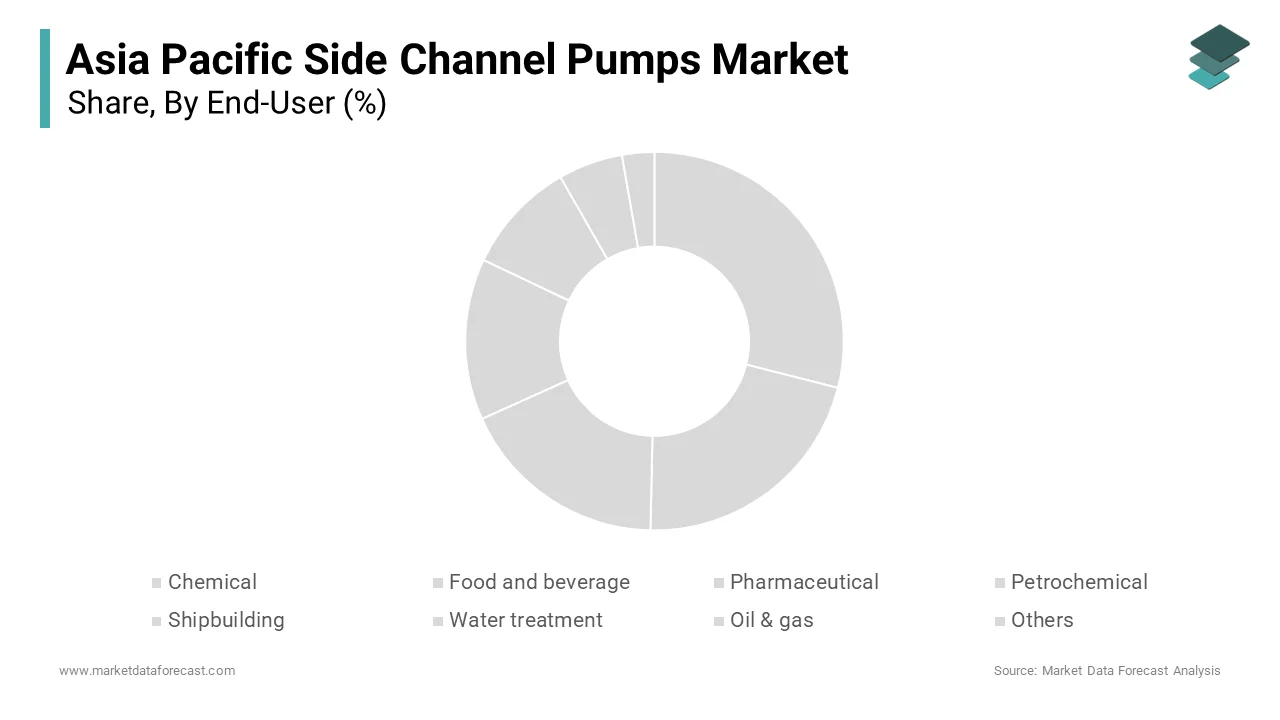
The pharmaceutical sector is swiftly emerging with th CAGR of 10.8% from 2025 to 2033, owing to the rising investments in biopharmaceutical manufacturing, stringent regulatory requirements for contamination-free processing, and the expansion of vaccine and sterile drug production facilities across the region. The rapid scaling of biopharmaceutical and mRNA vaccine production infrastructure across the Asia Pacific has become a primary catalyst for the accelerated adoption of side channel pumps. India’s Biological E and Serum Institute of India expanded their mRNA vaccine capacity by 300% in 2023, integrating side channel pumps into vacuum drying and cold trap systems to ensure sterility. The Korea Disease Control and Prevention Agency confirmed that the country now produces 180 million vaccine doses annually, up from 45 million in 2020. China’s National Medical Products Administration approved 12 new biologics manufacturing sites in 2023, each requiring between 50 and 75 vacuum pumps for process stability. As per the International Federation of Pharmaceutical Manufacturers & Associations, biopharma production in the region grew at 1a 3.4% CAGR between 2020 and 2023, outpacing global averages.
COUNTRY ANALYSIS
China Side Channel Pumps Market Analysis
China was the largest contributor in the Asia Pacific side channel pumps market with 38.2% of the sha, re in 2025, with its vast industrial base, encompassing petrochemicals, pharmaceuticals, and advanced manufacturing, all of which rely on high-efficiency vacuum systems. The Ministry of Industry and Information Technology confirmed that industrial energy efficiency improvements contributed to a 6.2% reduction in specific energy consumption across key sectors, with pump system optimization playing a central role. Additionally, China’s pharmaceutical sector, valued at USD 160 billion in 2023, has driven demand for sterile fluid handling systems, particularly in API and vaccine production.
India Side Channel Pumps Market Analysis
India was positioned second by capturing 16.2% of the Asia Pacific side channel pumps market share in 2025, with initiatives like Make in India and the National Green Hydrogen Mission, which have created robust demand for high-performance pumping systems across chemicals, pharmaceuticals, and energy sectors. The Gujarat and Odisha coastal chemical hubs alone house over 80 integrated facilities, each deploying hundreds of side channel pumps for boiler feed and LPG transfer. In pharmaceuticals, India exported USD 26 billion worth of formulations in 2023, as per the Indian Pharmaceutical Alliance, requiring GMP-compliant vacuum systems for lyophilization and solvent recovery.
Japan Side Channel Pumps Market Analysis
Japan's side channel pumps market is likely to grow with a significant CAGR during the forecast period due to its high-precision manufacturing ecosystem, particularly in semiconductors, pharmaceuticals, and advanced materials, where vacuum integrity is non-negotiable. Japanese semiconductor fabs, including those operated by Sony and Rapidus, rely on side channel pumps for lithography and etching processes, where even minor pressure fluctuations can compromise yield. Japan’s commitment to carbon neutrality by 2050 has spurred investments in hydrogen energy, with the New Energy and Industrial Technology Development Organization (NEDO) funding 12 green hydrogen pilot projects that utilize side channel pumps in electrolyzer feed systems. According to the Japan Society of Mechanical Engineers, over 60% of industrial pumps in high-tech facilities now incorporate IoT-based monitoring by enabling predictive maintenance and reducing downtime.
South Korea's Channel Pumps Market Analysis
South Korea side channel pumps market is growing steadily with its concentrated high-tech manufacturing base, particularly in semiconductors, electronics, and biopharmaceuticals, all of which require precision vacuum systems. SK Hynix and Samsung Electronics operate some of the world’s most advanced fabs, where side channel pumps are essential for maintaining vacuum in photolithography and plasma etching chambers. In biopharmaceuticals, the Korea Disease Control and Prevention Agency confirmed the commissioning of 18 new vaccine and monoclonal antibody production lines in 2023, each integrating side channel pumps for lyophilization and sterile filtration. Additionally, South Korea’s Green New Deal has prioritized hydrogen and carbon capture, with POSCO and SK ecoplant developing CCUS facilities that use side channel pumps in solvent regeneration units. The Ministry of Trade, Industry, and Energy noted that 72% of industrial facilities have adopted smart manufacturing systems, enabling real-time pump performance monitoring.
Australia's Side Channel Pumps Market Analysis
Australia side channel pumps are expected to grow with the rising focus on high-value sectors such as pharmaceuticals, mining technology, and renewable energy has created specialized demand for advanced pumping solutions. The Commonwealth Scientific and Industrial Research Organisation (CSIRO) confirmed that Australia’s biopharma sector grew by 14.2% in 2023, driven by investments in mRNA and cell therapy. Additionally, the National Hydrogen Strategy aims to deploy 15 GW of electrolyzer capacity by 2030, requiring vacuum deaeration units that rely on side channel pumps for ultrapure water preparation. The Australian Renewable Energy Agency (ARENA) has funded 11 green hydrogen projects, including the Asian Renewable Energy Hub in Western Australia, which will integrate over 200 such pumps. In mining, vacuum-assisted dewatering systems in remote operations increasingly use side channel pumps for their reliability in harsh environments.
COMPETITIVE LANDSCAPE
The competition in the Asia Pacific side channel pumps market is characterized by a blend of technological differentiation, regional specialization, and strategic agility among global and local players. While established Japanese and European manufacturers dominate high-end applications in semiconductors and pharmaceuticals, regional players are gaining ground in mid-tier industrial and HVAC segments through cost-effective, environment-specific designs. The market is witnessing intensified rivalry as companies seek to capitalize on the region’s rapid industrialization, clean energy transition, and regulatory push for energy efficiency. Differentiation is increasingly driven by digital integration, with leaders embedding IoT sensors and cloud-based analytics into pump systems to offer performance-as-a-service models. Service responsiveness, local support infrastructure, and compliance with diverse national standards have become competitive levers, especially in fragmented markets like Indonesia and the Philippines. Mergers, acquisitions, and joint ventures are on the rise, enabling faster market entry and technology transfer. Additionally, the entry of Chinese and Indian OEMs offering competitively priced alternatives is pressuring margins, compelling incumbents to innovate beyond hardware.
KEY MARKET PLAYERS
These are the market players that are dominating the Asia Pacific side channel pumps market.
- Flowserve Corporation
- SERO PumpSystems GmbH
- Kiturami Co., Ltd.
- Ebara Corporation
- Sulzer Ltd.
- KSB SE & Co. KGaA
- Inoxpa India Pvt. Ltd
- CIRCOR Industrial
- SPECK Pumpen
- Garbarino Pumps
- Aqua Group
- Manvac Technik Limited
- Emmecom (Asia) Pte. Ltd
- Dev Engineers, Gardner Denver
Top Players In The Market
- Ebara Corporation has long been a pivotal force in the Asia Pacific side channel pumps market, leveraging its Japanese engineering excellence to deliver high-efficiency, oil-free pumping solutions tailored for semiconductor, pharmaceutical, and chemical industries. The company’s HSM and V series side channel pumps are widely deployed across cleanroom environments and vacuum distillation units due to their reliability and low maintenance requirements. In 2023, Ebara launched its SmartPump IoT-integrated platform in Singapore and South Korea by enabling real-time monitoring of pump performance and predictive maintenance for processes. The company also expanded its manufacturing capabilities at its Yokohama facility to meet rising demand from green hydrogen projects, where its pumps support electrolyzer feed systems. Collaborations with local system integrators in India and Vietnam have strengthened its service network, ensuring rapid deployment and technical support. Ebara’s focus on energy-efficient designs aligns with regional decarbonization goals, particularly in Japan and Australia, where regulatory mandates are driving upgrades in industrial fluid systems.
- Sulzer has established a robust presence in the Asia Pacific side channel pumps market through its specialized Pumpe Division, which designs and manufactures high-performance regenerative pumps for demanding industrial applications. The company’s emphasis on customization and corrosion-resistant materials has made its side channel pumps a preferred choice in the petrochemical and pharmaceutical sectors across China, India, and Southeast Asia. In 2023, Sulzer introduced its next-generation MDX series in Shanghai, engineered specifically for volatile organic compound (VOC) recovery and flare gas systems, addressing tightening emissions regulations. The company also enhanced its local service footprint by opening a technical center in Kuala Lumpur, offering on-site diagnostics and retrofitting for aging pump infrastructure. Sulzer’s collaboration with Indian refiners such as Reliance Industries has led to the integration of its pumps in integrated refinery-petrochemical complexes, improving operational efficiency and reducing energy consumption. Additionally, the company invested in digital twin technology to simulate pump performance under extreme conditions, ensuring optimal design for tropical and coastal environments.
- Kiturami has emerged as a dominant regional player in the Asia Pacific side channel pumps market in heating, air conditioning, and boiler feed applications across South Korea, Japan, and Southeast Asia. Renowned for its compact, energy-efficient pump designs, the company integrates side channel technology into its thermal fluid systems, serving commercial buildings, industrial facilities, and district heating networks. In 2023, Kiturami launched its EcoFlow-V series, featuring variable-speed drives and advanced sealing mechanisms, specifically developed for high-humidity environments in tropical markets like Thailand and Indonesia. The company also strengthened its distribution network by partnering with HVAC system integrators in Vietnam and the Philippines, enabling faster deployment and localized support. Furthermore, the company aligned its product roadmap with South Korea’s 2050 Carbon Neutrality Strategy, focusing on reducing the energy footprint of heating systems.
Top Strategies Used By Key Market Participants
Key players in the Asia Pacific side channel pumps market are deploying a range of strategic initiatives to consolidate their positions and respond to evolving industrial demands. Product innovation remains a primary focus, with companies investing heavily in energy-efficient, IoT-enabled, and corrosion-resistant pump designs tailored for high-purity and harsh environments. Firms such as Ebara and Sulzer are integrating digital monitoring systems to offer predictive maintenance and remote diagnostics by enhancing customer value beyond hardware. Strategic partnerships with local engineering firms and system integrators are being leveraged to expand service networks and ensure faster deployment across emerging markets. Capacity expansion is another strategy, with manufacturers upgrading production facilities in China, India, and South Korea to meet rising demand from the petrochemical and semiconductor sectors. Additionally, companies are engaging in technology licensing and joint development programs with research institutions to accelerate R&D in materials science and vacuum optimization. After-sales service enhancement, including training programs and localized spare parts inventory, is being prioritized to improve customer retention.
RECENT MARKET NEWS
- In March 2023, Ebara Corporation launched its SmartPump IoT platform in South Korea, integrating real-time diagnostics and predictive maintenance features for semiconductor and pharmaceutical clients by enhancing operational reliability and reducing downtime across high-vacuum applications.
- In June 2023, Sulzer opened a technical service center in Kuala Lumpur, Malaysia, to provide localized pump diagnostics, retrofitting, and training for petrochemical and water treatment facilities, which is strengthening its after-sales support network across Southeast Asia.
- In September 2023, Kiturami Co., Ltd. introduced the EcoFlow-V series in Thailand, featuring variable-speed drives and enhanced sealing for tropical HVAC and boiler systems by improving energy efficiency and noise performance in commercial and industrial installations.
- In January 2025, Sulzer collaborated with Reliance Industries in India to deploy its MDX series side channel pumps in the Jamnagar refinery’s flare gas recovery system that supports emissions reduction and compliance with India’s revised environmental regulations.
- In April 2025, Ebara Corporation expanded its Yokohama manufacturing facility to increase production capacity for side channel pumps used in green hydrogen electrolysis systems, aligning with Japan’s and Australia’s national hydrogen strategies and accelerating delivery timelines for key energy projects.
MARKET SEGMENTATION
This research report on the Asia Pacific size channel pumps market is segmented and sub-segmented into the following categories.
By End-user
- Chemical
- Liquid transfer
- Boiler feed
- LPG pumping
- Heating/ air conditioning
- Others
- Food and beverage
- Pharmaceutical
- Petrochemical
- Shipbuilding
- Water treatment
- Oil & gas
- Others
By Country
- India
- China
- Japan
- South Korea
- Australia
- New Zealand
- Thailand
- Malaysia
- Vietnam
- Philippines
- Indonesia
- Singapore
- Rest of APAC