- Product Description Description
- Table of Contents TOC
- List of Table & Figure LOT
- Get Free Sample PDF Sample PDF
Market Size, 2025
$3.37 BnMarket Estimate, 2026
$4.18 BnMarket Forecast, 2034
$23.63 BnCAGR, 2026–2034
24.17%Asia Pacific Solar Tracker Market Size
The Asia Pacific solar tracker market size was valued at USD 3.37 billion in 2025 and is anticipated to reach USD 4.18 billion in 2026 from USD 23.63 billion by 2034, growing at a CAGR of 24.17% during the forecast period from 2026 to 2034.
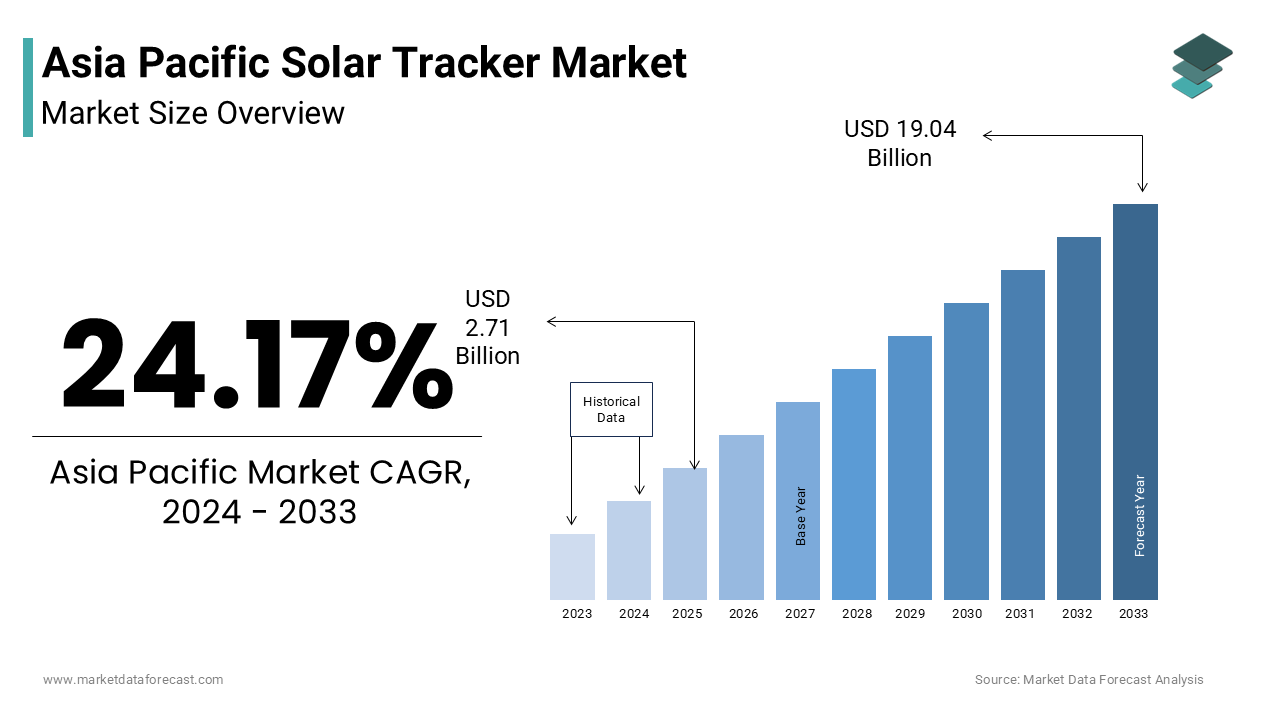
A solar tracker is a device designed to orient photovoltaic panels, modules, or mirrors toward the sun throughout the day, maximizing energy capture and improving the efficiency of solar power systems. In the Asia Pacific region, the adoption of solar trackers has gained momentum as governments and private enterprises seek to enhance the productivity of large-scale solar farms. Unlike fixed-tilt systems, which remain static, solar trackers dynamically adjust panel angles to follow the sun’s trajectory, thereby increasing energy output by up to 25–40%, depending on geographic location and system configuration.
The Asia Pacific solar tracker market is being propelled by rapid industrialization, growing investments in renewable energy infrastructure, and supportive government policies aimed at reducing carbon emissions. Countries such as India, Australia, Japan, and South Korea have implemented aggressive clean energy targets, creating a conducive environment for the deployment of advanced solar technologies. According to the International Energy Agency, solar power capacity in the Asia Pacific grew by over 100 gigawatts in 2023 alone, with utility-scale projects increasingly incorporating tracking systems to optimize land use and energy yield.
Moreover, advancements in smart grid integration and declining costs of photovoltaic components are further accelerating the uptake of solar trackers.
MARKET DRIVERS
Surging Demand for Utility-Scale Solar Projects Across the Region
The rapid expansion of utility-scale solar installations, particularly in countries like India, China, and Australia, is one of the primary drivers of the Asia Pacific solar tracker market. These large-scale solar farms require maximum energy efficiency to justify capital expenditures and meet national renewable energy targets. Solar trackers play a crucial role in enhancing power generation from limited land areas, making them an essential component of modern solar farms. Like, in Australia, where land availability is abundant but sunlight intensity varies seasonally, solar trackers have become integral to optimizing plant performance. Furthermore, government-backed tenders for large solar parks often mandate higher efficiency benchmarks, encouraging developers to deploy tracking solutions. As per the Australian Renewable Energy Agency, solar farms equipped with trackers achieved 20–35% greater annual energy output compared to fixed-tilt installations, reinforcing their economic viability.
Technological Advancements Enhancing Tracker Efficiency and Affordability
Advancements in solar tracking technology have significantly improved the efficiency, durability, and cost-effectiveness of solar trackers, making them more accessible to a broader range of applications in the Asia Pacific. Innovations such as sensor-based auto-calibration, AI-driven predictive tracking, and modular designs have reduced maintenance requirements and enhanced performance reliability even in challenging environmental conditions. As per the Fraunhofer Institute for Solar Energy Systems, recent developments in passive tracking mechanisms have eliminated the need for complex electrical components, lowering both installation and operational costs. This is particularly beneficial in rural and remote locations across Southeast Asia, where grid connectivity remains limited and off-grid solar solutions are gaining traction. In China, leading manufacturers have introduced hybrid solar trackers that integrate with energy storage and monitoring systems, enabling real-time adjustments based on weather forecasts and load demand. These intelligent tracking systems can increase energy production by up to 40% in high-insolation regions like Xinjiang and Tibet. Additionally, Japanese firms have pioneered lightweight and corrosion-resistant tracker designs suited for coastal and humid environments.
MARKET RESTRAINTS
High Initial Investment and Complex Installation Requirements
Solar trackers face resistance due to their relatively high initial costs and complex installation processes, which pose significant barriers to widespread adoption in the Asia Pacific. Compared to fixed-tilt mounting structures, solar trackers involve additional mechanical components, control systems, and foundation requirements, all of which contribute to increased capital expenditure. According to the World Bank Group, the incremental cost of installing a single-axis solar tracker can be 10–20% higher than a conventional fixed system, limiting its appeal among budget-conscious project developers, especially in emerging economies. In countries like Indonesia and the Philippines, where financial constraints often dictate investment decisions, this added expense discourages the inclusion of tracking systems in smaller or community-level solar projects. Moreover, the technical expertise required for proper installation and maintenance of tracking systems adds another layer of complexity. The National Renewable Energy Laboratory of India reported that improper alignment or calibration of trackers could result in suboptimal performance, negating potential efficiency gains. This necessitates skilled labor and ongoing technical support, which may not be readily available in certain parts of the region.
Environmental and Terrain Constraints Limiting Tracker Deployment
The influence of environmental and terrain-related challenges that limit the feasibility of tracker installation in certain geographical areas is another significant restraint affecting the Asia Pacific solar tracker market. While solar trackers are highly effective in open, flat landscapes with consistent sunlight exposure, their performance can be compromised in regions characterized by rugged topography, heavy rainfall, or extreme dust conditions. In mountainous areas of Nepal, Bhutan, and northern Vietnam, the uneven terrain makes it difficult to install large-scale tracking systems without extensive land modification, adding to project costs and timelines. According to the Asian Development Bank, nearly 30% of proposed solar sites in Southeast Asia are unsuitable for tracking systems due to land gradient issues and accessibility limitations. Similarly, in arid regions such as western India and central Australia, excessive dust accumulation on tracker-mounted panels can reduce efficiency and increase maintenance frequency. As per a study conducted by the Indian Institute of Technology Delhi, dust-induced soiling could decrease energy output by up to 25% in poorly maintained tracker-based installations, highlighting the need for regular cleaning and upkeep. These environmental factors are ultimately slowing down their adoption in certain parts of the Asia Pacific.
MARKET OPPORTUNITIES
Expansion of Hybrid Renewable Energy Systems Integrating Solar Trackers
The growing adoption of hybrid renewable energy systems that combine solar power with wind, battery storage, and diesel generators is a major opportunity for the Asia Pacific solar tracker market. These integrated systems are increasingly favored in remote and off-grid locations where energy reliability and efficiency are critical. By incorporating solar trackers into hybrid setups, developers can maximize solar energy capture while ensuring a balanced and stable power supply. According to the International Energy Agency, hybrid renewable projects in the Asia Pacific saw a 40% increase in 2023 compared to the previous year, driven by initiatives in countries like the Philippines, Thailand, and Papua New Guinea. In these regions, solar trackers enable better synchronization with intermittent wind and hydro sources by adjusting to peak solar hours and optimizing daily energy yields. Australia has been a pioneer in deploying tracker-integrated hybrid microgrids, particularly in mining operations located in isolated areas.
Rising Investments in Floating Solar Farms Utilizing Tracking Technologies
Floating solar farms represent a rapidly emerging segment within the Asia Pacific solar tracker market, offering innovative solutions for land-constrained countries and water reservoirs. Governments and private developers are increasingly investing in floating photovoltaic (FPV) systems to utilize unused water surfaces such as dams, lakes, and reservoirs. When combined with solar tracking mechanisms, these installations can achieve higher energy efficiency compared to fixed tilt floating arrays. Singapore, one of the most space-limited countries in the region, has led the way in FPV development, with pilot projects incorporating dynamic tracking systems to enhance power generation. According to the Economic Development Board of Singapore, the country aims to deploy 2 gigawatts of solar capacity by 2030, with a significant portion coming from floating solar installations. Japan has also embraced floating solar tracking technology, particularly in hydropower reservoirs, where dual-use of infrastructure supports both electricity generation and water conservation.
MARKET CHALLENGES
Supply Chain Disruptions and Component Shortages Impacting Project Timelines
The ongoing instability in global supply chains, particularly concerning critical components such as motors, sensors, and control units, is a key challenge confronting the Asia Pacific solar tracker market. The semiconductor shortage that began during the pandemic, along with geopolitical tensions and logistics bottlenecks, has disrupted manufacturing cycles and delayed project implementations across the region. In India, where domestic manufacturing of tracking systems is still in its early stages, import dependencies on European and North American suppliers have exacerbated delivery timelines. As per the Ministry of New and Renewable Energy, some utility-scale solar projects faced postponements of up to six months due to the unavailability of precision tracking components. Moreover, rising freight costs and fluctuating raw material prices have added financial pressure on developers, compelling some to reconsider tracker inclusion in favor of simpler mounting structures. In response, industry players are seeking localized manufacturing partnerships and alternative sourcing strategies to mitigate these disruptions.
Regulatory and Policy Uncertainties Hindering Long-Term Investment
Regulatory inconsistencies and policy uncertainties present a persistent challenge for the Asia Pacific solar tracker market, affecting investor confidence and project planning. While many countries in the region have set ambitious renewable energy targets, the lack of standardized incentive programs, permitting procedures, and grid interconnection rules creates uncertainty for developers integrating solar tracking systems. In countries like Indonesia and Vietnam, frequent changes in feed-in tariffs and net metering policies have caused hesitation among investors considering long-term commitments to solar tracker-based projects. According to the Institute for Energy Economics and Financial Analysis, abrupt policy revisions in Vietnam in 2023 led to a temporary slowdown in new tracker deployments despite high solar irradiation levels. Similarly, in the Philippines, regulatory delays in approving large-scale solar farm permits have slowed the adoption of tracking systems, particularly in utility-scale projects requiring multi-year return projections. The Department of Energy acknowledged that inconsistent enforcement of renewable energy laws hampers the sector’s growth.
REPORT COVERAGE
| REPORT METRIC | DETAILS |
| Market Size Available | 2025 to 2034 |
| Base Year | 2025 |
| Forecast Period | 2026 to 2034 |
| CAGR | 24.17% |
| Segments Covered | By Axis Type and Country. |
| Various Analyses Covered | Global, Regional & Country Level Analysis, Segment-Level Analysis, DROC, PESTLE Analysis, Porter’s Five Forces Analysis, Competitive Landscape, Analyst Overview of Investment Opportunities |
| Regions Covered | India, China, Japan, South Korea, Australia, New Zealand, Indonesia, Vietnam, Philippines, Singapore, Thailand, Malaysia, Rest of APAC. |
| Market Leaders Profiled | Soltec Energias Renovables S.L., Powerway Renewable Energy Co. Ltd., Trina Solar, GameChange Solar, Arctech Solar Holding Co., SunPower Corporation, PV Hardware Solutions S.L.U., Haosolar Co. Ltd., Nextracker Inc., Antaisolar, and Array Technologies Inc. |
SEGMENTAL ANALYSIS
By Axis Type Insights
The single-axis solar tracker segment dominated the Asia Pacific solar tracker market by accounting for 64.4% of total revenue in 2024. This widespread adoption is attributed to its cost-effectiveness, simpler mechanical design, and ability to significantly enhance energy output compared to fixed-tilt systems without the complexity and expense of dual-axis models. In utility-scale solar farms across India and China, single-axis trackers are preferred due to their reliability and ease of maintenance in large installations. According to the International Renewable Energy Agency, over 75% of new ground-mounted solar projects in India between 2021 and 2023 incorporated single-axis tracking systems to optimize land use and increase energy yield per megawatt installed. Australia has also witnessed strong demand for single-axis trackers, particularly in solar parks located in high-insolation regions such as Queensland and New South Wales. As per the Australian Renewable Energy Agency, single-axis trackers improved annual energy generation by up to 25% compared to fixed tilt structures, making them a strategic choice for developers seeking higher returns on investment. Additionally, technological advancements have made these trackers more durable and adaptable to diverse climates.
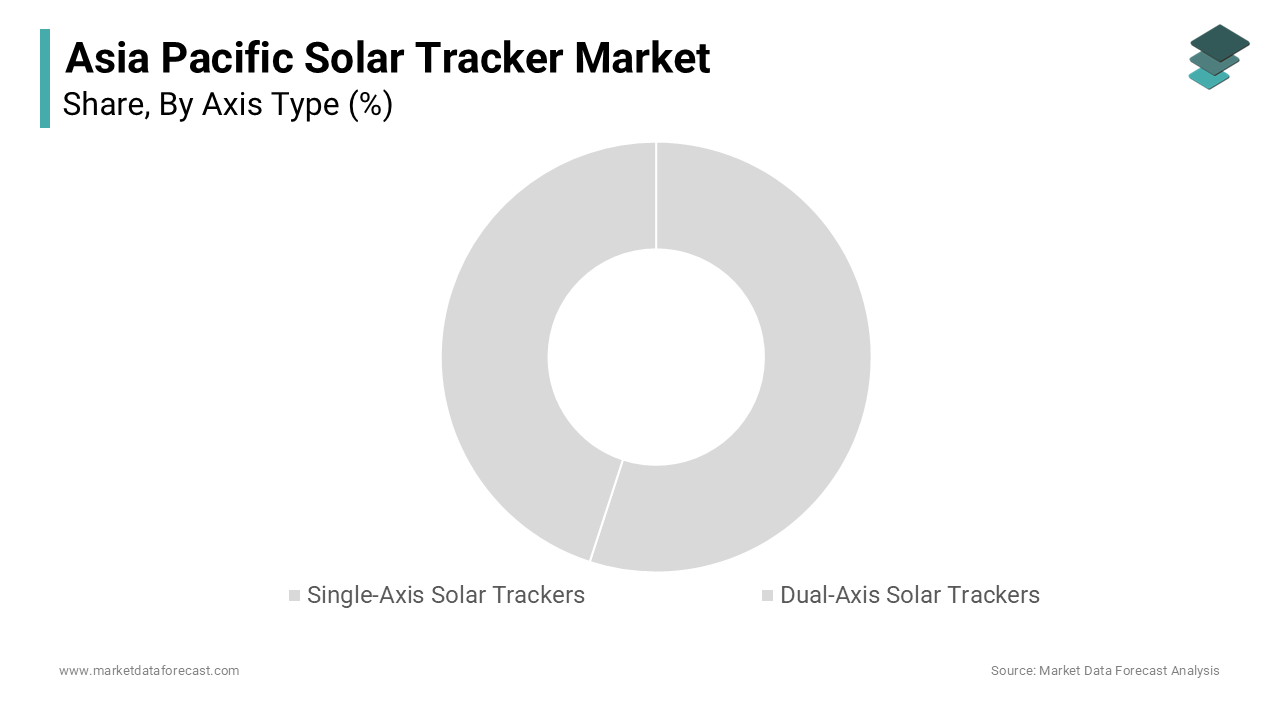
The dual-axis solar tracker segment is projected to grow at the fastest CAGR of 11.7% from 2025 to 2033 which is driven by increasing demand for maximum solar irradiance capture in high-efficiency applications. Unlike single-axis trackers, which follow the sun’s east-west movement, dual-axis systems adjust both azimuth and altitude angles to maintain optimal alignment throughout the day and across seasons. In Japan, where available land for solar farms is limited and sunlight intensity varies with elevation and seasonality, dual-axis trackers have gained traction among commercial and industrial solar installations. According to the New Energy and Industrial Technology Development Organization, dual-axis systems demonstrated up to 40% higher energy output compared to fixed tilt configurations in rooftop and small-scale solar deployments. South Korea has also seen rising interest in dual-axis technology, particularly in research and pilot projects focused on smart city infrastructure and decentralized energy generation. Moreover, dual-axis trackers are being increasingly integrated into hybrid renewable energy systems and off-grid microgrids in remote areas of Southeast Asia.
REGIONAL ANALYSIS
India Solar Tracker Market Insights
India spearheaded the Asia Pacific solar tracker market by contributing 34% of total regional demand in 2024. The country's rapid expansion of utility-scale solar capacity, supported by government initiatives like the National Solar Mission and production-linked incentive schemes, has created a strong foundation for solar tracker adoption. According to the Ministry of New and Renewable Energy, India added over 18 gigawatts of solar capacity in 2023, with nearly 60% of new projects incorporating single-axis tracking systems to improve energy yield. States like Rajasthan, Gujarat, and Andhra Pradesh have emerged as key hubs for large solar parks equipped with tracking solutions to maximize efficiency on vast tracts of arid land. Furthermore, the push for renewable procurement by state-run utilities through competitive bidding processes has incentivized developers to deploy tracking technologies to meet performance benchmarks. As per the Solar Energy Corporation of India, solar farms using trackers achieved higher capacity utilization factors, making them more economically viable despite higher upfront costs.
China Solar Tracker Market Insights
China is seeing a strong growth in the Asia Pacific solar tracker market and is leveraging its robust domestic manufacturing base and extensive utility-scale solar development to drive adoption. As the world’s largest producer and consumer of solar PV modules, China has integrated tracking systems into many of its large photovoltaic installations to enhance energy efficiency and optimize land usage. According to the National Energy Administration of China, over 90 gigawatts of new solar capacity were commissioned in 2023, with a significant portion utilizing single-axis trackers in western provinces such as Gansu, Qinghai, and Xinjiang—regions characterized by high solar irradiation and expansive terrain suitable for tracking systems. Chinese manufacturers have also played a pivotal role in reducing tracker costs through localized production and modular designs tailored for different climate zones. The Chinese Academy of Sciences noted that indigenous innovations in tracker durability and automated control systems have improved long-term performance and reduced maintenance requirements.
Australia Solar Tracker Market Insights
Australia is benefiting from its abundant sunshine and favorable policy environment that encourages large-scale solar farm development. With some of the highest levels of solar irradiation in the world, the country has embraced tracking technology to maximize energy generation from its vast open spaces. As per the Australian Renewable Energy Agency, over 7 gigawatts of utility-scale solar capacity were under construction in 2023, with a majority of projects opting for single-axis tracking systems to enhance performance and return on investment. Large solar farms such as the Sunraysia and Western Downs Green Power Hub incorporate thousands of tracker units to optimize daily energy capture. Moreover, Australia’s focus on integrating solar with battery storage and hydrogen production has reinforced the need for high-efficiency systems.
Japan Solar Tracker Market Insights
Japan is distinguished by its emphasis on high-efficiency systems tailored for constrained urban and mountainous environments. Given the country’s limited flatland availability, solar trackers have become essential tools for maximizing energy output from rooftops, floating solar farms, and hillside installations. These systems enable precise alignment with the sun’s trajectory, improving productivity even in less-than-ideal conditions. Japanese firms such as Sharp and Panasonic have developed lightweight, weather-resistant trackers designed for rooftop solar arrays, enhancing adoption in residential and commercial sectors. Additionally, the integration of AI-based predictive tracking software has allowed for real-time adjustments based on cloud cover and seasonal variations.
South Korea Solar Tracker Market Insights
South Korea occupies a significant portion of the Asia Pacific solar tracker market and is driven by strategic investments in smart solar farms, hybrid energy systems, and AI-integrated tracking technologies. As part of its Green New Deal initiative, the government has prioritized renewable energy expansion, encouraging the adoption of advanced tracking solutions in both utility-scale and distributed solar applications. Like, the country added over 5 gigawatts of solar capacity in 2023, with a growing number of installations incorporating tracking systems to enhance efficiency. In particular, dual-axis trackers are gaining traction in research facilities and demonstration projects aimed at maximizing energy yields in variable climatic conditions. South Korean companies are also developing smart tracking platforms that integrate with energy storage and building management systems to optimize power consumption. The Ministry of Trade, Industry and Energy has supported several pilot programs deploying trackers in combination with wind turbines and hydrogen electrolysis units to create resilient microgrids.
COMPETITIVE LANDSCAPE
The competition in the Asia Pacific solar tracker market is intensifying as both global leaders and regional players strive to capture a larger share of this rapidly expanding sector. Established international vendors bring technological expertise and proven track records from mature markets, while emerging companies focus on affordability, customization, and localized service support to gain traction. This dynamic creates a competitive yet collaborative environment where innovation, scalability, and adaptability determine long-term success.
Market participants are increasingly focusing on product differentiation by integrating advanced materials, automation, and digital control systems into their offerings. Additionally, strategic collaborations with engineering, procurement, and construction (EPC) firms are enabling vendors to provide end-to-end solutions tailored to specific geographical and climatic conditions across the region.
As solar adoption accelerates and project developers seek higher returns on investment, the demand for efficient and reliable tracking systems is rising. This has prompted companies to expand their regional footprints, establish technical support centers, and invest in after-sales services to build customer trust and ensure seamless operations. Ultimately, only those firms that combine technological excellence with deep regional understanding will maintain leadership in the evolving Asia Pacific solar tracker market.
KEY MARKET PLAYERS
The key players in the Asia Pacific Solar Tracker Market include
- Soltec Energias Renovables S.L.
- Powerway Renewable Energy Co. Ltd.
- Trina Solar
- GameChange Solar
- Arctech Solar Holding Co.
- SunPower Corporation
- PV Hardware Solutions S.L.U.
- Haosolar Co. Ltd.
- Nextracker Inc.
- Antaisolar
- Array Technologies Inc.
Top Players in the Asia Pacific Solar Tracker Market
One of the leading players in the Asia Pacific solar tracker market is Nextracker, a subsidiary of Flex Ltd. Known for its innovative single-axis tracking solutions, Nextracker has made significant contributions to global solar efficiency through advanced design and smart control systems. The company’s presence in the Asia Pacific has grown steadily due to its partnerships with major project developers and its ability to offer scalable, high-performance trackers tailored for large-scale utility projects.
Array Technologies is another key player shaping the regional solar tracker landscape. With a strong focus on simplicity, durability, and cost-efficiency, Array Technologies’ DuraTrack system has gained recognition for its ease of installation and maintenance. In the Asia Pacific, the company has expanded its reach by collaborating with local engineering firms and leveraging its modular designs to suit diverse environmental conditions across the region.
Soltec Manufacturing, a Spanish multinational, plays a pivotal role in advancing dual-axis and single-axis solar tracking technologies. Soltec's commitment to sustainability and performance optimization has positioned it as a preferred choice for precision-driven solar applications. In the Asia Pacific, the company has been actively engaging with governments and renewable energy agencies to promote high-efficiency solar deployment, particularly in countries with limited land availability and high energy demand.
Top Strategies Used by Key Market Participants
A primary strategy employed by key players in the Asia Pacific solar tracker market is localization of manufacturing and supply chain operations. Companies are increasingly setting up regional production hubs or partnering with local suppliers to reduce lead times, lower costs, and comply with domestic content requirements in various countries.
Another critical approach is technology differentiation through innovation and digital integration. Leading firms are embedding smart sensors, IoT-enabled monitoring, and predictive analytics into their tracking systems to enhance performance, reliability, and remote operability—features that appeal to utility developers and independent power producers.
Lastly, strategic partnerships and joint ventures with EPC firms and renewable energy developers have become a key growth driver. By aligning with regional project implementers, solar tracker manufacturers can better understand site-specific needs, streamline deployment, and strengthen customer relationships across diverse markets in the Asia Pacific.
RECENT MARKET DEVELOPMENTS
- In April 2024, DynaTouch, a kiosk solutions provider, acquired KioWare, a kiosk management software company. This acquisition is anticipated to allow DynaTouch to offer more comprehensive kiosk solutions and strengthen its market presence.
- In March 2024, Nextracker announced the launch of a new regional engineering center in Singapore aimed at supporting large-scale solar tracker deployments across Southeast Asia, enhancing technical support and project customization capabilities.
- In February 2024, Array Technologies formed a strategic partnership with a leading Indian EPC firm to co-develop optimized tracker solutions tailored for India’s monsoon-prone regions, improving durability and performance under challenging weather conditions.
- In January 2024, Soltec Manufacturing entered into a joint venture with an Australian solar developer to deploy next-generation dual-axis trackers in hybrid renewable energy parks, targeting increased energy yield in land-constrained zones.
- In May 2024, a prominent South Korean solar technology firm introduced an AI-powered tracking control system designed specifically for rooftop and floating solar installations, aiming to enhance efficiency and real-time responsiveness in urban and coastal environments.
MARKET SEGMENTATION
This research report on the Asia Pacific Solar Tracker Market has been segmented and sub-segmented into the following categories.
By Axis Type
- Single-Axis Solar Trackers
- Dual-Axis Solar Trackers
By Country
- India
- China
- Japan
- South Korea
- Australia
- New Zealand
- Thailand
- Malaysia
- Vietnam
- Philippines
- Indonesia
- Singapore
- Rest of APAC