- Product Description Description
- Table of Contents TOC
- List of Table & Figure LOT
- Get Free Sample PDF Sample PDF
Asia Pacific Subsea Pumps Market Size
The Asia Pacific subsea pumps market size was valued at USD 309.69 million in 2025 and is anticipated to reach USD 332.08 million in 2026 from USD 580.46 million by 2034, growing at a CAGR of 7.23% during the forecast period from 2026 to 2034.
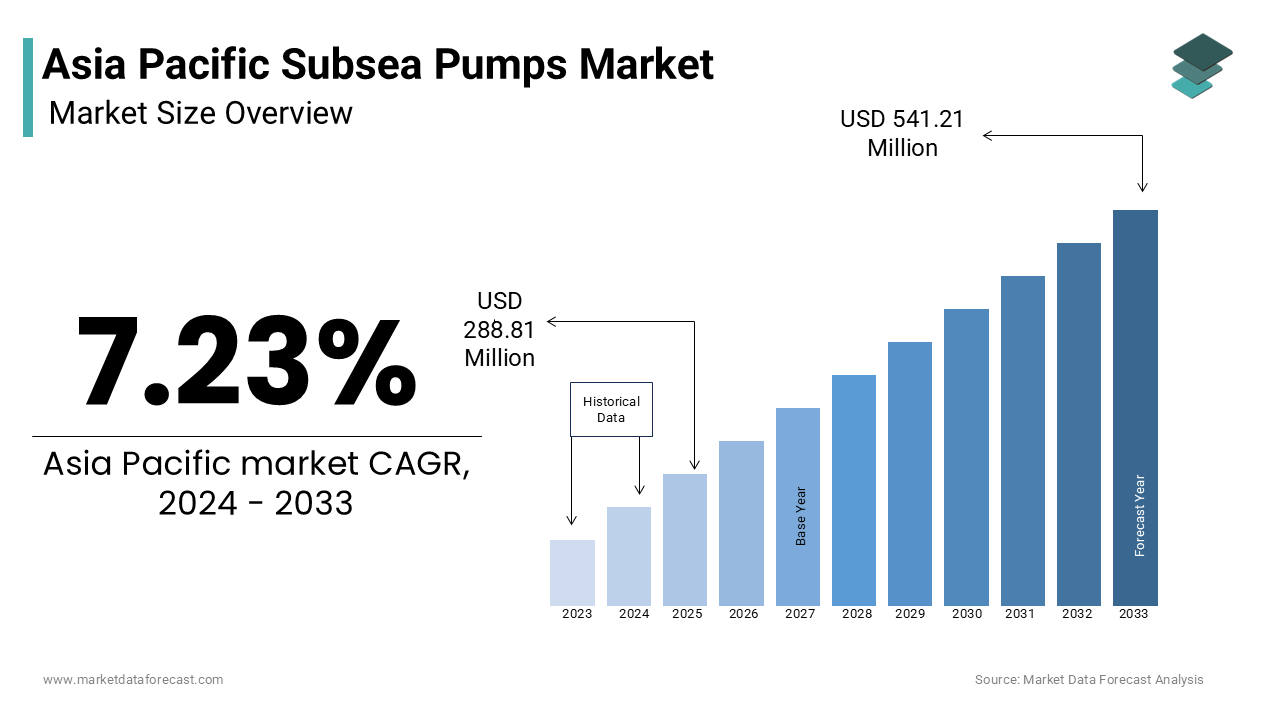
Subsea pumps are designed to operate underwater at great depths to enhance hydrocarbon recovery from subsea reservoirs. These pumps help maintain pressure levels in pipelines, improve flow efficiency, and extend the productive life of offshore fields. According to the International Energy Agency (IEA), the Asia Pacific accounts for over 30% of global offshore oil and gas reserves, with countries like Australia, Malaysia, Indonesia, and India actively investing in offshore field development. Additionally, governments across the region are emphasizing energy security and self-reliance, leading to increased capital expenditure on offshore projects. The Japan Organization for Metals and Energy Security (JOGMEC) has been supporting deepwater exploration initiatives to reduce dependency on imported fossil fuels.
MARKET DRIVERS
Expansion of Offshore Oil and Gas Exploration Activities
The increasing pace of offshore oil and gas exploration and production activities is escalating the growth of the Asia Pacific subsea pumps market. According to the International Energy Agency (IEA), offshore crude production in the Asia Pacific region grew by over 6% annually between 2019 and 2023 with new discoveries and field developments in countries such as Australia, Vietnam, and India fueling demand for advanced subsea equipment. Australia, for instance, remains a key hub for offshore energy development. As per the Australian Petroleum Production & Exploration Association (APPEA), the country’s offshore liquefied natural gas (LNG) projects contributed to more than 70% of total gas exports in 2023, requiring extensive use of subsea boosting systems to maintain optimal flow rates. Moreover, in Southeast Asia, Malaysia and Indonesia continue to expand their offshore portfolios. Petronas, Malaysia's national oil company, launched four deepwater field development projects in 2023, all of which incorporated subsea pump technology to enhance reservoir recovery.
Rising Need for Enhanced Oil Recovery (EOR) Techniques
The growing adoption of enhanced oil recovery (EOR) techniques to maximize hydrocarbon extraction from aging reservoirs is addtionally to fuel the growth of the Asia Pacific subsea pumps market. According to the U.S. Department of Energy (DOE), EOR can increase oil recovery rates by up to 40–60%, compared to conventional methods that typically recover only 20–40% of original oil in place. Additionally, Japan, despite its limited domestic hydrocarbon reserves, has been exploring subsea EOR applications in deepwater blocks under the Japan Organization for Metals and Energy Security (JOGMEC). As per JOGMEC’s 2023 research bulletin, field trials using electric submersible pumps in high-pressure environments demonstrated improved oil recovery rates, which is reinforcing their potential for broader deployment.
MARKET RESTRAINTS
High Capital Investment and Operational Costs
The substantial capital investment required for subsea pump installation and ongoing operational expenditures is restricting the growth of the Asia Pacific subsea pumps market. According to McKinsey & Company, capital costs for subsea pumping systems can account for up to 20–25% of total offshore project budgets by making them one of the more expensive components of deepwater field development. This financial burden limits widespread adoption among smaller independent operators and emerging markets with constrained energy budgets.
For example, in India, where offshore exploration is expanding but often undertaken by state-owned enterprises, budgetary constraints have led to delays in several deepwater projects. Similarly, in Indonesia, Pertamina has faced financial challenges in deploying subsea pumps in aging fields due to limited capital allocation and fluctuating oil prices. Moreover, maintenance and repair of subsea pumps involve complex logistics and specialized intervention vessels, further escalating lifecycle costs. As per a study conducted by DNV GL, subsea pump maintenance expenses can be 2–3 times higher than those of topside systems due to the need for remotely operated vehicles (ROVs) and deep-sea monitoring technologies.
Technical Complexity and Risk of Equipment Failure
The technical complexity involved in designing, installing, and operating subsea pumping systems in extreme offshore conditions is ascribed to impede the growth of the Asia Pacific subsea pumps market. According to the Society of Petroleum Engineers (SPE), subsea pumps must function reliably at depths exceeding 2,000 meters where they are exposed to high pressures, corrosive seawater, and unpredictable geological formations. These harsh conditions increase the risk of mechanical failure and unplanned downtime, impacting overall project economics. In China, where deepwater exploration is expanding rapidly, CNOOC reported multiple cases of premature pump failures in the South China Sea in 2023, primarily attributed to sand ingress and motor insulation degradation. Furthermore, the shortage of skilled personnel trained in subsea diagnostics and predictive maintenance adds to operational challenges.
MARKET OPPORTUNITIES
Growth in Deepwater and Ultra-Deepwater Field Developments
The increasing number of deepwater and ultra-deepwater field developments is setting up new opportunities for the growth of the Asia Pacific subsea pumps market. As per the International Energy Agency (IEA), deepwater reserves in the Asia Pacific region account for over 40% of untapped offshore hydrocarbon resources, which is attracting significant investment from major energy companies seeking to access these reserves. In Australia, the Scarborough and Browse Basin LNG projects, led by Woodside Energy, are pushing the boundaries of deepwater production, with water depths ranging between 800 and 2,000 meters. Similarly, in Malaysia, Petronas is advancing its Kasawari and Rotan gas fields, both of which are located in water depths exceeding 1,200 meters. Additionally, in India, ONGC has initiated feasibility studies for deepwater blocks in the Cauvery and Kaveri basins, where subsea pumps will be essential for enhancing hydrocarbon extraction.
Integration of Digital Technologies in Subsea Pump Monitoring and Control
The growing adoption of digital technologies in subsea pump monitoring and control is another factor boosting the growth of the Asia Pacific subsea pumps market. Advanced analytics, artificial intelligence (AI), and remote sensing tools are increasingly being integrated into subsea systems to optimize performance, predict failures, and reduce maintenance costs. According to the World Economic Forum (WEF), digitalization in upstream oil and gas operations has the potential to reduce operational costs by up to 20%, with real-time monitoring playing a key role in asset management.
MARKET CHALLENGES
Regulatory and Environmental Compliance Pressures
The tightening regulatory landscape and increasing environmental compliance requirements is acting as a barrier for the growth of the Asia Pacific subsea pumps market. Governments and international agencies are imposing stricter regulations on offshore oil and gas operations to mitigate ecological impact, which is leading to additional operational complexities for subsea pump manufacturers and operators.
Supply Chain Disruptions and Logistics Constraints
The persistent supply chain disruptions and logistical bottlenecks that hinder timely procurement and deployment of components is also to fuel the growth of the Asia Pacific subsea pumps market. According to McKinsey & Company, global lead times for subsea equipment increased by an average of 25% in 2023, which is primarily due to semiconductor shortages, shipping delays, and geopolitical tensions affecting raw material availability. In particular, the Russia-Ukraine conflict and trade restrictions on rare earth metals have disrupted the availability of high-performance alloys and electrical components essential for subsea pump manufacturing. Moreover, the logistical complexities associated with transporting large-scale subsea equipment to remote offshore locations add another layer of difficulty. Additionally, the lack of local manufacturing capabilities forces many Asia Pacific-based firms to rely on European and North American suppliers for high-specification subsea pumps.
SEGMENTAL ANALYSIS
By Type Insights
The centrifugal pumps segment held 35.4% of the Asia Pacific subsea pumps market share in 2024. According to the Society of Petroleum Engineers (SPE), subsea boosting accounted for over 60% of centrifugal pump usage in the Asia Pacific as these pumps are well-suited for handling multiphase fluids under high-pressure conditions. In Australia’s Browse Basin, operators such as Woodside Energy have extensively deployed centrifugal pumps to enhance gas recovery from remote offshore fields. Additionally, the maturity of centrifugal pump technology and its integration with digital monitoring systems has reinforced its preference among operators.
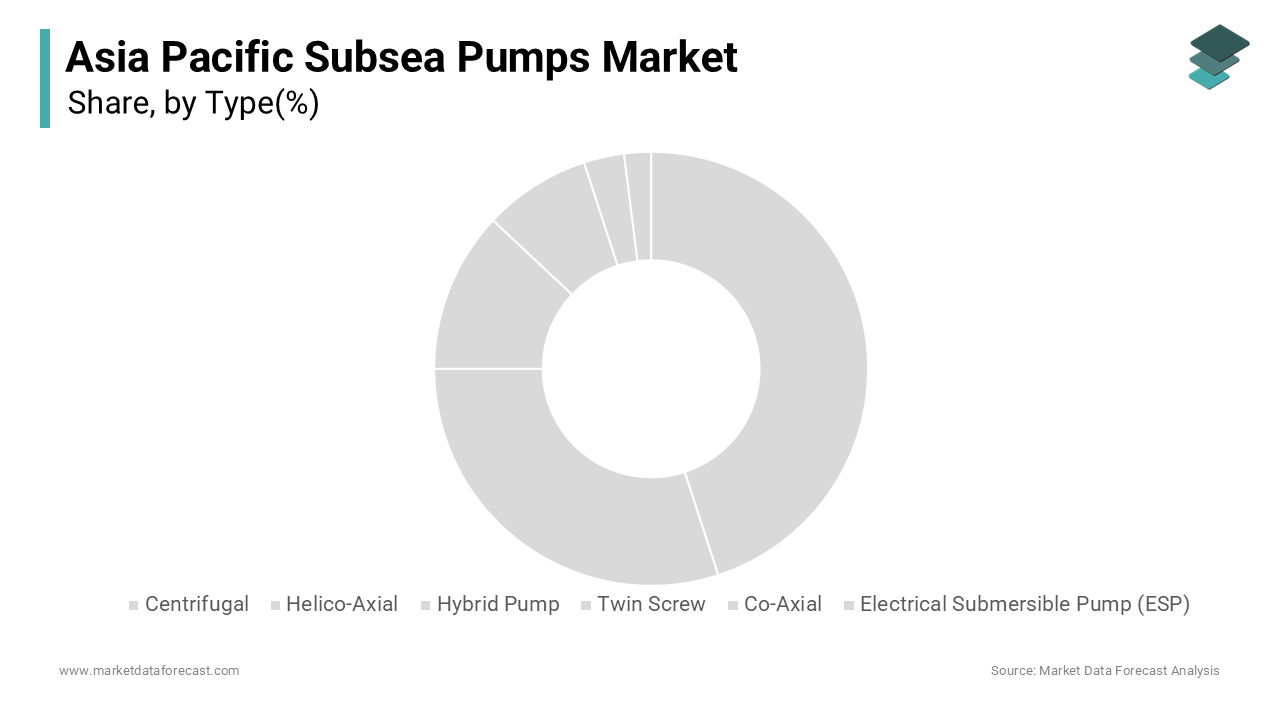
The Electrical Submersible Pump (ESP) segment is projected to grow with a CAGR of 9.7% in the next coming years with the rising need for enhanced oil recovery (EOR) in aging reservoirs across China, India, and Indonesia, where conventional extraction methods are no longer sufficient. Another significant factor contributing to this growth is the advancement in ESP design for deeper and harsher environments, including high-temperature and high-salinity conditions. As per Schlumberger’s 2023 white paper on subsea lifting technologies, new-generation ESPs can now operate at depths exceeding 3,000 meters by expanding their applicability in ultra-deepwater developments.
By Application Insights
The subsea boosting application dominated the Asia Pacific subsea pumps market by capturing 40.3% of share in 2024 due to the expansion of deepwater oil and gas fields, particularly in countries like Australia, Malaysia, and Vietnam. According to the International Energy Agency (IEA), deepwater reserves in the Asia Pacific account for nearly 45% of untapped offshore hydrocarbons, necessitating boosting solutions to overcome flow assurance challenges. Additionally, the need to counter pipeline slugging and reduce topside compression costs has further reinforced the adoption of subsea boosting systems. As per DNV GL, the use of subsea boosting can reduce capital expenditure by up to 15% in deepwater developments by making it an economically viable solution. Moreover, advancements in variable speed drives and real-time monitoring have enhanced system efficiency, leading to increased reliability.
The subsea gas compression segment is projected to expand at a CAGR of 10.5% from 2025 to 2033 owing to the increasing deployment of subsea gas compression systems in stranded and marginal gas fields in Japan and South Korea, where domestic energy security is a priority. Moreover, technological advancements in compact and modular compressor units have enabled their installation in deepwater environments previously deemed uneconomical. As per Aker Solutions’ 2023 technical review, the latest subsea gas compression systems can operate efficiently at depths beyond 2,500 meters by offering superior performance compared to traditional topside compression.
REGIONAL ANALYSIS
China was the largest contributor by holding 32.2% of the Asia Pacific Subsea Pumps Market share in 2024. As per the Ministry of Natural Resources, China added over 15 new offshore oil and gas fields between 2022 and 2024, significantly boosting demand for subsea pumping systems.
The government’s strategic push toward energy self-sufficiency is also to propel the growth of the Asia Pacific subsea pumps market. According to the China National Offshore Oil Corporation (CNOOC), investments in offshore energy infrastructure surpassed USD 28 billion in 2023 alone. Additionally, the integration of digital monitoring and automation technologies into subsea operations has further enhanced operational efficiency, supporting the adoption of advanced subsea pumps.
Australia Subsea Pumps Market held 19.2% of the share in 2024. According to the Australian Government’s Department of Industry, Science and Resources, Australia produced over 85 million tonnes of LNG in 2023, maintaining its status as one of the world’s top exporters. The development of deepwater projects such as Scarborough, Browse Basin, and Ichthys LNG has necessitated the deployment of high-performance subsea pumps for efficient hydrocarbon extraction. In addition, the rise in carbon capture and storage (CCS) initiatives, including the CO2CRC’s Otway Project, is opening new avenues for subsea pumping applications.
India Subsea Pumps Market is expected to grow prominently in the next coming years. The Ministry of Petroleum and Natural Gas stated that India’s offshore crude oil production rose by nearly 18% between 2021 and 2023, with key contributions from the Mumbai High and Krishna-Godavari basins. Additionally, the government’s Production Linked Incentive (PLI) scheme for the oil and gas sector has encouraged private and public companies to invest in offshore exploration.
Japan Subsea Pumps Market is substantially to have lucrative opportunities during the forecast period. Although Japan lacks extensive domestic fossil fuel reserves, its strategic investments in offshore energy infrastructure and marine technology have positioned it as a key player in the subsea equipment space. Additionally, the country’s emphasis on enhancing maritime security and resource independence has led to increased collaboration with international energy firms and research institutions.
South Korea Subsea Pumps Market growth is propelled with its advanced shipbuilding and marine engineering capabilities. The country’s growing involvement in offshore wind and deep-sea resource exploration is influencing the demand for subsea pumping systems. According to the Korea Institute of Ocean Science & Technology (KIOST), South Korea launched several deep-sea mining pilot projects in the Pacific Ocean in 2023, focusing on polymetallic nodules and rare earth elements. Additionally, the Ministry of Trade, Industry and Energy has been promoting offshore energy diversification, including hydrogen production from submerged sources. Companies like Samsung Heavy Industries and Hyundai Heavy Industries are actively developing integrated subsea pumping and processing units for export to international markets.
COMPETIITVE LANDSCAPE
The Asia Pacific subsea pumps market is highly competitive with the presence of global oilfield service giants alongside emerging regional players striving to capture a share of the expanding offshore energy sector. Competition is primarily driven by technological differentiation, service localization, and the ability to deliver reliable, high-performance pumping solutions for deepwater and ultra-deepwater projects. Major players leverage their global expertise while adapting to the unique geological and regulatory landscapes of individual countries like Australia, China, India, and Indonesia.
Innovation remains a key battleground, with companies focusing on improving pump durability, efficiency, and integration with digital monitoring platforms. The push for cost-effective, environmentally sustainable solutions has also intensified competition, particularly in markets where offshore exploration budgets fluctuate due to oil price volatility. Additionally, the growing emphasis on enhanced oil recovery techniques has led to increased demand for specialized submersible and multiphase pumps, prompting manufacturers to refine their offerings accordingly.
Smaller regional firms are gaining traction by offering cost-competitive alternatives and localized support, but they often struggle with the technical complexity of deepwater applications. The market will continue to be shaped by strategic investments, collaborative ventures, and advancements in subsea pumping technologies tailored for evolving energy needs.
KEY MARKET PLAYERS
The key players in the Asia Pacific Subsea Pumps Market include
- Aker Solutions
- Baker Hughes Company
- Halliburton Company
- Schlumberger Limited
- Flowserve Corporation
- Framo AS (an Alfa Laval company)
- OneSubsea (a Schlumberger company)
- ITT Inc.
Top Players in the Asia Pacific Subsea Pumps Market
Schlumberger Limited
Schlumberger is a global leader in subsea pumping technology and holds a strong presence in the Asia Pacific market. The company offers advanced subsea boosting and artificial lift solutions tailored for deepwater oil and gas fields. Schlumberger’s expertise lies in integrating digital monitoring systems with subsea pumps to enhance efficiency and reduce downtime. Its collaborations with regional energy firms and continuous R&D efforts have made it a trusted partner in offshore field development across Australia, Malaysia, and India.
Baker Hughes Company
Baker Hughes plays a pivotal role in the Asia Pacific subsea pumps market by delivering innovative electrical submersible pump (ESP) systems and multiphase pumping technologies. The company focuses on optimizing performance in challenging environments such as high-pressure and high-temperature reservoirs. Baker Hughes has become a preferred supplier for national oil companies and international operators looking to enhance recovery rates from aging offshore assets.
Aker Solutions ASA
Aker Solutions is a key player known for its cutting-edge subsea pumping and compression systems designed for ultra-deepwater applications. The company has been instrumental in advancing compact and modular subsea pump designs that are increasingly adopted in remote offshore developments across the Asia Pacific. Aker Solutions’ commitment to sustainability and digital integration has positioned it as a strategic partner in developing next-generation subsea infrastructure in the region.
Top Strategies Used by Key Market Participants
One of the primary strategies employed by leading players in the Asia Pacific subsea pumps market is technology innovation focused on reliability and efficiency in extreme offshore conditions. Companies are investing heavily in R&D to develop pumps that can withstand high pressure, corrosion, and abrasive elements while maintaining optimal performance over long operational cycles.
Another crucial approach is digitalization and predictive maintenance, where manufacturers integrate smart sensors, real-time monitoring, and data analytics into subsea pump systems. This enables operators to anticipate failures, optimize maintenance schedules, and reduce unplanned downtime, enhancing overall asset productivity.
Firms are increasingly adopting strategic partnerships and localized service networks, collaborating with regional energy companies, engineering firms, and government agencies to better understand local project requirements and regulatory frameworks.
RECENT MARKET DEVELOPMENTS
- In February 2023, Schlumberger introduced a new line of digitally integrated subsea pumps designed for deepwater applications in the Asia Pacific by aiming to improve flow assurance and reduce unplanned maintenance through real-time diagnostics.
- In June 2023, Baker Hughes partnered with an Indian state-owned energy firm to deploy customized electrical submersible pumps (ESPs) in mature offshore wells, which is supporting enhanced oil recovery initiatives in the Mumbai High basin.
- In October 2023, Aker Solutions launched a modular subsea pump system specifically engineered for deployment in high-salinity environments by targeting opportunities in Southeast Asian gas fields with challenging subsea conditions.
- In January 2024, Siemens Energy signed a joint development agreement with a Japanese energy technology institute to advance subsea pump motor efficiency and thermal management for use in ultra-deepwater exploration projects.
- In May 2024, Halliburton expanded its subsea service hub in Singapore by reinforcing its regional logistics and technical support capabilities to meet rising demand from offshore operators across the Asia Pacific.
MARKET SEGMENTATION
This research report on the Asia Pacific subsea pumps market is segmented and sub-segmented into the following categories.
By Type
- Centrifugal
- Helico-Axial
- Hybrid Pump
- Twin Screw
- Co-Axial
- Electrical Submersible Pump (ESP)
By Application
- Subsea Boosting
- Subsea Separation
- Subsea Injection
- Subsea Gas Compression
By Country
- India
- China
- Japan
- South Korea
- Australia
- New Zealand
- Thailand
- Malaysia
- Vietnam
- Philippines
- Indonesia
- Singapore
- Rest of APAC