- Product Description Description
- Table of Contents TOC
- List of Table & Figure LOT
- Get Free Sample PDF Sample PDF
Market Size, 2025
$100.93 MnMarket Estimate, 2026
$110.20 MnMarket Forecast, 2034
$222 MnCAGR, 2026–2034
9.18%Asia Pacific Ureteral Stents Market Size, Growth, Trends & Forecast (2026–2034)
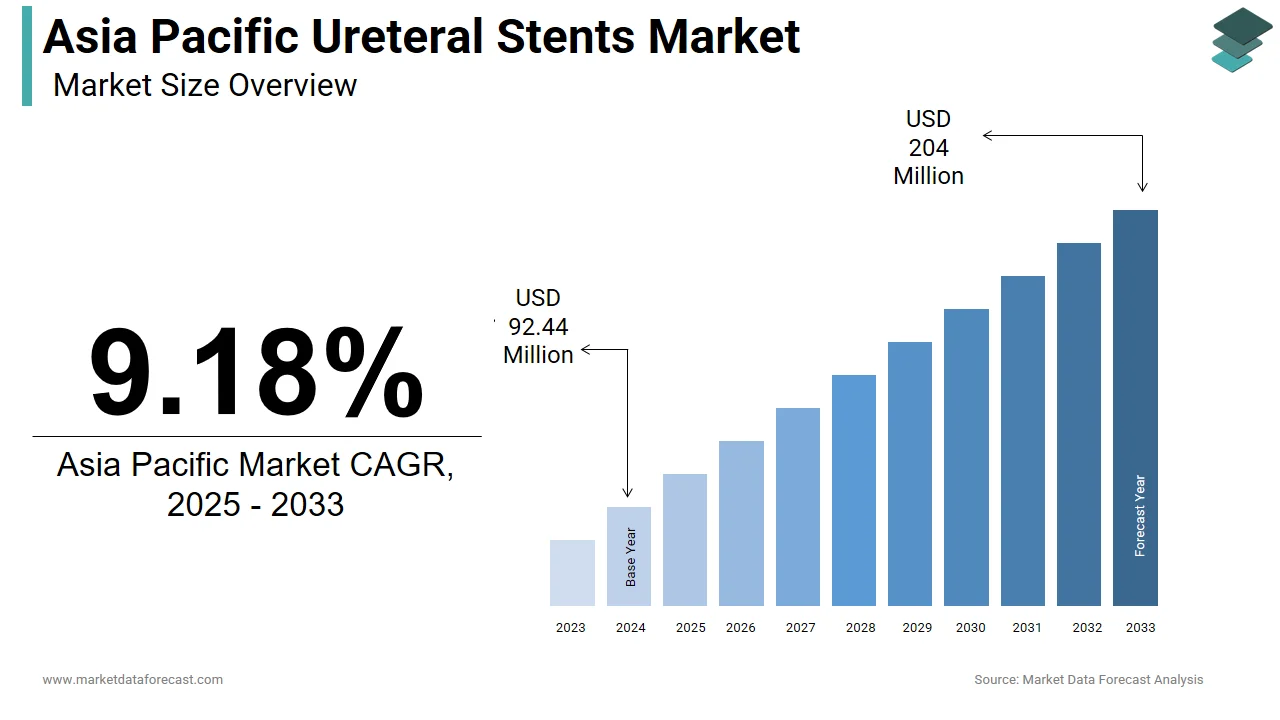
The Asia Pacific ureteral stents market was valued at USD 100.93 million in 2025, is estimated at USD 110.20 million in 2026, and is projected to reach USD 222 million by 2034, registering a compound annual growth rate (CAGR) of 9.18% during the forecast period from 2026 to 2034. Driven by the rising prevalence of urological disorders, kidney stones, increasing numbers of kidney transplants, and improving regional healthcare infrastructure, the market continues to post robust growth.
Key Executive Metrics (At-a-Glance)
- 2025 Base Valuation: USD 100.93 Million
- 2026 Current Valuation: USD 110.20 Million
- 2034 Forecast Valuation: USD 222 Million
- Compound Annual Growth Rate (CAGR): 9.18% (2026–2034)
- Dominant Type Segment: Double Pigtail Stent (JJ Stent)
- Dominant Medical Situation Segment: Kidney Stones (Urolithiasis)
- Regional Growth Leaders: China, India, and Japan (accelerating growth through medical tourism, aging populations, and rising healthcare spending).
Core Market Drivers
- Urological Disorders Surge: Increasing incidence of urolithiasis, urinary incontinence, and urinary tract infections linked to sedentary lifestyles and dietary habits.
- Transplant & Surgery Volume: Rising numbers of kidney transplants and minimally invasive procedures (such as ureteroscopy) requiring temporary stent placement.
- Material Innovations: Technological advancements in biodegradable polymers and stent composition aimed at minimizing migration, reflux, and tissue irritation.
Primary Market Restraints & Challenges
- Specialist Shortages: A shortage of skilled medical professionals and urology specialists trained in advanced procedures.
- Adverse Side Effects: Clinical complications and side effects associated with prolonged ureteral stent usage.
Asia Pacific Ureteral Stents Market Segmentation Breakdown
| Segment Category | Largest Segment | Fastest Growing Segment |
|---|---|---|
| By Type | Double Pigtail Stent (JJ Stent) | Expandable Stent |
| By Patients Sex | Male | Female |
| By End User | Hospital | Clinical |
| By Medical Situation | Kidney Stones | Kidney Failures |
| By Country | China & Japan | India |
Major Industry Players Profiled
Key market leaders shaping the Asia Pacific ureteral stents landscape include UteraC. R. Bard, Inc., Penn Medical, Cook Medical Inc., Boston Scientific Corporation, and Medline Industries, Inc.
Asia Pacific Ureteral Stents Market Size
The Asia Pacific ureteral stents market was worth USD 100.93 million in 2025. The global market is predicted to reach USD 110.20 million in 2026 and USD 222 million by 2034, growing at a CAGR of 9.18% from 2026 to 2034.
MARKET DRIVERS
Rising Urological Disorders and Unhealthy Lifestyles Drive Ureteral Stents Demand in Asia Pacific
Due to the rising prevalence of urological disorders, government measures to strengthen the healthcare system, and increased disposable money among the middle-class population, Asia Pacific offers significant potential. A ureteral stent is a small hollow tube put into the ureter to relieve blockages in the urine flow of the kidney. Urolithiasis (kidney and ureteral stones) and urine incontinence are becoming more common around the region due to many reasons, such as increased calcium in the diet, alcohol consumption, and unhealthy lifestyles.
Ureteroscopy and ureterorenoscopy, among other things, need a ureteral stent to treat kidney stones, which is driving the market. Negative lifestyle behaviors such as alcohol consumption and an increase in the number of smokers and an obese population with dietary abnormalities are a few of the variables that contribute to such disorders or conditions. After the kidney transplant, a ureteral stent is implanted in the patient's body for a few days to allow the newly transplanted kidney to acclimatize to the patient's body.
Increasing Kidney Transplants and UTI Cases Propel Demand for Ureteral Stents in Asia Pacific
The demand for ureteral stents has increased due to the rising number of kidney transplants and issues with renal dysfunction. It is expected to fuel the market for ureteral stents during the next few years. Furthermore, increased kidney transplants, the geriatric population, and developments in stent composition materials are projected to drive market growth. Due to a higher frequency of urinary tract infections and higher adoption of ureteral stents, the urinary tract infection segment is expected to grow significantly in the ureteral stents market.
MARKET RESTRAINTS
The market's expansion is restricted by a shortage of experienced specialists and the adverse side effects connected with the usage of ureteral stents.
REPORT COVERAGE
| REPORT METRIC | DETAILS |
| Market Size Available | 2025 to 2034 |
| Base Year | 2025 |
| Forecast Period | 2026 to 2034 |
| Segments Covered | By Type, Patients Sex, End User, Medical Situation, and Country. |
| Various Analyses Covered | Global, Regional and Country-Level Analysis, Segment-Level Analysis, Drivers, Restraints, Opportunities, Challenges; PESTLE Analysis; Porter’s Five Forces Analysis, Competitive Landscape, Analyst Overview of Investment Opportunities |
| Countries Covered | India, China, Japan, South Korea, Australia, New Zealand, Thailand, Malaysia, Vietnam, Philippines, Indonesia, Singapore, and Rest of APAC |
| Market Leaders Profiled | UteraC. R. Bard, Inc., Penn Medical, Cook Medical Inc., Boston Scientific Corporation and Medline Industries, Inc. |
COUNTRY LEVEL ANALYSIS
Geographically, Asia Pacific is expected to have the highest CAGR among others. A high aging population with kidney-related disorders, increased urological procedures, and improving healthcare infrastructure in this nation are all driving the market. Furthermore, the expanding medical tourism industry in developing countries such as India, China, and Japan is expected to boost market growth.
In addition, increased government healthcare spending, increased number of hospitalizations, enhanced reimbursement scenarios, and low ureteral stent manufacturing costs are a few other factors supporting the market's expansion in this area. Furthermore, factors driving the adoption of ureteral stents technology include an increase in the incidence of urological diseases caused by microorganism colonization or a sedentary lifestyle, an increase in the geriatric population, and technological advancements in stent composition materials.
In addition, more effective and better outcomes for urinary and renal problems have resulted from technological developments in ureteral stents due to biodegradable polymers. Furthermore, throughout the operation, leading companies are focused on lowering stent migration, ureterovesical reflux, and tissue irritation, which is expected to boost the market growth.
KEY MARKET PLAYERS
Top Companies leading the Asia Pacific Ureteral Stents Market Profiled in the Report are UteraC. R. Bard, Inc., Penn Medical, Cook Medical Inc., Boston Scientific Corporation and Medline Industries, Inc.
MARKET SEGMENTATION
This research report on the Asia Pacific Ureteral Stents Market has been segmented and sub-segmented into the following categories.
By Type
- Expandable Stent
- Double pigtail stent (JJ Stent))
By Patients Sex
- Male
- Female
By End User
- Hospital
- Clinical
By Medical Situation
- Kidney Stones
- Kidney Failures
- Tumors
By Country
- India
- China
- Japan,
- South Korea
- Australia
- New Zealand
- Thailand
- Malaysia
- Vietnam
- Philippines
- Indonesia
- Singapore
- Rest of Asia Pacific