- Product Description Description
- Table of Contents TOC
- List of Table & Figure LOT
- Get Free Sample PDF Sample PDF
Market Size, 2025
$25.90 BnMarket Estimate, 2026
$28.35 BnMarket Forecast, 2034
$58.47 BnCAGR, 2026–2034
9.47%Asia Pacific Wastewater Treatment Service Market Report Summary
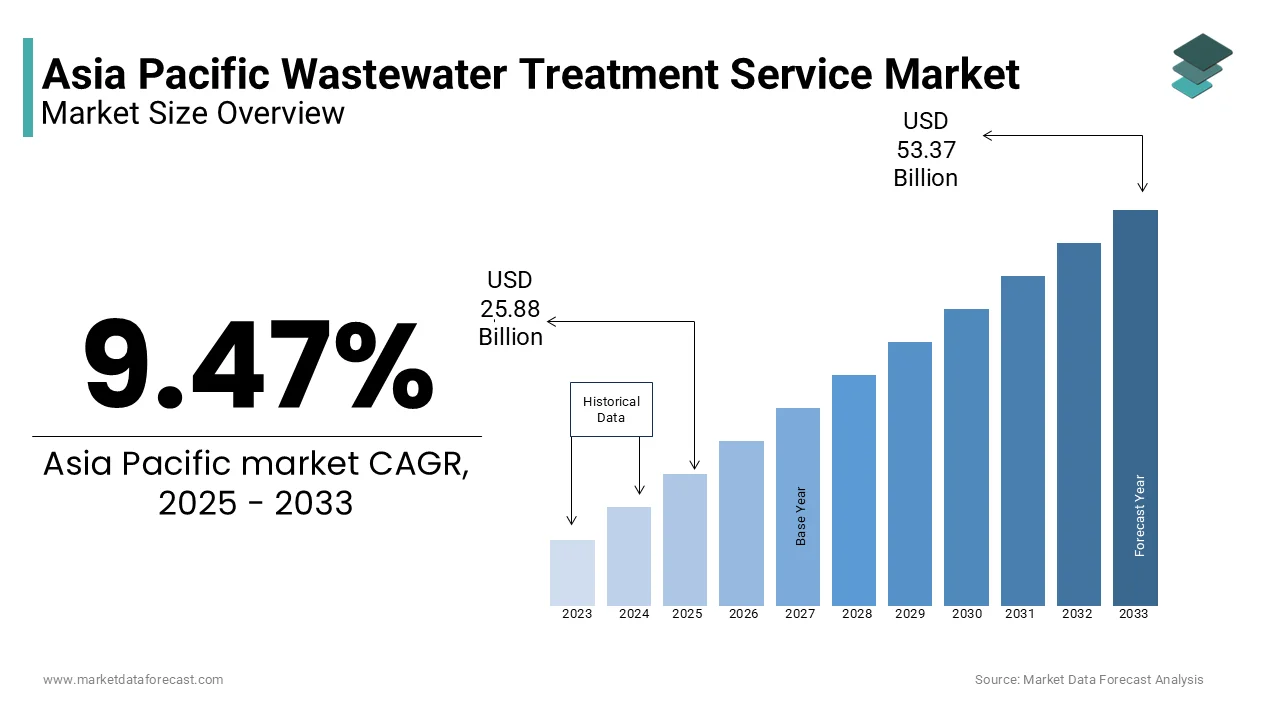
The Asia Pacific wastewater treatment service market was valued at USD 25.90 billion in 2025, is estimated to reach USD 28.35 billion in 2026, and is projected to reach USD 58.47 billion by 2034, growing at a CAGR of 9.47% during the forecast period. Market growth is driven by increasing water scarcity, stringent environmental regulations, and rising demand for efficient water reuse and recycling solutions. Rapid industrialization and urbanization across the region are generating higher volumes of wastewater, necessitating advanced treatment services. In addition, growing investments in infrastructure and sustainable water management practices are supporting strong market expansion.
Key Market Trends
- Rising water scarcity is driving demand for wastewater treatment and reuse solutions.
- Increasing regulatory pressure for water treatment and discharge standards is supporting market growth.
- Growing industrialization and urbanization are boosting wastewater generation.
- Expansion of water recycling and reuse initiatives is enhancing market development.
- Technological advancements in treatment processes are improving efficiency and performance.
Segmental Insights
- Based on type, the filtration segment was the largest and held 23.4% of the Asia Pacific wastewater treatment service market share in 2025. This dominance is attributed to its essential role in primary and secondary treatment processes across municipal and industrial applications.
- Based on technology, the secondary treatment segment accounted for 45.6% of the Asia Pacific wastewater treatment service market share in 2025. The segment’s growth is driven by its effectiveness in removing organic contaminants through biological treatment methods.
- Based on application, the municipal segment dominated with 54.9% of the Asia Pacific wastewater treatment service market share in 2025, supported by increasing urban population and rising demand for clean water infrastructure.
Regional Insights
- The Asia Pacific wastewater treatment service market is experiencing strong growth across key countries, supported by infrastructure development and regulatory frameworks.
- China was the largest contributor, accounting for 35.3% of the Asia Pacific wastewater treatment service market share in 2025, driven by large population base, rapid industrial growth, and significant investments in water treatment infrastructure.
Competitive Landscape
The Asia Pacific wastewater treatment service market is highly competitive, with key players focusing on technological innovation, service expansion, and strategic partnerships to strengthen their market position. Companies are investing in advanced treatment technologies, digital water solutions, and sustainable practices. Prominent players in the Asia Pacific wastewater treatment service market include Aquatech International Corporation, Danaher Corporation, Degremont SAS, GDF Suez S A, GE Water and Process Technologies, Veolia Environment SA, Xylem Inc, Kemira OYJ, The Dow Chemicals Company, and Ashland Water Technologies.
Asia Pacific Wastewater Treatment Service Market Size
The Asia Pacific wastewater treatment service market was valued at USD 25.90 billion in 2025 and is anticipated to reach USD 58.47 billion by 2034 from USD 28.35 billion in 2026. The market is predicted to register a CAGR of 9.47% during the forecast period.
The wastewater treatment service is to purify contaminated water before its release into the environment or reuse in industrial processes. This highly important for maintaining ecological balance and public health, across rapidly urbanizing nations, including China, India, Japan, and Australia. As per the United Nations Economic and Social Commission for Asia and Pacific, approximately 60% of the population in the region lacks access to safely managed sanitation services highlighting the urgent need for infrastructure development. Regulatory bodies in countries like Singapore and South Korea have implemented stringent discharge standards forcing industries to adopt advanced treatment technologies. The rise of industrial manufacturing hubs has increased the volume of complex effluents requiring specialized chemical and biological processing. Government initiatives aimed at achieving sustainable development goals drive investment in modernizing aging infrastructure. The integration of smart monitoring systems and Internet of Things devices enhances operational efficiency and compliance tracking. Water scarcity issues in arid regions further propel the adoption of water reuse and recycling services. The market dynamics are influenced by technological advancements in membrane bioreactors and reverse osmosis. Public private partnerships are becoming common models for funding large scale treatment plants.
MARKET DRIVERS
Rapid Urbanization and Industrial Expansion in Emerging Economies
The accelerating pace of urbanization and industrial expansion in emerging economies is propelling the growth of the Asia Pacific wastewater treatment service market. Countries, such as India, Vietnam, and Indonesia are experiencing massive migration of populations to urban centers leading to increased generation of municipal and industrial wastewater. According to the research, the urban population in East Asia is projected to reach 1 billion by 2030 with robust infrastructure to handle the resulting waste streams. Industrial zones specializing in textiles electronics and pharmaceuticals produce high volumes of complex effluents that require specialized treatment services to meet regulatory standards. The concentration of manufacturing activities in these regions creates a sustained demand for both construction of new treatment facilities and ongoing operational maintenance services. Governments are investing heavily in sewage networks and treatment plants to prevent environmental degradation and protect public health. The lack of adequate existing infrastructure in many developing cities presents a significant opportunity for service providers to establish long term contracts. Industrial parks are increasingly mandating centralized treatment facilities to ensure compliance with environmental laws. This structural shift towards organized industrial clusters drives the adoption of professional wastewater management solutions. The continuous growth of the middle class also increases domestic water consumption and subsequent wastewater generation.
Stringent Environmental Regulations and Compliance Mandates
The implementation of stringent environmental regulations and compliance mandates is also propelling the growth of Asia Pacific wastewater treatment service market. Governments, across the region are tightening discharge limits for pollutants such as heavy metals nitrogen and phosphorus to protect water bodies and ecosystems. According to the study, several countries have updated their environmental protection laws imposing heavier fines and penalties for non-compliance. China has enforced the Water Pollution Prevention and Control Law, which requires industries to install online monitoring systems and adhere to strict discharge standards. Similarly, India has mandated zero liquid discharge policies for certain polluting industries, such as textiles and distilleries. These regulatory pressures compel companies to engage professional service providers for efficient treatment and regular compliance reporting. The need for continuous monitoring and data submission drives demand for advanced analytical services and automated control systems. Regulatory frameworks also encourage the adoption of best available technologies to minimize environmental impact. Public awareness and activism regarding water pollution further pressure authorities to enforce laws rigorously. International agreements and sustainability goals adopted by national governments reinforce the commitment to cleaner water resources.
MARKET RESTRAINTS
High Capital Investment and Operational Costs
The requirement for high capital investment and substantial operational costs is impeding the growth of Asia Pacific wastewater treatment service market. Constructing advanced treatment facilities involves significant upfront expenditure on land equipment and technology which can be prohibitive for small and medium sized enterprises. Many developing nations in the region face budget constraints that limit their ability to invest in state of the art infrastructure. The high energy consumption of technologies, such as reverse osmosis and membrane bioreactors adds to the financial burden especially in countries with volatile electricity prices. Maintenance of sophisticated equipment requires specialized technical expertise which is often scarce and expensive in rural areas. The long payback period for wastewater treatment projects discourages private investment without government subsidies or guarantees. The lack of affordable financing options further hinders the adoption of compliant treatment solutions. Economic fluctuations and currency instability in some countries increase the risk for foreign investors and technology providers. These financial barriers slow down the modernization of wastewater infrastructure and limit the penetration of advanced services in price sensitive segments of the market.
Limited Technical Expertise and Infrastructure Gaps
The limited availability of technical expertise and existing infrastructure gaps is significantly hindering the growth of Asia Pacific wastewater treatment service market. Many regions lack the skilled workforce required to operate and maintain complex treatment systems effectively. According to the United Nations Educational Scientific and Cultural Organization, there is a shortage of trained engineers and technicians in the water sector, across several developing countries in Asia. This skills gap leads to inefficient operation frequent breakdowns and reduced lifespan of treatment facilities. The absence of comprehensive sewage collection networks in many urban and peri urban areas means that even if treatment plants are built they cannot function optimally due to lack of influent. Informal settlements often remain disconnected from central systems leading to untreated discharge into local water bodies. The fragmented nature of the industry with numerous small unregulated operators undermines quality standards and professional service delivery. Lack of standardized protocols and certification mechanisms further complicates the assessment of service quality. Rural areas face greater challenges due to dispersed populations and difficult terrain which increase the cost and complexity of infrastructure deployment. The reliance on outdated technologies in existing plants reduces treatment efficiency and compliance levels.
MARKET OPPORTUNITIES
Adoption of Zero Liquid Discharge and Water Reuse Technologies
The increasing adoption of zero liquid discharge and water reuse technologies is lucratively to pose new opportunities for the growth of Asia Pacific wastewater treatment service market. Water scarcity in regions such as Northern China India and Australia drives industries and municipalities to treat wastewater for reuse in cooling irrigation and process applications. According to the Global Water Intelligence the market for industrial water reuse is growing rapidly as companies seek to reduce freshwater intake and disposal costs. Zero liquid discharge systems allow facilities to recover nearly all water and valuable minerals from effluent turning waste into a resource. This approach aligns with circular economy principles and corporate sustainability goals. Governments are offering incentives and subsidies for projects that demonstrate high water recovery rates. The textile pharmaceutical and power generation sectors are early adopters of these technologies due to their high water intensity and regulatory pressure. Service providers who specialize in designing and operating ZLD plants can capture high value contracts. The technological advancement in membrane filtration and evaporation crystallization makes these systems more efficient and cost effective. The potential to sell recovered salts and minerals adds an additional revenue stream for operators. This shift towards resource recovery transforms wastewater treatment from a cost center to a value generating activity.
Integration of Digital Solutions and Smart Monitoring Systems
The integration of digital solutions and smart monitoring systems is another attribute to enhance growth of the Asia Pacific wastewater treatment service market. The adoption of Internet of Things sensors artificial intelligence and big data analytics enables real time monitoring of water quality and equipment performance. According to the International Water Association digital tools can reduce energy consumption by up to 20% and improve operational reliability through predictive maintenance. Smart platforms allow operators to detect leaks optimize chemical dosing and ensure compliance with discharge standards automatically. This technological transformation appeals to utilities and industries seeking to lower operational costs and enhance transparency. Governments are promoting smart city initiatives that include intelligent water management systems as a core component. Service providers can offer value added services such as remote diagnostics and data analytics consulting. The ability to provide actionable insights helps clients make informed decisions and optimize their treatment processes. Cybersecurity measures for these digital systems also create a niche market for specialized services. The scalability of cloud based solutions allows smaller facilities to access advanced management tools without heavy infrastructure investment. The trend towards digitalization enhances the competitiveness of service providers who can demonstrate superior efficiency and control. This technological evolution opens new revenue streams and strengthens customer relationships through continuous engagement.
MARKET CHALLENGES
Complexity of Industrial Effluents and Variable Quality
The complexity of industrial effluents and variable quality of incoming wastewater is one of the major challenges for the growth of Asia Pacific wastewater treatment service market. Industries, such as textiles tanneries and pharmaceuticals discharge wastewater containing a diverse mix of organic and inorganic pollutants heavy metals and toxic compounds. According to the United Nations Industrial Development Organization, treating such complex mixtures requires customized and often multi stage treatment processes which are difficult to standardize. The fluctuating composition of influent due to changes in production batches or seasonal variations complicates the operation of biological treatment systems. Shock loads of toxic substances can inhibit microbial activity leading to system failure and non-compliance. Service providers must constantly adjust operational parameters and chemical inputs to handle these variations, which increases complexity and cost. The lack of pre treatment at the source by industries exacerbates the problem placing a heavier burden on central treatment facilities. Developing robust treatment protocols that can handle wide variations requires advanced engineering and continuous monitoring. The risk of process upset due to unexpected contaminants poses a liability for service operators. Ensuring consistent treatment efficiency amidst such variability demands high levels of technical expertise and adaptive technology.
Inconsistent Regulatory Enforcement and Corruption Issues
Inconsistent regulatory enforcement and corruption issues is also to decline the growth of Asia Pacific wastewater treatment service market. While many countries have established comprehensive environmental laws the actual implementation and enforcement vary widely across regions and jurisdictions. This inconsistency creates an uneven playing field where compliant companies face higher costs compared to those who bypass regulations through illicit means. Weak monitoring capabilities and lack of transparency in data reporting allow violations to go undetected or unpunished. Local political interference can sometimes override environmental concerns in favor of rapid industrial development. This uncertainty discourages long term investment by reputable international service providers, who adhere to strict ethical and compliance standards. The lack of reliable legal recourse for contract disputes further increases business risks. Inconsistent enforcement undermines the credibility of regulatory frameworks and reduces the incentive for industries to invest in proper treatment infrastructure. Addressing these governance issues requires strong institutional reforms and greater civil society oversight.
REPORT COVERAGE
| REPORT METRIC | DETAILS |
| Market Size Available | 2025 to 2034 |
| Base Year | 2025 |
| Forecast Period | 2026 to 2034 |
| CAGR | 9.47% |
| Segments Covered | By Type, Technology, Application, and Region. |
| Various Analyses Covered | Global, Regional and Country Level Analysis, Segment-Level Analysis, DROC, PESTLE Analysis, Porter’s Five Forces Analysis, Competitive Landscape, Analyst Overview of Investment Opportunities |
| Regions Covered | India, China, Japan, South Korea, Australia, New Zealand, Thailand, Malaysia, Vietnam, Philippines |
| Market Leaders Profiled | Aquatech International Corporation, Danaher Corporation, Degremont SAS, GDF Suez S.A., GE Water & Process Technologies, Veolia Environment SA, Xylem Inc, Kemira OYJ, The Dow Chemicals Company, Ashland Water Technologies, and Others. |
SEGMENTAL ANALYSIS
By Type Insights
The filtration segment was the largest by holding 23.4% of the Asia Pacific wastewater treatment service market share in 2025 due to its role as a primary and secondary treatment step across various industrial and municipal applications. The process effectively removes suspended solids particulates and larger contaminants, which is essential for protecting downstream equipment and ensuring compliance with discharge standards. According to the study, industrial sectors such as textiles chemicals and food processing generate high volumes of effluent containing significant suspended solid loads that require robust filtration systems before further biological or chemical treatment. The widespread adoption of sand filtration membrane filtration and cartridge filtration technologies reflects the need for reliable and cost effective solutions. Regulatory frameworks in countries like China and India mandate strict limits on total suspended solids in discharged water driving industries to invest in advanced filtration services. The versatility of filtration allows it to be integrated into existing treatment plants with minimal disruption enhancing its appeal for retrofitting projects. Municipalities also rely on filtration to improve the clarity and quality of treated water before release into natural bodies. The continuous operation of industrial facilities necessitates regular maintenance and replacement of filter media creating a steady demand for ongoing services. This foundational requirement ensures that filtration remains the most utilized type of treatment service in the region.
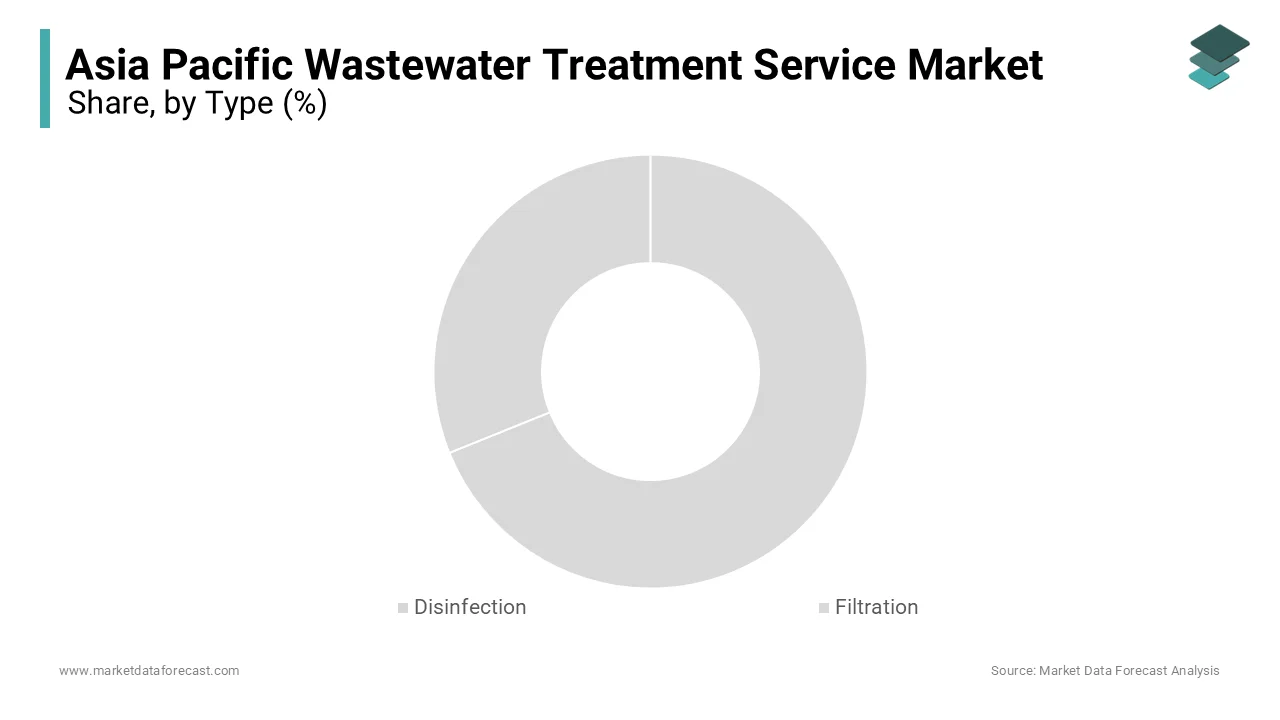
The disinfection segment is attributed to grow at an anticipated CAGR of 12.3% from 2026 to 2034 with the heightened public health concerns and stricter regulations regarding pathogen removal. The outbreak of infectious diseases has the importance of eliminating bacteria viruses and protozoa from treated wastewater to prevent waterborne illnesses. According to the World Health Organization, inadequate sanitation and contaminated water contribute to significant health burdens in developing nations prompting governments to enforce stricter disinfection protocols. Technologies, such as chlorination ultraviolet irradiation and ozonation are being widely adopted to ensure the safety of discharged water. Municipalities are upgrading their treatment facilities to include dedicated disinfection stages to meet new regulatory standards. The tourism and hospitality sectors, particularly in coastal areas are investing in advanced disinfection services to protect marine ecosystems and public beaches. Industrial facilities dealing with biological waste are also increasing their reliance on disinfection services to comply with environmental safety norms. The rising awareness among consumers about water quality drives demand for transparent and effective treatment processes. Governments are providing subsidies and technical assistance to help smaller municipalities implement disinfection systems.
By Technology Insights
The secondary treatment segment was accounted in holding 45.6% of the Asia Pacific wastewater treatment service market share in 2025 due to its effectiveness in removing dissolved and suspended organic matter through biological processes. This stage is essential for reducing the biochemical oxygen demand and chemical oxygen demand of wastewater to levels safe for environmental discharge. According to the United Nations Environment Programme, biological treatment methods, such as activated sludge trickling filters and rotating biological contactors are the most widely used technologies in municipal and industrial plants across the region. The ability of microorganisms to break down organic pollutants makes secondary treatment a cost effective and efficient solution for large volume applications. Regulatory standards in major economies like China Japan and South Korea mandate significant reduction in organic loads which secondary treatment reliably achieves. The maturity of these technologies means there is a vast pool of operational expertise and spare parts availability reducing maintenance costs. Municipalities prefer secondary treatment for its proven track record and reliability in handling fluctuating influent characteristics. Industrial sectors such as food and beverage and pulp and paper rely heavily on biological processes to treat high strength organic waste.
The primary treatment segment is likely to witness a fastest CAGR of is experiencing rapid growth in the Asia Pacific market particularly in developing nations where wastewater infrastructure is currently minimal or non existent. The initial step in establishing any wastewater management system is the installation of primary treatment facilities such as screens and sedimentation tanks to remove large solids. These greenfield projects prioritize primary treatment as a cost effective and immediate solution to reduce visible pollution and health hazards. The simplicity of primary treatment technology allows for quicker deployment and easier operation in areas with limited technical expertise. Governments are focusing on achieving basic sanitation goals under the Sustainable Development Goals which drives the construction of primary treatment units in rural and peri urban areas. The low capital requirement compared to secondary or tertiary systems makes it accessible for local municipalities with limited budgets. This foundational layer of treatment is essential before any advanced processing can be implemented. The sheer number of new projects starting from scratch contributes to a high compound annual growth rate for primary treatment services in these specific markets.
By Application Insights
The municipal segment was accounted in holding 54.9% of the Asia Pacific wastewater treatment service market share in 2025 due to the massive population growth and urgent need for urban sanitation in the region. Cities are expanding rapidly creating enormous volumes of domestic wastewater that require centralized treatment to protect public health and the environment. According to the United Nations Department of Economic and Social Affairs, the urban population in Asia is expected to increase by 1.2 billion people by 2050 placing immense pressure on existing infrastructure. Governments are prioritizing the construction and upgrade of municipal wastewater treatment plants to improve sanitation coverage and meet sustainable development goals. Major cities in China India and Indonesia are investing heavily in sewage networks and treatment facilities to address pollution in rivers and lakes. The scale of municipal projects is significantly larger than individual industrial installations contributing to the segment's dominance. Public funding and international aid are primarily directed towards municipal sanitation improvements. The social and political imperative to provide clean living environments drives continuous investment in this sector. Municipalities are also exploring water reuse for irrigation and landscaping which requires reliable treatment services.
The industrial segment is likely to register a fastest CAGR of 11.2% from 2026 to 2034 with the strict environmental regulations and the adoption of zero liquid discharge policies. Industries, such as textiles pharmaceuticals and electronics are under increasing pressure to minimize their environmental footprint and comply with stringent discharge limits. According to the study, new regulations require key industrial sectors to achieve near zero discharge of wastewater encouraging the adoption of advanced treatment and reuse technologies. The implementation of zero liquid discharge systems requires specialized services for design operation and maintenance driving rapid market growth. Industries are investing in closed loop water systems to recover valuable resources and reduce freshwater consumption. The complexity of industrial effluents necessitates customized treatment solutions which command higher service fees. Regulatory inspections and penalties for non-compliance are becoming more rigorous forcing industries to upgrade their treatment capabilities.
REGIONAL ANALYSIS
China Wastewater Treatment Service Market Analysis
China was the top performer in the Asia Pacific wastewater treatment service market by accounting 35.3% of share in 2025. The massive government investment in environmental protection and stringent enforcement of pollution control laws is escalating the growth of the Asia Pacific wastewater treatment service market. According to the Ministry of Ecology and Environment China has built over 10000 wastewater treatment plants with a total daily capacity exceeding 200 million cubic meters. The 14th Five Year Plan emphasizes the improvement of water quality in key river basins and the promotion of water reuse. The government's focus on ecological civilization has led to stricter discharge standards and increased penalties for violations. Investments in smart water management systems and membrane technologies are rising. The Yangtze River Protection Law mandates comprehensive treatment upgrades along the river basin. Public private partnerships are increasingly used to fund large scale projects. The demand for industrial wastewater treatment particularly in the chemical and textile sectors remains strong. China's commitment to carbon neutrality also drives energy efficient treatment solutions.
India Wastewater Treatment Service Market Analysis
India wastewater treatment service market held second position by holding 18.3% of share in 2025 with the significant infrastructure gaps and aggressive government initiatives to address sanitation and water pollution. The Namami Gange Program aims to clean the Ganges River through the construction of sewage treatment plants and interception diversion works. Drivers, include the rapid urbanization and the Swachh Bharat Mission which focuses on universal sanitation coverage. The government is promoting the use of treated wastewater for irrigation and industrial use to conserve freshwater. State governments are issuing tenders for new treatment plants and upgrading existing ones. The industrial sector particularly textiles and tanneries faces strict regulatory pressure to install effluent treatment plants. Private sector participation is encouraged through hybrid annuity models. The demand for decentralized treatment systems in smaller towns is growing. Awareness of water scarcity is driving interest in water reuse technologies.
Japan Wastewater Treatment Service Market Analysis
Japan wastewater treatment service market growth is likely to have significant opportunities throughput the forecast period with the advanced technology adoption high operational efficiency and a focus on sustainability. According to the research, Japan has a wastewater treatment coverage rate of over 90% in urban areas. The focus is shifting from basic treatment to advanced processes including nutrient removal and water reuse. The government promotes the concept of a recycling oriented society encouraging the recovery of resources from sludge such as biogas and phosphorus. Strict environmental standards drive the adoption of membrane bioreactors and advanced oxidation processes. The industrial sector emphasizes zero liquid discharge and water conservation. Smart water management systems are being integrated to optimize energy use and reduce operational costs. The aging population and shrinking workforce drive automation in treatment plants.
South Korea Wastewater Treatment Service Market Analysis
South Korea wastewater treatment service market growth is likely to grow with the high technological sophistication and strong government support for water quality improvement. According to the Ministry of Environment South Korea has achieved a wastewater treatment rate of over 90% in populated areas. The government promotes the use of smart water grids and real time monitoring systems. Industrial complexes are required to install advanced treatment facilities to meet strict discharge limits. The focus on water reuse for industrial and agricultural purposes is increasing. South Korea is a hub for water technology innovation with companies developing advanced membrane and desalination technologies. The government supports research and development in next generation treatment methods. Public awareness of water quality drives demand for transparent and efficient services.
Australia and New Zealand Wastewater Treatment Service Market Analysis
Australia and New Zealand wastewater treatment service market growth is propelled with the advanced regulatory frameworks and a focus on environmental sustainability. According to the Australian Bureau of Statistics, urban wastewater treatment coverage is nearly 100% with a focus on tertiary treatment and water reuse. The National Water Initiative promotes efficient water use and management. New Zealand focuses on protecting its pristine natural environments from agricultural and municipal runoff. Strict consent conditions under the Resource Management Act drive upgrades in treatment plants. The adoption of membrane technologies and advanced oxidation processes is common. Public private partnerships are used for large infrastructure projects. The industrial sector particularly mining and food processing requires specialized treatment services.
Thailand Wastewater Treatment Service Market Analysis
Thailand wastewater treatment service market growth is likely to grow with the increasing urbanization and government efforts to improve water quality in tourist areas and industrial zones. According to the Pollution Control Department, Thailand has expanded its wastewater treatment capacity but coverage remains low in many provinces. The tourism industry drives demand for high quality treatment in coastal areas to protect marine ecosystems. Industrial estates are required to have centralized wastewater treatment plants. The government is promoting public private partnerships to finance new projects. Water pollution in major rivers like the Chao Phraya is a concern driving remediation efforts. The adoption of decentralized treatment systems in communities is growing. International aid and loans support infrastructure development.
COMPETITIVE LANDSCAPE
The competition in the Asia Pacific wastewater treatment service market is characterized by the presence of global giants regional leaders and local specialized firms. International companies leverage their technological expertise and financial strength to secure large scale infrastructure projects. Regional players compete on local knowledge cost effectiveness and established relationships with government entities. The market is fragmented with numerous small operators serving niche segments or specific geographic areas. Differentiation is achieved through advanced technology offerings such as membrane bioreactors and smart water management systems. Price competition is intense in standardized municipal projects while specialized industrial treatments command higher margins. Regulatory compliance capabilities serve as a key competitive factor influencing client selection. Strategic alliances and joint ventures are common strategies to enhance market reach and share risks. Innovation in resource recovery and energy efficiency creates new avenues for competitive advantage. Customer service and operational reliability are critical for retaining long term contracts.
KEY MARKET PLAYERS
The following companies are playing dominating role in the Asia Pacific water and wastewater services market
- Aquatech International Corporation
- Danaher Corporation
- Degremont SAS
- GDF Suez S.A.
- GE Water & Process Technologies
- Veolia Environment SA
- Xylem Inc
- Kemira OYJ
- The Dow Chemicals Company
- Ashland Water Technologies
Top Players in the Market
- Veolia Environnement SA is a global leader in environmental services with a significant presence in the Asia Pacific wastewater treatment market. The company contributes to the global sector by providing integrated water management solutions that emphasize resource recovery and sustainability. It strengthens its market position through strategic partnerships with local governments and industries to modernize infrastructure. Recent actions include expanding its digital water solutions portfolio to enhance operational efficiency and reduce energy consumption. Veolia focuses on circular economy principles by recovering energy and nutrients from wastewater sludge. The organization invests in advanced technologies such as membrane bioreactors and reverse osmosis to meet stringent discharge standards. Its commitment to innovation and environmental stewardship attracts clients seeking sustainable wastewater management. Veolia also provides comprehensive operation and maintenance services ensuring long term performance of treatment facilities.
- Suez SA is a major player in the Asia Pacific wastewater treatment service market known for its innovative technologies and comprehensive service offerings. The company contributes to the global market by developing smart water solutions that optimize treatment processes and reduce environmental impact. It strengthens its position through collaborations with municipal authorities and industrial clients to implement customized wastewater management strategies. Recent actions involve investing in digital platforms that enable real time monitoring and predictive maintenance of treatment plants. Suez emphasizes the importance of water reuse and recycling to address scarcity issues in the region. The company offers a range of services from design and construction to operation and maintenance of wastewater facilities. Its focus on sustainability aligns with regulatory requirements and corporate social responsibility goals. Suez also engages in research and development to create next generation treatment technologies.
- Doosan Heavy Industries and Construction Co Ltd is a prominent engineering and construction company with strong capabilities in the Asia Pacific wastewater treatment sector. The company contributes to the global market by executing large scale water infrastructure projects using advanced engineering techniques. It strengthens its market position through the development of proprietary technologies for desalination and wastewater treatment. Recent actions include securing contracts for major municipal and industrial wastewater projects in South Korea and Southeast Asia. Doosan focuses on delivering high quality EPC services that ensure timely completion and cost effectiveness. The company integrates smart automation systems into its treatment plants to improve operational efficiency. Its expertise in complex engineering challenges makes it a preferred partner for government and private sector clients. Doosan also prioritizes environmental compliance and sustainability in its project designs.
Top Strategies Used by Key Market Participants
Key players in the Asia Pacific wastewater treatment service market employ technological innovation strategies to enhance treatment efficiency and compliance. Companies invest in advanced membrane technologies and digital monitoring systems to optimize operations. Strategic partnerships with local governments and industries facilitate market entry and project execution. Sustainability initiatives focus on resource recovery and energy neutrality to align with environmental goals. Expansion into emerging markets through joint ventures and acquisitions drives growth and diversification. Service providers emphasize operational excellence and maintenance support to ensure long term client relationships. Customized solutions address specific industrial and municipal needs enhancing value propositions. Regulatory compliance expertise helps clients navigate complex legal frameworks effectively. Investment in research and development fosters continuous improvement and competitive advantage. These strategies enable participants to capture opportunities and mitigate risks in a dynamic environment.
MARKET SEGMENTATION
This research report on the Asia Pacific water and wastewater service market has been segmented and sub-segmented based on the following categories.
By Type
- Disinfection
- Filtration
By Technology
- Primary
- Secondary
By Application
- Industrial
- Municipal
By Country
- India
- China
- Japan
- South Korea
- Australia
- New Zealand
- Thailand
- Malaysia
- Vietnam
- Philippines
- Indonesia
- Singapore