- Product Description Description
- Table of Contents TOC
- List of Table & Figure LOT
- Get Free Sample PDF Sample PDF
Market Size, 2025
$12.92 BnMarket Estimate, 2026
$13.80 BnMarket Forecast, 2034
$23.45 BnCAGR, 2026–2034
6.85%Asia Pacific Water Heater Market Size
The Asia Pacific water heater market was valued at USD 12.92 billion in 2025, is estimated to reach USD 13.80 billion in 2026, and is projected to reach USD 23.45 billion by 2034, growing at a CAGR of 6.85% from 2026 to 2034
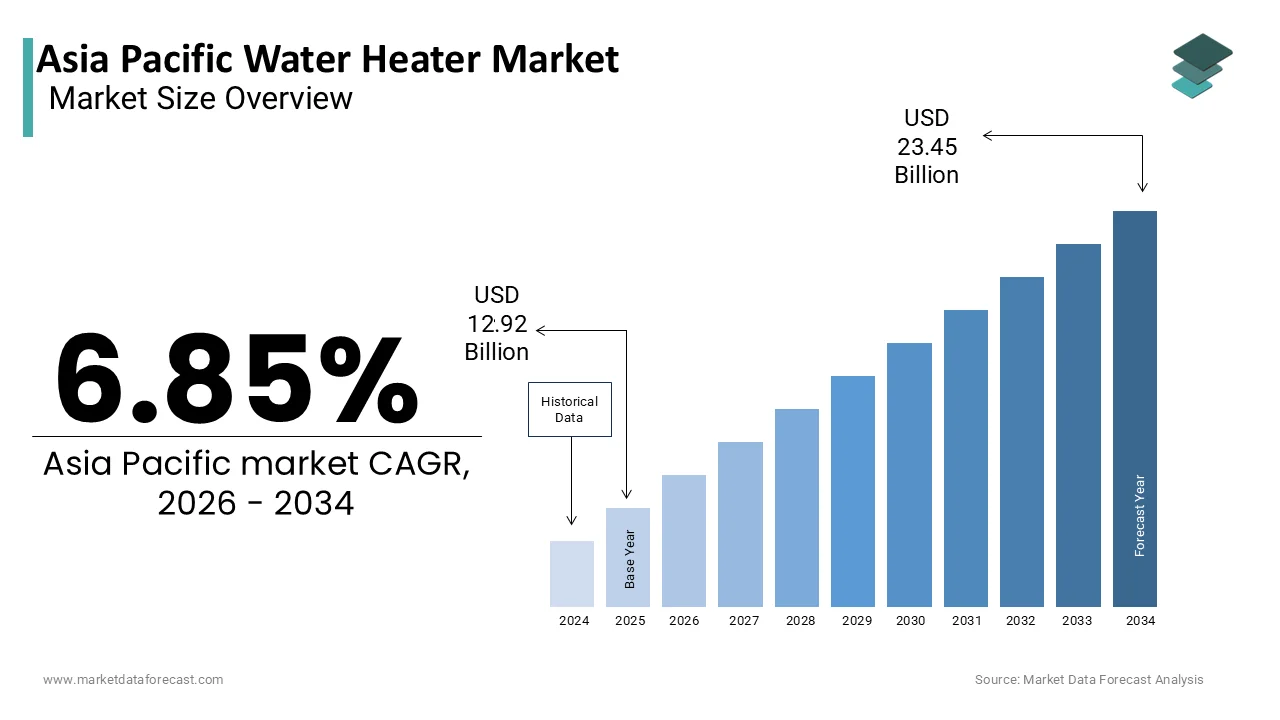
The Asia Pacific water heater market encompasses a diverse range of residential, commercial, and industrial heating systems designed to provide hot water for domestic and institutional use. The market includes both storage and tankless (instantaneous) water heaters powered by electricity, gas, solar energy, and heat pump technologies. As urbanization accelerates and disposable incomes rise across the region, there is a growing demand for comfort-oriented appliances, including advanced water heating solutions.
According to the Asian Development Bank, over 60% of the global population resides in the Asia Pacific region, with rapid migration to urban centers fueling housing and infrastructure development. Apart from these, increasing awareness of energy efficiency and environmental sustainability has prompted governments and consumers to favor eco-friendly alternatives such as solar and heat pump water heaters.
MARKET DRIVERS
Rapid Urbanization and Housing Expansion
Urbanization across the Asia Pacific region is one of the most significant catalysts driving the water heater market. According to the United Nations Department of Economic and Social Affairs, the region’s urban population is expected to grow by more than 1.2 billion people between 2020 and 2050. This unprecedented expansion has led to increased investments in residential infrastructure, especially in developing economies such as India, Bangladesh, and the Philippines.
Moreover, urban dwellers increasingly expect convenience and comfort, leading to higher adoption rates of instant water heaters and high-efficiency models. In China, despite a slowing property market, urban household formation continues to drive demand, with the China National Light Industry Council noting a 6% year-over-year growth in premium water heater sales in major cities.
These trends indicate that sustained urban expansion will continue to be a key driver for the water heater market in the Asia Pacific.
Rising Consumer Awareness Toward Energy Efficiency
Growing awareness regarding energy conservation and environmental impact has significantly influenced consumer preferences in the Asia Pacific water heater market.
In Japan, as per the Ministry of Economy, Trade and Industry, over 65% of newly purchased water heaters in 2025featured heat pump technology, known for its ability to reduce energy consumption by up to 60% compared to conventional electric models. Similarly, in South Korea, the Korea Energy Economics Institute notes a 24% increase in sales of high-efficiency gas and hybrid water heaters since 2021 due to national energy-saving campaigns.
India’s Bureau of Energy Efficiency introduced star labeling for water heaters in 2022, encouraging buyers to opt for products with higher energy ratings. As a result, companies like AO Smith and Racold have reported a surge in demand for their BEE-certified models. This shift toward energy-conscious purchasing behavior is reshaping the market landscape, reinforcing the long-term growth potential of efficient water heating technologies.
MARKET RESTRAINTS
High Upfront Costs of Advanced Water Heating Systems
The high initial investment required for energy-efficient and technologically advanced systems is one of the primary barriers impeding the widespread adoption of modern water heaters in the Asia Pacific region. While innovations such as heat pumps, solar, and condensing water heaters offer long-term cost savings and environmental benefits, their upfront expenses remain prohibitive for many consumers, particularly in emerging economies. In countries like Vietnam and Bangladesh, where affordability remains a key concern, this price disparity discourages low- and middle-income households from upgrading to more sustainable options.
Regulatory Fragmentation Across Regional Markets
Regulatory inconsistencies across Asia Pacific nations pose a significant challenge for water heater manufacturers and distributors seeking to scale operations efficiently. Unlike the European Union, which maintains unified standards for energy efficiency and safety, the Asia Pacific region lacks harmonized regulatory frameworks, making compliance complex and costly.
In Australia, the Greenhouse and Energy Minimum Standards (GEMS) Act mandates stringent efficiency requirements for imported water heaters, while in India, the Bureau of Energy Efficiency enforces star rating norms that vary by technology type. Meanwhile, countries like Thailand and the Philippines lack comprehensive national standards, leading to inconsistent enforcement and quality control issues.
According to a report by the ASEAN Centre for Energy, the absence of standardized testing procedures and labeling systems across member states delays product approvals and increases operational overhead for multinational manufacturers. In contrast, Japan and South Korea maintain highly structured certification processes but impose additional compliance burdens on foreign suppliers.
MARKET OPPORTUNITIES
Expansion of Smart Water Heater Technology
The emergence of smart water heater technology presents a transformative opportunity for the Asia Pacific market. These intelligent systems incorporate IoT connectivity, real-time monitoring, remote control via mobile applications, and AI-driven energy optimization—features that align with the region’s growing digital transformation and smart home adoption.
In countries like Singapore and South Korea, where smart city initiatives are well-established, consumers are rapidly adopting connected water heating solutions that enhance convenience and energy efficiency.
In India, as per the Ministry of Electronics and Information Technology, smart home appliance sales surged by 25% in FY2023, with major brands such as Havells and AO Smith launching Wi-Fi-enabled water heaters tailored for urban consumers. Similarly, in China, as per the China Internet Network Information Center, over 40% of urban households now own at least one smart home device, creating a conducive environment for smart water heater integration. With advancements in cloud computing and edge analytics, manufacturers are also exploring predictive maintenance features that reduce service disruptions and extend product lifecycles.
Government Incentives for Renewable Energy-Based Water Heating Systems
Government-backed incentives for renewable energy-based water heaters represent a significant growth avenue in the Asia Pacific market. Policymakers across the region are promoting solar, heat pump, and biomass-powered water heating systems through subsidies, tax exemptions, and mandatory installation policies to curb carbon emissions and reduce reliance on fossil fuels. India’s Ministry of New and Renewable Energy launched the Solar Water Heater Mission in 2022, offering capital subsidies and net metering facilities to encourage residential and institutional users. The initiative led to a rise in solar water heater installations in Tier-II and Tier-III cities within two years.
MARKET CHALLENGES
Supply Chain Disruptions and Raw Material Shortages
Supply chain instability has emerged as a critical challenge for the Asia Pacific water heater industry, impacting production timelines and cost structures. The sector relies heavily on components such as copper coils, stainless steel tanks, electronic controllers, and refrigerants—many of which have faced procurement difficulties due to global trade bottlenecks and geopolitical tensions. In India, the Confederation of Indian Industry reported a 20% increase in raw material costs, particularly for copper and aluminum, disrupting profit margins for mid-sized producers. Moreover, logistics constraints, including port congestion and freight cost surges, have further complicated distribution networks. These disruptions not only inflate operational expenses but also delay product availability, eroding consumer confidence.
Lack of Skilled Technicians for Installation and Maintenance
A persistent shortage of trained professionals for water heater installation and servicing is hindering market growth across the Asia Pacific region. As product complexity increases with the introduction of smart, hybrid, and renewable energy-based systems, the demand for skilled technicians capable of handling advanced technologies has outpaced workforce development efforts.
India’s National Skill Development Corporation identifies plumbing and heating system servicing as one of the top sectors facing labor shortages, with only 25% of available workers trained in energy-efficient equipment handling. This deficiency results in higher repair costs, reduced customer satisfaction, and slower adoption rates.
REPORT COVERAGE
| REPORT METRIC | DETAILS |
| Market Size Available | 2025 to 2034 |
| Base Year | 2025 |
| Forecast Period | 2026 to 2034 |
| Segments Covered | By Product, Capacity, Application, and Region. |
| Various Analyses Covered | Global, Regional, and Country-Level Analysis, Segment-Level Analysis, Drivers, Restraints, Opportunities, Challenges; PESTLE Analysis; Porter’s Five Forces Analysis, Competitive Landscape, Analyst Overview of Investment Opportunities |
| Countries Covered | India, China, Japan, South Korea, Australia, New Zealand, Thailand, Malaysia, Vietnam, Philippines, Indonesia, Singapore, Rest of APAC |
| Market Leaders Profiled | A. O. Smith Corporation, Rheem Manufacturing Company, Haier Group Corporation, Bradford White Corporation, Rinnai Corporation, Ariston Thermo Group, Noritz Corporation, Bajaj Electricals Ltd., Havells India Ltd., and Venus Home Appliances Pvt. Ltd. |
SEGMENTAL ANALYSIS
By Product Insights
The storage water heaters segment dominated the Asia Pacific water heater market by capturing 62.6% of total revenue in 2024. This segment includes both electric and gas-powered models that store and maintain hot water in insulated tanks for continuous supply, making them suitable for a wide range of residential and commercial applications.
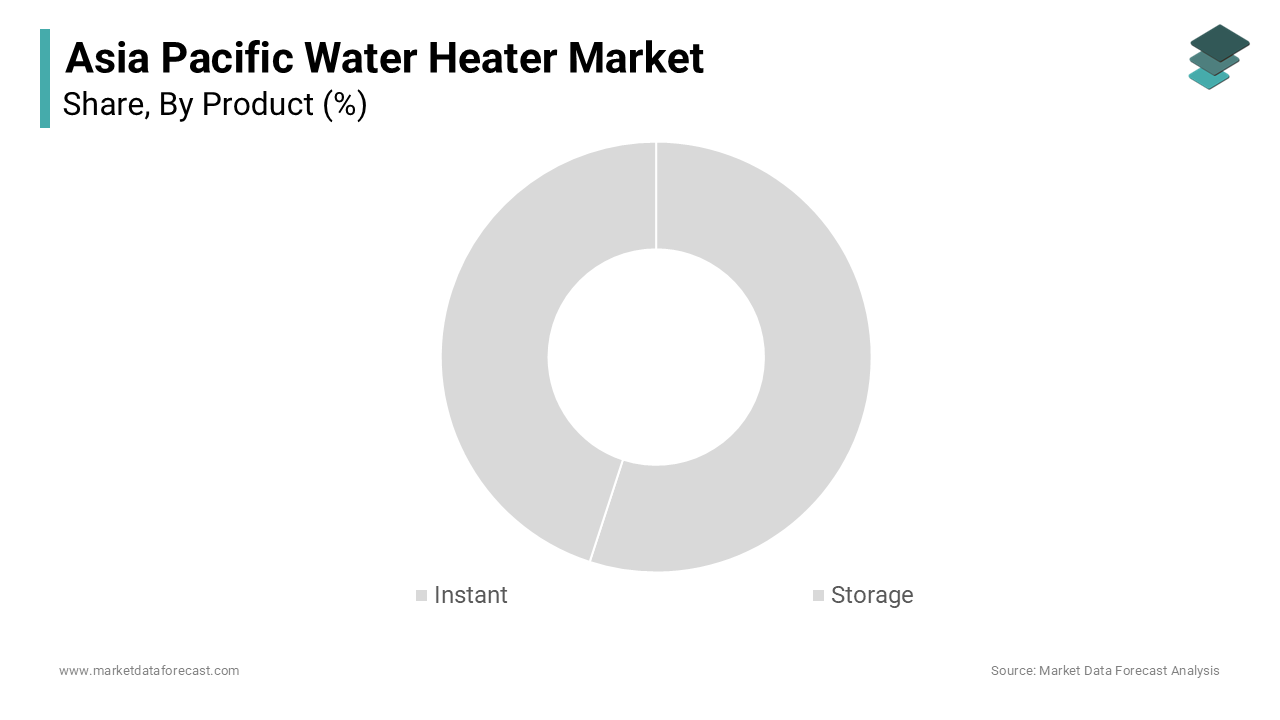
In India, as per the Bureau of Energy Efficiency, nearly 70% of households prefer storage units, especially in regions where water pressure and electricity supply are inconsistent, as these systems ensure hot water availability even during intermittent power outages.
In Australia, as per the Clean Energy Council, storage water heaters remain the most common type in multi-family housing developments, particularly in New South Wales and Queensland, where they are often integrated with off-peak electricity tariffs to reduce running costs. Despite growing interest in instant models, the entrenched preference for storage systems—especially among budget-conscious consumers—continues to solidify its position as the dominant product category.
The instant water heaters segment, also known as tankless or on-demand water heaters, represents the fastest-growing segment in the Asia Pacific market and is projected to expand at a CAGR of 9.8% from 2025 to 2033. These units heat water directly without the need for a storage tank, offering greater energy efficiency and space-saving advantages, which appeal to modern urban dwellers.
As per the Japan Refrigeration and Air Conditioning Industry Association (JRAIA), over 1.2 million instant water heaters were installed in Japan in 2023, driven by strong government support for energy-efficient appliances and rising consumer demand for compact living solutions. In South Korea, the Korea Gas Safety Corporation notes that tankless gas water heaters accounted for more than 45% of new installations in 2023, particularly in apartment complexes where real estate optimization is crucial.
Besides, in Southeast Asia, as per the ASEAN Centre for Energy, countries like Vietnam and Thailand have seen a 17% annual growth in instant water heater adoption since 2021, fueled by rapid urbanization and improved access to piped gas infrastructure.
By Application Insights
The residential shower application segment led the Asia Pacific water heater market in 2024. Hot water usage for personal hygiene remains the most fundamental requirement in households, driving extensive adoption of water heating systems across diverse income groups. In Japan, as per the Japan Sanitary Equipment Industry Association, nearly 85% of households use water heaters for bathing, with a strong cultural emphasis on hot tub-style showers contributing to high penetration rates. With expanding middle-class populations and increasing disposable incomes, the demand for comfort-oriented bathing experiences continues to reinforce the dominance of the residential shower application segment.
The residential dishwashing application segment is emerging as the fastest-growing within the Asia Pacific water heater market and is anticipated to grow at a CAGR of 10.3% through 2033. As modern lifestyles evolve and household automation gains traction, there is a noticeable shift toward convenience-driven kitchen appliances, including automated dishwashers that require a reliable hot water supply.
In China, as per the China Household Electrical Appliances Association, major appliance manufacturers have introduced energy-efficient dishwashers integrated with smart water heating controls, boosting demand in Tier-I and Tier-II cities. This trend shows a growing convergence between kitchen appliances and water heating technology, positioning dishwashing as a key growth driver in the residential application landscape.
By Capacity Insights
The 30–100 liters capacity segment held the largest share of the Asia Pacific water heater market with 48% of total unit sales in 2024. This range is ideal for small to medium-sized households, providing sufficient hot water for daily needs such as bathing, dishwashing, and laundry without excessive energy consumption. In Australia, the Clean Energy Council highlights that the majority of single-family homes opt for water heaters in this range, especially when paired with off-peak electricity tariffs to optimize cost savings.
The 100–250 liters capacity segment is the fastest-growing in the Asia Pacific water heater market and is expected to expand at a CAGR of 11.2% from 2025 to 2033. This range caters to larger households, multi-generational families, and small commercial establishments such as guesthouses, salons, and restaurants, where higher hot water demand necessitates more robust systems. According to the China National Light Industry Council, sales of 100–250-liter water heaters grew by 13% in 2023, particularly in second-tier cities where family sizes are relatively large,r and homeowners seek long-term durability and performance. In Vietnam, the Vietnam Association of Building Materials and Construction Industries notes that this capacity range is increasingly preferred in newly developed townships and mid-range hotels, aligning with the country's booming hospitality sector.
REGIONAL ANALYSIS
China Water Heater Market Insights
China led the Asia Pacific water heater market by contributing 32.6% of total regional revenue in 2024. As the world’s most populous country with a rapidly expanding urban middle class, China represents a vast consumer base for both residential and commercial water heating solutions. Moreover, the Ministry of Housing and Urban-Rural Development has mandated energy efficiency standards for water heaters used in new buildings, encouraging the adoption of high-efficiency electric and gas models. With ongoing smart city initiatives and increasing consumer preference for digital and connected appliances, China remains a pivotal growth engine for the regional water heater industry.
India Water Heater Market Insights
India is a key player in the Asia Pacific water heater market. The country’s growing urbanization, rising disposable incomes, and increasing awareness of comfort appliances have collectively fueled strong demand for water heating systems.
As per the India Brand Equity Foundation, leading brands such as AO Smith, Racold, and Havells have expanded their distribution networks to tier-two and tier-three cities, where demand is surging.
Further, the Bureau of Energy Efficiency launched star labeling for water heaters in 2022, promoting energy-conscious purchasing behavior. With government-backed initiatives and aggressive private-sector investments, India is positioned to sustain robust growth in the water heater market.
Japan Water Heater Market Insights
Japan is distinguished by its technological leadership and early adoption of advanced heating solutions. The country serves as a hub for innovation, with companies like Panasonic, Daikin, and Mitsubishi Electric pioneering eco-friendly and smart water heating technologies.
According to the Japan Sanitary Equipment Industry Association, over 1.2 million instant water heaters were sold in Japan in 2023, with more than 60% featuring condensing or hybrid heat pump technology. The Ministry of Economy, Trade, de and Industry mandates strict energy efficiency standards, ensuring that only high-performance models reach the market. Furthermore, Japan leads in hydrogen-compatible and solar-integrated water heating systems, aligning with national decarbonization goals.
South Korea Water Heater Market Insights
South Korea is characterized by a strong regulatory push toward energy efficiency and digital integration. The country has been proactive in enforcing green building codes and promoting smart home technologies, which have significantly influenced water heater adoption patterns. According to the Korea Gas Safety Corporation, over 45% of new residential installations in 2025involved tankless gas water heaters, favored for their compact design and energy efficiency. Moreover, the Smart City initiative in Seoul mandates the inclusion of IoT-enabled water heating systems in new apartment complexes, enabling remote control and adaptive temperature management.
Australia Water Heater Market Insights
Australia is marked by a strong emphasis on sustainability and regulatory compliance. The country’s water heater sector is shaped by ambitious net-zero targets and evolving building codes that favor energy-efficient and renewable-powered systems. The Australian Competition and Consumer Commission notes that heat pump water heaters are gaining traction, particularly in multi-residential developments where a centralized hot water supply is essential.
KEY MARKET PLAYERS AND COMPETITIVE LANDSCAPE
A. O. Smith Corporation, Rheem Manufacturing Company, Haier Group Corporation, Bradford White Corporation, Rinnai Corporation, Ariston Thermo Group, Noritz Corporation, Bajaj Electricals Ltd., Havells India Ltd., and Venus Home Appliances Pvt. Ltd.
The Asia Pacific water heater market is characterized by intense competition driven by a mix of global giants, regional powerhouses, and emerging local brands vying for market share. Established multinational corporations leverage their technological expertise, brand recognition, and financial strength to maintain dominance, particularly in urban and developed markets. At the same time, domestic manufacturers capitalize on cost advantages, localized supply chains, and tailored marketing strategies to cater to rural and semi-urban consumers.
Innovation remains a central battleground, with companies racing to introduce energy-efficient, smart-connected, and eco-friendly water heating solutions. As governments across the region tighten energy efficiency standards and promote renewable energy adoption, manufacturers are under pressure to align their product portfolios with sustainability goals. Besides, the growing trend toward smart homes and connected appliances has prompted industry leaders to incorporate IoT-enabled controls and predictive maintenance features into their offerings.
Market participants are also strengthening their foothold through strategic expansions, mergers, and joint ventures, especially in high-growth economies like India, Indonesia, and Vietnam. With rising disposable incomes and increasing awareness of comfort-driven living, the competition is expected to intensify further as companies seek to differentiate themselves through superior performance, customer service, and environmental responsibility.
Top Players in the Asia Pacific Water Heater Market
A. O. Smith Corporation
A. O. Smith is a global leader in water heating technology and holds a dominant position in the Asia Pacific market, particularly in China and India. The company has built a strong reputation for its high-efficiency electric and gas water heaters that combine durability with advanced features. A. O. Smith's innovation in heat pump and tankless technologies has positioned it at the forefront of sustainable solutions. Its localized manufacturing units and strategic partnerships have significantly enhanced its regional footprint.
Midea Group
Midea is a leading Chinese home appliance manufacturer with a substantial presence in the Asia Pacific water heater market. Known for its cost-effective yet reliable products, Midea offers a wide range of electric and gas-powered water heaters tailored to diverse consumer needs. The company leverages its robust R&D capabilities and digital transformation initiatives to enhance product performance and user experience. Midea’s brand portfolio includes both domestic and international labels, strengthening its market reach across the region.
Haier Smart Home Co., Ltd.
Haier is a globally recognized brand with deep penetration in the Asia Pacific water heater market. The company excels in integrating smart technology into its water heating systems, offering consumers intelligent control and energy-saving features. Haier’s commitment to innovation, combined with its customer-centric approach, has enabled it to maintain a competitive edge. Through continuous product development and strategic acquisitions, Haier continues to expand its influence across residential and commercial applications.
Top Strategies Used by Key Market Participants
One major strategy employed by key players in the Asia Pacific water heater market is product innovation and technological advancement, focusing on energy efficiency, smart connectivity, and sustainability. Companies are investing heavily in R&D to develop next-generation water heaters that meet evolving consumer expectations and regulatory requirements.
Another crucial approach is expanding local production and distribution networks, allowing manufacturers to better serve regional markets with customized offerings, faster delivery, and improved after-sales service. This localization strategy also helps reduce costs and improve responsiveness to market dynamics.
Lastly, strategic collaborations and brand diversification play a vital role in strengthening market presence. Leading companies are forming alliances with real estate developers, utility providers, and government agencies to integrate their products into new housing and infrastructure projects while leveraging multiple brand portfolios to capture different consumer segments effectively.
RECENT MARKET DEVELOPMENTS
- In May 2024, A. O. Smith launched an AI-integrated smart water heater platform in China designed to offer real-time temperature control, energy consumption tracking, and remote access via mobile applications, reinforcing its leadership in intelligent water heating solutions.
- In March 2024, Midea expanded its manufacturing facility in Thailand to increase production capacity and streamline supply chain operations, aiming to strengthen its presence in Southeast Asia and respond more efficiently to regional demand fluctuations.
- In February 2024, Haier Smart Home announced a partnership with a leading Indian real estate developer to pre-install smart water heaters in all upcoming residential projects across major metropolitan cities, enhancing brand visibility and customer acquisition.
- In July 2024, Daikin introduced a hybrid solar-electric water heater model tailored for off-grid and semi-urban households in Indonesia, targeting the growing demand for sustainable and cost-effective hot water solutions.
- In September 2024, AO Smith collaborated with a Vietnamese energy agency to promote energy-efficient water heaters through subsidized programs aimed at low-income families, supporting broader electrification and climate-conscious initiatives in the country.
MARKET SEGMENTATION
This research report on the Asia Pacific Water Heater Market has been segmented and sub-segmented into the following categories.
By Product
- Instant
- Storage
By Capacity
- 30 liters
- 30 – 100 liters
- 100 – 250 liters
- 250 – 400 liters
- >400 liters
By Application
- Residential
- Shower
- Dishwashing
- Washing Machine
- Others
- Commercial
By Country
- India
- China
- Japan
- South Korea
- Australia
- New Zealand
- Thailand
- Malaysia
- Vietnam
- Philippines
- Indonesia
- Singapore
- Rest of APAC