- Product Description Description
- Table of Contents TOC
- List of Table & Figure LOT
- Get Free Sample PDF Sample PDF
Market Size, 2025
$85.47 BnMarket Estimate, 2026
$89.41BnMarket Forecast, 2034
$128.22 BnCAGR, 2026–2034
4.61%Executive Summary: Asia Pacific Wire and Cable Market
- Market Scope: Comprehensive regional Asia-Pacific wire and cable market analysis covering voltage segments, installation types, end-use sectors, country-level leadership frameworks, and electrical infrastructure metrics.
- Market Valuation: Valued at USD 85.47 billion (2025 base year), estimated at USD 89.41 billion (2026), and projected to reach USD 128.22 billion by 2034, registering a steady CAGR of 4.61% (2026–2034).
- Primary Growth Drivers: Renewable-energy infrastructure expansion, grid modernization, smart-city initiatives, EV charging networks, 5G deployment, and fiber-optic expansion. Key infrastructural and regional highlights include Indonesia’s 35,000 MW fast-track electrification program supporting distribution-cable demand, and strategic projects like Prysmian installing 132 kV submarine cables for South Korea’s Buan offshore wind farm alongside Hengtong developing advanced 500 kV XLPE cables.
Key Market Segment Metrics (2026–2034)
| Category | Leading Segment (2025 Position) | Fastest-Growing Segment |
|---|---|---|
| By Voltage Segment | Low-Voltage Cables (dominated with 52.5% of total demand in 2025) | Extra-High-Voltage (EHV) Cables (projected to grow at a robust 9.8% CAGR) |
| By Installation Type | Overhead Cables (led installation segment with a 62.1% share in 2025) | Underground Cables (forecasted to grow at a 10.3% CAGR) |
| By End-Use Sector | Energy & Power (accounted for 44.7% of total demand by end use in 2025) | IT & Telecommunication (fastest-growing category with an 11.2% CAGR) |
| By Country / Region | China (led the regional market with a 35.3% share in 2025) | Southeast Asian Electrification & Grid Modernization Hubs (e.g., Indonesia) |
Major Market Players & Market Structure
Market Structure: Highly competitive Asia-Pacific electrical equipment and cable manufacturing landscape featuring major global enterprises competing intensely on localized production, fire-resistant and recyclable materials, IoT-enabled cable monitoring, EV charging infrastructure, offshore wind projects, and high-performance data-center applications.
Key Companies: Prysmian SpA, Nexans, NKT A/S, Belden, Fujikura, Leoni, Sumitomo, and Furukawa Electric.
Asia Pacific Wire and Cable Market Size
Asia Pacific wire and cable market size was valued at USD 85.47 billion in 2025, and the market size is expected to reach USD 128.22 billion by 2034 from USD 89.41 billion in 2026. The market's promising CAGR for the predicted period is 4.61%.
Wire and cable is designed to transmit electrical power and communication signals across residential, commercial, industrial, and infrastructure applications. Characterized by diverse product categories—including power cables, control cables, fiber optics, and building wires—this sector serves as the nervous system of modern electrification and digital connectivity. The region’s escalating energy demands, coupled with rapid urbanization and industrial modernization, have intensified the need for reliable, high-performance cabling solutions. With governments prioritizing energy access, digital infrastructure, and sustainable development, the wire and cable ecosystem is evolving to meet higher safety, efficiency, and environmental standards.
 MARKET DRIVERS
Expansion of Renewable Energy Infrastructure and Grid Modernization Initiatives
The large-scale deployment of renewable energy projects and the concurrent modernization of national power grids to accommodate decentralized generation is a pivotal driver of the Asia Pacific wire and cable market. Solar and wind farms, which require extensive cabling for interconnecting turbines, inverters, and substations, are proliferating across the region. These installations demand specialized medium-voltage (MV) and low-voltage (LV) cables resistant to UV radiation, moisture, and thermal cycling. Additionally, offshore wind developments in Taiwan and South Korea require subsea cables capable of withstanding marine environments, creating a niche but high-value segment. These developments collectively position the wire and cable industry as a foundational enabler of the region’s energy transition.
Surge in Urban Infrastructure and Smart City Development
The region-wide acceleration of urban infrastructure and smart city initiatives, which demand extensive electrical and data cabling for buildings, transportation systems, and digital networks. Governments across Asia Pacific are investing heavily in integrated urban ecosystems that rely on interconnected electrical and communication infrastructures. The rise of high-rise commercial and residential complexes also contributes, as modern buildings incorporate Building Management Systems (BMS) requiring extensive low-voltage cabling. These urban transformations are fundamentally reshaping the demand landscape for advanced, fire-resistant, and data-capable cabling solutions.
MARKET RESTRAINTS
Volatility in Raw Material Prices, Particularly Copper and Aluminum
The persistent volatility in prices of key raw materials, especially copper and aluminum, which constitute a notable share of production costs for most cable manufacturers, is a major restraint affecting the Asia Pacific wire and cable market. This cost instability forces manufacturers to either absorb margins or delay project quotations, disrupting procurement cycles. Aluminum, though cheaper, is also subject to price swings. These fluctuations are compounded by logistical bottlenecks—such as port congestion in Shanghai and Singapore—which extend lead times and increase inventory holding costs. Moreover, the reliance on imported refined metals exposes regional manufacturers to currency exchange risks, especially in countries like India and the Philippines. This material cost unpredictability undermines long-term planning and discourages investment in capacity expansion, constraining market stability.
Proliferation of Substandard and Non-Compliant Cables in Price-Sensitive Markets
The widespread circulation of substandard and non-certified cables, particularly in developing economies where procurement is driven by cost rather than performance or safety, is a critical impediment to sustainable market growth. These counterfeit or inferior products are often manufactured using recycled copper with inconsistent conductivity or polyvinyl chloride (PVC) sheathing that emits toxic fumes when burned. The problem is exacerbated by weak enforcement of quality regulations and a preference for lowest-bid procurement in public infrastructure tenders. These failures not only compromise safety but also increase lifecycle costs due to frequent replacements and downtime. Despite efforts by standards bodies such as Singapore’s SPRING and Japan’s JIS to promote certification, the lack of harmonized regional regulations allows subpar products to persist, eroding consumer trust and hindering technological advancement.
MARKET OPPORTUNITIES
Growth in Electric Vehicle (EV) Charging Infrastructure and Associated Cabling Needs
The rapid expansion of electric vehicle (EV) charging infrastructure, which demands specialized high-current, fire-resistant, and flexible cabling systems, is a transformative opportunity within the Asia Pacific wire and cable market. As governments push for decarbonization, EV adoption is accelerating, necessitating the deployment of charging stations in urban centers, highways, and residential complexes. These cables must withstand repeated bending, high temperatures, and outdoor exposure, driving demand for advanced materials like cross-linked polyethylene (XLPE) and halogen-free flame-retardant (HFFR) compounds. Additionally, fleet depots for electric buses and logistics vehicles are being equipped with high-density charging bays, further amplifying demand. This shift is prompting leading manufacturers to develop EV-specific cable lines, positioning them at the forefront of next-generation mobility infrastructure.
Deployment of 5G Networks and Fiber-Optic Backbone Expansion
The ongoing rollout of 5G telecommunications networks across Asia Pacific presents a significant growth avenue for fiber-optic and data cables, reshaping the composition of the wire and cable market. 5G technology requires a dense network of small cells, base stations, and backhaul connections, all dependent on high-speed optical fiber for data transmission. Also, countries are expanding their fiber-to-the-home (FTTH) and fiber-to-the-tower (FTTT) infrastructure. The initiatives are driving demand for bend-insensitive With governments viewing digital infrastructure as strategic, the wire and cable industry is evolving beyond power transmission to become a core enabler of the digital economy.
MARKET CHALLENGES
Increasing Regulatory Complexity and Divergence in Safety and Environmental Standards
The growing complexity and lack of harmonization in safety, environmental, and performance regulations across countries is a critical challenge confronting the Asia Pacific wire and cable market. While nations like Japan, South Korea, and Australia enforce stringent compliance with international standards such as IEC 60332 (fire resistance) and IEC 60754 (halogen emission), others in Southeast Asia and South Asia are in transitional phases of regulatory development, leading to inconsistent enforcement. Moreover, environmental regulations are tightening, with countries adopting directives on restricted substances (RoHS) and circular economy principles. The regulatory fragmentation increases operational costs. Without regional standardization, companies face prolonged market entry cycles and reduced scalability, hindering innovation and investment.
Skilled Labor Shortage in Cable Installation, Termination, and Testing
A growing operational challenge in the Asia Pacific wire and cable market is the acute shortage of skilled technicians capable of properly installing, terminating, and testing modern cabling systems, particularly in high-voltage and fiber-optic applications. As cable technology advances—featuring shielded designs, fiber integration, and smart monitoring—installation precision has become critical to ensure performance and safety. Improper jointing or sheathing damage can result in insulation breakdown, partial discharge, and premature cable failure. Vocational training systems have not kept pace with technological demands. Without targeted upskilling initiatives and industry-academia collaboration, the reliability of electrical and data networks will remain compromised, constraining the full potential of infrastructure investments.
REPORT COVERAGE
| REPORT METRIC | DETAILS |
| Market Size Available | 2025 to 2034 |
| Base Year | 2025 |
| Forecast Period | 2026 to 2034 |
| CAGR | 4.61% |
| Segments Covered | By Voltage, Installation, End-Use, and Region |
| Various Analyses Covered | Regional & Country Level Analysis, Segment-Level Analysis, DROC, PESTLE Analysis, Porter’s Five Forces Analysis, Competitive Landscape, Analyst Overview on Investment Opportunities |
| Regions Covered | India, China, Japan, South Korea, Australia, New Zealand, Thailand, Malaysia, Vietnam, Philippines, Indonesia, Singapore, and the Rest of Asia-Pacific |
| Market Leaders Profiled | Prysmian SpA, Nexans, NKT A/S, Belden Inc, Fujikura Ltd, Leoni AG ADR, Sumitomo Corp, and Furukawa Electric Co Ltd, and others |
SEGMENTAL ANALYSIS
By Voltage Insights
The low voltage (LV) segment dominated the Asia Pacific wire and cable market by capturing a 52.5% of total demand in 2025. This preeminence is primarily driven by the extensive use of LV cables in residential, commercial, and industrial building infrastructure. With rapid urbanization across South and Southeast Asia, the construction of housing units, office complexes, and industrial facilities continues to surge. A further critical factor is the proliferation of industrial machinery and automation systems operating at 1 kV or below. Additionally, the expansion of data centers requires extensive LV wiring for server racks, cooling systems, and backup power. The affordability, ease of installation, and widespread availability of LV cables further cement their dominance in both new builds and retrofit projects.
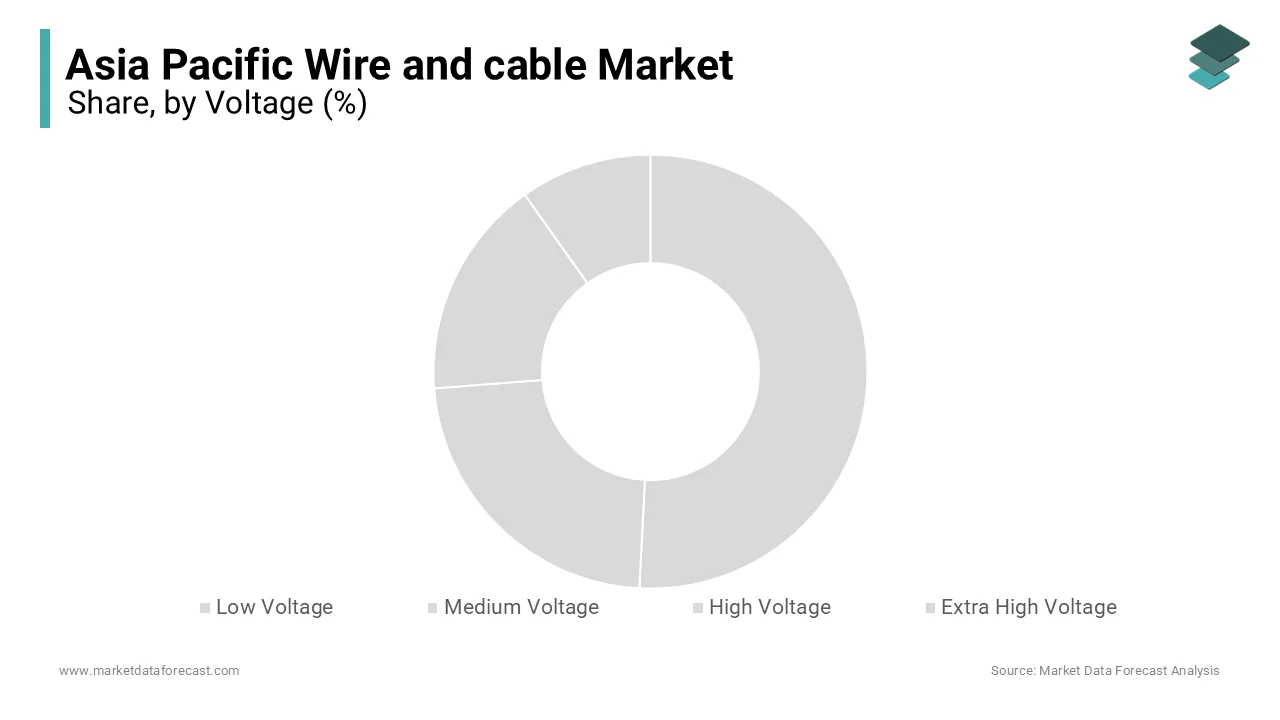
The extra-high voltage (EHV) cable segment is the fastest-growing in the Asia Pacific market and is projected to expand at a CAGR of 9.8% from 2026 to 2034. This growth is fueled by the need for long-distance, high-capacity power transmission to connect remote renewable energy sources with urban load centers. EHV cables, typically rated at 345 kV and above, are essential for minimizing transmission losses over vast distances. Some projects require thousands of kilometers of EHV cables, often installed underground or submarine in densely populated or environmentally sensitive areas. Another major driver is offshore wind integration. Technological advancements in cross-linked polyethylene (XLPE) insulation have also made EHV cables more reliable and easier to install than traditional oil-filled types, accelerating adoption.
By Installation Insights
The overhead cables segment constituted the largest installation method in the Asia Pacific wire and cable market by holding a 62.1% share in 2025. This dominance is rooted in the region’s vast geographical expanse and the cost-effectiveness of overhead transmission and distribution networks, particularly in rural and semi-urban areas. Overhead lines require significantly lower capital investment compared to underground systems making them the preferred choice for electrification in developing economies. The ease of maintenance and faster deployment also contribute to their prevalence; overhead systems can be installed faster than underground alternatives. Furthermore, in mountainous or forested regions, such as in Nepal and northern Vietnam, overhead lines are often the only feasible option for grid extension. The widespread use of aluminum conductor steel-reinforced (ACSR) cables, which offer high tensile strength and conductivity, further supports their reliability. Despite aesthetic and storm vulnerability concerns, the economic and logistical advantages of overhead cables ensure their continued dominance in large-scale power infrastructure.
The underground cable segment is experiencing the fastest growth in the Asia Pacific market and is projected to grow at a CAGR of 10.3% in the coming years. This surge is driven by urban densification and the need for resilient, space-efficient power networks in metropolitan areas. As cities expand vertically and land values rise, underground cabling offers a practical solution for integrating electrical infrastructure without encroaching on surface space. A further major driver is the increasing frequency of extreme weather events; cyclones and typhoons in the Philippines and Vietnam have caused widespread damage to overhead lines, prompting utilities to underground critical circuits. The development of high-capacity XLPE-insulated cables has also made underground transmission viable for EHV applications. Additionally, smart city initiatives and underground utility tunnels, such as those in Xiong’an and Shenzhen, integrate power, fiber, and water lines in shared conduits, accelerating adoption. With governments prioritizing urban resilience and aesthetics, the shift toward underground installation is accelerating.
By End-Use Insights
The Energy & Power sector was the leading end-use in the Asia Pacific wire and cable market by accounting for a 44.7% of total demand in 2025. This dominance is underpinned by the region’s massive investments in power generation, transmission, and distribution infrastructure to meet rising electricity consumption. Additionally, rural electrification programs across Southeast Asia, such as Indonesia’s 35,000 MW fast-track program, have driven demand for distribution-grade cables. The sector also includes critical applications in substations, switchyards, and generator leads, where fire-resistant and shielded cables are essential. With continued grid expansion and modernization, the Energy & Power segment remains the backbone of wire and cable demand.
The IT & Telecommunication segment is the fastest-growing end-use category in the Asia Pacific wire and cable market and is projected to grow at a CAGR of 11.2% from 2026 to 2034. This acceleration is driven by the rapid deployment of 5G networks, data centers, and fiber-optic broadband infrastructure. The proliferation of data centers is another major driver. With governments treating digital infrastructure as strategic, the IT & Telecommunication segment is reshaping the technological and material composition of the wire and cable industry.
REGIONAL ANALYSIS
China
China led the Asia Pacific wire and cable market by accounting for 35.3% in 2025. The country’s position is anchored in its colossal industrial base, state-driven infrastructure expansion, and dominance in global manufacturing. The State Grid Corporation’s investment in ultra-high-voltage (UHV) transmission has driven demand for high-voltage and submarine cables. Additionally, China’s renewable energy push, which added gigawatts of solar and wind capacity between 2020 and 2023, has created sustained demand for specialized cabling. The country’s leadership in 5G has further boosted fiber-optic consumption. Domestic manufacturers are expanding export operations into Southeast Asia and Africa. However, the market faces challenges from overcapacity and quality disparities, prompting a shift toward high-end, fire-resistant, and smart cables in urban and industrial applications.
India
India is key player in the Asia Pacific wire and cable market. The country’s growth is fueled by large-scale power infrastructure development, urbanization, and digital transformation initiatives. The National Infrastructure Pipeline includes extensive transmission and distribution upgrades. Additionally, the Pradhan Mantri Sahaj Bijli Har Ghar Yojana (Saubhagya) achieved a significant household electrification, resulting in the installation of millions of service connections, each requiring LV cabling, as per the Ministry of Power. The government’s BharatNet program has laid substantial number of kilometers of optical fiber to connect rural gram panchayats, accelerating demand for data cables. The automotive and real estate sectors also contribute significantly. With the Production-Linked Incentive scheme encouraging domestic manufacturing, India is reducing import dependence and building a self-reliant cable ecosystem.
Japan
Japan holds a notbale share of the Asia Pacific wire and cable market. The country’s market is defined by technological sophistication, stringent safety standards, and a focus on high-reliability applications. Unlike volume-driven markets, Japan’s demand centers on advanced cables for industrial automation, transportation, and disaster-resilient infrastructure. The country is also a pioneer in fire-safe cabling. Japanese manufacturers like Furukawa Electric and Sumitomo Electric are global leaders in material innovation and export high-performance cables worldwide.
South Korea
South Korea accounts for a notable share of the Asia Pacific wire and cable market. The country’s market is characterized by high technological integration, strong demand from advanced industries, and government-backed digital infrastructure programs. A key driver is the semiconductor and electronics sector. The government’s Digital New Deal initiative has accelerated the rollout of 5G and smart city networks. This has driven demand for high-speed data and coaxial cables. Additionally, South Korea’s leadership in shipbuilding requires extensive marine-grade cabling resistant to moisture and vibration. The country is also advancing in EV production. With domestic R&D in fire-resistant and lightweight materials, South Korea remains a hub for premium cable innovation.
KEY MARKET PLAYERS AND COMPETITIVE LANDSCAPE
Prysmian SpA, Nexans, NKT A/S, Belden Inc, Fujikura Ltd, Leoni AG ADR, Sumitomo Corp, and Furukawa Electric Co Ltd are key players in the Asia Pacific wire and cable market
The competition in the Asia Pacific wire and cable market is highly fragmented and dynamic, shaped by a convergence of global technology leaders, regional champions, and thousands of local manufacturers. While companies like Furukawa, Prysmian, and Hengtong lead in innovation and project execution, they face intense rivalry from cost-driven domestic producers in China, India, and Southeast Asia that dominate price-sensitive segments. Differentiation is increasingly based on technical reliability, compliance with international standards, and value-added services rather than price alone. The shift toward smart cities, renewable energy, and digital infrastructure has elevated demand for high-performance, fire-safe, and data-capable cables, pushing leading firms to invest in R&D and material science. Regulatory divergence across countries creates both barriers and opportunities, with companies achieving multi-market certification gaining a strategic advantage. Localization of manufacturing and supply chains has become essential to reduce lead times and respond to import restrictions. At the same time, the proliferation of substandard cables in emerging markets undermines safety and long-term market sustainability. Collaboration with government agencies, utilities, and EPC firms is critical for securing large infrastructure tenders. As the industry evolves toward sustainability and digital integration, the competitive landscape is shifting from volume-based competition to one centered on technological leadership, lifecycle performance, and environmental compliance.
TOP PLAYERS IN THE MARKET
Furukawa Electric Co., Ltd.
Furukawa Electric, headquartered in Japan, is a leading innovator in the Asia Pacific wire and cable market, renowned for its advanced materials and high-reliability products. The company plays a critical role in power transmission, telecommunications, and automotive sectors, supplying high-performance cables compliant with IEC, JIS, and IEEE standards. Furukawa has strengthened its regional presence through localized R&D centers in Singapore and India, enabling tailored solutions for tropical climates and high-load environments. In 2023, the company launched a new line of fire-safe, halogen-free cables for high-rise buildings in Southeast Asia, responding to stringent urban safety regulations. It has also expanded its submarine cable capabilities, securing contracts for offshore wind interconnections in Taiwan. By integrating fiber-optic and power transmission technologies, Furukawa supports smart grid and 5G infrastructure development. Its collaboration with NTT and KDDI on Japan’s fiber backbone reinforces its leadership in digital connectivity. The company continues to invest in sustainability, developing recyclable insulation materials and energy-efficient cable designs. Through technical partnerships with utilities and EPC firms, Furukawa ensures early project engagement and long-term service support, solidifying its reputation for engineering excellence and innovation across the region.
Prysmian Group
Prysmian Group, though Italian in origin, maintains a significant footprint in the Asia Pacific wire and cable market through strategic manufacturing and project execution capabilities. The company is a major supplier of high-voltage and submarine cables for energy infrastructure, particularly in offshore wind and long-distance transmission projects. Prysmian operates production facilities in China and India, allowing it to deliver large-diameter XLPE-insulated cables for ultra-high-voltage applications in alignment with regional grid modernization plans. In 2023, the company completed the supply of 132 kV submarine cables for a major offshore wind farm in South Korea, marking its first large-scale project in the country. It has also enhanced its technical support network across Southeast Asia, offering on-site jointing and testing services for critical installations. Prysmian actively participates in smart city and metro rail projects, providing fire-resistant and low-smoke cables for underground systems in cities like Mumbai and Bangkok. The company has invested in digital monitoring solutions, introducing cable health sensors for predictive maintenance in power networks. By aligning with global sustainability goals, Prysmian promotes recyclable materials and energy-efficient designs. Its engagement in high-profile infrastructure tenders and collaboration with local engineering firms have strengthened its reputation as a reliable partner for complex, high-stakes cabling projects across the region.
Hengtong Group
Hengtong Group, a Chinese industrial giant, is a pivotal force in the Asia Pacific wire and cable market, with deep integration across power, telecommunications, and marine sectors. The company is a leading domestic producer of optical fiber, high-voltage cables, and submarine systems, supporting China’s digital and energy infrastructure ambitions. Hengtong has expanded its influence through overseas projects, supplying fiber-optic networks for national broadband initiatives in Indonesia and Vietnam. In 2023, the company completed a turnkey fiber deployment for Nepal’s national telecom operator, enhancing cross-border connectivity. It has also developed advanced 500 kV XLPE cables for ultra-high-voltage transmission, used in China’s Green Energy Corridors. Hengtong’s submarine cable division has delivered systems for offshore wind farms in Fujian and Guangdong, with export potential to Taiwan and Japan. The company operates a state-of-the-art R&D center in Wuxi, focusing on fire-resistant materials and smart monitoring integration. By leveraging government-backed infrastructure programs and export incentives, Hengtong has built a robust supply chain and technical service network. Its vertical integration—from optical preforms to finished cables—enables cost efficiency and quality control. With a growing focus on ESG compliance and international certifications, Hengtong is positioning itself as a global contender in high-value cable segments.
TOP STRATEGIES USED BY KEY PLAYERS
Key players in the Asia Pacific wire and cable market are adopting multifaceted strategies to consolidate their competitive edge and respond to evolving technological and regulatory demands. Localization of production is a dominant approach, with companies establishing manufacturing hubs in India, Vietnam, and Indonesia to reduce costs, avoid tariffs, and ensure faster delivery. Firms are increasingly investing in material innovation, developing halogen-free, fire-resistant, and recyclable cables to comply with tightening environmental and safety regulations. Integration of digital technologies, such as cable health monitoring systems and IoT-enabled diagnostics, is being prioritized to offer predictive maintenance and lifecycle management services. Strategic collaborations with EPC contractors and government agencies enable early involvement in large infrastructure projects, ensuring design-in advantages. Expansion into high-growth applications—such as EV charging, offshore wind, and data centers—is driving product diversification. Additionally, companies are enhancing after-sales support through technical training, on-site jointing, and certification assistance. Mergers and acquisitions are also employed to gain access to specialized technologies, particularly in submarine and fiber-optic cables. Finally, adherence to international standards such as IEC, IEEE, and CPR is being emphasized to overcome regulatory fragmentation and build trust in quality-sensitive markets.
RECENT HAPPENINGS IN THE MARKET
-
- In July 2023, Furukawa Electric launched a new production line in Chennai, India, dedicated to fire-resistant, halogen-free cables for high-rise buildings and metro systems, enhancing its regional supply capability for safety-critical applications.
- In October 2023, Prysmian Group completed the installation of 132 kV submarine cables for South Korea’s Buan offshore wind farm, marking its entry into the country’s renewable energy market and strengthening its presence in Northeast Asia.
- In February 2025, Hengtong Group commissioned a new optical fiber preform facility in Wuxi, China, increasing its vertical integration and reducing reliance on imported core materials for telecommunications cables.
- In April 2025, Furukawa Electric partnered with Singapore’s Energy Market Authority to develop smart grid pilot projects using sensor-integrated power cables for real-time monitoring and fault detection in urban networks.
- In June 2025, Prysmian Group secured a contract to supply high-voltage underground cables for Mumbai Metro Line 4, reinforcing its position in India’s rapidly expanding urban rail infrastructure sector.
MARKET SEGMENTATION
This research report on the Asia Pacific wire and cable market has been segmented and sub-segmented based on the following categories.
By Voltage
- Low Voltage
- Medium Voltage
- High Voltage
- Extra High Voltage
By Installation
- Overhead
- Underground
By End-use
- Aerospace & Defense
- Building & Construction
- Oil & Gas
- Energy & Power
- IT & Telecommunication
- Automotive
- Others
By Country
- India
- China
- Japan
- South Korea
- Australia
- New Zealand
- Thailand
- Malaysia
- Vietnam
- Philippines
- Indonesia
- Singapore
- Rest of Asia-Pacific