- Product Description Description
- Table of Contents TOC
- List of Table & Figure LOT
- Get Free Sample PDF Sample PDF
Market Size, 2025
$72.94 BnMarket Estimate, 2026
$91.39 BnMarket Forecast, 2034
$555.30 BnCAGR, 2026–2034
25.3%Executive Summary: Global Augmented Reality (AR) and Virtual Reality (VR) Market
- Market Scope: Global analysis of the augmented reality and virtual reality sector, detailing component frameworks, device types, commercial applications, aesthetic device designs, and regional dynamics.
- Market Valuation: Valued at USD 72.94 billion in 2025, reaching USD 91.39 billion in 2026, and projected to expand to USD 555.30 billion by 2034, growing at a robust CAGR of 25.30% from 2026 to 2034.
- Primary Growth Drivers: Increasing focus on the aesthetic design of AR/VR wearable devices, rising demand for gesture and haptic control technologies, and expanding enterprise adoption for optimized productivity and training.
Key Market Segment Metrics
| Category | Leading Segment (Base Position) | Fastest-Growing / High-Growth Segment |
|---|---|---|
| By Component | Hardware (held dominant market share at 64.95%, driven by demand for high-performance displays, sensors, and depth-sensing systems) | Software (captured 23.91% share and projected for high-growth expansion driven by advanced rendering algorithms and immersive applications) |
| By Device Type | Head Mounted Display (HMD) & Head-Up Display (HUD) (held major share supported by extensive deployment in gaming, automotive, and military) | Gesture Control Devices (experiencing rapid growth propelled by demand for natural interaction and tactile feedback systems) |
| By Application | Consumer & Commercial (major revenue generators backed by widespread adoption in gaming, entertainment, and retail visualization) | Enterprise (anticipated as the fastest-growing segment driven by remote collaboration, real-time analytics, and efficient warehousing) |
| By Region | North America (market leader backed by technological advancements, high smartphone penetration, and early adoption of emerging tech) | Asia-Pacific (key high-growth hub driven by increased investments, rising consumer electronics adoption, and rapid industrial digitization) |
Major Market Players & Industry Landscape
Market Structure: Rapidly evolving global ecosystem transitioning from low-brand participants to advanced tech giants and specialized AR/VR platform providers focusing on aesthetic hardware design and immersive experiences.
Key Companies: Qualcomm Incorporated, Blippar, Catchoom, Innovega Inc., Laster Technologies, Metaio GmbH, Total Immersion, Vertalis Ltd, Augmented Pixels Co., Kooaba AG, Kishino Limited, and Wikitude GmbH.
 Download Free Sample Report
Global Augmented Reality (AR) and Virtual Reality (VR) Market Size
The global augmented and virtual reality market was valued at USD 72.94 billion in 2025, is estimated to reach USD 91.39 billion in 2026, and is projected to reach USD 555.30 billion by 2034, growing at a CAGR of 25.30% from 2026 to 2034.
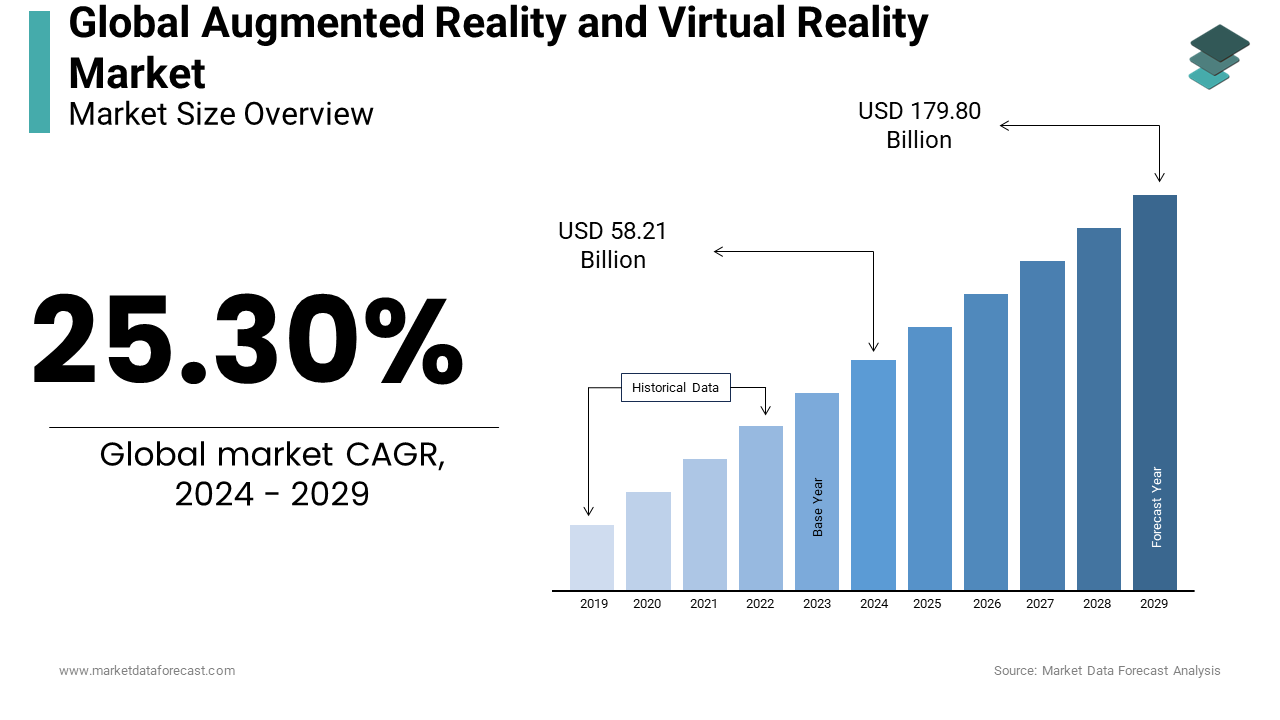
Hardware and software are the two driving segments adding to 64.95% and 23.91% of the general market, individually. The hardware systems market is mainly determined by expanding the surgeon's interest in an upgraded impression of depth during surgeries. The market segment involves an expansive scope of items, for example, video systems, head-mounted displays, motion sensors, 360° cameras, and surgical displays, among others.
MARKET DRIVERS
The developing focus of organizations on the feel of AR and VR devices is a crucial pattern in the global AR and VR market.
AR and VR devices, for example, smart glasses, heads-up displays (HUD), and head-mounted displays (HMD) offer a high level of flexibility and versatility to clients. The application territories of AR and VR are various, and organizations are investigating approaches to incorporate these technologies into multiple fields. Moreover, the associations working in the market are progressively concentrating on the feel of these devices, so as to make them voguish, to bring their appropriation up in various applications.
The rising interest for the gesture and haptic control is supporting the development of the AR and VR market, around the world.
The haptic innovation is utilized to make the feeling of touch that clients feel as applied forces, motion, or vibrations. At the same time, gesture recognition algorithms let clients control the devices and applications by utilizing their gestures, typically hand movements. With these advancements, the client can contact a virtual object, as though in reality. The rising prominence of these innovations has, in this manner added a new dimension to such devices, consequently driving their adoption.
MARKET RESTRAINTS
The limited user interface (UI) influencing the navigation performance of AR applications, limited processing power, less storage, and the limited size of the memory card in mobile phones, and differed infrastructure quality of the digital network will restrain the development of AR market. The health concerns identifying with low resolution and lack of movement and display latency and energy consumption influencing the general execution of VR devices are the significant limitations in the VR market.
REPORT COVERAGE
| REPORT METRIC | DETAILS |
| Market Size Available | 2025 to 2034 |
| Base Year | 2025 |
| Forecast Period | 2026 to 2034 |
| CAGR | 25.30% |
| Segments Covered | By Application, Device Type, Component, and Region |
|
Various Analyses Covered | Global, Regional & Country Level Analysis, Segment-Level Analysis, DROC, PESTLE Analysis, Porter’s Five Forces Analysis, Competitive Landscape, Analyst Overview on Investment Opportunities |
| Regions Covered | North America, Europe, APAC, Latin America, Middle East & Africa |
|
Market Leaders Profiled | Blippar, Catchoom, Innovega Inc., Laster Technologies, Metaio Gmbh, Total Immersion, Vertalis Ltd, Augmented Pixels Co., Kooaba AG, Kishino Limited, Qualcomm Incorporated, Wikitude Gmbh and Others. |
SEGMENTAL ANALYSIS
By Application Insights
The enterprise classification is expected to observe the quickest development in the global AR and VR market during the conjecture time frame, based on application. Enterprises are as of benefiting from AR and VR in various manners, for example, optimized productivity, enhanced learning outcomes, real-time data and analytics visualization, efficient warehousing and logistics, and better collaboration with remote workers.
By Device Type Insights
The HMD and HUD classifications are foreseen to hold the more significant share in the global AR and VR market by 2025, based on device type. In particular, HMDs are progressively gaining prominence in applications, for example, tourism, automotive, military, gaming, and education. The gigantic appropriation of mobile AR and VR is additionally presumed to help the dynamic development of this market category.
By Component Insights
The hardware category created a higher income in the global AR and VR market in 2025, in view of the component. This is because of the expanding interest for high-performance AR and VR devices, expanding application areas, and diminishing item costs.
REGIONAL ANALYSIS
North America AR and VR Market held the biggest share in this global business in 2025, fundamentally because of technological advancements, strong penetration of smartphones and internet, and early appropriation of rising technologies in the locale. Europe AR and VR market is second most prominent industry after North America, with increasing applications in end-user verticals. APAC augmented reality and virtual reality market is anticipated to witness the quickest development during the foreseen period, attributing to the increased investments in the adoption of latest technologies
KEY PLAYERS IN THE MARKET
Some of the major players operating in the global augmented reality and virtual reality market are Blippar, Catchoom, Innovega Inc., Laster Technologies, Metaio Gmbh, Total Immersion, Vertalis Ltd, Augmented Pixels Co., Kooaba AG, Kishino Limited, Qualcomm Incorporated, Wikitude Gmbh and others. Earlier this market was operated by players with relatively low brand image. Thus, after the entrance of new huge players in the business, the interest for augmented reality & virtual reality has increased amongst the clients.
RECENT HAPPENINGS IN THE MARKET
-
The museum in NYC utilizes VR to give guests an understanding of others' thoughts. The individual in this generation prefers to spend money on experiences than on material things. Askaryan's solution was to make a museum experience that accompanies with the cute nickname MoFE utilizing VR in areas for a brief time. He depicts it as "a curated cerebral experience mixing vivid theater, psychology, and VR for an in-depth exploration of individual and collective consciousness."
-
WASHINGTON [USA]: It turns out, augmented reality is fit for influencing individual's behavior, in both the physical world and a digitally improved one. As part of the examination, analysts found that after an individual had involvement in augmented reality (AR), reenacted by wearing goggles that layer computer-generated content onto real-world situations, their communications in their physical world changed. Considerably after their AR device was evacuated. As per the discoveries, while VR endeavors to reenact a real-life environment and take the client from the contemporary setting, AR technology layers' digital data on the user's physical environment.
MARKET SEGMENTATION
This research report on the global augmented reality (AR) and virtual reality (VR) market has been segmented and sub-segmented based on the application, device type, component, and region.
By Application
- Commercial
- Consumer
- Aerospace and Defense
- Healthcare
- Enterprise
By Device Type
- Head Mounted Display (HMD)
- Head-Up Display (HUD)
- Gesture Control Devices
- Projection Based Device
By Component
- Hardware
- Software
- Services
By Region
- North America
- Europe
- Asia Pacific
- Latin America
- Middle East and Africa