- Product Description Description
- Table of Contents TOC
- List of Table & Figure LOT
- Get Free Sample PDF Sample PDF
Market Size, 2025
$2.54 BnMarket Estimate, 2026
$2.69 BnMarket Forecast, 2034
$4.24 BnCAGR, 2026–2034
5.85%Global Auto Dimming Mirror Market Report Summary
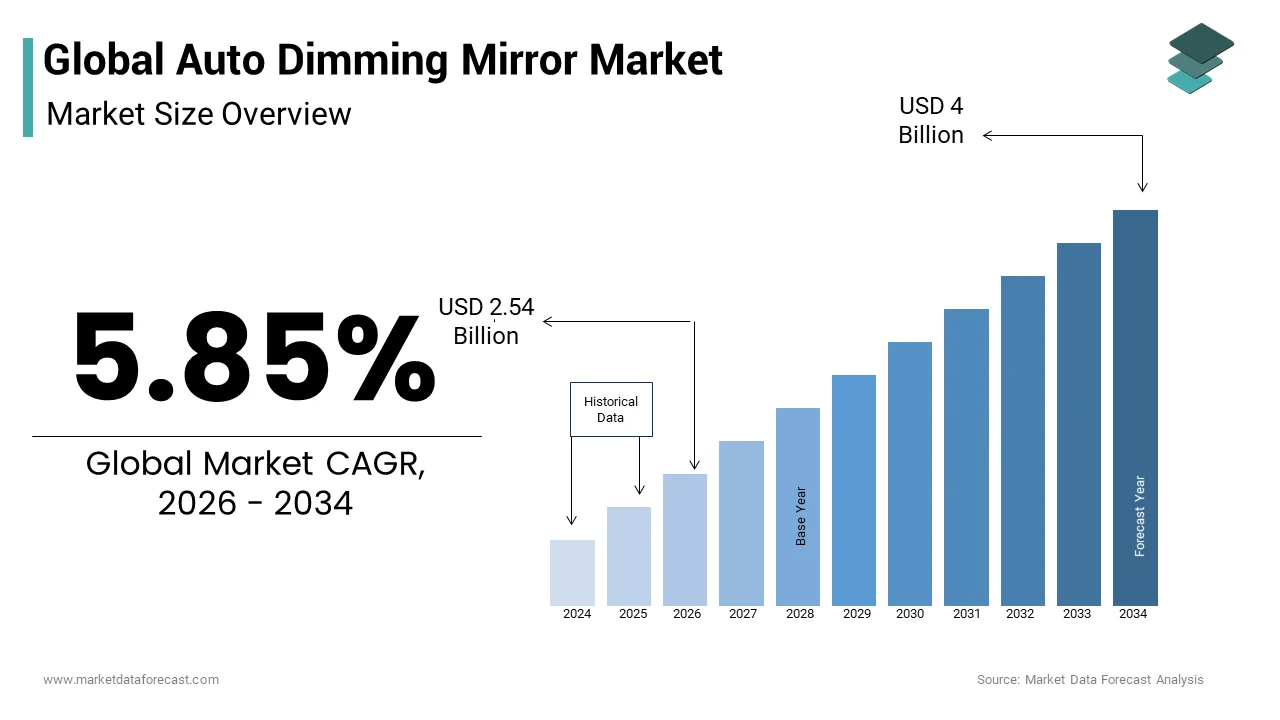
The global auto dimming mirror market was valued at USD 2.40 billion in 2025, is estimated to reach USD 2.54 billion in 2026, and is projected to reach USD 4.00 billion by 2034, expanding at a CAGR of 5.85% during the forecast period from 2026 to 2034. The global auto dimming mirror market is witnessing sustained growth as vehicle manufacturers increasingly prioritize driver safety, comfort, and advanced automotive technologies. Rising consumer demand for premium vehicle features, coupled with stricter road safety regulations, is accelerating the adoption of auto dimming mirrors across passenger and commercial vehicles. These mirrors help reduce glare from trailing vehicles during nighttime driving, improving visibility and minimizing driver fatigue. Growing integration of smart mirrors with cameras, sensors, connected vehicle technologies, and advanced driver assistance systems (ADAS) is further strengthening market demand. In addition, rising automotive production, increasing penetration of electric vehicles, and continuous innovation in intelligent cabin technologies are creating significant growth opportunities for manufacturers worldwide.
Key Market Trends
- Automakers are increasingly integrating auto dimming mirrors with ADAS, blind-spot monitoring, and rear-view camera systems to enhance vehicle safety.
- Demand for connected and smart interior mirrors is rising as vehicles adopt digital cockpit technologies and intelligent driver assistance features.
- Premium and luxury vehicle manufacturers continue to expand the use of electrochromic mirror technologies to improve driving comfort and visibility.
- The rapid growth of electric and autonomous vehicle development is driving demand for advanced mirror systems with integrated sensors and digital functionalities.
- Manufacturers are focusing on lightweight materials, energy-efficient electronics, and compact mirror designs to improve vehicle performance and sustainability.
Segmental Insights
Based on functionality, the non-connected auto dimming mirrors segment accounted for 44.5% of the global auto dimming mirror market share in 2025. The segment maintained its leadership due to widespread adoption across conventional vehicle models, cost-effectiveness, proven reliability, and strong demand from mass-market automotive manufacturers.
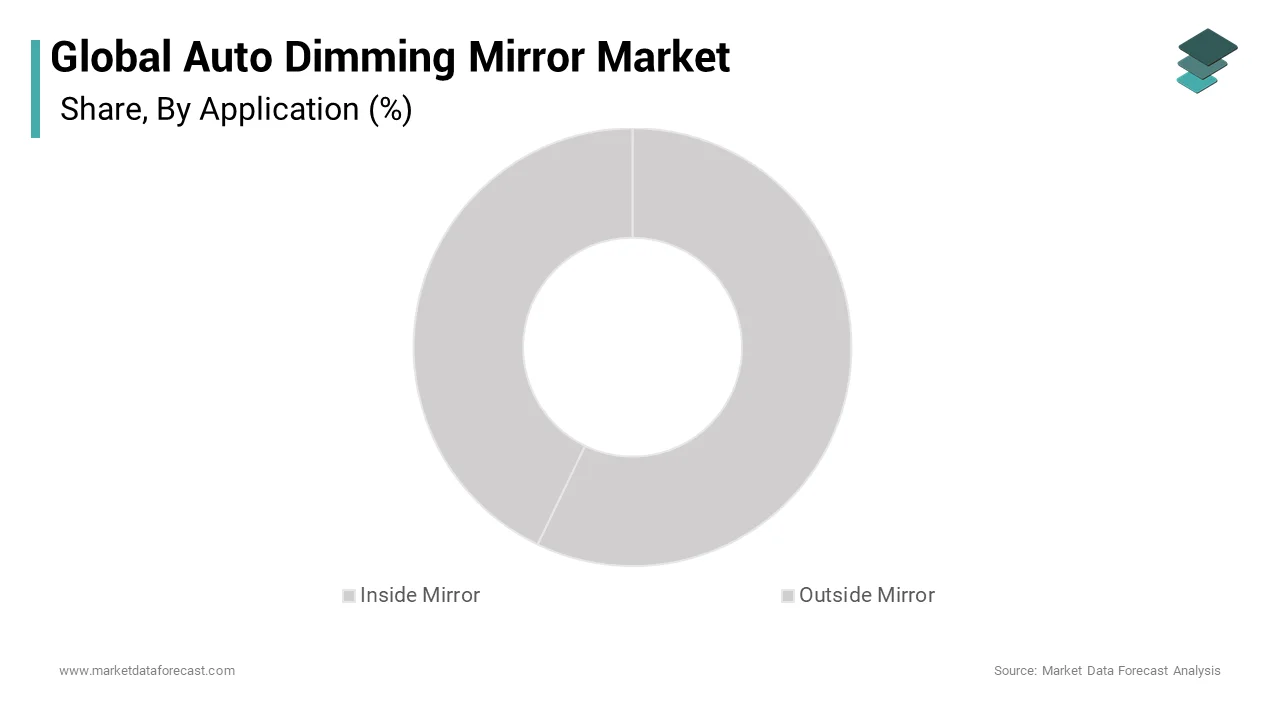
Based on application, the inside mirror segment captured 32.1% of the global auto dimming mirror market share in 2025. Interior rear-view mirrors remain the primary application because they directly improve nighttime driving visibility by automatically reducing glare from following vehicles, enhancing both driver comfort and road safety.
Based on vehicle type, the passenger vehicles segment held the dominant share of the global auto dimming mirror market in 2025. Growing production of passenger cars, increasing consumer preference for advanced safety features, and rising adoption of premium automotive technologies continue to support the segment's market leadership.
Regional Insights
North America led the global auto dimming mirror market by accounting for 44.6% of the market share in 2025, supported by high vehicle ownership, strong adoption of advanced safety technologies, and the presence of leading automotive component manufacturers. Europe ranked second with 34.2% of the market share, driven by stringent vehicle safety regulations, strong luxury automobile production, and continued investments in automotive innovation. Asia Pacific is expected to register significant growth during the forecast period as expanding automotive manufacturing, rising electric vehicle production, and increasing consumer demand for advanced safety systems accelerate market adoption. Latin America is witnessing steady expansion due to growing automotive sales in countries such as Brazil and Mexico, while the Middle East and Africa are experiencing gradual market growth, supported by rising demand for premium vehicles in Gulf countries and ongoing improvements in automotive safety standards across emerging African markets.
Competitive Landscape
The global auto dimming mirror market is highly competitive, with established automotive component manufacturers focusing on innovation, product integration, and strategic partnerships to strengthen their market positions. Leading companies are investing in electrochromic technologies, smart mirror solutions, digital displays, and sensor-based systems that complement next-generation vehicle platforms and ADAS capabilities. Collaborations with automotive OEMs, investments in research and development, and expansion of manufacturing capacities are enabling market participants to address the growing demand for connected and intelligent vehicle components. Companies are also emphasizing lightweight materials, energy-efficient electronics, and advanced manufacturing technologies to improve product performance while supporting the automotive industry's shift toward electrification and autonomous mobility. Continuous innovation and technology integration remain key competitive differentiators in the evolving global auto dimming mirror market.
Prominent players in the global auto dimming mirror market include Ficosa Internacional SA, Ichikoh Industries, Ltd., Murakami Co., Ltd., Magna International Inc., Samvardhana Motherson Group, Gentex Corporation, Tokairika Co., Ltd., SL Corporation, Shenzhen Germid Co., Ltd., Honda Lock Mfg. Co., Ltd., and other leading industry participants.
Global Auto Dimming Mirror Market Size
The Auto Dimming Mirror Market size will reach USD 2.54 billion in 2026 and is anticipated to reach a valuation of USD 2.69 billion in 2026 and reach USD 4.24 billion by 2034, growing at a CAGR of 5.85% during the forecast period from 2026 to 2034.
Introduction to the Auto Dimming Mirror Market
The auto dimming mirror is electrochromic device integrated into vehicle interiors to automatically reduce glare from high beam headlights of following vehicles. These mirrors utilize light sensors and electronic control units to detect intense light sources and adjust the reflectivity of the mirror surface within milliseconds ensuring driver visibility and comfort during nighttime driving. The technology has evolved from a luxury feature to a standard safety component in many modern vehicles driven by increasing consumer awareness of road safety and ergonomic driving conditions. The glare from oncoming or following vehicles contributes to approximately 10% of nighttime accidents, promoting the role of effective glare reduction technologies. The European Union General Safety Regulation mandates enhanced driver visibility standards, which indirectly supports the adoption of advanced interior mirror systems. Furthermore, data from the Insurance Institute for Highway Safety indicates that driver fatigue and visual impairment due to glare are significant factors in rear end collisions particularly on highways, where high beam usage is common. As automotive manufacturers strive to meet stringent safety ratings from organizations like Euro NCAP, the integration of auto dimming mirrors becomes essential for achieving higher scores. The global push toward autonomous driving also necessitates clear visual fields for both human drivers and internal monitoring cameras, making glare free environments crucial.
MARKET DRIVERS
Rising Incidence of Nighttime Driving Accidents Due to Glare
The escalating frequency of nighttime driving accidents caused by headlight glare is majorly promoting the growth of the auto dimming mirror market. Modern vehicle lighting systems, including LED and HID headlights produce significantly brighter illumination than traditional halogen bulbs increasing, the potential for temporary blindness and delayed reaction times among drivers. According to the Federal Highway Administration, over 50% of all traffic fatalities occur at night despite accounting for only 25% of total driving time indicating a disproportionate risk during low light conditions. Glare from following vehicles exacerbates this risk by creating visual discomfort and reducing the driver ability to perceive hazards in the rear view. Studies conducted by the Society of Automotive Engineers reveal that exposure to high intensity light can impair night vision for up to 30 seconds after the source is removed posing a severe safety threat. Auto dimming mirrors mitigate this issue by instantly reducing reflectivity thereby preserving the driver natural night vision and maintaining situational awareness. As per road safety audits in Europe and North America, jurisdictions with higher penetration of auto dimming mirrors report lower rates of glare related incidents reinforcing the correlation between this technology and improved road safety outcomes.
Stringent Regulatory Standards for Vehicle Interior Safety
The governmental regulations and safety assessment protocols increasingly mandate or encourage the inclusion of features that enhance driver visibility and reduce distraction, including auto dimming mirrors. The stringent regulatory standards for vehicle interior safety are propelling the growth of the auto dimming mirror market. In Europe, the General Safety Regulation requires new vehicle types to incorporate advanced safety measures that protect occupants and improve overall driving ergonomics. While not explicitly mandating auto dimming mirrors, these regulations set performance benchmarks for interior visibility and glare reduction that are difficult to meet without such technology. The leading car safety assessor in Europe vehicles must demonstrate optimal driver visibility in various lighting conditions to achieve five-star ratings, which heavily influences consumer purchasing decisions. The organization specifically evaluates the effectiveness of interior mirrors in managing glare from following vehicles during its testing procedures. Similarly, in the United States the National Highway Traffic Safety Administration includes interior field of view requirements in its Federal Motor Vehicle Safety Standards, which prompt manufacturers to adopt solutions that maintain clear rearward visibility. Automakers respond by integrating auto dimming mirrors as standard equipment to ensure compliance and competitive safety scores.
MARKET RESTRAINTS
High Production Costs Limiting Adoption in Entry Level Vehicles
The relatively high manufacturing cost of auto dimming mirrors compared to standard manual mirrors, particularly in budget friendly and entry level vehicle segments is impeding the growth of the auto dimming mirror market. Electrochromic mirrors require specialized materials, such as ion conducting gels and transparent conductive coatings along with precise electronic control units and light sensors, which increase the bill of materials. In emerging economies, where price sensitivity is acute this cost differential often leads manufacturers to exclude auto dimming features from base models to maintain affordability. Data from automotive supply chain studies indicate that raw material volatility especially for rare earth elements used in sensor components, further exacerbates cost pressures. This economic constraint restricts the market penetration of auto dimming technology to mid-range and luxury vehicles, where consumers have greater disposable income.
Technical Limitations in Extreme Temperature Conditions
The auto dimming mirrors face operational challenges in extreme temperature environments, which can affect the response time and longevity of the electrochromic gel used in the dimming process. The technical limitation in extreme temperature conditions is also inhibiting the growth of the auto dimming mirror market. The chemical reactions responsible for changing the mirror reflectivity are sensitive to temperature fluctuations with performance degrading significantly in very cold or very hot conditions. According to testing data from automotive engineering firms, electrochromic mirrors may take up to 10 seconds longer to dim in temperatures below minus 20 degrees Celsius compared to optimal operating ranges between 10 and 40 degrees Celsius. This delay can be crucial in sudden glare situations potentially compromising driver safety. Furthermore, prolonged exposure to high temperatures above 85 degrees Celsius can cause permanent degradation of the electrochromic layer leading to uneven dimming or complete failure of the device. These technical limitations raise concerns among consumers in regions with harsh winters or desert climates, such as Northern Europe and the Middle East. Manufacturers must invest in advanced thermal management systems and robust sealing technologies to protect the sensitive internal components, which further increases production complexity and cost. The need for climate specific calibration adds to the development burden limiting the scalability of standardized solutions, across diverse geographical markets and hindering universal acceptance of the technology.
MARKET OPPORTUNITIES
Integration with Smart Cabin and Connected Vehicle Ecosystems
The emergence of auto dimming mirrors with smart cabin technologies and connected vehicle systems for expansion and functional enhancement is attributed to create new opportunities for the growth of the auto dimming mirror market. Modern auto dimming mirrors are evolving beyond simple glare reduction to become multifunctional hubs that integrate displays for navigation rear camera feeds and driver monitoring systems. The trend toward software defined vehicles enables over the air updates that can enhance mirror functionality post purchase, such as adjusting dimming sensitivity based on driver preferences or traffic conditions. This integration allows automakers to offer personalized user experiences that increase brand loyalty and perceived value. Auto dimming mirrors serve as ideal platforms for these interfaces due to their central location and constant visibility. Furthermore, connectivity with vehicle to everything systems enables mirrors to receive real time data about surrounding traffic allowing for predictive dimming adjustments before glare occurs. This proactive capability enhances safety and comfort distinguishing premium vehicles in a competitive world.
Expansion into Commercial and Heavy Duty Vehicle Segments
The need to reduce driver fatigue and improve safety in long haul operations is to set up new opportunities for the growth of the auto dimming mirror market. Professional drivers spend extensive hours on the road often at night making them particularly vulnerable to glare induced exhaustion and reduced reaction times. According to the Federal Motor Carrier Safety Administration, driver fatigue is a contributing factor in 13% of large truck crashes promoting the urgent need for ergonomic improvements in commercial vehicle cabins. Auto dimming mirrors help mitigate this risk by maintaining consistent visibility and reducing eye strain during overnight journeys. Fleet operators are increasingly recognizing the return on investment from installing, such features as they lead to fewer accidents lower insurance premiums and improved driver retention. Technological advancements have led to the development of robust auto dimming mirrors capable of withstanding the vibrations and harsh conditions typical of heavy duty operations. As per transport safety studies, vehicles equipped with advanced interior visibility systems report up to 15% reduction in driver reported fatigue incidents demonstrating clear operational benefits. This trend is gaining momentum in Europe and North America where regulatory bodies emphasize driver welfare thereby opening lucrative avenues for auto dimming mirror providers in the commercial transportation sector.
MARKET CHALLENGES
Supply Chain Volatility for Rare Earth Materials
The production of auto dimming mirrors relies heavily on rare earth elements and specialized electronic components, which are subject to significant supply chain volatility and geopolitical risks. The supply chain volatility for rare earth materials is to act as a barrier for the growth of the auto dimming mirror market. Materials, such as indium tin oxide used for transparent conductive coatings are sourced from limited geographical regions making the supply chain vulnerable to disruptions. According to the United States Geological Survey, China controls over 80% of the global rare earth processing capacity creating a dependency that poses strategic risks for automotive manufacturers in other regions. Trade tensions export restrictions and environmental regulations in producing countries can lead to sudden price spikes and shortages of materials. Furthermore, the semiconductor shortage that affected the automotive industry in 2021 and 2022, the fragility of electronic component supplies including the microcontrollers used in mirror systems. These supply chain uncertainties force manufacturers to maintain higher inventory levels or seek alternative materials which may compromise performance or increase development costs. As per procurement reports from major automotive suppliers, securing stable and diversified sources for these materials remains a top priority but is challenging due to the concentrated nature of global mining and processing activities.
Consumer Preference for Manual Control and Customization
Despite the convenience of automatic dimming, a segment of consumers prefers manual control over mirror reflectivity citing issues with inconsistent performance or desire for personalized settings. The consumer preference for manual control and customization is likely to limit the growth of the auto dimming mirror market. Some drivers find that auto dimming mirrors react too slowly or aggressively leading to moments of inadequate visibility or excessive darkness that hinders rear observation. This dissatisfaction stems from the one size fits all approach of many systems, which do not account for individual visual acuity or driving habits. Additionally, older drivers or those with specific visual impairments may prefer the ability to manually adjust the mirror to their exact comfort level rather than relying on automated algorithms. This preference limits the universal acceptance of auto dimming technology and prompts some manufacturers to offer hybrid models with manual override options. However, the added complexity of these hybrid systems can increase costs and maintenance requirements.
REPORT COVERAGE
| REPORT METRIC | DETAILS |
| Market Size Available | 2025 to 2034 |
| Base Year | 2025 |
| Forecast Period | 2026 to 2034 |
| CAGR | 5.81% |
| Segments Covered | By Application, Vehicle Type, Fuel Type, and Region. |
| Various Analyses Covered | Global, Regional & Country Level Analysis, Segment-Level Analysis, DROC, PESTLE Analysis, Porter’s Five Forces Analysis, Competitive Landscape, Analyst Overview of Investment Opportunities |
| Regions Covered | North America, Europe, APAC, Latin America, Middle East & Africa |
| Market Leaders Profiled | Ficosa Internacional SA, Ichikoh Industries, Ltd, Murakami Co., Ltd., Magna International Inc., Samvardhana Motherson Group, Gentex Corporation, Tokairika Co., Ltd., SL Corporation, Shenzhen Germid Co., Ltd., and Honda Lock Mfg. Co., Ltd., and Others. |
SEGMENTAL ANALYSIS
By Functionality Insights
The non-connected auto dimming mirrors segment was the largest by holding 44.5% of the auto dimming mirror market share in 2025 due to their cost effectiveness reliability and widespread adoption in standard vehicle configurations. The lower manufacturing complexity compared to connected variants, which do not require integration with vehicle communication networks or advanced software protocols. This simplicity ensures higher durability and lower failure rates which appeals to both manufacturers and consumers seeking dependable safety features without additional maintenance concerns. As per reports from major automotive suppliers like Gentex and Magna, the majority of original equipment manufacturer contracts focus on these traditional systems due to their proven track record and ease of installation. Furthermore, regulatory requirements in many regions mandate basic glare reduction but do not yet require connectivity for interior mirrors allowing automakers to meet compliance standards at minimal expense. Consumer surveys indicate that while advanced features are desirable most drivers prioritize effective glare reduction over digital integration for rear view mirrors. This practical preference combined with the high-volume production of affordable vehicles ensures that non connected auto dimming mirrors remain the leading segment in terms of both unit sales and revenue generation globally.
The connected auto dimming mirrors segment is expected to exhibit a fastest CAGR of 12.5% from 2026 to 2034 with the increasing integration of smart cabin technologies and vehicle to everything communication systems. The evolution of automobiles into connected devices, where interior components serve as interfaces for digital services and real time data exchange. These mirrors can receive data from navigation systems traffic cameras and other vehicles to anticipate glare sources and adjust proactively rather than reactively enhancing driver comfort and safety. Furthermore, these mirrors often integrate with driver monitoring systems to adjust dimming levels based on individual user profiles and eye tracking data providing a personalized experience. The rise of over the air update capabilities allows manufacturers to improve mirror performance post sale adding long term value for consumers. Industry forecasts from Yole Development indicate that the penetration of connected interior displays will exceed 50% in premium vehicles by 2028 driving demand for sophisticated mirror solutions.
By Application Insights
The inside mirror applications segment was accounted in holding 32.1% of the auto dimming mirror market share in 2025 due to mandatory safety regulations and the critical role of rear view visibility in preventing accidents. The direct line of sight that inside mirrors provide to following traffic making them the most effective point for glare reduction during nighttime driving. Regulatory bodies in Europe and North America increasingly emphasize interior field of view standards, which necessitate the use of auto dimming technology to maintain clear visibility under all lighting conditions. Data from Euro NCAP shows that vehicles achieving five-star safety ratings typically include high performance inside auto dimming mirrors, as part of their standard safety suite. Furthermore, the inside mirror is easier to integrate with other cabin features, such as compasses garage door openers and emergency call buttons adding functional value beyond glare reduction. The relatively lower cost of installing a single inside mirror compared to multiple outside mirrors also makes it an attractive option for automakers looking to balance safety features with production costs.
The outside mirror applications segment is likely to witness a fastest CAGR of 9.8% from 2026 to 2034 with the increasing size of vehicle side mirrors and the rising prevalence of blind spot monitoring systems that require clear visual fields. The integration of auto dimming technology with side mirror cameras and sensors used for advanced driver assistance systems is driving the growth of the segment. The side mirror glare can significantly impair driver visibility during lane changes, particularly when following vehicles use high beam headlights. As modern vehicles adopt larger side mirrors to improve aerodynamics and reduce blind spots, the surface area exposed to glare increases necessitating more effective dimming solutions. Furthermore, regulatory initiatives in Europe promoting safer urban mobility encourage the use of advanced side mirror technologies that enhance visibility for cyclists and pedestrians. The expansion of electric vehicle platforms, which often feature sleek camera based mirror replacements also drives innovation in this segment.
By Vehicle Insights
The passenger vehicles segment held a dominant share of the auto dimming mirror market in 2025 due to the high volume of global production and stringent consumer expectations for comfort and safety features. This vast production base provides a substantial installed base for auto dimming mirrors as manufacturers strive to meet competitive benchmarks and regulatory requirements. Consumer awareness regarding driving comfort has reached unprecedented levels with buyers actively seeking features that reduce eye strain and fatigue during nighttime commutes. The interior comfort features, including auto dimming mirrors rank among the top ten factors influencing customer satisfaction scores for new vehicles. This high consumer preference encourages manufacturers to include auto dimming mirrors as standard equipment even in compact cars to enhance brand perception and sales performance. Furthermore, the implementation of Euro NCAP and similar safety rating programs globally pressures manufacturers to include comprehensive visibility aids to achieve high scores, which directly impacts marketability. The cost of implementing auto dimming technology in passenger vehicles has decreased significantly due to mass production and technological maturation by making it feasible for mainstream models.
The commercial vehicles segment is anticipated to register a fastest CAGR of 8.2% from 2026 to 2034 with the expansion of logistics fleets and increased focus on driver welfare and safety. The surge in e commerce and last mile delivery services has led to a significant increase in the number of trucks and vans on the road, which operate frequently at night and in diverse lighting conditions. Fleet operators are increasingly adopting auto dimming mirrors to reduce driver eye strain and improve reaction times, thereby enhancing overall road safety and operational efficiency. Furthermore, regulatory bodies in Europe and North America are introducing stricter safety standards for commercial vehicles mandating better visibility and reduced distraction. As per industry reports, the adoption of advanced interior features in commercial fleets is accelerating, as companies seek to lower insurance costs and improve safety records. The development of robust auto dimming mirrors capable of withstanding the vibrations and harsh conditions typical of heavy-duty operations, further supports this growth.
REGIONAL ANALYSIS
North America Market Analysis
North America was the largest contributor in the global auto dimming mirror market by holding 44.6% of share in 2025 with the high consumer adoption rates and a strong culture of vehicle comfort and safety. The region benefits from a mature automotive industry and high disposable incomes, which enable consumers to prioritize premium features, such as auto dimming mirrors. The presence of major automotive manufacturers and technology providers in the region facilitates rapid innovation and deployment of advanced mirror systems. Furthermore, the regulatory environment in Canada and the United States continues to evolve with proposals for enhanced visibility standards in new vehicles. This combination of regulatory pressure consumer demand and technological availability ensures that North America remains as a key driver of growth and innovation in the auto dimming mirror market.
Europe Market Analysis
Europe auto dimming mirrors market was ranked second by holding 34.2% of share in 2025 with the stringent regulatory frameworks and a strong emphasis on road safety and driver ergonomics. The European Union has implemented some of the most comprehensive vehicle safety regulations globally, including the General Safety Regulation, which mandates advanced visibility features for all new vehicles. The road fatalities in the EU have decreased significantly over the past decade but the goal is to reduce them by 50% by 2030, which necessitates widespread adoption of technologies like auto dimming mirrors, as per the study. Euro NCAP ratings heavily influence consumer purchasing decisions in Europe with vehicles achieving high scores only if they include comprehensive safety and comfort features. The dense urban infrastructure and mixed traffic conditions in European cities also increase the relevance of auto dimming mirrors for preventing glare from streetlights and other vehicles. Furthermore, the presence of leading automotive manufacturers in Germany, France, and Italy, fosters continuous innovation in electrochromic technologies.
Asia Pacific Market Analysis
Asia Pacific auto dimming mirror market is expected to have prominent growth opportunities in coming years with the increasing vehicle production and rising consumer awareness in countries like China, India, and Japan. The region accounts for more than half of global vehicle production according to the International Organization of Motor Vehicle Manufacturers providing a vast potential customer base for comfort and safety technologies. In China, the government has introduced new safety standards that encourage the adoption of advanced interior features in domestically produced vehicles. Japan has long been a pioneer in automotive electronics with manufacturers like Toyota and Honda integrating auto dimming mirrors into a wide range of models. According to the World Health Organization, road traffic injuries are a leading cause of death in many Asian countries prompting governments to promote safer and more comfortable vehicles. Furthermore, the expansion of multinational automotive brands in the region brings advanced features to local markets.
Latin America Market Analysis
Latin America auto dimming mirrors market growth is driven by the increasing automotive sales in key countries like Brazil and Mexico. The region faces significant challenges related to road safety with high accident rates prompting gradual improvements in vehicle standards. The road traffic injuries are a major public health issue in Latin America, leading to increased advocacy for safer and more comfortable vehicles. However, economic fluctuations and price sensitivity remain barriers to widespread adoption in lower income segments. Government initiatives to improve road infrastructure and enforce traffic laws are also contributing to a safer driving environment, which supports the gradual uptake of auto dimming mirror technologies in the region.
Middle East and Africa Market Analysis
The Middle East and Africa auto dimming mirrors market growth is driven by luxury vehicle preferences in the Gulf states and gradual safety improvements in African nations. In countries like the United Arab Emirates and Saudi Arabia, high disposable incomes and a preference for premium vehicles ensure strong demand for advanced comfort features, including auto dimming mirrors. The harsh driving conditions and intense sunlight in the Middle East make auto dimming mirrors particularly valuable for reducing glare from both sun and artificial lights. However, affordability and lack of strict enforcement of safety regulations limit the widespread adoption of advanced technologies.
COMPETITIVE LANDSCAPE
The competition in the auto dimming mirror market is characterized by a mix of established specialists and diversified automotive suppliers striving to innovate and capture value. Major players compete on the basis of technological superiority cost efficiency and ability to integrate mirrors with broader vehicle electronics ecosystems. Companies are increasingly focusing on software defined features that allow for personalization and over the air updates distinguishing their offerings from standard hardware solutions. Regulatory compliance serves as a critical competitive factor as manufacturers must ensure their products meet strict safety and environmental standards globally. The entry of new tech firms specializing in digital interior displays adds further pressure on traditional mirror makers to adapt and evolve. This dynamic environment drives constant improvement in product reliability and functionality benefiting consumers through safer and more comfortable driving experiences. The shift toward autonomous driving also intensifies competition, as mirrors become integral parts of sensor suites requiring higher precision and reliability from all market participants involved in this specialized sector.
KEY MARKET PLAYERS
A most dominating market players that are in the global auto dimming mirror market are
- Ficosa Internacional SA
- Ichikoh Industries, Ltd
- Murakami Co., Ltd.
- Ficosa International
- Magna International Inc.
- Samvardhana Motherson Group
- Gentex Corporation
- Tokairika Co., Ltd.
- SL Corporation
- Shenzhen Germid Co., Ltd.
- Honda Lock Mfg. Co., Ltd.
Top Players In The Market
- Gentex Corporation stands as a global leader in automatic dimming mirrors and holds a dominant position due to its extensive patent portfolio and manufacturing expertise. The company supplies electrochromic mirrors to nearly all major automotive manufacturers worldwide ensuring widespread adoption of its technology. Gentex, recently expanded its production facilities in Mexico and Asia to enhance supply chain resilience and meet rising demand from electric vehicle makers. The company continues to invest heavily in research and development to integrate camera-based display systems into rearview mirrors creating digital interior mirror solutions.
- Magna International Inc is a diversified automotive supplier that plays a significant role in the auto dimming mirror market through its comprehensive mechatronics and electronics divisions. The company provides integrated mirror systems that combine auto dimming functionality with blind spot monitoring and connectivity features for modern vehicles. Magna recently launched advanced smart mirror platforms that support over the air updates and personalized driver settings enhancing user experience. The firm leverages its global manufacturing footprint to serve clients, across North America Europe and Asia efficiently. By prioritizing modular design and software integration, Magna strengthens its market position by offering customizable solutions that meet the specific needs of various automakers seeking sophisticated interior visibility and safety technologies.
- Ficosa International is a prominent specialist in vision systems and automotive mirrors known for its innovative approach to exterior and interior mirror technologies. The company has strengthened its market position by developing compact and energy efficient auto dimming modules suitable for a wide range of vehicle types including commercial trucks. Ficosa recently introduced new electrochromic glass technologies that offer faster response times and improved durability in extreme weather conditions. The firm collaborates closely with tier one suppliers and original equipment manufacturers to co develop customized mirror solutions. By focusing on technical excellence and strategic partnerships, Ficosa enhances its global reach and contributes significantly to the advancement of auto dimming mirror technologies in both passenger and commercial vehicle segments worldwide.
Top Strategies Used By Key Market Participants
Key players in the auto dimming mirror market primarily focus on product innovation and technological integration to maintain competitive advantages. Companies invest heavily in research and development to create smarter mirrors that combine auto dimming with digital displays and connectivity features. Strategic partnerships with semiconductor firms ensure stable supply chains for critical electronic components required in electrochromic systems. Manufacturers also expand their global production footprints to reduce costs and mitigate logistical risks associated with regional disruptions. Additionally, firms prioritize customization by offering modular solutions that allow automakers to integrate mirrors seamlessly into diverse vehicle architectures. These strategies enable market participants to address evolving consumer demands for enhanced safety and comfort, while navigating the complexities of the modern automotive supply chain effectively and efficiently.
MARKET SEGMENTATION
This research report on the global auto dimming mirror market is segmented and sub-segmented into the following categories.
By Application
- Inside Mirror
- Outside Mirror
By Vehicle
- Passenger Vehicle
- Commercial Vehicle
By Fuel
- ICE
- Hybrid
- Electric
By Region
- North America
- Europe
- Asia Pacific
- Latin America
- Middle East and Africa