- Product Description Description
- Table of Contents TOC
- List of Table & Figure LOT
- Get Free Sample PDF Sample PDF
Market Size, 2025
$2.96 BnMarket Estimate, 2026
$3.35 BnMarket Forecast, 2034
$8.96 BnCAGR, 2026–2034
13.10%Executive Summary: Latin America Body Contouring Devices Market Size & Trends
- Market Scope: Comprehensive analysis of the Latin American body contouring devices market covering product segments (non-invasive devices, cryolipolysis) and key country-level adoption frameworks across Brazil, Mexico, Argentina, Chile, and the rest of the region.
- Market Valuation: Valued at USD 0.16 billion (2025), estimated at USD 0.19 billion (2026), and projected to reach USD 0.56 billion by 2034, registering a strong CAGR of 14.59% (2026–2034).
- Primary Growth Drivers: High prevalence of obesity and overweight adult populations (exceeding 50% in several countries), strong cultural emphasis on physical appearance and body aesthetics, and the booming medical tourism sector in nations like Mexico, Colombia, and Brazil.
Key Latin America Body Contouring Devices Market Segment Metrics (2026–2034)
| Category | Leading Segment (2025 Position) | Fastest-Growing / Dynamic Segment |
|---|---|---|
| By Product | Non-invasive devices (held dominant market share due to zero downtime and safety profiles) | Cryolipolysis segment (projected CAGR of 15.4% driven by clinical validation and high patient trust) |
| By Country | Brazil (led the market as the regional hub for aesthetic culture and high cosmetic procedure density) | Mexico (scaling up specialized medical tourism and non-surgical fat reduction infrastructure) |
Major Market Players & Competitive Landscape
Market Structure: Highly competitive landscape featuring global medical aesthetic pioneers and regional distributors competing through localized clinical education, flexible financing models, and comprehensive after-sales support networks.
Key Companies: Meridian, Cynosure, Lumenis, Alma Lasers, Syneron, Palomar Medical Technologies, Allergan Aesthetics, BTL Aesthetics, Merz Aesthetics, and Others.
 Download Free Sample Report
Global Automated Parking System Market Size
The global automated parking system market size was valued at USD 2.96 billion in 2025 and is anticipated to reach USD 3.35 billion in 2026 to reach USD 8.96 billion by 2034, to growing at a CAGR of 13.10% during the forecast period from 2026 to 2034.
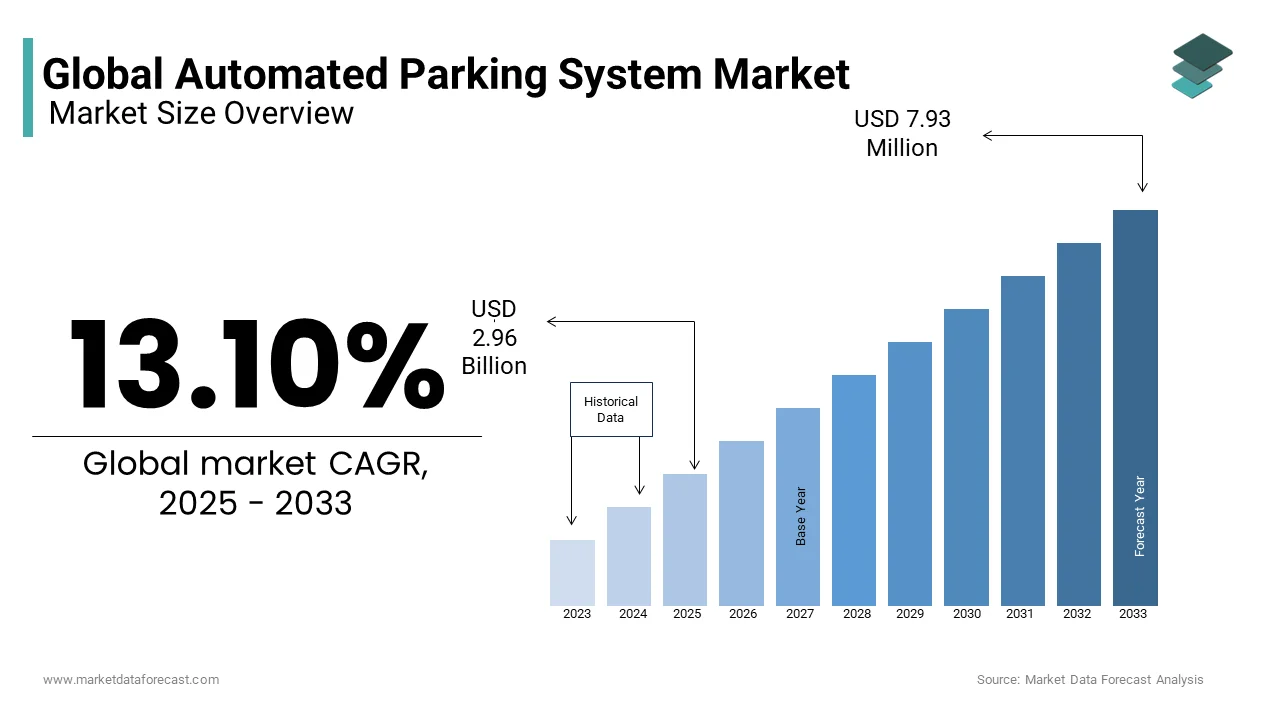
Automated parking systems may be a technique for mechanically parking and retrieving vehicles to accommodate the rise in interest in safe and convenient parking because the number of cars is growing every day. Automated parking systems limit the width and depth required for the parking lot and distances between parking spaces since no allowance must be made for driving the car into the parking lot or for the opening of car doors. Moreover, no driving lanes or ramps are required to drive the vehicle toward the parking lot.
The expansion of the infrastructure industry drives the marketplace for an automated parking system, along with the growing number of luxury and high-rise buildings, rising support from government bodies, and the increasing willingness of developers to put in an automatic parking system. Limited availability of parking spaces and therefore the growing number of vehicles has resulted in traffic jams in several regions. Drivers checking out vacant parking spaces account for nearly 40% of the entire traffic jam. Additionally, the time spent finding parking lots leads to a waste of fuel and increased emissions. The automated parking system can issue sustainable emission parking spaces. The benefits of an automated parking system over a conventional parking system are to grow efficiency by 35%-40%, increase capacity by 40%-50%, 10%-12% return on investment (ROI), 85% lesser CO2 emissions generated by driving, and inherent safety and security. The expansion of the infrastructure industry is predicted to supply tremendous opportunities for installing an automated parking system in under-construction and newly constructed buildings.
A key factor restraining the expansion of the automated parking system is the high complexity of the system, issues with internal control, and high capital requirements. The development of an automatic parking system is complex and requires deliberation of many factors. Within the absence of regulations to watch the working of an automated parking system, the difficulty of internal control also poses a challenge for manufacturers. However, a high initial investment is required for a high-caliber automated parking system. Thus, authorities must mandate and regulate the standard of the automated parking system.
REPORT COVERAGE
| REPORT METRIC | DETAILS |
| Market Size Available | 2025 to 2034 |
| Base Year | 2025 |
| Forecast Period | 2026 to 2034 |
| CAGR | 13.10% |
| Segments Covered | By Automation Level, System Type, End-User, Design Model, Platform Type, Parking Level, and Region. |
|
Various Analyses Covered | Global, Regional, & Country Level Analysis; Segment-Level Analysis; DROC, PESTLE Analysis; Porter’s Five Forces Analysis; Competitive Landscape; Analyst Overview of Investment Opportunities |
| Regions Covered | North America, Europe, APAC, Latin America, Middle East & Africa |
|
Market Leaders Profiled | Wohr (Germany), Nissei Build Kogyo (Japan), Klaus Multi Parking (Germany), CityLift (US), Westfalia (Germany), Robotic Parking Systems Inc. (the US), Skyline Parking, and Unitronics (Israel), and Others. |
SEGMENT ANALYSIS
By Automation Level Insights
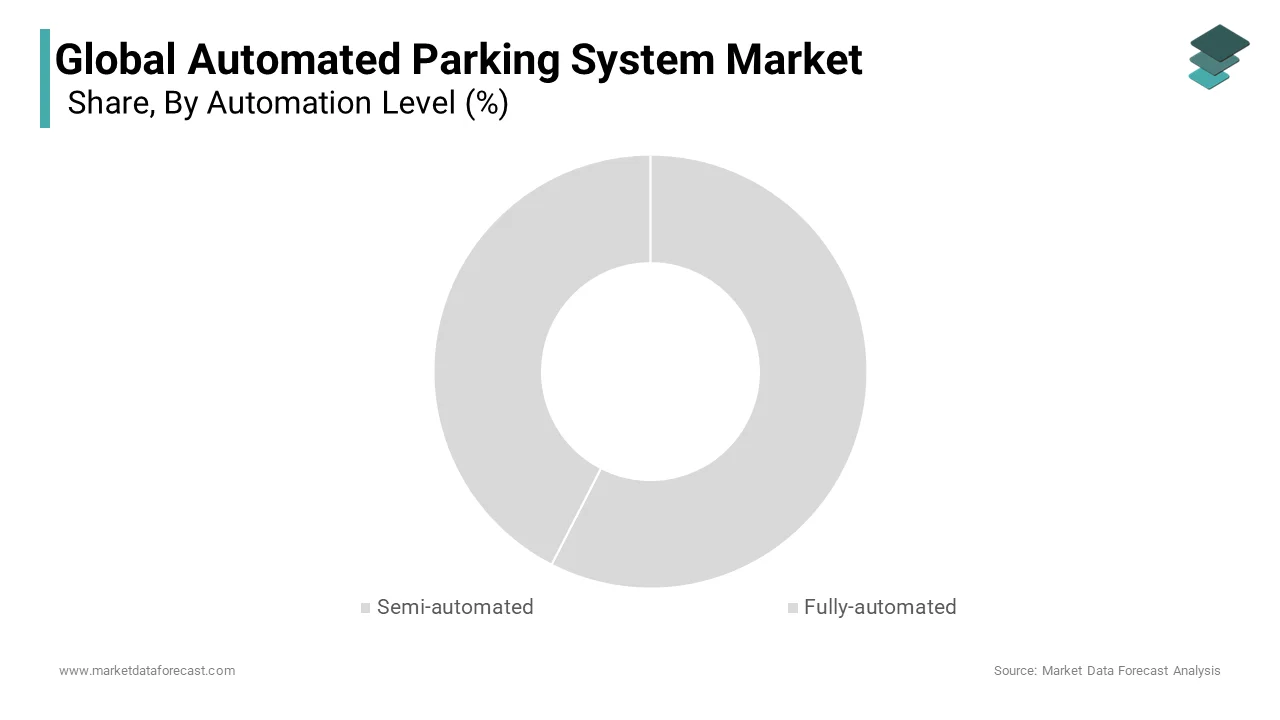
In the automated parking system (APS) market, the fully automated segment is the fastest-increasing part by automation level. The selection of an automatic parking system (APS) depends on several factors, such as the developer's available budget, the location of the project, and the application of the system. High-volume parking systems tend to be fully automated, while low-volume parking systems and throughout parking systems are semi-automated. Moreover, advantages like higher volume, better efficiency, less emission, and increased safety and convenience of a fully automated parking system are predicted to fuel the expansion of a fully automated parking system.
By System Type Insights
By system, hardware systems contribute to the most significant share of the cost of the automated parking system. Resulting in the best market share within the automated parking system. The analytics solutions segment in the software segment is predicted to grow at a surged rate during the foreseen phase. The expansion of this segment is majorly driven by the power of the parking sensors affixed to the sunshine poles to systematically and reliably assemble information about the vacant and occupied parking areas in time and transmit it to the drivers and managerial personnel using an analytics solution.
By End-User Insights
The automated parking system (APS) can considerably reduce emissions and increase the project's green footprint. As developers still specialize in decreasing emissions by offering low-emission sustainable houses, the demand for automated parking systems (APS) is predicted to extend to residential buildings.
By Platform Type Insights
As the non-palletized system has superior speed and efficiency, the demand for this sort of system is predicted to witness growth at a rapid pace.
REGIONAL ANALYSIS
The North American region is widely adopting digital technologies thanks to the main target of implementing smart cities and a better adoption rate for a sensible parking management system.

Europe is predicted to steer the automated parking system market. Europe features a state-of-the-art technology background and, therefore, the existence of major players in automated parking solutions. This further empowers private and public industries/ organizations to embrace automated parking system (APS) solutions to manage parking issues more efficiently.
In the Asia Pacific region, various smart city projects are unrolled to enhance citizen services. These smart city projects affect challenges associated with transit, infrastructure, connectivity, and utilities and are certain to reinforce the expansion of the automated parking system market.
KEY MARKET PLAYERS
Some of the major key players dominate the global automated parking system market. Are
- Wohr (Germany)
- Nissei Build Kogyo (Japan)
- Klaus Multi Parking (Germany)
- CityLift (US)
- Westfalia (Germany)
- Robotic Parking Systems Inc. (the US)
- Skyline Parking, Unitronics (Israel).
RECENT MARKET NEWS
- Multiparker 740 by Wohr provides saved parking space by stacking cars beside each other and on top of every other to a high rack storage system. Longitudinal parking is enabled next to the storage and retrieval system.
- KLAUS Multiparking GmbH now also provides 3D models of its parking systems for developing Information Modeling (BIM). With this, KLAUS Multiparking is responding to the development industry's interest in an innovative planning theory with which projects are often realized faster and more accurately.
- CityLift Parking, the leading distributor of automated parking lift solutions, was granted LA Research Report ("LARR") approval for its last completed project in LA. This is often the initial approval for a 3-level automated puzzle parking system within the City's history.
MARKET SEGMENTATION
This research report on the global automated parking market is segmented and sub-segmented into the following categories.
By Automation Level
- Semi-automated
- Fully-automated
By System Type
- Hardware
- Software
By End-User
- Commercial
- Residential
- Mixed-use
By Design Model
- Hydraulic
- Electro-mechanical
By Platform Type
- Palleted
- Non-palleted
By Parking Level
- Less than Level 5
- Level 5-Level 10
- More than Level 15
By Region
- North America
- Europe
- Asia Pacific
- Latin America
- Middle East and Africa