- Product Description Description
- Table of Contents TOC
- List of Table & Figure LOT
- Get Free Sample PDF Sample PDF
Market Size, 2025
$43.25 BnMarket Estimate, 2026
$46.62 BnMarket Forecast, 2034
$85.03 BnCAGR, 2026–2034
7.80%Executive Summary: Global Automotive Airbags and Seat Belts Market
- Market Scope: Comprehensive global automotive airbags and seat belts market analysis covering types, seat belt configurations, end-uses, vehicle categories, regional leadership frameworks, and biomechanical safety integration metrics.
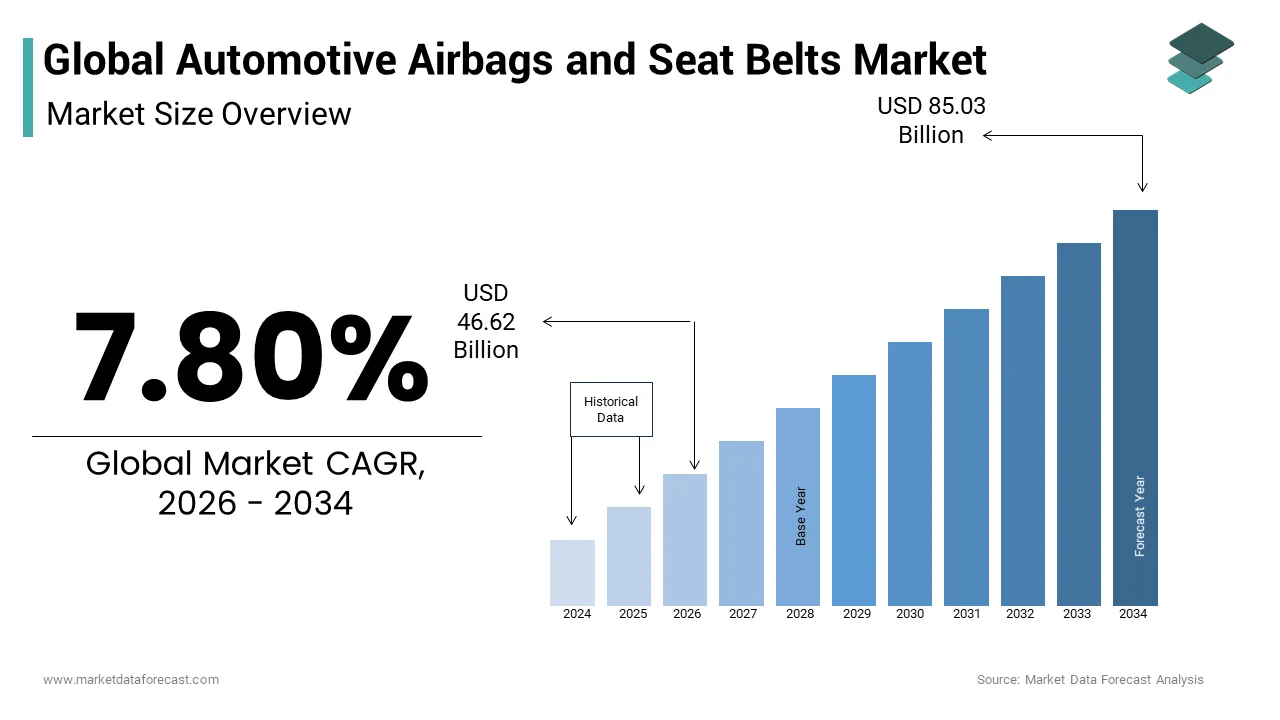
- Market Valuation: Valued at USD 43.25 billion (2025), estimated at USD 46.62 billion (2026), and projected to reach USD 85.03 billion by 2034, registering a CAGR of 7.80% (2026–2034).
- Primary Growth Drivers: Global tightening of passive safety regulations (such as the EU's GSR and regional dual front airbag/three-point belt mandates), consumer demand for premium safety and high crash-test ratings (Euro NCAP, IIHS), and the integration of AI-driven occupant sensing for context-aware deployment. Restraints include chemical propellant shortages and packaging challenges in lightweight EV architectures.
Key Market Segment Metrics (2026–2034)
| Category | Leading Segment (2025 Position) | Fastest-Growing Segment |
|---|---|---|
| By Type / Seat Belt | Three-point seat belts (led the market due to exceptional biomechanical efficacy and widespread standardization) | Curtain airbags (projected to record a strong CAGR of 11.3% driven by urban side-impact safety mandates) |
| By Vehicle Type | Passenger vehicles (accounted for the largest share due to rigorous multi-angle crash-test mandates and high sales volume) | Commercial vehicles (projected to grow at a CAGR of 9.7% due to regulatory catch-up and fleet liability concerns) |
| By Region | Asia-Pacific (dominated with 38.5% share in 2025, driven by massive production scale in China and safety mandates in India) | Europe and North America (maintaining steady expansion through stringent safety ratings, ADAS integration, and rear-seat warning rules) |
Major Market Players & Market Structure
Market Structure: Highly competitive automotive passive safety ecosystem featuring global tier-one restraint manufacturers competing intensely on deployment intelligence, chemical innovation, eco-friendly propellants, and active-passive safety convergence.
Key Companies: Autoliv, ZF Friedrichshafen, Joyson Electronic, Toyoda Gosei Co., Continental, Hyundai Mobis, Robert Bosch, Denso, Infineon Technologies, Toshiba, Aptiv, and Delphi Automotive PLC.
 Download Free Sample Report
Global Automotive Airbags and Seat Belts Market Size
The global automotive airbags and seat belts market size was valued at USD 43.25 billion in 2025 and is anticipated to reach a valuation of USD 46.62 billion in 2026 and USD 85.03 billion by 2034, growing at a CAGR of 7.80%, from 2026 to 2034.
Automotive airbags and seat belts are engineered restraint systems mandated to mitigate occupant injury during vehicular collisions through controlled deceleration and impact absorption. These are not mere accessories but codified safety interventions calibrated to biomechanical thresholds. As per the U.S. National Highway Traffic Safety Administration, seat belts alone reduce fatal injury risk by 45% for front-seat occupants in passenger cars. Globally, regulatory frameworks such as UNECE Regulation 16 and FMVSS 208 enforce minimum deployment standards, while Euro NCAP and IIHS assessments influence OEM design priorities.
MARKET DRIVERS
Global Safety Regulations Drive Growth in Automotive Airbags and Seat Belts Market
The global tightening of passive safety mandates, which is compelling OEMs to integrate multi-stage airbag systems and pretensioning seat belts as baseline equipment that boosts the expansion of the automotive airbags and seat belts market. The EU's General Safety Regulation (GSR) 2022 did mandate the inclusion of driver drowsiness detection and seat belt reminders for all seating positions by July 2024, driver drowsiness detection, and belt reminders for all seating positions, a stipulation projected to increase airbag count per vehicle. India mandated dual front airbags for all new cars in India, and three-point ELR (Emergency Locking Retractor) seatbelts made mandatory for all forward-facing passengers, including the rear-middle seat.
Consumer demand for premium safety ratings is accelerating growth in the automotive airbags and seat belts market.
Consumer demand for premium safety ratings in emerging countries, where insurance premiums and resale values correlate with crash-test performance, is accelerating the growth of the automotive airbags and seat belts market. The luxury SUV buyers prioritize vehicles with h designation from IIHS, a rating contingent on advanced restraint system performance. Models equipped with rear-center airbags and seat belt load limiters saw higher consumer consideration scores. This behavioral shift transforms airbags and belts from compliance items to brand differentiators, which accelerates adoption even in non-regulated vehicle segments.
MARKET RESTRAINTS
Global Safety Regulations Drive Growth in Automotive Airbags and Seat Belts Market
The technical incompatibility of advanced restraint systems with lightweight vehicle architectures, particularly in EV platforms where space and mass constraints challenge conventional deployment mechanisms, has emerged as an obstacle to the automotive airbags and seat belts market. The aluminum-intensive body structures in vehicles require more calibration iterations to ensure airbag sensors trigger within milliseconds of impact, a delay that can compromise thoracic protection. According to a study, carbon fiber monocoques absorb crash energy differently than steel, which necessitates bespoke inflator geometries that increase system cost per vehicle. This engineering friction delays standardization and inflates validation cycles for startups lacking legacy crash-test databases.
Inconsistent enforcement of seat belt laws in emerging economies like Brazil
Inconsistent enforcement of seat belt usage laws in emerging economies was eroding the efficacy of even the most advanced restraint systems, further degrading the growth of the automotive airbags and seat belts market. In Brazil, a portion of fatal crashes involved unbelted occupants, even in vehicles equipped with ten airbags. This behavioral gap creates a dissonance between technological investment and real-world outcome, which reduces OEM incentive to deploy premium restraint features in price-sensitive markets.
MARKET OPPORTUNITIES
AI-Driven Restraint Systems Transforming Automotive Safety into Intelligent Protection
The integration of restraint systems with occupant sensing AI, enabling context-aware deployment calibrated to passenger size, position, and posture that creates new prospects for the automotive airbags and seat belts market. Camera-based interior monitoring can reduce airbag-induced injuries by adjusting inflation force for children or out-of-position adults. Traditional safety components like airbags and seatbelts are evolving into intelligent, predictive, and personalized systems. This is driven by technological advances in AI, sensors, and computing, with the ultimate goal of moving toward a future of zero collisions.
Retrofit and Regulatory Upgrades Unlock New Growth Avenues for the Automotive Airbags and Seat Belts Market
The retrofit landscape in commercial and aging fleets, particularly in regions with delayed regulatory adoption, also offers fresh opportunities for the expansion of the automotive airbags and seat belts market. According to the study, a portion of buses and minibuses operating in Southeast Asia and Sub-Saharan Africa lack even basic three-point belts, which creates a notable aftermarket potential. Since 2022, Mexico has enacted updated safety standards for new vehicles, replacing earlier regulations. Effective January 1, 2024, new safety requirements for light-duty vehicles came into force, mandating technologies like electronic stability control (ESC) and ISOFIX/LATCH anchorages for child seats.
MARKET CHALLENGES
Global Propellant Shortage and Export Controls Disrupt Automotive Airbag Supply Chain
The global shortage of specialized propellant chemicals, particularly guanidine nitrate and sodium azide alternatives, essential for controlled airbag inflation, hampers the expansion of the automotive airbags and seat belts market. The export controls on high-purity nitrogen generators and phase-stable oxidizers delayed airbag module production for OEMs, including Hyundai and Ford. Also, according to research, European airbag manufacturers faced several weeks ' lead times for non-azide propellant blends, up from that in 2021, due to restricted Chinese precursor exports. This chemical barrier constrains scalability despite rising demand, a vulnerability unaddressed by current localization strategies.
Evolving Autonomous Vehicle Interiors Drive Need for Next-Generation Adaptive Airbag Systems
The calibration complexity introduced by non-standard seating configurations in mobility-as-a-service and autonomous pods hinders the rise of the automotive airbags and seat belts market. New interior designs in autonomous vehicles, such as swiveling seats, necessitate a fundamental reinvention of occupant protection systems. This shift leads to customized, integrated safety features within seats and requires advanced airbag technology for 360-degree coverage, which increases validation costs. As per the study, a portion of simulated crash tests failed due to mis-triggered side curtains when passengers reclined beyond certain degrees, a posture unaccounted for.
REPORT COVERAGE
| REPORT METRIC | DETAILS |
| Market Size Available | 2025 to 2034 |
| Base Year | 2025 |
| Forecast Period | 2026 to 2034 |
| CAGR | 7.80% |
| Segments Covered | By Type, End-Use, Vehicle Type, and Region. |
|
Various Analyses Covered | Global, Regional Country-Level Analysis; Segment-Level Analysis, DROC; PESTLE Analysis; Porter’s Five Forces Analysis; Competitive Landscape; Analyst Overview of Investment Opportunities |
| Regions Covered | North America, Europe, APAC, Latin America, Middle East & Africa |
|
Market Leaders Profiled | Infineon Technologies, Denso, Toyoda Gosei Co, ZF Friedrichshafen, Toshiba, Aptiv, Continental, Hyundai Mobis, Takata Corporation, Robert Bosch, Autoliv, Joyson Electronic, Delphi Automotive PLC, TRW Automotive Holdings Corporation, GWR Safety Systems, Rhodius GmbH, Telamon, Klippan, Sumitomo Electric, Ashimori Industry. |
SEGMENT ANALYSIS
By Type Insights
The three-point seat belt segment was the largest and held a substantial share of the automotive airbags and seat belts market in 2025. The growth of the three-point seat belt segment in the global market is primarily driven by biomechanical efficacy. According to the research, three-point belts reduce the risk of moderate-to-critical injury compared to two-point lap belts, a metric validated across millions of real-world crash records. As per the study, vehicles equipped with pretensioning and load-limiting three-point belts achieve notable thoracic protection scores, whereas lap-only systems score low. Automakers embed this design not merely for compliance but for brand equity. Even in budget segments, OEMs standardize three-point belts across all rows, which cements their irreplaceability.
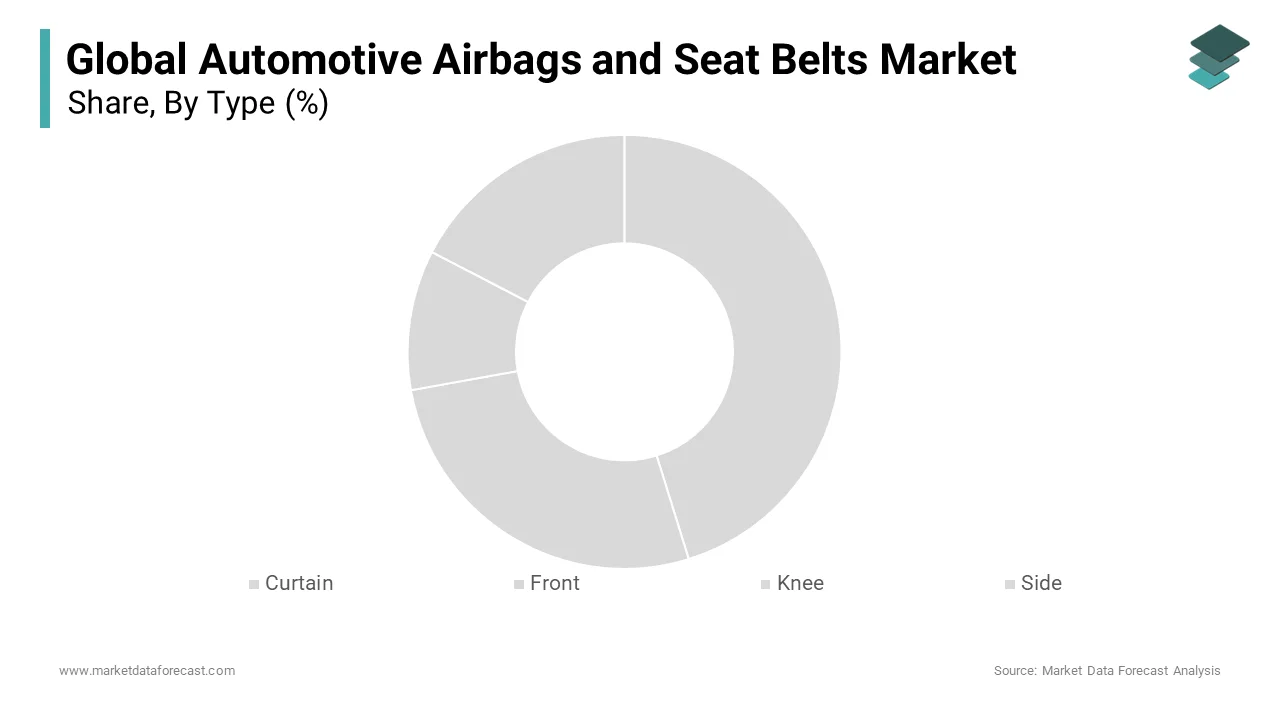
The curtain airbags segment is expected to grow with an expected CAGR of 11.3% from 2025 to 2033. The growth of the curtain airbags segment is propelled by regulatory expansion and consumer demand for side-impact protection in urban mobility corridors. Vehicles with curtain airbags reduce nearside occupant fatalities in intersection crashes, the leading cause of urban road deaths. In China, a portion of five-star vehicles includes extended curtain systems covering third-row seats, a feature newly adopted by BYD and Geely in midsize SUVs.
By End User & Vehicle Insights
The passenger vehicles segment led the automotive airbags and seat belts market by capturing a significant share in 2025. The prominence of the passenger vehicles segment is primarily driven by regulatory frameworks and consumer safety expectations. Passenger cars face the most stringent global crash-test mandates, including frontal, side, rollover, and small-overlap evaluations. According to a study, a percentage of 2024-rated passenger vehicles include at least six airbags and pretensioning three-point belts across all seating positions. In India, where passenger vehicle sales exceeded millions of units, it promotes dual front airbags and rear ELR seat belts, which triggers a surge in airbag module procurement by Maruti Suzuki and Hyundai.
The commercial vehicles segment is expected to exhibit a noteworthy CAGR of 9.7% during the forecast period. The expansion of the commercial vehicles segment is due to the accelerating regulatory catch-up and fleet operator liability concerns. Regulations from the United Nations Economic Commission for Europe (UNECE) and the GSR reinforce the existing requirement for seatbelt reminder systems (SBRs), especially for rear seats.
REGIONAL ANALYSIS
Europe Market Analysis
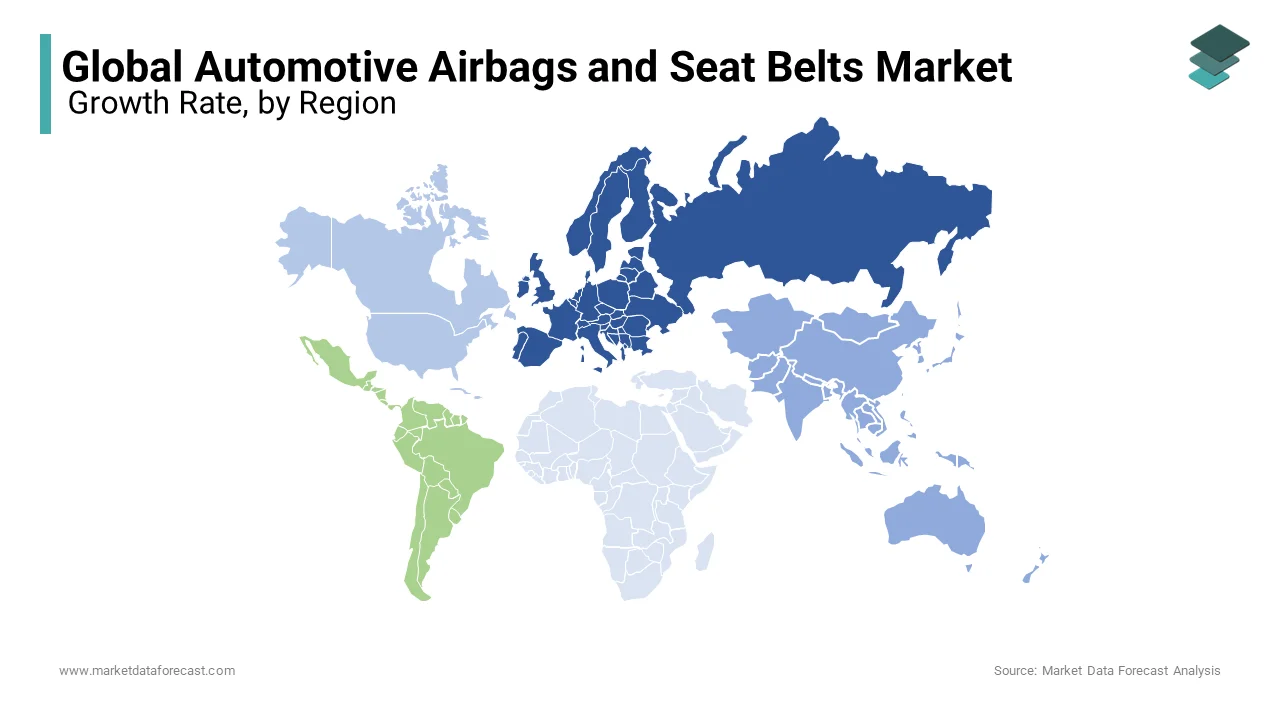
Europe is closely following in the automotive airbags and seat belts market and accounted for 32.7% of share in 2025. The growth of Europe is propelled by Germany’s engineering rigor and Sweden’s safety legacy, as per ACEA’s 2023 Safety Systems Deployment Audit. The inclusion of more airbags, such as side and curtain airbags, has been a broader industry trend driven by advancements in technology, increasing consumer demand for safety, and high-scoring criteria from independent crash-testing programs like Euro NCAP. According to research, a percentage of new models include ten or more airbags with occupant-sensitive deployment. In all buses where seat belts are present, passengers are legally required to wear them while the bus is in motion.
Asia Pacific Market Analysis
Asia Pacific dominated the automotive airbags and seat belts market by occupying 38.5% of share in 2025, with China installing a large number of airbag modules. This scale is fueled by regulatory escalation and domestic brand premiumization. Recent Chinese regulations and standards have focused on intelligent connected vehicles (ICVs), advanced driver assistance systems (ADAS), and over-the-air (OTA) software updates. India already requires dual front airbags. The mandate for both driver and front passenger airbags came into effect for all existing vehicle models by August 31, 2021.
North America Market Analysis
North America has expanded consistently in the automotive airbags and seat belts market, with the United States embedding restraint systems under some of the world’s most litigious and data-driven safety frameworks. Also, government safety standards are identified as a driver of safety technology. Moreover, as of January 2025, the National Highway Traffic Safety Administration (NHTSA) finalized a rule to require seat belt warning systems in rear seats. Vehicle manufacturers must comply with the new rear seat belt warning requirements by September 1, 2027. For instance, Tesla uses its camera system to enhance airbag deployment by predicting frontal crashes slightly earlier, but it relies on its Occupant Classification System (OCS), including pressure, weight sensors, and increasingly cabin radar for occupant sensing.
Latin America Market Analysis
LatiAmerica's automotive airbags and seat belts market growth is likely to grow with a prominent CAGR during the forecast period. The key regulations mandating dual front airbags and anti-lock braking systems (ABS) for all new vehicles in Brazil were put into place on January 1, 2014. Since the 2014 mandate, the airbag and seatbelt market in Brazil has continued to grow, with a steady increase in demand for both standard and advanced safety systems. In addition, Mexico’s regulations have evolved to include more standard safety features over time.
Middle East And Africa Market Analysis
The Middle East and Africa are likely to grow in the automotive airbags and seat belts market over the forecast period due to an ongoing structural transformation, which is led by GCC mandates and South African innovation. Saudi Arabia’s SASO 2882/2023 regulation requires new vehicles to include airbags and ISOFIX-compatible pretensioning belts, which affects a large number of annual imports. Also, seatbelt reminders and side airbags are becoming standard in GCC-spec vehicles, but this is a result of evolving and mandatory technical regulations. Moreover, manufacturers like Toyota and Nissan are proactively adding more safety features to stay competitive and meet tightening regulations, especially in the high-volume passenger car segment.
COMPETITIVE LANDSCAPE
Competition pivots on technological foresight, regulatory agility, and integration depth, and not cost alone. Players differentiate via deployment intelligence, chemical innovation, and compatibility with EV/autonomous structures. While Autoliv leads in premium multi-stage systems, Joyson dominates scalable solutions for emerging mandates. ZF leverages ADAS convergence to offer predictive restraint logic. Fragmentation persists in commercial and retrofit segments, where regional players thrive on localized compliance. M&A focuses on securing propellant alternatives and sensor fusion IP.
KEY MARKET PLAYERS
A few of the market players in the global automotive airbags and seat belts market
- Infineon Technologies
- Denso
- Toyoda Gosei Co
- ZF Friedrichshafen
- Toshiba
- Aptiv
- Continental
- Hyundai Mobis
- Takata Corporation
- Robert Bosch
- Autoliv
- Joyson Electronic
- Delphi Automotive PLC
- TRW Automotive Holdings Corporation
- GWR Safety Systems
- Rhodius GmbH
- Telamon
- Klippan
- Sumitomo Electric
- Ashimori Industry
Top Players In The Market
- Autoliv engineers integrated safety restraint systems for global OEMs, specializing in multi-stage airbag inflators and smart seat belt pretensioners calibrated for electric and autonomous platforms. The company expanded its sodium-free propellant production to comply with EU chemical restrictions and partnered to co-develop restraint systems for SEA architecture EVs, which strengthens its dominance in next-gen mobility safety.
- Joyson delivers cost-optimized yet high-specification restraint modules for mass-market and premium segments across Asia, Europe, and North America. It also opened a dedicated R&D center to serve new airbag mandates, which embeds regional compliance into global platform designs.
- ZF integrates active and passive safety via its “Integrated Safety Domain”, linking radar, cameras, and restraint systems for predictive crash response. ZF also co-developed a rear-center airbag with Honda by reducing head trauma in side impacts.
Top Strategies Used by Key Market Participants
Leading firms vertically integrate propellant and sensor supply chains to mitigate chemical shortages and ensure deployment precision. They embed AI-based occupant classification to enable context-aware airbag inflation and belt tensioning, vital for autonomous interiors. Strategic acquisitions target inflator IP and lightweight housing technologies compatible with EV architectures. Companies co-develop restraint systems with OEMs during vehicle platform design, not as add-ons but as core safety domains. Regional R&D centers are established to preempt regulatory shifts in high-growth markets like India, Brazil, and ASEAN, which ensures compliance is engineered in and not retrofitted.
RECENT MARKET NEWS
- In Infineon's portfolio, you'll find profoundly incorporated arrangements – the most significant level of coordination available – for reversible seat belt petitioners. Additionally, they'll spare you significant space and respect your financial limit.
- Toyoda Gosei Co., Ltd. and Tokai Rika Co., Ltd. reported that they have agreed to work together on the turn of events, production, and sale of integrative security frameworks, including airbags and seat belts.
- ZF is creating intelligent assist frameworks that help empower vehicles to identify risks sooner; however, they are structured with the possibility of being quicker and superior to human responses. Progressively advanced airbags and safety belt frameworks are assisting in providing occupant safety in instances of crisis.
MARKET SEGMENTATION
This research report on the global automotive airbag and seat belts market is segmented and sub-segmented into the following categories.
By Type
- Curtain
- Front
- Knee
- Side
By Seat Belt Type
- Two Point
- Three-Point
- Others
By End Use
- Airbag End Use
- Seat Belt End Use
By Vehicle Type
- Passenger Vehicle
- Commercial Vehicle
By Region
- North America
- Europe
- Asia Pacific
- Latin America
- Middle East and Africa