- Product Description Description
- Table of Contents TOC
- List of Table & Figure LOT
- Get Free Sample PDF Sample PDF
Market Size, 2025
$5.03 BnMarket Estimate, 2026
$6.24 BnMarket Forecast, 2034
$35.12 BnCAGR, 2026–2034
24.10%Executive Summary: Global Automotive Artificial Intelligence Market
- Market Scope: Comprehensive global automotive artificial intelligence market analysis covering applications, components, technologies, processes, and regional leadership frameworks.
- Market Valuation: Valued at USD 5.03 billion (2025), estimated at USD 6.24 billion (2026), and projected to reach USD 35.12 billion by 2034, registering a remarkable CAGR of 24.10% (2026–2034).
- Primary Growth Drivers: Growing interest in autonomous vehicles (automatic parking, self-driving, autopilot), increasing demand to decrease human effort during driving, and support from leading technology giants like Nvidia, Tesla, and Intel.
Key Market Segment Metrics (2026–2034)
| Category | Leading Segment (2025 Position) | Fastest-Growing Segment |
|---|---|---|
| By Technology | Machine learning & deep learning (most significant share due to image processing and motion recognition applications) | Computer vision and natural language processing |
| By Process | Signal and image recognition (identifying obstacles and driving situations from sensors) | Data mining (fastest-growing due to enormous volumes of vehicle-generated data) |
| By Component / Application | Software and hardware components (GPUs, processors, and HMI frameworks) | Fully autonomous vehicle solutions and predictive maintenance services |
| By Region | North America (leading with the largest share owing to rapid tech adoption and safety measures) | Asia-Pacific (set to have the highest growth rate during the forecast period) |
Major Market Players & Market Structure
Market Structure: Highly competitive global ecosystem featuring leading tech giants, automotive manufacturers, and specialized AI start-ups competing intensely on autonomous driving platforms, advanced neural networks, computer vision, and safety features.
Key Companies: NVIDIA Corporation, Alphabet Inc., IBM Corporation, Microsoft Corporation, Harman International Industries Inc., Xilinx Inc., Qualcomm Inc., Tesla Inc., Volvo Car Corporation, BMW AG, Audi AG, General Motors Company, Ford Motor Company, Toyota Motor Corporation, Hyundai Motor Corporation, and others.
Global Automotive Artificial Intelligence Market Size
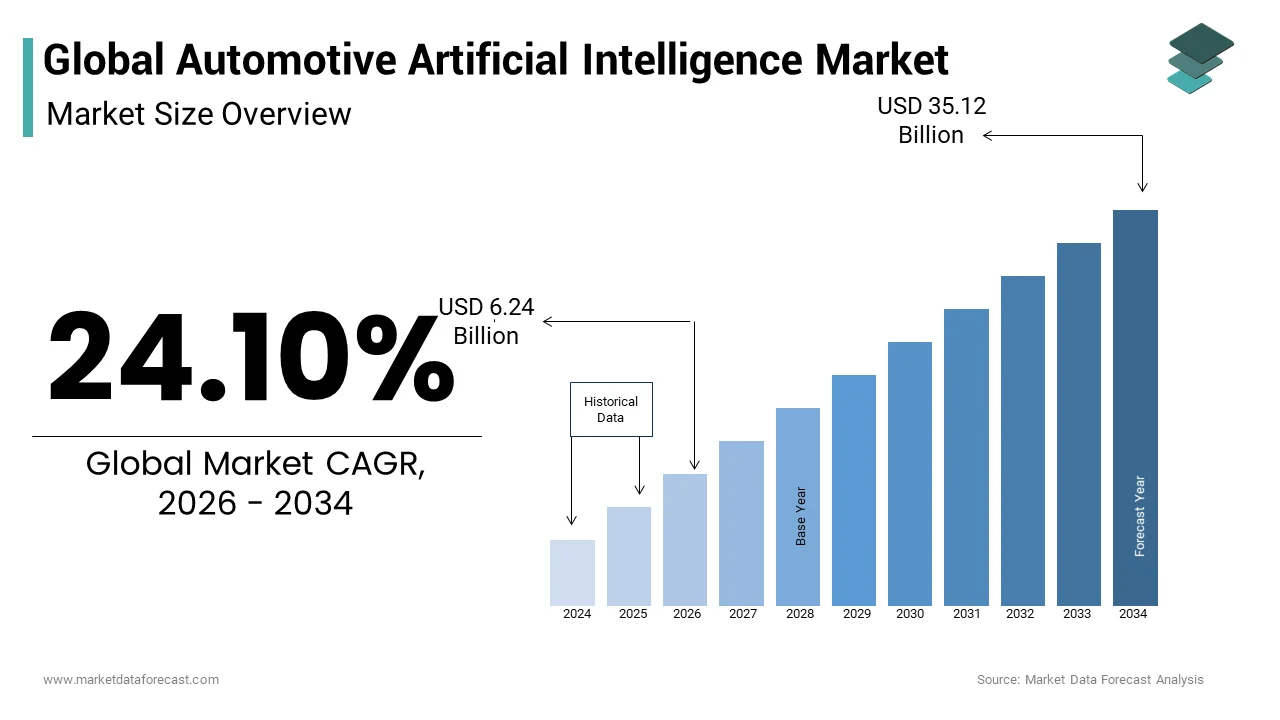
The global automotive artificial intelligence market size was valued at USD 5.03 billion in 2025 and is anticipated to reach a valuation of USD 6.24 billion in 2026 and USD 35.12 billion by 2034, growing at a CAGR of 24.10%, from 2026 to 2034.
Current Introduction To The Automotive Artificial Intelligence Market
Automotive Artificial Intelligence (AI) refers to the integration of machine learning, deep learning, computer vision, and real-time data analytics across the entire automotive lifecycle, from vehicle design and factory manufacturing to in-car operation, safety systems, and supply chain management. These technologies integrate machine learning algorithms with sensor fusion to enhance safety, efficiency, and driver experience. According to the World Health Organisation, global road traffic deaths dropped slightly to approximately 1.19 million per year, driving a worldwide shift toward digital safety standards. According to the National Highway Traffic Safety Administration, human error is a critical reason in 94% of crashes, prompting automakers to scale up commercial deployment of automated safety systems. As per the International Transport Forum, shared automated fleets combined with high-capacity public transport remove 9 out of 10 private cars in mid-sized cities, causing overall vehicle-kilometres to plunge by 37%. This efficiency gain supports broader sustainability goals by minimising idle time and fuel consumption. The integration of AI extends beyond driving functions to predictive maintenance and personalized infotainment services. Semiconductor advancements now allow real time processing of terabytes of data generated by lidar and camera arrays. Regulatory bodies increasingly mandate automated emergency braking and lane-keeping assistance, driving standardisation. The market evolves through collaborations between traditional automakers and technology firms specializing in neural networks. Consumer trust remains pivotal as systems transition from assisted to fully autonomous operations.
MARKET DRIVERS
Stringent Safety Regulations Mandating Advanced Driver Assistance
Stringent safety regulations mandate the inclusion of advanced driver assistance systems powered by AI in new vehicle models, which in turn propels the automotive artificial intelligence market. According to the European Commission, General Safety Regulation requirements make automated emergency braking and lane-keeping systems mandatory for all new car types registered in the European Union from July 2022. This legislative framework creates a guaranteed demand baseline for AI-enabled perception and decision-making modules. As per the National Highway Traffic Safety Administration, updated vehicle assessment protocols reward advanced crash-avoidance technologies to encourage early market adoption and sensing improvements before the 2029 mandatory deadline. According to the Insurance Institute for Highway Safety, automatic emergency braking systems cut rear-end crash rates in half and reduce rear-end crashes involving injuries by 56%. These empirical results justify regulatory pressure and encourage consumer acceptance. Automakers must integrate sophisticated computer vision and radar processing units to comply with these standards. Noncompliance results in restricted market access and significant financial penalties. The regulatory timeline forces rapid development cycles and validation processes. Suppliers invest heavily in certified AI chips that meet automotive-grade reliability standards. This compliance driven demand accelerates technology maturation and cost reduction through economies of scale. Safety mandates effectively transform AI from a luxury feature into a fundamental component of modern vehicle architecture.
Consumer Demand for Enhanced Connectivity and Personalisation
Consumer demand for enhanced connectivity and personalization further contributes to the automotive artificial intelligence market expansion. This demand drives the integration of AI into vehicle infotainment and user interface systems. According to J.D. Power, complex interior technology and frequent infotainment glitches degrade new-vehicle quality scores, shifting consumer preference toward simpler smartphone-mirroring setups. Modern drivers expect seamless smartphone integration, voice recognition, and predictive navigation services that adapt to individual habits. Moreover, according to the Consumer Technology Association, self-driving capabilities and smart thermal energy options stand out as top consumer-tracked tech desires as automakers expand digital cockpits. Artificial intelligence enables natural language processing that understands context and intent rather than simple commands. Machine learning algorithms analyze driving patterns to optimize climate control, seat positioning, and route suggestions automatically. This level of personalization enhances perceived value and differentiates brands in a crowded marketplace. Over-the-air updates allow manufacturers to introduce new AI-driven features post-purchase, extending vehicle relevance. Data privacy concerns are balanced by transparent consent mechanisms and secure cloud architectures. Users appreciate proactive maintenance alerts that prevent breakdowns and reduce ownership anxiety. The shift toward software-defined vehicles relies heavily on AI to manage complex electronic ecosystems. This consumer pull ensures continuous innovation in human machine interaction design.
MARKET RESTRAINTS
High Development and Validation Costs Limiting Accessibility
High development and validation costs limit the accessibility of advanced AI systems to premium vehicle segments initially, which slows down the growth of the global automotive artificial intelligence market. According to the Society of Automotive Engineers, global technology deployment transitions to city-by-city fleet operations as automakers prioritize commercially disciplined rollouts over broad system releases. The complexity of training neural networks on diverse global driving scenarios demands massive computational resources and data labeling efforts. In addition, as per According to the McKinsey Global Institute, global warranty liabilities double to consume over two percent of industry revenue, challenging vehicle reliability as electronics complexity scales up. These expenditures strain profit margins and delay return on investment timelines. Small and medium-sized manufacturers lack the capital reserves to compete in this high-stakes environment. Validation processes require millions of miles of real-world and simulated driving to ensure safety and reliability. Sensor hardware costs remain elevated despite gradual declines in semiconductor pricing. Cybersecurity measures add further layers of expense to protect against digital threats. The financial burden restricts rapid mass market penetration and creates a technology gap between luxury and economy vehicles. Budget constraints force prioritisation of specific features over comprehensive AI integration. This economic barrier slows overall market growth and limits consumer choice in lower price brackets.
Data Privacy and Security Concerns Hindering Adoption
Data privacy and security concerns hinder widespread adoption of AI systems that rely on continuous data collection and cloud connectivity, and ultimately hinder the global automotive artificial intelligence market. According to the European Data Protection Board, the General Data Protection Regulation imposes strict requirements on how automotive manufacturers collect, store, and process personal user data. Also, as per the European Data Protection Board, violations can result in fines amounting to 4% of global annual turnover, creating significant legal risks. According to the Identity Theft Resource Centre, financial and emotional impacts from modern scams hit historic highs as criminal syndicates repurpose previously compromised personal files. Consumers remain wary of sharing detailed driving habits and biometric data with corporations. Lack of transparency in algorithmic decision-making erodes trust in AI-driven safety features. Cyberattacks targeting vehicle control systems pose physical safety risks beyond mere data loss. Manufacturers must invest heavily in encryption and intrusion detection systems to mitigate these threats. Regulatory fragmentation across different countries complicates compliance strategies for global platforms. User consent management becomes complex when multiple third-party services access vehicle data. These privacy challenges slow down the deployment of connected AI features. Companies face reputational damage if security lapses occur, affecting brand equity long-term.
MARKET OPPORTUNITIES
Predictive Maintenance Reducing Operational Downtime
Predictive maintenance powered by AI paves the way to reduce operational downtime and extend vehicle lifespan for commercial fleets, which is likely to promote the global automotive artificial intelligence market growth. According to the American Trucking Associations, unplanned downtime costs carriers between $448 and $760 per vehicle per day, accelerating the industry adoption of predictive breakdown diagnostics. AI algorithms analyse real-time sensor data from engines, brakes, and transmissions to predict component failures before they occur. Moreover, as per the International Council on Clean Transportation, carbon dioxide emission and fuel efficiency mandates generate more than half of the global emission reductions required through 2050. This capability transforms maintenance from a reactive cost centre to a proactive efficiency driver. Fleet managers receive actionable insights via dashboards that prioritize repairs based on urgency and impact. Original equipment manufacturers offer subscription-based monitoring services that generate recurring revenue streams. Insurance companies provide discounts for fleets using verified predictive maintenance tools due to lower accident risks. Integration with supply chain systems ensures spare parts availability just in time for scheduled service. This operational efficiency appeals strongly to logistics and transportation sectors facing tight margins. The technology also supports sustainability goals by preventing catastrophic failures that lead to premature vehicle disposal.
Autonomous Ride Hailing Services Transforming Urban Mobility
Autonomous ride hailing services powered by AI offer a transformative opportunity to reshape urban mobility economics and accessibility, which is predicted to boost the global automotive artificial intelligence market expansion. According to the World Economic Forum, continuous regulatory improvements and expanded digital connectivity across modern transit grids accelerate the rollout of scaled shared automated transport networks. The drastic reduction makes private car ownership less economically attractive for urban residents. In addition, as per the International Association of Public Transport, automated vehicle deployments must integrate directly as shared assets reinforcing existing public transit systems to prevent increased urban congestion. Higher utilisation justifies the initial capital investment in advanced AI hardware and sensors. Cities benefit from reduced parking demand as vehicles circulate continuously or park in remote hubs. AI optimizes dispatching and routing to minimize wait times and maximize passenger pooling. This efficiency reduces overall vehicle miles travelled and associated emissions. Regulatory sandboxes in major cities allow testing of these services under controlled conditions. Early adopters gain valuable data on user behaviour and system performance in complex environments. The shift toward mobility as a service aligns with younger generations' preferences for access over ownership. This model opens new revenue channels for technology providers and automakers alike.
MARKET CHALLENGES
Ethical Decision Making in Critical Scenarios
Ethical decision-making in critical scenarios remains a profound hurdle for AI systems tasked with life-and-death choices during unavoidable accidents, and it holds back the global automotive artificial intelligence market's expansion. According to the Massachusetts Institute of Technology Moral Machine experiment, public opinion varies significantly across cultures regarding how autonomous vehicles should prioritise lives in dilemma situations. There is no universal consensus on whether AI should protect passengers or pedestrians, or prioritize younger individuals over older ones. Also, as per the German Ethics Commission on Automated Driving, vehicle safety guidelines require absolute programming neutrality that forbids any discrimination based on personal characteristics like age or gender. Programming these ethical frameworks into algorithms requires philosophical judgments that engineers are not trained to make. Liability issues arise when AI decisions result in harm, complicating insurance and legal responsibility. Public trust erodes if perceived biases exist in algorithmic prioritization logic. Regulators struggle to create standardised ethical protocols that apply globally. Manufacturers face reputational risks if their systems are perceived as unfair or unsafe in edge cases. The lack of clear legal precedents creates uncertainty for developers and insurers. Resolving these ethical dilemmas is essential for social acceptance of fully autonomous vehicles.
Infrastructure Readiness for Connected Autonomous Vehicles
Infrastructure readiness for connected autonomous vehicles remains a significant challenge for the global automotive artificial intelligence market. This limits the full potential of AI in transportation. According to the American Society of Civil Engineers, national transportation and structural assets earn an overall grade of C, showing that recent infrastructure investments are beginning to reverse decades of systemic underinvestment. Most existing roads lack the vehicle to infrastructure communication units necessary for real time data exchange with AI systems. Besides, as per the International Road Federation, comprehensive preventative maintenance and uniform pavement markings remain essential criteria for ensuring predictable vehicle guidance across global transit corridors. Smart traffic lights and roadside sensors are sparse outside of pilot zones in major cities. Rural areas suffer from limited connectivity bandwidth required for high definition map updates and cloud processing. Standardisation of communication protocols between different manufacturers and infrastructure providers is still evolving. Municipal budgets often prioritise basic repairs over digital upgrades needed for automation. The mismatch between advanced vehicle capabilities and primitive road environments creates operational bottlenecks. Weather conditions further degrade sensor performance on unmaintained surfaces. Bridging this infrastructure gap requires coordinated public investment and policy alignment that spans decades.
REPORT COVERAGE
| REPORT METRIC | DETAILS |
| Market Size Available | 2025 to 2034 |
| Base Year | 2025 |
| Forecast Period | 2026 to 2034 |
| CAGR | 24.10% |
| Segments Covered | By Application, Component, Technology, Process, and Region. |
|
Various Analyses Covered | Global, Regional & Country Level Analysis, Segment-Level Analysis, DROC, PESTLE Analysis, Porter’s Five Forces Analysis, Competitive Landscape, Analyst Overview of Investment Opportunities |
| Regions Covered | North America, Europe, APAC, Latin America, Middle East & Africa |
| Market Leaders Profiled | NVIDIA Corporation (US), Alphabet Inc. (US), (US), IBM Corporation (US), Microsoft Corporation (US), Harman International Industries Inc. (US), Xilinx Inc. (US), Qualcomm Inc. (US), Tesla Inc. (US), Volvo Car Corporation (Sweden), BMW AG (Germany), Audi AG (Germany), General Motors Company (US), Ford Motor Company (US), Toyota Motor Corporation (Japan), Hyundai Motor Corporation (South Korea), Uber Technologies Inc. (US), Honda Motor Co. Ltd. (Japan), Daimler AG (Germany), and Didi Chuxing (China). Some important start-ups in the automotive AI market have also been included: AImotive (Hungary), Nauto Inc. (US), nuTonomy (US), Argo AI (US), drive.ai (US), and Others. |
SEGMENTAL ANALYSIS
By Application Insights
Semi-Autonomous
In 2025, the semi-autonomous segment held the majority share in the automotive artificial intelligence market because of widespread regulatory mandates for advanced driver assistance systems and higher consumer trust levels. According to the European Commission, General Safety Regulation requirements mandate automated emergency braking and lane keeping systems for all new vehicle types, creating a standardized baseline for semi-autonomous features. This legislative push ensures that nearly every new vehicle sold in major markets includes AI-powered safety interventions. Moreover, according to the Insurance Institute for Highway Safety, automatic emergency braking systems cut rear-end crash rates in half and reduce rear-end crashes involving injuries by 56%. Consumers perceive semi-autonomous features as helpful aids rather than replacements for human control, reducing psychological barriers to adoption. Automakers can deploy these systems using existing sensor suites without requiring the expensive lidar arrays needed for full autonomy. The technology allows for gradual feature expansion through over the air updates, extending vehicle lifecycle value. Liability frameworks remain clear since the driver retains ultimate responsibility for vehicle operation. Insurance premiums decrease for vehicles with verified semi-autonomous capabilities, creating financial incentives for buyers. These factors combine to make semi-autonomous applications the volume driver of the current market landscape.
Fully Autonomous
The fully autonomous segment is likely to experience the fastest CAGR of 28.4% between 2026 and 2034, as commercial logistics operators seek to eliminate labour costs and improve supply chain efficiency. This acceleration is propelled by the economic imperative to operate vehicles continuously without the driver rest breaks mandated by labour laws. According to the American Trucking Associations, the industry needs 60,800 more drivers to meet freight demands, prompting carriers to expand domestic recruitment pipelines. Fully autonomous trucks can operate 24 hours a day, significantly increasing asset utilisation rates and delivery speed. In addition, as per the World Economic Forum, empty miles account for 15% of total trucking distances, forcing logistics networks to deploy AI routing systems for better capacity matching. Regulatory sandboxes in states like Arizona and Texas allow extensive testing of driverless heavy-duty vehicles on public highways. Technology companies partner with established carriers to validate safety records in real-world conditions. The controlled environment of highway driving is technically simpler than urban navigation, accelerating deployment timelines. Investment capital flows heavily into this segment due to the clear return on investment model. These commercial drivers propel fully autonomous technology forward despite slower consumer adoption rates.
By Component Insights
Hardware
The hardware segment was the largest in 2025 and occupied a commanding share of the automotive artificial intelligence market. This market prominence was supported by the fact that every AI function requires physical sensors, cameras, and high-performance computing units to process data. According to the Semiconductor Industry Association, worldwide microchip production systems face changing assembly pressures as consumer electronics and vehicle manufacturers compete for advanced silicon wafers. The substantial increase reflects the need for powerful graphics processing units and neural network accelerators. Besides, as per the International Electrotechnical Commission, global vehicle developers operating specialized test fleets record 22 terabytes of operational metrics per car daily during engineering evaluations. Lidar, radar, and ultrasonic sensors form the physical eyes of the AI system, requiring precise manufacturing and calibration. Automotive-grade chips must withstand extreme temperatures and vibrations, adding complexity to production. Supply chain constraints for specialised components have highlighted the strategic importance of hardware availability. Original equipment manufacturers secure long-term supply agreements to ensure production continuity. The physical nature of hardware creates high entry barriers for new competitors due to capital intensity. These tangible requirements ensure hardware remains the largest component of AI spending in the near term.
Software
The software segment is expected to exhibit a noteworthy CAGR of 19.2% during the forecast period. Vehicles are transitioning to software-defined architectures that allow continuous improvement post-purchase. This growth is fueled by the ability of manufacturers to monetize features through subscriptions and enhance performance remotely. According to a study, automated driver assistance systems feature in 52 percent of global vehicle shipments, changing entry-level factory configurations. The shift transforms automobiles into updatable devices similar to smartphones. In addition, as per the Society of Automotive Engineers, connected platform architectures let engineering teams extract field metrics directly to monitor software performance patterns after system changes. The capability reduces warranty costs and improves customer satisfaction significantly. Artificial intelligence algorithms require constant retraining with new data to improve accuracy and handle edge cases. Cloud based platforms facilitate this continuous learning loop across entire fleets. Cybersecurity software becomes increasingly critical to protect connected vehicles from digital threats. The recurring revenue potential of software services attracts significant investment from technology firms. These dynamics drive rapid expansion in the software component of the AI market.
By Process Insights
Image Recognition
Image recognition led the automotive artificial intelligence market and captured a significant share in 2025. Visual perception is fundamental for lane detection, traffic sign reading, and obstacle identification, and therefore contributes to the leading position of this segment. According to the National Highway Traffic Safety Administration, distraction-affected crashes account for approximately 8% of all road fatalities, urging automotive teams to develop robust driver monitoring safety electronics. Cameras provide high-resolution data that allows AI systems to interpret complex visual scenes in real time. Moreover, as per the Institute of Electrical and Electronics Engineers, multi-sensor computer vision networks show improved edge processing efficiency as automakers scale up vision-based vehicle intelligence packages. This reliability makes image recognition the primary input for most advanced driver assistance systems. Automotive cameras are relatively inexpensive compared to lidar sensors, enabling widespread deployment across vehicle segments. Image processing algorithms identify pedestrians, cyclists, and other vehicles with high precision. The technology supports automatic emergency braking and adaptive cruise control functions effectively. Continuous improvements in low light performance expand operational capabilities during night driving. Regulatory standards increasingly require camera-based monitoring of driver attention levels. These widespread applications ensure image recognition remains the dominant processing method in current AI implementations.
Data Mining
The data mining segment is predicted to witness the highest CAGR of 22.5% from 2026 to 2034. This quick surge of the segment is driven by the need to extract actionable insights from the massive datasets generated by connected vehicles. Manufacturers are leveraging vast amounts of vehicle telemetry for predictive maintenance and user personalisation. According to the International Data Corporation, the global datasphere will grow to 175 zettabytes by 2025, with automotive data representing a significant and valuable portion. Data mining algorithms identify patterns in engine performance, battery degradation, and driving behaviour to predict failures before they occur. Besides, as per the American Trucking Associations, freight carriers expand real-time telemetry systems across operations to optimize truck distribution and monitor vehicle condition metrics. Personalised insurance models use mined data to offer usage-based premiums that reward safe driving habits. Manufacturers analyse aggregated data to improve future vehicle designs and feature sets. Cloud computing platforms enable scalable processing of this information across millions of vehicles. Privacy preserving techniques allow useful analysis without compromising individual user confidentiality. The economic value of derived insights drives investment in advanced analytics tools. This trend transforms raw data into a strategic asset for automotive companies.
REGIONAL ANALYSIS
North America Market Analysis
North America holds a prominent position in the automotive artificial intelligence market and captured a 35.6% share in 2025. The regional market is known for strong technological innovation and supportive regulatory frameworks for testing. This growth of the North American market is propelled by significant investments from technology giants and established automakers. According to the United States Department of Transportation, federal guidelines for automated driving systems provide a flexible framework that encourages innovation while ensuring safety. The approach has allowed companies to conduct extensive testing in multiple states. Moreover, as per the National Highway Traffic Safety Administration, customized vehicle developer exemptions provide tailored evaluation pathways for purpose-built designs lacking traditional manual inputs. Silicon Valley serves as a hub for AI software development, attracting top talent and venture capital. Consumer acceptance of advanced driver assistance features is high due to familiarity with technology products. Insurance models are evolving to accommodate AI-driven safety improvements. The presence of major semiconductor manufacturers supports local supply chain resilience. Cross-border collaboration with Canada enhances research capabilities in cold-weather automation. These factors create a robust ecosystem for continued market leadership and technological advancement.
Europe Market Analysis
Europe is also a major player in the automotive artificial intelligence market because of strict safety regulations and a focus on ethical AI development. The region prioritises passenger protection and data privacy, influencing global standards for autonomous vehicle deployment. According to the European Commission, the General Data Protection Regulation sets stringent rules for handling personal data collected by connected vehicles, shaping global privacy practices. The regulatory environment builds consumer trust in AI systems. The United Nations Economic Commission for Europe establishes international regulations for automated lane-keeping systems that member states adopt. German automakers lead in engineering precision and integration of AI into luxury vehicles. France and Sweden invest heavily in smart infrastructure projects that support vehicle-to-grid communication. Public transportation agencies explore AI for optimising bus and tram networks in dense urban areas. The European Green Deal promotes AI solutions that reduce emissions through efficient driving patterns. Collaboration between academia and industry fosters innovation in explainable AI algorithms. These structured approaches ensure sustainable and responsible market growth across the continent.
Asia Pacific Market Analysis
Asia-Pacific dominated the automotive artificial intelligence market and accounted for a 40.5% share in 2025. This dominance is led by China's aggressive manufacturing scale and government support for smart mobility. The region benefits from rapid urbanization and high adoption rates of electric vehicles that serve as platforms for AI integration. According to the Ministry of Industry and Information Technology of China, nationwide intelligent vehicle deployments integrate standardized combined driver assistance frameworks to govern local data localization and cybersecurity parameters. Japan and South Korea contribute advanced robotics and semiconductor expertise to the regional supply chain. Singapore implements comprehensive smart nation initiatives that include autonomous public transport trials. India emerges as a software development hub for AI algorithms used globally. High population density in cities creates urgent needs for traffic optimization solutions. Local governments provide subsidies for intelligent transportation infrastructure projects. Manufacturing cost advantages enable competitive pricing for AI-enabled vehicles. Cross-border trade agreements facilitate component flow within the region. The combination of policy support, technical talent, and market size ensures Asia Pacific remains the centre of gravity for automotive AI innovation and production.
Latin America Market Analysis
Latin America is a developing landscape in the automotive artificial intelligence market due to gradual adoption of advanced safety features in premium segments. The region faces infrastructure challenges but demonstrates growing interest in connectivity solutions for fleet management. According to the Inter-American Development Bank, region-wide transportation initiatives prioritise regional connectivity frameworks under a unified regional action plan to improve cross-border logistics efficiency. Brazil leads regional adoption with local manufacturing plants integrating basic AI assisted driving systems. Mexico benefits from proximity to North American supply chains and export-oriented production facilities. Urban congestion in major cities like Sao Paulo and Mexico City drives demand for navigation and traffic prediction tools. Insurance companies begin offering telematics based policies that rely on AI data analysis. Economic volatility limits widespread deployment of expensive autonomous hardware. However, mobile connectivity growth enables cloud-based AI services for older vehicle models. Government efforts to modernise public transport include pilot projects for smart bus systems. The market remains nascent but shows potential as economic stability improves and technology costs decline.
Middle East and Africa Market Analysis
The Middle East and Africa region is anticipated to expand in the global automotive artificial intelligence market during the forecast period. This growth is fuelled by visionary smart city projects in Gulf nations and safety initiatives in Africa. The region leverages oil revenues to invest in futuristic transportation infrastructure that incorporates AI technologies. According to the Saudi Arabian Public Investment Fund, masterplanned giga-projects expand advanced underground high-speed transit networks to enable automated, zero-car surface districts. Dubai aims to convert 25% of all transportation trips to autonomous modes by 2030, creating a strong policy driven demand. South Africa leads African adoption, with mining companies using autonomous haul trucks for improved safety and efficiency. High temperatures and desert conditions require specialized AI calibration for sensor reliability. Tourism sectors explore autonomous shuttles for enhanced visitor experiences in resort areas. Limited local manufacturing means reliance on imports from global suppliers. Connectivity improvements enable remote monitoring and management of AI systems. Government partnerships with technology firms accelerate knowledge transfer and local capability building. The market focuses on high-value applications in controlled environments before expanding to general public roads.
COMPETITIVE LANDSCAPE
The automotive artificial intelligence market features intense competition among technology giants semiconductor manufacturers and traditional automakers seeking leadership in autonomous driving. Major players leverage their extensive resources to develop comprehensive ecosystems that integrate hardware software and cloud services. Competition centers on processing power algorithm accuracy and safety validation metrics. Companies strive to demonstrate reliability through millions of miles of simulated and real world testing data. Intellectual property rights drive continuous innovation in neural network architectures and sensor fusion techniques. Partnerships with ride hailing services provide valuable operational data for refining AI models. Price competitiveness remains crucial as economies of scale reduce component costs over time. Talent acquisition is a key battleground as skilled AI engineers are in short supply globally. Regulatory compliance capabilities determine market access in different jurisdictions. The market structure favors entities with strong financial backing to sustain long development cycles. Reputation for safety and technological superiority significantly impacts brand positioning and customer trust.
KEY MARKET PLAYERS
These are the market players that are dominating the global automotive artificial intelligence market.
- NVIDIA Corporation (US)
- Alphabet Inc. (US)
- IBM Corporation (US)
- Intel Corporation
- Microsoft Corporation (US)
- Harman International Industries Inc. (US)
- Xilinx Inc. (US)
- Qualcomm Inc. (US)
- Tesla Inc. (US)
- Volvo Car Corporation (Sweden)
- BMW AG (Germany)
- Audi AG (Germany)
- General Motors Company (US)
- Ford Motor Company (US)
- Toyota Motor Corporation (Japan)
- Hyundai Motor Corporation (South Korea)
- Uber Technologies Inc. (US)
- Honda Motor Co. Ltd. (Japan)
- Daimler AG (Germany)
- Didi Chuxing (China)
- AImotive (Hungary)
- Nauto Inc. (US)
- nuTonomy (US)
- Argo AI (US)
- Drive.ai (US)
Top Players In The Market
- NVIDIA Corporation serves as a foundational enabler of automotive artificial intelligence by providing high performance computing platforms for autonomous driving. The company supplies powerful graphics processing units and system on chips that process vast amounts of sensor data in real time. Recent actions include expanding partnerships with major automakers to integrate its DRIVE platform into next generation vehicle architectures. NVIDIA focuses on developing end to end AI solutions that cover simulation, training, and inference. Its Omniverse platform allows manufacturers to create digital twins for virtual testing and validation. The firm invests heavily in software development kits that simplify AI integration for engineers. Collaborations with cloud providers enable scalable data processing for fleet learning. These initiatives solidify its role as a critical technology partner in the transition to software defined vehicles.
- Intel Corporation contributes significantly through its Mobileye subsidiary which specializes in computer vision and advanced driver assistance systems. The company provides comprehensive hardware and software stacks that power autonomous driving capabilities across various vehicle segments. Recent developments involve scaling production of EyeQ system on chips to meet growing global demand. Intel leverages its manufacturing expertise to ensure supply chain stability for critical automotive components. The firm collaborates with regulatory bodies to establish safety standards for automated driving technologies. It offers robust mapping services that support precise localization for autonomous vehicles. Strategic alliances with tier one suppliers facilitate seamless integration of AI modules into vehicle electronics. These efforts enhance its position as a leader in safe and scalable autonomous driving solutions.
- Alphabet Inc drives innovation in the automotive artificial intelligence market through its Waymo subsidiary which leads in fully autonomous driving technology. The company operates commercial robotaxi services that generate real world data to refine AI algorithms continuously. Recent actions include expanding operational zones in multiple cities and partnering with traditional automakers for vehicle integration. Alphabet invests in specialized lidar and sensor technologies to improve perception accuracy in complex environments. Its deep learning models excel at predicting pedestrian and vehicle behavior in urban settings. The firm shares its safety framework and best practices with industry stakeholders to build trust. Cloud infrastructure supports massive data storage and processing needs for machine learning training. These strategies maintain its competitive edge in high level autonomy development and deployment.
Top Strategies Used By Key Market Participants
Key players in the automotive artificial intelligence market prioritize strategic partnerships to combine hardware expertise with software innovation effectively. Companies invest heavily in research and development to create proprietary algorithms that differentiate their offerings from competitors. Vertical integration strategies allow firms to control critical components such as chips and sensors ensuring supply chain resilience. Open source initiatives foster ecosystem growth by enabling developers to build applications on standardized platforms. Acquisitions of specialized AI startups accelerate technology adoption and fill capability gaps quickly. Focus on cybersecurity ensures protection against evolving digital threats targeting connected vehicles. Collaboration with regulatory bodies helps shape favorable policies for autonomous testing and deployment. Data sharing consortia improve algorithm training efficiency by pooling diverse driving scenarios. These approaches collectively drive technological advancement and market expansion in the sector.
MARKET SEGMENTATION
This research report on the global automotive artificial intelligence market is segmented and sub-segmented into the following categories.
By Application
- Semi-Autonomous
- Fully Autonomous
By Component
- Hardware
- Processor
- Microprocessor (MPU)
- Graphics Processing Unit (GPU)
- Memory
- Network
- Processor
- Software
- Service
By Technology
- Machine Learning & Deep Learning
- Computer Vision
- Natural Language Processing
By Process
- Signal recognition
- Image recognition
- Data mining
By Region
- North America
- Europe
- Asia Pacific
- Latin America
- Middle East and Africa