- Product Description Description
- Table of Contents TOC
- List of Table & Figure LOT
- Get Free Sample PDF Sample PDF
Market Size, 2025
$52.15 BnMarket Estimate, 2026
$55.75 BnMarket Forecast, 2034
$95.07 BnCAGR, 2026–2034
6.90%Executive Summary: Global Automotive Bearing Market
- Market Scope: Comprehensive global automotive bearing market analysis covering bearing types, outer diameter specifications, industry applications, regional leadership frameworks, and friction-reduction performance metrics.
- Market Valuation: Valued at USD 52.15 billion (2025), estimated at USD 55.75 billion (2026), and projected to reach USD 95.07 billion by 2034, registering a CAGR of 6.90% (2026–2034).
- Primary Growth Drivers: Rapid expansion of global vehicle production, increasing average vehicle life driven by low-fuel consumption technologies, heightened demand for lightweight high-performance materials, and advanced seal/gasket technologies designed to block contaminants and increase operational longevity.
Key Market Segment Metrics (2026–2034)
| Category | Leading Segment (2025 Position) | Fastest-Growing Segment |
|---|---|---|
| By Bearing Type | Ball and plain bearings (widely deployed for high-speed rotation, heavy load capacity, and minimal noise/vibration) | Roller bearings and composite cone/needle variants engineered for high-performance automotive powertrains |
| By Outer Diameter | Mid-range outer diameters (10mm–21mm and 23mm–32mm categories commonly utilized in compact automotive assemblies) | Larger-diameter bearing specs (>45mm) aligned with heavy-duty commercial vehicle architectures |
| By Application | Automotive sector (occupies the largest market share owing to surging passenger car and two-wheeler manufacturing) | Electrical and industrial vehicle systems experiencing rapid electrification upgrades |
| By Region | Asia-Pacific (leads globally due to high manufacturing output and immense vehicle demand in China, India, and Japan) | Europe and North America (mature markets expanding steadily with a 5.80% CAGR through lightweight R&D investments) |
Major Market Players & Market Structure
Market Structure: Highly consolidated global bearing manufacturing landscape dominated by multinational precision-engineering giants competing on rolling element production capacity, low-friction durability, and localized supply chain expansion.
Key Companies: Timken Co. (U.S.), SKF (Sweden), Schaeffler AG (Germany), JTEKT Corp. (Japan), NTN Corp. (Japan), Iljin Bearing Co. Ltd, RKB Bearings, ORS Bearings, and CW Bearing.
 Download Free Sample Report
Global Automotive Bearing Market Size
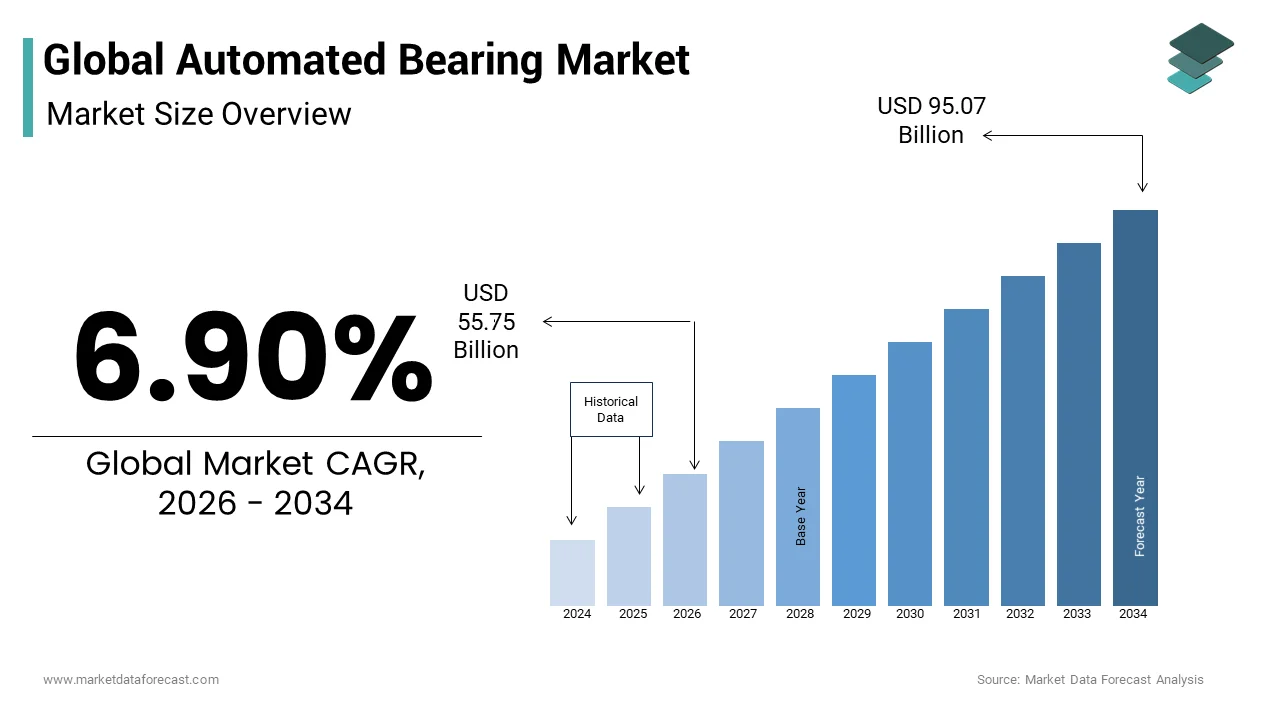
The global automotive bearing market size was valued at USD 52.15 billion in 2025 and is anticipated to reach a valuation of USD 55.75 billion in 2026 and USD 95.07 billion by 2034, growing at a CAGR of 6.90%, from 2026 to 2034.
Introduction and Overview of the Automotive Bearing Market
An automotive bearing is a critical mechanical component designed to reduce friction, support heavy loads, and guide smooth rotational or linear movement between stationary and moving parts within a vehicle. These high-precision components are critical to wheel hubs, internal combustion engine systems, transmissions, steering assemblies, electric vehicle e-axles, and suspension setups. Market growth is fundamentally tied to international vehicle assembly volumes, technological shifts toward electrification, and the demand for lightweight structural materials. According to the International Organisation of Motor Vehicle Manufacturers (OICA), world motor vehicle assembly hit 92.7 million units in 2024, demonstrating a clear rebound in manufacturing scale that directly supports factory-level bearing demand. Furthermore, structural shifts within vehicle architectures are altering component requirements. As per the International Energy Agency (IEA), global sales of electric cars passed 17 million units in 2024, representing over 20% of all vehicle purchases. Consequently, bearing designs are evolving rapidly to withstand higher rotational speeds, reduce energy loss, and operate efficiently without fluid lubrication in localised electric drivetrain environments.
MARKET DRIVERS
Global Production Volume Acceleration in Emerging Automotive Hubs
Rapid industrial expansion and rising localized motorization rates are driving the automotive bearing market. These are accelerating output requirements for vehicular rotational components across primary assembly regions. According to the International Organisation of Motor Vehicle Manufacturers (OICA), Asia Pacific automotive factories generated more than 61% of total world vehicle output in 2025. Within this manufacturing ecosystem, as per the International Organisation of Motor Vehicle Manufacturers (OICA), China produced 34.53 million vehicles in 2025, marking a 10.4% year-over-year growth rate. This volume spike creates massive, direct demand for wheel hub assemblies, transmission needle roller bearings, and steering system ball bearings. Because every standard four-wheel passenger vehicle incorporates between 35 and 50 distinct bearings across its mechanical sub-assemblies, localised vehicle production directly scales factory delivery quotas for component suppliers. High manufacturing output in key growth zones requires tier 1 suppliers to build continuous inventory streams, driving heavy sustained orders for specialised high-carbon chromium steel bearings.
Electrification of Powertrains Demanding High-Speed Bearing Units
The structural conversion from internal combustion engines to electric propulsion systems represents a major technological driver reshaping bearing specifications and demand profiles, which propels the automotive bearing market. According to the International Energy Agency (IEA), total global electric car sales increased by 20% in 2025 compared to 2024, exceeding 20 million units. Furthermore, as per the International Energy Agency (IEA), the overall market penetration of electric cars reached 25% of all new car sales worldwide in 2025. Electric vehicle motors operate at significantly higher revolutions per minute compared to standard combustion engines, often exceeding 15000 to 20000 RPM. This operational environment forces automakers to upgrade from traditional metallic bearings to advanced ceramic hybrid bearings and specialised deep groove ball bearings designed to mitigate electrical stray currents and high thermal friction. The ongoing fleet conversion ensures elevated replacement and original equipment manufacturer demand for ultra-low-friction, high-speed rotational components tailored exclusively for electric motor housings and integrated e-axles.
MARKET RESTRAINTS
Price Volatility of High Grade Carbon and Alloy Steels
Raw material price instability is a major structural restraint to profit margins and pricing predictability for component manufacturers, which slows down the growth of the automotive bearing market. According to sources, the global automotive bearing market operates under high exposure to fluctuating input costs for essential raw materials like steel, which accounts for a significant portion of manufacturing costs and experiences volatility due to geopolitical tensions and supply-demand dynamics. Additionally, as per sources, high-carbon chromium bearing steel grades, such as 100Cr6, serve as a foundational material segment for producing rolling elements and rings within the global automotive bearing supply chain. Because high-carbon steel forms the fundamental structural backbone for outer rings, inner rings, and rolling elements, price swings in raw metal directly squeeze component profit margins. Tier 1 bearing suppliers frequently work under long-term, multiyear supply contracts with vehicle original equipment manufacturers, preventing them from instantly passing sudden steel price hikes onto end clients. This creates serious cost pressure and financial uncertainty throughout the manufacturing tier.
Thermal and Electrical Breakdown in High Voltage Propulsion Systems
The technical challenges associated with stray current damage and thermal degradation in electric drivetrains limit the operational lifespan of traditional metallic bearings, which constrains the expansion of the automotive bearing market. As per the International Energy Agency, the share of battery electric cars in total electric car sales rose from 55% in 2020 to nearly 70% in 2025, reflecting global electrification trends across major passenger vehicle fleets. Additionally, as per research, standard steel remains the foundational and primary material used across the global automotive bearing production sector due to its structural strength and load capacity. In high-voltage battery electric vehicles, electrical current leakage often passes through standard steel bearings, causing electric discharge micro-pitting, fluting, and premature lubricant failure. Standard steel bearings struggle to handle these micro electrical discharges without costly insulated coatings or expensive ceramic hybrid replacements. This structural durability bottleneck creates hesitation among vehicle manufacturers relying on lower-cost steel components, forcing expensive redesigns and material re-evaluations across vehicle assembly lines.
MARKET OPPORTUNITIES
Commercialisation of Silicon Nitride Ceramic Hybrid Bearings
The push toward high-efficiency vehicle platforms creates a major commercial opportunity in advanced ceramic hybrid bearing technologies, which are expected to fuel the growth of the automotive bearing market. According to sources, ceramic and hybrid bearings are projected to demonstrate a fast growth pace through 2031 within the overall automotive bearing landscape. Furthermore, as per the International Energy Agency, battery electric vehicle sales in emerging and developing economies outside China surged by roughly 80% in 2025, demonstrating massive market expansion into non-traditional automotive regions. Ceramic hybrid bearings utilise silicon nitride rolling elements with steel rings, offering complete electrical insulation, lower density than steel, and exceptional heat resistance during extreme rotational speeds. As automakers strive to maximise electric vehicle driving range by cutting internal mechanical drag, ceramic hybrid bearings offer a proven route to lower energy consumption. Component manufacturers investing early in silicon nitride processing capabilities can capture high-margin premium contracts across next-generation electric vehicle platforms.
Expanding Last Mile Logistics and Light Commercial Fleet Demand
The global surge in e-commerce delivery networks provides a strong growth opening for durable commercial vehicle bearing assemblies, which are anticipated to accelerate the expansion of the automotive bearing market. As per market consensus, the commercial vehicle sector represents a key growing category in automotive steel utilisation, targeted to expand alongside the broader global vehicle production. Additionally, as per the International Organisation of Motor Vehicle Manufacturers, worldwide motor vehicle sales reached ~99.8 million in 2025 (a 4.7% rise from 95.3 million in 2024). Light commercial fleets operate under demanding stop-and-start cycles, elevated payload stresses, and continuous high-mileage daily routes. This constant operational stress accelerates component wear, driving steady demand for heavy-duty tapered roller bearings, double-row hub units, and aftermarket replacement kits. Bearing manufacturers that develop high load capacity unitised bearings tailored for urban delivery vans and commercial fleets stand to gain dependable, continuous aftermarket and OEM revenue streams.
MARKET CHALLENGES
Weight Reduction Pressures vs Heavy Mechanical Duty Demands
The conflict between structural weight reduction targets and long-term mechanical load resistance in modern vehicle design creates a significant challenge and ultimately limits the growth of the automotive bearing market. According to the World Steel Association, the use of Advanced High-Strength Steels (AHSS) enables carmakers to optimise vehicle design and reduce structural weight by 25% to 39% compared to conventional steel, supporting a strong industry-wide push for lightweight automotive components. Simultaneously, according to the International Energy Agency, the global fleet of electric vehicles avoided the consumption of 1.7 million barrels per day of oil globally in 2025, highlighting the continuous industry focus on energy efficiency and weight minimisation. Bearings are subjected to intense dynamic forces during vehicle acceleration, cornering, and braking. Downsizing bearing dimensions or using thinner wall rings to save weight often compromises structural rigidity, leading to premature fatigue failure under heavy shock loads. Engineers face a complex technical hurdle. They must continuously reduce component mass and wall thickness while maintaining high dynamic load ratings, noise, vibration, and harshness standards, and operating lifespans over 150,000 miles.
Counterfeit Component Infiltration in Aftermarket Distribution Channels
The proliferation of substandard counterfeit bearings in the global replacement aftermarket threatens brand credibility and vehicle operational safety, a factor that holds back the expansion of the automotive bearing market. As per the International Organization of Motor Vehicle Manufacturers, overall global vehicle production reached 92.7 million units in 2024, maintaining a massive worldwide active vehicle fleet that demands ongoing maintenance. Additionally, as per research, passenger vehicles make up the vast majority of the global automotive fleet, serving as a primary target for component suppliers and third-party aftermarket replacement sales. Counterfeiters manufacture sub-par bearings using inferior low grade steel alloys and inaccurate grinding tolerances, then package them as authentic products from leading tier 1 brands. These fraudulent components often fail prematurely under standard operating loads, leading to severe wheel lockup, axle damage, or catastrophic vehicle failure. Original bearing manufacturers are forced to invest heavily in cryptographic packaging verification, supply chain tracking systems, and legal anti-counterfeiting actions to protect their market share and brand reputation.
REPORT COVERAGE
| REPORT METRIC | DETAILS |
| Market Size Available | 2025 to 2034 |
| Base Year | 2025 |
| Forecast Period | 2026 to 2034 |
| CAGR | 6.90% |
| Segments Covered | By Bearing Type, Outer Diameter, Application, and Region. |
|
Various Analyses Covered | Global, Regional, and Country Level Analysis; Segment-Level Analysis, DROC; PESTLE Analysis; Porter’s Five Forces Analysis; Competitive Landscape; Analyst Overview of Investment Opportunities |
| Regions Covered | North America, Europe, APAC, Latin America, Middle East & Africa |
| Market Leaders Profiled | Timken Co. (U.S.), SKF (Sweden), Schaeffler AG (Germany), JTEKT Corp. (Japan), NTN Corp. (Japan), Jtekt Corporation, Iljin Bearing Co. Ltd, Svenska Kullagerfabriken AB, RKB Bearings, ORS Bearings, CW Bearing, and Others. |
SEGMENTAL ANALYSIS
By Bearing Insights
Ball Bearings
The ball bearings segment was the largest in 2025 and occupied a 49.8% share of the automotive bearing market. Its operational versatility allows it to handle both radial and axial loads efficiently across wheel hubs, transmissions, steering columns, and electric vehicle traction motors. The main driver behind the prominence of this segment is its extensive adoption across virtually all rolling vehicle subassemblies. According to sources, ball bearings account for a leading revenue share in the automotive sector, driven by their widespread integration in steering setups, gearboxes, engine accessories, and suspension modules. Furthermore, as per the International Organization of Motor Vehicle Manufacturers, global motor vehicle output reached 92.7 million units in 2024, creating an expansive original equipment manufacturing pipeline that utilizes an average layout of individual ball bearing units per passenger car. This immense vehicle volume requires component manufacturers to stock millions of standardised deep groove and angular contact ball bearings, preserving their major market share across global assembly lines.
Plain Bearings
The plain bearings segment is expected to exhibit a noteworthy CAGR of 6.4% across the automotive bearing market forecast period due to aggressive vehicle weight reduction mandates and tight spatial constraints within next-generation vehicle architectures. Vehicle manufacturers are increasingly substituting bulky rolling element bearings with compact plain bearings to meet rigorous mass reduction targets. According to data from the International Energy Agency, electric light commercial vehicle sales expanded by more than 40% in 2024, creating intense engineering pressure to optimise battery space and minimise structural weight. Additionally, as per research, plain bearing assemblies captured massive global revenue in 2025, supported by expanding utilization in connecting rods, crankshafts, compact gearboxes, and lightweight shock absorbers. Plain bearings feature a self-lubricating, pin-less construction that eliminates the need for heavy rolling cages, enabling automotive engineers to trim subassembly weight while maintaining structural durability under high dynamic loads.
By Outer Diameter Insights
33mm to 40mm Outer Diameter
In 2025, the 33-to-40mm outer-diameter segment held the majority share in the automotive bearing market. It serves as the standard size profile for mid-sized wheel hubs, accessory drives, and transmission output shafts. Vehicle platform modularity fuels the supremacy of this segment. According to studies, passenger cars maintain the largest vehicle share in automotive components, accounting for a dominant majority of overall bearing installation volumes. Furthermore, as per the International Organization of Motor Vehicle Manufacturers, global passenger car production reached 67.8 million units in 2024, anchoring steady baseline demand for standardized subassemblies. Component suppliers prefer 33mm to 40mm outer diameter bearings because their dimensional footprint perfectly accommodates standard passenger car drive shafts, power steering pumps, and alternator pulleys, giving component factories massive volume production advantages.
6mm to 10mm Outer Diameter
The 6-to-10mm outer-diameter segment is predicted to witness the highest CAGR of 7.1% from 2026 to 2034, owing to the proliferation of electronic control units, compact electric motors, and smart cabin actuation systems. Modern luxury and electric vehicles integrate dozens of micro motors for power seats, electronic throttle valves, retractable door handles, and thermal cooling fans. According to the International Energy Agency, total global electric car sales crossed 17 million units in 2024, driving a rapid expansion in electric component and actuator configurations across the global fleet. Additionally, as per sources, miniature ball bearings in small dimensional ranges account for significant growth within micro-mobility and automotive electronics due to their low frictional torque and noise damping capabilities. The rapid transition toward highly digitised, feature-rich vehicle interiors accelerates demand for 6mm to 10mm bearings, allowing them to outpace larger structural bearing dimensions in overall market growth rate.
By Application Insights
Automotive
The automotive segment led the automotive bearing market and accounted for a substantial share in 2025. Direct integration into commercial trucks, buses, and light passenger vehicles drives the dominance of this segment. According to research, total automotive bearing market valuation reached a leading baseline in 2025, with direct vehicle manufacturing representing the primary consumption driver. Furthermore, as per the International Organization of Motor Vehicle Manufacturers, world motor vehicle output expanded to 96.4 million units in 2025. The continuous operation of massive global vehicle fleets generates steady dual-stream demand: initial original equipment fitment during factory assembly and recurring aftermarket replacements caused by continuous road wear, ensuring this application maintains its dominant market position.
Electrical Application
The electrical application segment is accelerating at the highest CAGR of 8.2%over the forecast period. This swift expansion of the segment is propelled by the global transition toward high voltage electric vehicle drive units and electrified auxiliary equipment. Electric powertrains impose extreme mechanical and electrical demands that require specialised, high-performance bearing technologies. According to the International Energy Agency, electric car sales grew by 20% in 2025 compared to 2024, reaching a historic peak of over 20 million units worldwide. Additionally, as per sources, high-voltage automotive system architectures are expanding rapidly, forcing electric motor suppliers to adopt insulated electrical-grade bearings capable of handling higher operational stresses. Traditional automotive applications do not experience high frequency stray current discharge, making the specialized electrical segment the fastest growing area for high value ceramic hybrid and insulated bearing installations.
REGIONAL ANALYSIS
North America Market Analysis
North America occupies a major position in the international market. The region is led by heavy light truck manufacturing in the United States. Robust consumer demand for light trucks and SUVs, combined with expanding domestic EV production, defines the regional market landscape. According to sources, the United States automotive bearing market is projected to reach an estimated multi-billion dollar valuation by 2032, driven by steady demand across light vehicle manufacturing applications. Furthermore, as per the International Organization of Motor Vehicle Manufacturers, total vehicle output in North America reached approximately 16.1 million units in 2024, led by strong production activity across domestic assembly plants. Demand is primarily sustained by high dynamic load requirements for heavy duty light trucks, which demand large tapered roller bearings, coupled with a growing regional emphasis on localizing battery and powertrain supply chains.
Europe Market Analysis
Europe was positioned in the global automotive bearing market and held a share of 27.1% in 2025. This position of the European market is supported by a dense concentration of premium vehicle original equipment manufacturers and stringent environmental regulations driving low-friction component innovation. According to sources, Europe retained a significant revenue share in global automotive components in 2025, supported by high OEM investment in lightweighting technologies and hybrid powertrain systems. Additionally, as per the International Energy Agency, electric cars captured about one in five (20%) new car registrations across Europe in 2024, creating an immediate operational need for high speed ceramic bearings. Strict European Union carbon emission targets force regional automakers to integrate ultra-low-friction bearings across wheel hubs and drivelines to maximise overall fuel and energy economy.
Asia-Pacific Market Analysis
Asia-Pacific led the automotive bearing market and captured a 54.5% share in 2025. The region's dominance was driven by immense automotive manufacturing hubs in China, Japan, India, and South Korea, which together form the world's largest vehicle assembly base. According to studies, Asia-Pacific captured the dominant majority of the global automotive bearings market in 2025, solidifying its position as the core growth engine of the global industry. Furthermore, as per the International Organization of Motor Vehicle Manufacturers, China alone produced 34.53 million vehicles in 2025, reflecting a 10% year-over-year growth rate from the previous year. Massive domestic motorization, low manufacturing costs, expanding battery supply chains, and rising aftermarket replacement demands across emerging Asian economies keep Asia-Pacific firmly at the forefront of global bearing consumption.
Latin America Market Analysis
Latin America is a developing region in the global automotive bearing market. Despite its relatively small share, the area continues to display a steady industrial recovery. The regional market status is closely linked to automotive assembly expansion in Brazil and Mexico, which serve as strategic export hubs for North American and European markets. According to research, the automotive manufacturing and component sector in South America is forecast to expand at a steady pace through 2035, driven by emerging electric vehicle assembly and dynamic regional sourcing. Additionally, as per the International Organization of Motor Vehicle Manufacturers, Brazilian motor vehicle production grew by 9.7% in 2024, reaching more than 2.55 million assembled units. Rising regional production of light commercial vehicles and agricultural utility transport drives steady demand for heavy duty tapered roller bearings designed to withstand harsh road conditions.
The Middle East and Africa Market Analysis
The Middle East and Africa region is steadily expanding in the automotive bearing market. This growth is primarily fuelled by heavy aftermarket distribution and expanding commercial fleet operations. The regional status is defined by limited domestic vehicle manufacturing, placing heavy reliance on imported replacement components to service an aging vehicle fleet. According to the International Organization of Motor Vehicle Manufacturers, vehicle production across Africa reached approximately 1.1 million units in 2024, with South Africa accounting for roughly 600,000 units of the total continental production. Furthermore, as per research, the demand for rugged aftermarket wheel hub and suspension bearings across the Middle East is projected to grow at a steady pace through 2035 due to the aging car parc and harsh operating conditions.
COMPETITIVE LANDSCAPE
The Automotive Bearing Market features a highly competitive landscape dominated by established global tier one suppliers alongside strong regional manufacturing entities. Competition centers on technological innovation, structural weight minimization, friction reduction, operational durability, and cost optimization. Major international enterprises compete aggressively to capture long term original equipment manufacturer contracts by developing specialized components tailored for high voltage electric vehicle drive units and advanced chassis systems.
The market dynamics are heavily shaped by ongoing transitions toward electric powertrains, which demand bearings capable of enduring ultra high rotational speeds, elevated thermal stress, and stray electrical currents. Consequently, technical differentiation relies on advanced material science, such as silicon nitride ceramic rolling elements and specialized insulation resins. Price competition remains intense due to raw material cost fluctuations in high grade bearing steel, forcing companies to implement automated manufacturing processes and lean operational models. Mid tier manufacturers and regional producers compete by supplying cost effective replacement parts to the expanding automotive aftermarket. Success in this competitive ecosystem depends on a company's ability to maintain high manufacturing standards while rapidly adapting to original equipment manufacturer performance mandates.
KEY MARKET PLAYERS
Some of the major market players are involved in this global automotive-bearing market.
- Timken Co. (U.S.),
- SKF (Sweden)
- Schaeffler AG (Germany)
- JTEKT Corp. (Japan)
- NTN Corp. (Japan)
- Jtekt Corporation
- Iljin Bearing Co. Ltd
- Svenska Kullagerfabriken AB
- RKB Bearings
- ORS Bearings
- CW Bearing
Top Players In The Market
- SKF Group operates as a prominent global manufacturer in the automotive bearing sector, delivering high performance wheel hub units, powertrain bearings, and specialized electrification components. The organization plays a pivotal role in engineering ultra low friction solutions designed to enhance energy efficiency in modern vehicle systems. To bolster its market footprint, the company implemented a strategic corporate reorganization aimed at separating its automotive operations into an independent business structure. This structural shift enables dedicated focus on electric vehicle applications, localized production expansions, and targeted investments in low friction ceramic roller bearings tailored for next generation automotive architectures.
- Schaeffler AG serves as a critical technology supplier to the automotive ecosystem, offering advanced precision bearings for engine subassemblies, transmission shafts, e-axles, and chassis setups. The enterprise maintains extensive involvement in supporting the global transition toward sustainable mobility through lightweight and insulated component designs. The firm executed strategic expansion initiatives by integrating Vitesco Technologies to accelerate its power electronics and electric drivetrain integration capabilities. This bold integration enhances its capacity to package high speed rolling element bearings directly within integrated electric drive units while optimizing global production plants to deliver high volume automotive solutions.
- NSK Ltd is a foundational player in the automotive bearing domain, specializing in wheel hub bearings, electric power steering components, and low torque powertrain bearing assemblies. The company actively advances structural weight reduction and friction reduction technologies that support overall vehicle fuel economy and battery range expansion. The corporation recently expanded its manufacturing and technological capabilities by deploying advanced artificial intelligence systems to streamline internal quality control and product development processes. Additionally, the business launched enhanced low friction hub unit bearings engineered specifically for electric vehicles to lock in key supply contracts with international vehicle manufacturers.
Top Strategies Used By The Key Market Participants
Key players in the Automotive Bearing Market prioritize strategic portfolio diversification and targeted electrification research to address evolving powertrain architectures. Manufacturers heavily invest in high speed ceramic hybrid bearings and insulated resin coatings to solve electrical pitting issues inherent in high voltage electric vehicle drive units. Strategic acquisitions and corporate restructuring remain vital tools for leading enterprises to consolidate technical capabilities, streamline back office operations, and create dedicated business units focused exclusively on automotive electrification trends.
Simultaneously, major competitors execute aggressive manufacturing localization strategies to establish regional supply chain resilience near major automotive assembly hubs across North America, Europe, and Asia Pacific. Companies actively incorporate artificial intelligence, automated inspection systems, and digital twin technology on the factory floor to optimize production speeds and enhance product quality control. Finally, strategic joint ventures and long term supply partnerships with leading vehicle original equipment manufacturers allow bearing producers to secure early stage design integration across upcoming electric vehicle platforms, ensuring sustained high volume demand.
MARKET SEGMENTATION
This research report on the global automotive bearing market has been segmented & sub-segmented based on the product type, type, and region.
By Bearing Type
- Ball Bearings
- Plain Bearings
- Others (Roller Bearings, Journal Bearings, Sleeve Bearings, Composite Bearings, and Rifle Bearings)
By Outer Diameter
- Below 5mm
- 6mm-10mm
- 10mm-21mm
- 22mm
- 23mm-32mm
- 33mm-40mm
- 41mm-45mm
- Others (>45mm)
By Applications
- Automotive
- Electrical
- Agriculture
- Mining & Construction
- Railway & Aerospace
By Region
- North America
- Europe
- Asia Pacific
- Latin America
- Middle East and Africa