- Product Description Description
- Table of Contents TOC
- List of Table & Figure LOT
- Get Free Sample PDF Sample PDF
Market Size, 2025
$1.28 BMarket Estimate, 2026
$1.46 BMarket Forecast, 2034
$4.21 BCAGR, 2026–2034
14.15%Global Automotive Camera-Based Side Mirrors Market Report Summary
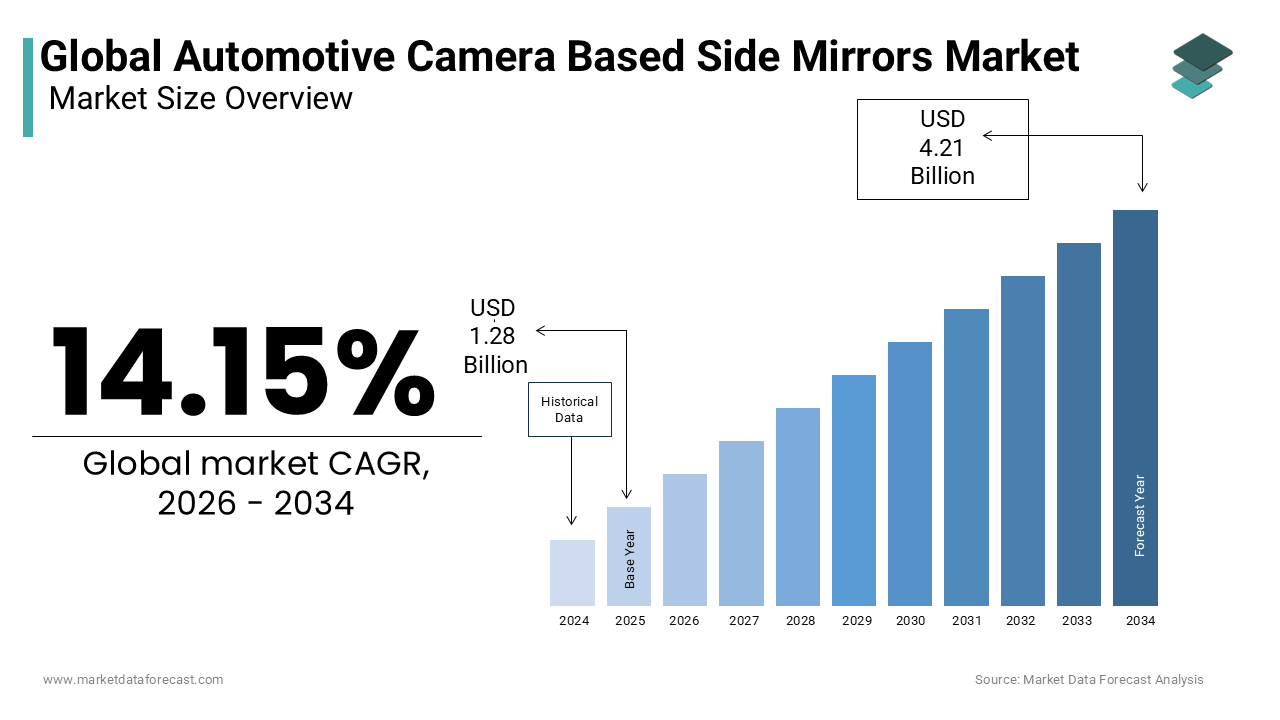
The global automotive camera-based side mirrors market was valued at USD 1.28 billion in 2025, is estimated to reach USD 1.46 billion in 2026, and is projected to reach USD 4.21 billion by 2034, growing at a CAGR of 14.15% during the forecast period from 2026 to 2034. The growth of the global automotive camera-based side mirrors market is driven by increasing demand for advanced vehicle safety systems, stringent fuel efficiency and emission regulations, and growing adoption of digital mirror technologies in premium and electric vehicles. Rising integration of camera monitor systems with advanced driver assistance systems (ADAS), increasing focus on aerodynamic vehicle design, and growing investments in autonomous driving technologies are further accelerating market growth. Moreover, continuous advancements in imaging technologies, smart cockpit integration, and software-defined vehicle platforms are supporting the expansion of the global automotive camera-based side mirrors market.
Key Market Trends
-
Rising adoption of camera monitor systems as replacements for conventional side mirrors in premium and electric vehicles.
-
Increasing integration of automotive camera-based side mirrors with ADAS and autonomous driving technologies.
-
Growing demand for aerodynamic vehicle designs to improve fuel efficiency and extend electric vehicle driving range.
-
Rising adoption of OLED-based display technologies for enhanced image quality and driver visibility.
-
Increasing deployment of smart cockpit solutions integrating digital mirror systems with infotainment and driver assistance features.
Segmental Insights
- Based on vehicle type, the passenger cars segment dominated the global automotive camera-based side mirrors market and accounted for 34.2% of the market share in 2025. The dominance of the segment is attributed to high passenger vehicle production volumes, increasing consumer demand for premium safety features, growing adoption of electric vehicles, stringent safety regulations, and rising integration of digital mirror systems into luxury and premium passenger cars.
- The commercial vehicles segment is projected to witness the fastest CAGR of 16.5% during the forecast period owing to increasing demand for improved blind-spot visibility, growing emphasis on fleet safety, rising adoption of advanced driver assistance technologies in heavy-duty trucks and buses, significant fuel savings through aerodynamic improvements, and expanding regulatory support for commercial vehicle safety systems.
- Based on camera position, the side mirror segment dominated the global automotive camera-based side mirrors market and accounted for 54.3% of the market share in 2025. The growth of the segment is driven by its ability to eliminate blind spots, improve aerodynamic efficiency, provide wider fields of view, enhance driver safety, and seamlessly integrate into existing vehicle architectures without major structural modifications.
- The A-pillar camera segment is anticipated to register the fastest CAGR of 18.2% during the forecast period due to increasing development of autonomous driving technologies, growing need for additional environmental perception, expanding adoption of multi-angle vision systems, improving pedestrian safety, and rising demand for enhanced urban driving assistance features.
- Based on display type, the LCD segment dominated the global automotive camera-based side mirrors market in 2025. The dominance of the segment is attributed to its mature manufacturing ecosystem, cost-effectiveness, excellent brightness performance, established automotive supply chain, and widespread adoption across mid-range and premium vehicle categories.
- The OLED segment is expected to witness the fastest CAGR of 22.4% during the forecast period owing to superior image quality, deeper contrast ratios, faster response times, wider viewing angles, thinner display architecture, and increasing adoption in premium vehicle interiors and advanced digital cockpit systems.
Regional Insights
- North America dominated the global automotive camera-based side mirrors market and accounted for 52.1% of the global market share in 2025. The region's leadership is driven by early adoption of advanced vehicle safety technologies, increasing deployment of autonomous driving systems, strong presence of leading automotive technology companies, expanding electric vehicle production, and growing investments in intelligent transportation solutions.
- Europe held 22.3% of the global automotive camera-based side mirrors market share in 2025 owing to stringent environmental regulations, favorable regulatory approval for camera monitor systems, strong automotive manufacturing base, increasing adoption of premium electric vehicles, and growing emphasis on vehicle aerodynamics and road safety.
- Asia Pacific is projected to witness the fastest growth during the forecast period due to expanding automotive production, rapid growth of electric vehicle manufacturing, increasing government support for intelligent mobility, rising disposable incomes, growing demand for advanced automotive technologies, and strong electronics manufacturing capabilities across China, Japan, South Korea, and India.
- Latin America is expected to experience steady growth owing to increasing automotive assembly operations, rising vehicle safety awareness, expanding adoption of international safety standards, improving economic conditions, and growing demand for advanced visibility technologies in passenger and commercial vehicles.
- The Middle East & Africa is anticipated to witness notable growth during the forecast period due to increasing luxury vehicle demand, expanding smart city initiatives, growing investments in connected mobility, improving transportation infrastructure, and rising adoption of premium automotive safety technologies across Gulf Cooperation Council countries and South Africa.
Competitive Landscape
The global automotive camera-based side mirrors market is highly competitive and characterized by the presence of established automotive component manufacturers, electronics companies, and vision system specialists competing through continuous product innovation, advanced imaging technologies, and strategic collaborations with vehicle manufacturers. Leading companies are focusing on developing high-resolution camera monitor systems, improving image processing algorithms, integrating artificial intelligence into digital visibility systems, expanding manufacturing capabilities, and strengthening partnerships with original equipment manufacturers. Continuous investments in research and development, aerodynamic innovations, software-defined vehicle technologies, and smart cockpit integration continue to strengthen competitive positioning across the global automotive camera-based side mirrors market. The prominent players operating in the global automotive camera-based side mirrors market include Robert Bosch GmbH, Continental AG, Magna International Inc., Valeo SA, Ficosa International S.A., Gentex Corporation, Stoneridge, Inc., Samvardhana Motherson International Limited (SMR), Hyundai Mobis Co., Ltd., Denso Corporation, Panasonic Holdings Corporation, Mitsubishi Electric Corporation, Murakami Corporation, Hitachi Astemo, Ltd., and ZF Friedrichshafen AG.
Global Automotive Camera Based Side Mirrors Market Size
The global automotive camera based side mirrors market size was valued at USD 1.28 billion in 2025 and is anticipated to reach USD 1.46 billion in 2026 from USD 4.21 billion by 2034, growing at a CAGR of 14.15% during the forecast period from 2026 to 2034.
The automotive camera based side mirrors are technological paradigm shift in vehicle exterior design replacing traditional glass reflective surfaces with high resolution digital cameras and interior display screens. These systems capture real time video feeds of the vehicle blind spots and rear surroundings transmitting them to monitors located inside the cabin near the A pillars or on the dashboard. This innovation addresses longstanding limitations of conventional mirrors, such as blind spots glare from headlights and aerodynamic drag. According to the Society of Automotive Engineers camera monitor systems can reduce the frontal area of a vehicle compared to standard mirrors, significantly improving aerodynamic efficiency. The European Commission states that transport accounts for approximately 25% of total greenhouse gas emissions in the European Union prompting manufacturers to adopt technologies that enhance fuel economy and reduce carbon footprints. Furthermore, the improved visibility through wider field of view cameras can mitigate lane change accidents, which constitute a significant portion of highway collisions. As regulatory frameworks evolve to permit digital replacements for physical mirrors in regions like Japan and Europe, automakers are increasingly integrating these systems into premium and electric vehicles. The transition supports broader industry goals of electrification and autonomous driving readiness by providing cleaner data inputs for advanced driver assistance systems, while offering drivers enhanced situational awareness in adverse weather conditions.
MARKET DRIVERS
Enhanced Aerodynamic Efficiency and Fuel Economy Optimization
The pursuit of superior aerodynamic performance for the adoption of camera-based side mirrors in the automotive sector is fuelling the growth of the automotive camera based side mirrors market. Traditional side mirrors create substantial air resistance due to their bulky shape and protrusion from the vehicle body contributing to increased drag coefficients. By replacing these physical structures with compact camera units, manufacturers can streamline vehicle profiles and reduce wind noise. According to the United States Department of Energy, aerodynamic drag accounts for nearly 60% of the energy required to move a truck at highway speeds meaning even minor reductions, yield significant fuel savings. This improvement is for meeting stringent Corporate Average Fuel Economy standards in North America and emission norms in Europe. The optimizing aerodynamics is one of the most cost-effective methods to improve vehicle efficiency without compromising powertrain performance. Consequently, automakers leverage camera mirrors as a tangible engineering solution to meet regulatory compliance and enhance vehicle performance metrics appealing to both commercial fleet operators seeking lower operating costs and individual buyers prioritizing sustainability.
Superior Visibility and Enhanced Driver Safety Features
The advanced visibility capabilities and integration with safety systems by addressing limitations of traditional glass mirrors is substantially promoting the growth of the automotive camera based side mirrors market. Conventional mirrors suffer from blind spots limited field of view and distortion particularly in rain snow or low light conditions. Camera systems offer a wider and adjustable field of view eliminating blind spots and providing clearer images regardless of external lighting. Lane change crashes result in thousands of injuries annually many of which could be prevented with better lateral visibility. Camera monitors can display dynamic guidelines and overlay warning indicators when vehicles approach from behind enhancing situational awareness. Additionally, these systems reduce glare from following headlights at night improving driver comfort and reducing eye strain. The Federal Highway Administration reports that poor visibility contributes to a significant%age of multi vehicle accidents especially during adverse weather. Camera lenses can be equipped with hydrophobic coatings and heating elements to maintain clarity in rain and fog unlike glass mirrors which require manual wiping or defogging. Furthermore, the digital nature of these feeds allows seamless integration with blind spot monitoring and lane departure warning systems creating a cohesive safety ecosystem. This technological advantage positions camera based mirrors, as a vital component in modern vehicle safety architectures appealing to consumers and regulators alike.
MARKET RESTRAINTS
High Initial Costs and Complex Manufacturing Requirements
The substantial initial costs associated with developing and manufacturing requirement is hindering the growth of the automotive camera based side mirrors market. Unlike traditional mirrors, which consist of simple glass and plastic components camera systems require high resolution sensors image processing units displays and robust wiring harnesses. The bill of materials for a digital mirror system can be two to three times higher than that of a conventional mirror posing a barrier for many vehicles. The complexity of integrating these electronic components into the vehicle architecture demands specialized engineering expertise and rigorous testing to ensure reliability under various environmental conditions. Small and medium sized automakers often lack the financial resources to invest in such advanced technologies without compromising profitability. Additionally, the need for redundant systems to prevent total visibility loss in case of electronic failure adds further cost and complexity. Supply chain constraints for semiconductor chips and display panels have also led to price volatility affecting production budgets. While economies of scale may eventually reduce costs the current premium pricing limits availability to luxury and high-end models. Consequently, the high entry cost slows the transition from traditional to digital mirrors despite their technical advantages.
Regulatory Hurdles and Standardization Gaps
The inconsistent regulatory frameworks and lack of global standardization with the uniform deployment of advanced technologies are impeding the growth of the automotive camera based side mirrors market. While countries like Japan and members of the European Union have updated regulations to permit camera monitor systems, other regions including parts of North America and emerging countries still mandate physical glass mirrors for legal road use. According to the United Nations Economic Commission for Europe, Regulation No 46 was amended to allow camera systems but full global harmonization remains incomplete creating compliance challenges for multinational automakers. Manufacturers must design vehicles with region specific configurations increasing development time and production complexity. The absence of universal standards for image resolution latency brightness and field of view leads to variability in system performance and user experience. Consumers may face confusion regarding the functionality and reliability of these systems if specifications differ significantly between places. Additionally, regulatory bodies require extensive validation data to prove that digital systems provide equal or superior safety compared to traditional mirrors a process that is time consuming and costly. The lag in regulatory updates in certain jurisdictions prevents automakers from launching globally standardized platforms with camera mirrors.
MARKET OPPORTUNITIES
Integration with Autonomous Driving and Smart Cockpit Ecosystems
The emergence of autonomous driving technologies and smart cockpit interfaces is significantly to boost the growth of the automotive camera based side mirrors market. As vehicles progress towards higher levels of automation, the need for precise and reliable environmental data becomes paramount. Camera feeds from side mirrors can serve as input sources for advanced driver assistance systems providing continuous visual data for object detection and path planning. Level 3 and Level 4 autonomous vehicles require redundant sensor suites to ensure safe operation in complex environments. Integrating side view cameras into this network enhances system robustness and reduces dependency on single sensor types. Furthermore, these digital feeds can be displayed on augmented reality heads up displays or central infotainment screens creating a unified and immersive driver interface. Automakers can leverage this integration to offer customizable views, such as zooming in on specific areas or displaying navigation overlays. The rise of software defined vehicles allows for over the air updates that improve image processing algorithms and add new features post purchase. This flexibility creates new revenue streams through subscription based services and enhances customer retention.
Expansion into Commercial Vehicle and Heavy Duty Truck Segments
The need for improved safety and operational efficiency in large trucks and buses is also to leverage new opportunities for the growth of the automotive camera based side mirrors market. Traditional mirrors on heavy duty vehicles are large cumbersome and prone to damage resulting in high maintenance costs and downtime. Camera systems eliminate these physical vulnerabilities and provide drivers with clearer views of blind spots, which are significantly larger in commercial vehicles. The blind spot related accidents involve a substantial number of commercial trucks, annually causing significant property damage and injuries. Digital mirrors can offer multiple viewing angles and wide-angle perspectives that help drivers navigate tight urban spaces and manage trailer positioning more effectively. Fleet operators benefit from reduced fuel consumption due to improved aerodynamics, which is important for long haul logistics where marginal gains translate to substantial savings. Additionally, the durability of camera units compared to glass mirrors reduces replacement frequency and maintenance expenses. Regulatory initiatives in Europe and North America are increasingly encouraging the use of advanced safety technologies in commercial fleets to protect vulnerable road users, such as cyclists and pedestrians.
MARKET CHALLENGES
Consumer Acceptance and Adaptation to Digital Interfaces
Overcoming consumer hesitation and adapting to digital viewing interfaces is likely to impede the growth of the automotive camera based side mirrors market. Drivers accustomed to the immediate and intuitive nature of glass mirrors may find it difficult to adjust to looking at screens for lateral visibility. The depth perception and spatial awareness provided by traditional mirrors are deeply ingrained in driving habits and replicating this naturally on a two-dimensional screen requires careful calibration of image perspective and latency. Any delay in video transmission or poor image quality in bright sunlight can compromise safety and erode trust in the system. Manufacturers must invest heavily in human machine interface design to ensure that displays are positioned optimally and provide realistic visuals. Additionally, concerns about system reliability in case of power failure or software glitches create psychological barriers for potential buyers. Educating consumers about the benefits and safety redundancies of camera systems is essential but requires significant marketing effort.
Technical Reliability and Environmental Durability Concerns
Ensuring consistent technical reliability and environmental durability under diverse operating conditions is ascribed to degrade the growth of the automotive camera based side mirrors market. Unlike passive glass mirrors, digital systems rely on active electronic components that are susceptible to failure due to extreme temperatures moisture vibration and electromagnetic interference. According to the research, automotive electronics must withstand harsh environments ranging from minus 40 degrees Celsius to over 85 degrees Celsius while maintaining performance stability. Camera lenses can become obscured by dirt mud ice or water droplets requiring sophisticated cleaning mechanisms such as air jets or wipers, which add mechanical complexity and potential points of failure. Display screens inside the cabin must remain visible in direct sunlight and not cause glare or distraction during night driving. Software bugs or connectivity issues can lead to black screens or frozen images posing immediate safety risks. Manufacturers must implement rigorous redundancy protocols and fail safe modes to ensure that drivers retain some level of visibility if the primary system fails. However, achieving this level of robustness increases development costs and testing timelines.
REPORT COVERAGE
| REPORT METRIC | DETAILS |
| Market Size Available | 2025 to 2034 |
| Base Year | 2025 |
| Forecast Period | 2026 to 2034 |
| CAGR | 10.53% |
| Segments Covered | By Vehicle Type, Camera Position, Display Type and Region. |
| Various Analyses Covered | Global, Regional & Country Level Analysis, Segment-Level Analysis, DROC, PESTLE Analysis, Porter’s Five Forces Analysis, Competitive Landscape, Analyst Overview of Investment Opportunities |
| Country Covered | North America, Europe, Asia-Pacific, Latin America, and the Middle East and Africa. |
| Market Leaders Profiled | Robert Bosch GmbH, Continental AG, Magna International Inc., Valeo SA, Ficosa International S.A., Gentex Corporation, Stoneridge, Inc., Samvardhana Motherson International Limited (SMR), Hyundai Mobis Co., Ltd., Denso Corporation, Panasonic Holdings Corporation, Mitsubishi Electric Corporation, Murakami Corporation, Hitachi Astemo, Ltd., and ZF Friedrichshafen AG |
SEGMENTAL ANALYSIS
By Vehicle Type Insights
The passenger cars segment was the largest by holding 34.2% of the automotive camera based side mirrors market share in 2025 with the high production volumes and the intense competition among automakers to differentiate vehicles through advanced technology and design. The consumer demand for enhanced aesthetics and aerodynamic efficiency, which directly impacts fuel economy and electric vehicle range. According to the International Organization of Motor Vehicle Manufacturers, passenger car production accounted for approximately 75% of global vehicle output in recent years providing a massive addressable market for digital mirror systems. Automakers leverage camera-based mirrors to create sleeker profiles that reduce drag coefficients thereby improving energy efficiency. Additionally, premium passenger car segments utilize these systems to offer superior visibility and blind spot elimination enhancing safety ratings. The integration of camera feeds with infotainment systems allows for customizable views and augmented reality features appealing to tech savvy consumers. Regulatory approvals in key countries like Europe and Japan have further accelerated adoption in passenger vehicles, as manufacturers seek to comply with safety norms while offering innovative user experiences.
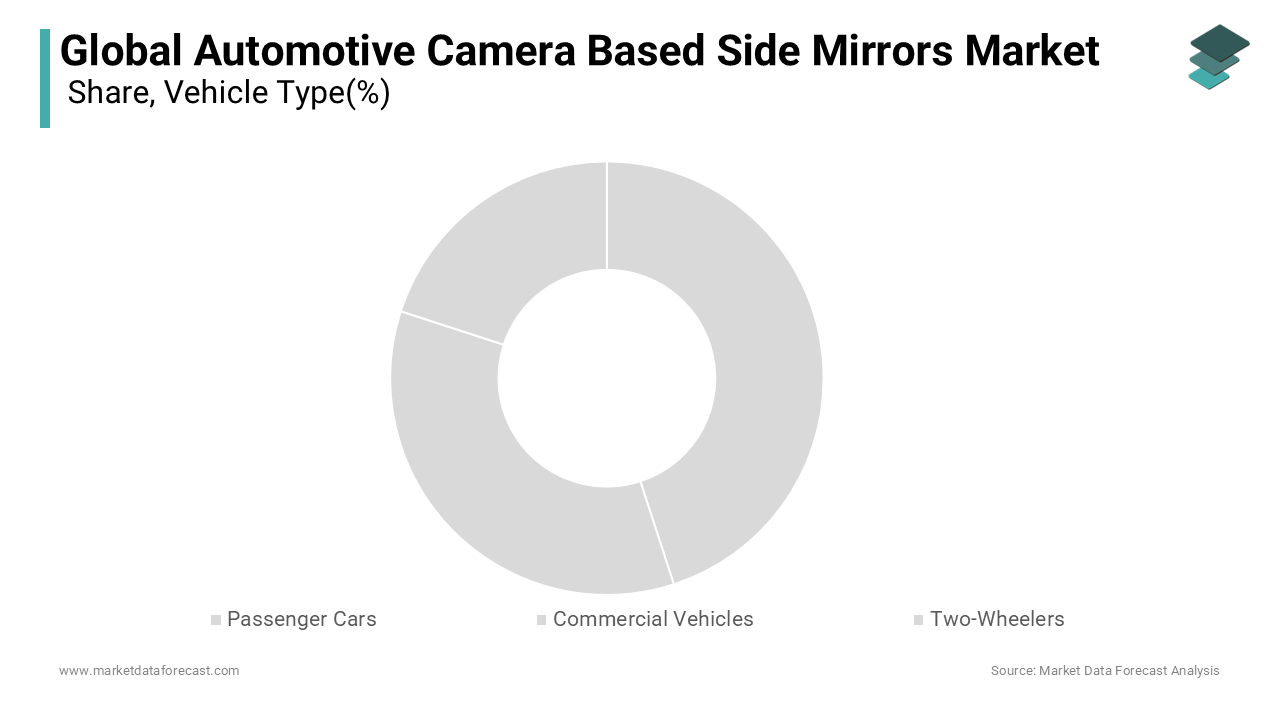
The commercial vehicles segment is expected to register a fastest CAGR of 16.5% from 2026 to 2034 owing to the crucial need to eliminate large blind spots inherent in trucks and buses, which are major causes of accidents involving vulnerable road users. Heavy goods vehicles are involved in a disproportionate number of fatal accidents with cyclists and pedestrians prompting strict regulations mandating advanced visibility systems. Camera based mirrors provide wide angle views and multiple perspectives that help drivers navigate tight urban spaces and monitor trailer positions effectively. Furthermore, the aerodynamic benefits of replacing bulky traditional mirrors with compact cameras result in significant fuel savings for long haul trucks, where every point of efficiency translates to substantial cost reductions. Fleet managers are increasingly adopting these systems to enhance operational safety and reduce maintenance costs associated with broken glass mirrors.
By Camera Position Insights
The side mirror position segment was the largest by holding 54.3% of the automotive camera based side mirrors market share in 2025 with the most crucial visibility gaps and aerodynamic inefficiencies associated with conventional mirror designs. The lane change accidents are frequently caused by blind spots, which side mounted cameras effectively eliminate by providing a wider and distortion free field of view. The regulatory focus on lateral visibility and the ability of side cameras to integrate seamlessly with existing vehicle architectures without major structural changes. Automakers prefer this position, as it allows for immediate improvements in aerodynamic drag contributing to better fuel economy. Additionally, side mounted cameras are less prone to obstruction from cargo or passengers compared to other positions ensuring consistent visibility. The maturity of technology for this specific application combined with established manufacturing processes makes it the most widely adopted configuration.
The A-pillar camera position segment is likely to grow at a fastest CAGR of 18.2% during the forecast period with the innovative approach of integrating cameras into the A-pillars to provide a comprehensive view of the front side areas, which are often obscured by the vehicle structure itself. Cameras positioned here can offer unique angles that traditional mirrors cannot achieve, such as looking down at the curb or monitoring cross traffic more effectively. This position is particularly beneficial for electric vehicles with thick A-pillars required for structural rigidity and safety. Automakers are exploring this configuration to enhance pedestrian safety and improve manoeuvrability in dense urban environments. The multi-angle camera systems can significantly reduce driver stress and improve reaction times in complex driving scenarios. As autonomous driving technologies advance, the need for diverse visual inputs from various vehicle points increases making A-pillar cameras an attractive option for comprehensive environmental perception.
By Display Type Insights
The liquid crystal display technology segment held a prominent share of the automotive camera based side mirrors market in 2025 due to its mature manufacturing ecosystem cost effectiveness and reliable performance. LCD screens are widely used because they offer good brightness levels color accuracy and viewing angles suitable for interior cabin conditions. LCD panels account for the majority of automotive display shipments due to their established supply chains and lower production costs compared to newer technologies. The balance between performance and affordability allowing automakers to include digital mirrors in mid-range vehicles without excessive price increases. LCDs are also highly durable and can withstand the temperature fluctuations typical in automotive interiors. The International Electrotechnical Commission standards for automotive displays are well aligned with LCD capabilities ensuring compliance with safety and reliability requirements. Furthermore, the widespread availability of LCD components reduces lead times and simplifies procurement for manufacturers. While newer technologies exist LCD remains the preferred choice for mass market applications where cost sensitivity is high.
The organic light emitting diode technology segment is likely to grow at a fastest CAGR of 22.4% during the forecast period with the superior image quality deeper blacks and higher contrast ratios that OLED screens provide, which are important for clear visibility in varying lighting conditions. The adoption of OLED in automotive applications is accelerating, as manufacturers seek to create premium and immersive cockpit experiences. OLED displays offer faster response times and wider viewing angles than LCDs reducing latency and improving the real time feel of the camera feed. This is particularly important for safety critical applications, where even minor delays can be hazardous. Additionally, OLED panels are thinner and more flexible allowing for innovative design integrations within the vehicle interior. The ability to dim individual pixels enhances night driving comfort by reducing glare from bright lights in the camera view. As production costs decrease and yields improve, OLED is becoming more accessible for high end vehicles. Automakers leverage OLED technology to differentiate their brands through superior visual performance and modern aesthetics.
REGIONAL ANALYSIS
North America Automotive Camera Based Side Mirrors Market Analysis
North America was the top performer in the automotive camera based side mirrors market by capturing 52.1% of the share in 2025 with the strong technological adoption and a robust automotive industry. The United States has seen a steady decline in traffic fatalities partly due to the adoption of advanced safety technologies including digital visibility systems. Major automakers in Detroit and Silicon Valley are actively integrating camera mirrors into their electric and autonomous vehicle portfolios to gain competitive advantage. The regulatory environment is evolving with ongoing discussions to update Federal Motor Vehicle Safety Standards to fully accommodate digital mirror systems. The presence of leading technology suppliers and semiconductor companies in the region supports rapid innovation and local production. Consumer preference for large sport utility vehicles and trucks, which benefit significantly from improved blind spot visibility further drives demand. Additionally, the strong aftermarket sector provides opportunities for retrofitting older vehicles with camera systems.
Europe Automotive Camera Based Side Mirrors Market Analysis
Europe automotive camera based side mirrors market held 22.3% of share in 2025 with the stringent environmental regulations and a strong commitment to road safety. The European Union’s General Safety Regulation and aerodynamic efficiency mandates encourage the adoption of technologies that reduce drag and emissions. The transport sector emissions must be reduced significantly to meet climate goals making aerodynamic improvements from camera mirrors highly valuable. Countries like Germany and France are home to major automakers, who are pioneers in integrating digital mirrors into premium and electric vehicles. The United Nations Economic Commission for Europe has updated regulations to permit camera monitor systems facilitating legal use across member states. Consumer demand for sustainable and safe mobility solutions aligns well with the benefits of camera based mirrors. The region’s advanced infrastructure supports the testing and validation of these systems ensuring high reliability. Additionally, the strong presence of component suppliers specializing in optics and electronics strengthens the supply chain.
Asia Pacific Automotive Camera Based Side Mirrors Market Analysis
The Asia Pacific automotive camera based side mirrors market growth is fuelling with the rapid automotive production and increasing adoption of electric vehicles. China, Japan, and South Korea are at the forefront of this trend with Japan being one of the first countries to legalize camera based mirrors. Asia Pacific accounts for more than half of global vehicle production providing a vast base for technology integration. Chinese electric vehicle manufacturers are aggressively incorporating digital mirrors to enhance aerodynamics and extend driving range. Government initiatives in countries like China and India promote smart mobility and safety technologies accelerating market growth. The rising middle class and increasing disposable incomes drive demand for premium vehicles equipped with advanced features. Local suppliers are investing heavily in research and development to produce cost effective camera and display solutions. The region’s strong electronics manufacturing base supports efficient production and scaling of components.
Latin America Automotive Camera Based Side Mirrors Market Analysis
Latin America automotive camera based side mirrors market growth is driven by increasing vehicle imports and local assembly operations. The region faces challenges related to economic volatility but shows potential as safety awareness rises. The road safety remains a priority prompting governments to consider stricter vehicle standards. Brazil and Mexico are the largest contributors in the region with local production facilities adopting global safety norms to remain competitive in export countries. The influence of international safety ratings encourages automakers to include advanced visibility features in vehicles sold locally. Consumer demand for used vehicles with advanced safety features is also growing, as buyers seek value and protection. However, high import tariffs and limited local manufacturing capabilities for high tech components constrain rapid adoption. As economic conditions stabilize and regulatory frameworks evolve, the penetration of camera based mirrors in Latin America is expected to increase. Partnerships between global suppliers and local distributors will play a key role in making these technologies more accessible to the broader population in the region.
The Middle East and Africa Automotive Camera Based Side Mirrors Market Analysis
The Middle East and Africa automotive camera based side mirrors market growth is driven by luxury vehicle demand in the Gulf states and infrastructure development in key African nations. High income levels in countries like Saudi Arabia and the United Arab Emirates fuel demand for premium vehicles equipped with the latest technologies, including digital mirrors. In South Africa, the automotive industry is well established with local manufacturing adhering to international safety standards. Governments in the Middle East are investing in smart city projects that integrate connected vehicle technologies creating a favorable environment for growth. The extreme climate conditions in the region require robust sensor systems capable of withstanding high temperatures and dust. As regional economies diversify and urbanization increases, the demand for safer and more efficient transportation solutions will rise.
COMPETITIVE LANDSCAPE
The competition in the automotive camera-based side mirrors market is intensifying as traditional automotive suppliers, and technology specialists vie for dominance through innovation and strategic alliances. Major competitors leverage their expertise in optics electronics and software to deliver reliable and high-performance systems that meet stringent safety regulations. Price competition is significant particularly for commercial vehicle applications, where total cost of ownership is a key decision factor. However, differentiation through advanced features, such as dynamic guidelines and weather resistance helps premium suppliers maintain higher margins. The shift towards electrification and autonomous driving has accelerated competition as companies race to provide aerodynamic and data rich visibility solutions. Regulatory approval processes vary by region adding complexity requiring companies to maintain flexible and compliant product portfolios.
KEY MARKET PLAYERS
Some of the promising companies that are playing a dominating role in the Automotive Camera Based Side Mirrors Market include
- Robert Bosch GmbH
- Continental AG
- Magna International Inc.
- Valeo SA
- Ficosa International S.A.
- Gentex Corporation
- Stoneridge, Inc.
- Samvardhana Motherson International Limited (SMR)
- Hyundai Mobis Co., Ltd.
- Denso Corporation
- Panasonic Holdings Corporation
- Mitsubishi Electric Corporation
- Murakami Corporation
- Hitachi Astemo, Ltd.
- ZF Friedrichshafen AG
Top Players in the Global Automotive Camera Based Side Mirrors Market
Continental AG
Continental AG is a leading provider of camera monitor systems that replace traditional side mirrors with digital alternatives to enhance safety and aerodynamics. The company supplies high resolution cameras and interior displays integrated with advanced image processing software for premium automakers. Continental strengthens its market position by collaborating with major vehicle manufacturers to develop customized solutions that meet specific regulatory standards. Recent actions include expanding its production capabilities for automotive cameras and investing in artificial intelligence algorithms to improve object recognition. The company focuses on reducing latency and enhancing image quality in adverse weather conditions to ensure driver confidence.
Mekra GmbH
Mekra GmbH specializes in the development and manufacturing of camera based mirror replacement systems for commercial and passenger vehicles. The company offers comprehensive solutions including robust exterior camera units and high brightness interior monitors designed for optimal visibility. Mekra strengthens its market position by focusing on durability and compliance with international safety regulations, such as UN R46. Recent initiatives, involve partnering with truck manufacturers to integrate digital mirrors into new heavy duty vehicle platforms. The company invests in research to enhance camera performance in extreme temperatures and lighting conditions. Mekra also provides modular systems that allow for easy installation and maintenance.
Ficosa International
Ficosa International is a key player in the automotive camera based side mirrors market known for its expertise in vision systems and exterior components. The company designs and produces camera monitor systems that offer wide angle views and real time video feeds for enhanced situational awareness. Ficosa strengthens its market position by developing lightweight and aerodynamic camera housings that contribute to vehicle efficiency. Recent actions include launching next generation systems with improved resolution and dynamic guidelines for better depth perception. The company collaborates with technology partners to integrate smart features, such as blind spot detection and lane change assistance. Ficosa focuses on delivering cost effective solutions for both passenger cars and commercial vehicles. Its global presence and strong engineering capabilities enable Ficosa to meet the diverse needs of automakers worldwide, while driving the adoption of digital mirror technology.
Top Strategies Used by Key Market Participants
Key players in the automotive camera based side mirrors market employ several strategic approaches to maintain competitiveness and drive growth. Product innovation is a primary strategy where companies invest in developing high resolution cameras and low latency displays to enhance image quality and reliability. Strategic partnerships with original equipment manufacturers allow firms to co-develop customized solutions that integrate seamlessly with vehicle architectures. Regulatory compliance is another important focus as companies work closely with authorities to ensure their systems meet evolving safety standards globally. Geographic expansion enables manufacturers to establish production facilities in emerging countries to reduce costs and serve local demand efficiently. Additionally, companies emphasize sustainability by designing lightweight components that improve vehicle aerodynamics and fuel efficiency. Investment in research and development for artificial intelligence and sensor fusion technologies helps differentiate products and prepare for future autonomous driving requirements.
MARKET SEGMENTATION
The research report on the global automotive camera based side mirrors market has been segmented and sub-segmented based on categories.
By Vehicle Type
- Passenger Cars
- Commercial Vehicles
- Two-Wheelers
By Camera Position
- Side Mirrors
- Rear Side Windows
- A-Pillar
By Display Type
- OLED
- LCD
- TFT
By Connectivity
- Bluetooth
- Wi-Fi
- Cellular
By Technology
- CMOS
- CCD
- MEMS Mirror
By Region
- North America
- Europe
- Asia-Pacific
- Latin America
- Middle East and Africa