- Product Description Description
- Table of Contents TOC
- List of Table & Figure LOT
- Get Free Sample PDF Sample PDF
Market Size, 2025
$14.39 BnMarket Estimate, 2026
$15.14 BnMarket Forecast, 2034
$22.68 BnCAGR, 2026–2034
5.18%Executive Summary: Global Automotive Catalyst Market
- Market Scope: Comprehensive global automotive catalyst market analysis covering catalyst types, vehicle categories, regional leadership frameworks, and key industry growth drivers.
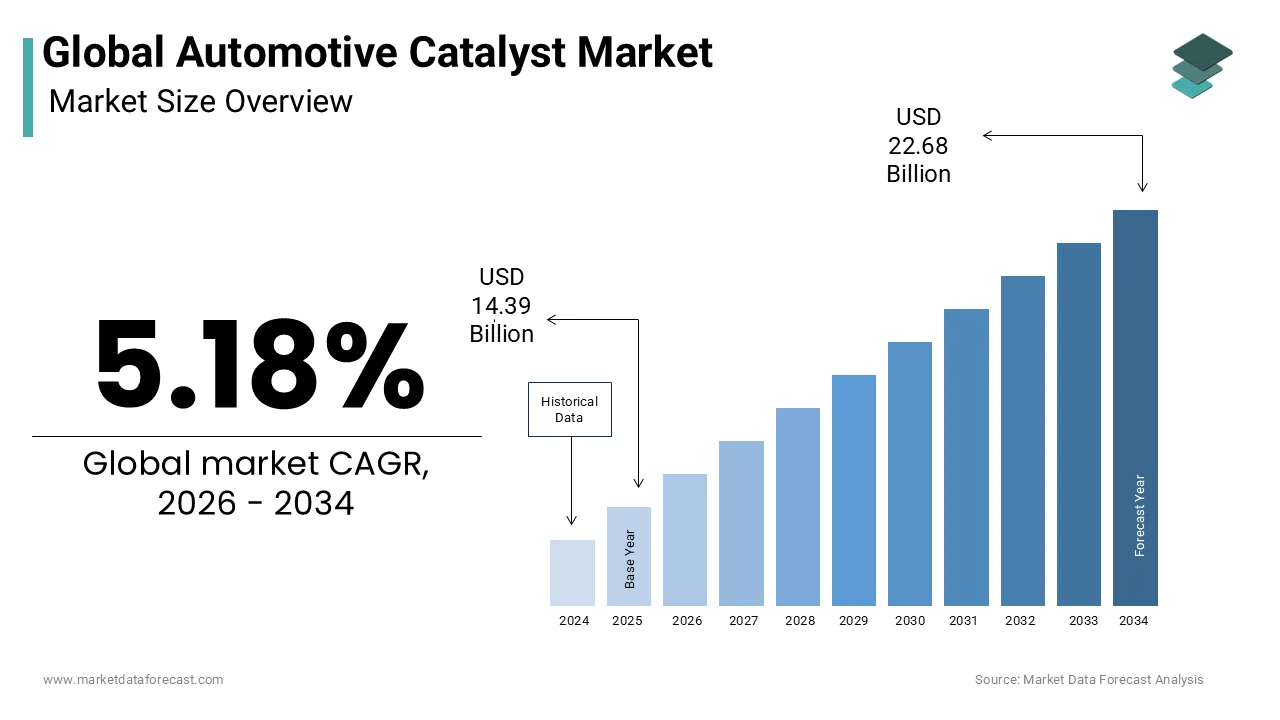
- Market Valuation: Valued at USD 14.39 billion (2025), estimated at USD 15.14 billion (2026), and projected to reach USD 22.68 billion by 2034, registering a robust CAGR of 5.18% (2026–2034).
- Primary Growth Drivers: Rapid expansion of the global automotive industry, stringent vehicle emission regulations, increasing focus on fuel economy standards, and rising demand for light-duty vehicles equipped with precious-metal catalysts like palladium.
Key Market Segment Metrics (2026–2034)
| Category | Leading Segment (2025 Position) | Fastest-Growing Segment |
|---|---|---|
| By Type | Palladium (calculated to have the largest percentage of the global automotive catalysts market value, fueled by vehicle emission standards) | Palladium & Platinum (driven by rigorous environmental standards and light-duty fuel economy requirements) |
| By Vehicle Type | Light-Duty Vehicles (holding significant market volume due to high production rates and emerging middle-class economies) | Light-Duty Vehicles (witnessing the fastest growth driven by strict fuel economy standards and rising vehicle production) |
| By Region | Asia-Pacific (led globally due to a massive customer base, cheap labor, and resource availability in countries like China and India) | Asia-Pacific (projected as the fastest-growing region with the highest CAGR driven by expanding industrial and automotive sectors) |
Major Market Players & Market Structure
Market Structure: Highly competitive global automotive emissions control landscape featuring major multinational chemical and engineering companies competing on precious metal technologies, emission reduction efficiency, and strategic OEM partnerships.
Key Companies: Symrise, BASF, Eberspacher, Johnson Matthey, Umicore, Cataler, Klarius Products Ltd., Cummins, Heraeus, Clariant, INTERKAT, Sinocat, N.E. Chemcat, CDTi Advanced Materials, Tenneco, Ecocat India Pvt. Ltd., and IBIDEN.
 Download Free Sample Report
Global Automotive Catalyst Market Size
The global automotive catalyst market size was valued at USD 14.39 billion in 2025 and is expected to reach USD 22.68 billion by 2034 from USD 15.14 billion in 2026. The market is projected to grow at a CAGR of 5.18%.
An automotive catalyst is a chemical substance housed inside a vehicle's exhaust system to transform toxic engine pollutants into less harmful gases before they exit the tailpipe. These systems primarily utilize precious metals such as platinum, palladium and rhodium to facilitate oxidation and reduction processes within internal combustion engines. The global push for cleaner air drives the necessity for advanced catalytic converters. According to the World Health Organisation, ambient air pollution causes an estimated 4.2 million premature deaths annually. This health crisis compels governments to enforce stricter emission standards, thereby increasing the demand for high efficiency catalysts. As per details by the International Council on Clean Transportation, road transport accounts for about 21% of global energy-related carbon dioxide emissions. Such significant contributions to pollution necessitate robust after treatment technologies to mitigate environmental impact. Catalytic converters serve as the final line of defence in reducing nitrogen oxides, carbon monoxide, and hydrocarbons before they enter the atmosphere. As the vehicle parc continues to grow, the integration of sophisticated catalyst formulations becomes essential for regulatory compliance. The transition toward hybrid vehicles also sustains demand since these powertrains still rely on internal combustion engines requiring effective emission control. Consequently, the market remains critical in balancing mobility needs with environmental sustainability goals across diverse geographic regions.
MARKET DRIVERS
Stringent Global Emission Regulations and Compliance Mandates
Strict governmental regulations mandating lower tailpipe emissions drive the expansion of the Automotive Catalyst Market. These regulations compel original equipment manufacturers to adopt advanced after-treatment technologies. Regulatory bodies worldwide are implementing progressively tighter limits on pollutants such as nitrogen oxides and particulate matter to combat urban smog and climate change. According to the European Parliament, the Euro 7 standards maintain Euro 6 exhaust limits for cars and vans while introducing stricter limits for buses and trucks, along with new rules for brake and tyre particles. As per the United States Environmental Protection Agency, the Tier 3 emission standards require approximately an 80% reduction in fleet average non-methane organic gases and nitrogen oxides compared to previous Tier 2 levels. Compliance with such rigorous norms necessitates the use of three way catalysts and selective catalytic reduction systems that offer superior conversion efficiency. The potential rise drives policymakers to maintain pressure on the automotive industry to innovate. Consequently, manufacturers must continuously upgrade their catalyst designs to meet evolving legal requirements. The harmonization of global standards further accelerates the adoption of uniform high efficiency solutions. Penalties for non-compliance are becoming severe. As a result, the market for advanced automotive catalysts experiences sustained growth driven by regulatory necessity rather than optional upgrades.
Rising Vehicle Production and Expanding Global Mobility
The continuous increase in global vehicle production significantly fuels the Automotive Catalyst Market growth. Every new internal combustion engine vehicle requires a catalytic converter for legal operation. Emerging economies are witnessing a surge in automobile ownership due to rising disposable incomes and improved infrastructure. According to the International Organisation of Motor Vehicle Manufacturers, global motor vehicle production reached approximately 96.4 million units in recent years. The high volume of production creates a direct and substantial demand for emission control components, including catalysts. Furthermore the expansion of commercial vehicle fleets for logistics and transportation adds to the cumulative demand for heavy-duty catalysts. As per the World Bank, vehicle ownership in many developing country cities is growing at a rate of 15 to 20% annually. This growth trajectory ensures a steady stream of new installations for catalytic systems. Additionally the replacement market contributes significantly, as older vehicles require catalyst replacements to pass periodic inspections. The sheer scale of the global automotive industry provides a stable foundation for catalyst manufacturers. Even as electric vehicles gain traction, the vast existing parc of internal combustion engines ensures long-term demand. The interplay between new sales and aftermarket replacements sustains market vitality. Thus, the sheer volume of vehicles on the road acts as a primary driver for consistent market expansion.
MARKET RESTRAINTS
Rapid Adoption of Battery Electric Vehicles
The accelerating shift toward battery electric vehicles is a major restraint to the Automotive Catalyst Market. These vehicles do not produce tailpipe emissions and therefore do not require catalytic converters. Governments and consumers are increasingly prioritising zero-emission mobility to achieve climate goals, which reduces the total addressable market for internal combustion engine components. According to the International Energy Agency, the share of electric cars in overall car sales is set to exceed 40% in 2030 under today's policy settings. This dramatic shift implies a substantial decline in the production of new internal combustion engine vehicles, which directly impacts catalyst demand. Major automakers have announced plans to phase out gasoline and diesel engines in key markets within the next two decades. As per the European Commission, a 100% emission reduction target was introduced for new passenger cars and vans from 2035 onwards. Such policy decisions create long term uncertainty for catalyst manufacturers who rely on traditional powertrain volumes. While hybrid vehicles retain some demand, they represent a transitional technology with a limited lifespan. The rapid scaling of battery production and charging infrastructure further accelerates the transition away from fossil fuels. Consequently, the shrinking share of internal combustion engines in new vehicle sales poses a structural threat to the market. Manufacturers must diversify or face declining revenues as the automotive landscape fundamentally transforms.
Volatility in Precious Metal Prices
The extreme volatility in prices of precious metals such as platinum, palladium, and rhodium constrains the Automotive Catalyst Market. Consequently, this instability creates unpredictable production costs and supply chain risks. These metals are essential components of catalytic converters, and their prices fluctuate based on geopolitical tensions, mining output and industrial demand. Such instability makes it difficult for manufacturers to maintain consistent profit margins and pricing strategies. Automakers often hesitate to commit to long-term contracts when metal prices are erratic, leading to delayed procurement decisions. According to the United States Geological Survey, Russia and South Africa together account for approximately 80% of the world's total palladium mine production. High material costs also incentivise the development of alternative technologies or reduced metal loading, which can compromise performance. Manufacturers struggle to pass these costs onto consumers without affecting vehicle affordability. The financial risk associated with holding large inventories of expensive metals further burdens company balance sheets. Supply sources must diversify, and price stabilisation mechanisms must improve. Until then, this volatility will continue to hinder market stability and investment confidence.
MARKET OPPORTUNITIES
Growth in Hybrid Electric Vehicle Segment
The expanding hybrid electric vehicle segment offers a major opportunity for the Automotive Catalyst Market. This growth is due to these vehicles combining internal combustion engines with electric motors, which requires specialized emission control systems. Hybrids operate in complex modes where the engine starts and stops frequently, necessitating catalysts that can reach operating temperature quickly and maintain efficiency under varying loads. According to the International Energy Agency, global hybrid vehicle sales grew by 35% in 2021, reaching approximately 3.1 million units. Manufacturers are developing close-coupled catalysts and electrically heated systems to optimise performance in hybrid applications. The unique operating conditions of hybrids allow for innovation in catalyst design, offering higher value propositions. Furthermore many emerging markets lack the charging infrastructure for full electrification, making hybrids a preferred choice for decades. As per sources, hybrids are expected to dominate the green vehicle segment in regions with limited grid capacity. This sustained demand provides a lucrative niche for catalyst producers. Companies that specialise in low-temperature light-off technologies will capture significant market share. The transition period toward full electrification ensures that hybrids remain relevant, thereby supporting continued catalyst innovation and sales.
Advancements in Catalyst Material Science and Efficiency
Technological advancements in catalyst material science unlock potential for the Automotive Catalyst Market. This occurs by enabling higher efficiency and reduced precious metal usage. Researchers are developing new substrates and washcoat technologies that improve conversion rates while lowering the amount of expensive metals required. According to the American Chemical Society, nanostructured catalysts can increase surface area and reactivity, leading to better performance with less material. This innovation allows manufacturers to reduce costs while meeting stricter emission standards. The use of alternative materials such as cerium and zirconium in combination with precious metals enhances durability and thermal stability. Such developments appeal to automakers seeking to optimize cost performance ratios. Additionally the integration of artificial intelligence in catalyst design accelerates the discovery of new formulations. As per the United States Department of Energy, platinum group metal intensities have gone down by approximately 80% in PEM fuel cells since 2005 due to active dematerialisation efforts. Improved catalyst longevity reduces the frequency of replacements, benefiting both manufacturers and consumers. As emission norms become more stringent, the need for high-performance materials intensifies. Companies investing in research and development can differentiate themselves through proprietary technologies. This focus on innovation opens new revenue streams through licensing and premium product offerings. The continuous evolution of material science ensures that the market remains dynamic and responsive to environmental challenges.
MARKET CHALLENGES
Supply Chain Constraints for Critical Raw Materials
Supply chain constraints for critical raw materials are a serious hurdle for the Automotive Catalyst Market. These disruptions threaten production continuity and increase overall costs. The majority of platinum group metals are mined in a few geographically concentrated regions, making the supply vulnerable to political instability and labour disputes. As per sources, supply disruptions in major mining jurisdictions can lead to shortages lasting several months, affecting global automotive production. Such bottlenecks force manufacturers to scramble for alternative sources or pay premium prices. The logistical complexities of transporting hazardous materials further complicate the supply chain. Geopolitical tensions can lead to trade restrictions or export bans, exacerbating scarcity issues. According to studies, similar supply chain fragilities have impacted other automotive components, highlighting systemic risks. Manufacturers struggle to secure long term supply agreements amidst uncertain global conditions. The lack of transparent pricing mechanisms for rare metals adds to the difficulty of strategic planning. Recycling rates for precious metals remain insufficient to meet growing demand independently. Until diversified sourcing strategies and robust recycling ecosystems are established, the market will remain exposed to supply shocks. This vulnerability undermines the ability of manufacturers to guarantee delivery schedules and maintain competitive pricing.
Technical Complexity of Meeting Real World Driving Emissions
The technical complexity of meeting real-world driving emissions is a major challenge to the Automotive Catalyst Market. This difficulty arises because laboratory tests often differ significantly from actual road conditions. Regulators are increasingly focusing on real driving emissions, which expose vehicles to varying temperatures, speeds and loads that affect catalyst performance. According to the International Council on Clean Transportation, real-world nitrogen oxide emissions can be up to 10 times higher than laboratory limits for some diesel vehicles, driving the requirement for catalysts to perform efficiently across a wider range of operating conditions. This discrepancy requires catalysts to perform efficiently across a much wider range of operating conditions. Achieving consistent performance in cold weather or during aggressive driving demands sophisticated engineering and calibration. The need for larger and more complex after treatment systems increases vehicle weight and reduces fuel efficiency. Automakers face difficulties in integrating these bulky systems into compact vehicle designs. The cost of developing and validating these advanced systems is substantial, requiring extensive testing and resources. Failure to meet real-world standards can result in massive recalls and reputational damage. The technical barrier to entry rises as norms become more precise and demanding. Manufacturers must invest heavily in simulation and on-road testing to ensure compliance. This ongoing technical arms race strains research budgets and delays product launches.
REPORT COVERAGE
| REPORT METRIC | DETAILS |
| Market Size Available | 2025 to 2034 |
| Base Year | 2025 |
| Forecast Period | 2026 to 2034 |
| CAGR | 5.18% |
| Segments Covered | By Type, Vehicle Type, and Region. |
|
Various Analyses Covered | Global, Regional & Country Level Analysis, Segment-Level Analysis, DROC, PESTLE Analysis, Porter’s Five Forces Analysis, Competitive Landscape, Analyst Overview of Investment Opportunities |
| Regions Covered | North America, Europe, APAC, Latin America, Middle East & Africa |
| Market Leaders Profiled | Symrise, BASF, Eberspacher, Johnson Matthey, Umicore, Cataler, Klarius Products Ltd., Cummins, Heraeus, Clariant, INTERKAT, Sinocat, N.E. Chemcat, CDTi Advanced Materials, Tenneco, Ecocat India Pvt. Ltd., and IBIDEN |
SEGMENTAL ANALYSIS
By Type Insights
The palladium segment led the automotive catalyst market and captured a significant share in 2025. This leading position of the segment was primarily attributed to its extensive use in gasoline-powered vehicles, which constitute the majority of the global passenger car fleet. The metal exhibits superior oxidation capabilities, making it highly effective in converting carbon monoxide and hydrocarbons into less harmful substances. According to the International Platinum Group Metals Association (IPA), the automotive sector drives more than 80% of total demand for palladium due to its application in catalytic converters for internal combustion engines. This heavy reliance ensures consistent demand despite fluctuations in other industrial sectors. Furthermore the historical preference for gasoline engines in major markets such as North America and Europe has cemented palladium's role as the primary catalytic material. Stricter United States Environmental Protection Agency emissions standards historically increased the per-vehicle consumption of palladium in catalytic converters for gasoline-powered cars, though newer regulations accelerating electrification are projected to reduce long-term demand. Although recent trends show some substitution with platinum, the sheer volume of gasoline vehicles on the road maintains palladium's dominance. The metal's ability to perform efficiently at lower operating temperatures also makes it ideal for modern start-stop systems. As long as internal combustion engines remain prevalent in personal transportation, palladium will continue to lead the market. The established supply chains and manufacturing processes optimized for palladium further reinforce its leading status. Manufacturers have invested heavily in palladium-based formulations, ensuring its continued prevalence in new vehicle production.
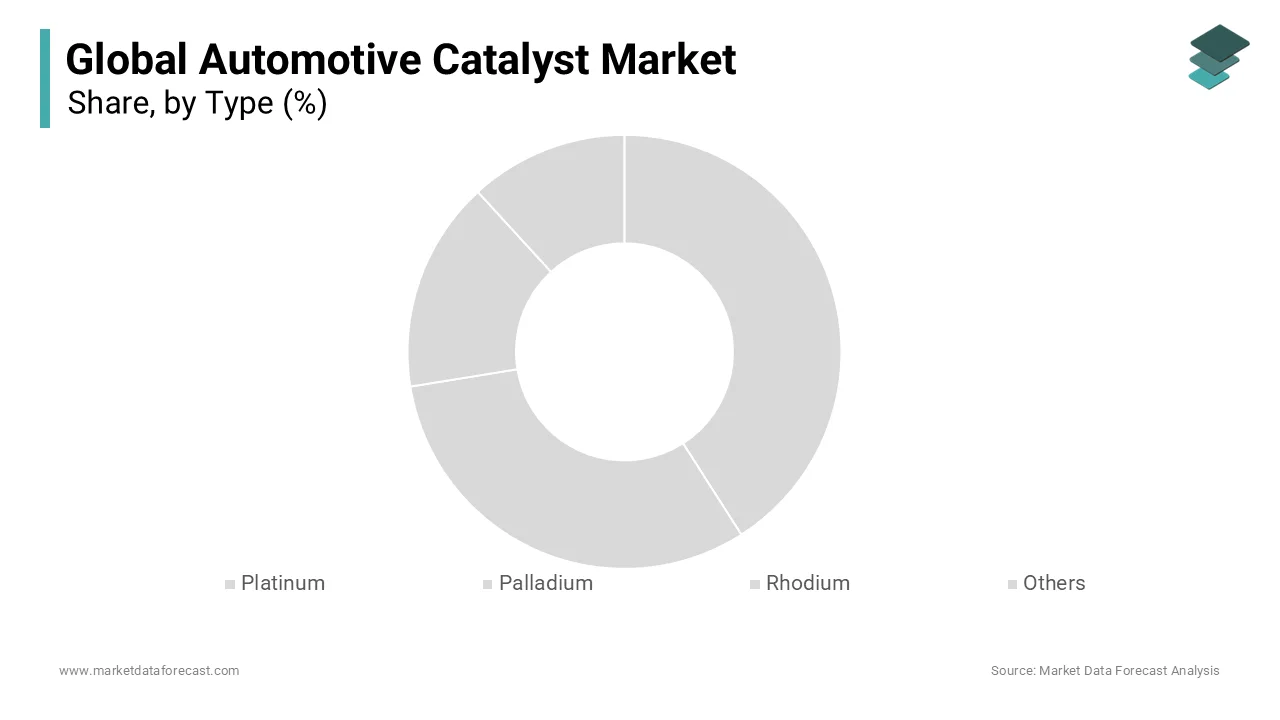
The rhodium segment is likely to experience the fastest CAGR of 5.2% from 2026 to 2034 due to its indispensable role in reducing nitrogen oxide emissions in both gasoline and diesel engines. As emission standards become stricter globally, the need for efficient nitrogen oxide conversion has intensified. According to the International Council on Clean Transportation, long-term exposure to nitrogen oxides and fine particulates from transportation exhaust causes respiratory diseases like asthma, steering cleaner air programs to guide global vehicle emission limits. Rhodium is uniquely effective in selective catalytic reduction processes required to meet these stringent norms. Under the European emission standards, successive Euro regulations progressively lowered allowable petrol and diesel nitrogen oxide (NOx) limits down to Euro 6 benchmarks. While petrol vehicles rely on stoichiometric three-way catalytic converters, often using rhodium for chemical reduction, diesel vehicles require lean-burn aftertreatment solutions such as Selective Catalytic Reduction (SCR) or Lean NOx Traps (LNT) to meet these limits. Additionally the growing popularity of gasoline direct injection engines, which produce higher nitrogen oxide emissions, further boosts rhodium demand. The Society of Motor Manufacturers and Traders indicates that modern engine technologies require more sophisticated after treatment systems where rhodium plays a critical part. Its scarcity and high value also drive innovation in recycling and recovery methods, creating a dynamic market segment. While substitutes are explored for palladium, rhodium remains difficult to replace due to its specific chemical properties. The increasing focus on air quality in emerging economies also contributes to its rapid growth. Consequently, rhodium usage is expanding faster than other platinum group metals in the automotive sector.
By Vehicle Type Insights
The light-duty vehicles segment dominated the automotive catalyst market and accounted for a substantial share in 2025. This dominance of the segment was driven by its overwhelming share of global vehicle production and sales. Passenger cars and light trucks account for the vast majority of vehicles on the road worldwide, creating substantial demand for emission control systems. According to the International Organisation of Motor Vehicle Manufacturers, light-duty vehicles comprise over 75 per cent of total global automobile production annually. This massive volume directly translates to higher consumption of catalytic converters compared to heavy duty segments. Furthermore consumer preference for personal mobility in urban and suburban areas sustains high demand for these vehicles. Governments in developed nations often provide incentives for cleaner passenger cars, encouraging the adoption of advanced catalyst technologies. As per the U.S. Environmental Protection Agency (EPA) and Department of Transportation (USDOT), light-duty vehicles account for over half of mobile source transportation emissions, making them a primary target of joint federal emissions and fuel economy regulations. Strict fuel economy and emission standards for passenger cars necessitate the use of high efficiency catalysts. The rapid turnover of passenger vehicle fleets also contributes to a robust aftermarket for replacement catalysts. Technological advancements in lightweight materials and engine efficiency are primarily focused on light-duty vehicles, further supporting this segment. As urbanisation continues, the demand for personal transportation ensures that light-duty vehicles remain the primary driver of the catalyst market.
The heavy-duty vehicles segment is expected to exhibit a noteworthy CAGR of 4.8% during the forecast period owing to increasingly rigorous emission regulations for commercial transport and logistics. Trucks, buses and construction equipment operate under severe conditions and produce significant amounts of pollutants requiring robust after-treatment solutions. According to the European Environment Agency, heavy-duty vehicles contribute disproportionately to nitrogen oxide and particulate matter emissions in urban areas, prompting strict regulatory action. New standards such as Euro VI and EPA 2027 require advanced catalytic systems including selective catalytic reduction and diesel particulate filters. The growth of e-commerce and global trade has expanded the freight industry, leading to increased production of heavy duty vehicles. As per the American Trucking Associations (ATA) Freight Transportation Forecast, U.S. freight tonnage will grow by roughly 24% to 25% through 2035, supporting sustained demand for fleet replacement and new commercial vehicles. These vehicles require larger and more complex catalyst systems to handle higher exhaust volumes and temperatures. Additionally the push for cleaner public transportation systems in cities worldwide boosts demand for bus catalysts. Retrofitting older heavy-duty fleets with modern emission controls also contributes to market growth. As governments prioritise reducing industrial pollution, the heavy-duty segment offers significant expansion opportunities. The technological complexity of these systems adds value and drives revenue growth in this segment.
REGIONAL ANALYSIS
North America Automotive Catalyst Market Analysis
North America holds a noteworthy share of the automotive catalyst market. The market in this region is supported by a mature automotive industry and strict environmental regulations. The United States and Canada have well-established emission standards that mandate the use of advanced catalytic converters in all new vehicles. According to sources, the United States Environmental Protection Agency enforces Tier 3 standards, which require significant reductions in tailpipe emissions, driving the adoption of high efficiency catalysts. The region benefits from a high rate of vehicle ownership and a large aftermarket for replacement parts. As per the Alliance for Automotive Innovation, millions of vehicles are sold annually in the region, ensuring steady demand for original equipment catalysts. The presence of major automotive manufacturers and catalyst producers fosters technological innovation and competitive pricing. Consumer awareness regarding air quality and environmental sustainability further supports the market. Government incentives for low-emission vehicles also encourage the use of advanced after-treatment technologies. The region's focus on reducing urban smog, particularly in cities like Los Angeles, drives continuous improvement in catalyst performance. As the fleet ages, the demand for replacement catalysts remains strong. North America continues to lead in setting regulatory benchmarks that influence global market trends.
Europe Automotive Catalyst Market Analysis
Europe followed closely behind the dominant region in the automotive catalyst market in 2025. This position of the European market was propelled by aggressive climate goals and stringent emission directives. The European Union has implemented some of the world's toughest emission standards, including Euro 6 and the upcoming Euro 7 norms. According to the European Commission, transport accounts for nearly 25 per cent of the EU's greenhouse gas emissions, prompting urgent action. This regulatory pressure compels automakers to use high loadings of precious metals in catalysts to ensure compliance. The region is also a leader in diesel technology, which requires complex after-treatment systems including selective catalytic reduction. As per the Society of Motor Manufacturers and Traders (SMMT), manufacturers are investing billions into advanced plug-in hybrid and battery-electric technologies to meet stringent zero-emission vehicle mandates. The widespread adoption of these technologies supports demand for palladium- and rhodium-based catalysts. Additionally the European Green Deal aims to reduce emissions by 55 per cent by 2030, further tightening regulations. The mature automotive market in countries like Germany, France and the United Kingdom ensures consistent demand. Recycling initiatives for precious metals are also more advanced in Europe, contributing to supply chain sustainability. As the transition to electric vehicles progresses, the region remains a key market for hybrid and efficient internal combustion engine catalysts.
Asia Pacific Automotive Catalyst Market Analysis
Asia-Pacific was the largest contributor to the automotive catalyst market and occupied a commanding share in 2025. This strong position of the APAC market was fueled by expanding vehicle production and improving regulatory frameworks. China, India, and Southeast Asian nations are experiencing a surge in automobile ownership due to economic growth and urbanisation. According to the China Association of Automobile Manufacturers, China is the world's largest automotive market, producing and selling millions of vehicles annually. This massive scale creates immense demand for catalytic converters. Governments in the region are implementing stricter emission standards such as China 6 and Bharat Stage VI to combat air pollution. The World Health Organisation identifies several Asian cities among the most polluted globally, driving policy changes. These regulations mandate the use of advanced catalysts in both passenger and commercial vehicles. The presence of major global automotive manufacturers in the region also supports local catalyst production. Rising disposable incomes increase the demand for personal vehicles, further boosting market growth. Additionally the growing logistics sector drives demand for heavy-duty vehicle catalysts. As awareness of environmental issues grows, consumers and governments alike prioritise cleaner technologies. The region offers significant potential for market expansion due to its large and growing vehicle parc.
Latin America Automotive Catalyst Market Analysis
Latin America is a developing region in the automotive catalyst market due to increasing vehicle sales and gradual regulatory improvements. Brazil Mexico and Argentina are the key markets in the region where automotive production is concentrated. According to the Brazilian Association of Automobile Manufacturers, vehicle production in Brazil has rebounded strongly post-pandemic, supporting component demand. While emission standards are less stringent than in North America or Europe, countries are gradually adopting stricter norms. The implementation of Proconve programs in Brazil mandates emission controls for new vehicles, driving catalyst adoption. Economic recovery and rising middle-class incomes contribute to higher vehicle ownership rates. The region also has a significant aftermarket for replacement catalysts due to the age of the vehicle fleet. International automakers operating in the region bring global standards which indirectly raise local requirements. However, economic volatility and currency fluctuations can impact purchasing power and investment. Despite these challenges, the long term trend toward urbanisation and mobility supports market growth. As governments focus on improving air quality in major cities, the demand for effective emission control solutions will increase. The region offers opportunities for manufacturers who can provide cost effective and durable catalyst solutions.
Middle East and Africa Automotive Catalyst Market Analysis
The Middle East and Africa region is the fastest-growing region in the automotive catalyst market, owing to infrastructure development and growing automotive imports. Countries in the Gulf Cooperation Council such as Saudi Arabia and the United Arab Emirates are investing in modern transportation networks. According to sources, the Saudi Arabian Standards Organization has introduced stricter emission regulations for imported vehicles aligning with international norms. This shift drives demand for compliant catalytic converters in new and used vehicle imports. The African continent faces challenges related to older vehicle fleets, but major economies like South Africa and Egypt are implementing cleaner fuel standards. As per the United Nations Environment Programme, air pollution is a growing concern in African urban centers prompting policy action. The region relies heavily on vehicle imports, which must meet specific emission criteria. As local assembly plants expand in countries like Morocco and Egypt, the demand for original equipment catalysts grows. The hot climate in the Middle East requires catalysts with high thermal stability, creating specific technical demands. Government initiatives to diversify economies and improve environmental standards support market development. While the market is smaller compared to other regions, it offers growth potential as regulatory frameworks mature and vehicle ownership increases.
COMPETITIVE LANDSCAPE
The competition in the automotive catalyst market is characterized by intense rivalry among a few dominant global players and specialized regional manufacturers. Major companies differentiate themselves through technological innovation superior material science and comprehensive recycling services. The market features high barriers to entry due to the complex chemistry involved and strict regulatory requirements. Price competition remains significant particularly for standard catalyst formulations but leading firms compete on value added services such as custom engineering and supply chain security. The transition toward electric vehicles forces competitors to adapt their strategies by focusing on hybrid applications and alternative mobility solutions. Intellectual property protection is critical as companies strive to safeguard their proprietary catalyst formulations and manufacturing processes. Collaborative ventures between catalyst producers and automakers are becoming common to accelerate the development of next generation emission control technologies. Regulatory compliance serves as a key differentiator as manufacturers must consistently meet evolving global standards. Customer loyalty is driven by reliability technical expertise and the ability to provide sustainable solutions. The competitive landscape encourages continuous investment in research and development to stay ahead of technological curves. Overall the market rewards innovation and operational excellence in a highly regulated environment.
KEY MARKET PLAYERS
Some of the key players in the automotive catalyst market are
- Symrise (Germany)
- BASF (Germany)
- Eberspacher (Germany)
- Johnson Matthey (UK)
- Umicore (Belgium)
- Cataler (Japan), Klarius Products Ltd. (UK)
- Cummins (US)
- Heraeus (Germany)
- Clariant (Switzerland)
- INTERKAT (Germany)
- Sinocat (China)
- N.E. Chemcat (Japan)
- CDTi Advanced Materials (US)
- Tenneco (US)
- Ecocat India Pvt. Ltd. (India)
- IBIDEN (Japan)
Top Players in the Market
- BASF SE contributes significantly to the automotive catalyst market through its extensive portfolio of emission control technologies for gasoline and diesel engines. The company develops advanced three way catalysts and selective catalytic reduction systems that help manufacturers meet stringent global emission standards. BASF recently expanded its production capacity for precious metal coated substrates to address growing demand in Asia and Europe. This strategic expansion ensures reliable supply chains for original equipment manufacturers facing tight production schedules. The company invests heavily in research and development to create next generation catalyst formulations with reduced precious metal content. These innovations lower costs while maintaining high conversion efficiency for harmful pollutants. BASF also collaborates with automakers to integrate catalysts into hybrid powertrains ensuring optimal performance during frequent engine start stop cycles. Their focus on sustainability includes developing recycling processes for spent catalysts to recover valuable metals. This comprehensive approach strengthens their position as a leading supplier of environmentally friendly automotive solutions.
- Johnson Matthey Plc plays a vital role in the automotive catalyst market by leveraging its expertise in platinum group metal chemistry and catalysis. The company supplies high performance catalysts for light duty and heavy duty vehicles worldwide focusing on nitrogen oxide reduction. Johnson Matthey recently launched new catalyst technologies designed specifically for hybrid electric vehicles which operate at lower exhaust temperatures. This innovation addresses the unique challenges of hybrid powertrains ensuring compliance with cold start emission regulations. The company actively engages in partnerships with major automakers to co develop customized after treatment systems. Their global manufacturing footprint allows for efficient delivery and technical support across key automotive regions. Johnson Matthey also prioritizes circular economy principles by establishing robust recycling networks for end of life catalysts. This initiative secures raw material supplies and reduces environmental impact. By combining technological leadership with sustainable practices Johnson Matthey maintains its competitive edge in the evolving automotive landscape.
- Umicore SA is a key player in the automotive catalyst market specializing in the refining and recycling of precious metals used in emission control devices. The company provides closed loop services that allow automakers to recover platinum palladium and rhodium from scrap catalysts. Umicore recently invested in advanced hydrometallurgical technologies to improve the recovery rates of these critical materials. This enhancement supports the industry's shift toward sustainable sourcing and reduces dependency on primary mining. The company also manufactures high quality catalyst substrates and coatings that meet rigorous performance standards. Umicore collaborates with technology providers to develop solutions for emerging powertrain architectures including hydrogen fuel cells. Their expertise in material science enables the creation of durable and efficient catalytic components. By offering integrated services from material supply to recycling Umicore strengthens its value proposition. This holistic approach helps customers manage costs and comply with environmental regulations effectively.
Top Strategies Used by Key Market Participants
Key players in the automotive catalyst market primarily focus on technological innovation and sustainable sourcing to maintain competitive advantage. Companies invest heavily in research and development to create advanced catalyst formulations that reduce precious metal usage while maintaining high efficiency. Integrating digital tools for real time monitoring allows manufacturers to optimize catalyst performance and predict maintenance needs. Strategic partnerships with automakers enable co development of customized solutions for hybrid and alternative fuel vehicles. Manufacturers also emphasize expanding their recycling capabilities to secure stable supplies of platinum group metals and reduce environmental impact. This circular approach addresses supply chain vulnerabilities and lowers raw material costs. Additionally companies pursue geographic expansion into emerging markets where vehicle production is growing rapidly. By offering comprehensive services including technical support and regulatory compliance assistance participants strengthen their market presence. Continuous improvement in production efficiency helps mitigate the effects of volatile metal prices. These strategies ensure long term resilience and growth in a transforming automotive landscape.
MARKET SEGMENTATION
This research report on the global automotive catalyst market has been segmented and sub-segmented based on the following categories.
By Type
- Platinum
- Palladium
- Rhodium
- Other
By Vehicle Type
- Light-Duty Vehicles
- Heavy-Duty Vehicles
By Region
- North America
- Europe
- Asia Pacific
- Latin America
- The Middle East and Africa