- Product Description Description
- Table of Contents TOC
- List of Table & Figure LOT
- Get Free Sample PDF Sample PDF
Market Size, 2025
$5.19 BnMarket Estimate, 2026
$6.30 BnMarket Forecast, 2034
$29.51 BnCAGR, 2026–2034
21.30%Executive Summary: Global Automotive Cybersecurity Market
- Market Scope: Global market analysis covering security solutions, encryption protocols, intrusion detection systems, and threat mitigation services for connected, autonomous, and software-defined vehicles (SDVs).
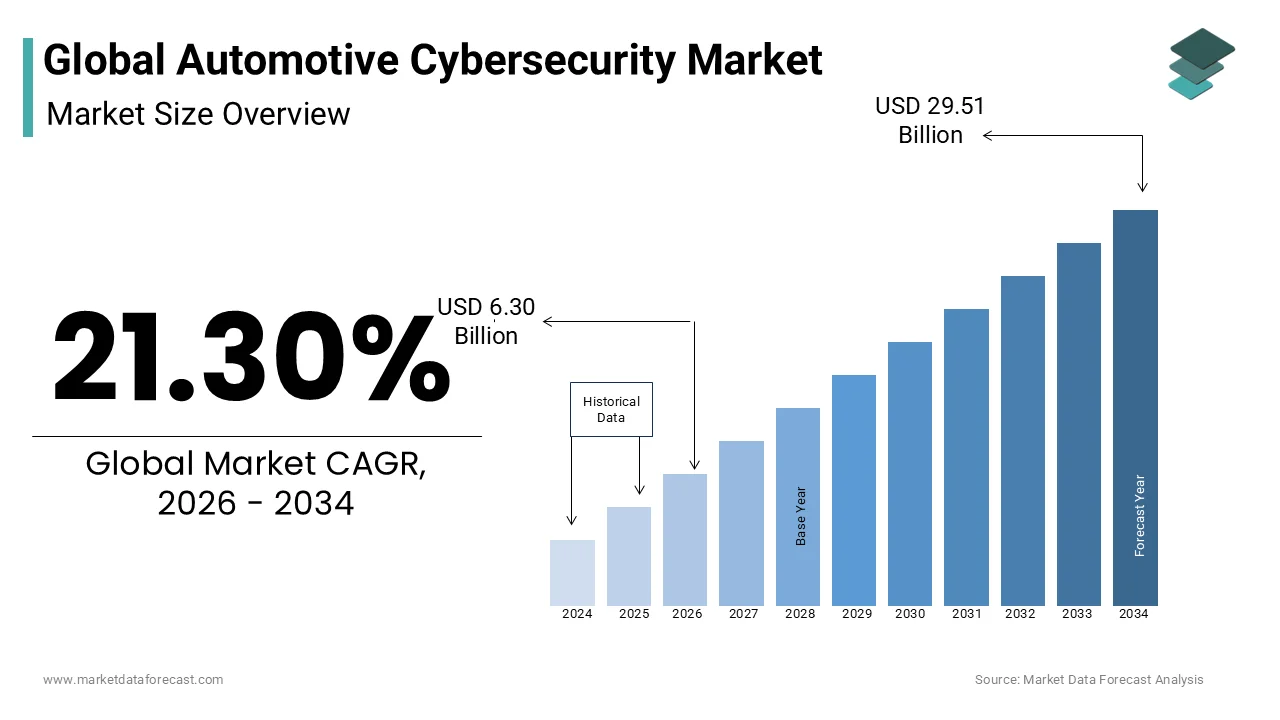
- Market Valuation: Valued at USD 5.19 billion (2025), estimated at USD 6.30 billion (2026), and projected to reach USD 29.51 billion by 2034, registering a robust CAGR of 21.30% (2026–2034).
- Primary Growth Drivers: Proliferation of connected cars, over-the-air (OTA) software updates, cloud-mobile infrastructure expansion, and strict regulatory compliance mandates (such as UNECE WP.29).
Key Market Segment Metrics (2026–2034)
| Category | Leading Segment (2025 Position) | Fastest-Growing Segment |
|---|---|---|
| By Security Type | Wireless network security (dominant due to the high vulnerability of in-vehicle wireless terminals and interfaces) | Application security |
| By Application | ADAS & Safety Systems (crucial for protecting continuous ECU-to-cloud connections and automated driving nodes) | Infotainment and telematics systems |
| By Vehicle Type | Passenger cars (leading via heavy integration of digital cockpits, smart interfaces, and consumer connectivity) | Commercial vehicles (driven by fleet protection and logistics network security demands) |
| By Region | North America (accumulates largest market share due to mature ICT-automotive convergence and connected ecosystems) | Asia-Pacific (fast-expanding region backed by soaring vehicle production and rapid urbanization) |
Major Market Players & Market Structure
Market Structure: Highly specialized and competitive landscape involving automotive Tier-1 suppliers, semiconductor giants, and cybersecurity software firms forming strategic tech alliances.
Key Companies: Infineon Technologies AG, Argus Cyber Security, Intel Corporation, Trillium Inc., Harman International Industries, Delphi Automotive PLC, Lear Corporation, SBD Automotive & NCC Group, Arilou Technologies, Karamba Security, and ESCRYPT GmbH.
 Download Free Sample Report
Global Automotive Cybersecurity Market Size
The global automotive cybersecurity market size was valued at USD 5.19 billion in 2025 and is anticipated to reach a valuation of USD 6.30 billion in 2026 and USD 29.51 billion by 2034, growing at a CAGR of 21.30%, from 2026 to 2034.
Current Market Introduction and Definition
Automotive cybersecurity is the practice of protecting a vehicle's electronic systems, software, internal networks, and connected services from digital attacks, unauthorised access, and malicious tampering. This critical sector safeguards electronic control units, communication networks, and cloud interfaces as modern automobiles evolve into sophisticated Internet of Things devices on wheels. According to Upstream Security, automotive cybersecurity incidents spiked 225% between 2018 and 2021, rather than between 2018 and 2023. As per the United Nations Economic Commission for Europe (UNECE), UN Regulation No. 155 mandates that cybersecurity management system compliance applies to all new vehicle types from July 2022 and became mandatory for all new vehicles produced from July 2024. These regulatory and threat-driven imperatives define the strategic scope of the Automotive Cybersecurity Market as original equipment manufacturers transition from reactive patching to proactive security-by-design principles. The integration of over-the-air update capabilities with encrypted communication protocols ensures continuous protection against emerging vulnerabilities throughout the vehicle lifecycle. Consequently, the market serves as the foundational shield for consumer trust and operational safety in an era where software-defined vehicles dominate the transportation landscape.
MARKET DRIVERS
Mandatory Regulatory Compliance Frameworks Driving Adoption
Strict governmental regulations and international standards propel the automotive cybersecurity market. This, in turn, makes comprehensive security measures a legal prerequisite for vehicle certification and sale. According to the United Nations Economic Commission for Europe, Regulation No. 155 requires all manufacturers to implement a certified Cybersecurity Management System to obtain type approval for new vehicles in major markets, including Europe, Japan and South Korea. The National Highway Traffic Safety Administration in the United States has issued similar guidelines urging automakers to adopt a layered cybersecurity approach to protect safety-critical systems from remote exploitation. These regulatory frameworks transform cybersecurity from an optional feature into a mandatory compliance requirement with severe penalties for non-adherence, including bans on vehicle sales. Automakers must invest heavily in security operations centres and vulnerability management processes to maintain certification status. The harmonisation of these standards across regions simplifies global compliance but raises the baseline for entry. This policy-driven mandate ensures sustained demand for security solutions regardless of economic conditions, as manufacturers prioritise regulatory adherence to maintain market access.
Proliferation of Connected and Autonomous Vehicle Technologies
The rapid integration of advanced connectivity and autonomous driving features significantly fuels the growth of the automotive cybersecurity market. This integration expands the attack surface and increases the potential impact of cyber threats. According to sources, Level 3 and Level 4 autonomous vehicles integrate advanced sensor frameworks and vehicle-to-everything (V2X) connectivity, expanding the potential attack surface for malicious exploits. As per studies, modern vehicles contain over 100 million lines of code, surpassing fighter jets in sheer software codebase volume. Each connected component, such as infotainment systems, telematics units, and mobile apps, requires robust encryption and authentication to prevent unauthorised access. The shift toward software-defined vehicles allows for frequent feature updates but also necessitates continuous security monitoring and over-the-air patching capabilities. Consumers increasingly demand assurance that their personal data and physical safety are protected from remote hijacking. This technological evolution drives automakers to embed security at every layer of the vehicle architecture, ensuring resilience against sophisticated attacks.
MARKET RESTRAINTS
High Development and Integration Costs Limiting Adoption
Prohibitive costs associated with developing and integrating robust cybersecurity solutions primarily hamper the growth of the automotive cybersecurity market. These expenses significantly strain the budgets of original equipment manufacturers and suppliers. According to sources, implementing robust vehicular cybersecurity measures typically increases manufacturing costs due to the integration of hardware modules and validation requirements. As per studies, tier-two automotive component suppliers often encounter resource constraints when trying to fulfil extensive cybersecurity compliance demands. These high costs force manufacturers to make difficult trade-offs between feature richness and security depth, particularly in budget-friendly vehicle segments. The complexity of securing legacy electronic architectures further increases engineering hours and validation expenses. Many companies struggle to justify the return on investment for invisible security features compared to visible consumer amenities. Until standardised, cost-effective security modules become widely available, this financial burden will persist. Consequently, the universal adoption of advanced cybersecurity measures across all vehicle classes will continue to slow down.
Shortage of Specialised Automotive Cybersecurity Talent
A critical shortage of skilled professionals with expertise in both automotive engineering and cybersecurity severely impacts the automotive cybersecurity market. This acute talent deficit directly limits the capacity of organisations to design and maintain secure systems. According to research, there is a global shortage of cybersecurity personnel, with a specific demand for engineers trained in embedded automotive network systems. As per reports, traditional academic curricula rarely combine vehicular dynamics with automotive network protection, requiring subsequent organisational training. This talent gap leads to delayed product launches and increased reliance on external consultants, which raises project costs. The competition for qualified experts drives up salary expectations, making it difficult for smaller suppliers to attract top talent. Without adequate human capital, even the most advanced security tools fail to deliver promised protection levels. This workforce constraint acts as a significant bottleneck, slowing down the pace of innovation and implementation across the automotive industry globally.
MARKET OPPORTUNITIES
Integration of Blockchain for Secure Data Exchange
The adoption of blockchain technology represents a key growth area for the automotive cybersecurity market. This integration provides immutable and transparent records for vehicle data and software updates. According to research, utilising blockchain-based protocols can help secure the integrity of over-the-air updates by ensuring only authorised and authenticated firmware packages execute on an electronic control unit. As per reports, decentralised identity architecture and blockchain frameworks can protect vehicle-to-grid and vehicle-to-infrastructure communication channels against spoofing or data tampering. This technology enables secure sharing of threat intelligence among manufacturers without compromising proprietary information. Automotive consortia are exploring blockchain for managing digital keys and access permissions in shared mobility scenarios. The ability to create tamper-proof logs of vehicle events supports forensic analysis after security incidents. This technological innovation opens new revenue streams for security providers capable of integrating distributed ledger technologies with existing vehicle architectures. Vendors who develop scalable blockchain solutions for automotive use cases will capture first-mover advantage in this emerging segment.
Expansion of Security Operations Centres for Vehicles
The establishment of dedicated Security Operations Centres specifically for monitoring connected vehicle fleets offers substantial opportunities for the automotive cybersecurity market. This development directly drives market expansion by enabling real-time threat detection and response. According to sources, specialised automotive Security Operations Centre (SOC) services are expected to scale up as manufacturers transition toward persistent threat monitoring models. As per studies, cooperative threat vector analysis and intelligence sharing among sector entities help identify and remediate zero-day operational vulnerabilities more rapidly. These centres provide 24/7 surveillance of vehicle networks, allowing for immediate isolation of compromised nodes before widespread damage occurs. Service providers offer managed security services that reduce the operational burden on automakers while ensuring compliance with evolving regulations. The subscription-based model of SOC services creates recurring revenue streams and strengthens long-term customer relationships. This shift toward service-oriented security models aligns with the software-defined nature of modern vehicles. Providers offering comprehensive monitoring and incident response capabilities will benefit from this critical operational evolution.
MARKET CHALLENGES
Complexity of Legacy Vehicle Architectures
Integrating modern cybersecurity measures into legacy vehicle electronic architectures severely challenges the automotive cybersecurity market. This process demands extensive retrofitting and complex compatibility adjustments to ensure effective system integration. According to sources, many operating vehicles utilise older networking architectures like Controller Area Network protocols that lack built-in cryptographic security features. As per studies, retrofitting legacy electronic architectures with hardware security modules or boundary gateways can potentially influence data processing timelines and system predictability. These technical hurdles increase development time and cost for manufacturers seeking to protect older models still in production. The fragmented nature of supplier components means that security must be coordinated across multiple vendors with varying levels of maturity. Lack of standardisation in legacy interfaces forces custom engineering solutions for each vehicle platform. Until newer, secure-by-design architectures replace older systems, this technical debt will continue to hinder efficient security implementation. Furthermore, it will persist in frustrating engineers who are seeking uniform protection strategies.
Rapidly Evolving Threat Landscape
The constantly changing nature of cyber threats impedes the expansion of the automotive cybersecurity market. This dynamic environment requires continuous adaptation and updating of defence mechanisms to effectively stay ahead of attackers. According to research, threat actors are increasingly leveraging automation and artificial intelligence methodologies to systematically identify software flaws in automotive systems. As per reports, connected vehicular ecosystems and their backend platforms face evolving threats from cyber extortion, ransomware, and the unauthorised extraction of user data. This dynamic environment makes static security measures obsolete quickly, requiring frequent software patches and over-the-air updates. Manufacturers struggle to balance the need for rapid response with rigorous testing to ensure updates do not disrupt vehicle functionality. The asymmetry between defenders who must secure all entry points and attackers who need only find one weakness creates persistent risk. Keeping pace with this evolving threat landscape demands significant ongoing investment in research and development, which strains resources for many industry participants.
REPORT COVERAGE
| REPORT METRIC | DETAILS |
| Market Size Available | 2025 to 2034 |
| Base Year | 2025 |
| Forecast Period | 2026 to 2034 |
| CAGR | 21.30% |
| Segments Covered | By Vehicle Type, Application, Security, Service, and Region. |
| Various Analyses Covered | Global, Regional & Country Level Analysis, Segment-Level Analysis, DROC, PESTLE Analysis, Porter’s Five Forces Analysis, Competitive Landscape, Analyst Overview on Investment Opportunities |
| Regions Covered | North America, Europe, APAC, Latin America, Middle East & Africa |
| Market Leaders Profiled | Infineon Technologies AG, Argus Cyber Security, Intel Corporation, Trillium Inc., Harman International Industries, Inc., Delphi Automotive PLC, Lear Corporation, SBD Automotive & NCC Group, Arilou Technologies, Karamba Security, ESCRYPT GmbH, and Others. |
SEGMENTAL ANALYSIS
By Application Insights
Infotainment
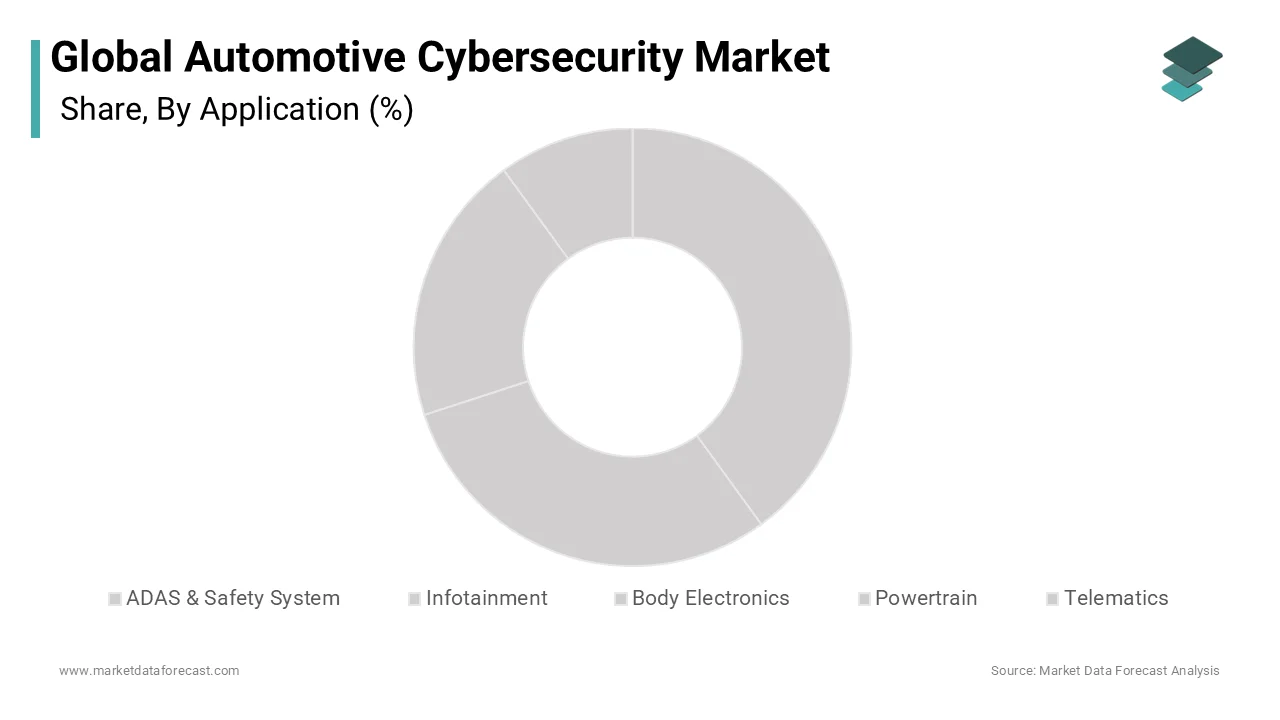
In 2025, the infotainment segment held the majority share in the automotive cybersecurity market because it serves as the most accessible interface for external connectivity and thus the primary target for cyber intrusions. According to Upstream Security, telematics and cloud data serve as the primary automotive attack vectors, accounting for 43% of attacks, while infotainment-related incidents accounted for only 15% of the total in 2023. As per research, modern automotive infotainment applications aggregate large volumes of user telemetry, such as synced smartphone addresses and geographical search histories, creating data extraction risks. This vulnerability necessitates robust encryption and intrusion detection systems specifically designed for multimedia processors. Manufacturers must secure these units to prevent unauthorised access to the internal vehicle network through gateway exploitation. The complexity of third-party applications installed on infotainment platforms further expands the attack surface, requiring continuous monitoring. Consequently, security solutions for infotainment represent the largest share of application-specific spending as automakers prioritise protecting the most exposed component of the connected car architecture.
The prominence of this segment is further reinforced by the increasing integration of third-party apps and cloud services, which introduce unverified code into the vehicle ecosystem. According to the Open Web Application Security Project, automotive applications suffer from vulnerabilities similar to those in mobile apps, such as insecure data storage and improper session management, requiring specialised application-layer security. As per reports, the deployment of multiple third-party application modules inside vehicle ecosystems requires isolated software sandboxing to constrain potential code injection vulnerabilities. This proliferation of software sources forces manufacturers to implement rigorous app verification and runtime protection mechanisms. Users expect seamless connectivity with smartphones and smart home devices, creating complex interaction scenarios that must be secured against man-in-the-middle attacks. The need to balance user experience with strict security protocols drives significant investment in infotainment cybersecurity. This dynamic ensures that infotainment remains the focal point for security innovation and expenditure.
Telematics
The telematics segment exhibits the highest CAGR of 14.2% due to its central role in enabling Vehicle-to-Everything communication, which requires constant secure data exchange with external infrastructure. According to sources, vehicle-to-everything (V2X) framework communications operate over high-frequency telematics channels requiring data authentication structures to mitigate message manipulation risks. As per sources, maintaining verified telemetry architectures is required to safely implement coordinated adaptive motion control and emergency collision avoidance features. This safety imperative drives rapid adoption of hardware security modules within telematics control units. The expansion of smart city infrastructure further increases the volume of data transmitted, requiring scalable security solutions. Automakers invest heavily in securing telematics to ensure regulatory compliance and maintain consumer trust in automated driving features. This critical function ensures sustained high growth for telematics security.
Rapid growth in the telematics segment is fueled by stringent global regulations mandating the protection of location and usage data collected by tracking devices. As per the General Data Protection Regulation in Europe, telematics providers must ensure that personal data is anonymised and stored securely with explicit user consent for processing. The California Consumer Privacy Act imposes similar requirements, forcing manufacturers to implement robust access controls and audit trails for telematics data. Noncompliance results in severe financial penalties and reputational damage, driving urgent investment in privacy-enhancing technologies. Telematics systems must also protect against unauthorised tracking and stalking, which pose physical safety risks to users. The rise of insurance telematics and usage-based policies increases the sensitivity of collected data, requiring higher security standards. These legal and ethical obligations accelerate the deployment of advanced encryption and identity management solutions in telematics units.
By Security Insights
Endpoint Security
The endpoint security segment was the largest in 2025 and occupied a commanding share of the automotive cybersecurity market. This supremacy was supported by the fact that it provides the fundamental layer of defence for individual electronic control units against local and remote exploits. According to studies, modern connected vehicles leverage dozens of electronic control units (ECUs), requiring implementation of foundational protection frameworks like memory isolation and secure boot sequences to block firmware tampering. The United Nations Economic Commission for Europe Regulation No. 155 mandates that manufacturers implement measures to protect all critical endpoints from unauthorised access and modification. This regulatory requirement drives universal adoption of endpoint security solutions across all vehicle segments. Hardware security modules embedded in ECUs ensure that only authenticated software can execute, preventing malicious code injection. The distributed nature of vehicle electronics makes endpoint protection the first line of defence against lateral movement by attackers. Consequently, endpoint security accounts for the largest share of security spending as it forms the basis of a secure vehicle architecture.
The leading position of this segment is also bolstered by the need to prevent physical tampering and reverse engineering of vehicle software by malicious actors. As per the SAE International J3061 standard, endpoints must be resilient to physical attacks such as probing and fault injection, which are common methods used to extract cryptographic keys. As per research, the occurrence of unauthorised vehicle reprogramming via compromised electronic access tokens emphasises the broader automotive demand for reliable, hardware-insulated credential authentication. Secure elements within ECUs store sensitive keys in tamper-resistant memory, ensuring they cannot be extracted even if the device is physically accessed. This level of protection is crucial for maintaining the integrity of digital keys and immobiliser systems. Manufacturers prioritise endpoint hardening to prevent cloning and unauthorised duplication of vehicle identities. This physical and logical security combination cements endpoint security as the market leader.
Wireless Network Security
The wireless network security segment is estimated to register the fastest CAGR of 13.8% from 2026 to 2034, owing to the increasing reliance on over-the-air updates for software maintenance and feature deployment. According to sources, executing over-the-air (OTA) firmware updates introduces massive data transfer streams across wireless infrastructure, creating risks of intermediary interception and man-in-the-middle exploits if the channels are left unencrypted. As per studies, deploying safe OTA distribution channels relies on a continuous balance of mutual signature verification and end-to-end telemetry validation before applying update packages to vehicular subsystems. This necessity drives adoption of advanced transport layer security protocols specifically optimised for automotive bandwidth constraints. The frequency of OTA updates is increasing as vehicles become more software-defined, requiring continuous validation of wireless connections. Any breach in the update channel could allow attackers to install malicious firmware across entire fleets. This critical risk fuels rapid investment in wireless network security solutions.
The swift expansion of this segment gains further momentum from the widespread adoption of keyless entry and remote start systems, which are vulnerable to relay and replay attacks. According to research, electronic car theft increasingly incorporates signal boosting and relay amplification setups to extend key fob radio footprints, granting entry without physical key manipulation. As per reports, a rise in electronic vehicle compromises utilising physical bypass vectors has driven automotive development toward ultra-wideband (UWB) communications to enable precise, multi-point physical distance constraints. Securing these short-range wireless communications requires robust encryption and challenge-response protocols to prevent spoofing. The integration of smartphone-based digital keys further expands the wireless attack surface, requiring secure Bluetooth and NFC implementations. Consumers demand assurance that their vehicles cannot be remotely unlocked or started by unauthorised users. This consumer pressure drives automakers to prioritise wireless network security enhancements.
By Vehicle Insights
Passenger Vehicles
The passenger vehicles segment dominated the automotive cybersecurity market and accounted for a substantial share in 2025. This dominance was driven by its high production volumes and the sensitive nature of personal data stored within connected infotainment systems. According to the International Organisation of Motor Vehicle Manufacturers, over 60 million passenger cars are produced annually globally, each requiring baseline cybersecurity measures to meet regulatory standards. As per sources, approximately 70% of surveyed citizens explicitly indicate that autonomous passenger vehicles would be structurally more acceptable if they are clearly labelled as driverless for visual identification. Automakers prioritise security in passenger vehicles to maintain brand reputation and consumer trust in an increasingly competitive market. The prevalence of subscription-based services in passenger cars also requires secure billing and identity management systems. High-volume manufacturing allows for economies of scale in security hardware deployment, making it cost-effective to equip every unit. These mass-market dynamics ensure passenger vehicles remain the largest segment for cybersecurity adoption.
Market leadership in the passenger vehicle segment is driven by strict consumer protection laws that mandate high standards for data privacy and functional safety. As per the European Union General Data Protection Regulation, automakers must obtain explicit consent for data collection and provide users with control over their information, necessitating sophisticated consent management platforms. The National Highway Traffic Safety Administration emphasises that cybersecurity is a safety issue requiring passenger vehicles to be protected from remote control attacks that could endanger occupants. These regulations force manufacturers to integrate security-by-design principles from the initial development stages. Recall costs for cybersecurity vulnerabilities are extremely high, incentivising proactive investment in robust protection mechanisms. The visibility of passenger vehicle breaches in the media further pressures companies to maintain high security standards. This regulatory and reputational landscape secures the dominant position of passenger vehicles in the market.
Electric Vehicles
The electric vehicles segment is anticipated to witness the fastest CAGR of 15.5% over the forecast period. This surge is propelled by the added complexity of securing battery management systems and charging interfaces against sophisticated attacks. According to the International Energy Agency, global EV sales reached 14 million units in 2023, each featuring complex software-controlled battery packs that require protection from manipulation to prevent thermal runaway or performance degradation. Academic vulnerability testing presented at USENIX VehicleSec reveals that standardised ISO 15118 Plug & Charge protocols are vulnerable to cryptographic relay attacks via fake charging stations that misroute transaction bills. This dual exposure to vehicle and infrastructure vulnerabilities drives significant investment in specialised EV security solutions. The high-voltage nature of EV systems makes them attractive targets for ransomware attacks threatening physical safety. Automakers and charging network operators collaborate to establish secure communication frameworks. This unique threat profile accelerates cybersecurity adoption in the EV segment.
The fast development of this segment is accelerated by the integration of electric vehicles with smart grids and vehicle-to-grid energy trading platforms, which expand the attack surface. According to research, the large-scale rollout of vehicle-to-grid (V2G) power routing requires centralised cryptographic validation to prevent malicious node spoofing, systemic grid load distortion, and operational instability. As per reports, clusters of compromised electric vehicles could theoretically be coordinated via automated botnets to execute distributed denial-of-service (DDoS) power-draw spikes against regional distribution infrastructure. This critical infrastructure dependency mandates military-grade security for EV communication modules. The emergence of blockchain-based energy trading further requires robust cryptographic capabilities within vehicle hardware. Regulatory bodies are developing specific standards for V2G security, driving early adoption of advanced solutions. The strategic importance of EVs in the energy ecosystem ensures sustained high growth for cybersecurity in this segment.
By Services Insights
In-Vehicle Security
The in-vehicle security segment led the automotive cybersecurity market and captured a significant share in 2025. This leading position was attributed to its role as a mandatory prerequisite for obtaining type approval under global regulations such as UN R155. According to the United Nations Economic Commission for Europe, manufacturers must demonstrate that they have implemented a Cybersecurity Management System covering the entire vehicle lifecycle, including risk assessment and mitigation during design and production. The regulatory mandate creates a consistent and non-discretionary demand for in-vehicle security consulting, testing, and certification services. Automakers rely on specialised service providers to conduct penetration testing and vulnerability assessments to identify weaknesses before production. The complexity of modern vehicle architectures makes internal expertise insufficient, necessitating external support. This compliance-driven requirement ensures in-vehicle services remain the largest revenue generator in the services segment.
The dominance of in-vehicle services is reinforced by the need for continuous monitoring and incident response capabilities throughout the vehicle's operational life. As per the ISO/SAE 21434 standard, manufacturers are required to establish structured organisational procedures for continuous vulnerability management and incident response in deployed vehicles. The Upstream Security indicates that real-time monitoring of vehicle networks is essential to detect anomalies and prevent widespread attacks across fleets. Service providers offer managed security operations centres that analyse telemetry data to identify potential threats and deploy over-the-air patches. This shift from one-time certification to continuous service engagement creates recurring revenue streams. The increasing sophistication of attacks makes static defences insufficient, requiring dynamic response capabilities. Automakers prefer outsourcing these complex operations to specialised firms with advanced threat intelligence. This operational necessity sustains the leadership of in-vehicle security services.
External Cloud Services
The external cloud services segment is on the rise and is expected to be the fastest-growing segment in the market, witnessing a CAGR of 16.1% between 2026 and 2034. This expansion is fuelled by the need for centralised threat intelligence and big data analytics to protect large fleets of connected vehicles. According to studies, centralised cloud-based mobility platforms aggregate telemetry across large vehicle fleets to analyse threat behaviour patterns and deploy security updates across the network. As per research, cloud infrastructure provides the high-performance computing capabilities needed to execute scalable machine learning models that monitor and identify subtle variations in fleet-wide telematics profiles. This capability allows for proactive threat hunting and faster response times compared to localised solutions. Automakers leverage cloud services to manage security policies and updates for global fleets efficiently. The ability to correlate data from multiple sources enhances situational awareness and decision-making. The scalability and flexibility of cloud services make them ideal for handling the growing volume of connected vehicle data. This technological advantage drives rapid adoption of external cloud security solutions.
Rapid growth in external cloud services is fueled by the transition to software-defined vehicle architectures, which rely heavily on cloud infrastructure for functionality and updates. As per reports, software-defined vehicles treat the car as a platform for continuous service delivery, requiring secure cloud backends for managing subscriptions and features. The Linux Foundation notes that open source software components used in automotive clouds require rigorous vulnerability scanning and patch management to prevent supply chain attacks. Cloud service providers offer specialised automotive security suites that integrate with development pipelines, ensuring secure code deployment. The separation of compute-intensive tasks from the vehicle to the cloud reduces onboard hardware costs but increases reliance on secure connectivity. This architectural shift makes cloud security a critical component of the overall vehicle security posture. The strategic importance of cloud infrastructure in future mobility ensures sustained high growth for this segment.
REGIONAL ANALYSIS
North America Market Analysis
North America was the top performer in the automotive cybersecurity market and accounted for a 35.3% share in 2025. This dominance was driven by advanced connected vehicle adoption and strong regulatory guidance. According to the National Highway Traffic Safety Administration, the United States has issued comprehensive cybersecurity best practices for modern vehicles, encouraging automakers to adopt robust security frameworks voluntarily. The Society of Automotive Engineers plays a pivotal role in setting global standards such as J3061, which are widely adopted by North American manufacturers. High consumer awareness of data privacy issues drives demand for transparent security features. The presence of major technology companies and cybersecurity firms fosters innovation and collaboration. Significant investment in autonomous driving research further accelerates the need for advanced security solutions. These factors sustain North America’s leadership position in the global market.
Europe Market Analysis
Europe followed closely behind in the global market in 2025. This position was supported by the strictest regulatory environment globally, with the enforcement of UN R155 and R156. According to the United Nations Economic Commission for Europe (UNECE), UN Regulation No. 155 requires a certified Cybersecurity Management System (CSMS) for new vehicle type approvals from July 2022, and expands compliance to all newly produced vehicles sold in the European Union from July 2024. The European Union Agency for Cybersecurity provides guidelines and support for automotive stakeholders, enhancing overall resilience. Strong data protection laws under GDPR increase the cost of non-compliance, driving investment in privacy-preserving technologies. Collaborative initiatives like the Automotive ISAC facilitate information sharing among European manufacturers. High penetration of premium vehicles with advanced connectivity features further boosts demand. These regulatory and structural advantages position Europe as a key leader in automotive cybersecurity standards and adoption.
Asia-Pacific Market Analysis
Asia-Pacific showcases the highest growth potential in the automotive cybersecurity market due to rapid electrification and connected car production in China, Japan, and South Korea. According to sources, China enforces data security laws requiring domestic storage and localised handling of in-vehicle and road sensory data, driving automotive cybersecurity integration. The Japanese Ministry of Land, Infrastructure, Transport and Tourism mandates cybersecurity compliance for autonomous vehicle testing, accelerating adoption in the region. South Korea is a global leader in 5G connectivity, enabling advanced V2X applications that require robust security. Rising disposable income supports growth in premium connected vehicles. Government initiatives to promote smart mobility infrastructure create favourable conditions for market expansion. These dynamics ensure Asia-Pacific remains the fastest-growing regional market.
Latin America Market Analysis
Latin America is a developing player within the global market, owing to increasing vehicle theft rates and the gradual adoption of connected technologies. According to research, addressing vehicle theft in Latin America has generated demand for hardened vehicle immobilisers and secure telematics tracking technology. As per sources, regulatory authorities in Brazil are reviewing electronic safety and communications standards to harmonise domestic and imported vehicle requirements with international norms. Economic constraints limit premium adoption, but basic security features are becoming standard. Local assembly plants of global manufacturers bring international security practices to the region. Growing awareness of digital risks among consumers drives demand for secure infotainment systems. These factors drive steady, albeit moderate market growth in the region.
Middle East And Africa Market Analysis
The Middle East and Africa region is expected to grow notably in the automotive cybersecurity market from 2026 to 2034, due to smart city projects and high-value vehicle markets. According to sources, Saudi Arabia's Vision 2030 initiatives emphasise smart mobility and transportation sector modernisation, requiring secure digital vehicle connectivity. The United Arab Emirates is investing heavily in autonomous taxi services, which rely on robust cybersecurity to ensure passenger safety. High temperatures and harsh conditions require ruggedised security hardware. Oil and gas sectors use secure fleet management systems for asset protection. Limited local expertise relies on international vendors and partnerships. Government visions for smart mobility provide policy direction and funding. These unique regional challenges create specific demand niches for adaptable and high-security automotive solutions.
COMPETITIVE LANDSCAPE
The competitive landscape of the Automotive Cybersecurity Market features intense rivalry among specialized cybersecurity startups established automotive suppliers and large technology conglomerates striving for dominance in a critical safety sector. Leading companies leverage their extensive patent portfolios and regulatory expertise to maintain leadership positions while navigating complex international compliance requirements. Emerging competitors gain traction by offering niche solutions such as blockchain based identity management or quantum resistant encryption that appeal to forward thinking automakers. Innovation remains a key differentiator as firms introduce AI driven anomaly detection and automated incident response tools to reduce manual workload. Strategic acquisitions of software security firms enable traditional hardware manufacturers to expand their digital capabilities and offer integrated end to end platforms. Customer loyalty is driven by proven track records in preventing breaches and seamless integration with existing vehicle architectures without impacting performance. Price competition is less significant than reliability and certification status forcing manufacturers to focus on technical superiority and long term support. The convergence of automotive engineering and information technology continues to reshape competitive dynamics requiring constant adaptation from all market participants to sustain relevance in this high stakes industry.
KEY MARKET PLAYERS
These are the market players that are dominating the global automotive cybersecurity market.
- Infineon Technologies AG
- Argus Cyber Security
- Intel Corporation
- Continental AG
- Trillium Inc
- Harman International Industries, Inc
- Delphi Automotive PLC
- Lear Corporation
- SBD Automotive & Ncc Group
- Arilou Technologies
- Karamba Security
- ESCRYPT GmbH
Top Players In The Market
- Argus Cyber Security contributes significantly to the Automotive Cybersecurity Market through its comprehensive vehicle security platform that protects electronic control units and network communications. The company actively strengthens its position by integrating artificial intelligence driven threat detection capabilities into its intrusion detection systems for real time monitoring. Recent initiatives include expanding partnerships with major semiconductor manufacturers to embed security directly into chipsets during production. Argus collaborates with global automakers to ensure compliance with UN R155 regulations through certified cybersecurity management systems. Its focus on over the air update security ensures continuous protection against emerging vulnerabilities throughout the vehicle lifecycle. These strategic efforts reinforce its reputation as a technology leader while addressing evolving industry needs for robust scalable and compliant security solutions in connected and autonomous vehicles worldwide.
- Harman International Industries plays a vital role in the Automotive Cybersecurity Market by providing integrated security solutions within its advanced infotainment and connectivity platforms. The company leverages its deep expertise in automotive electronics to offer end to end protection from the cloud to the vehicle edge. Recent actions involve launching shielded gateway modules that secure vehicle to everything communications against spoofing and interception attacks. Harman partners with cybersecurity firms to enhance its threat intelligence capabilities and respond rapidly to new exploits. It emphasizes secure software development practices to prevent vulnerabilities in third party applications. The company also invests in training programs for automotive engineers to build internal security expertise. These initiatives solidify its role as a key enabler of safe digital experiences enhancing consumer trust and operational safety for diverse global automotive clients.
- Continental AG contributes to the Automotive Cybersecurity Market through its holistic approach combining hardware security modules with secure software architectures for vehicle domains. The company strengthens its market presence by developing standardized security frameworks that simplify integration for original equipment manufacturers across different vehicle platforms. Recent developments include introducing secure access service edge solutions that protect remote diagnostic and maintenance operations from unauthorized access. Continental collaborates with regulatory bodies to shape global cybersecurity standards and best practices for the automotive industry. It also expands its portfolio to include blockchain based identity management for secure vehicle to grid interactions. The company invests heavily in research and development to create next generation encryption methods resistant to quantum computing threats. These strategic moves enhance its value proposition by ensuring long term resilience and compliance for future mobility ecosystems.
Top Strategies Used By Key Market Participants
Key players in the Automotive Cybersecurity Market primarily employ product innovation strategies focusing on integrating artificial intelligence and machine learning into intrusion detection systems to enhance real time threat identification and response capabilities. Companies increasingly prioritize compliance with global regulations such as UN R155 and ISO/SAE 21434 to ensure their solutions meet mandatory certification requirements for vehicle type approval. Strategic partnerships with semiconductor manufacturers enable the embedding of hardware security modules directly into chips creating a root of trust at the silicon level. Expansion into cloud based security services allows providers to offer continuous monitoring and over the air update protection for entire fleets rather than just individual vehicles. Firms also invest heavily in penetration testing and red teaming services to identify vulnerabilities before production ensuring robust defense mechanisms. Adoption of zero trust architecture principles promotes strict identity verification for every person and device trying to connect to resources. These multifaceted approaches allow manufacturers to differentiate their offerings and capture value in a highly competitive and rapidly evolving industry focused on safety and data privacy.
MARKET SEGMENTATION
This research report on the global automotive cybersecurity market is segmented and sub-segmented into the following categories.
By Application
- ADAS & Safety System
- Infotainment
- Body Electronics
- Powertrain
- Telematics
By Security
- Endpoint
- Application
- Wireless Network
By Vehicle Type
- Commercial Vehicle
- Passenger Car
- Electrical Vehicle
By Service
- In-vehicle Services
- External Cloud Services
By Region
- North America
- Europe
- Asia-Pacific
- Latin America
- Middle East and Africa