- Product Description Description
- Table of Contents TOC
- List of Table & Figure LOT
- Get Free Sample PDF Sample PDF
Market Size, 2025
$9.43 BnMarket Estimate, 2026
$10.41 BnMarket Forecast, 2034
$23.05 BnCAGR, 2026–2034
10.44%Executive Summary: Automotive Dash Cam Market
- Market Scope: Comprehensive global automotive dash cam market analysis covering technologies, channel structures, application sectors, regional leadership frameworks, and AI-enabled smart camera integration.
- Market Valuation: Valued at USD 9.43 billion (2025), estimated at USD 10.41 billion (2026), and projected to reach USD 23.05 billion by 2034, registering a strong CAGR of 10.44% (2026–2034).
- Primary Growth Drivers: Rising road traffic incidents, legal reliance on video evidence, insurance incentives, commercial fleet safety mandates, and integration with ADAS and telematics platforms.
Key Market Segment Metrics (2026–2034)
| Category | Leading Segment (2025 Position) | Fastest-Growing Segment |
|---|---|---|
| By Technology | Basic Dash Cams (dominated with a 58.2% share in 2025) | Smart Dash Cams (projected to grow at a CAGR of 24.3% from 2025 to 2033) |
| By Product & Application | One-Channel Products & Personal Vehicles (held dominant and largest shares in 2025) | Two-Channel Systems (21.8% CAGR) & Commercial Vehicles (26.1% CAGR) |
| By Distribution & Region | Online Distribution (dominant share in 2025) / Asia-Pacific (42.2% share in 2025) | In-Store Sales (12.7% CAGR) / Europe & North America (supported by GDPR compliance and insurance validation) |
Major Market Players & Market Structure
Market Structure: Highly competitive global automotive electronics landscape featuring consumer tech brands, tier-1 suppliers, and semiconductor giants competing on AI event detection, data privacy compliance, and insurance endorsements.
Key Companies: PAPAGO Inc., Texas Instruments Incorporated, Aptive, MiVue by MiTAC, BlackVue, Clarion, Continental AG, Cedar Electronics, Transcend Information Inc., Valeo SA, DENSO TEN Limited, Garmin Ltd., Honeywell International Inc., JVCKENWOOD Corporation, and Koninklijke Philips N.V.
 Download Free Sample Report
Global Automotive Dash Cam Market Size
The global automotive dash cam market was valued at USD 9.43 billion in 2025 and is anticipated to reach a valuation of USD 10.41 billion in 2026 and USD 23.05 billion by 2034, growing at a CAGR of 10.44%, from 2026 to 2034.
MARKET DRIVERS
Rising Crash Incidents Drive Demand for Automotive Dash Cams
The automotive dash cam is a rapidly evolving segment of vehicular safety and surveillance technology, defined by the deployment of forward and rear-facing video recording devices permanently mounted within passenger and commercial vehicles. According to the National Highway Traffic Safety Administration, over 6.7 million police reported motor vehicle crashes occurred in the United States in 2022 alone, creating a foundational demand for verifiable incident documentation.
Rising Road Incidents and Legal Reliance on Video Evidence Drive Automotive Dash Cam Market
The global escalation in road traffic incidents, coupled with the legal and insurance systems’ increasing reliance on video evidence to resolve liability, is boosting the growth of the automotive dash cam market. According to the World Health Organization, approximately 1.19 million people die each year due to road traffic crashes, and an additional 20 to 50 million suffer non-fatal injuries, many of which result in protracted legal or insurance disputes. Furthermore, according to Germany’s Federal Motor Transport Authority, courts accepted dash cam footage as admissible evidence in 94 % of contested traffic violation cases in 2023, reinforcing its legal credibility.
MARKET RESTRAINTS
Fleet Expansion and Regulatory Compliance Boost Automotive Dash Cam Market
The explosive growth of commercial fleet operations and the accompanying regulatory and operational imperative for driver behavior monitoring and incident accountability is additionally to elevate the growth of the automotive dash cam market. In Europe, according to the International Road Transport Union, cross-border freight operators increased dash cam adoption by 53 % between 2021 and 2023 to comply with EU-mandated driver hour monitoring and accident reporting protocols. China’s Ministry of Transport confirms that all newly registered commercial vehicles over 3.5 tons must be equipped with dual lens dash cams linked to centralized monitoring platforms, affecting over 4.2 million vehicles annually.
Privacy Concerns and Legal Restrictions Restrain Automotive Dash Cam Market Growth
The persistent consumer and regulatory concern regarding privacy rights and the legality of continuous video recording in public and private spaces is restraining the growth of the automotive dash cam market. According to the European Data Protection Board, dash cams that record audio or transmit footage in real time without explicit consent may violate General Data Protection Regulation provisions, leading to fines and device bans in several member states. In the United States, according to the Electronic Privacy Information Center, 12 states, including California and Illinois, impose restrictions on audio recording without third-party consent, rendering many dual lens dash cams legally noncompliant unless audio is disabled.
MARKET OPPORTUNITIES
Data Management and Durability Issues Limit Growth of the Automotive Dash Cam Market
The technological limitations related to data management, storage capacity, and environmental durability, which undermine consumer confidence in the reliability of dash cam systems during events, are hindering the growth othe f the automotive dash cam market. According to the Consumer Technology Association, 34 % of dash cam returns in 2023 were attributed to memory card corruption or failure to overwrite old footage during new incident capture, resulting in loss of crucial evidence. As per the National Institute of Standards and Technology, less than 15 % of consumer-grade dash cams meet minimum standards for timestamp accuracy and GPS synchronization, casting doubt on the forensic integrity of their recordings. Additionally, according to J D Power’s 2023 Tech Experience Index, users of entry-level dash cams reported a 41 % dissatisfaction rate with mobile app connectivity and cloud upload reliability, particularly during low-bandwidth scenarios.
ADAS Integration and Telematics Expand Opportunities in the Automotive Dash Cam Market
The integration of dash cams with advanced driver assistance systems and vehicle telematics platforms is substantially to create new opportunities for the growth of the automotive dash cam market. According to SAE International, over 60 % of new vehicle platforms launched globally in 2023 included factory-integrated camera systems capable of dual use for ADAS functions and incident recording, eliminating the need for aftermarket retrofits. The expansion of dash cam adoption in emerging markets where traffic enforcement is inconsistent, insurance penetration is low, and vehicle theft remains prevalent is additionally prompting new opportunities for the growth of the automotive dash cam market.
MARKET CHALLENGES
Lack of Standardization and Interoperability Challenges Restrict Automotive Dash Cam Market Growth
The absence of universal technical and data standards is leading to interoperability failures, evidence inadmissibility, and consumer confusion, which is ascribed to the challenge to the growth of the automotive dash cam market. According to the International Organization for Standardization, no globally recognized certification currently exists for dash cam video integrity, timestamp accuracy, or chain of custody protocols, resulting in courts and insurers applying inconsistent acceptance criteria. As per the U.S. National Highway Traffic Safety Administration, fewer than 20 % of aftermarket dash cams meet the minimum forensic standards required for use in federal crash investigations, limiting their utility in serious accident reconstructions. Furthermore, according to IEEE’s Vehicular Technology Society, the lack of common APIs between dash cams and telematics platforms forces fleet operators to maintain multiple incompatible software dashboards, increasing training costs and reducing operational efficiency.
Price Compression and Low-Quality Components Restrain Automotive Dash Cam Market Growth
The intensifying price compression and commoditization of entry-level dash cam devices, which erodes brand differentiation and pressures manufacturers to cut corners on component quality and software support, is also restricting the growth of the automotive dash cam market. As per iFixit’s 2023 Teardown Analysis, 78 % of budget dash cams used recycled or off-specification memory controllers, resulting in a 3.5 times higher failure rate compared to premium models. The Better Business Bureau reports that consumer complaints related to dash cam malfunctions surged by 57 % in 2023, with the majority citing devices that stopped recording after six to eight months of use. Additionally, according to Gartner’s IoT Device Sustainability Index, less than 10 % of sub-60-dollar dash cams receive firmware updates beyond 12 months, leaving users exposed to unpatched security vulnerabilities and compatibility issues with newer smartphones or cloud services.
REPORT COVERAGE
| REPORT METRIC | DETAILS |
| Market Size Available | 2025 to 2034 |
| Base Year | 2025 |
| Forecast Period | 2026 to 2034 |
| CAGR | 10.44% |
| Segments Covered | By Technology, Product, Video Quality, Application, Distribution Channel, and Region. |
| Various Analyses Covered | Global, Regional, and Country-Level Analysis, Segment-Level Analysis, DROC, PESTLE Analysis, Porter’s Five Forces Analysis, Competitive Landscape, Analyst Overview of Investment Opportunities |
| Regions Covered | North America, Europe, APAC, Latin America, Middle East & Africa |
| Market Leaders Profiled | PAPAGO Inc., Texas Instruments Incorporated, Aptive, Clarion, Continental AG, Cedar Electronics, Transcend Information, Inc., Valeo SA, DENSO TEN Limited, Garmin Ltd., Honeywell International Inc., JVCKENWOOD Corporation, Koninklijke Philips N.V., and Others. |
SEGMENTAL ANALYSIS
By Technology Insights
The basic dash cam segment was the largest and held 58.2% of the global automotive dash cam market share in 2025, with affordability, simplicity, and broad accessibility first-time adopters across emerging and mature markets alike. In India, according to the Automotive Electronics Council, entry-level dash cams outsold advanced models by a ratio of 4 to 1 in 2023, as price sensitivity outweighed demand for AI or cloud features among private vehicle owners.
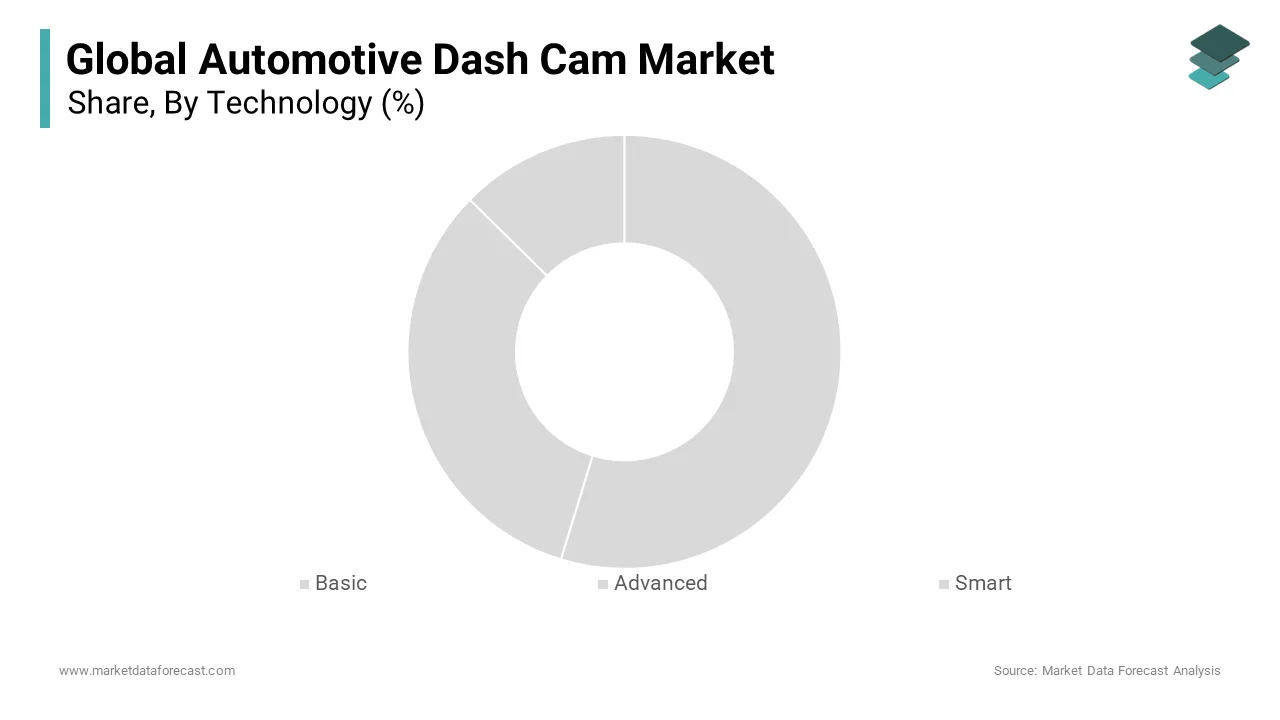
The smart dash cam segment is projected to grow at a CAGR of 24.3 % from 2025 to 2033, with the integration with vehicle telematics, artificial intelligence-powered event detection, and real-time cloud connectivity features increasingly demanded by fleet operators and premium vehicle owners. As per SAE International, over 41 % of new commercial fleet contracts signed in North America during 2023 mandated AI-enabled dash cams capable of detecting distracted driving, lane departure, and sudden acceleration. Bosch Mobility’s 2023 Innovation Brief confirms that its smart dash cams, which fuse driver gaze tracking with forward collision alerts, reduced preventable accidents by 37 % in pilot deployments with European logistics firms.
By Product Insights
The one-channel dash cam segment held a dominant share of the automotive dash cam market in 2025 with its simplicity, lower cost, and sufficiency for the primary use case by capturing forward-facing road incidents for insurance and legal purposes. According to the Insurance Information Institute, 88 % of liability-determining events in passenger vehicle collisions occur in the front field of view, making rear or cabin recording unnecessary for the majority of private owners. Additionally, as per Consumer Reports’ 2023 Reliability Audit, single lens dash cams demonstrated 31 % fewer technical failures over 24 months compared to dual lens models due to simpler thermal management and reduced power draw.
The two-channel dash cam segment is likely to grow with a CAGR of 21.8 % from 2025 to 2033, owing to the rising consumer awareness of rear-end collisions, insurance incentives for comprehensive coverage, and regulatory mandates for commercial fleets. In Japan, according to the Japan Automobile Federation, two-channel dash cam adoption among private vehicle owners increased by 44 % in 2023, driven by urban parking lot collision concerns and manufacturer bundled promotions with new car sales. The European Road Safety Observatory confirms that commercial delivery fleets in Germany and France increased dual camera installations by 57 % in 2023 to monitor loading zone incidents and prevent fraudulent claims.
By Application Insights
The personal vehicles segment was the largest by accounting for a significant share of the automotive dash cam market in 2025, with the owned vehicles worldwide and the individual driver’s need for self-protection against fraudulent claims and ambiguous liability determinations. As per the World Health Organization, over 60 % of road traffic injuries involve passenger vehicles, creating a vast addressable base for incident documentation tools. The UK Department for Transport notes that personal vehicle dash cam footage was cited in 84 % of contested minor collision cases adjudicated in 2023, reinforcing its perceived necessity. Additionally, as per Statista’s 2023 Consumer Electronics Survey, 61 % of global dash cam owners cited “peace of mind” as their primary motivation, a sentiment largely absent in fleet procurement driven by cost control.
The commercial vehicle segment is growing at a CAGR of 26.1 % during the forecast period, with regulatory compliance, insurance cost containment, and AI-driven driver behavior analytics that deliver measurable ROI. As per the American Trucking Associations, over 85 % of large US-based fleets mandated dash cam installation across all vehicles in 2023. In the European Union, according to the European Commission’s Mobility and Transport Directorate, new regulations effective in 2025 require all commercial vehicles over 3.5 tons to be equipped with dual-lens, GPS-enabled dash cams transmitting data to centralized fleet safety platforms. China’s Ministry of Transport confirms that 4.8 million commercial vehicles were retrofitted with government-approved dash cams in 2023 to combat insurance fraud and monitor driver fatigue. Furthermore, as per Verizon Connect’s 2023 Fleet Benchmark Report, operators using AI-enhanced dash cams reduced preventable collisions by 39 % through real-time alerts for mobile phone usage and lane drifting.
By Distribution Channel Insights
The online segment accounted in holding a dominant share of the automotive dash cam market in 2025, with price transparency, extensive product comparison capabilities, and direct access to user reviews that validate real-world performance. As per the US Census Bureau, e-commerce sales of automotive electronics grew by 19 % year over year in 2023, with dash cams ranking among the top three fastest-moving categories on platforms like Amazon and Alibaba.
The in-store segment is lucratively to grow with an expected CAGR of 12.7% from 2025 to 2033 with the experiential retail strategies, instant installation services, and strategic partnerships with auto dealerships and service centers that convert foot traffic into bundled sales. As per the National Automobile Dealers Association, 68 % of new car buyers in the United States in 2023 opted for dealer-installed dash cams, primarily due to seamless integration with factory wiring and extended warranty coverage. In Germany, according to the German Automotive Aftermarket Association, specialty auto electronics retailers increased in-store dash cam sales by 29 % in 2023 by offering free professional installation and live night vision demonstrations.
REGIONAL ANALYSIS
Asia Pacific Market Analysis
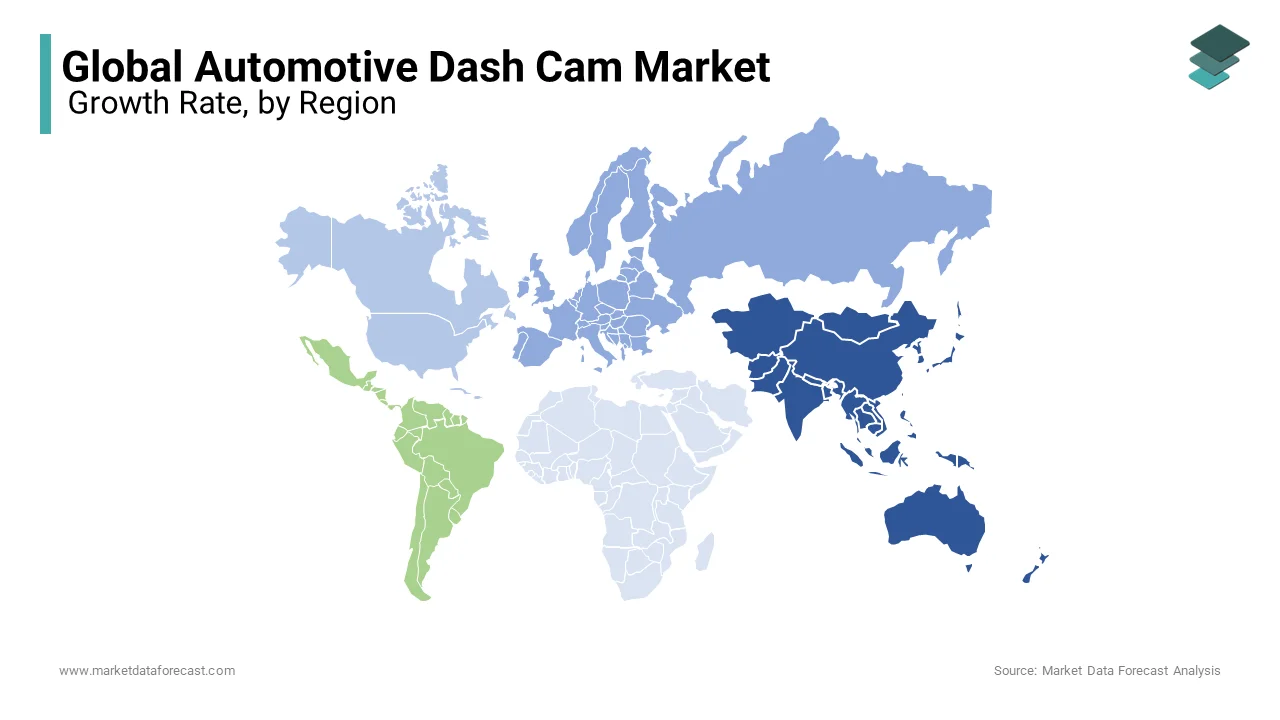
Asia Pacific was the top performer of the global automotive dash cam market with 42.2% of share in 2025. China was the largest contributor with historically low public trust in traffic law enforcement and insurance adjudication. As per China’s Ministry of Public Security, dash cam footage was submitted in 6.3 million traffic dispute cases in 2023, making it the de facto standard for private vehicle owners. Japan’s National Police Agency confirms that 68 % of dash cams sold in 2023 featured parking mode surveillance, addressing urban vehicle vandalism concerns.
Europe Market Analysis
Europe was positioned second by capturing 28.3% of the automotive dash cam market share in 2025. According to the European Transport Safety Council, courts in Germany, France, and the Netherlands accepted dash cam footage in 89 % of contested traffic violation cases in 2023. The UK Motor Insurers Bureau states that over 1.2 million dash cam clips were processed for claims in 2023, reducing average settlement time by 11 days. The European Data Protection Board’s 2023 guidelines have also clarified legal boundaries for footage retention, which is reducing consumer hesitation and stimulating replacement cycles for GDPR compliant models.
North America Market Analysis
North America's automotive dash cam market growth is likely to grow with the legal defensibility, insurance incentives, and commercial fleet mandates. According to the Insurance Information Institute, over 77 % of bodily injury claims in the United States in 2023 involved dash cam evidence, accelerating adoption among private owners. Canada’s Traffic Injury Research Foundation states that provinces like Ontario and British Columbia saw a 31 % increase in dash cam adoption in 2023 following court rulings affirming footage admissibility.
Latin America Market Analysis
Latin America's automotive dash cam market growth is likely to grow, with Brazil and Argentina leading regional growth. According to the Brazilian Insurance Confederation, dash cam adoption among private vehicle owners surged by 61 % in 2023, driven by rising insurance fraud and police underreporting in metropolitan areas. Argentina’s National Road Safety Agency states that commercial fleets increased dash cam installations by 44 % in 2023 to comply with new cargo security regulations.
Middle East and Africa Market Analysis
The Middle East and Africa automotive dash cam market is likely to grow steadily during the forecast period. According to the Turkish Statistical Institute, dash cam unit sales increased by 58 % in 2023, driven by tourism-related rental car mandates and insurance discount programs. Nigeria’s Vehicle Import Authority reports that grey market dash cam imports grew by 73 % in 2023, indicating latent demand despite infrastructural constraints.
COMPETITIVE LANDSCAPE
The automotive dash cam market in Asia Pacific is characterized by a tri-tier competitive landscape where global technology leaders, regional specialists, and budget manufacturers vie for dominance across distinct customer segments. Premium brands like Garmin and BlackVue compete on AI integration, cloud infrastructure, and forensic reliability, targeting fleets and affluent private owners. Mid-tier players such as MiVue and Thinkware focus on balancing advanced safety features with affordability, capturing the mass middle class through retail and insurance partnerships. Patent filings for AI-based event detection surged 38 % in 2023, signaling an innovation arms race. Regional compliance, particularly around data privacy in Japan and Australia, is becoming a key barrier to entry. Consumer trust, built through verified performance reviews and insurer endorsements, remains the ultimate competitive moat.
KEY MARKET PLAYERS
A few of the market players in the global automotive dash cam market include
- PAPAGO Inc
- Texas Instruments Incorporated
- Aptive
- MiVue by MiTAC
- BlackVue
- Clarion
- Continental AG
- Cedar Electronics
- Transcend Information, Inc
- Valeo SA
- DENSO TEN Limited
- Garmin Ltd.
- Honeywell International Inc.
- JVCKENWOOD Corporation
- Koninklijke Philips N.V
Top Players In The Market
- Garmin has established itself as a premium provider of automotive dash cams across the Asia Pacific region, known for its ruggedized designs, reliable GPS tagging, and seamless integration with navigation ecosystems. In 2023, the company launched its Ultra Night Vision series tailored for Southeast Asian megacities, which addresses low-light recording challenges in dense urban environments. Garmin partnered with Japanese insurers to offer bundled discount programs, incentivizing private vehicle owners to adopt its dual lens models. It also expanded local language support in India and Thailand, enhancing user accessibility.
- BlackVue dominates the high-end dash cam segment in Asia Pacific through its cloud-connected, AI-enabled surveillance systems, favored by fleet operators and luxury vehicle owners. The company opened a regional innovation center in Seoul in early 2023 to accelerate the development of localized firmware for markets like Japan and Australia. It introduced a subscription-based cloud storage model with automatic incident backup, reducing reliance on physical memory cards. BlackVue also collaborated with ride-hailing platforms in Indonesia and Thailand to supply tamper-proof, remotely monitored dash cams.
- MiVue, a brand under MiTAC International, has carved a strong niche in the Asia Pacific by offering feature-rich dash cams at mid-tier price points, particularly popular in India, Taiwan, and Malaysia. In 2023, MiVue launched its Smart Sentry series with integrated driver fatigue alerts and lane departure warnings, targeting safety-conscious families and small fleet owners. The company strengthened its retail presence by partnering with major electronics chains in Thailand and the Philippines for in-store demonstrations and instant installation services. MiVue also introduced region-specific parking mode algorithms to handle extreme heat conditions in Australia and India.
Top Strategies Used By Key Market Participants
Leading players prioritize localized product engineering to address regional challenges such as extreme temperatures, low light conditions, and language barriers. Strategic partnerships with insurers and ride-hailing platforms drive bundled adoption and recurring revenue through cloud subscriptions. Companies invest heavily in over-the-air update capabilities to extend product lifecycle and enhance cybersecurity. Retail collaborations with auto dealerships and electronics chains facilitate experiential marketing and instant installation. AI-powered driver behavior analytics are increasingly embedded to appeal to commercial fleets.
MARKET SEGMENTATION
This research report on the global automotive dash cam market is segmented and sub-segmented into the following categories.
By Technology
- Basic
- Advanced
- Smart
By Product
- 1-channel
- 2-channel
- Rear View
By Video Quality
- SD & HD
- Full HD & 4K
By Application
- Commercial Vehicle
- Personal Vehicle
By Distribution Channel
- Online
- In-store
By Region
- North America
- Europe
- Asia-Pacific
- Latin America
- Middle East and Africa