Automotive Data Logger Market Size, Share, Growth, Trends and Forecast Research Report, Segmented By Connection, Application, End Market, Channel, Component, By Region (North America, Europe, Asia-Pacific, Latin America, Middle East and Africa), Industry Analysis From 2025 to 2033
Global Automotive Data Logger Market Size
The global automotive data logger market size was valued at USD 4.30 billion in 2024 and is anticipated to reach USD 4.62 billion in 2025 to USD 8.18 billion by 2033, growing at a CAGR of 7.40% during the forecast period from 2025 to 2033.

Automotive Data Loggers are a range of electronic devices designed to record, monitor, and analyze vehicle performance data in real-time. These loggers are widely used across automotive testing, diagnostics, fleet management, and autonomous driving development. Typically integrated with onboard diagnostics (OBD), GPS, CAN bus systems, and sensor networks, data loggers capture parameters such as speed, engine temperature, fuel efficiency, braking patterns, and driver behavior.
Their applications extend beyond traditional automotive engineering into areas like insurance telematics, predictive maintenance, and electric vehicle optimization. As vehicles become more connected and autonomous, the demand for high-precision data acquisition tools has surged, making data loggers essential components in both research and commercial settings.
According to the Society of Automotive Engineers (SAE), modern data loggers are now being embedded directly into vehicle ECUs (Electronic Control Units) to support over-the-air updates and AI-driven analytics. This evolution aligns with the push toward smart mobility ecosystems and enhanced road safety protocols.
As per the International Organization of Motor Vehicle Manufacturers (OICA), increasing regulatory mandates around emissions monitoring and vehicle diagnostics have further propelled the integration of data logging technologies in new vehicle models.
MARKET DRIVERS
Growth in Connected and Autonomous Vehicles Development
The rapid advancement in connected and autonomous vehicle technologies, which rely heavily on real-time data collection and analysis, is one of the primary drivers of the Automotive Data Logger Market. Autonomous driving systems require extensive data inputs from sensors, cameras, radar, and lidar, all of which are recorded and processed by high-performance data loggers to enable machine learning and system validation.
According to the Center for Automotive Research (CAR), autonomous vehicle development projects generate terabytes of data daily, necessitating robust logging solutions capable of handling vast volumes of information under dynamic conditions. These loggers not only store raw sensor data but also synchronize timestamps across multiple sources to ensure accurate event reconstruction and compliance with ISO 26262 functional safety standards.
Moreover, companies involved in Level 3 and above autonomous systems, including Waymo, Tesla, and BMW Group, utilize advanced data loggers during simulation, prototyping, and field testing phases. As per the European Commission’s Intelligent Transport Systems Unit, regulatory frameworks in the EU now mandate the use of event data recorders (EDRs) similar to aircraft black boxes, reinforcing the importance of data loggers in future mobility ecosystems.
This technological shift toward autonomy and connectivity has significantly increased the adoption of automotive data loggers, ensuring continuous growth in this segment.
Increasing Regulatory Requirements for Vehicle Diagnostics and Emissions Monitoring
The rising number of regulatory mandates requiring detailed vehicle diagnostics and emissions monitoring is another major driver boosting the Automotive Data Logger Market. Governments worldwide are implementing stringent emission control policies, mandating automakers to integrate real-time data recording capabilities to ensure compliance and transparency.
According to the U.S. Environmental Protection Agency (EPA), On-Board Diagnostics (OBD) regulations require vehicles to include standardized diagnostic connectors and protocols that allow access to critical engine and emissions-related data, functions enabled through sophisticated data logging systems. Similarly, the European Union's Real Driving Emissions (RDE) tests, introduced post-Dieselgate, depend on portable emission measurement systems equipped with data loggers to verify compliance under real-world conditions.
In addition, according to the International Council on Clean Transportation (ICCT), emerging markets such as India and China have adopted Euro VI-equivalent emission norms, prompting local manufacturers to deploy advanced data loggers in production vehicles and fleet monitoring units.
Beyond compliance, these loggers assist in predictive maintenance, fault diagnosis, and usage-based insurance models.
MARKET RESTRAINTS
High Costs Associated with Advanced Data Logging Systems
The high cost associated with advanced data logging systems, particularly those tailored for autonomous vehicles, heavy-duty fleets, and high-fidelity R&D applications, is a significant restraint affecting the Automotive Data Logger Market. These systems often include multi-channel interfaces, high-speed processors, cloud connectivity, and cybersecurity features, significantly raising their price point. This makes them inaccessible for small-scale developers, independent workshops, and emerging automotive startups.
Besides, organizations such as the National Highway Traffic Safety Administration (NHTSA) note that integrating these loggers into existing vehicle architectures requires specialized software compatibility and calibration services, further increasing deployment costs. The complexity of installation and training also limits adoption among smaller enterprises.
While large OEMs and Tier 1 suppliers can absorb these expenses, budget constraints among mid-sized players and aftermarket service providers hinder broader market penetration.
Data Privacy and Cybersecurity Concerns
Data privacy and cybersecurity concerns are increasingly acting as restraints on the Automotive Data Logger Market, particularly as vehicles become more connected and reliant on real-time data transmission. Modern data loggers collect sensitive information, including driving behavior, geolocation, and vehicle performance metrics, raising legal and ethical questions about ownership and usage rights.
According to the European Union Agency for Cybersecurity (ENISA), automotive data breaches have risen sharply in recent years, with hackers targeting vehicle communication systems and onboard storage devices. This has prompted regulators to impose stricter cybersecurity certifications for data logging hardware, increasing time-to-market and development costs for manufacturers.
Furthermore, the U.S. Department of Transportation (DOT) reports that stakeholders, including consumers, insurers, and fleet operators, are becoming more cautious about data access permissions, especially regarding third-party utilization of logged information. Legal ambiguities surrounding who owns the data—vehicle manufacturer, software provider, or end-user—further complicate adoption strategies.
Industry bodies like SAE International emphasize that resolving these issues will require standardized encryption protocols, secure cloud storage, and transparent data governance frameworks.
MARKET OPPORTUNITY
Expansion of Electric and Hybrid Vehicle Testing and Validation
The rapid expansion of electric and hybrid vehicle development, where precise data acquisition is crucial for battery management, energy efficiency, and system diagnostics, presents an emerging opportunity for the Automotive Data Logger Market. Unlike internal combustion engines, EVs rely heavily on real-time monitoring of battery health, thermal performance, regenerative braking, and charging cycles—all of which require high-resolution data logging.
According to the International Energy Agency (IEA), global electric car sales surpassed 14 million units in 2023, up from just 2 million in 2020, indicating an exponential growth trajectory that demands robust validation infrastructure. Automotive data loggers play a central role in capturing and analyzing this complex data during both development and field testing phases.
In addition, battery degradation studies, drive cycle analysis, and thermal runaway investigations depend on continuous data acquisition systems capable of operating under extreme conditions. Many EV manufacturers, including Tesla and BYD, have begun embedding proprietary data logging modules to optimize vehicle performance and enhance predictive maintenance capabilities.
Integration with IoT and Cloud-Based Telematics Platforms
The integration of automotive data loggers with Internet of Things (IoT) and cloud-based telematics platforms presents a compelling growth opportunity for the Automotive Data Logger Market. This convergence enables real-time remote monitoring, predictive analytics, and over-the-air (OTA) updates, enhancing both vehicle performance and user experience.
According to the McKinsey Center for Future Mobility, over 80% of new premium vehicles launched in 2023 featured some form of cloud-connected diagnostics or telemetry, underscoring the shift toward digitally integrated transport ecosystems. Automotive data loggers serve as the backbone of this transformation, collecting and transmitting granular vehicle data to centralized cloud servers for processing and actionable insights.
Moreover, fleet operators and logistics companies are increasingly adopting cloud-connected data loggers for route optimization, fuel efficiency tracking, and driver behavior monitoring. These insights contribute to lower operational costs and improved sustainability metrics.
This trend is also influencing after-sales services, enabling remote diagnostics and proactive maintenance scheduling based on real-time data.
MARKET CHALLENGES
Complexity of System Integration Across Heterogeneous Vehicle Platforms
The complexity involved in integrating data loggers across heterogeneous vehicle platforms, each with distinct communication protocols, hardware configurations, and software environments, is one of the foremost challenges in the Automotive Data Logger Market. As automakers transition from legacy systems to modular architectures supporting OTA updates and AI-based diagnostics, compatibility issues between data loggers and vehicle ECUs have intensified.
There is a wide range of different communication protocols currently in use within the automotive sector, ranging from CAN FD and LIN to Ethernet-based systems. Ensuring seamless interoperability across these platforms requires extensive customization and firmware development, delaying deployment timelines and increasing costs.
Also, discrepancies in OBD-II pinouts, signal encoding standards, and data formatting across regions add another layer of complexity. This fragmentation hampers the scalability of universal data logger designs, forcing manufacturers to develop region-specific variants. To address these hurdles, industry consortia such as AUTOSAR are working on standardized software architectures, yet full harmonization remains distant.
Regulatory Fragmentation and Compliance Across Geographies
Regulatory fragmentation poses a major challenge to the Automotive Data Logger Market, as varying legal requirements across countries dictate how vehicle data is captured, stored, and shared. While some regions enforce strict data localization laws, others prioritize open data access for regulatory oversight, creating conflicting compliance landscapes for global automotive suppliers.
Similarly, the European Data Protection Board (EDPB) has issued guidelines requiring explicit user consent before collecting personal driving data, impacting how automotive data loggers operate in passenger vehicles. In contrast, North American jurisdictions exhibit more lenient approaches, allowing broader data utilization for performance analytics and insurance telematics.
These divergent regulatory frameworks force manufacturers to tailor product offerings to regional specifications, increasing design complexity and time-to-market.
REPORT COVERAGE
| REPORT METRIC | DETAILS |
| Market Size Available | 2024 to 2033 |
| Base Year | 2024 |
| Forecast Period | 2025 to 2033 |
| CAGR | 7.40% |
| Segments Covered | By Application, Channel, Connection Type, and Region. |
| Various Analyses Covered | Global, Regional & Country Level Analysis, Segment-Level Analysis, DROC, PESTLE Analysis, Porter’s Five Forces Analysis, Competitive Landscape, Analyst Overview of Investment Opportunities |
| Regions Covered | North America, Europe, APAC, Latin America, Middle East & Africa |
| Market Leaders Profiled | Robert Bosch GmbH (Germany); Harman International (US), Continental Automotive GmbH, Aptiv PLC, Racelogic (UK), TTTech Computertechnik AG (Austria), and anXilinx, and Others. |
SEGMENTAL ANALYSIS
By Application Insights
Post-Sales Application
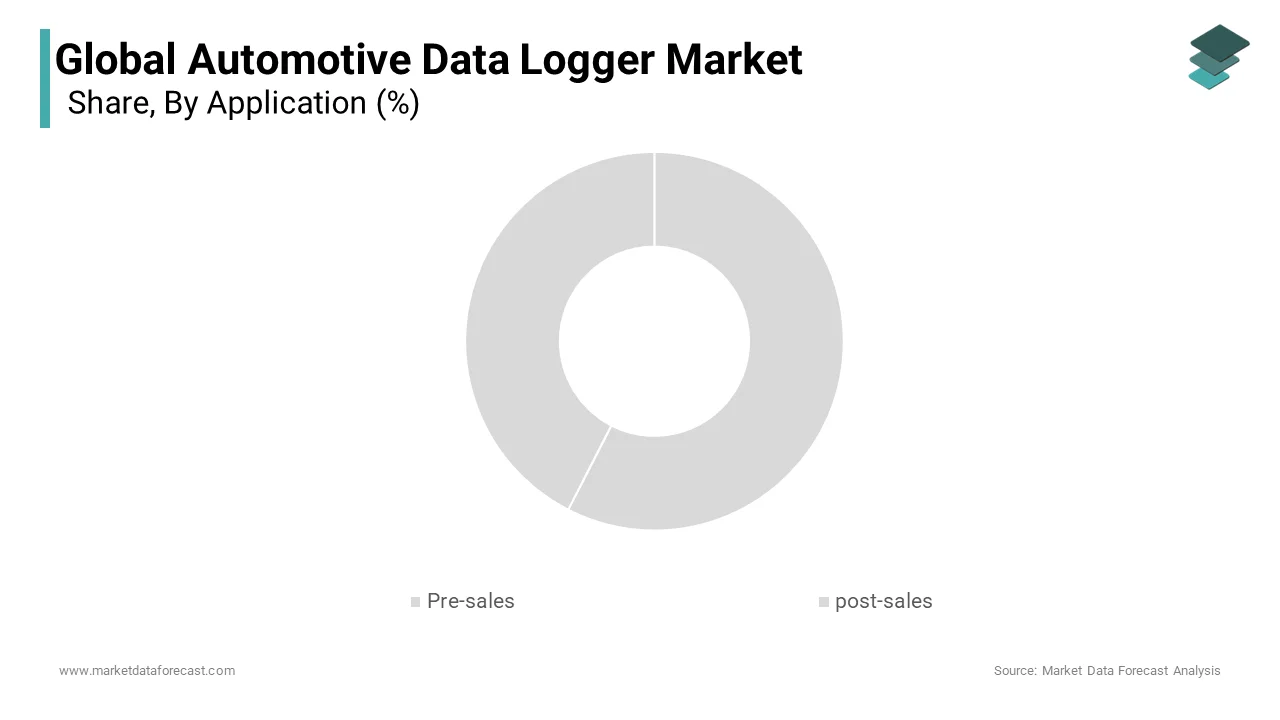
The post-sales segment dominated the automotive data logger market by accounting for 56.4% of the global market share in 2024. The growing need for real-time diagnostics, vehicle performance monitoring, and compliance with regulatory standards after the sale of vehicles is primarily attributed to the dominance of the post-sales segment. The increasing integration of advanced driver-assistance systems (ADAS) and electric vehicles (EVs), which require extensive post-deployment monitoring, also contributes to the growth of the post-sales segment. For instance, according to the International Energy Agency (IEA), over 14 million EVs were sold globally in 2023, up from 10 million in 2024. These vehicles generate vast amounts of data that must be logged and analyzed post-sale to ensure safety, optimize battery usage, and improve software updates.
Furthermore, the rise in government regulations mandating vehicle telematics and onboard diagnostics is another major growth factor for this segment. In the U.S., the Federal Motor Carrier Safety Administration (FMCSA) requires commercial vehicles to use electronic logging devices (ELDs), significantly boosting the adoption of data loggers in the post-sales phase.
Moreover, fleet management companies are increasingly relying on post-sales data analytics for predictive maintenance, fuel efficiency optimization, and accident analysis. Also, predictive maintenance can reduce downtime by up to 50%, making it a critical tool for logistics and transport firms. This further reinforces the demand for robust data logging solutions beyond the point of sale.
Pre-Sales Application
The pre-sales segment is projected to grow at the fastest CAGR of 14.6% during the forecast period. The rising complexity of vehicle development and the increasing reliance on simulation-based testing and validation processes are fuelling the rapid expansion of the pre-sales segment. The surge in autonomous vehicle development. Companies like Waymo, Tesla, and General Motors are investing heavily in autonomous driving technologies, requiring extensive data collection during prototype testing and before product launch, which also propels the growth of the pre-sales segment. This exponential growth necessitates high-capacity data loggers to record sensor inputs, environmental conditions, and system responses during trial phases.
Further, the increasing use of data loggers in emissions testing and regulatory compliance during vehicle design cycles is accelerating their adoption in the pre-sales stage. The European Union’s Real Driving Emissions (RDE) testing framework, introduced in 2017, mandates on-road emissions testing using portable emission measurement systems (PEMS), many of which incorporate automotive data loggers. As per the European Environment Agency, in 2022, over 1.2 million PEMS tests were conducted across EU member states, highlighting the scale of data logging activity in pre-commercialization stages.
Furthermore, automotive OEMs are integrating data loggers into concept vehicles to gather insights for improving future models. BMW, for example, uses embedded data loggers in its iX series prototypes to evaluate energy consumption patterns and refine thermal management systems before mass production. Such initiatives are contributing to the rapid expansion of the pre-sales segment.
By Channels Insights
Controller Area Network (CAN & CAN FD)
The Controller Area Network (CAN & CAN FD) segment commanded the automotive data logger market by capturing 42.4% of the total revenue in 2024. This dominance stems from widespread adoption in both traditional internal combustion engine (ICE) vehicles and modern electric vehicles (EVs), for real-time communication between electronic control units (ECUs) is largely fuelling the dominance of CAN & CAN FD segments.
Like, more than 90% of all vehicles produced globally since 2010 have incorporated the CAN protocol, making it the de facto standard for in-vehicle networking, according to a study. CAN FD, an enhanced version offering higher bandwidth and faster data rates, is increasingly being used in high-performance and autonomous-ready vehicles.
In addition, its cost-effectiveness and compatibility with legacy systems are other reasons behind the lead position of the AN & CAN FD segments. Unlike newer protocols such as Ethernet or FlexRay, CAN remains affordable and scalable for low-to-mid-range vehicles, especially in emerging markets where price sensitivity is high.
Apart from these, CAN FD supports advanced applications such as ADAS and vehicle diagnostics, aligning with evolving automotive trends. For instance, Continental AG integrates CAN FD in its latest ADAS platforms to enable seamless data exchange between cameras, radar, and control modules. The ability of CAN FD to handle larger message payloads is proving crucial due to the rise in software-defined vehicles.
Therefore, the entrenched presence of CAN in existing vehicle architectures, its adaptability to new technologies, and its affordability collectively sustain its dominance in the automotive data logger market.
Automotive Ethernet
The automotive Ethernet segment is anticipated to grow at the highest CAGR of 22.3% from 2025 to 2033. Rapid digitization of vehicles and the demand for high-speed data transmission are accelerating the swift expansion of the automotive Ethernet segment.
This growth is also fueled by the proliferation of connected and autonomous vehicles. Automotive Ethernet offers bandwidth capabilities exceeding 10 Gbps, enabling real-time processing of camera feeds, LiDAR data, and V2X communications—critical for Level 3+ autonomous driving.
BMW and Mercedes-Benz have already adopted Automotive Ethernet as the backbone for their next-generation vehicle architectures. BMW reported that its Neue Klasse platform, launching in 2025, will utilize Ethernet-based domain controllers to support OTA updates and AI-driven driver assistance features.
Regulatory support also plays a role. The IEEE 802.1BA standard for AVB/TSN (Audio Video Bridging / Time-Sensitive Networking) ensures deterministic latency and synchronization, essential for mission-critical functions. Like, Ethernet-based networks reduce cabling weight by up to 30%, improving fuel economy and range in EVs—an added incentive for automakers, as per the findings.
By Connection Insights
USB (Universal Serial Bus)
The USB connection type segment led the automotive data logger market by representing 37.5% of total revenue in 2024. Its dominance is rooted in its universal compatibility, ease of use, and established infrastructure within both consumer electronics and automotive manufacturing is one of the key reasons behind the growth of the USB connection type segment.
According to the USB Implementers Forum (USB-IF), more than 10 billion USB-enabled devices have been shipped globally since its inception, ensuring widespread familiarity among consumers and technicians alike. The plug-and-play functionality of USB allows seamless data extraction without requiring additional software or network configurations, making it ideal for diagnostic tools, firmware updates, and field service operations.
In the automotive sector, USB ports are now standard in nearly all vehicles, particularly for infotainment systems and OBD-II (On-Board Diagnostics) interfaces. Owing to this ubiquity, automotive data loggers equipped with USB interfaces are widely used by mechanics, fleet operators, and engineers for quick access to vehicle data.
Moreover, USB supports high-speed data transfer rates, with USB 3.0 capable of delivering speeds up to 5 Gbps, making it suitable for transferring large volumes of logged data efficiently. Toyota and Ford have integrated USB-based data logging systems in their service centers to streamline diagnostics and reduce turnaround time.
Bluetooth/Wi-Fi
The Bluetooth/Wi-Fi connection type segment is projected to register the highest CAGR of 18.1% during the forecast period. The expanding adoption of wireless connectivity solutions in smart and connected vehicles is propelling the progress of the Bluetooth/Wi-Fi connection type segment.
This development is also closely tied to the increasing deployment of cloud-connected data loggers and mobile diagnostics applications. Automotive data loggers with these wireless interfaces allow users to download logs remotely through smartphones or tablets, eliminating the need for physical cables.
Vehicle manufacturers such as Tesla and Rivian have embraced wireless diagnostics to support over-the-air (OTA) updates and remote troubleshooting. Tesla’s mobile app, for instance, enables owners to access vehicle diagnostics and logs via Bluetooth, enhancing user experience and reducing service center visits.
Wi-Fi further plays a pivotal role in factory-level diagnostics and automated testing environments. BMW's Dingolfing plant utilizes Wi-Fi-enabled data loggers to collect and analyze performance metrics during final assembly line checks, enabling real-time feedback and process optimization.
Besides, the integration of Vehicle-to-Everything (V2X) communication and telematics services is pushing automakers to embed Wi-Fi hotspots and Bluetooth Low Energy (BLE) modules in vehicles.
REGIONAL ANALYSIS
North America Market Analysis
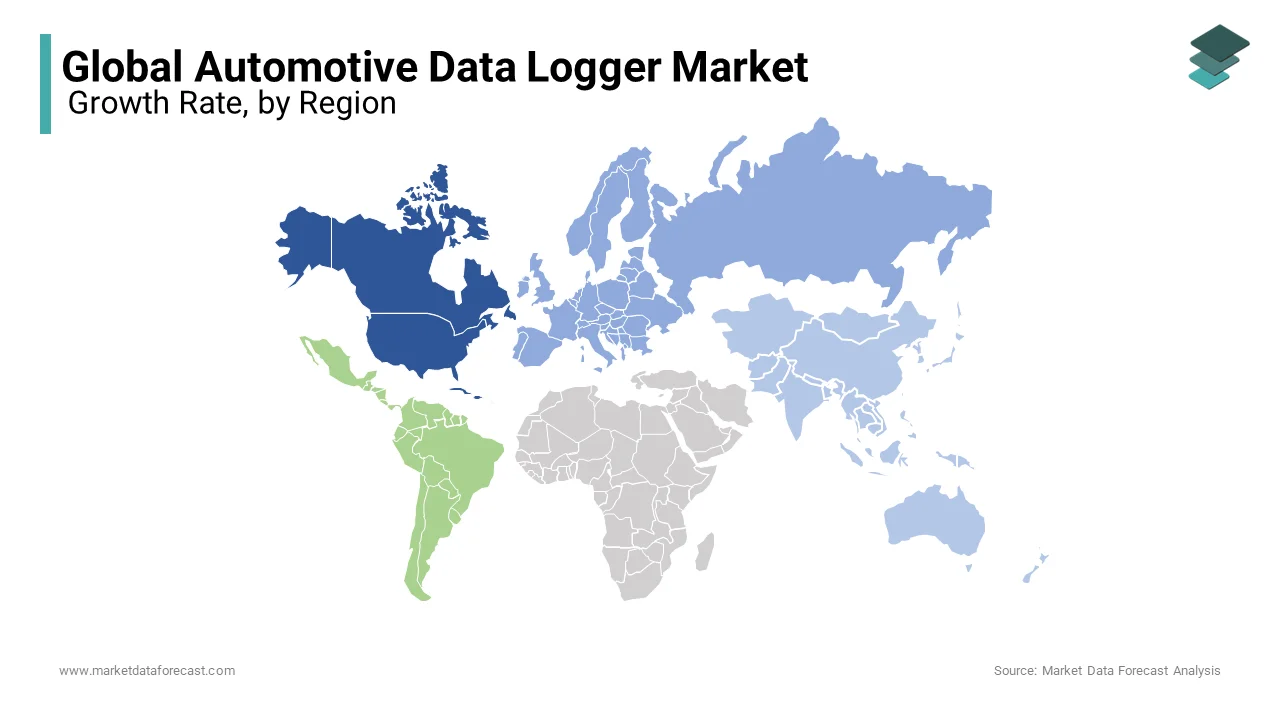
North America commanded the regional market share with 27.8% in 2024. The region’s lead position is supported by strong automotive manufacturing, early adoption of electric and autonomous vehicles, and stringent regulatory frameworks governing vehicle safety and emissions.
The United States is the dominant force within North America, driven by the presence of major automakers such as Ford, General Motors, and Tesla, along with tech giants like NVIDIA and Qualcomm developing advanced mobility solutions. According to the IEA – International Energy Agency, 1.4 million electric vehicles were registered in the U.S. in 2023, a 40% increase from the previous year. These vehicles rely extensively on data loggers for battery management, ADAS calibration, and software diagnostics.
Canada Market Analysis
Canada and Mexico also contribute to regional growth. Canada’s auto industry is witnessing increased investments in connected vehicle technologies, while Mexico’s low-cost manufacturing base and proximity to the U.S. make it a hub for automotive component suppliers.
Moreover, the U.S. Electronic Logging Device (ELD) mandate enforced by FMCSA has mandated the installation of telematics systems in commercial trucks, directly boosting data logger adoption. North America's position in the automotive data logger market is thus reinforced by technological innovation, regulatory enforcement, and a robust automotive supply chain.
Europe Market Analysis
Europe is also a significant player in the market, which is driven by stringent emissions regulations, a strong presence of premium automakers, and a mature automotive electronics ecosystem.
Germany leads the European market, accounting for nearly 35% of the region’s automotive data logger demand. As home to automotive giants like BMW, Mercedes-Benz, and Volkswagen, Germany is at the forefront of adopting data loggers for vehicle diagnostics, emissions compliance, and autonomous driving research.
France and the UK also play significant roles. France’s push for electrification saw electric vehicle sales increase in 2023, supported by national policies encouraging EV adoption. Renault and Stellantis are leveraging data loggers for battery health monitoring and predictive maintenance in their EV fleets. Meanwhile, the UK’s Transport Research Laboratory (TRL) is actively involved in autonomous vehicle trials, utilizing high-speed data loggers to validate self-driving algorithms.
The European Commission’s General Safety Regulation (GSR), effective from July 2024, mandates the inclusion of intelligent driver assistance systems in all new cars, further stimulating demand for data loggers. Apart from these, the ISO 26262 functional safety standard requires rigorous data logging for ASIL-rated components, ensuring compliance across the continent.
Europe’s emphasis on sustainability, safety, and innovation makes it a key contributor to the global automotive data logger market.
Asia Pacific Market Analysis
Asia Pacific is the fastest-growing region in the automotive data logger market in 2024 and is driven by rapid industrialization, rising EV adoption, and government-led smart mobility initiatives.
China is the epicenter of growth in APAC, contributing over 50% of the region’s market share. According to the Chinese Ministry of Industry and Information Technology (MIIT), EV sales in China surpassed 9.5 million units in 2023, accounting for over 60% of global EV sales. This boom has led to increased deployment of data loggers in battery management systems (BMS), charging infrastructure, and autonomous driving projects. BYD and NIO are incorporating advanced data logging modules to monitor vehicle performance and enhance battery longevity.
Japan remains a leader in automotive electronics, with companies like Denso, Panasonic, and Toyota integrating data loggers into hybrid and hydrogen-powered vehicles. Japan Automobile Manufacturers Association (JAMA) noted that Japan exported 4.42 million vehicles in 2023, many featuring sophisticated telematics systems.
India is another emerging hotspot, with the government’s FAME II policy incentivizing EV adoption. According to ICRA Limited, EV sales in India grew by 42% YoY in FY2024, prompting automakers like Tata Motors and Mahindra to adopt data loggers for diagnostics and OTA updates.
Latin America Market Analysis
Latin America is smaller in scale compared to other regions. It is showing signs of steady growth, driven by increasing vehicle production and the gradual adoption of connected technologies.
Major automakers such as Fiat Chrysler (Stellantis), Toyota, and Hyundai operate local manufacturing plants, gradually introducing advanced diagnostics and telematics features in new models.
Mexico, despite being part of North America economically, often aligns with Latin American trends in terms of vehicle exports and regional trade agreements. It serves as a bridge for North American automakers exporting to South America, where demand for mid-tier vehicles with basic data logging capabilities is growing.
Chile and Colombia are also emerging markets, with governments promoting cleaner transportation options.
However, challenges such as economic instability, limited infrastructure, and lower consumer awareness regarding vehicle diagnostics slow down broader adoption.
Middle East and Africa Market Analysis
The Middle East and Africa region exhibits unique growth dynamics influenced by government investments in smart cities, fleet modernization programs, and oil-funded infrastructure development.
The UAE is the standout performer in the Middle East, with Dubai and Abu Dhabi leading smart mobility initiatives.
Saudi Arabia is also advancing its automotive sector through Vision 2030, aiming to diversify its economy beyond oil. The country plans to establish a domestic EV manufacturing base, with Lucid Motors setting up a factory in Riyadh to produce luxury electric sedans. These developments will likely boost demand for data loggers in diagnostics and battery management.
Africa, though lagging due to economic constraints and limited vehicle electrification, is seeing pockets of progress. South Africa, Nigeria, and Kenya are exploring fleet telematics and ride-hailing platforms, creating opportunities for data logger integration.
COMPETITIVE LANDSCAPE
The automotive data logger market features a dynamic and evolving competitive landscape, shaped by the presence of both established players and emerging innovators. Dominant firms often leverage deep technical expertise, strong R&D capabilities, and long-standing relationships with automotive manufacturers to maintain their positions. At the same time, newer entrants are capitalizing on digital transformation trends, introducing flexible, cloud-connected, and wireless-enabled solutions that appeal to tech-savvy consumers and fleet operators. Competition is further intensified by the increasing convergence between automotive engineering and software-driven ecosystems, prompting companies to expand beyond hardware and offer comprehensive data analytics platforms. As automakers prioritize real-time diagnostics, predictive maintenance, and over-the-air updates, the demand for versatile and interoperable data loggers continues to rise. This has led to strategic acquisitions, cross-industry collaborations, and continuous product enhancements aimed at securing long-term market relevance. Ultimately, the competition revolves around technological agility, ecosystem integration, and the ability to anticipate future mobility trends.
KEY MARKET PLAYERS
A few of the market players in the global automotive data logger market include
Robert Bosch GmbH (Germany)
Harman International (US)
Continental Automotive GmbH
Aptiv PLC
Racelogic (UK)
TTTech Computertechnik AG (Austria) and AnXilinx
Vector Informatik GmbH
Crane Merchandising Systems
Nordic Semiconductor ASA
Top Players in the Market
- Vector Informatik is a leading global provider of tools and software solutions for automotive electronics development, including high-performance data logging systems. The company plays a pivotal role in enabling vehicle manufacturers to capture, analyze, and interpret real-time data from electronic control units (ECUs). Known for its CANoe and CANalyzer tools, Vector supports major OEMs and Tier-1 suppliers in integrating data loggers within advanced driver-assistance systems (ADAS) and electric vehicles. Their solutions are widely used across pre-sales testing and post-sales diagnostics, contributing significantly to the standardization and reliability of automotive communication protocols worldwide.
- Crane Merchandising Systems, through its subsidiary A Better Mousetrap, has developed robust data logging solutions primarily used in fleet management and commercial vehicle diagnostics. Their flagship product, the AutoPi platform, offers cloud-connected, open-source data loggers that enable remote monitoring, diagnostics, and automation of vehicle functions. This versatility makes it popular among developers, researchers, and enterprise fleets seeking customizable and scalable data collection tools. The platform’s integration with IoT ecosystems allows users to leverage logged data for predictive maintenance and telematics-based services, reinforcing Crane’s growing influence in the automotive data logger domain.
- Nordic Semiconductor is a key enabler in the wireless connectivity space, offering Bluetooth Low Energy (BLE) and Wi-Fi-based chipsets that power next-generation automotive data loggers. While not a direct manufacturer of loggers, Nordic's ultra-low-power wireless solutions are embedded in many portable and onboard diagnostic devices used globally. Their technology facilitates seamless over-the-air (OTA) updates, real-time diagnostics, and mobile integration via smartphones, aligning with the industry's shift toward connected and smart mobility solutions. As automotive data loggers increasingly rely on wireless transmission and edge computing, Nordic Semiconductor continues to shape the evolution of this market through its innovative semiconductor platforms.
Top Strategies Used By Key Market Participants
- One major strategy employed by key players is product innovation and differentiation, where companies continuously develop advanced data loggers with higher processing capabilities, wireless connectivity, and compatibility with emerging automotive technologies such as autonomous driving and electric vehicles. These innovations help firms meet evolving customer needs while maintaining a competitive edge.
- Another crucial approach is strategic partnerships and collaborations, wherein companies work closely with automotive OEMs, Tier-1 suppliers, and software developers to integrate their data logging solutions into new vehicle architectures. Such alliances ensure early adoption and long-term integration into production lines, enhancing market penetration and brand visibility.
- Lastly, expansion into emerging markets is a priority for many players. Companies are focusing on establishing regional offices, local distribution networks, and support centers in fast-growing regions like the Asia Pacific and Latin America. This helps them cater to local demand more efficiently while adapting products to regional regulatory and operational requirements.
RECENT MARKET NEWS
- In January 2024, Vector Informatik expanded its portfolio by launching an enhanced version of its CANoe software suite, which now includes integrated data logging and simulation tools specifically designed for electric and autonomous vehicles. This move strengthens their leadership in automotive development environments.
- In March 2024, Nordic Semiconductor announced a partnership with a leading European automaker to embed its Bluetooth LE chips into next-generation onboard diagnostics systems, enabling seamless smartphone connectivity and real-time data access for vehicle owners and service providers.
- In May 2024, Crane Merchandising Systems introduced an upgraded version of the AutoPi platform with improved cloud integration and AI-powered diagnostics, allowing businesses to remotely monitor vehicle health and optimize fleet performance more effectively.
- In July 2024, Bosch launched a new line of compact, high-speed data loggers tailored for use in battery electric vehicles, supporting advanced diagnostics and energy efficiency tracking, reflecting the company’s commitment to electrification and smart mobility.
MARKET SEGMENTATION
This research report on the global automotive data logger market has been segmented and sub-segmented into the following categories.
By Connection Type
- USB
- SD Card
- Bluetooth/Wi-Fi
- Cellular Modem
By Application
- On-Board Diagnostics (OBD)
- Advanced Driver Assistance Systems (ADAS) & Safety
- Fleet Management
- Automotive Insurance
By End Market
- Original Equipment Manufacturers (OEMs)
- Service Stations
- Regulatory Bodies
By Channel
- Controller Area Network (CAN) & CAN FD
- Local Interconnect Network (LIN)
- Ethernet
- FlexRay
By Component
- Hardware
- Software
By Region
- North America
- Europe
- Asia Pacific
- Latin America
- Middle East and Africa
Frequently Asked Questions
What is an automotive data logger?
An automotive data logger is an electronic device or system used to record various vehicle performance parameters over time. These include engine diagnostics, fuel efficiency, speed, temperature, emissions, driving behavior, and other real-time metrics. They are essential tools for monitoring, analyzing, and improving vehicle operations.
Why are automotive data loggers important in modern vehicles?
With the rise of electric vehicles (EVs), autonomous driving systems, and advanced driver-assistance systems (ADAS), there's a growing need to collect and analyze large volumes of data. Data loggers help manufacturers, service providers, and researchers understand how vehicles perform under different conditions, enabling better design, maintenance, and safety improvements.
How does the integration of IoT impact automotive data loggers?
The Internet of Things (IoT) allows data loggers to transmit collected information in real-time to cloud platforms or central servers. This enables remote diagnostics, predictive maintenance, and over-the-air updates. In connected cars, IoT-enabled data loggers provide valuable insights into vehicle health and driver behavior, supporting smarter mobility solutions.
How is the automotive data logger market affected by electric vehicles?
Electric vehicles generate more digital data than traditional internal combustion engine (ICE) vehicles, especially related to battery health, charging patterns, and energy consumption. As EV adoption grows globally, so does the demand for advanced data loggers capable of capturing and interpreting this critical information efficiently.
What role do data loggers play in autonomous vehicles?
In autonomous vehicles, data loggers are crucial for recording sensor inputs, decision-making processes, and environmental interactions. This recorded data helps engineers refine algorithms, improve safety features, and comply with regulatory requirements. It also plays a key role in accident investigations and liability assessments.
Are there any privacy or cybersecurity concerns associated with automotive data loggers?
Yes, as these devices collect sensitive data such as location, driving habits, and vehicle diagnostics, there are increasing concerns about data misuse and unauthorized access. Manufacturers are focusing on encryption, secure communication protocols, and anonymization techniques to protect user privacy and ensure data integrity.
Who are the major players in the global automotive data logger market?
While international tech and automotive firms like Bosch, Continental, and Delphi Technologies are active in this space, specialized data logging solution providers are also gaining prominence. Companies offering customized hardware-software combinations for vehicle diagnostics and telematics are playing a growing role in shaping the market.
How are aftermarket data loggers changing the consumer landscape?
Aftermarket data loggers are becoming increasingly popular among car enthusiasts, fleet managers, and DIY mechanics. These plug-and-play devices allow users to monitor vehicle performance, diagnose issues, and even customize engine settings without visiting dealerships. The affordability and accessibility of such tools have expanded the market beyond OEMs and professional workshops.
How are governments influencing the adoption of data loggers?
Governments in various countries are introducing regulations that require vehicles to be equipped with data recording systems, especially for commercial fleets and public transport. These policies aim to improve road safety, reduce emissions, and enhance traffic management through data-driven insights.
What is the projected growth rate for the global automotive data logger market?
The market is expected to grow steadily over the next five years, driven by the expansion of the electric vehicle sector, stricter emission norms, and rising demand for connected car technologies. Analysts project a compound annual growth rate (CAGR) of approximately 8–10%, depending on regional developments and technological advancements.
Access the study in MULTIPLE FORMATS
Purchase options starting from
$ 2500
Didn’t find what you’re looking for?
TALK TO OUR ANALYST TEAM
Need something within your budget?
NO WORRIES! WE GOT YOU COVERED!
Call us on: +1 888 702 9696 (U.S Toll Free)
Write to us: sales@marketdataforecast.com