- Product Description Description
- Table of Contents TOC
- List of Table & Figure LOT
- Get Free Sample PDF Sample PDF
Market Size, 2025
$143.4 BnMarket Estimate, 2026
$150.64 BnMarket Forecast, 2034
$223.42 BnCAGR, 2026–2034
5.05%Global Automotive Front-End Module (FEM) Market Size, Growth, Trends & Forecast (2026–2034)
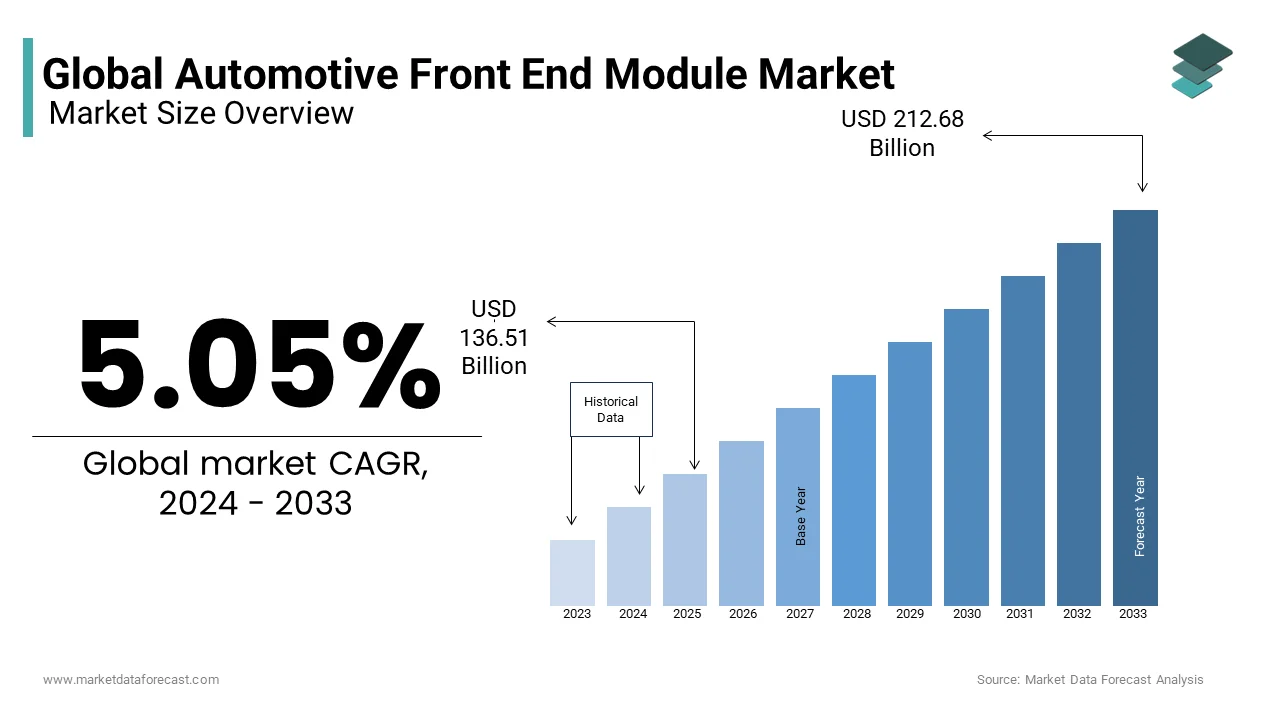
The global automotive front-end module (FEM) market size was valued at USD 143.40 billion in 2025, is estimated at USD 150.64 billion in 2026, and is projected to reach USD 223.42 billion by 2034, registering a compound annual growth rate (CAGR) of 5.05% during the forecast period from 2026 to 2034. Driven by the rising adoption of modular manufacturing, increased vehicle lightweighting, growing electric vehicle (EV) production, and the integration of advanced driver-assistance systems (ADAS), the market continues to expand steadily.
Key Executive Metrics (At-a-Glance)
- 2025 Base Valuation: USD 143.40 Billion
- 2026 Current Valuation: USD 150.64 Billion
- 2034 Forecast Valuation: USD 223.42 Billion
- Compound Annual Growth Rate (CAGR): 5.05% (2026–2034)
- Leading Region: Asia Pacific (commanding 34.2% of the market share, anchored by China, Japan, and India)
Core Market Drivers
- Lightweight Vehicle Structures: Widespread adoption of aluminum, high-strength steel, and engineered thermoplastics to enhance fuel economy and comply with CAFE and EU emission standards.
- ADAS & Sensor Integration: Evolving vehicle architectures requiring complex front-end modules to house and align safety-critical cameras, radars, and LiDAR units.
- Electric Vehicle (EV) Expansion: Surging EV production necessitating specialized FEMs equipped with thermal management systems, active grille shutters, and aerodynamic enhancements.
Primary Market Restraints & Challenges
- High Costs & Manufacturing Complexity: Elevated material expenses for composites/aluminum alloys and heavy capital expenditure required for automated production tooling.
- Sensor Calibration & Supply Disruptions: Technical hurdles in maintaining micro-tolerance alignment for ADAS sensors alongside persistent semiconductor shortages and supply chain volatility.
Global Automotive Front-End Module Market Segmentation Breakdown
| Segment Category | Largest Segment | Fastest-Growing Segment |
|---|---|---|
| By Type | Radiator (18% share) | Automotive Air Quality Sensor (9.3% CAGR) |
| By Vehicle Type | Passenger Cars (PC - 62.8% share) | Heavy Commercial Vehicles (HCV - 7.8% CAGR) |
| By Material | Steel (40.5% share) | Composites (10.2% CAGR) |
| By Region | Asia Pacific (34.2% share) | North America / Europe |
Major Industry Players Profiled
Key global market leaders shaping the automotive front-end module ecosystem include Faurecia SA, Denso Corporation, MAHLE GmbH, HBPO Group, Magna International Inc., Hyundai Mobis, Plastic Omnium, Samvardhana Motherson Group, and ZF Friedrichshafen AG.
 Download Free Sample Report
Automotive Front-End Module Market Size
The global automotive front-end module (FEM) market size was valued from USD 143.4 billion in 2025 and is anticipated to reach a valuation of USD 150.64 billion in 2026 and USD 223.42 billion by 2034, growing at a CAGR of 5.05% from 2026 to 2034.
The Automotive Front-End Module (FEM) is a pre-assembled structural component that integrates key vehicle systems such as headlights, radiator support, cooling modules, bumper beams, and sensor arrays. Positioned at the front section of a vehicle, it serves both functional and aesthetic purposes by enhancing crash performance, aerodynamics, and design coherence. The FEM plays a critical role in accommodating advanced driver-assistance systems (ADAS), electric vehicle thermal management components, and lightweight materials aimed at improving fuel efficiency.
In recent years, the automotive industry has witnessed a shift toward modular manufacturing strategies to streamline production processes and reduce assembly time. This trend has led to an increased adoption rate of integrated modules like FEM across major automotive hubs. In Asia-Pacific, countries like China and India are accelerating their uptake due to rising urbanization and growing demand for compact, efficient vehicles. This evolving landscape underscores the FEM's growing strategic importance within modern automotive design and manufacturing frameworks.
MARKET DRIVERS
Increasing Demand for Lightweight Vehicle Structures
A primary driver of the Automotive Front End Module (FEM) market is the growing emphasis on lightweight vehicle structures. Automakers are increasingly adopting lightweight materials such as aluminum, high-strength steel, and engineered thermoplastics in FEMs to enhance fuel efficiency and meet stringent emission norms.
According to the Aluminum Association, reducing a vehicle’s weight by 10% can improve fuel economy by up to 8%, making lightweighting a central strategy in automotive engineering. Further, it is supported by regulatory mandates such as the Corporate Average Fuel Economy (CAFE) standards in the U.S. and the European Union’s CO₂ emission targets for passenger cars.
Besides, electric vehicle (EV) manufacturers are prioritizing weight reduction to extend driving range and optimize battery usage. BloombergNEF reports that global EV sales surpassed 14 million units in 2022, with many models incorporating aluminum-based FEMs to reduce overall mass.
Moreover, suppliers like Magna International and Plastic Omnium have ramped up investments in composite material development and automated assembly lines for FEMs, signaling strong industry momentum. These developments reflect a sustained push toward lightweight architectures, positioning FEMs as a crucial enabler of next-generation automotive platforms.
Rising Integration of Advanced Driver-Assistance Systems (ADAS)
A different significant growth driver for the Automotive Front End Module (FEM) market is the increasing integration of Advanced Driver-Assistance Systems (ADAS). ADAS technologies such as adaptive cruise control, automatic emergency braking, lane departure warning, and pedestrian detection rely heavily on sensors, cameras, and radar systems positioned within the front end of the vehicle. As a result, the FEM has evolved into a complex hub for housing and aligning these safety-critical components.
According to the Insurance Institute for Highway Safety (IIHS), vehicles equipped with forward collision warning and automatic emergency braking systems have seen a 50% reduction in front-to-rear crashes. This has prompted regulatory bodies and automakers alike to mandate and adopt ADAS features more broadly. Tier-1 suppliers such as Bosch and Continental are collaborating with OEMs to develop modular FEMs that allow for easier calibration and maintenance of ADAS hardware, reinforcing the market's upward trajectory.
MARKET RESTRAINTS
High Material and Manufacturing Costs
A key restraint impeding the growth of the Automotive Front End Module (FEM) market is the elevated cost associated with advanced materials and precision manufacturing processes. As automakers increasingly use lightweight composites, aluminum alloys, and engineered plastics to meet fuel efficiency and emissions targets, the material costs for FEMs have risen significantly. According to the International Aluminium Institute, aluminum is nearly three times more expensive than conventional steel on a per-ton basis, directly impacting the overall cost of front-end module assemblies.
Furthermore, the integration of complex electronics and sensor housings—required for ADAS functionalities—adds layers of complexity to the manufacturing process. This necessitates investment in high-precision tooling, automated assembly lines, and rigorous quality control measures. As per PwC, capital expenditure for setting up a fully automated FEM production line can exceed $50 million, a barrier for smaller suppliers and emerging market players.
Apart from these, fluctuating raw material prices have introduced financial volatility. These cost pressures often translate into higher vehicle sticker prices, potentially deterring consumer adoption, especially in price-sensitive markets. Consequently, while demand for technologically advanced FEMs continues to grow, economic constraints remain a notable challenge for widespread deployment.
Supply Chain Disruptions and Component Shortages
Another significant constraint affecting the Automotive Front End Module (FEM) market is persistent supply chain instability and semiconductor shortages. The global automotive sector has been grappling with delays in sourcing critical electronic components, particularly those embedded within FEMs for ADAS, lighting systems, and connectivity features. According to S&P Global Mobility, semiconductor shortages alone contributed to a loss of over 4.5 million vehicle production globally in 2022.
These disruptions stem from geopolitical tensions, pandemic-induced factory shutdowns, and logistical bottlenecks, which have collectively slowed down FEM production timelines. Tier-1 suppliers such as Denso and Aptiv have reported lead times extending beyond 26 weeks for certain microchips used in front-end sensor modules, as noted by Reuters in early 2023.
Moreover, the reliance on just-in-time (JIT) inventory practices exacerbates vulnerability to supply shocks. A report by McKinsey & Company indicated that over 60% of automotive manufacturers experienced production halts in 2022 due to component unavailability, directly affecting FEM assembly schedules. While companies are diversifying supplier bases and building buffer inventories, the transition remains gradual and costly. Until the supply chain stabilizes, the pace of FEM adoption will continue to be constrained, particularly in regions dependent on imported components.
MARKET OPPORTUNITY
Surge in Electric Vehicle Production
A major opportunity shaping the Automotive Front End Module (FEM) market is the rapid expansion of electric vehicle (EV) production worldwide. As governments implement stricter emissions regulations and consumers shift toward sustainable mobility solutions, automakers are investing heavily in electrification programs. According to the International Energy Agency (IEA), global EV sales reached 14 million units in 2023, representing a year-over-year growth of 35%. This surge is creating new demand for specialized FEMs tailored to EV architecture.
Unlike traditional internal combustion engine (ICE) vehicles, EVs require front-end modules designed to accommodate advanced thermal management systems, aerodynamic enhancements, and integrated sensor suites for autonomous driving features.
Automotive suppliers such as Marelli and ZF Friedrichshafen are capitalizing on this shift by developing scalable FEM platforms compatible with various EV architectures. With major automakers committing to electrify their fleets by 2030, the demand for next-generation front-end modules is poised for sustained growth, offering substantial revenue potential for industry participants.
Adoption of Modular Vehicle Platforms
One more promising avenue for the Automotive Front End Module (FEM) market lies in the growing adoption of modular vehicle platforms by automakers. Modular architectures enable manufacturers to produce multiple vehicle variants using shared components, streamlining production, reducing costs, and accelerating time-to-market. According to McKinsey & Company, over 65% of global automotive production now utilizes some form of modular platform, fostering increased integration of pre-assembled modules like FEMs.
This approach allows OEMs to standardize front-end designs across different models and segments, facilitating economies of scale. Like, Volkswagen’s MQB platform supports a wide range of vehicles from compact hatchbacks to SUVs, each incorporating a unified FEM structure.
Moreover, modularization supports faster integration of new technologies such as LED lighting, ADAS sensors, and active grille shutters. Companies like Benteler Automotive and Grupo Antolin are expanding their modular FEM offerings to cater to this trend. Given the ongoing shift toward flexible manufacturing systems, the FEM market stands to benefit significantly from the continued proliferation of modular vehicle architectures.
MARKET CHALLENGES
Complexity in Sensor Integration and Calibration
A major challenge confronting the Automotive Front End Module (FEM) market is the increasing complexity involved in integrating and calibrating sensor systems within front-end structures. As vehicles become more reliant on Advanced Driver-Assistance Systems (ADAS), the number of sensors—including cameras, radar, and LiDAR—housed within the FEM has grown substantially.
Ensuring accurate sensor placement and maintaining calibration during and after assembly presents technical hurdles. Even minor misalignments can compromise system accuracy, leading to potential safety risks. Also, recalibration costs following minor front-end collisions have increased, raising concerns among insurers and repair shops. This complexity also extends to manufacturing, where tolerances must be maintained within microns to prevent interference with sensor operation.
Besides, the need for continuous software updates and compatibility testing adds another layer of difficulty. Major automakers such as BMW and Toyota have reported extended validation cycles for FEM-integrated sensor systems, delaying product launches. While technological advancements offer long-term benefits, the current challenges in sensor integration remain a bottleneck for widespread FEM adoption.
Regulatory Compliance Across Diverse Markets
Another pressing challenge for the Automotive Front End Module (FEM) market is navigating the complex web of regulatory requirements across different regions. Each country imposes unique standards concerning vehicle safety, emissions, lighting specifications, and electromagnetic compatibility, necessitating customized FEM designs.
For multinational automakers and suppliers, ensuring compliance across markets such as the EU, U.S., China, and India demands extensive testing and certification. Furthermore, evolving regulations—such as the Euro NCAP’s updated ADAS assessment protocols and China’s revised vehicle safety laws—require frequent redesigns, adding to development timelines and expenses.
Regional variations also affect material selection and sensor placement. For instance, Japan mandates specific headlamp beam patterns, while the U.S. Federal Motor Vehicle Safety Standards (FMVSS) impose strict impact absorption criteria. Until harmonization efforts gain traction, regulatory divergence will continue to pose a significant operational challenge for FEM manufacturers.
REPORT COVERAGE
| REPORT METRIC | DETAILS |
| Market Size Available | 2025 to 2034 |
| Base Year | 2025 |
| Forecast Period | 2026 to 2034 |
| CAGR | 5.05% |
| Segments Covered | By Type, Vehicle Type, Material, and Region. |
| Various Analyses Covered | Global, Regional and Country Level Analysis, Segment-Level Analysis, DROC, PESTLE Analysis, Porter’s Five Forces Analysis, Competitive Landscape, Analyst Overview of Investment Opportunities |
| Regions Covered | North America, Europe, APAC, Latin America, Middle East & Africa |
| Market Leaders Profiled | Faurecia SA (France), Denso Corporation (Japan), MAHLE GmbH (Germany), Calsonic Kansei Corporation (Japan), HBPO Group (Germany), Magna International Inc. (Canada), Hyundai Mobis (South Korea), Plastic Omnium (France), Amvardhana Motherson Group (The Netherlands), and Others. |
SEGMENTAL ANALYSIS
By Type Insights
Radiator
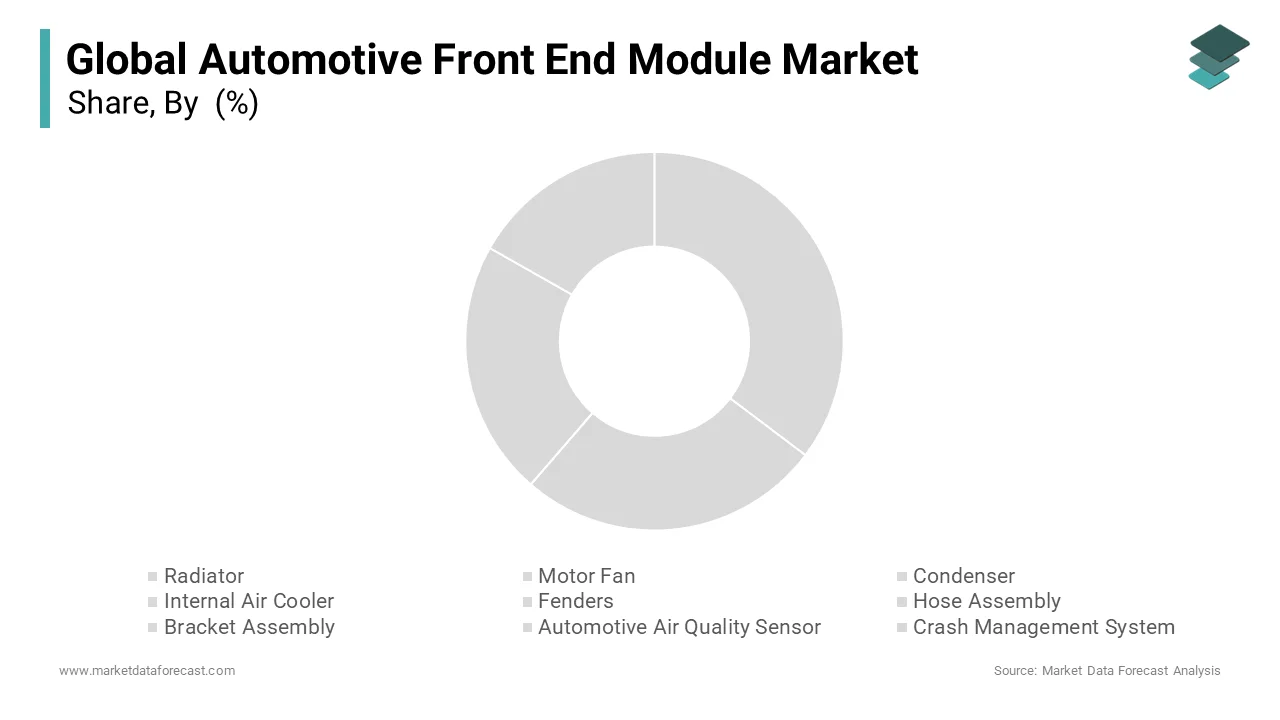
The radiator segment held the largest share, accounting for 18% of the FEM market in 2025. This dominance is primarily attributed to the radiator's critical role in engine cooling and thermal management across both internal combustion engine (ICE) vehicles and electric vehicles (EVs). Despite the rise of electrification, ICE vehicles still constitute over 75% of total automotive production globally, as reported by OICA in 2023.
The radiator remains essential for maintaining optimal operating temperatures in hybrid and plug-in hybrid vehicles as well. Mahle GmbH, a leading supplier, notes that modern radiators are being redesigned with aluminum alloys and enhanced fin structures to improve heat dissipation efficiency by up to 20%.
Moreover, stringent emission norms imposed by regulatory bodies such as the European Commission and U.S. EPA have pushed automakers to adopt high-performance radiators capable of managing increased thermal loads from downsized turbocharged engines.
Moreover, rising vehicle production in Asia-Pacific—especially in China and India—has further fueled demand. This sustained requirement positions the radiator as a cornerstone component within the FEM landscape.
Automotive Air Quality Sensor
The Automotive Air Quality Sensor segment is projected to grow at the fastest CAGR of 9.3% in the future. This rapid expansion is driven by increasing concerns regarding urban air pollution and the integration of cabin air filtration systems in premium and mid-segment vehicles.
Governments across Europe and North America have introduced regulations mandating air quality monitoring features in new vehicles. Also, automakers like BMW and Volvo have incorporated multi-layered air filtration systems with real-time sensors embedded in the front-end module.
In addition, emerging markets like India and Indonesia are witnessing a surge in demand for vehicles equipped with air quality sensors as awareness about the health impacts of poor air quality rises. This trend, combined with advancements in IoT-enabled sensors, is accelerating adoption and driving the segment’s exponential growth trajectory.
By Vehicle Insights
Passenger Cars (PC)
Passenger cars commanded the Automotive Front End Module (FEM) market, holding a 62.8% of the share in 2024. This dominance stems from the consistently high production volumes of passenger vehicles worldwide.
One of the key drivers behind this segment’s leadership is the growing consumer preference for technologically advanced and aesthetically refined vehicles. Modern passenger cars increasingly incorporate modular front-end designs to accommodate ADAS sensors, LED lighting, and aerodynamic enhancements. According to McKinsey & Company, more than 70% of new passenger car launches in 2023 featured fully integrated front-end modules, reducing assembly complexity and enhancing design flexibility.
Moreover, the shift toward electric mobility has further reinforced the importance of FEMs in passenger cars. Companies like BYD and Tesla are redesigning front-end modules to support EV-specific requirements such as active grille shutters and optimized airflow channels. These factors collectively ensure the continued dominance of the passenger car segment in the FEM market.
Heavy Commercial Vehicles (HCV)
The Heavy Commercial Vehicles (HCV) segment is anticipated to witness the highest CAGR of 7.8% during the forecast period. This accelerated growth is primarily fueled by the expanding logistics and freight transportation sectors, particularly in developing economies.
HCVs require robust FEM designs to withstand extreme operating conditions and frequent usage. Components such as heavy-duty radiators, crash management systems, and reinforced bumpers are integral to these vehicles. Tata Motors and Daimler Truck AG have been actively upgrading their FEM offerings to enhance thermal efficiency and structural resilience in commercial fleets.
Apart from these, stricter emissions regulations, especially in Europe and China, are pushing manufacturers to adopt lightweight and aerodynamically optimized front-end solutions.
By Material Insights
Steel
Steel remained the prominent material segment in the Automotive Front End Module (FEM) market, capturing 40.5% of the total market share in 2024. Its widespread use is attributed to its high mechanical strength, cost-effectiveness, and compatibility with existing manufacturing infrastructure. According to the World Steel Association, over 65% of body-in-white structures in conventional vehicles continue to be made from steel, reinforcing its foundational role in automotive design.
Despite the industry’s push toward lightweighting, steel remains dominant in structural FEM components such as bumper beams and radiator supports where durability and crash resistance are paramount. The Insurance Institute for Highway Safety (IIHS) notes that steel-based front-end structures contribute significantly to improved crash performance ratings, making them a preferred choice among automakers seeking to meet safety mandates without compromising on affordability.
Also, in emerging markets like India and Southeast Asia, where cost-sensitive consumers prioritize vehicle longevity and repairability, steel continues to hold strong. This enduring relevance ensures that steel remains the most widely used material in FEM manufacturing despite growing competition from composites and plastics.
Composites
Composites are projected to register the highest CAGR of 10.2% in the Automotive Front End Module (FEM) market from 2025 to 2033. This rapid growth is driven by the automotive industry’s increasing focus on weight reduction, fuel efficiency, and design flexibility. As per the American Composites Manufacturers Association (ACMA), replacing traditional metal components with fiber-reinforced composites can reduce part weight, directly contributing to improved vehicle performance and lower emissions.
Electric vehicle (EV) manufacturers, in particular, are adopting composite materials in front-end modules to offset battery mass and extend driving range. Tesla’s Model Y, for instance, incorporates composite-based FEM components that reduce frontal weight while improving aerodynamics. As per BloombergNEF, global EV production surged past 14 million units in 2023, creating substantial demand for lightweight, corrosion-resistant materials like carbon fiber and glass-reinforced polymers.
Furthermore, advancements in automated manufacturing techniques such as resin transfer molding (RTM) and compression molding have made composite production more scalable and cost-effective. With regulatory pressures intensifying and consumer demand shifting toward sustainable materials, composites are poised for sustained growth in the FEM sector.
REGIONAL ANALYSIS
North America
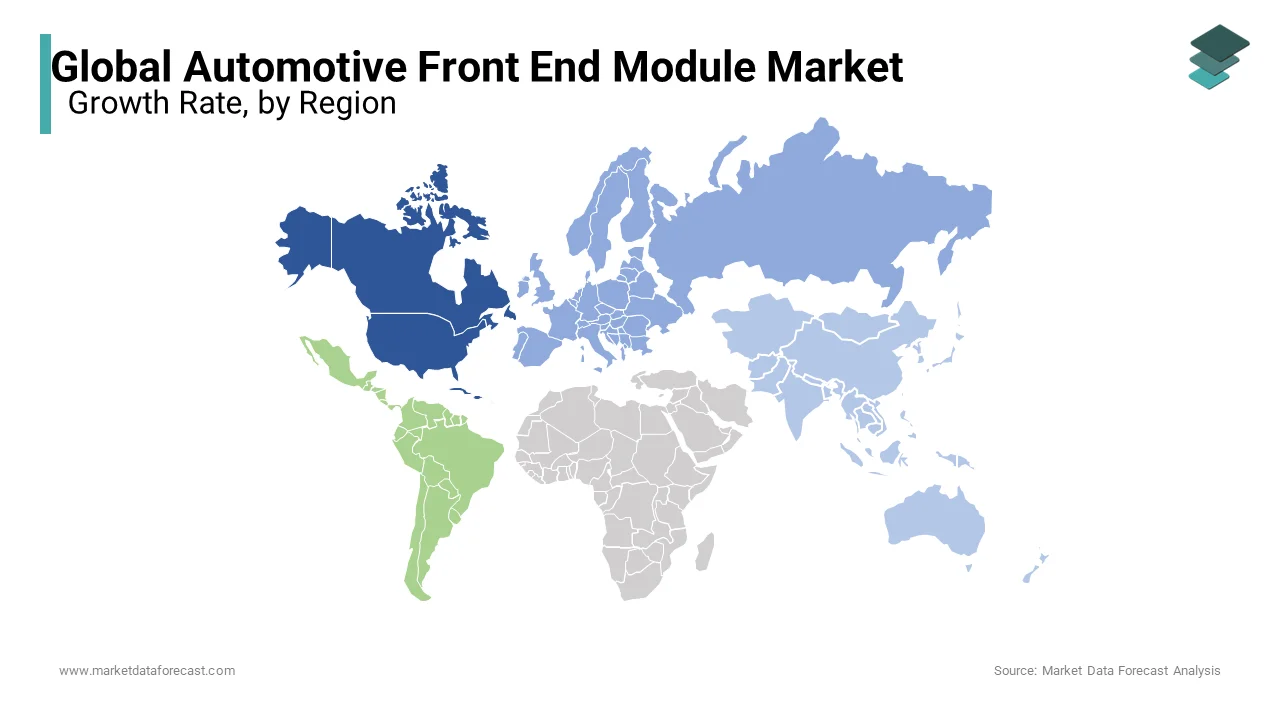
North America is a mature landscape, accounted for 18.7% of the global Automotive Front End Module (FEM) market, driven by strong technological adoption and regulatory emphasis on vehicle safety and emissions. The region's automotive industry benefits from a well-established supply chain and the presence of major OEMs such as Ford, General Motors, and Tesla.
Regulatory frameworks such as the Federal Motor Vehicle Safety Standards (FMVSS) mandate high crashworthiness and occupant protection standards, encouraging the integration of reinforced FEM structures. Also, the rise of electric vehicles in the U.S. is boosting demand for thermally optimized FEMs. Tier-1 suppliers like Magna International and Aptiv are expanding their FEM production facilities in Michigan and Texas to cater to domestic OEMs, reinforcing North America's strategic position in the global FEM market.
Europe
Europe commands a notable share of the Automotive Front End Module (FEM) market, supported by stringent emissions regulations and a high concentration of premium automakers. Germany, France, and Italy remain central to this growth. German brands such as BMW, Mercedes-Benz, and Audi are known for integrating highly engineered FEMs that house complex ADAS systems and aerodynamic enhancements.
Euro NCAP’s evolving safety protocols have played a pivotal role in shaping FEM design strategies. Furthermore, the EU’s CO₂ emission targets for 2030 are compelling automakers to adopt lightweight materials and modular front-end assemblies to reduce overall vehicle mass.
The region is also a hub for innovation, with companies like Bosch and Continental developing smart FEM platforms that integrate LiDAR, radar, and camera modules. These factors collectively solidify Europe’s position as a leader in advanced FEM development and deployment.
Asia Pacific
Asia Pacific led the Automotive Front End Module (FEM) market with a commanding share of 34.2% in 2024. China, Japan, and India are the primary contributors. The country's aggressive push toward electric mobility has spurred demand for specialized front-end modules tailored for EVs.
In India, rising disposable incomes and urbanization have led to increased vehicle ownership. Also, Japanese automakers such as Toyota and Honda are leveraging modular platform strategies, enabling standardized FEM designs across multiple models.
Apart from these, South Korea and Thailand are emerging as regional manufacturing hubs, attracting investments from global Tier-1 suppliers. Denso and Hyundai Mobis have expanded their FEM production capacities in South Korea to serve both domestic and export markets. With government initiatives promoting smart mobility and connected vehicle technologies, Asia Pacific remains the epicenter of FEM market growth.
Latin America
Latin America contributes a notable share to the global Automotive Front End Module (FEM) market, with Brazil and Mexico serving as the primary growth engines. The country’s automotive industry benefits from local content incentives and trade agreements that encourage FEM manufacturing within the region.
Mexico, on the other hand, remains a key export hub for North America-bound vehicles. Companies like Grupo Antolin and Plastic Omnium have established FEM production units in Monterrey and Guadalajara to support OEMs such as Nissan and Volkswagen.
Despite challenges related to currency fluctuations and political instability, Latin America’s FEM market is gaining traction due to increased investment in automotive manufacturing zones.
Middle East and Africa
The Middle East and Africa collectively account for approximately 6% of the global Automotive Front End Module (FEM) market, with Saudi Arabia, UAE, and South Africa leading the way. While not a major production center, the region is experiencing gradual growth due to government-led industrialization programs and rising vehicle imports.
Saudi Arabia’s Vision 2030 initiative includes automotive manufacturing as a strategic priority. Similarly, the UAE is investing in smart city infrastructure and autonomous vehicle testing, fostering demand for advanced front-end modules equipped with ADAS sensors.
South Africa, though constrained by economic volatility, maintains a modest domestic production base. With rising urbanization and fleet modernization efforts underway, the MEA region presents long-term opportunities for FEM suppliers willing to navigate logistical and regulatory complexities.
KEY MARKET PLAYERS
Faurecia SA (France), Denso Corporation (Japan), MAHLE GmbH (Germany), Calsonic Kansei Corporation (Japan), HBPO Group (Germany), Magna International Inc. (Canada), Hyundai Mobis (South Korea), Plastic Omnium (France), Samvardhana Motherson Group (The Netherlands). Some of the market players dominate the global automotive front-end module market.
Top Players In The Market
Magna International Inc.
Magna International is a leading global automotive supplier known for its comprehensive front-end module solutions. The company integrates multiple components such as radiators, lighting systems, and ADAS sensors into modular front-end structures. Magna’s expertise lies in offering scalable and lightweight FEM platforms that cater to both traditional and electric vehicles. Its strategic partnerships with major OEMs allow it to deliver tailored solutions that enhance vehicle performance and design efficiency.
Plastic Omnium S.A.
Plastic Omnium is a key player recognized for its innovation in lightweight front-end modules. The company specializes in plastic and composite-based FEMs that contribute to fuel efficiency and aerodynamic optimization. With a strong focus on sustainability and advanced manufacturing techniques, Plastic Omnium supports automakers in meeting evolving emission standards while maintaining structural integrity and aesthetic appeal across diverse vehicle segments.
ZF Friedrichshafen AG (ZF Group)
ZF Group is a technology leader in automotive systems, including integrated front-end modules designed for next-generation mobility. The company emphasizes intelligent front-end designs that house radar, camera, and sensor systems for autonomous driving applications. ZF’s commitment to electrification and active safety technologies positions it at the forefront of the FEM market, supporting OEMs in delivering high-performance, future-ready vehicles.
Top Strategies Used by Key Market Participants
Strategic Partnerships and Collaborations
Leading players frequently engage in strategic alliances with automotive OEMs and technology firms to co-develop advanced front-end modules. These collaborations enable seamless integration of ADAS, thermal management systems, and aerodynamic enhancements, ensuring alignment with evolving vehicle architectures and regulatory requirements.
Investment in Lightweight Material Innovation
A core strategy among top companies involves research and development in lightweight materials such as composites, thermoplastics, and aluminum alloys. By adopting these materials, manufacturers aim to reduce vehicle mass, improve fuel efficiency, and support the growing demand for electric vehicles without compromising structural integrity or safety.
Expansion of Modular Manufacturing Capabilities
To meet the rising demand for pre-assembled front-end modules, companies are investing in modular production facilities worldwide. This approach streamlines assembly processes, reduces costs, and allows for faster deployment of customized FEM solutions tailored to specific vehicle platforms and regional markets.
COMPETITION OVERVIEW
The competition in the Automotive Front End Module (FEM) market is intense and marked by continuous innovation, strategic collaborations, and geographic expansion. As automotive manufacturers shift toward modular vehicle platforms and lightweight designs, suppliers are under pressure to offer integrated, cost-effective, and technologically advanced front-end solutions. The industry is dominated by a few global players who have established extensive R&D centers, production networks, and long-standing relationships with major automakers. However, regional players are increasingly gaining traction by leveraging localized manufacturing capabilities and cost advantages. The race to develop FEMs compatible with electric and autonomous vehicles has further intensified rivalry, prompting companies to invest heavily in material science, sensor integration, and automated production. To maintain competitive differentiation, firms are focusing on expanding their product portfolios, optimizing supply chains, and enhancing engineering expertise. The convergence of regulatory mandates, consumer expectations, and technological advancements continues to shape the competitive landscape, making agility and innovation critical success factors.
RECENT HAPPENINGS IN THE MARKET
- In January 2024, Magna International announced a new joint venture with a South Korean battery manufacturer to develop front-end modules specifically designed for electric vehicles. This partnership aimed at integrating thermal management systems directly into the FEM structure to improve cooling efficiency and overall vehicle performance.
- In March 2024, Plastic Omnium launched an advanced line of aerodynamically optimized front-end modules featuring adaptive grilles and embedded sensor housings. The product line was introduced to support automakers in achieving improved fuel economy and compliance with upcoming emissions regulations.
- In June 2023, ZF Friedrichshafen unveiled a modular front-end platform capable of accommodating Level 3 autonomous driving features. The system integrates radar, LiDAR, and camera units within a single compact module, allowing for easier calibration and maintenance across different vehicle models.
- In September 2023, Bosch formed a strategic alliance with a German startup specializing in AI-driven sensor calibration. This initiative targeted front-end module applications, enabling real-time recalibration of ADAS components post-assembly, thereby reducing service downtime and improving system reliability.
- In November 2023, Grupo Antolin expanded its production facility in Mexico to increase capacity for front-end modules catering to North American OEMs. The expansion focused on lightweight thermoplastic-based FEMs designed for compact and mid-sized passenger vehicles, aligning with regional trends toward fuel-efficient transportation.
MARKET SEGMENTATION
This research report on the global automotive front-end module market is segmented and sub-segmented into the following categories.
By Type
- Radiator
- Motor Fan
- Condenser
- Internal Air Cooler
- Radiator Core Support
- Oil Cooler
- Headlight
- Front Grill
- Front Active Grill
- Bumpers
- Horn Assembly
- Fenders
- Hose Assembly
- Bracket Assembly
- Automotive Air Quality Sensor
- Crash Management System
By Vehicle Type
- PC
- LCV
- HCV
By Material
- Steel
- Composites
- Plastic
- Hybrid
By Region
- North America
- Europe
- Asia Pacific
- Latin America
- Middle East & Africa