- Product Description Description
- Table of Contents TOC
- List of Table & Figure LOT
- Get Free Sample PDF Sample PDF
Global Automotive Labels Market Size
The global automotive labels market size was valued at USD 1.34 billion in 2024 and is anticipated to reach USD 1.42 billion in 2025 to USD 2.20 billion by 2033, growing at a CAGR of 5.64% during the forecast period from 2025 to 2033.
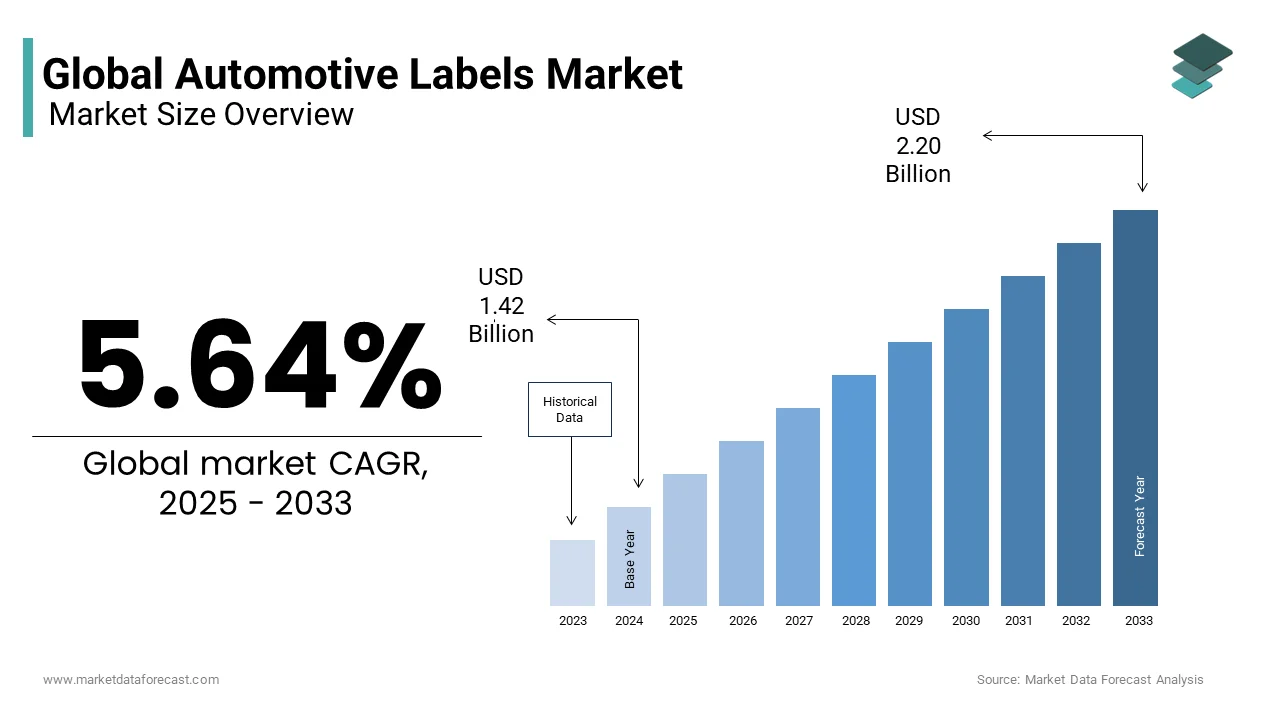
The automotive labels are an application of specialized adhesive identifiers used across vehicle assembly supply chains and aftermarket services to convey data, including part numbers, safety warnings, compliance certification, barcodes, and operational instructions. These labels are engineered to withstand extreme thermal cycles, chemical exposure, abrasion, and prolonged UV radiation without degradation or loss of legibility. Emerging electric vehicle platforms demand even higher label density due to high voltage warnings, battery chemistry identifiers, and charging protocol decals.
MARKET DRIVERS
Regulatory Compliance Mandates Are Forcing Universal Adoption of Durable and Tamper-Proof Labeling
The global automotive safety and traceability regulations are compelling manufacturers to embed permanent resilient labeling across every vehicle system is majorly driving the growth of the automotive labels market. As per the National Highway Traffic Safety Administration, every vehicle sold in the United States must display a certification label verifying compliance with Federal Motor Vehicle Safety Standards, including frontal crash protection and airbag deployment thresholds. Similarly, the European Union’s End of Life Vehicles Directive requires each component containing over 0.1 % by weight of lead, mercury, cadmium, or hexavalent chromium to be marked with material identification codes. These regulatory imperatives eliminate discretionary spending on labeling and instead mandate investment in industrial-grade adhesives, UV-stable inks, and laser-etched substrates that survive fifteen-year vehicle lifespans under desert, tropical, and arctic conditions.
Supply Chain Digitization Is Accelerating Demand for Smart Labels with Embedded Data Capabilities
The automotive manufacturers are transitioning from static printed labels to dynamic smart labels capable of storing and transmitting component history maintenance records and real-time sensor data, which is an additional factor enhancing the growth of the automotive labels market. As per the Fraunhofer Institute for Material Flow and Logistics, over 60% of German automotive plants now use RFID-enabled labels on engines, transmissions, and battery packs to enable real-time work-in-process tracking and predictive maintenance scheduling. According to the China Automotive Technology and Research Center, all new energy vehicles produced in China since 2023 must include NFC-enabled battery labels storing state of health, charge cycle, and recall status accessible via service center readers. These smart labels are no longer passive identifiers but active data nodes enabling closed-loop quality control, automated recalls, and lifecycle transparency.
MARKET RESTRAINTS
Transition to Electric and Autonomous Platforms Is Creating New Labeling Categories for High Voltage and Sensor Zones
The proliferation of electric and autonomous vehicles is generating entirely new categories of mandatory labeling focused on electrical safety, sensor calibration, and software version control, which is also expected to escalate the growth of the automotive labels market. Tesla’s 2023 service manual reveals each Model Y contains over 45 high voltage warning labels, including bilingual cautions near the 400-volt battery disconnect and inverter compartments. Waymo’s fifth-generation vehicles now feature QR code labels on every external sensor that technicians scan to pull alignment tolerances and firmware logs. These emerging labeling requirements are not optional accessories but foundational safety infrastructure ensuring technicians, first responders, and recyclers can safely interact with increasingly complex vehicle architectures.
Localization of Component Manufacturing Is Driving Demand for Multilingual and Region-Specific Label Content
OEMs are mandating region-specific label content in local languages, safety symbols, and regulatory formats as automotive supply chains decentralize to mitigate geopolitical risk, which is expected to degrade the growth of the automotive labels market. According to the ASEAN Automotive Federation, over 80% of vehicles assembled in Thailand, Vietnam, and Indonesia now require under-hood labels printed in both English and the national language to comply with local labor safety laws. Tata Motors’ Pune facility uses AI-driven label printers that auto-switch between Hindi, Marathi, and English based on the final destination market.
MARKET OPPORTUNITIES
Shortage of Industrial Grade Adhesive Substrates Is Constraining Production Scalability and Application Reliability
The global supply of pressure-sensitive adhesives and chemically resistant facestocks suitable for under-hood and underbody applications is eventually to slow the growth of the automotive labels market. As per the European Chemicals Agency, over forty-five % of traditional solvent-based acrylic adhesives used in automotive labeling were phased out in 2023 under REACH Annex XVII restrictions on volatile organic content. According to the Japan Adhesive Tape Manufacturers Association, rejection rates for engine compartment labels rose by nineteen % in 2023 as substitute adhesives failed shear adhesion tests after thermal cycling. Indian OEMs, including Mahind, faced production delays when monsoon humidity caused water-based adhesive labels to delaminate during transit to assembly plants.
REPORT COVERAGE
| REPORT METRIC | DETAILS |
| Market Size Available | 2024 to 2033 |
| Base Year | 2024 |
| Forecast Period | 2025 to 2033 |
| CAGR | 5.5% |
| Segments Covered | By Type, Application, Raw Materials, and Region. |
| Various Analyses Covered | Global, Regional & Country Level Analysis, Segment-Level Analysis, DROC, PESTLE Analysis, Porter’s Five Forces Analysis, Competitive Landscape, Analyst Overview of Investment Opportunities |
| Regions Covered | North America, Europe, APAC, Latin America, Middle East & Africa |
| Market Leaders Profiled | 3M Company, Resource Label Group, H.B. Fuller, Avery Dennison Corporation, and Others. |
SEGMENTAL ANALYSIS
By Type Insights
The warning and safety labels segment held 52.3% of the global automotive labels market share in 2024, with legally binding mandates that require explicit hazard communication on every vehicle system from battery terminals to airbag housings. European Union’s Machinery Directive 2006 42 EC mandates that all serviceable vehicle components carry pictograms and multilingual text warning of crush, pinch, hand, and electrocution risks.
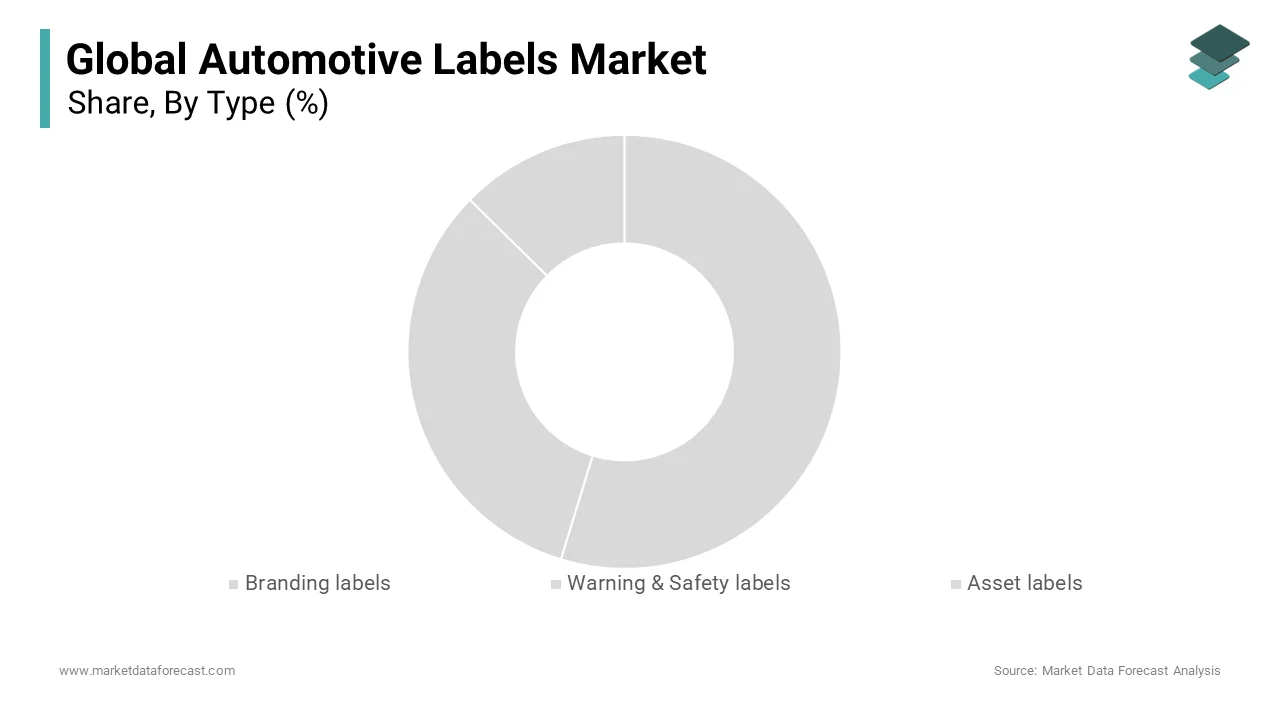
The asset labels segment is likely to grow at an expected CAGR of 11.4% during the forecast period with the integration of serialized identifiers into digital twin ecosystems that track component history, performance, and maintenance across the vehicle lifecycle. According to the China Automotive Technology and Research Center, all new energy vehicles produced since 2023 must embed NFC-enabled battery labels storing charge cycle counts, state of health, and firmware versions accessible via authorized service tools. UPM Raflatac noted a two hundred and forty % surge in orders for UHF RFID asset labels from EV battery manufacturers seeking real-time temperature logging during shipping. These labels are evolving from static identifiers into active data nodes, enabling closed-loop quality control, automated recalls, and lifecycle transparency.
By Application Insights
The engine components labels segment was accounted in holding 43.2% of the automotive labels market share in 20,24 with the uniquely harsh operating environment under the hood, where labels must endure thermal cycling from minus forty to over two hundred degrees Celsius, chemical exposure to oils, coolan, ts and solve,nts and continuous mechanical abrasion. Toyota’s 2023 engine plant audit revealed that 89% of warranty claims related to misinstalled parts were resolved by verifying label data on camshafts and fuel injectors. Avery Dennison’s technical bulletin noted that demand for polyimide-backed labels with silicone adhesives for engine applications grew by fifty-seven % in 2023 as EV power electronics required similar durability.
The exterior labels segment is likely to grow with an expected CAGR of 10.7% during the forecast period, with two parallel trends: the proliferation of sensor calibration markers for autonomous systems and stricter national mandates for visible branding and compliance decals. As per SAE International’s J3150 standard, all LIDAR camera and radar housings must carry calibration data, field of view, and alignment tolerance labels visible without disassembly. According to Brazil’s National Traffic Department, all vehicles must display ethanol compatibility decals and tire pressure placards in Portuguese, Spanish, and Guarani on the driver's side door jamb. India’s Ministry of Road Transport now requires VIN etching or labeling on the windshield and chassis for all vehicles above 125 cc engine capacity to combat theft.
By Raw Materials Insights
The polypropylene segment was the largest and held 47.5% of the automotive labels market share in 2024, with an unmatched balance of chemical resistance, dimensional stability under thermal stress, and cost efficiency at scale. According to the European Chemicals Agency, polypropylene remains exempt from REACH restrictions on phthalates and heavy metals, making it the default choice for EU-bound vehicles. The material’s recyclability and compatibility with water-based inks further align with sustainability mandates without compromising performance in the most demanding under-hood and underbody environments.
The polyvinyl chloride segment is likely to grow with 9.8% CAGR in the coming years, with the electric vehicle platforms where flexible conformable PVC labels are mandated for high voltage cable identification and battery warning systems. As per SAE J2894 standard, all EV power cables must carry orange PVC-backed labels with a minimum ten-point font voltage identifiers that remain legible after exposure to 150 degrees Celsius and battery acid splash. UPM Raflatac noted a one hundred and eighty % increase in demand for matte finish PVC labels from European luxury OEMs seeking premium tactile surfaces for center console control identifiers.
REGIONAL ANALYSIS
North America Market Analysis
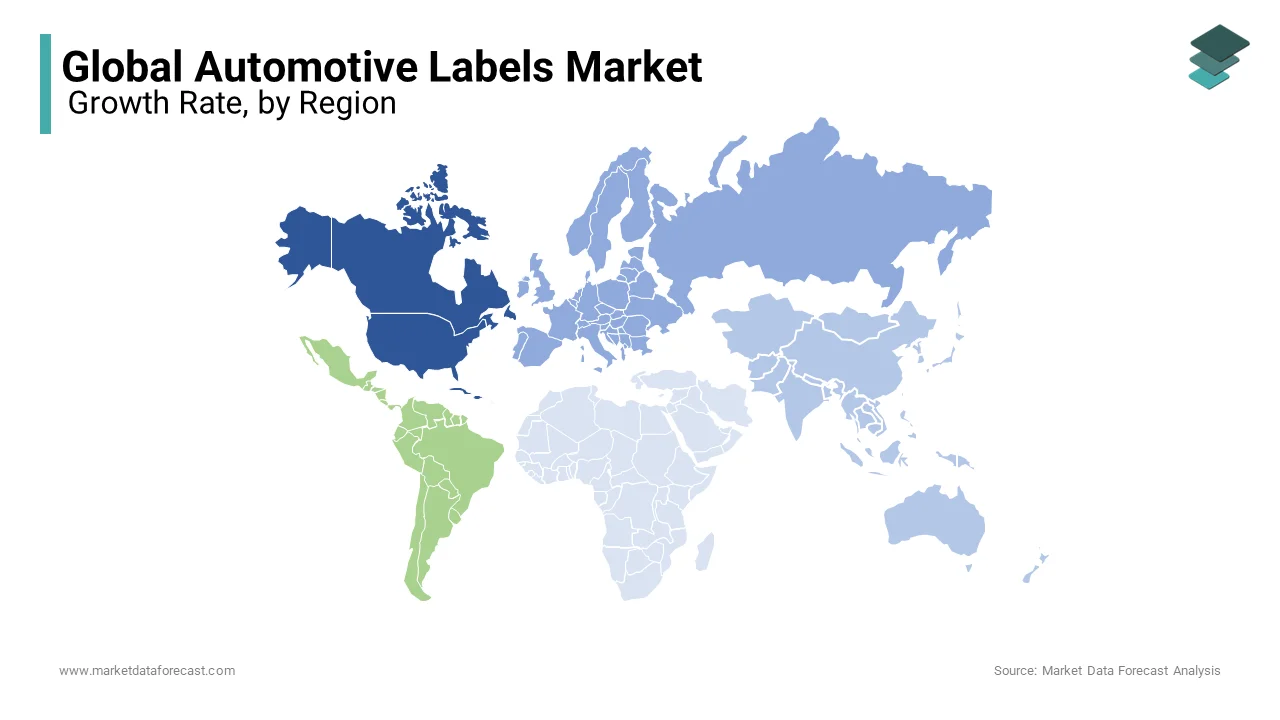
North America automotive labels market was the top performer with 29.2% of the share in 2024. As per the National Highway Traffic Safety Administration, every vehicle sold in the U.S. must display a Monroney sticker with fuel economy ratings and a separate certification label verifying compliance with all Federal Motor Vehicle Safety Standards.
Europe Market Analysis
Europe's automotive labels market held 21.3% of share in 2024, with harmonizing labeling requirements across 27 member states, while pioneering circular economy mandates for material composition andend-of-lifee recovery. As per the EU’s End of Life Vehicles Directive, every component containing over 0.1 % by weight of lead, mercury, cadmium, or hexavalent chromium must carry material identification codes in all twenty-four official languages. According to the German Federal Environment Agency, all replacement air filters sold in the EU must display recycling symbols and polymer type codes under DIN EN 13428 standards. UPM Raflatac’s Helsinki facility reported a ninety % increase in bio-based polypropylene label orders in 2023 as OEMs seek to meet EU Green Deal carbon footprint targets.
Asia Pacific Market Analysis
Asia Pacific automotive labels market growth is propelled by national policies mandating local language labeling and the world’s largest concentration of electric vehicle production, requiring high voltage and battery traceability identifiers.
Latin America Market Analysis
Latin America automotive labels market is expected to grow with significant growth opportunities in the coming years. Its distinctiveness lies in national mandates for anti-theft labeling and indigenous language inclusion to ensure public safety comprehension in rural communities. As per Mexico’s Secretariat of Economy, all replacement airbags must carry warning labels in Spanish, Nahuatl, a nd Maya to prevent improper handling in indigenous regions. Brazil’s National Traffic Department requires all vehicles to display ethanol compatibility decals and tire pressure placards in Portuguese, Spanish, and Guarani on the driver's side door jamb.
Middle East and Africa Market Analysis
The Middle East and Africa automotive labels market is gearing up with extreme environmental durability and strict customs documentation linking physical labels to digital import certificates. As per the Saudi Standards Metrology and Quality Organization, all vehicles imported into the Kingdom must carry under-hood labels printed in Arabic with a minimum UV resistance rating of five years at fifty degrees Celsius ambient temperature.
COMPETITIVE LANDSCAPE
Competition in the Automotive labels market is intensifying as regulatory complexity, digitization, and electric vehicle adoption redefine performance expectations. Global leaders compete with regional specialists who excel in rapid adaptation to local language mandates and extreme climate durability. Innovation is no longer confined to adhesive strength but extends to embedded data capabilities,s, including RFID, NFC, C, and QR code integration that link physical components to cloud-based digital twins. Material science breakthroughs in bio-based polymers, flame-retardant fibers a nd ceramic-coated polyester are becoming key differentiators. Supply chain resilience is paramount with players vertically integrating into resin production to mitigate raw material shortages.
KEY MARKET PLAYERS
A few of the market players in the global automotive labels market include
- 3M Company
- Resource Label Group
- UPM Raflatac
- H.B. Fuller
- Avery Dennison Corporation
Top Players in the Market
- Avery Dennison is a global leader in pressure-sensitive materials serving automotive OEMs and tier suppliers across the Asia Pacific with high durability labeling solutions. The company supplies chemically resistant labels for under-hood applications and multilingual safety decals compliant with ASEAN and Indian regulatory standards. Recent actions include launching a new line of laser-etchable polypropylene films for EV battery modules and opening a technical application center in Pune, India, to accelerate regional customization.
- 3M Company delivers advanced adhesive and substrate technologies tailored for extreme automotive environments, including engine compartments and exterior sensor housings across the Asia Pacific. The company recently introduced anti-graffiti laminated exterior labels for fleet operators in Southeast Asia and expanded its production of flame-retardant polyvinyl chloride films for high-voltage EV cable identification. 3M partnered with Toyota Kirloskar to develop humidity-resistant labels for underbody applications in tropical climates.
- UPM Raflatac specializes in sustainable and smart labeling solutions for the automotive sector with strong penetration in China, Jap, and India. The company supplies RFID-enabled asset tracking labels and bio-based polypropylene films that meet stringent low VOC requirements. Recent actions include launching UHF RFID labels with temperature logging capabilities for EV battery logistics and establishing a dedicated digital label integration team in Suzhou, China. UPM Raflatac collaborates with NIO and MG Motor to embed encrypted NFC labels in battery packpacksabling secure over-the-air updates and state-of-health monitoring, strengthening traceability and cybersecurity in next-generation vehicles.
Top Strategies Used By The Key Market Participants
Leading players in the Automotive labels market prioritize regulatory compliance by developing region-specific multilingual and symbol-compliant label systems that meet national safety and import mandates. They invest heavily in material science to engineer substrates that withstand extreme thermal, chemical, and UV exposure without degradation. Strategic partnerships with OEMs enable the development of smart labels integrated with digital twins and predictive maintenance platforms. Geographic expansion through localized technical centers accelerates customization for tropical humidity, desert, and multilingual requirements.
MARKET SEGMENTATION
This research report on the global automotive labels market has been segmented and sub-segmented into the following categories.
By Type
- Branding labels
- Warning & Safety labels
- Asset labels
By Application
- Interior labels
- Exterior labels
- Engine components labels
By Raw Materials
- Polyethylene (PE)
- Polypropylene (PP)
- Polyvinyl chloride (PVC)
By Region
- North America,
- Europe,
- Asia Pacific
- Latin America
- Middle East & Africa