- Product Description Description
- Table of Contents TOC
- List of Table & Figure LOT
- Get Free Sample PDF Sample PDF
Market Size, 2025
$6.27 BnMarket Estimate, 2026
$6.98 BnMarket Forecast, 2034
$16.39 BnCAGR, 2026–2034
11.26%Global Automotive Rear Seat Infotainment Market Report Summary
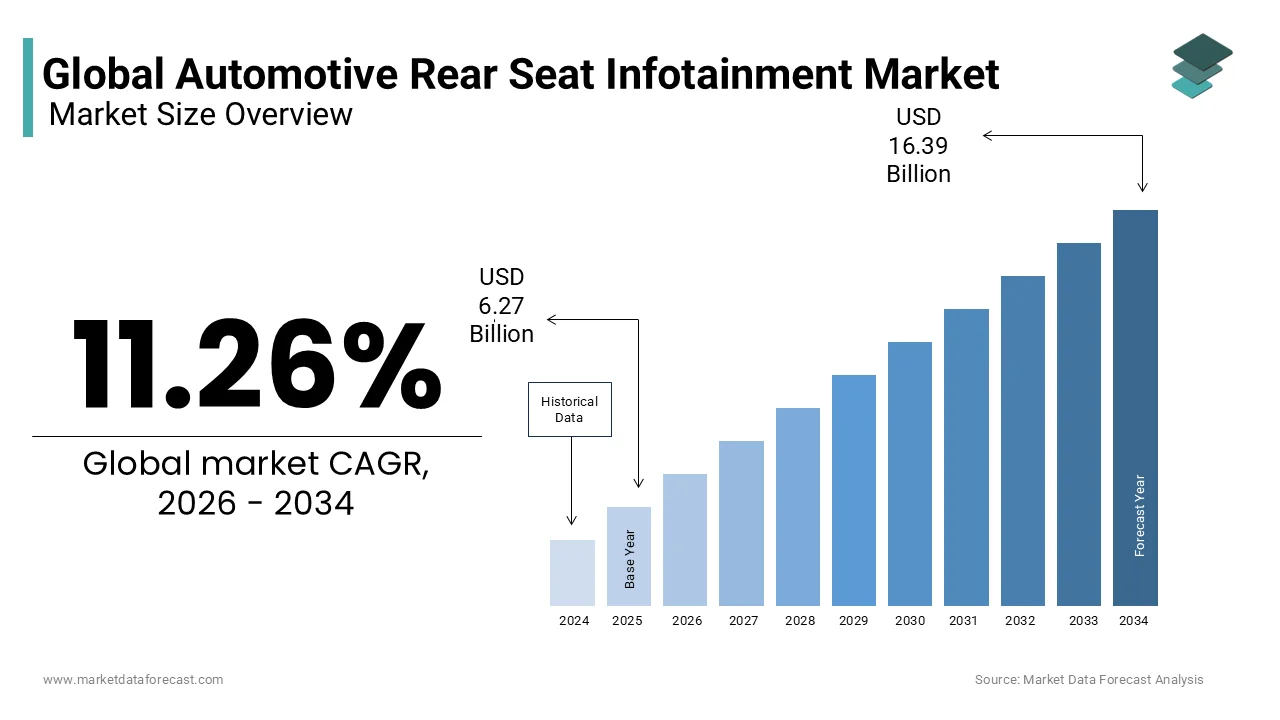
The global automotive rear seat infotainment market was valued at USD 6.27 billion in 2025, is estimated to reach USD 6.98 billion in 2026, and is projected to reach USD 16.39 billion by 2034, growing at a CAGR of 11.26% during the forecast period from 2026 to 2034. The growth of the global automotive rear seat infotainment market is driven by increasing consumer demand for in-vehicle entertainment, rising adoption of connected vehicle technologies, and growing sales of premium and luxury vehicles. Automakers are integrating advanced infotainment systems featuring high-resolution displays, streaming services, wireless connectivity, and interactive entertainment to enhance passenger experience. Additionally, advancements in 5G connectivity, artificial intelligence, and smart cockpit technologies are accelerating market expansion worldwide.
Key Market Trends
-
Rising demand for connected and personalized in-car entertainment is driving the adoption of rear seat infotainment systems.
-
Increasing integration of high-resolution touchscreens, streaming platforms, and gaming features is enhancing passenger experience.
-
Growing adoption of 4G LTE and emerging 5G connectivity is enabling seamless content streaming and cloud-based services.
-
Expanding sales of premium, luxury, and electric vehicles are boosting the installation of advanced rear seat infotainment solutions.
-
Automakers are increasingly integrating AI, voice assistants, and smart cockpit technologies to improve user interaction and convenience.
Segmental Insights
-
Based on vehicle type, the passenger cars segment dominated the global automotive rear seat infotainment market in 2025. The segment's leadership is attributed to increasing consumer demand for enhanced passenger comfort, rising adoption of connected vehicles, and growing sales of premium passenger cars equipped with advanced infotainment features.
-
Based on component, the display and touchscreen module segment held the largest share of the global automotive rear seat infotainment market in 2025. The segment's dominance is driven by increasing demand for larger, high-definition displays, intuitive touch interfaces, and multimedia capabilities that enhance the in-vehicle entertainment experience.
-
Based on connectivity generation, the 4G LTE segment accounted for the largest share of the global automotive rear seat infotainment market in 2025. The segment's growth is supported by widespread network availability, reliable high-speed connectivity, and the growing demand for real-time streaming, navigation, and connected vehicle services.
Regional Insights
-
The global automotive rear seat infotainment market is witnessing rapid growth due to increasing consumer expectations for connected mobility, technological advancements, and rising vehicle electrification.
-
North America dominated the global automotive rear seat infotainment market by accounting for 35.1% of the market share in 2025. The region's leadership is supported by high adoption of premium vehicles, strong consumer demand for advanced in-car technologies, and the presence of leading automotive technology providers.
-
Europe remains a significant market due to the strong presence of luxury automobile manufacturers, increasing integration of connected vehicle technologies, and rising demand for premium passenger experiences.
Competitive Landscape
The global automotive rear seat infotainment market is highly competitive, with companies focusing on advanced display technologies, connected vehicle platforms, artificial intelligence, and next-generation infotainment solutions. Manufacturers are investing in research and development, strategic collaborations, and software-driven innovations to deliver immersive in-vehicle entertainment experiences and strengthen their market positions. Key players operating in the global automotive rear seat infotainment market include Panasonic Corporation, Alpine Electronics Inc., Harman International (Samsung), Bosch, Continental AG, Denso Corporation, Visteon Corporation, LG Electronics, Pioneer Corporation, JVC Kenwood, Clarion (Faurecia-Forvia), Aptiv PLC, Desay SV Automotive, Huawei Technologies, Valeo SA, Garmin Ltd., Alps Alpine, Xperi Inc. (TiVo), Access Co., and Nreal (AR Displays).
 Download Free Sample Report
Global Automotive Rear Seat Infotainment Market Size
The global automotive rear seat infotainment market size was valued at USD 6.27 billion in 2025, and is expected to be worth USD 16.39 billion by 2034 from USD 6.98 billion by 2026. The market is growing at a CAGR of 11.26% during the forecast period.
Automotive Rear Seat Infotainment (RSI) refers to in-car multimedia, entertainment, and connectivity systems specifically designed for passengers in the second and third rows of a vehicle. These systems typically include high resolution touchscreens streaming capabilities gaming interfaces and wireless connectivity options that transform the travel experience into a productive or leisurely activity. As vehicle interiors evolve into mobile living spaces the demand for sophisticated rear seat solutions has intensified among luxury and premium automakers. According to J.D. Power, overall vehicle satisfaction is heavily influenced by in-vehicle technology, with consumers increasingly demanding that native infotainment systems mirror the seamless, wireless usability of their personal smartphones. The integration of these systems supports multiple users simultaneously allowing for personalized content consumption without disturbing the driver. Modern implementations feature voice control gesture recognition and seamless integration with personal devices ensuring intuitive interaction. The rise of electric vehicles provides an ideal platform for these technologies due to their spacious interiors and robust electrical architectures that support high power consumption devices. Automakers are leveraging rear seat infotainment as a key differentiator in the competitive luxury segment where comfort and convenience are paramount. The shift towards autonomous driving features further amplifies the importance of rear seat engagement as passengers gain more freedom to interact with digital content during transit. This technological evolution reflects broader societal trends where digital connectivity is expected in all aspects of daily life including transportation.
MARKET DRIVERS
Rising Demand for Premium Vehicle Experiences Driving Adoption
The escalating consumer preference for premium and luxury vehicle experiences contributes to the growth of the automotive rear seat infotainment market. Affluent buyers increasingly view automobiles not merely as transportation tools but as extensions of their personal living and working environments. According to a study, while advanced tech interest is growing, safety features and total cost of ownership remain the top consumer priorities influencing vehicle brand choice globally. This trend is particularly evident in markets like China and the Middle East where rear seat occupancy is common for business executives and high net worth individuals. Automakers respond by integrating large high definition screens premium audio systems and interactive gaming platforms into the rear cabin. The ability to conduct video conferences stream media or play multiplayer games enhances the perceived value of the vehicle. Flagship models from Mercedes-Benz, BMW, and Audi feature advanced rear-seat entertainment architecture as premium, optional packages tailored for executive and luxury consumers. The customization options available allow passengers to tailor their environment including lighting climate and content preferences. This focus on passenger experience aligns with the broader industry shift towards service oriented mobility where comfort and convenience drive brand loyalty. Competition is intensifying in the luxury segment. To meet rising expectations, manufacturers continue to innovate with larger screens, faster processors, and more immersive audio-visual experiences.
Expansion of Ride Hailing and Luxury Transportation Services
The rapid growth of ride hailing and luxury transportation services significantly boosts the expansion of the automotive rear seat infotainment market. This is because operators are seeking to differentiate their offerings. Companies providing premium ride services recognize that passenger satisfaction directly influences ratings and repeat business. According to research, global ride-hailing segment revenues are projected to continue their steady expansion through 2030, supported heavily by urban congestion and corporate luxury transit options. High end ride providers equip their vehicles with rear seat screens offering entertainment news and local information to enhance the passenger journey. This strategy helps justify higher fares and creates a distinctive brand identity in a crowded marketplace. Passengers appreciate the ability to relax and be entertained during commutes reducing stress and improving overall experience. Fleet operators also benefit from data collected through these systems which can inform marketing strategies and service improvements. The integration of advertising platforms on rear screens provides an additional revenue stream for service providers. As urbanization increases and traffic congestion worsens the time spent in vehicles grows making entertainment features more valuable. Luxury taxi services in major cities like London New York and Tokyo increasingly adopt these technologies to cater to discerning clients who expect seamless connectivity and comfort during their travels.
MARKET RESTRAINTS
High Installation and Maintenance Costs Restricting Mass Market Penetration
The substantial costs associated with installing and maintaining RSI systems impede the growth of the automotive rear seat infotainment market. This limits their adoption to only high end vehicle segments. These systems require complex hardware including high resolution displays powerful processors and sophisticated wiring harnesses that increase manufacturing expenses. Integrating premium rear-seat entertainment systems can increase a vehicle's retail price significantly, with flagship factory-installed theatrical screen systems adding up to $5,000 to the baseline MSRP. This pricing structure makes such features inaccessible to average consumers who prioritize affordability over luxury amenities. Additionally the maintenance of these electronic components requires specialized technical expertise and expensive replacement parts. Screen failures software glitches or connectivity issues can lead to costly repairs that deter budget conscious buyers. The rapid pace of technological obsolescence means that systems may become outdated quickly requiring frequent updates or replacements. Automakers face pressure to balance feature richness with cost efficiency often opting to exclude rear seat infotainment from mid range models. The complexity of installation also extends production times and increases labor costs for manufacturers. As a result these systems remain confined to luxury vehicles where customers are willing to pay a premium for enhanced comfort. This cost barrier prevents widespread adoption and limits market growth to a niche segment of affluent buyers.
Technical Complexity and Integration Challenges with Vehicle Architecture
The intricate technical requirements for integrating rear seat infotainment systems with existing vehicle architecture are significant barriers for manufacturers in the automotive rear seat infotainment market. These systems must seamlessly communicate with the vehicle central computer power management and security protocols without compromising safety or performance. According to SAE International standard frameworks, automotive electronics require rigorous electromagnetic compatibility validation to mitigate signal interference among co-located cabin components. The need to manage heat dissipation from high performance processors in the rear cabin adds another layer of engineering complexity. Manufacturers must design cooling systems that do not interfere with passenger comfort or interior aesthetics. Software integration presents further difficulties as different operating systems and applications must work harmoniously across multiple screens and user profiles. Cybersecurity concerns also arise as connected infotainment systems create potential entry points for malicious attacks on vehicle networks. Protecting passenger data and preventing unauthorized access requires robust encryption and regular software updates. The lack of standardized interfaces across different automakers complicates the development of universal solutions for suppliers. These technical hurdles increase development timelines and costs delaying product launches. Ensuring reliability under various environmental conditions such as extreme temperatures and vibrations further tests the durability of these sophisticated systems.
MARKET OPPORTUNITIES
Integration of Augmented Reality and Immersive Gaming Technologies
The emergence of augmented reality and immersive gaming technologies offers a substantial opportunity for innovation in the automotive rear seat infotainment market. As processing power increases and display technologies advance manufacturers can offer interactive experiences that blend digital content with the physical environment. According to PwC, the rapid transition toward software-defined vehicles is enabling automakers to capture new revenue streams through immersive digital services and connected cabin features. Rear seat passengers can participate in multiplayer games that use vehicle motion and external scenery as part of the gameplay enhancing immersion. Educational applications can overlay historical or geographical information onto passing landmarks turning travel into a learning experience. These features appeal to families and younger demographics who value interactive and educational content during long journeys. Automakers can partner with gaming studios and content creators to develop exclusive titles that leverage vehicle specific capabilities. The integration of haptic feedback and spatial audio further enriches the sensory experience making it comparable to home entertainment systems. This differentiation strategy allows brands to attract tech savvy consumers who seek unique and memorable travel experiences. As 5G connectivity becomes more widespread low latency streaming will enable cloud based gaming and real time collaborative applications. This technological convergence opens new revenue streams through content subscriptions and in app purchases within the vehicle ecosystem.
Growth of Subscription Based Content and Service Models
The shift towards subscription-based content and service models sets the stage for automakers and technology providers in the automotive rear-seat infotainment market. Instead of relying solely on hardware sales companies can generate recurring revenue through monthly or annual subscriptions for premium entertainment packages. According to McKinsey, software-defined vehicle features and digital services are projected to generate significant automotive revenue shares by 2030, compensating for shifting traditional hardware margins. Subscriptions can include access to exclusive movies music libraries educational content and productivity tools tailored for rear seat passengers. This model allows users to customize their experience based on individual preferences and usage patterns. Families can choose child friendly content while business travelers may opt for news and conference calling services. The flexibility of subscription plans appeals to consumers who prefer paying for what they use rather than buying bundled features. Automakers can bundle these services with vehicle leases or financing packages making them more accessible. Partnerships with streaming platforms and content providers ensure a diverse and up to date library of offerings. Data analytics from subscription usage can inform product development and marketing strategies enhancing customer retention. This transition to service oriented revenue models aligns with broader industry trends towards software defined vehicles and continuous value delivery throughout the vehicle lifecycle.
MARKET CHALLENGES
Cybersecurity Vulnerabilities and Data Privacy Concerns
The increasing connectivity of RSI systems introduces significant cybersecurity vulnerabilities that pose serious risks to vehicle safety and passenger privacy, and thereby hold back the growth of the automotive rear seat infotainment market. These systems often connect to external networks via Wi Fi Bluetooth or cellular data creating potential entry points for hackers. According to Upstream Security, recorded cyber incidents impacting global automotive infrastructure experienced a massive multi-year surge, emphasizing critical vulnerabilities across connected vehicle software ecosystems. Rear seat screens may store personal data such as login credentials payment information and location history making them attractive targets for malicious actors. A successful breach could compromise not only entertainment functions but also critical vehicle systems if proper isolation measures are not in place. Manufacturers must implement robust encryption firewalls and intrusion detection systems to protect against unauthorized access. Regular software updates are essential to patch known vulnerabilities but many users neglect to install them promptly. The lack of universal cybersecurity standards in the automotive industry complicates efforts to ensure consistent protection across different brands. Consumer awareness of data privacy issues is growing leading to stricter regulations such as the General Data Protection Regulation in Europe. Failure to address these concerns can result in legal liabilities reputational damage and loss of consumer trust. Ensuring secure communication between rear seat devices and vehicle networks requires continuous investment in security research and development.
Rapid Technological Obsolescence and Upgrade Limitations
The rapid pace of technological advancement leads to quick obsolescence of RSI hardware, which slows down the expansion of the automotive rear seat infotainment market. This creates challenges for both manufacturers and consumers. Unlike mechanical components that last for years electronic systems often become outdated within a few years due to new software requirements and hardware limitations. Rear seat screens and processors may struggle to run newer applications or support latest streaming formats leading to poor user experience. Upgrading these embedded systems is difficult and expensive as they are integrated into the vehicle structure unlike smartphones or tablets. Consumers may find themselves stuck with outdated technology for the duration of vehicle ownership which can diminish resale value. Manufacturers face pressure to design modular systems that allow for easier upgrades but this increases initial complexity and cost. The mismatch between vehicle lifecycle and technology lifecycle creates a disconnect that frustrates users accustomed to frequent device updates. Keeping software compatible with evolving operating systems and apps requires ongoing support and resources from automakers. This challenge necessitates a shift towards cloud based solutions where processing occurs remotely reducing dependence on onboard hardware. However reliance on connectivity introduces other dependencies and potential service disruptions.
REPORT COVERAGE
| REPORT METRIC | DETAILS |
| Market Size Available | 2025 to 2034 |
| Base Year | 2025 |
| Forecast Period | 2026 to 2034 |
| CAGR | 11.26% |
| Segments Covered | By Vehicle Type, Component, Propulsion Type, Connectivity Generation, Operating System, Sales Channel, and Region. |
| Various Analyses Covered | Global, Regional & Country Level Analysis, Segment-Level Analysis, DROC, PESTLE Analysis, Porter’s Five Forces Analysis, Competitive Landscape, Analyst Overview of Investment Opportunities |
| Regions Covered | North America, Europe, APAC, Latin America, Middle East & Africa |
| Market Leaders Profiled | Panasonic Corporation, Alpine Electronics Inc., Harman International (Samsung), Bosch, Continental AG, Denso Corporation, Visteon Corporation, LG Electronics, Alpine Electronics, Pioneer Corporation, JVC Kenwood, Clarion (Faurecia-Forvia), Aptiv PLC, Desay SV Automotive, Huawei Technologies, Valeo SA, Garmin Ltd., Alps Alpine, Xperi Inc. (TiVo), Access Co., and Nreal (AR Displays) |
SEGMENTAL ANALYSIS
By Vehicle Type Insights
In 2025, passenger cars dominated the automotive rear seat infotainment market and accounted for a substantial share. This dominance of the segment was driven by increasing average commute times and a strong desire to keep passengers, especially children, engaged during travel. Consequently, high consumer demand for personalized in-vehicle entertainment accounted for a substantial market share. According to the U.S. Census Bureau, the average one-way commute time for Americans peaked at 27.6 minutes in 2019 before experiencing a historic post-pandemic drop driven by widespread work-from-home adaptation. Automakers have responded by integrating factory installed entertainment systems into mid range and luxury SUVs and sedans making them accessible to a broader demographic beyond just ultra luxury buyers. The proliferation of streaming services like Netflix and Disney Plus has further accelerated this trend as parents seek seamless ways to provide content without relying on personal tablets that require mounting and charging. Sources highlight that built-in rear-seat screen packages have faced declining buyer necessity due to the flexibility and rapid technological life cycles of personal consumer mobile tablets. This shift reflects a broader cultural change where the automobile is viewed as an extension of the home living space rather than merely a mode of transport. Manufacturers leverage this demand by offering bundled packages that include wireless headphones and multiple screen inputs enhancing the overall value proposition for family buyers.
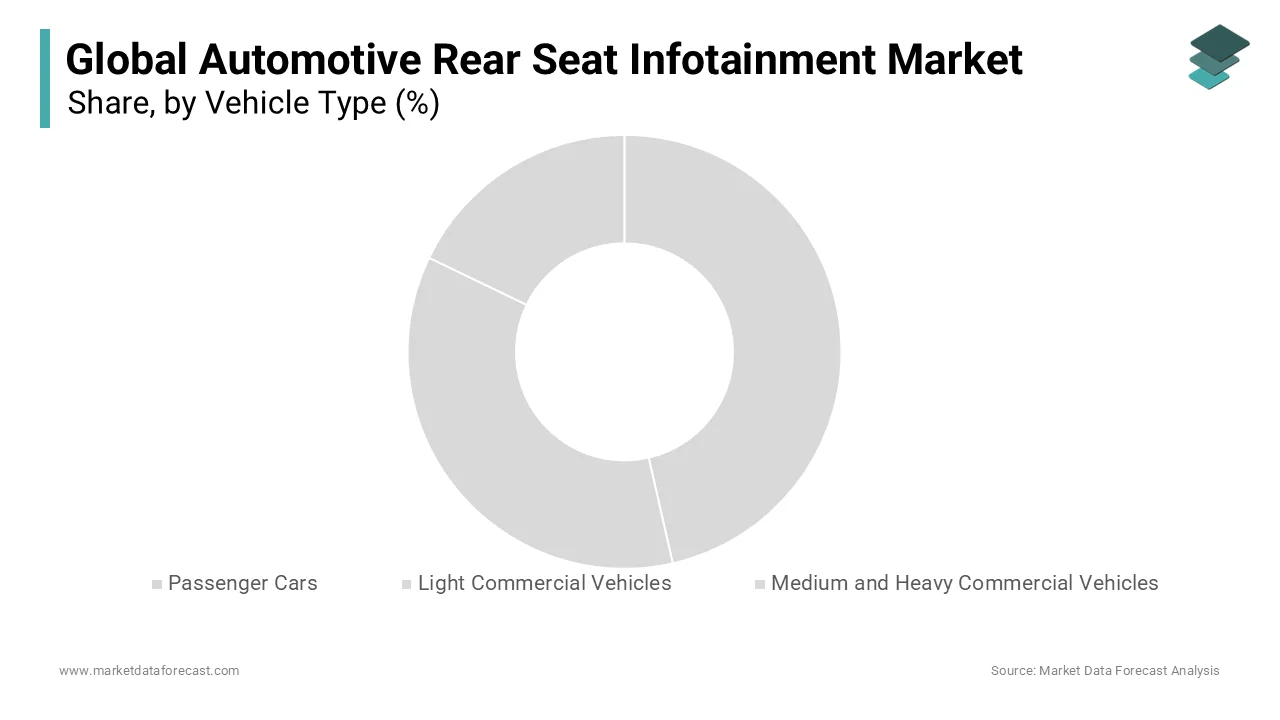
On the other hand, the commercial vehicles segment is on the rise and is expected to be the fastest growing segment in the market by witnessing a CAGR of 14.9% during the forecast period due to the transformation of ride hailing and luxury chauffeur services into premium mobility experiences where passenger comfort directly correlates with service ratings and pricing power. According to sources, overall global mobility ecosystems are shifting toward multi-modal platforms, with autonomous, software-driven consumer services expected to generate significant shared mobility value pools by 2030.Fleet operators are installing rear seat infotainment systems to differentiate their offerings from standard taxi services and justify higher fare structures. Business travelers increasingly expect to remain productive or entertained during transit turning travel time into valuable leisure or work hours. The rise of autonomous shuttle prototypes also contributes to this growth as these vehicles are designed entirely around passenger experience rather than driver utility. Autonomous rideshare operators like Waymo and Cruise utilize optimized cabin display touchscreens designed primarily to provide passengers real-time routing visualizations, safety notifications, and ride trip trip-management tools. Additionally corporate wellness programs are beginning to subsidize premium ride services for employees creating a B2B demand channel for equipped vehicles. This segment benefits from bulk purchasing agreements and standardized installation processes that reduce per unit costs compared to individual consumer retrofits.
By Component Insights
The display and touch screen module segment led the automotive rear seat infotainment market and captured the largest share in 2025. This leading position of the segment was attributed to the fact that the screen serves as the primary interface through which all content consumption and interaction occur, making it the most visible and valued element of the system. According to research, global automotive display panel shipments exceeded 200 million units in 2023, driven primarily by the rapid adoption of front center stack displays and digital cockpit clusters. Consumers judge the quality of the entire infotainment system based largely on screen resolution brightness and responsiveness driving manufacturers to prioritize display technology upgrades. The transition from LCD to OLED and Mini LED panels enhances color accuracy and contrast ratios providing a cinema like viewing experience that justifies premium pricing. Supply chain maturity for automotive grade displays ensures reliable availability and competitive pricing enabling wider adoption across vehicle classes. Integration of touch sensitivity and haptic feedback transforms passive screens into interactive control centers reducing reliance on separate remote controls. Safety regulations also influence design requiring shatterproof materials and secure mounting mechanisms that add to component complexity and value. As screen sizes continue to increase beyond 12 inches in many models the bill of materials cost for displays rises reinforcing their status as the dominant revenue driver in the component landscape.
But the connectivity module segment is expected to exhibit a noteworthy CAGR of 16.7% over the forecast period owing to the essential need for constant high speed internet access. Modern rear seat entertainment relies almost entirely on cloud based streaming and real time multiplayer gaming both of which require robust low latency connections that only dedicated automotive modules can reliably provide. Unlike portable hotspots integrated modules offer superior antenna placement and signal stability ensuring uninterrupted service even at highway speeds or in rural areas. The rollout of 5G networks specifically enables high bandwidth applications like 4K video streaming and augmented reality experiences that were previously impossible in moving vehicles. Automakers are increasingly bundling data plans with vehicle purchases creating recurring revenue streams tied directly to connectivity hardware sales. Over the air update capabilities also depend on these modules allowing manufacturers to improve software and add features remotely extending vehicle lifecycle value. Security enhancements in newer modules address cybersecurity concerns making them mandatory for compliance with evolving automotive safety standards. This convergence of network infrastructure advancement and consumer expectation for always online experiences propels the connectivity module segment ahead of traditional hardware components.
By Connectivity Generation Insights
The 4G LTE connectivity segment held the majority share of the automotive rear seat infotainment market in 2025 because of its widespread coverage, proven reliability, and cost-effectiveness for mainstream applications. This technology provides sufficient bandwidth for standard definition streaming music playback and basic web browsing which satisfies the needs of the majority of current users. According to the Ericsson Mobility Report, global 4G LTE population coverage extended past 85% multiple years ago, serving as a mature and resilient network foundation as global telecom operators steadily expand 5G infrastructure. The mature ecosystem of 4G chipsets allows for lower manufacturing costs compared to emerging 5G alternatives enabling inclusion in mid tier vehicle trims. Most existing content platforms are optimized for 4G speeds meaning there is no immediate performance penalty for using this established standard. Regulatory approvals and carrier partnerships for 4G are well established reducing deployment risks and certification timelines for new vehicle models. Backward compatibility ensures that vehicles sold today will remain functional for years even as networks evolve. For fleet operators and budget conscious consumers 4G offers the best balance of performance and affordability. While not capable of supporting cutting edge immersive experiences it reliably delivers core entertainment functions that drive daily usage and customer satisfaction. This practical advantage secures its position as the volume leader despite the hype surrounding next generation technologies.
On the other hand, the 5G connectivity segment is predicted to witness the highest CAGR of 25.5% between 2026 and 2034. It is unlocking next-generation user experiences. This explosive growth is fueled by the technical requirements of emerging applications, such as cloud gaming, augmented reality, navigation, and multi-user 4K video conferencing, that demand ultra-low latency and massive bandwidth. Premium brands are adopting 5G as a key differentiator to attract tech forward buyers who expect smartphone level performance in their vehicles. The technology enables edge computing integration allowing complex processing to occur in the cloud while delivering instant responses to user inputs. Smart city initiatives and vehicle to everything communication protocols also rely on 5G creating synergies between infotainment and safety systems. Government investments in 5G infrastructure across North America Europe and Asia accelerate network availability making deployment viable for mass market vehicles. Early adopters benefit from exclusive content partnerships and enhanced service tiers that create competitive advantages. Although currently limited to high end models the rapid decline in module costs and expanding coverage will drive mainstream adoption fueling sustained high growth rates throughout the forecast period.
REGIONAL ANALYSIS
North America Automotive Rear Seat Infotainment Market Analysis
North America was the top performer in the global automotive rear seat infotainment market and occupied a 35.1% share in 2025. This dominance of the North American market was driven by high disposable income and early technology adoption. The region’s dominance is also supported by strong consumer preference for large SUVs and minivans which serve as primary platforms for rear seat entertainment systems. According to the Bureau of Economic Analysis, real U.S. personal consumption expenditures on durable goods, including recreational goods and vehicles, grew by over 6% in 2023, signaling a broad resilience in high-value consumer product spending. Major automakers headquartered in the United States prioritize domestic market preferences when designing infotainment architectures ensuring alignment with local tastes. The presence of leading technology companies fosters innovation through partnerships between Silicon Valley firms and Detroit automakers accelerating feature development. High penetration of streaming subscriptions creates natural synergy with vehicle based entertainment ecosystems. Regulatory frameworks support connected vehicle deployment through spectrum allocation and safety guidelines. Aftermarket solutions also thrive due to a large installed base of older vehicles seeking upgrades. Consumer willingness to pay for convenience and family friendly features sustains premium pricing strategies. The region benefits from robust telecommunications infrastructure enabling reliable connectivity for cloud based services. North America continues to set trends that influence global product roadmaps particularly in software integration and user experience design.
Europe Automotive Rear Seat Infotainment Market Analysis
Europe was the next prominent region in the automotive rear seat infotainment market and captured a 28.9% share in 2025. This position of the European market was propelled by stringent safety standards and emphasis on premium craftsmanship. German French and British luxury automakers lead adoption integrating sophisticated systems that reflect regional expectations for quality and functionality. According to Eurostat, European Union household final consumption expenditure on transport and recreation both experienced a 3.0% increase after correcting for inflation, marking a stable rebound in transport-related personal expenditures. European consumers prioritize data privacy and security influencing system design toward localized processing and transparent consent mechanisms. The region’s dense urban environments and extensive public transit network create unique use cases for short trip entertainment distinct from long haul American patterns. Strict electromagnetic compatibility regulations ensure high reliability but increase development costs and time to market. Sustainability considerations drive preference for energy efficient displays and recyclable materials aligning with EU Green Deal objectives. Cross border travel necessitates multi language support and roaming capabilities adding complexity to connectivity solutions. Strong labor unions and manufacturing traditions support high quality assembly of electronic components. Collaboration between automakers and telecom providers facilitates seamless cross national connectivity. Europe’s focus on holistic user experience rather than mere specification chasing shapes global benchmarks for intuitive interface design and passenger comfort integration.
Asia Pacific Automotive Rear Seat Infotainment Market Analysis
Asia Pacific remains the fastest growing region in the automotive rear seat infotainment market due to rising middle class affluence and digital native populations. China, Japan, South Korea, and India collectively account for a significant portion of global market share with China alone contributing nearly half of regional volume. According to the Asian Development Bank, economic growth in developing Asia reached approximately 5.0%, outpacing global averages due to robust domestic demand and resilient industrial productivity across major regional trade hubs. Local consumers exhibit higher acceptance of digital interfaces and mobile payments compared to Western markets accelerating adoption of app based entertainment ecosystems. Domestic automakers aggressively integrate infotainment as standard equipment even in affordable models to capture younger demographics. Government smart city initiatives promote connected vehicle infrastructure creating favorable conditions for advanced services. Manufacturing hubs in the region enable cost effective production of displays and modules supporting competitive pricing. Cultural emphasis on family mobility and multi generational travel increases relevance of rear seat features. Rapid 5G deployment in major cities provides necessary backbone for next generation experiences. Regional content platforms tailor offerings to local languages and preferences enhancing engagement. Asia Pacific’s dynamic combination of technological readiness demographic trends and policy support positions it as the primary engine of future market expansion.
Latin America Automotive Rear Seat Infotainment Market Analysis
Latin America expanded moderately in the automotive rear seat infotainment market, with growth concentrated in Brazil Mexico and Argentina. The region’s market status is defined by selective adoption among upper income segments and premium ride services rather than mass market penetration. According to the Inter-American Development Bank, trade integration agreements and structural nearshoring trends are accelerating logistics investments in Mexico and Brazil, establishing them as key hubs for regional automotive global value chains. Economic volatility limits broad consumer purchasing power but creates opportunities for targeted marketing to affluent urban professionals. Ride hailing platforms serve as key adoption vectors introducing rear seat entertainment to wider audiences through premium service tiers. Import tariffs and currency fluctuations incentivize regional manufacturing partnerships to reduce costs. Mobile phone penetration exceeds fixed broadband access making cellular dependent infotainment particularly relevant. Content localization remains underdeveloped presenting opportunity for regional players to fill gaps. Safety concerns in certain areas increase value proposition of keeping passengers occupied inside vehicles. Government incentives for electric vehicles indirectly boost infotainment adoption as EVs typically feature advanced digital cockpits. Latin America’s path to growth differs significantly from developed markets relying more on service based models and selective premiumization than universal hardware inclusion.
Middle East and Africa Automotive Rear Seat Infotainment Market Analysis
Middle East and Africa region is anticipated to grow notably in the global automotive rear seat infotainment market with highly divergent dynamics between Gulf Cooperation Council nations and sub Saharan African countries. The Gulf states particularly UAE Saudi Arabia and Qatar punch above their weight due to extreme heat conditions that make indoor vehicle time longer and luxury vehicle ownership rates among highest globally. According to the International Monetary Fund, structural non-oil diversification reforms across GCC countries have accelerated public and private investments in the tourism, hospitality, and logistics sectors to drive long-term macroeconomic stability. Sub Saharan Africa faces infrastructure challenges but shows promise through mobile first solutions and ride sharing innovation in cities like Lagos and Nairobi. Extreme temperatures in Gulf region necessitate specialized thermal management for electronics increasing component specifications. High expatriate populations create demand for multilingual and international content options. Sovereign wealth funds actively invest in automotive technology startups fostering local innovation ecosystems. Limited local manufacturing means heavy reliance on imports affecting pricing and availability. Religious and cultural considerations influence content moderation and interface design requirements. Luxury sedan and SUV dominance aligns perfectly with rear seat infotainment value proposition. The region’s unique combination of climate wealth and demographic diversity creates specialized market conditions distinct from other global regions.
COMPETITIVE LANDSCAPE
The competition in the automotive rear seat infotainment market is characterized by intense rivalry among established electronics giants and specialized automotive suppliers who strive to differentiate through technological innovation and user experience. These key players leverage their extensive expertise in consumer electronics and automotive engineering to develop integrated solutions that meet the high expectations of luxury and premium vehicle buyers. The barrier to entry is significant due to the need for rigorous safety certifications and complex integration with vehicle electrical architectures. Competitors distinguish themselves by offering unique features such as augmented reality gaming multi screen synchronization and premium audio enhancements. Price competition is moderate as brands prioritize quality and brand reputation over cost leadership in this niche segment. However the rise of software defined vehicles introduces new competitors from the tech industry who bring agile development practices and advanced connectivity solutions. Strategic alliances with automakers are critical for securing long term contracts and influencing design standards. The focus on sustainability and energy efficiency further intensifies competition as firms seek to reduce power consumption while enhancing performance. Continuous innovation in hardware and software is essential to maintain relevance and capture growing demand for immersive in vehicle entertainment experiences.
KEY MARKET PLAYERS
Some of the key players dominating the global automotive rear seat infotainment market are
- Panasonic Corporation
- Alpine Electronics Inc
- Harman International (Samsung)
- Bosch
- Continental AG
- Denso Corporation
- Visteon Corporation
- LG Electronics
- Alpine Electronics
- Pioneer Corporation
- JVC Kenwood
- Clarion (Faurecia-Forvia)
- Aptiv PLC
- Desay SV Automotive
- Huawei Technologies
- Valeo SA
- Garmin Ltd.
- Alps Alpine
- Xperi Inc. (TiVo)
- Access Co.
- Nreal (AR Displays)
Top Players in the Market
- Alpine Electronics Inc maintains a strong presence by delivering high quality audio and visual solutions tailored for premium automotive interiors. The company focuses on integrating advanced display technologies with intuitive user interfaces to enhance passenger engagement during travel. Recent initiatives include developing modular rear seat entertainment units that support seamless connectivity with personal devices and streaming platforms. Alpine collaborates closely with major automakers to customize systems that meet specific vehicle architecture requirements while ensuring superior sound quality. Their commitment to innovation is evident in the adoption of high resolution touchscreens and voice activated controls that simplify user interaction. Alpine prioritizes reliability and aesthetic integration. In doing so, the company strengthens its reputation as a trusted supplier in the competitive luxury vehicle segment, where passenger experience is paramount.
- Panasonic Corporation plays a pivotal role through its comprehensive portfolio of automotive electronics including sophisticated rear seat infotainment systems. The Japanese multinational leverages its expertise in consumer electronics to create immersive entertainment experiences featuring large format displays and premium audio integration. Panasonic recently expanded its partnerships with electric vehicle manufacturers to supply integrated cockpit solutions that include rear passenger screens and connectivity modules. The company invests heavily in research and development to introduce lightweight and energy efficient components that align with sustainability goals. Their focus on software defined vehicles enables over the air updates and personalized content delivery enhancing long term value for users. Panasonic’s global manufacturing footprint ensures consistent quality and timely delivery supporting automakers in scaling production of advanced infotainment features across diverse markets.
- Harman International Industries a Samsung subsidiary contributes significantly by providing connected car technologies and premium audio systems for rear seat applications. The company specializes in creating holistic digital cockpit experiences that integrate rear entertainment with front console functionalities for a unified user journey. Harman recently launched new platforms supporting 5G connectivity and cloud based gaming services specifically designed for rear passengers. Their strategic acquisitions of software firms enhance capabilities in artificial intelligence and machine learning enabling predictive content recommendations and adaptive interfaces. Harman works with leading global automakers to implement scalable solutions that cater to both luxury and mass market segments. Harman ensures the safe and reliable operation of connected infotainment systems through a strong focus on cybersecurity and data privacy. As a result, this reinforces trust among consumers and manufacturers.
Top Strategies Used by Key Market Participants
Key players in the automotive rear seat infotainment market primarily employ strategic partnerships with technology firms and content providers to enhance system capabilities and user engagement. Companies frequently collaborate with streaming services and gaming studios to offer exclusive content that differentiates their offerings from competitors. Innovation through research and development remains central as firms invest in high resolution displays faster processors and intuitive user interfaces. Mergers and acquisitions are utilized to acquire specialized software expertise and expand product portfolios quickly. Additionally manufacturers focus on modular designs that allow for easy customization and upgrades reducing development costs for automakers. Digital transformation initiatives including cloud integration and over the air updates are increasingly adopted to provide continuous value and maintain customer loyalty in a rapidly evolving technological landscape.
MARKET SEGMENTATION
This research report on the global automotive rear seat infotainment market is segmented and sub-segmented into the following categories.
By Vehicle Type
- Passenger Cars
- Light Commercial Vehicles
- Medium and Heavy Commercial Vehicles
By Component
- Display / Touch-screen Module
- Head Unit / Domain Controller
- Operating-System Software and Apps
- Connectivity ICs and Antenna Modules
By Propulsion Type
- Internal-Combustion Engine Vehicles
- Hybrid Electric Vehicles
- Battery Electric Vehicles
By Connectivity Generation
- 4G LTE
- 5G
- Legacy 2G/3G
By Operating System
- Linux-Based (AAOS, AGL, etc.)
- QNX
- Android Automotive OS
- Others (Proprietary, RTOS)
By Sales Channel
- OEM-Installed
- Aftermarket
By Region
- North America
- Europe
- Asia Pacific
- Latin America
- Middle East & Africa