- Product Description Description
- Table of Contents TOC
- List of Table & Figure LOT
- Get Free Sample PDF Sample PDF
Market Size, 2025
$9.50 BnMarket Estimate, 2026
$10.36 BnMarket Forecast, 2034
$20.36 BnCAGR, 2026–2034
9%Executive Summary: Global Automotive Sunroof Market Analysis
- Market Scope: Comprehensive analysis of the global automotive sunroof industry, assessing product configurations, material types, vehicle categories, propulsion technologies, operation mechanisms, distribution channels, and regional performance trends.
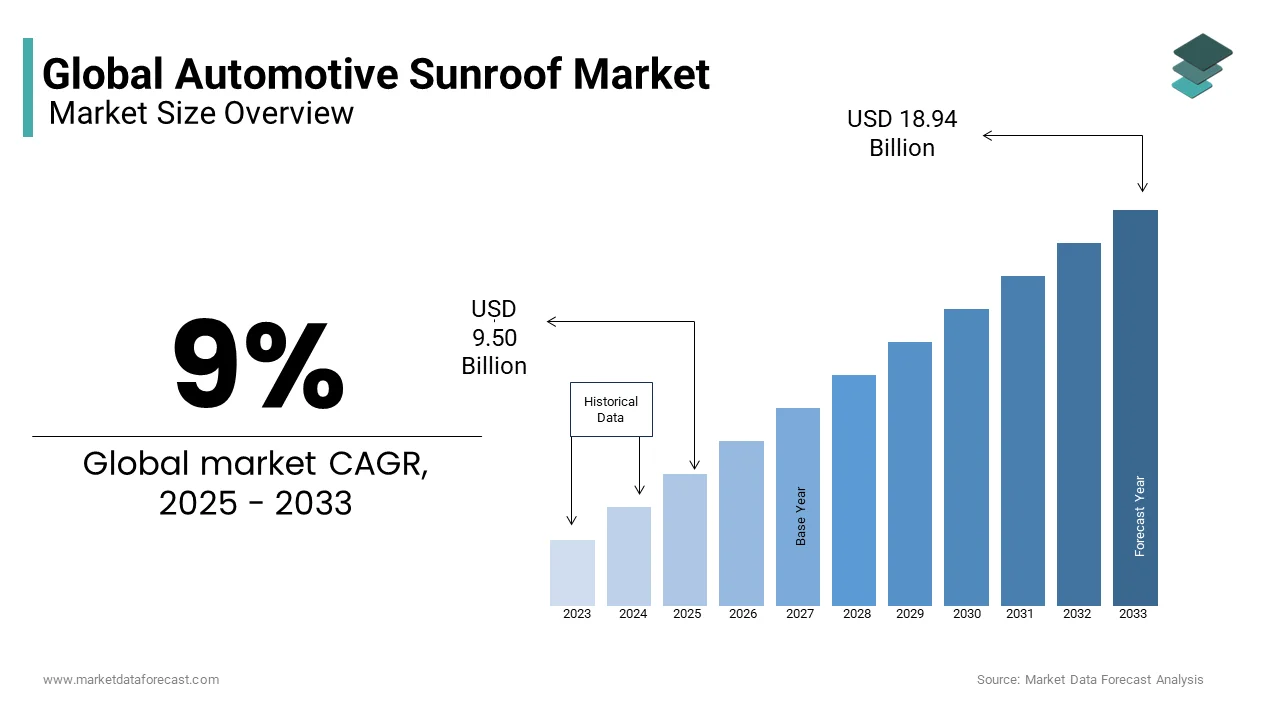
- Market Valuation: Valued at USD 9.50 billion in 2025, estimated at USD 10.36 billion in 2026, and projected to scale up to USD 20.36 billion by 2034, growing at a steady compound annual growth rate (CAGR) of 9.00% during the forecast period from 2026 to 2034.
- Primary Growth Drivers: Growing consumer preference for vehicle aesthetics, enhanced natural ventilation, rising popularity of mid-segment and SUV vehicles equipped with sunroofs, and the integration of solar roofs into electric vehicles (EVs) to extend operational ranges.
Key Market Segment Metrics (2026–2034)
| Category | Leading Segment (2025 Position) | Fastest-Growing / Prominent Segment |
|---|---|---|
| By Material | Glass Sector (dominated baseline market share backed by UV-reflecting technology, safety glazing innovations, and natural lighting benefits) | Glass Sunroofs (continue expanding exponentially while fabric options shrink alongside lower convertible car sales) |
| By Product | Built-In Segment (expected to hold the largest market share due to OEM preferences for standard integrated venting, sunshades, and auto-close functions) | Panoramic Segment (projected to surge significantly as standard or premium features across high-end and expanding mid-segment vehicles) |
| By Vehicle Type | Passenger Automobiles (account for major market volume supported by cost-effective comfort options and widespread adoption) | Electric Vehicles (EVs) & SUVs (growing rapidly with sunroofs integrated as standard components for all-around vision and modern aesthetics) |
| By Region | Asia-Pacific (leads the global market, powered by rising disposable incomes, domestic vehicle production expansion in China/India, and EV incentives) | Europe & North America (maintain steady contributions backed by luxury vehicle production and high SUV adoption rates) |
Major Market Players & Industry Structure
Market Structure: A competitive and established global marketplace driven by Tier-1 automotive component manufacturers specializing in advanced glazing, mechanical sunroof assemblies, and mechatronic opening mechanisms.
Key Companies: Yachiyo Industry Co Ltd (Japan), Aisin Seiki Co Ltd (Japan), CIE Automotive SA (Spain), Automotive Sunroof-Customcraft Inc (Canada), Magna International (Canada), Inteva Products LLC (US), Johnan America Inc (US), Inalfa Roof Systems Inc (Netherlands), Valmet Automotive (Finland), and BOS GMBH & Co KG (Germany).
Global Automotive Sunroof Market Size
The global automotive sunroof market size was valued at USD 9.50 billion in 2025 and is anticipated to reach USD 10.36 billion in 2026 to reach USD 20.36 billion by 2034, growing at a CAGR of 9.00% during the forecast period from 2026 to 2034.
Current Scenario of the Global Automotive Sunroof Market
An automotive sunroof is a window in the roof of a car that allows fresh air and light to enter the vehicle's interior. Sunroofs can be operated manually or electrically, and come in a variety of sizes, forms, and styles, depending on the vehicle. They improve passenger comfort by improving air circulation and delivering enhanced brightness and illumination during the day. OEMs have begun to offer panoramic, low-cost pop-up sunroofs or optional sunroof systems, as well as various spoiler-type miniature sunroofs, to mid-segment automobiles, in addition to luxury and premium vehicles.
MARKET DRIVERS
The increased popularity of mid-segment automobiles can be attributed to a growing consumer preference for vehicles that provide both aesthetic and safety and comfort characteristics. The sunroof is a suitable alternative since it reduces noise while keeping the car well-ventilated and providing fresh airflow, which improves occupant comfort levels.
Automatic opening and shutting systems are quickly becoming standard in a wide range of vehicles due to their convenience. Various governments, particularly those in developing countries, are actively encouraging ecologically friendly automobiles to comply with increasingly stringent emission regulations. The electricity generated by the solar roof can be used to power the car's electrical equipment, such as seat heaters and air conditioning systems. As a result, efficiency improves, which has a positive impact on the operational range of an electric car.
MARKET RESTRAINTS
Vehicle weight reduction is a priority for manufacturers since it improves braking, acceleration, and fuel efficiency. Heavy equipment like the fuel tank, engine, and others are normally positioned as low as possible to optimize handling and vehicle stability. Regular assemblies, on the other hand, weigh between 20 and 30 kg, depending on the size, and the panoramic sunroof can weigh up to 90 kg.
In addition to the required electric motor, drainage channel, and reinforcing bars, panoramic glass roofs weigh more since glass is significantly heavier and thicker than aluminum or steel roof panels. As a result, the added weight might have a substantial impact on the vehicle's fuel efficiency. In addition, glass or clear synthetic resin is utilized, and its ability to insulate from outside temperature is inferior to that of a regular vehicle roof. It's also possible that rain will seep through the rubber sealant between the window panel and the roof. They are both expensive to install and expensive to repair.
Impact Of COVID-19 On The Automotive Sunroof Market
During the COVID-19 pandemic, the global automotive sunroof market was hindered due to the shutdown of manufacturing units, which halted the supply chain. The drop in demand amidst the pandemic, resulting from lockdowns and a fall in per capita income worldwide, also threatened the automotive market.
REPORT COVERAGE
| REPORT METRIC | DETAILS |
| Market Size Available | 2025 to 2034 |
| Base Year | 2025 |
| Forecast Period | 2026 to 2034 |
| CAGR | 9.00% |
| Segments Covered | By Material, Product, Vehicle, Propulsion Type, Operation, Distribution Channel, and Region. |
| Various Analyses Covered | Global, Regional & Country Level Analysis, Segment-Level Analysis, DROC, PESTLE Analysis, Porter’s Five Forces Analysis, Competitive Landscape, Analyst Overview of Investment Opportunities |
| Regions Covered | North America, Europe, APAC, Latin America, Middle East & Africa |
| Market Leaders Profiled | Yachiyo Industry Co Ltd (Japan), Aisin Seiki Co Ltd (Japan), CIE Automotive SA (Spain), Automotive Sunroof-Customcraft Inc (Canada), Magna International (Canada), Inteva Products LLC (US), Johnan America Inc (US), Inalfa Roof Systems Inc (Netherlands), Valmet Automotive (Finland), BOS GMBH & Co KG (Germany), and Others. |
SEGMENTAL ANALYSIS
By Material Insights
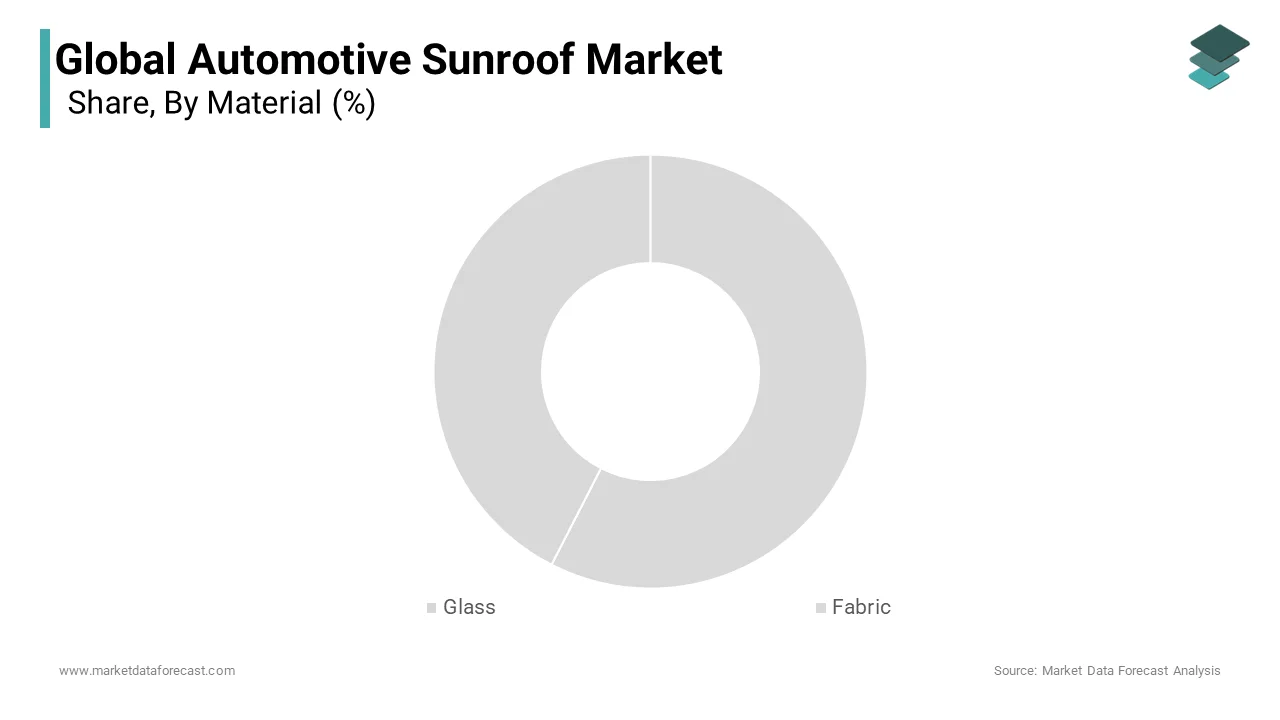
In 2020, the glass sector had the biggest market share, and it is predicted to increase at an exponential rate throughout the forecast period. This segment's increased popularity can be due to technology breakthroughs and material innovation, such as improved sunroof glazing that has reduced overhead safety concerns and glass that can reflect UV rays. Because they allow a direct flow of natural light and promote natural air circulation within the vehicle, glass sunroofs can lessen dependency on the vehicle's air conditioning system. As a result of falling convertible car sales, the market for fabric sunroofs is likely to shrink over the forecast period.
By Product Insights
The inbuilt segment is expected to have the largest market share due to OEMs preferring to provide inbuilt in their cars as well as additional functions such as vents, sunshades, auto-close, and others that improve vehicle comfort levels. Because of the high demand for vehicles with short roof sizes and the ease of operation provided by their simple sliding process, the tilt and slide segment is expected to grow strongly in this market.
In this segment, the panoramic category is expected to increase significantly. Panoramic roofs cover a greater area, allowing both front and rear-seat passengers to benefit from increased natural freshness, and they are typically included as standard equipment in high-end vehicles. This segment's positive growth can be attributed to several causes.
The pop-up segment is expected to rise steadily in this market, owing to its lower cost compared to other varieties and the fact that certain vehicles have a completely removable function. The top mount section of the market is also predicted to increase steadily, as they offer more headroom and are often equipped with wind deflectors, which reduce unwanted noise at high speeds.
By Vehicle Insights
The passenger automobile segment of the business is expected to grow significantly in the next years. The introduction of cost-effective alternatives that provide natural ventilation and greater comfort without the large expenses associated with sunroof installation and maintenance has resulted in considerable growth in this area.
The light commercial vehicle category is predicted to grow fast in the market over the projection period, owing to the growing popularity of sports utility vehicles, particularly in emerging markets.
The electric vehicle (EV) segment of the market is also expected to rise significantly. The good growth of the electric car segment can be attributed to the introduction of sunroofs as a standard feature, improved all-around vision, and early adoption of novel materials.
REGIONAL ANALYSIS
Asia Pacific Market Analysis
In the Asia Pacific, the market for automobile sunroofs is characterized by rising population and disposable Income combined with a surge in demand for premium vehicles in growing economies such as China and India. To meet the increased demand, automakers have been aggressively expanding this region's domestic production capacity. Furthermore, government measures to stimulate the adoption of electrified vehicles, as well as the surge in mass-market cars that provide sunroofs as an optional feature, have boosted demand for in-vehicle sunroofs.

Europe Market Analysis
Europe is predicted to have the second-largest market share for automobile sunroofs. Factors driving market growth in this region include rising passenger car sales despite strict emission regulations in place, as well as the presence of manufacturers such as Audi, BMW, and Mercedes-Benz, which are leaders in technological innovation and are also established players in the premium vehicle segment.
This market is expected to grow steadily in North America, with the United States accounting for the largest share. This region has established itself as a steady contributor to the industry due to the early adoption of comfort-oriented features and the high adoption rate of sports utility vehicles.
KEY MARKET PLAYERS
Some of the market players dominate the global automotive sunroof market.
- Yachiyo Industry Co Ltd (Japan)
- Aisin Seiki Co Ltd (Japan)
- CIE Automotive SA (Spain)
- Automotive Sunroof-Customcraft Inc (Canada)
- Magna International (Canada)
- Inteva Products LLC (US)
- Johnan America Inc (US)
- Inalfa Roof Systems Inc (Netherlands)
- Valmet Automotive (Finland)
- BOS GMBH & Co KG (Germany)
RECENT MARKET NEWS
- A sunroof is a car that is a window in the roof that enables fresh air and light into the vehicle's interior. Sunroofs are available in a range of sizes, shapes, and styles, depending on the vehicle. They can be operated manually or electronically. During the day, they boost passenger comfort by enhancing air circulation and providing increased brightness and illumination. In addition to luxury and premium vehicles, OEMs have begun to offer panoramic, low-cost pop-up sunroofs or optional sunroof systems, as well as numerous spoiler-type micro sunroofs, to mid-segment vehicles.
- Magna's FreeFormTM seating technology is the perfect solution for automakers looking to differentiate themselves through aesthetics. The innovative seat trim technology, which will debut on four new cars, one later this year and three in 2022, delivers a clean, contoured, and smooth aesthetic surface and allows for a variety of design alternatives.
- Lightyear One, an electric car powered in part by integrated solar cells built by Lightyear from the Netherlands, has signed a letter of intent with VALMET AUTOMOTIVE. The electric vehicles will be manufactured at the Finnish automaker's assembly plant in Uusikaupunki, Southern Finland, in the first half of 2022.
MARKET SEGMENTATION
This research report on the global automotive sunroof market is segmented and sub-segmented into the following categories.
Automotive Sunroof Market
By Product
- Panoramic
- Built-In
- Top Mount/Spoiler
- Pop-Up
- Folding
By Material
- Glass
- Fabric
By Vehicle Type
- Economical
- Medium Priced
- Luxury
By Propulsion Type
- ICE
- Electric
By Operation
- Manually Operated
- Automatic
By Distribution Channel
- OEM
- Aftermarket
By Region
- North America
- Europe
- Asia Pacific
- Latin America
- Middle East and Africa