- Product Description Description
- Table of Contents TOC
- List of Table & Figure LOT
- Get Free Sample PDF Sample PDF
Market Size, 2025
$56.83 BnMarket Estimate, 2026
$59.27 BnMarket Forecast, 2034
$83.01 BnCAGR, 2026–2034
4.30%Executive Summary: Global Automotive Wiring Harness Market
- Market Scope: Comprehensive global automotive wiring harness market analysis covering application categories, vehicle types, regional demand dynamics, and electrical power/data transmission metrics.
- Market Valuation: Valued at USD 56.83 billion (2025), estimated at USD 59.27 billion (2026), and projected to reach USD 83.01 billion by 2034, registering a CAGR of 4.30% (2026–2034).
- Primary Growth Drivers: Rapid automotive industry expansion driven by electronic feature integration, rising consumer and regulatory demand for advanced vehicle security and driver-assistance systems, and the shift toward high-speed data transfer (fiber optics) in luxury and autonomous vehicles. Restraints include wiring degradation and short-circuiting in severe weather conditions (rain, snow) leading to high replacement costs, alongside supply chain liquidity pressures.
Key Market Segment Metrics (2026–2034)
| Category | Leading Segment (2025 Position) | Fastest-Growing Segment |
|---|---|---|
| By Application | Body and engine wiring harnesses (account for the largest share due to widespread use in power distribution and sensor signals) | Fiber optic and high-speed data transmission harnesses for luxury and autonomous vehicles |
| By Vehicle Type | Passenger cars (dominate the market share backed by high production volumes and luxury electronics penetration) | Two-wheelers and commercial vehicles experiencing advanced access control and security upgrades |
| By Region | Asia-Pacific (leads globally due to booming manufacturing, rising luxury car sales, and key automotive assembly hubs in China, Japan, and India) | North America and Eastern Europe (expanding via automotive manufacturing capacity growth in Mexico, Canada, and Eastern European plants) |
Major Market Players & Market Structure
Market Structure: Highly consolidated global wire harness manufacturing landscape dominated by major multinational electronics and cable assembly specialists competing on architectural innovation, high-voltage hybrid shielding, and lightweight material design.
Key Companies: Sumitomo Electric Industries (Japan), Yazaki Corporation (Japan), Aptiv PLC (Ireland), Leoni AG (Germany), Furukawa Electric (Japan), and Aisin Seiki (Japan).
 Download Free Sample Report
Global Automotive Wiring Harness Market Size
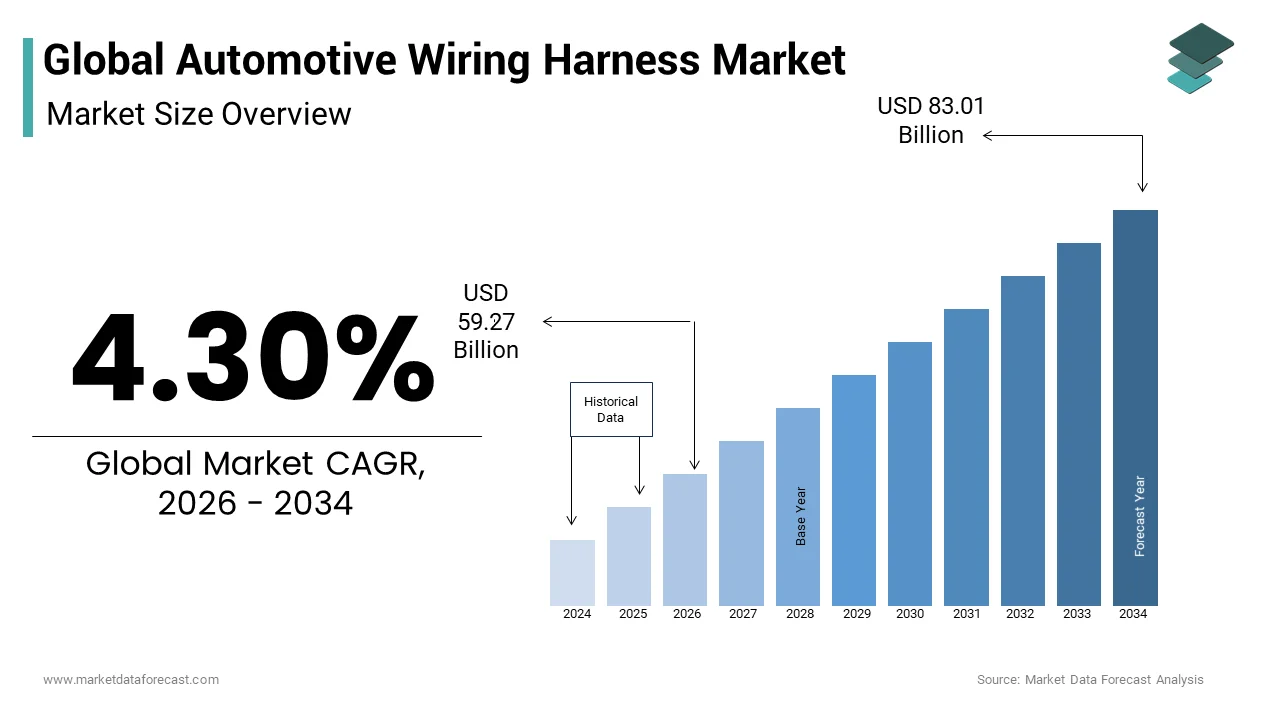
The global automotive wiring harness market size was valued at USD 56.83 billion in 2025 and is anticipated to reach a valuation of USD 59.27 billion in 2026 and USD 83.01 billion by 2034, growing at a CAGR of 4.3%, from 2026 to 2034.
Introduction to the Automotive Wiring Harness Market
An automotive wiring harness is an organised assembly of cables, wires, connectors, and terminals that safely transmits electrical power and signals throughout a vehicle. As vehicles evolve into software-defined platforms, the density and sophistication of these electrical architectures increase exponentially to support advanced functionalities. According to a study, premium cars today may house over 150 ECUs and up to 5 kilometres of wiring, adding more than 50 kg to vehicle weight. As per the Institute of Electrical and Electronics Engineers, deterministic networking through IEEE 802.1 Time-Sensitive Networking provides the standardized communication primitives that modular software-defined vehicle architectures must leverage to achieve functional integration. These metrics highlight wiring harnesses as the vital link enabling autonomous driving, modern entertainment, and passenger safety. The transition toward electric mobility further amplifies complexity as high voltage cables must coexist with low voltage signal wires, necessitating advanced insulation and shielding technologies. Regulatory mandates for electromagnetic compatibility and fire safety drive continuous innovation in material selection and assembly processes. Consequently, the market dynamics are shaped by the dual imperatives of minimizing weight while maximizing data transmission capacity and durability under harsh operating conditions.
MARKET DRIVERS
Proliferation of Advanced Driver Assistance Systems
The widespread integration of advanced driver assistance systems drives the automotive wiring harness market growth. This proliferation directly fuels demand for sophisticated wiring harnesses capable of handling high-speed data transmission. According to the Partnership for Analytics Research in Traffic Safety, advanced driver assistance systems have achieved significant market penetration in the United States, with multiple safety features exceeding a 90 percent adoption rate on new models. Each of these systems relies on sensors, cameras, and radar units that generate massive amounts of data requiring high bandwidth connections to central processing units. As per the Society of Automotive Engineers, the classification of automated driving systems strictly separates Driver Support Systems at Levels 1 and 2 from actual Automated Driving Systems starting at Level 3. The technological shift transforms traditional copper based harnesses into hybrid architectures that combine power delivery with high speed data links. Manufacturers must ensure signal integrity over long distances within the vehicle chassis which drives innovation in connector design and cable shielding. The correlation between automation levels and wiring complexity is linear, as each additional sensor adds new connection points and routing challenges. Automakers prioritize harness reliability because any failure in data transmission can compromise vehicle safety and lead to costly recalls. This safety-critical requirement ensures sustained investment in high-quality wiring solutions.
Electrification of Vehicle Powertrains
The rapid transition to electric vehicles creates substantial demand for high-voltage wiring harnesses designed to manage power distribution from battery packs to motors and therefore propels the automotive wiring harness market expansion. According to the International Energy Agency, global electric car sales reached nearly 14 million units in 2023, constituting roughly 18 percent of all new vehicle registrations worldwide. Electric powertrains operate at voltages ranging from 400 to 800 volts, requiring thick insulated cables capable of carrying high currents without excessive heat generation. As per the Institute of Electrical and Electronics Engineers, cross-linked polyethylene functions as the primary solid insulation candidate for medium- and high-voltage power transmission and distribution lines due to its high dielectric strength. The technical requirements differentiate electric vehicle harnesses from conventional low voltage systems and command a higher value per unit. The architecture of electric vehicles also simplifies some aspects of wiring by reducing mechanical components but introduces complexity in battery management and charging interfaces. Manufacturers must design harnesses that accommodate flexible packaging constraints while ensuring efficient thermal management. The growth in electric vehicle adoption thus serves as a primary catalyst for market expansion, as every new platform requires custom-engineered high-voltage solutions. This shift redefines the core competency of harness suppliers toward high voltage expertise and safety compliance.
MARKET RESTRAINTS
Volatility in Raw Material Prices
Fluctuating costs of key raw materials such as copper and aluminium create significant financial pressure for manufacturers and automakers in the global automotive wiring harness market. According to the International Copper Study Group, global refined copper balances shifted through 2023 as structural mine output disruptions clashed with accelerating clean energy industrial demand, causing historical disruptions in spot premiums. Copper constitutes a substantial portion of wiring harness cost, meaning any price surge directly impacts production expenses and profit margins. As per the American Chemistry Council, global chemical manufacturing output expanded in late 2025 and early 2026 despite persistent supply chain friction and volatile raw material input costs. The input cost fluctuations force manufacturers to either absorb losses or pass increases to customers, risking contract renegotiations and order cancellations. Long-term supply agreements often lack flexibility to adjust for sudden commodity spikes, leaving suppliers exposed to margin erosion. Small and mid-sized harness producers struggle to hedge against these risks, leading to market consolidation where only large players with diversified sourcing survive. The unpredictability of raw material costs undermines investment in capacity expansion and technology development. Automakers facing budget constraints may delay model launches or seek cheaper alternatives, compromising quality. This economic instability restricts market growth by creating an environment of financial uncertainty that hinders long term planning and strategic partnerships.
Complexity of Supply Chain Logistics
The labour-intensive nature of wiring harness assembly, combined with global supply chain fragility, is a significant operational barrier for the automotive wiring harness market. As per the European Automobile Manufacturers’ Association, automotive wiring harness processing remains a highly labor-intensive sector where roughly 70 percent of the production steps rely on manual assembly. Recent global disruptions have highlighted the risks of relying on single-source suppliers for critical components such as connectors and semiconductors. As per the Semiconductor Industry Association, global chip sales climbed consistently into early 2026, driven by intense demand for automotive-grade integrated electronics and advanced microcontrollers. The delay rippled through the supply chain, forcing automakers to build inventory buffers that tie up capital and increase storage costs. Just-in-time manufacturing models prove inadequate when faced with unpredictable component availability, leading to inefficiencies and increased waste. Geographic concentration of production in low-cost regions exposes the industry to trade barriers and logistics bottlenecks. Diversifying supply chains requires significant investment in new facilities and workforce training, which takes years to mature. This logistical complexity challenges the market by introducing operational risks that complicate procurement and production scheduling for both manufacturers and end users.
MARKET OPPORTUNITIES
Adoption of Zonal Architecture Designs
The shift from domain-based to zonal electrical architectures offers a transformative opportunity for wiring harness manufacturers to reduce complexity and weight, which is expected to fuel the automotive wiring harness market growth. According to the International Energy Agency, the transition to zonal electronic layouts cuts down total cabling length by eliminating cross-vehicle point-to-point connections. This design approach simplifies routing and allows for the use of standardized modules that can be assembled more efficiently. As per the Institute of Electrical and Electronics Engineers, deterministic communication through IEEE 802.1 Time-Sensitive Networking provides bounded latency and jitter over automotive Ethernet backbones. Manufacturers who develop modular harness solutions tailored to zonal designs gain competitive advantages by offering cost effective and lightweight alternatives to traditional complex bundles. This architectural evolution aligns with automaker goals to reduce vehicle mass and improve fuel efficiency or electric range. It also enables easier maintenance and upgrades, as modules can be replaced individually without dismantling entire harness sections. Suppliers investing in zonal-compatible products position themselves as strategic partners in next-generation vehicle development. The transition to zonal architecture creates new revenue streams for companies capable of providing integrated hardware and software solutions. This technological shift redefines the value proposition of wiring harnesses from simple connectivity to intelligent distribution nodes.
Integration of Lightweight Materials
The growing emphasis on vehicle lightweighting to improve energy efficiency drives demand for innovative materials in wiring harness construction, which is likely to promote the automotive wiring harness market expansion. According to the Aluminum Association, lightweight aluminum wiring can reduce the density of standard electrical systems relative to traditional copper wire options. The weight reduction directly contributes to improved fuel economy in internal combustion engines and extended range in electric vehicles. As per the Society of Automotive Engineers, vehicle system engineers utilize digital twin software and algorithmic routing simulations to drop physical prototype cycles during harness design. Manufacturers are developing advanced aluminum alloys and composite insulation materials that offer comparable durability to traditional copper solutions at lower weight and cost. These innovations allow automakers to meet stringent emissions regulations without compromising electrical performance. The adoption of lightweight materials also reduces material costs, providing economic benefits alongside environmental advantages. Suppliers who master aluminium processing and termination techniques can capture significant market share as automakers seek sustainable solutions. This material transition opens opportunities for collaboration between material scientists and harness engineers to optimize design and manufacturing processes. The push for sustainability thus creates a fertile ground for innovation and growth in the wiring harness sector.
MARKET CHALLENGES
Labor-Intensive Manufacturing Processes
The reliance on manual labor for wiring harness assembly is a persistent challenge to scalability and cost efficiency in the automotive wiring harness market. According to the International Labour Organization, manufacturing industries worldwide face widespread skill shortages that call for expanded investments in human capital and vocational training frameworks to sustain output. Unlike other automotive components, harness production has resisted full automation due to the flexibility required to handle varied wire gauges and connector types. As per the Society of Automotive Engineers, the adoption of standardized high-voltage interface connections like the SAE J3400 North American Charging Standard harmonizes vehicle cable architectures and helps tier-one suppliers scale global electric vehicle manufacturing. The labour dependency makes the industry vulnerable to wage inflation and workforce shortages, particularly in traditional manufacturing hubs. Automakers demand zero defect quality standards which are difficult to maintain consistently with manual processes. The lack of standardized automation solutions forces manufacturers to invest heavily in training and retention programs to ensure skill levels remain high. This operational bottleneck restricts the ability to rapidly scale production in response to surging vehicle demand. Companies face pressure to develop semi-automated solutions, but high initial investment costs deter widespread adoption. This challenge impedes market agility and profitability, requiring innovative approaches to manufacturing efficiency.
Standardisation of High Voltage Components
The lack of universal standards for high-voltage connectors and wiring in electric vehicles creates compatibility issues and increases development costs, which constrains the automotive wiring harness market expansion. According to the International Electrotechnical Commission, global standardization of high-voltage and high-current electrical physical interfaces under the IEC 62196-3 standard secures functional interoperability and safe energy transfer across global vehicle charging corridors. Automakers often develop proprietary connector designs to differentiate their vehicles, which prevents interoperability between components from different suppliers. As per the Society of Automotive Engineers, vehicle system engineers are increasing their utilization of digital twin architectures and algorithmic harness simulation software to cut down physical routing prototype iterations and drop production complexities. The absence of standardisation also complicates aftermarket service and repair, as technicians require specialised tools and knowledge for each vehicle brand. This inefficiency slows down the adoption of electric vehicles by increasing maintenance burdens and parts availability issues. Industry efforts to establish common standards face resistance from manufacturers seeking to protect intellectual property and market share. The resulting heterogeneity challenges harness suppliers who must navigate a complex landscape of custom requirements. This lack of harmonization hinders innovation by diverting resources toward customization rather than performance improvement. Addressing this challenge requires collaborative industry initiatives to define common interfaces and safety protocols.
REPORT COVERAGE
| REPORT METRIC | DETAILS |
| Market Size Available | 2025 to 2034 |
| Base Year | 2025 |
| Forecast Period | 2026 to 2034 |
| CAGR | 4.3% |
| Segments Covered | By Application, Vehicle, and Region. |
| Various Analyses Covered | Global, Regional, & Country Level Analysis; Segment-Level Analysis, DROC; PESTLE Analysis; Porter’s Five Forces Analysis; Competitive Landscape; Analyst Overview of Investment Opportunities |
| Regions Covered | North America, Europe, APAC, Latin America, Middle East & Africa |
| Market Leaders Profiled | Sumitomo Electric Industries (Japan), Yazaki Corporation (Japan), Aptiv PLC (Ireland), Leoni AG (Germany), Furukawa Electric (Japan), and Others. |
SEGMENTAL ANALYSIS
By Application Insights
Body Wiring Harness
The body wiring harness segment dominated the automotive wiring harness market and accounted for a substantial share in 2025. This dominance of the segment was driven by its extensive coverage of interior and exterior vehicle systems. According to the Society of Automotive Engineers, low-voltage electrical wiring standards like SAE J1128 govern cross-linked polyethylene wire insulation materials to withstand harsh localized thermal environments within body wiring architectures. The universal applicability ensures consistent demand across all vehicle segments, from entry level cars to luxury models. In addition, as per the International Organization of Motor Vehicle Manufacturers, global automotive connector deployment is expanding rapidly as escalating electrical signal distribution requirements require heavy integration of physical multi-pin wiring terminals. These facts highlight the foundational role of body wiring in vehicle architecture. Modern vehicles increasingly integrate smart features such as ambient lighting and automated climate control into the body harness, increasing its complexity and value. The segment benefits from high replacement rates in the aftermarket, as wear and tear on door and window mechanisms often necessitates harness repairs. Furthermore, the trend toward larger vehicle interiors in sport utility vehicles and minivans requires longer and more intricate body wiring routes. This structural necessity combined with the proliferation of electronic comfort features solidifies the dominance of the body wiring harness segment in the global market.
The rising consumer expectation for advanced comfort and connectivity features directly drives the complexity and volume of body wiring harnesses. According to J.D. Power, buggy in-car infotainment screens, integrated electrical wiring, and multi-core dashboard processors account for the highest concentration of software-heavy owner defect complaints. Each of these devices requires dedicated wiring connections within the body harness to ensure reliable power and data transmission. Moreover, as per the European Automobile Manufacturers' Association, the expansion of high-end cabin premiumization trends forces tier-one suppliers to redesign basic body architectures to support extra integrated hardware components. The technological integration increases the length and number of branches in the body harness, driving up material usage and assembly time. Automakers also incorporate heated seats, steering wheels, and mirrors, which require additional high-current-carrying wires within the body harness. The demand for personalized lighting schemes further adds to the wiring load, as LED strips require precise voltage regulation and control signals. These consumer-driven trends transform the body harness from a simple power distribution network into a complex data and power backbone. Suppliers must innovate in connector miniaturisation and wire routing to accommodate these features without compromising interior space or aesthetics. This continuous addition of electronic amenities ensures sustained growth and dominance for the body wiring harness segment.
Sensors Wiring Harness
The sensors wiring harness segment is predicted to witness the highest CAGR of 7.8% from 2026 to 2034 due to the rapid adoption of advanced driver assistance systems and autonomous driving technologies. The National Highway Traffic Safety Administration mandates that all new passenger vehicles in the United States must include rear visibility technology and encourages the adoption of automatic emergency braking systems, which rely heavily on sensor networks. These regulatory pushes create immediate demand for specialised wiring solutions that can connect cameras, radar, and lidar units to central processing modules. As per the European Automobile Manufacturers’ Association, the market penetration of driving assistance packages forces electronic networks to carry high-frequency sensor traffic safely across vehicle platforms. The requirement for signal integrity drives the adoption of coaxial and fiber optic wires within the sensor harness segment. According to the International Energy Agency, the transition toward advanced electronic driver support systems expands the volume of localized sensor cabling lines integrated into high-voltage frameworks. The harsh operating environments of external sensors also necessitate robust insulation and shielding materials that can withstand temperature extremes and vibration. This technical specialization commands higher value per meter compared to standard low voltage wires. The accelerated deployment of smart safety features globally ensures that the sensors wiring harness segment outpaces other applications in growth rate.
The exponential increase in data generation from autonomous driving sensors creates a critical need for high performance wiring harnesses capable of handling massive bandwidth loads. As per the Society of Automotive Engineers, data framework standards dictate specific over-the-air communication layouts to structure the basic safety messages generated by connected automated driving components. This data deluge forces automakers to adopt Ethernet-based wiring architectures within the sensor harness to ensure real-time processing and decision-making. According to the International Telecommunication Union, radio frequency spectrum allocations for intelligent transport systems enable real-time vehicle-to-everything communication to bolster highway safety parameters. Sensor harnesses must therefore integrate advanced shielding techniques such as double braided shields or foil layers to prevent signal degradation from high voltage powertrains. The transition to software defined vehicles means that sensor data is not only used for immediate safety but also for over the air updates and machine learning algorithms. This dual use case increases the reliability standards for sensor wiring, as any data loss can compromise both safety and future software functionality. Manufacturers are investing in lightweight yet high capacity cables to meet these demands without adding excessive weight to the vehicle. This technological imperative positions the sensor wiring harness as the fastest-growing segment in the market.
By Vehicle Insights
Passenger Cars
The passenger cars segment led the automotive wiring harness market and captured a significant share in 2025. This leading position of the segment was attributed to its high production volumes and increasing electronic content. According to the International Organisation of Motor Vehicle Manufacturers, global passenger car production reached approximately 68 million units in 2022, securing a prominent share of overall industrial factory output. Each passenger car requires a complex wiring harness to support engine management, safety systems, infotainment and comfort features. Besides, as per the Society of Automotive Engineers, standard automotive low-voltage wiring profiles are detailed under metrics like SAE J1128 to govern internal cable configurations against operational heat zones. The high density of electronics ensures that passenger cars consume the largest volume of wiring harnesses by value and quantity. Consumer preference for feature-rich vehicles drives automakers to add more sensors, actuators and displays, which further increases harness complexity. The trend toward electric passenger cars also boosts demand, as high voltage battery systems require specialized heavy gauge wiring. Additionally the short product life cycles of passenger cars lead to frequent design changes and updates, keeping the market dynamic and competitive. Aftermarket demand for wiring repairs and upgrades in the passenger car segment also contributes to its leadership position. The sheer scale of the passenger car industry combined with its technological advancement makes it the primary driver of the global wiring harness market.
Strong consumer demand for connected services and advanced safety features in passenger cars fuels the continuous expansion of wiring harness requirements. According to J.D. Power, complex software architecture and connected screen modules stand out as major sources of consumer defect complaints regarding initial vehicle quality. These modules require dedicated wiring paths with high shielding effectiveness to prevent interference from other vehicle systems. In addition, as per the National Highway Traffic Safety Administration, standardizing automatic emergency braking capabilities across passenger vehicle types targets thousands of annual crash preventions. Each safety sensor adds new wiring branches to the harness, increasing overall material usage and assembly complexity. Consumers also expect seamless over-the-air update capabilities, which rely on stable high speed data connections throughout the vehicle lifecycle. This expectation drives the use of higher-grade cables and connectors in passenger car harnesses to ensure long-term reliability. Automakers respond by designing modular harness architectures that can easily accommodate new features without complete redesigns. This flexibility supports rapid innovation while maintaining cost efficiency. The relentless push for safer and more connected vehicles ensures that passenger cars remain the leading segment for wiring harness consumption.
Commercial Vehicles
The commercial vehicle segment is estimated to register the fastest CAGR of 6.5% during the forecast period owing to the expansion of global logistics and stringent emissions regulations. According to the International Transport Forum, global transport policy frameworks must focus heavily on infrastructure resilience and freight decarbonization pathways to balance escalating trade activities. The growth in fleet size directly translates to higher demand for durable and high capacity wiring harnesses capable of withstanding rigorous operational conditions. Moreover, as per the European Automobile Manufacturers Association, tightening regulatory standards across regional heavy-duty logistics segments expand manufacturer deployment of specialized energy-management tech. These systems monitor nitrogen oxide and particulate matter levels in real time, requiring robust sensor connections that can endure high temperatures and vibration. The electrification of commercial fleets, particularly in urban delivery sectors, also accelerates growth as electric trucks require high-voltage harnesses for battery and motor connections. Regulatory mandates for telematics and fleet tracking further increase wiring content as commercial operators seek to optimise route efficiency and fuel consumption. The combination of fleet expansion, regulatory compliance, and electrification creates a multifaceted growth driver for the commercial vehicle wiring harness segment.
The rapid electrification of last mile delivery vehicles serves as a primary catalyst for the accelerated growth of wiring harnesses in the commercial sector. According to BloombergNEF, commercial transport electrification trends indicate that zero-emission medium and heavy trucks require rapid public fleet investments to match strict fleet-transition curves. Each electric commercial vehicle requires a specialised high-voltage wiring harness to connect the battery pack to the electric motor and charging interface. These harnesses must be designed to handle higher currents and voltages than conventional diesel trucks necessitating thicker insulation and advanced cooling solutions. Besides, as per the Society of Automotive Engineers, vehicle engineering protocols require specialized computer-aided wire-routing simulations to establish functional thermal boundaries within busy commercial engine compartments. Additionally, the integration of regenerative braking systems adds complexity to the wiring architecture as energy flows bidirectionally between the motor and battery. Fleet operators prioritise reliability and uptime, making high-quality wiring essential to prevent costly breakdowns. The shift toward autonomous delivery pods and drones further expands the scope of wiring applications in the commercial sector. These emerging technologies require compact yet highly reliable wiring solutions to support navigation and communication systems. This technological transformation drives substantial growth in the commercial vehicle wiring harness market.
REGIONAL ANALYSIS
North America Market Analysis
North America maintains a strong presence in the automotive wiring harness market because of high adoption of electric vehicles and strict safety regulations. According to the United States Environmental Protection Agency, light-duty vehicle greenhouse gas emissions standards phase in over model years 2027 through 2032 to advance structural transition toward zero-emission vehicle platforms. Apart from these, as per the Alliance for Automotive Innovation, automakers and battery production partners have committed approximately 125 billion dollars to expand electric vehicle assembly and battery manufacturing pipelines inside North America. This investment surge supports market growth by fostering innovation in material science and assembly automation. The presence of major technology companies in the region accelerates the integration of connected and autonomous features requiring high bandwidth wiring solutions. Supply chain localization initiatives encourage domestic production of harnesses to reduce dependency on imports and mitigate logistics risks. The region’s focus on sustainability and regulatory compliance ensures continued demand for high quality and eco friendly wiring products. Strong collaboration between automakers and suppliers fosters rapid development of next-generation electrical architectures. This dynamic ecosystem positions North America as a leader in high-value automotive wiring innovations.
Europe Market Analysis
Europe was positioned second in the automotive wiring harness market and captured a major share in 2025. This position was supported by aggressive electrification targets and stringent environmental regulations. Also, as per the European Commission, a legislative timeline sets a 100 percent CO2 reduction target for new passenger cars and vans by 2035 to transition European transport infrastructure to zero-emission networks. According to the European Automobile Manufacturers Association, the operational stock of battery-electric vehicles on European roads reached approximately 3 million active units by the end of 2023. Strict REACH regulations govern the use of hazardous substances in wiring materials, pushing manufacturers toward sustainable and recyclable alternatives. The region’s strong emphasis on circular economy principles encourages the development of harnesses that facilitate end-of-life vehicle recycling. European automakers are leaders in autonomous driving technology requiring advanced high speed data wiring for sensors and communication systems. The presence of renowned engineering firms supports innovation in lightweight and high performance wiring solutions. Collaborative projects between industry and academia accelerate the commercialisation of new technologies. This regulatory and technological leadership ensures Europe remains a key market for premium automotive wiring harnesses.
Asia Pacific Market Analysis
Asia Pacific remained the largest and fastest-growing region in the automotive wiring harness market and accounted for a substantial share in 2025. This dominance of the APAC market was propelled by its massive vehicle production base and rapid electrification. According to the China Association of Automobile Manufacturers, automotive factories in China produced over 30 million total vehicles in 2023, hitting an all-time record high. The region’s aggressive push toward electric mobility, led by government subsidies and infrastructure investment, drives substantial consumption of high voltage and low voltage harnesses. In addition, as per the Japan Automobile Manufacturers Association, regional manufacturing roadmaps emphasize heavy long-term industrial focus on diversified alternative powertrain systems to achieve decarbonization milestones. Rapid urbanisation and rising disposable incomes in emerging economies such as India and Southeast Asia boost passenger car sales, further expanding the harness market. Local manufacturing capabilities are expanding to meet domestic demand and reduce costs, with many global suppliers establishing production facilities in the region. Government initiatives to improve air quality and reduce emissions reinforce the need for efficient electrical systems. This combination of scale innovation and policy support positions Asia Pacific as the central hub for automotive wiring harness growth.
Latin America Market Analysis
Latin America is moving ahead steadfastly in the automotive wiring harness market due to regional production hubs and evolving regulatory landscapes. According to the Brazilian Association of Automotive Vehicle Manufacturers, localized vehicle operations reached 2.55 million units manufactured across domestic automotive corridors in 2024. The region’s gradual adoption of flex fuel and hybrid technologies creates specific wiring requirements for diverse powertrain configurations. Environmental regulations are tightening in major markets such as Mexico and Chile, prompting automakers to upgrade wiring solutions to meet emissions and safety standards. As per the Inter-American Development Bank, dedicated clean energy financing windows channel capital toward large-scale public transport electrification programs and regional grid expansion projects. The transitional phase creates opportunities for harness suppliers to introduce cost-effective solutions tailored to local market conditions. Local content requirements in some countries encourage domestic production of wiring harnesses, fostering regional supply chain development. Economic volatility and currency fluctuations pose challenges, but the long-term trend toward vehicle modernisation supports market growth. Strategic partnerships between global suppliers and local manufacturers help navigate regulatory and economic complexities.
Middle East and Africa Market Analysis
The Middle East and Africa region is anticipated to expand notably in the automotive wiring harness market from 2026 to 2034 owing to luxury vehicle demand and emerging manufacturing initiatives. As per the Gulf Cooperation Council Standardization Organization, unified conformity certification protocols mandate strict physical safety reviews for imported motor vehicle models and tires. The United Arab Emirates and Saudi Arabia are investing heavily in electric vehicle infrastructure and local assembly plants as part of economic diversification strategies, creating new opportunities for harness suppliers. As per the African Union, comprehensive urban development agendas prioritize expanded cross-border transportation networks and modernized infrastructure frameworks to facilitate sustainable regional mobility. Harsh climatic conditions in the region necessitate robust wiring insulation to protect against extreme heat and dust, which can degrade standard materials. Luxury and premium vehicle segments, which have higher electronic content and complex wiring requirements, remain strong in Gulf markets. Local manufacturing initiatives in countries such as Morocco and South Africa are attracting global automakers who bring advanced wiring technologies with them. The region’s focus on sustainability and smart city development also supports the adoption of connected and electric vehicles. While currently smaller in scale, the market is poised for growth as infrastructure and regulatory frameworks mature.
COMPETITIVE LANDSCAPE
The automotive wiring harness market features intense competition among global leaders and regional specialists vying for contracts with major original equipment manufacturers. Large multinational corporations leverage their extensive production networks and research capabilities to offer comprehensive electrical architecture solutions. These firms compete on technical innovation supply chain reliability and ability to support global vehicle platforms rather than price alone. Regional players often focus on niche segments or local markets where they possess deep knowledge and established relationships. Competition is further intensified by the rapid transition to electric vehicles which requires specialized high voltage harnesses and new manufacturing techniques. Companies differentiate themselves through lightweight designs automated production methods and strong engineering support services. Regulatory pressures drive continuous improvement in material sustainability and safety standards forcing all participants to invest in compliant technologies. Consolidation trends see larger firms acquiring smaller entities to gain access to new technologies or regional markets. This dynamic environment rewards agility technical expertise and operational efficiency while penalizing those unable to adapt to the complexities of modern vehicle electrical systems.
KEY MARKET PLAYERS
Some of the major players in the automotive wiring harness market include
- Aisin Seiki (Japan)
- Yazaki Corporation (Japan)
- Aptiv PLC
- Yazaki Corporation
- Sumitomo Electric Industries Ltd
- Aptiv PLC (Ireland)
- Leoni AG (Germany)
- Furukawa Electric (Japan).
Top Players In The Market
- Aptiv PLC stands as a global leader in developing advanced electrical architectures and wiring harness solutions for the automotive industry. The company specializes in high voltage systems for electric vehicles and lightweight designs that enhance fuel efficiency. Aptiv recently expanded its manufacturing capabilities in Asia to support the growing demand for electric mobility components in key markets. The firm invests heavily in research to create modular harness systems that simplify assembly and reduce vehicle weight. Strategic partnerships with major automakers allow Aptiv to integrate its solutions early in the design phase ensuring optimal performance. By focusing on innovation and sustainability Aptiv strengthens its position as a preferred supplier for next generation vehicle platforms. This approach enables the company to deliver reliable and efficient wiring solutions that meet stringent global standards.
- Yazaki Corporation is a prominent manufacturer of wiring harnesses and automotive components known for its extensive global production network. The company provides comprehensive electrical distribution systems that support complex vehicle electronics and safety features. Yazaki recently invested in automation technologies to improve production efficiency and reduce labor dependency in its manufacturing facilities. The firm collaborates closely with original equipment manufacturers to develop customized harness solutions tailored to specific vehicle architectures. Yazaki emphasizes quality control and supply chain resilience to ensure timely delivery of critical components. By leveraging its scale and technical expertise the company maintains a strong presence in both traditional and electric vehicle segments. This commitment to operational excellence and customer collaboration reinforces Yazaki’s role as a key enabler of automotive electrification and connectivity.
- Sumitomo Electric Industries Ltd offers a wide range of wiring harness products designed for passenger cars commercial vehicles and industrial applications. The company focuses on developing high performance materials that withstand extreme temperatures and mechanical stress. Sumitomo recently launched new lightweight aluminum wiring solutions to help automakers meet fuel economy targets and reduce emissions. The firm expands its footprint in emerging markets by establishing local production hubs that cater to regional demand. Sumitomo integrates digital tools into its design process to optimize harness routing and minimize material waste. Through continuous innovation and strategic expansion the company delivers robust electrical systems that enhance vehicle reliability. This proactive approach ensures Sumitomo remains competitive in a rapidly evolving market driven by electrification and autonomous driving technologies.
Top Strategies Used By Key Market Participants
Key players in the automotive wiring harness market primarily focus on geographic expansion and technological innovation to maintain competitive advantage. Companies establish manufacturing facilities in low cost regions to reduce production expenses and meet local content requirements. Simultaneously firms invest in research and development to create lightweight and high voltage harness solutions for electric vehicles. Developing automated assembly processes helps reduce labor dependency and improve production efficiency. Strategic partnerships with automakers enable suppliers to integrate harness designs early in the vehicle development cycle. Sustainability initiatives drive the adoption of recyclable materials and energy efficient manufacturing practices. These strategies ensure companies remain agile and responsive to the changing demands of the global automotive industry while maintaining cost competitiveness and product quality.
MARKET SEGMENTATION
This research report on the global automotive wiring harness market is segmented and sub-segmented based on vehicle, application, and region.
By Application
- Body Wiring Harness
- Engine Wiring Harness
- Chassis Wiring Harness
- HVAC Wiring Harness
- Sensors Wiring Harness
By Vehicle
- Two Wheelers
- Passenger Cars
- Commercial Vehicles
By Region
- North America
- Europe
- Asia Pacific
- Latin America
- Middle East and Africa