- Product Description Description
- Table of Contents TOC
- List of Table & Figure LOT
- Get Free Sample PDF Sample PDF
Market Size, 2025
$16.14 BnMarket Estimate, 2026
$17.17 BnMarket Forecast, 2034
$28.21 BnCAGR, 2026–2034
6.4%Executive Summary: Global Ballistic Protection Market
- Market Scope: Comprehensive global ballistic protection market analysis covering personal protective equipment, structural/vehicle armor platforms, soft and hard armor technologies, homeland security applications, and regional defense frameworks.
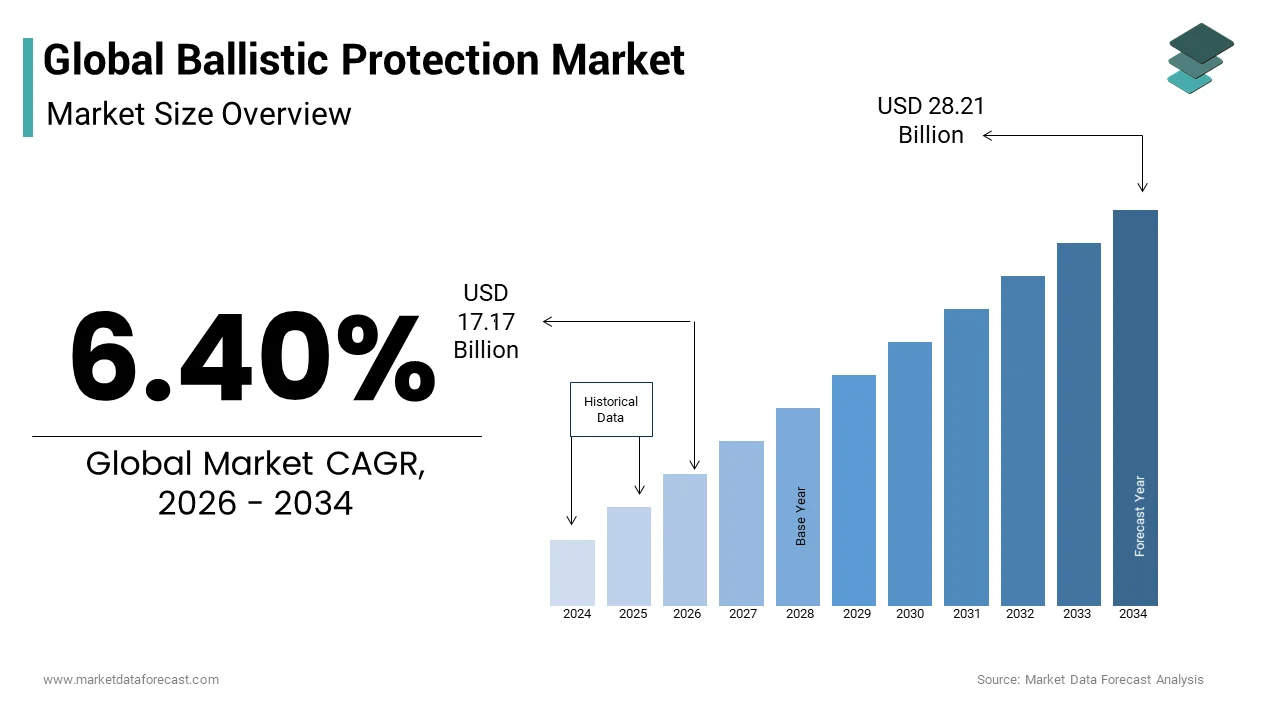
- Market Valuation: Valued at USD 16.14 billion (2025), estimated at USD 17.17 billion in 2026, and projected to reach USD 28.21 billion by 2034, registering a steady CAGR of 6.40% (2026–2034).
- Primary Growth Drivers: Heightened geopolitical tensions and territorial conflicts driving massive defense budget increases; intense focus on improving soldier survivability and combat mobility; growing adoption of lightweight bulletproof vests and composite plates; and rising demand for unmanned aerial vehicle (UAV) and tactical vehicle shielding. Market challenges include high equipment acquisition costs and mobility constraints imposed by heavy legacy armor systems.
Key Market Segment Metrics (2026–2034)
| Category | Leading Segment (Base Position) | Fastest-Growing Segment |
|---|---|---|
| By Product | Personal Protective Equipment (PPE) (anchoring core infantry defense with helmets, body armor, and tactical garments) | Modular and lightweight vehicle/airborne armor add-ons |
| By Technology | Hard Armor (widely deployed using advanced ceramics and composite strike faces for high-threat mitigation) | Soft Armor PPE (registering robust revenue growth due to demand for flexible, multi-threat ergonomics) |
| By Platform | Ground Platforms (commanding primary military land vehicle and infantry allocations) | Airborne platforms, driven heavily by unmanned aerial vehicles (UAVs) and tactical helicopter retrofits |
| By Application | Military Defense (largest consumer baseline utilizing comprehensive combat and tactical systems) | Homeland Security (expanding rapidly as law enforcement and border agencies upgrade tactical gear) |
| By Region | North America (dominant revenue share backed by substantial U.S. and Canadian defense spending) | Asia-Pacific (lucrative growth driven by modernization initiatives in China and India) |
Major Market Players & Market Structure
Market Structure: Highly strategic, consolidated defense manufacturing landscape where global prime contractors and specialized material scientists compete through long-term military procurement contracts, advanced composite R&D, and vehicle fleet modernization upgrades.
Key Companies: BAE Systems, 3M, Rheinmetall AG, Koninklijke Ten Cate Bv, Point Blank Enterprises Inc., MKU Limited, Elmon, FMS Enterprises Migun Ltd, Permali, Revision Military, Saab AB, and Survitec Group Limited.
 Download Free Sample Report
Global Ballistic Protection Market Size
The global ballistic protection market size was valued at USD 16.14 billion in 2025 and is anticipated to reach USD 17.17 billion in 2026 and USD 28.21 billion by 2034, growing at a CAGR of 6.40% during the forecast period from 2026 to 2034.
Ballistic protection offers safety against penetration of projectiles of many speeds, shapes, and sizes. They are widely used in applications such as military, homeland security, defense, and commerce. The material used to make the ballistic protection is selected based on its ability to absorb energy, as well as the speed and efficiency of that energy transfer. Rising geopolitical tensions in emerging economies and massive defense spending due to internal conflicts and tensions in developing countries, such as Brazil, India, and Russia, are expected to drive the growth of the ballistic protection industry in the coming days.
The high adoption of ballistic protection to improve the survivability of soldiers is a key factor in the growth of the global ballistic protection market. In addition, the growing defense budget in emerging economies is another factor supporting the growth of the worldwide market. Growing demand for technologically advanced equipment and corporate security awareness are also growth factors of the target market. Also, intensified research and development to make armor lighter weight is a factor that is estimated to increase the growth of the global ballistic protection market in the near future.
However, the high cost of ballistic protection equipment is a factor that may hamper the growth of the global business to some extent. In addition, high-weight ballistic protection reduces mobility and is a difficult factor that could affect its demand among end-users. However, the growing adoption of lightweight bulletproof vests can create huge revenue opportunities for target market players.
REPORT COVERAGE
| REPORT METRIC | DETAILS |
| Market Size Available | 2025 to 2034 |
| Base Year | 2025 |
| Forecast Period | 2026 to 2034 |
| CAGR | 6.4% |
| Segments Covered | By Product, Platform, Application, Technology, and Region |
| Various Analyses Covered | Global, Regional & Country Level Analysis, Segment-Level Analysis, DROC, PESTLE Analysis, Porter’s Five Forces Analysis, Competitive Landscape, Analyst Overview on Investment Opportunities |
| Regions Covered | North America, Europe, APAC, Latin America, Middle East & Africa |
| Market Leaders Profiled | BAE Systems (UK), 3M (US), Rheinmetall AG (Germany), Koninklijke Ten Cate Bv (Netherlands), Point Blank Enterprises, Inc (United States), MKU Limited (India), Elmon (Greece), FMS Enterprises Migun Ltd (Israel), Permali (United Kingdom), Revision Military (United States), Saab AB (Sweden) and Survitec Group Limited (United Kingdom). |
SEGMENTAL ANALYSIS
By Product Insights
Among products, the personal protective equipment segment is expected to show lucrative revenue growth in the near future. Personal protective equipment is designed to protect against biological, thermal, electrical, chemical, and physical hazards. Includes glasses, aids, clothing, etc. Different materials such as glass, Kevlar, Lexan, fiber, and aramid are used for the manufacture of protective equipment or clothing.
By Technology Insights
The soft armor personal protective equipment segment is expected to register strong growth in terms of revenue during the forecast period.
By Platform Insights
The airborne segment is expected to grow at a higher CAGR over the forecast period. It includes fixed-wing aircraft and helicopters, and unmanned aerial vehicles (UAVs). There is a growing demand for aircraft on various aerial platforms for military purposes. This demand is attributed to increased military spending in several countries, including China, Japan, South Korea, and the United States. The UAV segment is expected to experience the highest CAGR in the forecast period. The growth of this segment is mainly credited to recent trends in warfare dynamics that led to the arrival of drones on the battlefield.
By Application Insights
The Homeland Security segment is expected to grow at a higher rate than the military segment during the forecast period. Homeland Security officers wear a tough bulletproof vest in the field to protect against specific ballistic threats. National security officers use personal protective equipment, including bulletproof vests, ballistic helmets, and gloves, to ensure safety during any mission. Ballistic helmets can offer protection to the user by securing them from small arms fire and fragmentation. The combat systems used by National Security agents are resistant to ballistics because ceramics and thermoplastics strengthen them.
REGIONAL ANALYSIS
North America Market Analysis
At present, the North American market represents a significant share in terms of revenue and is expected to maintain its dominance during the outlook period. The high military budget and the presence of key players are factors that support the growth of the target market in countries like the United States and Canada in this region. Moreover, the increasing demand for armor for commercial vehicles is another factor that is estimated to drive the growth of the ballet protection market in North America. Europe represents the second-highest revenue share of the world market. However, defense budget cuts, due to the economic crisis in countries in this region, could affect the growth of the target market in the projection period.
Asia Pacific Market Analysis
The Asia-Pacific market is likely to show lucrative revenue growth in the near future, followed by the Middle East, Africa, and Latin America. The rising military budget in countries like China and India, and the adoption of logistics support equipment, are growth factors in the ballistic protection market in the Asia-Pacific.
KEY MARKET PLAYERS
- BAE Systems (UK)
- 3M (US)
- Rheinmetall AG (Germany)
- Koninklijke Ten Cate Bv (Netherlands)
- Point Blank Enterprises, Inc (United States)
- MKU Limited (India)
- Elmon (Greece)
- FMS Enterprises Migun Ltd (Israel)
- Permali (United Kingdom)
- Revision Military (United States)
- Saab AB (Sweden)
- Survitec Group Limited (United Kingdom).
RECENT MARKET NEWS
-
In March 2021, BAE Systems received a $ 339 million contract amendment from the US military for the production of 48 vehicle sets of the M109A7 self-propelled howitzer (SPH) and its partner, the M992A3 transporter, ammunition, tracked vehicle (CAT). This contract further includes support after delivery, along with the provision of spare parts.
-
In December 2019, BAE Systems received a $ 249 million contract amendment from the US Army to complete an additional 60 M109A7 self-propelled howitzers that will enhance the artillery capabilities of the El Armored Brigades' combat teams. Army.
-
In December 2019, Rheinmetall AG won a contract with the Royal Netherlands Armed Forces for the second phase of modernization of its Bergepanzer 3-Büffel / Buffalo armored recovery vehicle fleet.
-
In December 2019, Leonardo Helicopters signed a deal with Permali for the delivery of a ballistic protection system for use in the Royal Navy’s new Commando Merlin Mk4 helicopters.
-
In October 2019, BAE Systems received a $ 120 million contract from the United States Marine Corps for additional amphibious combat vehicles as part of the Low Rate Initial Production Third Order (LRIP)
MARKET SEGMENTATION
This research report on the global ballistic protection market has been segmented and sub-segmented based on the product, technology, platform, application, and region.n
By Product
- Personal Protective Equipment
- Ballistic Blocks
- Barrier Systems
- Hull & Body
- Weapon Station and Optronics
- Pilot Seat Protection
- Ballistic Floors
- Windows and Doors
- Engine Protection
- Others
By Technology
- Hard Armor
- Soft Armor
By Platform
- Ground
- Airborne
- Marine
By Application
- Military
- Homeland Security
By Region
- North America
- Europe
- Asia-Pacific
- South America
- Middle East & Africa