- Product Description Description
- Table of Contents TOC
- List of Table & Figure LOT
- Get Free Sample PDF Sample PDF
Market Size, 2025
$19.26 BnMarket Estimate, 2026
$20.67 BnMarket Forecast, 2034
$36.37 BnCAGR, 2026–2034
7.32%Executive Summary: Global Biocides Market
- Market Scope: Comprehensive global market analysis of the biocide industry covering types (metallic compounds, halogen-based, organic acids, sulphones, phenol-based, others), applications (food & beverage, construction, agriculture, pharmaceutical, personal care, water treatment, paints & coatings, home care, others), and regional landscapes across North America, Europe, Asia Pacific, Latin America, and Middle East & Africa.
- Market Valuation: Valued at USD 19.26 billion in 2025, estimated at USD 20.67 billion in 2026, and projected to reach USD 36.37 billion by 2034, registering a steady CAGR of 7.32% during the forecast period.
- Primary Growth Drivers: Escalating incidence of waterborne pathogens and microbial contamination in municipal/industrial water systems; stringent hygiene and disinfection mandates in healthcare and food safety sectors; and rapid urbanization in emerging economies.
Key Market Segment Metrics (2026–2034)
| Category | Leading Segment / Position | Growth Dynamics |
|---|---|---|
| By Type | Quaternary Ammonium Compounds (held 32.1% share in 2025 due to broad-spectrum antimicrobial efficacy and surface compatibility) | Organosulfur compounds are projected to grow at a CAGR of 7.4%, driven by demand for eco-compatible soil and water treatments. |
| By Application | Water Treatment Segment (held 35.4% share in 2025, essential for controlling biofouling in industrial cooling and municipal supplies) | Paints and coatings application segment is swiftly growing at a CAGR of 6.8%, fueled by antimicrobial and mold-resistant finishes. |
| By Region | Asia Pacific (largest contributor capturing 38.2% market share in 2025, driven by rapid industrialization and urban infrastructure) | North America and Europe follow closely, underpinned by strict environmental regulations and high hygiene standards. |
Major Market Players & Market Structure
Market Structure: Highly competitive global landscape characterized by multinational chemical giants and regional specialists focusing on eco-friendly bio-based innovations, regulatory compliance, and regional expansion.
Key Companies: BASF SE, Dow, Lanxess AG, Troy Corporation, Thor Specialities, Ashland Inc., Arch Chemicals, Akzo Nobel N.V., Champion Technology Services Inc., Albemarle Corporation, Kemira OYJ, Solvay SA, The Lubrizol Corporation, and Clariant AG.
Global Biocide Market Size
The global biocides market size was valued at USD 19.26 billion in 2025 and is expected to reach USD 36.37 billion by 2034 from USD 20.67 billion in 2026, growing at a CAGR of 4.36%.
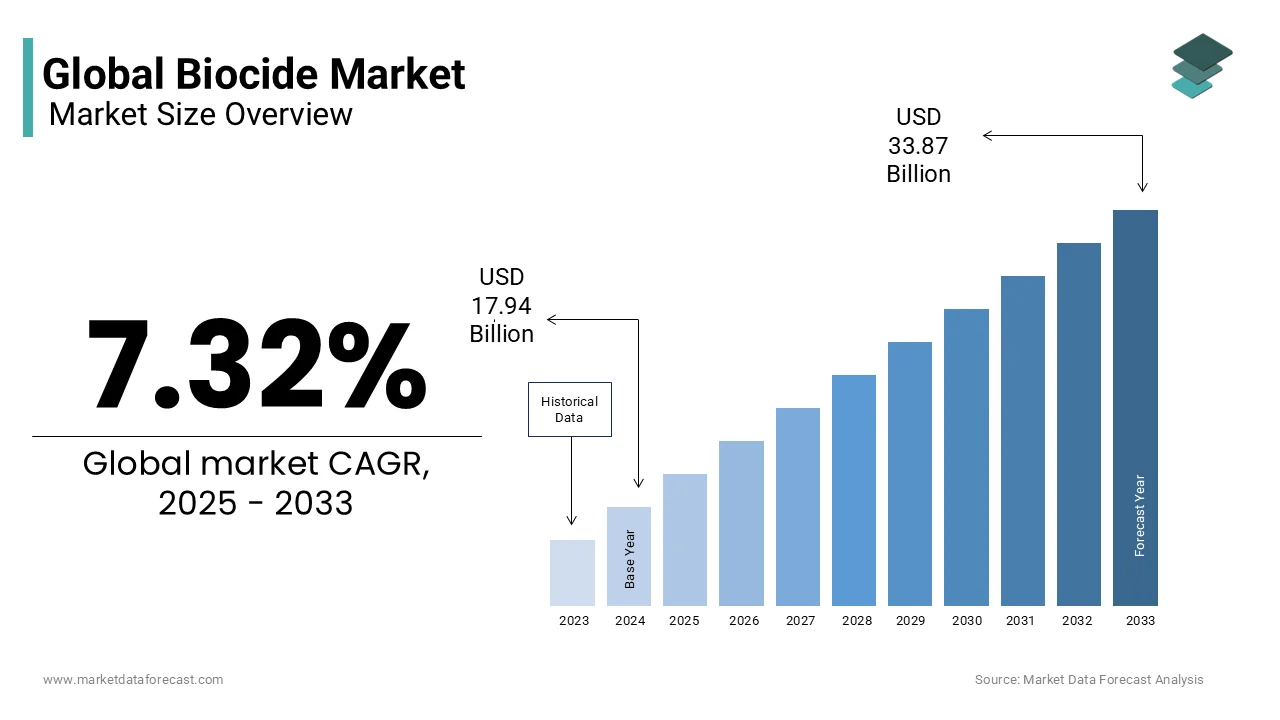
Biocides are chemical substances designed to inhibit, deter, or eliminate harmful microorganisms in industrial, healthcare, and consumer environments. As per the World Health Organization, over 2 billion people globally use drinking water sources contaminated with fecal matter, which is amplifying the need for effective disinfection protocols where biocides play a pivotal role.
MARKET DRIVERS
Escalating Incidence of Waterborne Pathogens in Urban Infrastructure
The rising prevalence of waterborne diseases due to microbial contamination in municipal and industrial water systems is a major factor propelling the growth of biocides market. According to the U.S. Centers for Disease Control and Prevention, Legionella alone causes between 8,000 and 18,000 hospitalizations annually in the United States, primarily through contaminated cooling towers and plumbing systems. This has prompted stringent water safety mandates, such as the CDC’s Water Management Program Guidelines, adopted by over 65% of large U.S. hospitals by 2023. In response, facility operators increasingly deploy oxidizing biocides like chlorine dioxide and brominated compounds to control biofouling. Urbanization in emerging economies further intensifies pressure, with the United Nations estimating that 60% of the global population will reside in cities by 2030.
Regulatory Mandates in Healthcare and Food Safety Protocols
The stringent hygiene regulations in healthcare and food processing sectors are significantly amplifying the growth of biocides market. The U.S. Food and Drug Administration mandates that all food-contact surfaces in processing facilities must be sanitized using EPA-registered antimicrobial agents, a requirement that applies to over 24,000 food manufacturing units across the country, as per FDA facility registration data. Similarly, the European Food Safety Authority recorded over 5,000 foodborne outbreak incidents in 2022, many linked to Listeria and Salmonella, reinforcing the need for robust disinfection. In healthcare, the Joint Commission requires U.S. hospitals to maintain infection control protocols, with 92% of accredited facilities now using quaternary ammonium compounds and hydrogen peroxide-based biocides for surface disinfection, according to a 2023 survey by the Association for Professionals in Infection Control and Epidemiology.
MARKET RESTRAINTS
Environmental Persistence and Ecotoxicity of Conventional Biocides
Many traditional biocides, particularly organotin and chlorine-releasing compounds, exhibit high environmental persistence and toxicity to aquatic life, which is hindering the growth of biocides market. As per the European Environment Agency, tributyltin (TBT), once widely used in antifouling paints, has been detected in marine sediments across 78% of coastal monitoring sites in the EU, despite its global ban under the International Maritime Organization’s 2008 convention. Similarly, the U.S. Environmental Protection Agency has identified dichloroaniline, a breakdown product of certain phenolic biocides, as a potential groundwater contaminant with a half-life exceeding 120 days. These ecological impacts have triggered stricter risk assessments under REACH and TSCA, delaying product approvals.
Rising Microbial Resistance to Common Biocidal Agents
The integration of biocide-resistant microbial strains is likely to hinder the growth of biocides markets. According to the research conducted by the United Kingdom’s Health Security Agency, Pseudomonas aeruginosa isolates from hospital water systems show reduced susceptibility to quaternary ammonium compounds in over 40% of tested samples, attributed to efflux pump mechanisms. The World Health Organization has flagged this cross-resistance phenomenon as a public health threat, noting that biocide resistance can accelerate the spread of multidrug-resistant organisms in healthcare environments. These findings have prompted a reevaluation of long-term reliance on single-mode biocides, which is compelling industries to adopt rotation strategies or combination treatments, thereby increasing operational complexity and limiting the scalability of legacy products.
MARKET OPPORTUNITIES
Development of Bio-Based and Readily Degradable Biocides
The shift toward sustainable and eco-compatible antimicrobials is creating significant opportunities for next-generation biocides. As per the Organisation for Economic Co-operation and Development, biodegradable biocides account for nearly 30% of new product submissions under the EU BPR as of 2023, reflecting industry innovation. Companies are increasingly investing in essential oil-derived actives, such as thymol and eugenol, and enzyme-based systems that degrade rapidly in the environment. For instance, Evonik Industries launched a bio-based isothiazolinone alternative in 2023, derived from renewable feedstocks, which demonstrated 99.9% microbial kill rate in independent tests while achieving OECD 301B biodegradation compliance.
Integration of Smart Release and Nanotechnology in Biocidal Systems
The advancements in nanotechnology and controlled-release mechanisms are enabling smarter, longer-lasting microbial control solutions, which is to elevate the growth of the biocides market in coming years. Researchers at the Massachusetts Institute of Technology have developed silica nanoparticles loaded with silver ions that release biocidal agents in response to microbial pH changes, extending efficacy by up to fourfold compared to conventional coatings. These innovations not only improve performance but also reduce reapplication frequency and environmental load by offering a compelling value proposition for high-hygiene environments.
MARKET CHALLENGES
Complex and Divergent Global Regulatory Pathways
Navigating the fragmented regulatory landscape for biocides remains a formidable challenge for manufacturers. The European Union’s Biocidal Products Regulation requires up to 10 years and €3 million per active substance for full authorization, as noted by the European Chemicals Agency. In contrast, the U.S. EPA operates under the Federal Insecticide, Fungicide, and Rodenticide Act (FIFRA), where registration timelines vary significantly based on data completeness. China’s Ministry of Ecology and Environment mandates separate evaluations under its IECSC, while India’s Chemical Management Rules under the Manufacture, Storage and Import of Hazardous Chemicals (MIIHC) notification are still being operationalized.
Balancing Efficacy with Human Safety in High-Contact Applications
Ensuring biocidal effectiveness without compromising human health in consumer-facing and medical settings is a challenging factor for biocides market players. Similarly, the American Contact Dermatitis Society lists quaternary ammonium compounds among the top 10 causes of occupational skin allergies, affecting an estimated 12% of healthcare personnel exposed regularly. These safety concerns have led to reformulation pressures and restricted usage in sensitive environments. In 2023, France’s ANSES recommended limiting the concentration of certain isothiazolinones in household products due to rising sensitization rates.
REPORT COVERAGE
| REPORT METRIC | DETAILS |
| Market Size Available | 2025 to 2034 |
| Base Year | 2025 |
| Forecast Period | 2026 to 2034 |
| CAGR | 7.32% |
| Segments Covered | By Type, Application, and Region. |
| Various Analyses Covered | Global, Regional & Country Level Analysis, Segment-Level Analysis, DROC, PESTLE Analysis, Porter’s Five Forces Analysis, Competitive Landscape, Analyst Overview of Investment Opportunities |
| Regions Covered | North America, Europe, APAC, Latin America, Middle East & Africa |
| Market Leaders Profiled | Troy Corporation, DowDuPont Inc., Thor Specialities, Ashland Inc., Arch Chemicals, BASF SE, Akzo Nobel N.V., Champion Technology Services Inc., Lanxess, Albemarle Corporation, Kemira OYJ, Solvay SA, The Lubrizol Corporation, and Clariant AG, and Others. |
SEGMENTAL ANALYSIS
By Type Insights
The quaternary ammonium segment was accounted in holding 32.1% share of the global biocides market in 2025 with the broad-spectrum antimicrobial efficacy, stability in formulation, and compatibility with a wide range of surfaces. Quats are extensively used in disinfectants, sanitizers, and surface cleaners due to their ability to disrupt microbial cell membranes. According to the U.S. Environmental Protection Agency, over 220 quat-based products were registered for use in healthcare settings in 2023, reflecting institutional reliance on these compounds.
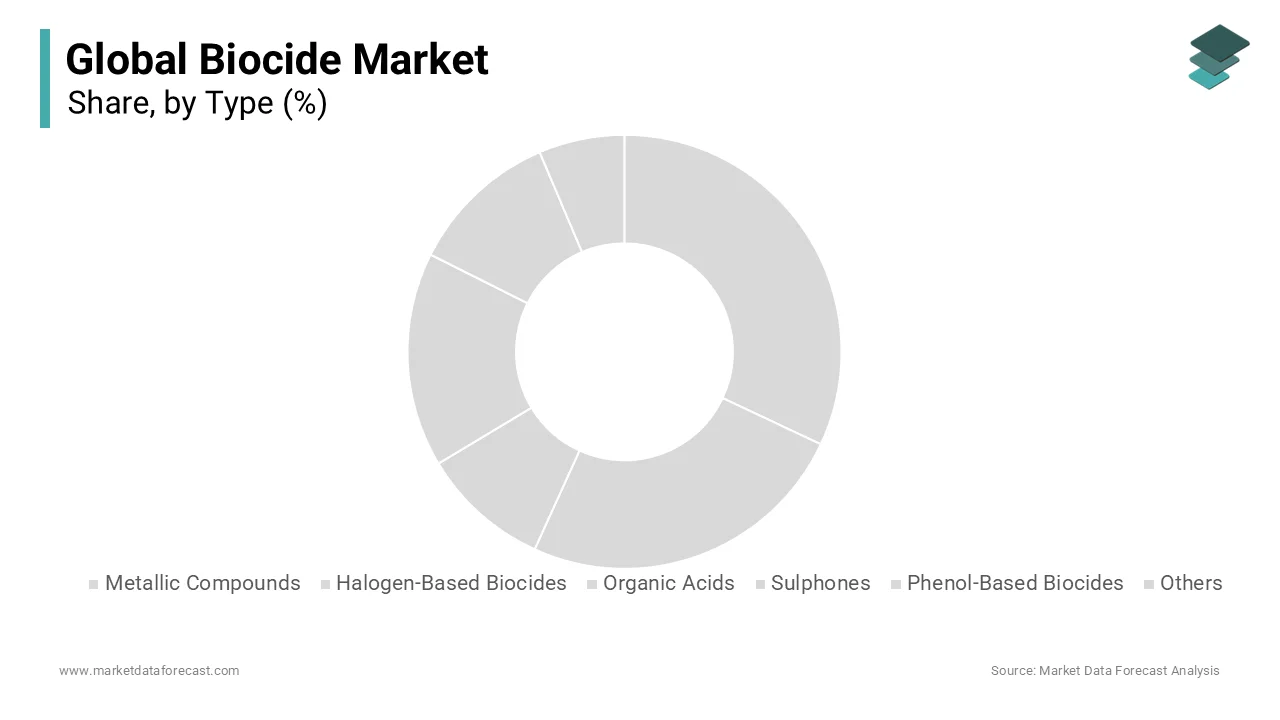
The organosulfur compounds segment is likely to grow with an expected CAGR of 7.4% from 2026 to 2034 with the rising demand for eco-compatible biocides with rapid degradation profiles. Dimethyldisulfide (DMDS) and other sulfur-based actives are increasingly replacing methyl bromide in soil fumigation, particularly in Europe and North America. The European Commission reports that over 60,000 hectares of agricultural land in Spain, Italy, and France transitioned to DMDS-based treatments between 2020 and 2023 under the EU’s phase-out of ozone-depleting fumigants. Additionally, organosulfur compounds are gaining traction in water treatment due to their effectiveness against sulfate-reducing bacteria in oil and gas pipelines.
By Application Insights
The water treatment segment was accounted in holding 35.4% of the biocide market share in 2025 with the control microbial growth in industrial cooling systems, municipal water supplies, and wastewater facilities. Biofouling in cooling towers can reduce heat transfer efficiency by up to 30%, according to the U.S. Department of Energy, necessitating continuous biocide dosing. Additionally, the global fleet of industrial cooling towers exceeds 1.8 million units, per ASHRAE data, nearly all of which require routine microbial control.
The paints and coatings application segment is swiftly growing with an anticipated CAGR of 6.8% during the forecast period owing to the increasing demand for antimicrobial and mold-resistant finishes in residential, healthcare, and commercial buildings. In Europe, rising humidity levels due to climate change have increased mold incidence; the European Centre for Environment and Health states that up to 30% of homes in Northern and Western Europe suffer from dampness and mold, prompting regulatory action. Germany’s DIN 55455 standard now requires biocidal protection in interior wall coatings for public buildings.
REGIONAL ANALYSIS
Asia Pacific Market Analysis
Asia-Pacific was the largest contributor of the global biocides market by capturing 38.2% of share in 2025 with the rapid industrialization, urbanization, and expanding healthcare infrastructure. China and India are pivotal, with China alone accounting for over 40% of regional biocide production, as per the China Petroleum and Chemical Industry Federation. The Indian Ministry of Housing and Urban Affairs reports that over 500 new smart cities are being developed, each requiring advanced water and surface hygiene systems.
North America Market Analysis
North America biocides market was positioned second by holding 23.1% of share in 2025. The United States biocides market growth is due to stringent regulatory frameworks and high hygiene standards. The U.S. Environmental Protection Agency regulates over 10,000 biocidal products under FIFRA, ensuring rigorous safety and efficacy evaluation. The country’s extensive industrial base, including over 150,000 manufacturing facilities, necessitates biocide use in cooling systems, metalworking fluids, and process water, as documented by the U.S. Census Bureau. The CDC’s 2023 National Healthcare Safety Network report reveals that 95% of U.S. acute care hospitals implement biocide-based disinfection protocols to combat healthcare-associated infections, which affect 1 in 31 hospital patients daily. Furthermore, the rise of green building standards, such as LEED certification, has spurred demand for antimicrobial coatings in commercial real estate.
Europe Market Analysis
Europe biocides market growth is to have a significant growth opportunities during the forecast period with the strict regulatory oversight and a shift toward sustainable chemistries. The European Union’s Biocidal Products Regulation (BPR) has streamlined the approval process while enforcing high safety and environmental standards, with over 500 active substances currently under review, as stated by the European Chemicals Agency. Germany, France, and the UK are leading consumers, particularly in water treatment and healthcare. Additionally, the EU’s Green Deal and Circular Economy Action Plan are pushing manufacturers to develop biodegradable and non-toxic formulations, reshaping the regional market landscape.
Middle East & Africa Market Analysis
Middle East and Africa biocides market growth is likely to grow with the infrastructure development and public health initiatives. According to the Saudi Water Authority, over 70% of desalinated water produced in the country is treated with biocides to prevent biofouling in pipelines. In South Africa, Eskom’s power plants use biocides in cooling systems to maintain efficiency, with over 80% of thermal stations implementing microbial control programs, as per the Department of Mineral Resources and Energy.
Latin America Market Analysis
Latin America biocides market growth is to grow with Brazil and Mexico leading consumption. The region’s growth is tied to expanding food and beverage processing, pharmaceuticals, and construction. Brazil and Mexico are the major contributors in the biocides market. However, economic instability in countries like Argentina and Venezuela limits investment in advanced biocidal systems.
COMPETITIVE LANDSCAPE
KEY MARKET PLAYERS
- Troy Corporation
- DowDuPont Inc
- Thor Specialities
- Ashland Inc
- Arch Chemicals
- BASF SE
- Akzo Nobel N.V
- Champion Technology Services, Inc
- Lanxess, and Albemarle Corporation
- AkzoNobel N.V
- Kemira OYJ
- AG, Solvay SA
- The Lubrizol Corporation
- Clariant AG
TOP STRATEGIES USED BY THE KEY MARKET PLAYERS
Key players in the biocides market employ several strategic initiatives to maintain competitive advantage. Product innovation is central, with companies developing eco-friendly, regulatory-compliant formulations to meet evolving environmental standards. Geographic expansion, especially in emerging Asia Pacific economies, enables access to high-growth markets. Strategic partnerships with local manufacturers and distributors enhance market penetration and technical support. Capacity expansion and investment in regional production facilities ensure supply chain resilience. Additionally, companies focus on sustainability by introducing biodegradable and low-toxicity biocides.
COMPETITION OVERVIEW
The biocides market is highly competitive, characterized by the presence of global chemical giants and regional specialty players vying for dominance through innovation and strategic expansion. Intense rivalry stems from increasing regulatory pressures, rising demand for sustainable solutions, and evolving customer requirements across industries like construction, water treatment, and healthcare. Companies differentiate themselves via product performance, environmental compliance, and technical support. The Asia Pacific region has become a key battleground due to rapid industrialization and urbanization.
TOP PLAYERS IN THE MARKET
- BASF SE is a leading player in the biocides market, offering a wide range of innovative microbial control solutions for industries such as construction, paints and coatings, and water treatment. In the Asia Pacific region, BASF has strengthened its presence through localized R&D and strategic collaborations with regional manufacturers. The company emphasizes sustainable and eco-efficient biocidal formulations, aligning with tightening environmental regulations. Recently, BASF launched new preservatives for architectural coatings in China and India, tailored to humid climates. It also expanded its production capabilities in South Korea to meet rising demand.
- Dow Inc. plays a pivotal role in the biocides market with its advanced antimicrobial technologies used in industrial and consumer applications. In the Asia Pacific region, Dow has focused on expanding its water treatment and material protection portfolios, particularly in fast-growing economies like India and Vietnam. The company invests heavily in sustainability-driven innovation, introducing non-metallic and low-toxicity biocides suited for eco-conscious markets. It also launched a new line of isothiazolone-based biocides in Southeast Asia, improving performance in high-temperature environments.
- Lanxess AG is a prominent contributor to the biocides market, specializing in high-performance preservatives for coatings, polymers, and wood protection. Across the Asia Pacific region, Lanxess has intensified its market engagement through targeted product launches and partnerships with regional distributors. The company emphasizes regulatory compliance and safety, aligning with APAC’s growing focus on green chemistry. In 2023, Lanxess introduced a new generation of formaldehyde-free biocides in China and Indonesia, catering to strict indoor air quality standards. It also upgraded its technical service lab in Shanghai to accelerate customer support and product testing.
MARKET SEGMENTATION
This research report on the global biocides market has been segmented and sub-segmented based on type, application, and region.
By Type
- Metallic Compounds
- Halogen-Based Biocides
- Organic Acids
- Sulphones
- Phenol-Based Biocides
- Others
By Application
- Food & Beverage
- Construction
- Agriculture
- Pharmaceutical
- Personal Care
- Water Treatment
- Paints & Coatings
- Home Care
- Others
By Region
- North America
- Europe
- Asia Pacific
- Latin America
- Middle East & Africa