- Product Description Description
- Table of Contents TOC
- List of Table & Figure LOT
- Get Free Sample PDF Sample PDF
Market Size, 2025
$2.05 BnMarket Estimate, 2026
$2.18 BnMarket Forecast, 2034
$3.61 BnCAGR, 2026–2034
6.50%Global Biomethane Market Size
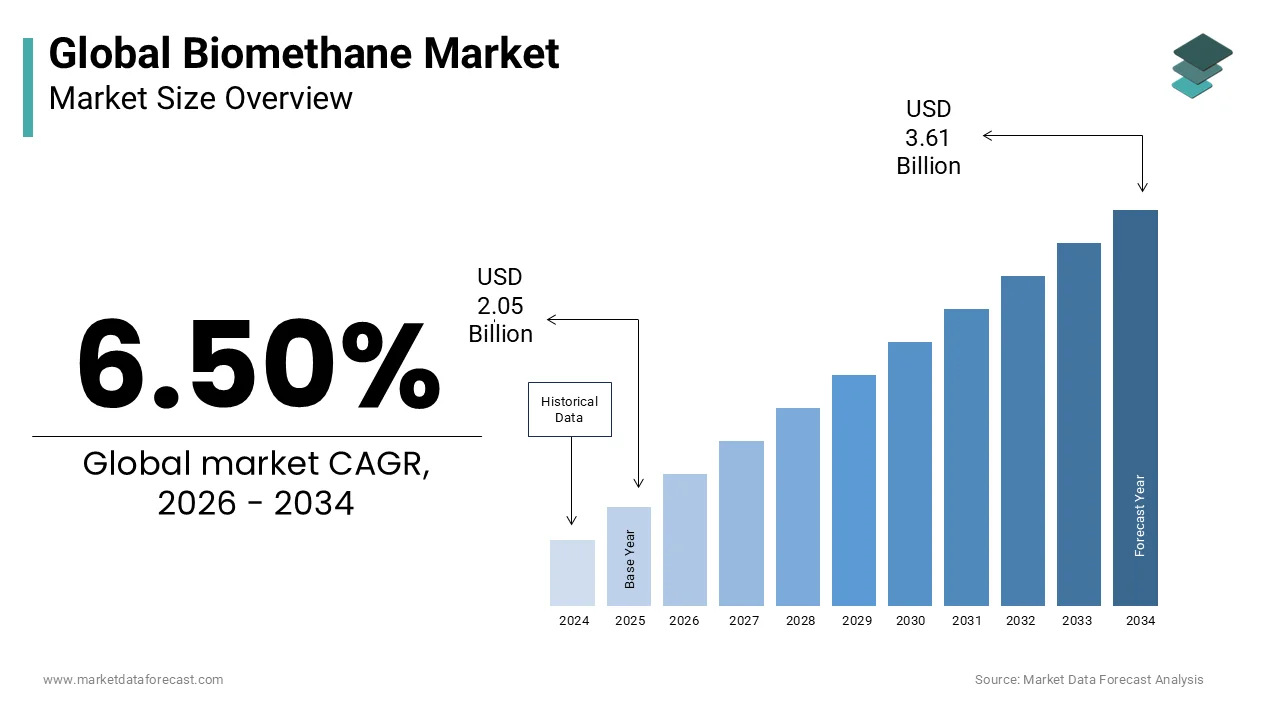
The global biomethane market size was valued at USD 2.05 billion in 2025, and is projected to reach USD 3.61 billion by 2034 from USD 2.18 billion in 2026, growing at a CAGR of 6.50%.
Biomethane is a natural gas created through the anaerobic digestion of organic matter such as agricultural waste, green waste, domestic garbage, food industry waste, and even industrial waste. Natural gas that is renewable and sustainable is another name for it. Biogas is the primary material for biomethane synthesis, and it can be made from a variety of sources such as plants and animals. As a result, it is both environmentally benign and the most efficient fuel for various uses. To make liquified biomethane, it is liquefied. It's frequently used in the automobile and power generation industries. When compared to other fuels, biomethane reduces CO2 emissions dramatically. Furthermore, it is appropriate for all engine types and forms of transportation.
MARKET DRIVERS
The market is expanding as more biomethane is used for power generation to fulfill the growing electricity demand. Furthermore, favorable government rules encourage market demand. As the use of biomethane as a transportation fuel rises in an increasing number of nations worldwide and the creation of biogas-based power plants, the Biomethane Market is expected to grow. Renewable natural gas will continue to be in high demand on the market. The need for biogas producers is increasing in tandem with the desire for alternative energy sources. The demand for biomethane is predicted to fuel the expansion of the Biomethane Market since it is an environmentally benign and highly efficient fuel. In addition, the increasing use of biomethane for power generation to meet the global need for electricity is predicted to promote market growth.
Gasification and fermentation are the two processes for producing biomethane. Gasification is a biomass thermochemical conversion process. Biomass is broken down utilizing a high temperature of 700-800°C and high pressure in the presence of a gasifying agent, such as oxygen in the environment, in this process. Biomass produces a mixture of gases known as syngas or synthesis gas under these conditions. Hydrogen, carbon monoxide, and methane are all components of synthetic gas. Syngas is converted to biomethane by eliminating acidic and corrosive elements. To produce methane, catalysts such as silica gel are needed to initiate a reaction between hydrogen, carbon dioxide, and carbon monoxide.
Furthermore, favorable assistance for biomethane generation from developed nations is driving biomethane market expansion. One of the primary reasons driving revenue growth in the biomethane market is the rising demand for biomethane due to growing environmental concerns. Furthermore, significant industrial expansion in developing nations is predicted to increase demand for biomethane for power generation, boosting revenue growth in the biomethane market over the forecast period. In addition, rapid industrialization, rising private investment in biomethane production, favorable governmental policies for biomethane production in various countries, and a growing preference for clean and green fuel are all expected to drive revenue growth in the global biomethane market throughout the forecast period.
MARKET RESTRAINTS
Biomethane is highly flammable, and its production and transportation from one location to another necessitate extreme prudence. This is a significant factor projected to limit the global biomethane market's revenue growth throughout the forecast period.
REPORT COVERAGE
| REPORT METRIC | DETAILS |
| Market Size Available | 2025 to 2034 |
| Base Year | 2025 |
| Forecast Period | 2026 to 2034 |
| CAGR | 6.50% |
| Segments Covered | By Feedstock Analysis, Production Method, End User, and Region. |
|
Various Analyses Covered | Global, Regional and Country Level Analysis, Segment-Level Analysis, DROC, PESTLE Analysis, Porter’s Five Forces Analysis, Competitive Landscape, Analyst Overview of Investment Opportunities |
| Regions Covered | North America, Europe, Asia Pacific, Latin America, Middle East & Africa. |
| Market Leaders Profiled | CNG Services, Planet Biogas Global, VERBIO, Future Biogas, Magne Gas, Gasrec, Gazasia, Biogas Products, SGN, Schmack Carbotech, and Others. |
SEGMENTAL ANALYSIS
By Feedstock Insights
In 20223, the agricultural waste category had the most significant revenue share in the global market. This segment is expected to be driven by regulatory bodies' increased attention on decreasing GHG emissions and rising demand for bio-gas generated from agricultural waste. Biogas, a renewable fuel source, is produced by agricultural plants using organic elements found on farms. These plants are made to consume energy crops that have been specifically grown for the use of agricultural wastes. In India, biogas plants are known as Gober gas plants. APAC farmers practice mixed farming, which entails having both plantation and cattle land. Furthermore, the genetic makeup of cattle differs substantially by region. In addition, different cultures and faiths have resulted in a variety of livestock combinations in some areas.
By Production Method Insights
The worldwide biomethane market has been divided into two categories based on the technique of production: gasification and fermentation. In 2020, the fermentation category had the most significant revenue share in the global market. Fermentation provides several advantages, including low initial investment, a more straightforward procedure, considerable efficacy, and environmental friendliness, which would boost this market. Biomethane is produced using a variety of techniques, one of which is gasification. Carbon-based or organic-based chemicals are converted to hydrogen, carbon monoxide, and carbon dioxide in this process. In addition, gasification generates electricity, which is considered a renewable energy source.
By End-User Insights
The power-generating segment is predicted to have the largest market share and grow at a rapid rate. Biogas plant waste is used as organic manure/fertilizer to improve soil fertility and reduce commercial fertilizers, either immediately or after drying. It's also free of weeds, foul odours, and infections. Thus it's non-polluting. Vehicle fuel has a considerable market share due to its widespread use in reducing pollution from car fuel. When biogas fails to match the compressed natural gas (CNG) fuel requirements, hydrogen sulfide is removed, resulting in biomethane.
REGIONAL ANALYSIS
North America is expected to increase significantly throughout the projected period, owing to rising demand from the vehicle segment, which is concerned with reducing hazardous gas emissions and protecting the environment. Nonetheless, new biomethane plants being built in the United States continue to convert the world's power needs and urge the business to expand with viable coal and GHG reduction options. As a result, the United States benefits the most from the North American biomethane market. Due to increased natural gas use and imports, Asia Pacific has the most biomethane potential. The most significant countries with high biomethane consumption include Europe, Italy, France, the United Kingdom, and Germany. Due to growing environmental concerns, financial aid programs, and favorable legislation for biomethane production as a vehicle fuel.
KEY MARKET PLAYERS
CNG Services, Planet Biogas Global, VERBIO, Future Biogas, Magne Gas, Gasrec, Gazasia, Biogas Products, SGN, and Schmack Carbotech are some of the notable companies in the global Biomethane market.
RECENT HAPPENINGS IN THE MARKET
- On May 14th, 2021, the world's largest biomethane refuelling station will be opened by CNG Fuels. Near Bristol, UK, CNG Fuels will open the world's largest public biomethane refueling station for heavy goods vehicles (HGVs). The new station, which is anticipated to open by the end of the year, will allow fleet operators to use low-carbon fuel, contribute to net-zero ambitions, and save money.
- On June 16th, 2021, Future Biogas will construct 25 new plants with the help of CCS (Carbon Capture and Storage) capabilities.
MARKET SEGMENTATION
This research report on the global biomethane market has been segmented and sub-segmented based on feedstock analysis, production method, end user, and Region.
By Feedstock Analysis
- Industrial food processing waste
- Energy crops
- Organic household waste
- Agricultural waste
By Production Method
- Fermentation
- Gasification
By End-User
- Power generation
- Automotive
- Others
By Region
- North America
- Europe
- Asia Pacific
- Latin America
- Middle East and Africa