- Product Description Description
- Table of Contents TOC
- List of Table & Figure LOT
- Get Free Sample PDF Sample PDF
Market Size, 2025
$63.55 BnMarket Estimate, 2026
$69.40 BnMarket Forecast, 2034
$140.32 BnCAGR, 2026–2034
9.20%Executive Summary: Global Biotechnology Instruments Market
- Market Scope: Global market analysis covering product categories, end-use segments, regional leadership frameworks, and technological drivers in life sciences.
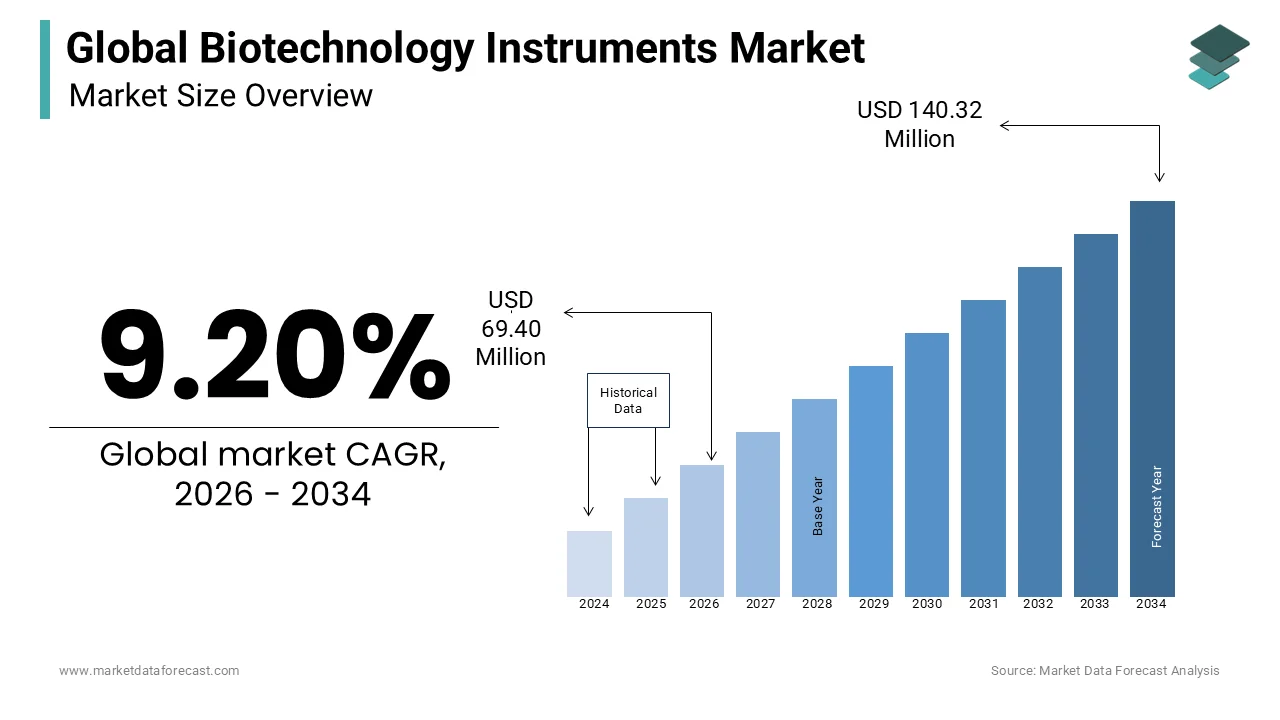
- Market Valuation: Valued at USD 63.55 billion (2025), estimated at USD 69.40 billion (2026), and projected to reach USD 140.32 billion by 2034, growing at a robust CAGR of 9.20% (2026–2034).
- Primary Growth Drivers: Proliferation of point-of-care testing (such as molecular testing capable of detecting COVID-19 in under five minutes), adoption of nanopore sequencing, rising chronic disease prevalence, demand for minimally invasive procedures, acceleration of new-drug development, and expanding healthcare R&D investments. Secondary contextual metrics highlight strong consumption baselines for life-science consumables, including ~500,000 self-testing RT-PCR kits sold in Mumbai within a single week in January 2022.
Key Market Segment Metrics (2026–2034)
| Category | Leading Segment (2025 Position) | Fastest-Growing Segment |
|---|---|---|
| By Product | Life Science Consumables (dominated the product segment in 2025 and expected to retain leadership) | — |
| By End User | Pharmaceutical & Biotechnology Companies (accounted for 41.2% of the global market in 2025, driven by gene sequencers, protein analyzers, and screening systems) | Academic and Research Institutes (expected to register significant growth) |
| By Region | North America (dominated with 45.2% market share in 2025, supported by advanced systems, R&D investments, and U.S. government funding like Project NextGen's >$1.4B allocation) | Asia-Pacific (expected to be the fastest-growing regional market) |
Major Market Players & Market Structure
Market Structure: Highly competitive global scientific instrument and life-sciences technology landscape where leading enterprises compete on precision analytical capabilities, high-throughput sequencing systems, consumable supply chains, and extensive R&D collaborations.
Key Companies: Thermo Fisher Scientific, Water Corp., Agilent Technologies, Bio-Rad Laboratories, Bruker, Shimadzu, Danaher, PerkinElmer, Mettler Toledo, and Illumina.
Global Biotechnology Instruments Market Size
The global biotechnology instruments market was valued at USD 63.55 billion in 2025, is estimated to reach USD 69.40 billion in 2026, and is projected to reach USD 140.32 billion by 2034, growing at a CAGR of 9.20% from 2026 to 2034.
Biotechnology is the science study implemented in numerous clinical, experimental, and industrial applications. The basis of biotechnology is the lab where the equipment with technology is utilized for the clinical and experimental methods. Biotechnology uses various types of instruments depending on the lab's purpose and the kind of research being done in the lab. All the biotechnology labs have DNA sequencing equipment, typical lab equipment, and essential equipment, irrespective of the research type. Biotechnology development requires standard laboratory equipment for performing experimental or clinical research.
MARKET DRIVERS
Point-of-care testing (PCOT) has been gaining traction in recent periods across the globe among people and is influencing market growth. The PCOT is conducted on the patient's site and where the treatment is provided as PCOT gives rapid test results, which help in implementing the appropriate treatment. To improve the quality of care, various point-of-care testing devices are adopting technological advancements that enhance the market revenue of biotechnology instruments—considering this as the market trend, various market players are investing in these instruments to gain the consumer base, which fuels the market expansion. For Instance, Abbott launched a molecular point-of-care test to detect COVID-19 in less than five minutes during the Pandemic. Product launches like these and the regulatory approvals for the products are propelling the market growth. Another primary factor that increases the demand for biotechnology instruments is nanopore sequencing, which the researchers and scientists from the centralized and decentralized labs are highly adopting. The primary aim is to accelerate the exchange of sequencing data from SARS-CoV2.
The increase in the incidence of chronic target diseases across the globe is raising the number of surgical procedures, demanding biotechnology instruments, and augmenting market share growth. The growing number of geriatric people across the world is enhancing the cases of chronic diseases such as diabetes, heart disease, and others. The rising demand for surgical procedures, majorly minimally invasive, is expected to provide market growth opportunities. Due to the growing prevalence of chronic illness worldwide, the market for new drug development has risen, enhancing the biotechnology instruments market.
The rising demand for biotechnology procedures in research will increase the adoption of biotechnology instruments by providing market growth opportunities during the forecast period. The increasing demand for life science consumables consists of the lab's necessities for research procedures. These include syringes, pipettes, beakers, testing kits, and others most used in all research laboratories. The glass consumables are in high demand compared to the plastic consumables due to efficient work. The growing R&D activities in the healthcare structure and the government funding the R&D are expected to enhance the biotechnology instruments market growth during the forecast period.
MARKET RESTRAINTS
The high cost of biotechnology instruments is hampering global market growth. The adoption of biotechnology instruments is restrained due to expensive output for operation and maintenance compared to other instruments. The cases of hazardous viruses or bacteria leaking from research facilities are influencing people to doubt the efficiency of biotechnology equipment. In a few cases, the same equipment used for the development of vaccines and for deadly virus growth may result in contamination, which influences human health. These rare scenarios are expected to limit the market growth of biotechnology instruments due to a decreased adoption rate.
The use of biotechnology instruments in the agricultural field has the more significant potential to spread crop diseases and contaminate the gene pool, impeding the adoption of biotechnology instruments, which limits market expansion.
Various stringent regulations for product approvals by the regulatory authorities are challenging for market growth. Launching biotechnology testing kits or other devices to detect or diagnose diseases is challenging for the market expansion as the regulatory approvals are time-consuming and complex, which is expected to hamper market growth.
REPORT COVERAGE
| REPORT METRIC | DETAILS |
| Market Size Available | 2025 to 2034 |
| Base Year | 2025 |
| Forecast Period | 2026 to 2034 |
| Segments Covered | By Product, End-Use, and region |
| Various Analyses Covered | Global, Regional & Country Level Analysis, Segment-Level Analysis, Drivers, Restraints, Opportunities, Challenges; PESTLE Analysis; Porter's Five Forces Analysis; Competitive Landscape; Analyst Overview of Investment Opportunities |
| Regions Covered | North America, Europe, Asia Pacific, Latin America, Middle East & Africa |
SEGMENT ANALYSIS
By Product Insights
The life science consumables segment dominated the global biotechnology instruments market in 2025 and is expected to dominate during the forecast period. The life science consumables include essential equipment that is necessary for research labs. The demand for life science consumables has considerably increased during the Pandemic as the demand for PCR kits increased during the COVID-19 outbreak. For Instance, in January 2022, around 5 lakh self-testing RT-PCR kits were sold in Mumbai within the week to diagnose COVID-19. The innovations in biotechnology instruments are boosting the market growth in this segment.
Due to increasing product approvals and launches, the IVD instruments segment is anticipated to increase during the forecast period.
By End-Use Insights
The Pharmaceutical and Biotechnology companies dominated the global market with a market share of 41.2% in 2025. The pharmaceutical and biotechnology industries depend on various instruments, such as gene sequencers, protein analyzers, and screening systems, that drive drug design, discovery, development, and production processes. The growing market trends like precision medicine and novel therapies with advanced research procedures are expected to boost the market growth over the forecast period.
The Academic and Research Institutes segment is expected to grow significantly over the forecast period as these institutions adopt biotechnology instruments such as DNA synthesizers, flow cytometers, and microarray systems. The rising collaborations, acquisitions, and breakthrough discoveries in various fields are expected to propel the market growth. The academic and research institutions act as fundamental knowledge for the research, which emphasizes innovation, contributing to the market expansion during the forecast period.
REGIONAL ANALYSIS
North American region held the dominant market share of 45.2% in the global market over 2025 due to the region's high demand for biotechnology instruments. The growing investments in R&D and collaborations are strengthening the demand for biotechnology instruments in the region the presence of advanced healthcare systems in developed countries like the US and Canada. The presence of market key players in the region and increasing government funding for better healthcare infrastructure are boosting the market growth. In 2023, the US Department of Health and Human Services funded over USD 1.4 billion for Project NextGen, which aims to develop advanced tools and technologies that provide long-term protection against COVID-19.
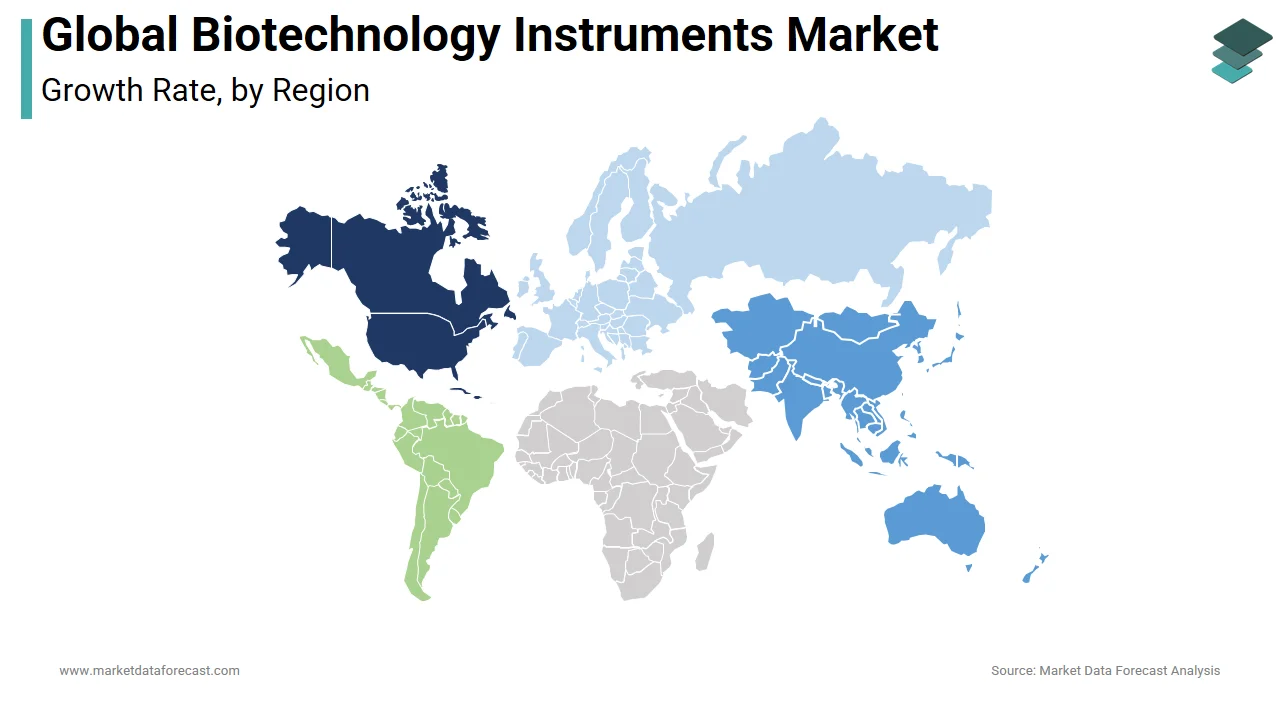
The Asia Pacific region is anticipated to grow fastest during the forecast period due to rising biotechnology research in countries like China, India, and Japan. The growing government initiatives for the R&D activities in these countries fuel the market revenue. The rising pharmaceutical and biotechnology companies' regional profiles enhance the demand for biotechnology instruments.
KEY MARKET PLAYERS
Thermo Fisher Scientific, Inc.,Water Corp., Agilent Technologies, Inc., Bio-Rad Laboratories, Inc., Bruker Corp., Shimadzu Corp., Danaher, PerkinElmer, Inc., Mettler Toledo, Illumina, Inc.
RECENT MARKET DEVELOPMENTS
- In April 2023, Mawi DNA Technologies announced its approval from the FDA for its ISWAB-RC-EL collection device, where these devices are used for stabilizing and deactivating human upper respiratory and saliva samples containing SARS-CoV-2.
- In January 2023, MGI Tech Co. Ltd launched complete sequencing platforms at Biotech Showcase during JP Morgan Healthcare Conference Week. They announced a free three-month trial and reagent rental leasing, which allows the customers to test the quality and reliability of products before purchase.
- In January 2023, Qiagen launched the EZ2 Connect MDx IVD platform, which offers automated sampling for diagnostic labs. This device helps labs purify DNA and RNA simultaneously in up to 24 samples in 30 minutes.
- In June 2022, Agilent Technologies Inc. launched CE-IVD market instruments and kits under IVDR Class A due to new EU IVDR regulation in May 2022. This resulted in the EU labs using Agilent IVDR products with updated regulatory standards.
- In March 2022, Thermo Fisher Scientific launched a next-generation sequencing tool for clinical labs approved by CE-IVD. This tool helps in testing, clinical research, and diagnosis.
MARKET SEGMENTATION
This research report on the Global Biotechnology Instruments Market has been segmented and sub-segmented based on product, End-Use, and region.
By Product
- Lab Automation Instruments
- Life science consumables
- IVD Instruments
- Medical Lasers
By End-Use
- Pharmaceutical & Biotechnology Companies
- Hospitals & Diagnostic Laboratories
- Academic & Research Institutes
- Others
By Region
- North America
- Europe
- Asia Pacific
- Latin America
- Middle East and Africa