- Product Description Description
- Table of Contents TOC
- List of Table & Figure LOT
- Get Free Sample PDF Sample PDF
Market Size, 2025
$34.90 BnMarket Estimate, 2026
$39.58 BnMarket Forecast, 2034
$108.40 BnCAGR, 2026–2034
13.42%Executive Summary: Global Blind Spot Monitor Market Analysis & Growth Forecast (2026-2034)
- Market Scope: Comprehensive industry analysis covering components, technologies, vehicle types, electric vehicle types, system types, applications, and regional performance frameworks across global automotive markets.
- Market Valuation: Valued at USD 34.90 billion in 2025, estimated at USD 39.58 billion in 2026, and projected to reach USD 108.40 billion by 2034, registering a robust CAGR of 13.42% from 2026 to 2034.
- Primary Growth Drivers: Escalating global focus on road safety standards, stringent government mandates (such as EU General Safety Regulations and NCAP safety rating criteria), and rising consumer adoption of Advanced Driver Assistance Systems (ADAS).
Key Global Blind Spot Monitor Market Segment Metrics (2026-2034)
| Category | Leading Segment (Position) | Fastest-Growing / High-Impact Segment |
|---|---|---|
| By Technology | Radar Sensor (held 56.2% share in 2025 due to superior all-weather performance, reliability, and long detection ranges up to 70 meters) | Camera Sensor (projected to grow at a fast CAGR backed by AI advancements, computer vision, and pedestrian/cyclist recognition) |
| By Product / System | Blind Spot Detection (BSD) Systems (captured 38.9% share in 2025 aligned with core collision avoidance mandates) | Park Assist Systems (expanding at a fast CAGR of 9.2% driven by urbanization and tighter metropolitan parking spaces) |
| By Vehicle Type | Passenger Vehicles (accounted for 38.2% share in 2025 driven by massive production volumes and mainstream ADAS integration) | Light Commercial Vehicles (growing rapidly at a CAGR of 7.8% propelled by e-commerce expansion and last-mile delivery fleets) |
| By Region | North America (captured a leading 44.3% market share in 2025 supported by mature automotive infrastructure and safety awareness) | Asia-Pacific & Europe (high-growth hubs powered by strict regulatory frameworks like EU GSR and rising vehicle production in China/Japan) |
Major Global Blind Spot Monitor Market Players & Industry Structure
Market Structure: Highly competitive global landscape characterized by intense rivalry among established tier-1 automotive suppliers, tech innovators, and software developers focusing on sensor fusion, AI integration, and modular architectures.
Key Companies: Continental AG, Denso Corporation, Robert Bosch, Delphi Automotive, Autoliv Inc., ZF Friedrichshafen, Valeo S.A., Ficosa International, and Preco Electronics.
 Download Free Sample Report
Global Blind Spot Monitor Market Size
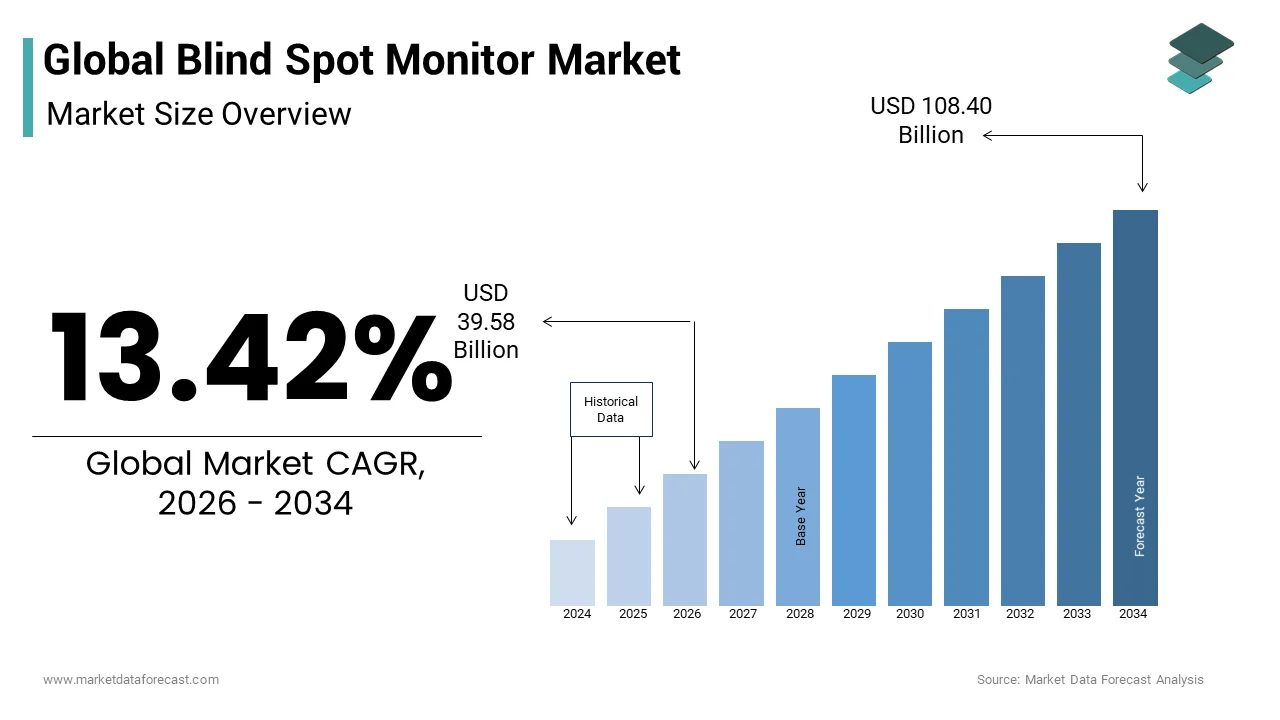
The global blind spot monitor market size was valued at 34.90 billion in 2025 and is anticipated to reach USD 39.58 billion in 2026, to reach USD 108.40 billion by 2034, and is predicted to register a CAGR of 13.42% during the forecast period from 2026 to 2034.
Comprehensive Analysis of the Blind Spot Monitor Market
The blind spot monitor is advanced driver assistance system designed to detect vehicles in areas not visible to the driver through mirrors or direct vision. These systems utilize radar sensors ultrasonic sensors or cameras mounted on the vehicle exterior to identify objects in adjacent lanes and alert drivers through visual auditory or haptic warnings. As automotive safety standards evolve globally, this technology has transitioned from a luxury feature to a component of modern vehicle architecture. The integration of these monitors aligns with broader industry trends toward autonomous driving capabilities and enhanced road safety protocols. According to the World Health Organization, approximately 1.35 million people die each year, as a result of road traffic crashes, which promotes the urgent need for preventive technologies like blind spot detection. The European Union has mandated that all new cars registered after July 2022, must include specific safety features including lane keeping assistance and emergency braking, which indirectly promotes the adoption of comprehensive monitoring systems. The technological sophistication of these systems continues to improve with artificial intelligence enabling more accurate object classification and reduced false alarms, thereby increasing consumer trust and regulatory acceptance across major automotive markets worldwide.
MARKET DRIVERS
Rising Consumer Awareness Regarding Vehicle Safety Standards
The consumer prioritization of safety features in both passenger and commercial vehicles, which is propelling the growth of the blind spot monitor market. Modern car buyers increasingly view advanced driver assistance systems, as essential rather than optional leading manufacturers to integrate these technologies into standard equipment packages. This heightened awareness stems from extensive public education campaigns by automotive safety organizations and increased media coverage of preventable accidents. Additionally, social media platforms and automotive review channels frequently demonstrate the real world benefits of these systems, further amplifying consumer demand. NCAP ratings vehicles achieving five-star safety scores often require comprehensive sensor suites including blind spot detection, which influences purchasing decisions in Europe where safety ratings heavily impact brand perception. This consumer driven demand compels automakers to accelerate the deployment of blind spot monitors, across various vehicle segments, including entry level models thereby expanding penetration and fostering widespread acceptance of this life saving technology among diverse demographic groups globally.
Stringent Government Regulations Mandating Advanced Safety Features
Governmental bodies worldwide are implementing rigorous safety regulations that directly mandate or strongly encourage the inclusion of blind spot monitoring systems in new vehicles. The stringent government regulaations mandating advanced safety features is promoting the growth of the blind spot monitor market. In Europe, the General Safety Regulation requires all new vehicle types to be equipped with advanced safety features effective from 2022 with full compliance mandatory for all new registrations by 2024. This legislative framework pushes automakers to incorporate blind spot detection as part of their standard safety suite to meet legal requirements and avoid penalties. According to the European Commission, these regulations aim to reduce road fatalities by 50% by 2030 and serious injuries by 50% by 2030 compared to 2019 levels, creating a regulatory environment that favors proactive safety technologies. Similarly, in the United States the National Highway Traffic Safety Administration has proposed rules that would require automatic emergency braking and improved visibility systems, which often encompass blind spot monitoring capabilities. The Japanese Ministry of Land Infrastructure Transport and Tourism also enforces strict safety standards that promote the adoption of such systems in domestic and export vehicles. These regulatory mandates not only ensure baseline safety but also stimulate innovation as manufacturers strive to exceed minimum requirements to gain competitive advantage.
MARKET RESTRAINTS
High Installation and Maintenance Costs Limiting Market Penetration
The substantial costs associated with installing monitor systems is hindering the growth of the blind spot monitor market. These systems require precise calibration of radar or camera sensors, which demands specialized equipment and trained technicians increasing the overall expense for both manufacturers and consumers. According to study, the average cost of adding a blind spot monitoring system ranges from 200 to 500 USD per vehicle depending on the complexity and integration level, which can deter budget conscious buyers. Furthermore, maintenance issues, such as sensor misalignment due to minor collisions or environmental factors like dirt and snow require regular servicing adding to the long term ownership cost. As per survey in regions like Southeast Asia and parts of Latin America, over 60% of consumers cite cost as the primary reason for opting out of advanced safety features. This economic constraint limits the penetration of blind spot monitors in affordable vehicle categories, thereby restricting market expansion to premium and mid-range segments, where consumers have greater disposable income and willingness to pay for enhanced safety technologies.
Technical Limitations in Adverse Weather and Environmental Conditions
The significant technical challenges when operating in adverse weather conditions, such as heavy rain snow fog or extreme temperatures, which can impair sensor accuracy and reliability is declining the growth of the blind spot monitor market. Radar based systems may struggle with signal interference caused by water droplets or ice accumulation on sensor surfaces, while camera based systems suffer from reduced visibility in low light or obscured lenses. These limitations raise concerns among consumers and regulators about the dependability of such systems in diverse climatic zones, particularly in regions with harsh winters or monsoon seasons. Furthermore, sensor obstruction due to mud dirt or debris requires frequent cleaning, which many drivers neglect leading to degraded performance and potential safety risks. These technical shortcomings not only affect user confidence but also pose liability issues for manufacturers if system failures contribute to accidents. Consequently, the industry must invest in developing more resilient sensor technologies and protective housings to ensure consistent performance across all environmental conditions, thereby addressing this major restraint to market growth and consumer acceptance globally.
MARKET OPPORTUNITIES
Integration with Autonomous Driving Technologies Creating New Avenues
The emergence of blind spot monitoring systems with autonomous driving technologies, as vehicles progress toward higher levels of automation is ascribed to boost the growth of the blind spot monitor market. Blind spot monitors serve as foundational components in the sensor suite required for Level 2 and Level 3 autonomous driving, where the vehicle assumes partial control under specific conditions. The global automotive industry is rapidly advancing toward Level 4 autonomy, which necessitates redundant and highly reliable sensing systems, including blind spot detection to ensure safe lane changes and merging maneuvers. This integration allows blind spot monitors to share data with adaptive cruise control lane keeping assist and automatic emergency braking systems creating a cohesive safety network that enhances overall vehicle intelligence. Automakers are increasingly designing modular architectures that facilitate seamless integration of these sensors reducing development time and costs. Furthermore, the rise of vehicle to everything communication technologies enables blind spot monitors to exchange information with infrastructure and other vehicles providing early warnings of potential hazards beyond the immediate vicinity.
Expansion into Commercial and Heavy Duty Vehicle Segments
The growing demand for the application of blind spot monitoring systems in commercial trucks, buses, and heavy-duty vehicles for stringent safety regulations is also to fuel the growth of the blind spot monitor market. Commercial vehicles have larger blind spots due to their size and configuration making them particularly susceptible to lane change accidents involving smaller vehicles or pedestrians. This statistic has prompted regulatory bodies and fleet operators to prioritize the installation of blind spot monitors to enhance road safety and reduce liability. Fleet managers are increasingly adopting these systems to lower insurance premiums and improve driver safety scores, which directly impact operational costs. Furthermore, technological advancements have led to the development of robust sensor systems capable of withstanding the vibrations and harsh conditions typical of heavy duty operations. Vehicles equipped with blind spot monitoring in commercial fleets report reduction in side swipe accidents demonstrating clear return on investment.
MARKET CHALLENGES
Sensor Fusion Complexity and Data Integration Issues
The increasing complexity of integrating multiple sensor types for comprehensive blind spot detection for manufacturers striving to ensure seamless data fusion and accurate object recognition is a major challenge for the growth of the blind spot monitor market. Modern systems often combine radar cameras and ultrasonic sensors requiring sophisticated algorithms to process and reconcile data from disparate sources in real time. Engineering experts achieving reliable sensor fusion demands substantial computational power and advanced software development, which increases production costs and extends development timelines. Furthermore, the lack of standardized communication protocols between different sensor manufacturers complicates integration efforts forcing automakers to develop proprietary solutions that limit scalability and interoperability. This fragmentation increases the burden on original equipment manufacturers who must validate each unique configuration extensively to meet safety standards. The interconnected nature of these systems also introduces vulnerabilities to hacking and data breaches requiring additional security measures that further escalate development costs.
Consumer awareness and Overreliance on Automated Systems
Consumer awareness regarding their reliability and the risk of overreliance on automated systems is solely a major challenge for the growth of the blind spot monitor market. Many drivers either distrust the technology due to occasional false alarms or become overly dependent on it neglecting traditional mirror checks and situational awareness. According to a study by the University of Iowa, nearly 25% of drivers using blind spot monitoring systems reported ignoring visual checks because they assumed the system would always detect hazards leading to dangerous complacency. This behavioral issue undermines the intended safety benefits and can result in accidents, when the system fails or encounters limitations. Furthermore, negative experiences with false alerts caused by roadside objects or weather conditions erode consumer confidence prompting some users to disable the feature entirely. This disengagement reduces the effectiveness of safety investments and complicates efforts by regulators and manufacturers to promote widespread adoption. Additionally, the lack of comprehensive driver education on proper system usage exacerbates these issues leaving consumers ill-prepared to interpret alerts correctly.
REPORT COVERAGE
| REPORT METRIC | DETAILS |
| Market Size Available | 2025 to 2034 |
| Base Year | 2025 |
| Forecast Period | 2026 to 2034 |
| CAGR | 13.42% |
| Segments Covered | By Component, Technology, Vehicle, Electric Vehicle, System, Application, and Region. |
| Various Analyses Covered | Global, Regional, and Country-Level Analysis, Segment-Level Analysis, DROC, PESTLE Analysis, Porter’s Five Forces Analysis, Competitive Landscape, Analyst Overview of Investment Opportunities |
| Regions Covered | North America, Europe, APAC, Latin America, Middle East & Africa |
| Market Leaders Profiled | Continental AG, Denso Corporation, Robert Bosch, Delphi Automotive, and Autoliv Inc. are the dominant players in the global automotive blind spot monitor market. Other manufacturers are ZF TRW, Xiamen Autostar Electronics, Auto-i Corp, Valeo S.A., Ficosa International, Preco Electronics, and Others. |
SEGMENTAL ANALYSIS
By Technology Insights
The radar based segment was the largest by holding 56.2% of the global blind spot monitor market share in 2025 due to their superior reliability and all-weather performance capabilities. The ability of radar sensors to function effectively in adverse conditions, such as heavy rain fog snow and darkness where optical systems often fail. This technological robustness makes radar the preferred choice for original equipment manufacturers, who prioritize consistent performance across diverse geographical climates. Furthermore, radar systems offer longer detection ranges typically up to 70 meters, allowing for earlier hazard identification compared to ultrasonic or camera based alternatives. qawThis price decline has enabled the integration of radar based blind spot monitors into mid range vehicle segments significantly expanding the addressable market. The Insurance Institute for Highway Safety notes that vehicles equipped with radar based blind spot warning systems demonstrate a 14% reduction in lane change crashes reinforcing the safety value proposition. Consequently, the combination of proven reliability decreasing costs and strong safety outcomes amplifies the position of radar based technology as the leading segment in the blind spot monitor market globally.
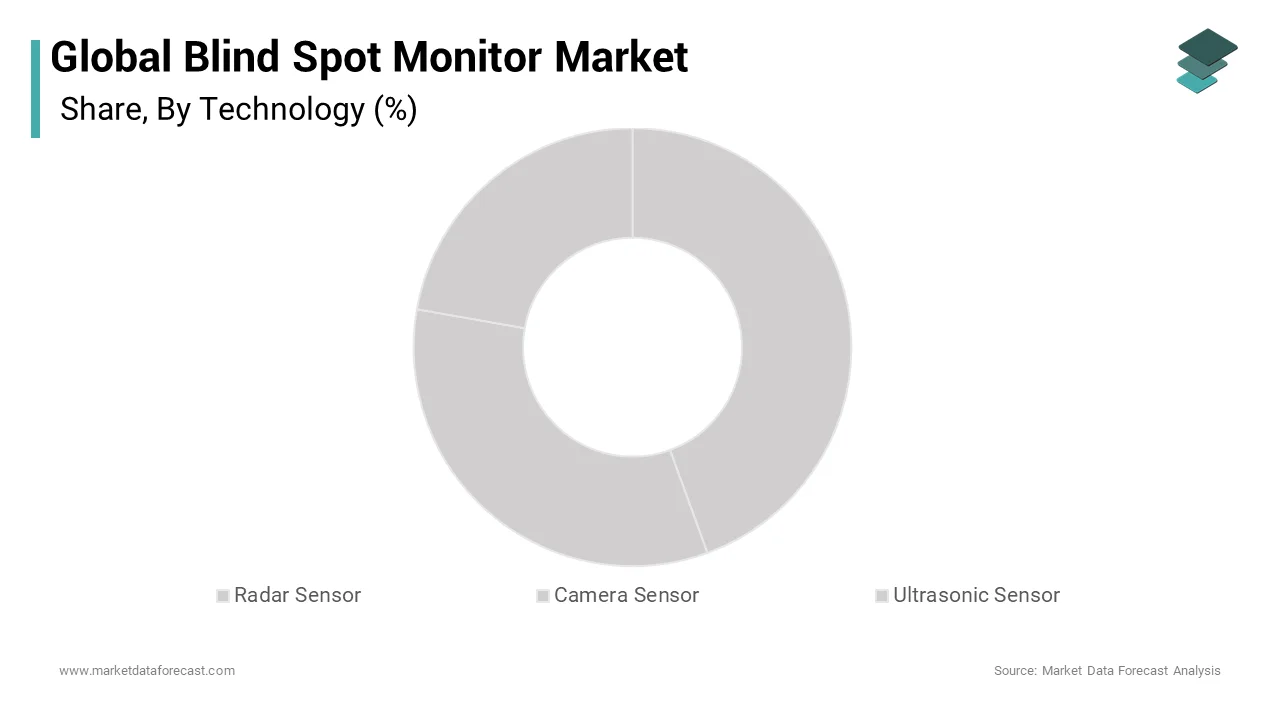
The camera based segment is expected to grow at a fastest CAGR of 8.5% from 2026 to 2034 with the advancements in artificial intelligence and computer vision algorithms. The increasing integration of cameras for multiple driver assistance functions, allowing automakers to leverage existing hardware for blind spot detection thereby reducing overall system costs. This synergy enables more comprehensive environmental perception, as cameras provide rich visual data that can be processed to identify not just vehicles but also pedestrians cyclists and other vulnerable road users. The development of high dynamic range cameras and improved image processing chips has enhanced performance in challenging lighting conditions addressing previous limitations. The camera-based systems offer intuitive visual feedback through dashboard displays or side mirrors, which many drivers find easier to interpret than auditory alerts alone. Furthermore, the push toward higher levels of autonomy requires detailed visual mapping of the surroundings making camera based solutions essential for future vehicle architectures.
By Product Insights
The blind spot detection system segment was accounted in holding 38.9% of the blind spot monitor market share in 2025 due to its direct alignment with core safety mandates and consumer demand for collision avoidance technologies. The fundamental role these systems play in preventing lane change accidents, which constitute a significant proportion of roadway collisions. Automakers prioritize blind spot detection, as a standalone feature because it offers immediate tangible safety benefits without requiring complex integration with other vehicle control systems. The simplicity of installation and calibration compared to park assist or backup camera systems also contributes to its widespread adoption across various vehicle platforms. The blind spot monitoring is among the top three desired safety features for new car buyers surpassing many other advanced driver assistance options. This high consumer preference encourages manufacturers to include blind spot detection as standard equipment even in entry level models to enhance competitiveness. Furthermore, regulatory frameworks in Europe and North America increasingly mandate specific safety features that align closely with blind spot detection capabilities ensuring sustained demand.
The park assist system segment is likely to grow at a fastest CAGR of 9.2% from 2026 to 2034 with the urbanization trends and the increasing complexity of parking environments in densely populated areas. The rising number of vehicles on the road coupled with limited parking space in metropolitan cities, which increases the risk of minor collisions during parking maneuvers. Park assist systems utilize a combination of ultrasonic sensors cameras and sometimes radar to provide comprehensive guidance during parallel and perpendicular parking tasks. Consumer surveys indicate that over 60% of drivers feel anxious when parking in confined spaces making park assist an attractive feature for enhancing convenience and confidence. Additionally, the integration of park assist with remote parking capabilities via smartphone applications is emerging as a premium feature in luxury vehicles further accelerating market growth.
By Vehicle Insights
The passenger vehicles segment was accounted in holding 38.2% of the blind spot monitor market share in 2025 due to the high volume of production and stringent safety regulations targeting personal transportation. This vast production base provides a substantial installed base for blind spot monitoring technologies, as manufacturers strive to meet competitive benchmarks and regulatory requirements. Consumer awareness regarding vehicle safety has reached unprecedented levels with buyers actively seeking advanced driver assistance systems as key differentiators when purchasing new cars. The cost of implementing blind spot monitoring in passenger vehicles has decreased significantly due to mass production and technological maturation, making it feasible for mainstream models. The passenger vehicles with blind spot monitoring have lower accident rates, which translates to reduced insurance premiums for owners creating a compelling economic incentive.
The light commercial vehicles segment is expected to grow at a fastest CAGR of 7.8% during the forecast period with the expansion of e-commerce and last mile delivery services. The surge in online shopping has led to a significant increase in the number of delivery vans and light trucks on the road, which operate frequently in congested urban environments with high pedestrian traffic. Fleet operators are increasingly adopting blind spot monitors to reduce accident rates and associated liability costs as commercial vehicles are involved in a disproportionate number of urban incidents. The large and medium sized trucks are involved in numerous fatal crashes annually with blind spots being a contributing factor in many cases. This statistical reality prompts logistics companies to invest in safety technologies to protect their assets and drivers. Furthermore, regulatory bodies in Europe and North America are introducing stricter safety standards for commercial vehicles mandating the inclusion of advanced driver assistance systems.
REGIONAL ANALYSIS
North America Market Analysis
North America was the top performer in the global blind spot monitor market by capturing 44.3% of the share in 2025 with the high consumer adoption rates and rigorous safety regulations. The region benefits from a mature automotive industry and a strong culture of vehicle safety awareness among consumers. The United States sees millions of vehicle crashes annually with lane change accidents representing a significant portion, which drives the demand for preventive technologies. The presence of major automotive manufacturers and technology providers in the region facilitates rapid innovation and deployment of advanced blind spot monitoring systems. Furthermore, the regulatory environment in Canada and the United States continues to evolve with proposals for mandatory advanced driver assistance systems in new vehicles.
Europe Market Analysis
Europe blind spot monitor market was ranked second by holding 33.2% of share in 2025 with the stringent regulatory frameworks and a strong emphasis on road safety initiatives. The European Union has implemented some of the most comprehensive vehicle safety regulations globally including the General Safety Regulation, which mandates advanced driver assistance systems for all new vehicles. According to the European Commission, road fatalities in the EU have decreased significantly over the past decade but the goal is to reduce them by 50% by 2030, which necessitates widespread adoption of technologies like blind spot monitoring. Euro NCAP ratings heavily influence consumer purchasing decisions in Europe with vehicles achieving high scores only if they include comprehensive safety features. The dense urban infrastructure and mixed traffic conditions in European cities, also increase the relevance of blind spot monitors for preventing accidents involving cyclists and pedestrians. Furthermore, the presence of leading automotive manufacturers in Germany, France, and Italy fosters continuous innovation in sensor technologies.
Asia Pacific Market Analysis
Asia Pacific blind spot monitor market growth is likely to have a prominent growth opportunities throughout the forecast period with the increasing vehicle production and rising consumer awareness in countries like China, India, and Japan. In China, the government has introduced new safety standards that encourage the adoption of advanced driver assistance systems in domestically produced vehicles. Japan has long been a pioneer in automotive safety technology with manufacturers like Toyota and Honda integrating blind spot monitors into a wide range of models. The road traffic injuries are a leading cause of death in many Asian countries prompting governments to promote safer vehicle technologies. Furthermore, the expansion of multinational automotive brands in the region brings advanced safety features to local areas.
Latin America Market Analysis
Latin America blind spot monitors market growth is likely to grow with the potential linked to economic stability and increasing automotive sales in key countries like Brazil and Mexico. The region faces significant challenges related to road safety with high accident rates prompting gradual improvements in vehicle safety standards. In Brazil, the Latin NCAP program has been instrumental in raising awareness about vehicle safety and encouraging manufacturers to include advanced features like blind spot monitoring to achieve higher ratings. However, economic fluctuations and price sensitivity remain barriers to widespread adoption in lower income segments. Government initiatives to improve road infrastructure and enforce traffic laws are also contributing to a safer driving environment, which supports the gradual uptake of blind spot monitoring technologies in the region.
Middle East and Africa Market Analysis
The Middle East and Africa blind spot monitor market growth is driven by luxury vehicle preferences in the Gulf states and gradual safety improvements in African nations. In countries like the United Arab Emirates and Saudi Arabia, high disposable incomes and a preference for premium vehicles ensure strong demand for advanced safety features including blind spot monitoring. There is a growing emphasis on vehicle safety standards that align with international best practices. The harsh driving conditions and high speeds on highways in the Middle East make blind spot monitors particularly valuable for preventing accidents. The Africa has the highest road traffic fatality rate globally, which is prompting calls for safer vehicles. However, affordability and lack of strict enforcement of safety regulations limit the widespread adoption of advanced technologies.
COMPETITIVE LANDSCAPE
The competition in the blind spot monitor market is characterized by intense rivalry among established automotive suppliers and emerging technology firms striving to innovate and capture market share. Major players compete primarily on the basis of technological superiority cost efficiency and integration capabilities with existing vehicle architectures. Companies are also focusing on developing software driven solutions that leverage artificial intelligence to enhance object recognition and decision-making processes. Strategic alliances between hardware manufacturers and software developers are common as firms seek to create comprehensive safety ecosystems. Price competition remains significant particularly in the mid-range vehicle segment, where cost sensitivity is high. Regulatory compliance serves as another critical competitive factor as manufacturers must ensure their systems meet stringent safety standards in various regions. The entry of new players specializing in computer vision and machine learning adds further pressure on traditional suppliers to adapt and innovate rapidly. This dynamic environment drives continuous improvement in product quality and functionality benefiting consumers through safer and more reliable vehicles.
KEY MARKET PLAYERS
A few of the market players in the global blind spot monitor market
- Continental AG
- Denso Corporation
- Robert Bosch
- Bosch
- Delphi Automotive
- Autoliv Inc.
- ZF TRW
- ZF Friedrichshafen
- Xiamen Autostar Electronics
- Auto-i Corp
- Valeo S.A.
- Ficosa International
- Preco Electronics
Top Players In The Global Market
- Bosch is a leading supplier of automotive technology that significantly influences the blind spot monitor market through its advanced radar and camera systems. The company focuses on integrating artificial intelligence into its sensor suites to enhance detection accuracy and reduce false alarms. Bosch recently expanded its production capabilities for semiconductor components to ensure a stable supply chain for its driver assistance systems. This strategic move allows the company to meet the growing demand from automakers worldwide who seek reliable and scalable safety solutions. By collaborating closely with major vehicle manufacturers, Bosch continues to innovate its blind spot monitoring technologies to support higher levels of autonomous driving. Their commitment to research and development ensures they remain at the forefront of technological advancements in vehicle safety and sensor fusion capabilities.
- Continental AG plays a pivotal role in the blind spot monitor market by providing comprehensive sensor solutions, including radar ultrasonic and camera technologies. The company emphasizes the development of modular systems that can be easily integrated into various vehicle platforms ranging from compact cars to heavy duty trucks. Continental recently launched a new generation of short-range radar sensors that offer improved resolution and wider detection angles. This innovation enhances the performance of blind spot monitoring in complex urban environments. The company also invests heavily in software development to enable over the air updates for its safety systems.
- ZF Friedrichshafen is a prominent player in the automotive industry known for its robust portfolio of driver assistance systems including blind spot monitors. The company leverages its expertise in chassis and powertrain technology to create holistic safety solutions that integrate seamlessly with vehicle dynamics. ZF recently introduced a centralized electronic architecture that consolidates data from multiple sensors to provide a unified view of the vehicle surroundings. This approach improves the reliability and response time of blind spot warnings. The company also partners with technology firms to incorporate machine learning algorithms into its systems. These efforts enable ZF to offer sophisticated blind spot monitoring capabilities that adapt to different driving conditions and user preferences thereby enhancing overall road safety and driver confidence.
Top Strategies Used By Key Market Participants
Key players in the blind spot monitor market primarily focus on strategic partnerships and collaborations to enhance their technological capabilities and expand their reach. Companies frequently engage in joint ventures with semiconductor manufacturers to secure supply chains and accelerate the development of advanced sensor chips. Another major strategy involves significant investment in research and development to innovate sensor fusion algorithms that improve detection accuracy and reduce false positives. Additionally, firms are increasingly adopting software defined vehicle architectures to enable over the air updates, which allow for continuous improvement of blind spot monitoring features post purchase. Expansion into emerging markets through local manufacturing facilities helps companies reduce costs and comply with regional regulations.
MARKET SEGMENTATION
This research report on the global blind spot monitor market has been segmented and sub-segmented based on application, type, product, and region
By Component:
- Sensor
- Display Unit
- Control Unit
By Technology:
- Radar Sensor
- Camera Sensor
- Ultrasonic Sensor
By Vehicle Type:
- Passenger Car
- Light Commercial Vehicle
- Heavy Commercial Vehicle
By Electric Vehicle Type:
- Battery Electric Vehicle (BEV)
- Hybrid Electric Vehicle (HEV)
- Plug-in Hybrid Electric Vehicle (PHEV)
By System Type:
- Blind Spot Detection (BSD)
- Blind Spot Intervention (BSI)
By Application:
- Passenger Cars
- Commercial Vehicles
By Region
- North America
- Europe
- Asia Pacific
- Latin America
- Middle East and Africa