- Product Description Description
- Table of Contents TOC
- List of Table & Figure LOT
- Get Free Sample PDF Sample PDF
Market Size, 2025
$85.03 BnMarket Estimate, 2026
$90.56 BnMarket Forecast, 2034
$149.88 BnCAGR, 2026–2034
6.50%Executive Summary: Global Butanes Market
- Market Scope: Comprehensive global analysis of the butanes market segmented by type, application, end-user, and regional/country-level markets.
- Market Valuation: Valued at USD 85.03 billion in 2025, estimated at USD 90.56 billion in 2026, and projected to reach USD 149.88 billion by 2034, growing at a compound annual growth rate (CAGR) of 6.50% from 2026 to 2034.
- Primary Growth Drivers: Rapid expansion of petrochemical industries in emerging economies (Asia and the Middle East), surging demand for high-octane fuels (alkylation in transportation), rising adoption of LPG in off-grid/rural areas for clean cooking, and increased usage of butane in green refrigerant formulations (e.g., R600a).
Key Market Segment Metrics (2026–2034)
| Category | Leading Segment Focus | Detailed Taxonomy & Sub-Segments |
|---|---|---|
| By Type | n-Butane (57.6% market share in 2025) / Iso-butane (Fastest-growing at 5.4% CAGR) | n-Butane & Iso-butane |
| By Application | Liquefied Petroleum Gas (LPG - 59.4% share in 2025) / Petrochemicals (Fastest-growing at 5.8% CAGR) | Liquefied Petroleum Gas (LPG) & Petrochemicals |
| By Region Focus | North America (Largest regional share at 28.2% in 2025) & Asia-Pacific (Key growth engine) | North America, Europe, Asia-Pacific (APAC), Latin America, & Middle East & Africa (MEA) |
Regional Insights & Market Dynamics
North America & Asia-Pacific: North America leads the global market supported by abundant NGLs from shale gas extraction and extensive Gulf Coast petrochemical operations. Meanwhile, Asia-Pacific serves as a primary growth hub driven by massive chemical processing capacity expansion in China, India, and Southeast Asia.
Market Restraints & Challenges: Volatility in upstream crude oil and natural gas prices, stringent environmental regulations governing flammability and greenhouse gas emissions (e.g., EU REACH, F-Gas), inherent safety risks, and regulatory divergences across regions.
Key Market Leaders Profiled: Exxon Mobil Corporation, Royal Dutch Shell, China Petroleum & Chemical Corporation (Sinopec), British Petroleum Plc, Chevron, Total S.A., ConocoPhillips, China National Petroleum Corporation (CNPC), Bharat Petroleum Corporation Limited, and Indian Oil Corporation Ltd.
Global Butanes Market Size
The global butanes market was worth USD 85.03 billion in 2025. The global market is expected to reach USD 149.88 billion by 2034 from USD 90.56 billion in 2026, rising at a CAGR of 6.50% from 2026 to 2034.
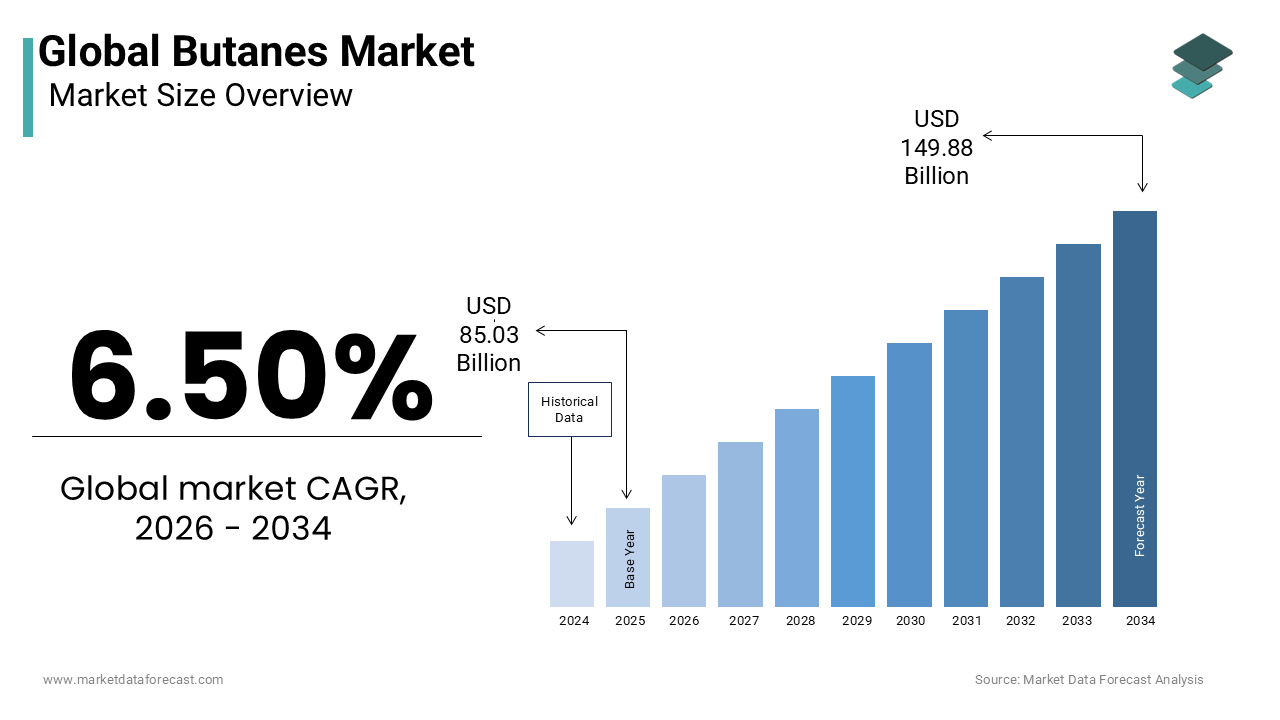
The butanes market encompasses the production, distribution, and application of two primary isomers: n-butane and isobutane. These hydrocarbons are derived from crude oil refining and natural gas processing and serve as critical feedstocks across various industrial sectors. N-butane is predominantly used in the petrochemical industry for the production of ethylene and butadiene, key intermediates in polymer manufacturing. Isobutane, on the other hand, plays a crucial role in alkylation processes within refineries to produce high-octane gasoline components and serves as a raw material in the synthesis of propylene oxide and methyl tertiary butyl ether (MTBE). The global demand for butanes has seen steady growth, driven by expanding applications in the chemical, energy, and refrigeration sectors. In the United States, the shale gas boom has significantly increased the availability of natural gas liquids, including butanes, enhancing domestic supply and export capabilities In addition to traditional uses, butanes are increasingly being utilized in emerging applications such as green refrigerants and aerosol propellants, replacing more environmentally harmful substances like chlorofluorocarbons (CFCs).
MARKET DRIVERS
Expansion of Petrochemical Industries in Emerging Economies
One of the most significant drivers of the butanes market is the rapid expansion of petrochemical industries in emerging economies, particularly in Asia and the Middle East. Countries like India, China, Saudi Arabia, and Indonesia are investing heavily in downstream chemical infrastructure to meet growing domestic and international demand for polymers, synthetic rubbers, and solvents, many of which rely on butane derivatives According to the American Chemistry Council (ACC), the global ethylene production capacity is expected to grow by more than 45 million metric tons between 2023 and 2030, with over half of this increase coming from Asia and the Gulf region. Ethylene, produced via steam cracking of n-butane, is a foundational building block for polyethylene plastics used extensively in packaging, automotive, and consumer goods In Saudi Arabia, the government-backed SABIC has expanded its butadiene extraction capacity using n-butane as a feedstock, aligning with Vision 2030 goals to diversify beyond crude exports. Similarly, Indian refiners like Reliance Industries and Indian Oil Corporation have ramped up butane fractionation units to support domestic polymer manufacturing This industrial shift toward integrated refining and chemical complexes is significantly boosting butane consumption. With governments prioritizing self-sufficiency in chemicals and materials, the demand for butane as a petrochemical feedstock is expected to remain robust.
Rising Demand for High-Octane Fuels in the Transportation Sector
Another key driver of the butanes market is the increasing demand for high-octane fuels in the transportation sector, particularly isobutane’s role in alkylation units at oil refineries. Alkylate, a product of isobutane and butylene reaction, is a clean-burning, high-octane blending component essential for producing premium gasoline that meets stringent environmental regulations.As per the U.S. Energy Information Administration (EIA), global gasoline demand is projected to rise steadily through 2030, especially in developing economies where vehicle ownership rates are increasing. In response, refineries in the Middle East, Latin America, and Southeast Asia are upgrading their alkylation capacities to enhance fuel quality and reduce emissions In the UAE, ADNOC has invested over USD 1.2 billion in modernizing its Ruwais refinery, incorporating advanced alkylation technology that utilizes higher volumes of isobutane Moreover, regulatory mandates aimed at reducing benzene and sulfur content in gasoline are pushing refiners to blend more alkylate into finished fuels. With continued emphasis on cleaner transportation fuels, the demand for isobutane in alkylation remains a strong growth pillar for the butanes market.
MARKET RESTRAINTS
Volatility in Crude Oil and Natural Gas Prices
A major restraint affecting the butanes market is the volatility in crude oil and natural gas prices, which directly influences feedstock availability and pricing dynamics. Since butanes are primarily extracted as byproducts of crude refining and natural gas processing, fluctuations in upstream production levels and commodity prices significantly impact their supply chain. These fluctuations led to inconsistent investment in exploration and production activities, causing intermittent disruptions in butane supply. For example, in North America, the decline in shale drilling activity during periods of low oil prices resulted in reduced natural gas liquids (NGLs) output, including butanes. According to the U.S. Energy Information Administration (EIA), a 9% drop in NGL production in early 2021 was due to lower rig counts and capital constraints among independent producers. Additionally, geopolitical tensions in key oil-producing regions such as the Middle East and Eastern Europe have contributed to price instability. A sudden embargo or supply cut can lead to sharp increases in butane costs, affecting downstream users such as petrochemical manufacturers and refiners. Given the dependency of the butanes market on stable upstream conditions, ongoing geopolitical uncertainty and fluctuating energy prices continue to pose significant challenges to long-term planning and investment decisions.
Environmental Regulations Limiting Use in Certain Applications
Environmental regulations restricting the use of butanes in certain applications present another major challenge to market growth. Although butanes are relatively clean hydrocarbons compared to older alternatives, concerns over flammability risks and indirect greenhouse gas effects have prompted stricter oversight in some regions. In the European Union, directives under the REACH regulation and the F-Gas Regulation have placed limitations on the use of hydrocarbon refrigerants, including butane blends, despite their low global warming potential. According to the European Chemicals Agency (ECHA), safety concerns related to flammability have led to restrictions on butane-based refrigerants in large-scale commercial installations, limiting their adoption despite energy efficiency benefits. Similarly, in the United States, the Environmental Protection Agency (EPA) has imposed labeling and handling requirements for aerosol products containing butane, citing fire hazard risks. While these regulations do not outright ban butane usage, they increase compliance costs for manufacturers, potentially discouraging new product development in regulated sectors. Furthermore, the phase-out of hydrofluorocarbon (HFC)-based refrigerants has created an opening for butane-based alternatives; however, slow regulatory approvals and varying regional standards hinder widespread adoption. For instance, while countries like India and Brazil have embraced butane-based refrigerants in household appliances, others remain cautious.
MARKET OPPORTUNITIES
Growing Use of Butane in Green Refrigerant Formulations
One of the most promising opportunities for the butanes market lies in its increasing use in green refrigerant formulations as a sustainable alternative to synthetic refrigerants with high global warming potential (GWP). Hydrocarbon refrigerants, particularly propane (R290) and isobutane (R600a), offer superior thermodynamic properties and minimal environmental impact, making them ideal candidates for next-generation cooling systems. According to the United Nations Environment Programme (UNEP), the global transition away from hydrofluorocarbons (HFCs) under the Kigali Amendment is accelerating, creating favorable conditions for hydrocarbon-based refrigerants. China, in particular, has emerged as a leader in adopting isobutane-based refrigerants. As per data from the China Household Electrical Appliances Association (CHEAA), more than 85% of domestic refrigerators manufactured in the country now use R600a, driven by both regulatory incentives and cost advantages. This trend is gradually spreading to other regions, including South America and parts of Africa, where energy-efficient and affordable cooling solutions are in high demand. Additionally, leading appliance manufacturers such as Whirlpool, Electrolux, and Haier have committed to scaling up the use of butane-based refrigerants in their global product lines.
Increasing Demand for Liquefied Petroleum Gas (LPG) in Rural and Off-Grid Areas
The rising demand for liquefied petroleum gas (LPG), of which butane is a key component, in rural and off-grid areas presents a substantial opportunity for the butanes market. As governments worldwide push for cleaner cooking fuels to replace biomass and coal, LPG adoption has surged, particularly in developing economies across Asia, Africa, and Latin America. According to the World Bank, approximately 2.4 billion people globally still rely on solid fuels for cooking, contributing to indoor air pollution and health risks. To address this issue, several national programs have been launched to promote LPG access. In Sub-Saharan Africa, the African Development Bank (AfDB) estimates that less than 20% of the population has access to clean cooking fuels. However, initiatives like the Clean Cooking Alliance are working with private sector players to expand LPG distribution networks, particularly in Nigeria, Kenya, and Ethiopia. Moreover, the use of butane-enriched LPG in portable camping stoves, recreational vehicles, and emergency heating systems is also gaining traction in developed markets. With increasing focus on energy access and sustainability, the butanes market is well-positioned to benefit from this expanding LPG ecosystem.
MARKET CHALLENGES
Safety Concerns Due to the Flammability of Butane
One of the foremost challenges facing the butanes market is the inherent safety risk associated with butane’s high flammability. As a volatile hydrocarbon, butane poses hazards in storage, transportation, and end-use applications, necessitating stringent handling protocols and regulatory oversight. These safety concerns act as a barrier to broader adoption, particularly in densely populated urban environments and industrial settings where fire risks are a major liability. According to the U.S. Chemical Safety and Hazard Investigation Board (CSB), incidents involving hydrocarbon leaks and explosions have led to multiple industrial accidents over the past decade. Such incidents reinforce the need for costly infrastructure upgrades and enhanced worker training, adding financial pressure on companies utilizing butane. Besides, public perception of butane-related risks has influenced regulatory policies in some jurisdictions. In parts of Europe, local authorities have restricted the use of butane-based aerosols and refrigerants in residential buildings due to fire safety concerns. While technological advancements in leak detection and safer system design are helping mitigate these risks, the persistent association of butane with combustion dangers continues to limit its acceptance in certain high-risk applications, posing a major challenge to market expansion.
Regulatory Hurdles and Compliance Costs Across Regions
Regulatory divergence and increasing compliance costs across different regions represent a significant challenge for the butanes market. Unlike standardized commodities, butane applications are subject to a complex web of national and international regulations governing safety, environmental impact, and industrial use, complicating global trade and production strategies. In the United States, the Environmental Protection Agency (EPA) regulates butane under the Toxic Substances Control Act (TSCA) and enforces strict guidelines on its use in consumer products. Similarly, the Occupational Safety and Health Administration (OSHA) imposes workplace exposure limits and handling procedures, increasing operational costs for manufacturers. Emerging markets face their own set of regulatory inconsistencies. In India, state-level variations in LPG licensing and cylinder distribution create logistical complexities for butane suppliers. Meanwhile, in parts of Africa, weak enforcement mechanisms and a lack of standardized codes result in informal market proliferation, undermining formal sector growth. These regulatory disparities force multinational butane suppliers to adapt their operations to each jurisdiction, increasing administrative burdens and compliance expenditures.
REPORT COVERAGE
| REPORT METRIC | DETAILS |
| Market Size Available | 2025 to 2034 |
| Base Year | 2025 |
| Forecast Period | 2026 to 2034 |
| CAGR | 6.50% |
| Segments Covered | By Type, Application, End User, and Region. |
| Various Analyses Covered | Global, Regional and Country Level Analysis, Segment-Level Analysis, DROC, PESTLE Analysis, Porter’s Five Forces Analysis, Competitive Landscape, Analyst Overview of Investment Opportunities |
| Regions Covered | North America, Europe, APAC, Latin America, Middle East & Africa |
| Market Leaders Profiled | Exxon Mobil Corporation, Royal Dutch Shell, China Petroleum & Chemical Corporation (Sinopec), British Petroleum Plc, Chevron, Total S.A., ConocoPhillips, China National Petroleum Corporation (CNPC), Bharat Petroleum Corporation Limited, Indian Oil Corporation Ltd, and Others. |
MARKET SEGMENTATION
By Type Insights
Among the two primary types of butane, n-butane dominates the global market with a share of 57.6% in 2025. This dominance is primarily driven by its extensive use in petrochemical applications, particularly for the production of ethylene and butadien key intermediates in polymer manufacturing.
One of the major growth drivers for n-butane is the rising demand for polyethylene, which is widely used in packaging, automotive components, and consumer goods. In countries like China and India, where plastic consumption is growing rapidly, n-butane utilization in olefin plants has seen a marked increase.
Additionally, n-butane serves as a crucial feedstock in the production of maleic anhydride, which is used in resins, lubricant additives, and agricultural chemicals. Furthermore, the shale gas boom in North America has significantly boosted n-butane availability, making it more cost-effective compared to alternative feedstocks.
Although smaller in volume than n-butane, iso-butane is the fastest-growing segment, projected to expand at a CAGR of 5.4%. This growth is fueled by increasing demand in refinery alkylation units and the production of high-octane gasoline blends.
Iso-butane plays a critical role in alkylation processes that produce alkylate, a clean-burning, high-octane component essential for modern gasoline formulations.
Moreover, iso-butane is a key raw material in the synthesis of methyl tertiary butyl ether (MTBE), a gasoline additive used to enhance octane levels and reduce emissions.
Another emerging application driving iso-butane demand is its use in green refrigerants. The adoption of R600a (isobutane) in domestic refrigeration systems continues to rise, especially in Europe and Asia. With continued emphasis on cleaner fuels and sustainable refrigerants, iso-butane is poised for sustained growth across multiple industries.
By Application Insights
The liquefied petroleum gas (LPG) segment held the largest share of the butanes market, accounting for 59.4% of total consumption in 2025. This dominance is primarily attributed to the widespread use of LPG for residential cooking, commercial heating, and rural electrification initiatives, particularly in developing economies.
A key driver behind this segment’s leadership is the global push toward cleaner cooking fuels. Besides, the use of LPG in off-grid and remote areas is gaining traction.
Beyond household use, LPG also finds application in industrial sectors such as food processing, ceramics, and metal fabrication, where reliable and clean energy sources are required. With increasing urbanization and energy transition policies favoring low-carbon fuels, the LPG segment remains the dominant application area for butanes.
The petrochemicals segment is anticipated to register the highest growth rate in the butanes market, with a projected CAGR of 5.8%. This rapid expansion is primarily driven by the increasing demand for polymers, synthetic rubbers, and chemical intermediates that rely on butane derivatives.
One of the key growth factors is the expansion of ethylene production through the steam cracking of n-butane. Countries like Saudi Arabia, China, and India are investing heavily in integrated refining and petrochemical complexes to support domestic plastic and fiber manufacturing.
Moreover, the production of butadiene a derivative of n-butane is gaining momentum due to its use in synthetic rubber for the automotive industry.
In addition, iso-butane is increasingly being used in the manufacture of propylene oxide via the PO/TBA (propylene oxide/tert-butyl alcohol) process. As industrialization accelerates in emerging markets and chemical production shifts toward butane-based feedstocks, the petrochemicals segment is set to outpace other applications in terms of growth.
REGIONAL ANALYSIS
North America Butanes Market Analysis
North America commanded the largest regional share of the global butanes market, contributing 28.2% of total consumption in 2025. The region’s dominance stems from its abundant supply of natural gas liquids (NGLs), particularly from shale gas extraction, which provides a steady stream of butane for both domestic use and export.
One of the primary drivers of butane demand in North America is its utilization in the petrochemical sector. Ethylene crackers in the Gulf Coast, such as those operated by ExxonMobil and Chevron Phillips Chemical, rely heavily on n-butane as a feedstock for producing polyethylene.
Additionally, the region sees significant use of butane in blending with motor gasoline to enhance vapor pressure during colder months. Refineries in Texas and Louisiana routinely adjust butane content in gasoline formulations to comply with seasonal specifications.s
Asia-Pacific Butanes Market Analysis
Asia-Pacific is a lucrative market. The region’s rapid industrialization, coupled with strong demand for petrochemicals and LPG, underpins its robust market position.
China is the largest consumer within the region, driven by its massive chemical industry. State-run refiners such as Sinopec and PetroChina have expanded butane fractionation and olefin production capabilities.
India, too, has emerged as a key player, particularly in the LPG sector. Government initiatives like Pradhan Mantri Ujjwala Yojana have played a pivotal role in scaling up consumption. Meanwhile, Japan and South Korea continue to import substantial volumes of butane for use in refineries and chemical complexes. With growing investment in downstream processing and energy transition strategies favoring cleaner fuels, Asia-Pacific remains a dynamic and fast-expanding market for butanes.
Middle East & Africa Butanes Market Analysis
The Middle East and Africa collectively account for a notable share of the global butanes market. The region’s market is primarily driven by its vast oil and gas reserves, which provide ample feedstock for butane extraction and downstream utilization.
Saudi Arabia leads the region in butane production and consumption, leveraging its status as one of the world’s top crude oil producers. The Saudi Basic Industries Corporation (SABIC) operates several butane-based petrochemical complexes, producing ethylene, butadiene, and polyethylene.
The UAE is another key contributor. Abu Dhabi’s Ruwais Industrial Complex is expanding its butane-fed polyethylene production capacity to meet growing demand in the GCC and beyond.
In Africa, butane demand is primarily linked to LPG usage, particularly in Nigeria, Kenya, and Egypt. With abundant upstream resources and increasing downstream investments, the MEA region remains a strategically important market for butanes.
Europe Butanes Market Analysis
Europe contributes a descent share in the market. The region’s market is characterized by mature refining infrastructure, stringent environmental regulations, and a growing focus on sustainable applications for butane.
One of the main growth drivers in Europe is the increasing use of isobutane in refrigeration systems. Besides, butane plays a vital role in the production of high-octane gasoline blends through alkylation units. Refineries in Germany, France, and the Netherlands have upgraded their alkylation capacities to comply with Euro VI emission standards. While industrial demand remains stable, residential LPG consumption is gradually declining in Western Europe due to electrification and renewable energy adoption. However, Eastern European countries such as Poland and Romania continue to see growth in LPG cylinder usage, particularly in rural areas.
Latin America Butanes Market Analysis
Latin America accounts for a portion of the global butanes market. The region’s market is driven by a combination of LPG expansion, refining activities, and growing petrochemical demand, particularly in Brazil, Mexico, and Argentina.
Brazil stands out as the largest consumer in the region, with butane-rich LPG serving as a primary cooking fuel for millions of households. Mexico, on the other hand, is focusing on expanding its petrochemical base. Pemex and private refiners are investing in butane-fed olefin units to boost domestic plastic production. Argentina is also witnessing growth in LPG demand, particularly in urban and semi-rural regions where pipeline gas coverage is limited. The Argentine government has introduced subsidies to promote LPG as a cleaner alternative to firewood and kerosene.
COMPETITIVE LANDSCAPE
The competition in the butanes market is shaped by the presence of large, vertically integrated energy and chemical companies alongside regional LPG suppliers and specialty chemical producers. Global giants dominate due to their access to upstream resources, established refining capabilities, and extensive distribution networks. However, regional players are gaining traction by offering cost-effective butane solutions tailored to local market needs, particularly in the LPG and small-scale petrochemical sectors. The market remains highly dynamic, influenced by fluctuations in crude oil and natural gas prices, regulatory changes, and shifting end-use demand patterns. Innovation continues to be a critical differentiator, with companies investing in cleaner fuel formulations, green refrigerants, and more efficient processing technologies to stay competitive. Strategic alliances, joint ventures, and capacity expansions are commonly used tactics to secure long-term market positions. As the world transitions toward sustainable energy sources, the ability to adapt to evolving environmental standards and diversify product offerings will determine future success in this sector.
KEY MARKET PLAYERS
Some of the key market players include
- Exxon Mobil Corporation
- Royal Dutch Shell
- China Petroleum & Chemical Corporation (Sinopec)
- British Petroleum Plc
- Chevron
- Total S.A.
- ConocoPhillips
- China National Petroleum Corporation (CNPC)
- Bharat Petroleum Corporation Limited
- Indian Oil Corporation Ltd
Top Players in the Butane Market
ExxonMobil Corporation
ExxonMobil is a leading global player in the butanes market, leveraging its extensive refining and petrochemical infrastructure to supply high-quality n-butane and iso-butane for industrial applications. The company plays a crucial role in supplying butane feedstock for ethylene and butadiene production, which are essential for polymer manufacturing. Through its integrated downstream operations, ExxonMobil supports large-scale chemical and fuel production across North America, Europe, and Asia. Its commitment to innovation and sustainability has enabled it to maintain a strong presence in both traditional and emerging markets.
Royal Dutch Shell plc
Shell is a key participant in the butanes market, with a strong focus on natural gas processing and LPG distribution. The company supplies butane-rich LPG blends for residential, commercial, and industrial use, particularly in developing economies where clean cooking fuels are in high demand. Shell’s global logistics network ensures efficient transportation and storage of butane products, supporting energy transition initiatives in various regions. Additionally, the company integrates butane into its refining operations to produce cleaner-burning gasoline components, reinforcing its strategic position in the market.
Sinopec Corporation
Sinopec is one of the largest consumers and distributors of butane in Asia, playing a pivotal role in the region's expanding petrochemical and LPG sectors. The company utilizes butane as a feedstock in its olefin plants and also blends it into motor fuels to meet domestic and export demands. With a vast network of refineries and chemical complexes, Sinopec contributes significantly to butane-based product development and market expansion in China and neighboring countries. Its investments in downstream integration further strengthen its leadership in the butanes market.
Top Strategies Used by Key Market Participants
One of the primary strategies employed by major players in the butanes market is expanding downstream integration through refinery and petrochemical complex upgrades. Companies are investing heavily in advanced processing units that maximize butane utilization for high-value products such as ethylene, butadiene, and alkylate. This not only enhances profitability but also strengthens supply chain resilience.
Another key approach is enhancing LPG logistics and distribution networks, especially in emerging markets. Leading firms are deploying modern storage solutions, cylinder exchange programs, and digital tracking systems to improve accessibility and safety in rural and off-grid areas. These efforts support government initiatives aimed at promoting clean cooking fuels and reducing indoor air pollution.
Lastly, companies are increasingly focusing on sustainability-driven product development, including the promotion of hydrocarbon refrigerants and cleaner gasoline blending components. By aligning with global environmental regulations and consumer preferences for low-carbon alternatives, industry leaders are positioning themselves at the forefront of the evolving butanes market landscape.
RECENT MARKET DEVELOPMENTS
- In January 2024, ExxonMobil announced the launch of a new butane fractionation unit at its Baytown refinery in Texas, aimed at enhancing the purity and availability of n-butane for downstream chemical production.
- In March 2024, Shell signed a long-term supply agreement with a major Southeast Asian LPG distributor to expand its butane exports to growing markets in Indonesia and the Philippines.
- In May 2024, Sinopec initiated a technology upgrade at its Maoming petrochemical complex to increase iso-butane extraction efficiency and support higher alkylate production for premium gasoline blending.
- In July 2024, ADNOC entered into a joint venture with a European chemical firm to develop a butane-based polyethylene facility in Abu Dhabi, strengthening its foothold in the Gulf petrochemicals market.
- In September 2024, TotalEnergies introduced a new line of butane-enriched LPG canisters designed for portable recreational use in Europe, targeting outdoor enthusiasts and camping equipment retailers.
MARKET SEGMENTATION
This research report on the global Butanes market is segmented and sub-segmented into the following categories.
By Type
- N-Butane
- Iso-Butane
By Application
- Liquefied Petroleum Gas (LPG)
- Petrochemicals
By End-User
- Commercial/Residential
- Industrial
- Engine Fuel
- Refineries
By Region
- North America
- Europe
- Asia Pacific
- Latin America
- Middle East & Africa