- Product Description Description
- Table of Contents TOC
- List of Table & Figure LOT
- Get Free Sample PDF Sample PDF
Market Size, 2025
$54.03 BnMarket Estimate, 2026
$57.17 BnMarket Forecast, 2034
$89.82 BnCAGR, 2026–2034
5.81%Global Calcium Carbonate Market Summary
The global calcium carbonate market was valued at USD 54.03 billion in 2025, is expected to reach USD 57.17 billion in 2026, and is projected to grow to USD 89.82 billion by 2034, expanding at a CAGR of 5.81% from 2026 to 2034. The growth of the global calcium carbonate market is driven by increasing demand in construction materials, rising use in paper and plastics production, growing industrial applications, and technological advancements in mining and processing.
Key Market Trends
- Expanding use of calcium carbonate in sustainable construction materials.
- Rising adoption in plastics and coatings industries as a filler material.
- Increasing demand in healthcare and food-grade applications.
- Shift towards nano-calcium carbonate for high-performance applications.
- Growth in Asia-Pacific infrastructure and manufacturing sectors.
Segmental Insights
- Based on type, the ground calcium carbonate segment dominated the global market in 2025.
- Based on application, the construction materials segment led the market by holding 45.2% of the share in 2025.
- Based on end-user industry, the construction industry accounted for 38.2% of the global calcium carbonate market share in 2025.
Regional Insights
- Asia Pacific was the largest contributor to the global calcium carbonate market, accounting for 48.2% of the share in 2025, supported by robust growth in infrastructure, paper, and plastics industries.
- North America showed strong demand driven by the paper and plastics industries.
- Europe experienced consistent adoption in paints, coatings, and industrial applications.
- Latin America and the Middle East & Africa are witnessing gradual growth with rising construction and industrialization activities.
Competitive Landscape
Prominent players in the global calcium carbonate market include AGSCO Corp., Carmeuse, Blue Mountain Minerals, GCCP Resources, GLC Minerals, LLC, Greer Limestone Company, Gulshan Polyols Ltd., ILC Resources, Imerys, Mineral Technologies, Mississippi Lime, Omya, Parchem Fine & Specialty Chemicals, and The National Lime & Minerals, Inc. These companies are investing in capacity expansion, product innovation, and eco-friendly production processes to strengthen their market position.
Global Calcium Carbonate Market Size
The global calcium carbonate market size was valued at USD 54.03 billion in 2025 and is expected to reach USD 89.82 billion by 2034 from USD 57.17 billion in 2026. The market is projected to grow at a CAGR of 5.81%.
Calcium carbonate is a naturally occurring mineral found in limestone, chalk, and marble, serves as a industrial raw material across sectors such as construction, paper, plastics, pharmaceuticals, and food. It exists in two primary forms ground calcium carbonate (GCC) and precipitated calcium carbonate (PCC) each tailored for specific applications based on purity, particle size, and surface properties. The mineral’s versatility is further emphasized by its use in environmental applications, including flue gas desulfurization, where over 200 million tons of limestone-derived calcium carbonate are consumed annually in Europe and North America alone, as documented by the European Industrial Minerals Association (IMA-Europe).
MARKET DRIVERS
Expanding Demand in the Construction Industry
The construction sector is developing economies experiencing rapid urbanization is escalating the growth of calcium carbonate market. Calcium carbonate is extensively used as a filler in cement, concrete, and asphalt, enhancing durability and reducing production costs. According to the International Energy Agency (IEA), global cement production reached 4.3 billion tons in 2023. This surge in cement manufacturing directly correlates with increased consumption of ground calcium carbonate, especially in ready-mix concrete formulations where filler efficiency improves compressive strength.
Rising Use in Plastics and Polymers Manufacturing
The integration of calcium carbonate as a functional filler in plastics and polymer composites has surged due to its ability to enhance mechanical properties while reducing material costs is enhancing the growth of calcium carbonate market. In polyvinyl chloride (PVC), polypropylene (PP), and polyethylene (PE), calcium carbonate improves impact resistance, dimensional stability, and processability. The shift toward lightweight automotive components has further accelerated adoption. For example, calcium carbonate-reinforced polymers are used in underbody panels and interior trims, which is contributing to fuel efficiency.
MARKET RESTRAINTS
Environmental Regulations on Quarrying and Dust Emissions
The extraction and processing of calcium carbonate are increasingly constrained by stringent environmental regulations targeting air quality and land degradation is restricting the growth of calcium carbonate market. Open-pit mining of limestone, the primary source of ground calcium carbonate, generates significant particulate matter, contributing to ambient PM10 and PM2.5 levels. As per the World Health Organization (WHO), over 99% of the global population breathes air exceeding safe PM2.5 thresholds, which is prompting governments to enforce tighter emission controls. These regulatory pressures are compelling producers to invest in enclosed processing units and electrostatic precipitators, which is delaying project approvals and limiting expansion in ecologically sensitive regions such as the karst landscapes of Southeast Asia.
Volatility in Energy and Transportation Costs
The calcium carbonate supply chain is highly sensitive to fluctuations in energy and freight expenses due to the energy-intensive nature of grinding, calcination, and transportation is major factor degrading the growth of calcium carbonate market. Calcination of limestone to produce calcium oxide or precipitated calcium carbonate requires sustained temperatures above 900°C, making kiln operations heavily dependent on natural gas or coal. According to the International Energy Agency (IEA), global industrial natural gas prices spiked by 45% between 2021 and 2022, peaking at $30 per million Btu in Europe during the winter of 2022–2023. This volatility directly impacts production margins, particularly for PCC manufacturers with limited access to alternative fuels. Furthermore, calcium carbonate’s low value-to-weight ratio renders it vulnerable to freight cost swings. As per the World Bank’s 2023 Logistics Performance Index, shipping costs for bulk minerals increased by 32% post-pandemic, with overland transport in Africa and South Asia accounting for up to 40% of final product cost.
MARKET OPPORTUNITIES
Growth in Eco-Friendly Building Materials
The shift toward sustainable construction is creating new avenues for calcium carbonate in green building applications. According to the Global Cement and Concrete Association (GCAA), over 400 low-carbon concrete projects were initiated globally in 2023, many utilizing calcium carbonate as a supplementary cementitious material to reduce clinker content. In Norway, the use of limestone calcined clay cement (LC3), which includes up to 15% calcium carbonate has reduced CO₂ emissions by 40% compared to traditional Portland cement, as validated by the Swiss Federal Laboratories for Materials Science and Technology (Empa).
Advancements in Nano-Calcium Carbonate for High-Performance Applications
The development of nano-sized calcium carbonate particles is unlocking transformative applications in advanced materials in biomedicine, electronics, and high-barrier packaging. Nano-calcium carbonate, with particle sizes below 100 nanometers, exhibits superior dispersion, opacity, and reinforcement capabilities. Furthermore, the European Chemicals Agency (ECHA) has approved several nano-calcium carbonate variants for use in medical devices, citing biocompatibility and controlled degradation.
MARKET CHALLENGES
Geographic Concentration of High-Quality Deposits
The commercially viable deposits with high purity and consistent composition are geographically limited, which is degrading the growth of calcium carbonate market. Only 15% of global limestone reserves meet the 98%+ calcium carbonate purity required for pharmaceutical and food-grade applications, as per the British Geological Survey (BGS). Major high-grade sources are concentrated in Europe (notably France and Germany), North America, and parts of China, forcing manufacturers in regions like Sub-Saharan Africa and Southeast Asia to import raw materials or accept lower specifications. In India, over 60% of domestic limestone is classified as non-metallurgical grade, necessitating costly beneficiation processes, according to the Indian Bureau of Mines. This uneven distribution complicates global supply resilience, particularly as demand for premium GCC and PCC rises.
Technological Barriers in Precipitated Calcium Carbonate Production
The synthesis of precipitated calcium carbonate (PCC) involves complex chemical processes carbonation, slaking, and precipitation, which is declining the growth of calcium carbonate market. These parameters dictate the final product’s performance in applications such as paper coating or pharmaceutical excipients. As per the American Chemical Society (ACS), achieving uniform particle size distribution below 2 microns demands advanced process automation and real-time analytics, which remain inaccessible to many mid-tier producers. Moreover, the capital expenditure for a state-of-the-art PCC plant exceeds $100 million, as noted by Wood Mackenzie in 2023, deterring new entrants.
REPORT COVERAGE
| REPORT METRIC | DETAILS |
| Market Size Available | 2025 to 2034 |
| Base Year | 2025 |
| Forecast Period | 2026 to 2034 |
| CAGR | 5.81% |
| Segments Covered | By Type, Application, End-User Industry, and Region |
| Various Analyses Covered | Global, Regional, & Country Level Analysis; Segment-Level Analysis; DROC; PESTLE Analysis; Porter’s Five Forces Analysis; Competitive Landscape; Analyst Overview of Investment Opportunities |
| Regions Covered | North America, Europe, APAC, Latin America, Middle East & Africa |
| Market Leaders Profiled | AGSCO Corp., Carmeuse, Blue Mountain Minerals, GCCP Resources, GLC Minerals, LLC, Greer Limestone Company, Gulshan Polyols Ltd., ILC Resources, Imerys, Mineral Technologies, Mississippi Lime, Omya, Parchem Fine & Specialty Chemicals, and The National Lime & Minerals, Inc. |
SEGMENTAL ANALYSIS
By Type Insights
The ground Calcium Carbonate dominated the global calcium carbonate market share in 2025 with its cost-effectiveness, natural abundance, and wide adaptability across industries. GCC is produced by mechanically grinding high-purity limestone by making it significantly cheaper than precipitated alternatives. Its widespread use in paper, construction, and plastics bolsters its lead. For instance, in the paper industry, GCC accounts for over 60% of filler and coating applications, as reported by the TAPPI Journal in 2022. Additionally, the global limestone reserves exceed 100 billion metric tons, primarily in China, India, and the U.S., ensuring stable raw material supply.
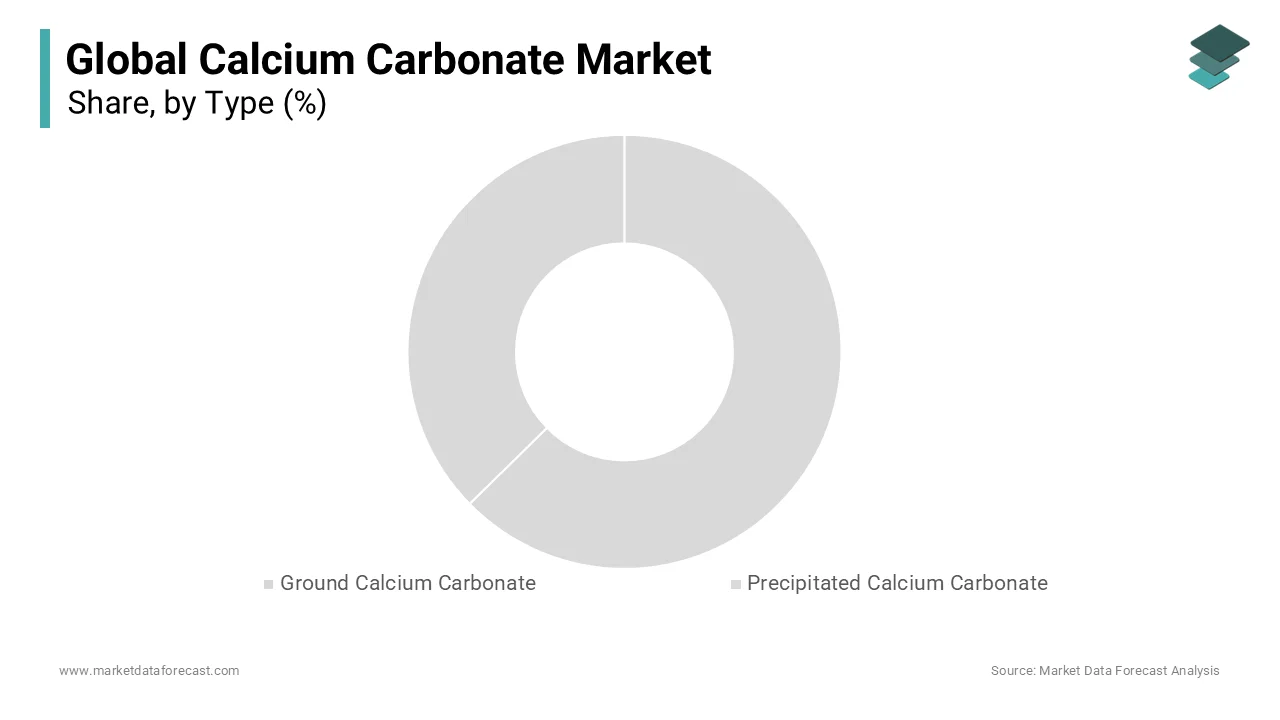
The precipitated calcium carbonate segment is likely to grow with an expected CAGR of 6.8% during the forecast period with the rising demand for high-purity, customizable particle sizes in specialty applications. PCC is chemically synthesized by allowing precise control over morphology, which is in high-performance sectors like pharmaceuticals and specialty plastics. According to the Food and Agriculture Organization (FAO), calcium deficiency affects over 2 billion people globally, fueling demand for fortified foods and supplements where PCC is a key ingredient. Environmental regulations favoring closed-loop PCC systems in paper mills in Europe are further accelerating adoption.
By Application Insights
The construction materials segment was accounted in holding 45.2% of calcium carbonate market share in 2025 with the additive in cement, concrete, and asphalt. Calcium carbonate enhances workability, durability, and crack resistance in concrete. The global cement industry produced 4.1 billion metric tons in 2023, as reported by the International Energy Agency (IEA), with China and India accounting for nearly 60% of output. Each ton of cement typically incorporates 5–15% mineral additives, including calcium carbonate. Furthermore, the push for sustainable construction has increased the use of finely ground calcium carbonate as a partial clinker substitute, reducing CO₂ emissions by up to 10% per ton of cement, according to a 2022 study by the Cement Sustainability Initiative.
The dietary supplement application is likely to grow with an anticipated CAGR of 8.3% during the forecast period with the rising awareness of bone health and widespread calcium deficiency. The World Health Organization (WHO) estimates that osteoporosis affects 200 million women globally, with calcium supplementation being a primary preventive measure. PCC, the preferred form in supplements due to its high purity and solubility, constitutes over 70% of calcium carbonate used in nutraceuticals, according to Nutrition Business Journal.
By End-User Industry Insights
The construction industry segment was accounted in holding 38.2% of calcium carbonate market share in 2025 with the material’s role as a functional filler and strength enhancer in cement, mortars, and precast concrete. Calcium carbonate improves the rheology of concrete mixtures, reduces shrinkage, and enhances surface finish. Moreover, the integration of micronized calcium carbonate in self-compacting concrete has gained traction such concrete is used in over 30% of high-rise projects in Japan and South Korea, as noted by the Japan Concrete Institute.
The plastics industry segment is augmented in holding an expected CAGR of 7.1% during the forecast period with the need for cost-effective, lightweight, and high-performance fillers in polypropylene, PVC, and polyethylene. Calcium carbonate can constitute up to 60% of the filler content in plastic profiles, enhancing stiffness and dimensional stability while reducing resin usage. For example, in automotive interiors, calcium carbonate-filled PP reduces part weight by 10–15%, which is improving fuel efficiency, as reported by Society of Plastics Engineers. Additionally, the circular economy push is favoring mineral-filled plastics, which are easier to recycle and have lower carbon footprints.
REGIONAL ANALYSIS
Asia Pacific Calcium Carbonate Market Insights
Asia Pacific was the largest contributor and held 48.2% of the global calcium carbonate market share in 2025 with industrialization and urban expansion. China and India are two major countries contributing highest share for the calcium carbonate market. The country produced 2.4 billion tons of cement in 2023, according to the National Bureau of Statistics of China, the highest in the world. India’s infrastructure push under the National Infrastructure Pipeline, which is targeting $1.4 trillion in investments by 2026, is accelerating demand. The region’s low production costs and expanding manufacturing base make it both a consumer and exporter hub.
North America Calcium Carbonate Market Insights
North America calcium carbonate market held 22.3% of share in 2025. The U.S. is the primary consumer, with the construction and paper industries driving usage. The region is a leader in PCC innovation Omya and Minerals Technologies operate advanced PCC plants integrated with paper mills, reducing transportation and emissions. Regulatory clarity and high health awareness support steady growth, while investments in green construction are fostering new applications.
Europe Calcium Carbonate Market Insights
Europe calcium carbonate market growth is likely to grow with prominent CAGR during the forecast period. PCC demand is rising in paper recycling, over 72% of paper in Europe is recycled, per CEPI, and PCC is essential for maintaining brightness and strength in recycled fibers. Germany and Sweden host some of the most advanced PCC facilities, often co-located with pulp mills. Additionally, the EU’s Novel Foods Regulation ensures high purity standards for calcium carbonate in supplements.
Latin America Calcium Carbonate Market Insights
Latin America calcium carbonate market growth is esteemed to grow in the coming years with Brazil and Mexico as key contributors. Brazil’s construction sector, which contributed 4.8% to GDP in 2023, as reported by Brazilian Institute of Geography and Statistics (IBGE), is a major driver. Mexico’s packaging and automotive industries are also increasing filler usage.
Middle East & Africa Calcium Carbonate Market Insights
The Middle East and Africa calcium carbonate market growth is esteemed to have a prominent opportunities in the coming years. GCC is primarily used in cement and building materials, with Gulf countries investing heavily in megaprojects. Egypt, with limestone reserves exceeding 50 billion tons, is positioning itself as a regional production hub.
COMPETITIVE LANDSCAPE
KEY MARKET PLAYERS
A few of the notable players in the global calcium carbonate market include
- AGSCO Corp.
- Carmeuse
- Blue Mountain Minerals
- GCCP Resources
- GLC Minerals, LLC
- Greer Limestone Company
- Gulshan Polyols Ltd.
- ILC Resources
- Imerys
- Mineral Technologies
- Mississippi Lime
- Omya
- Parchem Fine & Specialty Chemicals
- The National Lime & Minerals, Inc.
TOP STRATEGIES USED BY THE KEY MARKET PLAYERS
Key players in the calcium carbonate market employ several strategic initiatives to maintain competitive advantage. These include capacity expansion to meet rising regional demand, particularly in Asia Pacific’s growing manufacturing sectors. Companies invest heavily in R&D to develop specialty and surface-modified calcium carbonates for high-performance applications. Vertical integration is common, ensuring raw material control and cost efficiency. Strategic partnerships with end-user industries enhance application-specific solutions. Geographic expansion into emerging markets strengthens regional supply networks. Sustainability-driven innovation, such as reducing carbon footprint and energy use, aligns with regulatory and customer demands. Acquisition of smaller regional producers enables rapid market entry and technology access. Digital integration in production and logistics improves operational efficiency.
COMPETITION OVERVIEW
The calcium carbonate market features intense competition driven by technological innovation, regional expansion, and sustainability demands. Major players compete on product quality, customization, and technical support, particularly in high-growth sectors like plastics, paper, and construction across Asia Pacific. Companies differentiate through specialty grades, such as nano and surface-treated calcium carbonate, catering to advanced applications. Competitive dynamics are shaped by vertical integration, R&D investments, and localized production to reduce costs and improve supply chain resilience. Environmental regulations push firms to adopt cleaner production methods, influencing market positioning. Emerging regional producers challenge established players, prompting global companies to strengthen local partnerships and expand facilities.
TOP PLAYERS IN THE MARKET
Omya AG
Omya AG is a leading global provider of industrial minerals, which is primarily calcium carbonate, with a strong footprint across the Asia Pacific region. The company supplies high-purity calcium carbonate for diverse applications, including paper, plastics, coatings, and construction. In Asia Pacific, Omya has expanded its presence through strategic investments in production facilities in China and India, ensuring localized supply and improved logistics. Recently, Omya launched surface-treated calcium carbonate grades tailored for high-performance plastics, meeting the region’s growing demand for lightweight and sustainable materials.
Imerys S.A.
Imerys is a global leader in mineral-based specialties, offering a wide range of calcium carbonate products essential for industries such as paper, plastics, pharmaceuticals, and construction. In the Asia Pacific market, Imerys has strengthened its position through targeted expansions in China, South Korea, and Southeast Asia, aligning with regional industrial growth. The company recently commissioned an advanced processing facility in Malaysia, enhancing its ability to deliver high-brightness, ultrafine calcium carbonate. Imerys has also focused on sustainability, introducing energy-efficient production methods and low-carbon products to meet Asia Pacific’s tightening environmental regulations. Additionally, the company has increased R&D investments to develop specialty grades for high-end applications by ensuring continued relevance in evolving markets like electric vehicle components and green building materials.
Minerals Technologies Inc.
Minerals Technologies Inc. is a prominent innovator in mineral and chemical solutions, with its calcium carbonate products widely used in paper, packaging, and polymer industries. In the Asia Pacific region, MTI has built a robust presence through technical service centers and joint development programs with key manufacturers. The company recently introduced a new line of engineered calcium carbonate additives in India and Japan, designed to improve opacity and strength in paper while reducing fiber use. MTI has also enhanced its regional supply chain by partnering with local distributors and investing in application testing labs. These efforts support customer innovation and sustainability goals, particularly in packaging and lightweight plastics.
MARKET SEGMENTATION
This research report on the global calcium carbonate market has been segmented and sub-segmented based on type, application, end-use industry and region.
By Type
- Ground Calcium Carbonate (GCC)
- Precipitated Calcium Carbonate (PCC)
By Application
- Raw Substance for Construction Material
- Dietary Supplement
- Additive for Thermoplastics
- Filler and Pigment
- Component of Adhesives
- Desulfurization of Fuel Gas
- Neutralizing Agent in Soil
- Other Applications
By End-user Industry
- Paper
- Plastic
- Adhesives and Sealants
- Construction
- Paints and Coatings
- Pharmaceutical
- Automotive
- Agriculture
- Rubber
- Other End-user Industries
By Region
- North America
- Europe
- Asia-Pacific
- Latin America
- Middle East and Africa