- Product Description Description
- Table of Contents TOC
- List of Table & Figure LOT
- Get Free Sample PDF Sample PDF
Market Size, 2025
$3.75 BnMarket Estimate, 2026
$4.10 BnMarket Forecast, 2034
$8.31 BnCAGR, 2026–2034
9.24%Global CAM Market Size
The global computer-aided manufacturing (CAM) market was valued at USD 3.75 billion in 2025. The global market is estimated to reach USD 8.31 billion by 2034 from USD 4.10 billion in 2026, rising at a CAGR of 9.24% from 2026 to 2034.

Computer-Aided Manufacturing (CAM) is a technology that helps factories and manufacturers automate production using software. It works by taking designs from Computer-Aided Design (CAD) software and converting them into machine instructions for tools like CNC machines, 3D printers, and industrial robots. This eliminates manual control, making manufacturing faster, more precise, and more reliable. CAM is changing industries by making machining more accurate and reducing waste. The International Federation of Robotics (IFR) states that in 2023, over 4 million industrial robots were in operation worldwide, a 10% increase from 2022. This shows how industries are increasingly using automation, making CAM essential for programming and controlling these robots.
In aerospace, CAM is critical for making aircraft components with high accuracy. A Boeing 747-8 has over 6 million parts, and each must be precisely manufactured. CAM helps by guiding machines to cut and assemble each component perfectly. Similarly, medical device makers depend on CAM for creating custom implants and prosthetics. The American Dental Association states that most dental crowns and implants today are made using CAM-driven milling machines. These machines ensure better fit and comfort for patients. As industries shift towards digital manufacturing, CAM adoption will continue to rise, leading to faster production, reduced costs, and the ability to create complex designs. It will be a key part of future smart factories.
MARKET DRIVERS
Advancements in 3D Printing
The rise of 3D printing (also called additive manufacturing) has increased the demand for CAM. CAM software designs and controls 3D printers, enabling them to make complex parts with extreme accuracy. The U.S. Department of Energy reports that 3D printing can reduce material costs by up to 90% in some cases. This means less waste and lower expenses, making manufacturing more cost-efficient. CAM also makes it easier to customize products, which is important in healthcare, aerospace, and automotive industries. With more industries using 3D printing, CAM’s role will keep growing. Its ability to optimize material use, improve precision, and enhance customization makes it a key driver of modern manufacturing.
Government Support for Digital Manufacturing
Governments are investing in digital manufacturing to make industries more efficient and competitive. The UK’s Department for Business, Energy & Industrial Strategy has invested over £600 million in more than 100 automation projects since 2015. These projects aim to increase productivity and encourage businesses to use CAM software. By funding research, training, and implementation, governments help industries modernize and adopt smart manufacturing technologies. These efforts reduce production costs, increase efficiency, and improve global competitiveness. As more countries prioritize smart factories, the CAM market is set for steady growth. These investments push industries to embrace automation, making CAM a crucial tool in modern production.
MARKET RESTRAINTS
High Costs of Implementation
Installing CAM can be very expensive, especially for small and medium-sized businesses (SMEs). The National Institute of Standards and Technology (NIST) states that high software costs, powerful computing needs, and system integration are major challenges for small manufacturers. Many also face strict industry regulations, adding extra expenses. Because of these costs, smaller manufacturers often hesitate to invest in CAM, which slows its adoption. Unless prices drop or financing options improve, CAM adoption among SMEs may remain limited.
Lack of Skilled Workers
Using CAM requires special skills, but there is a shortage of trained professionals. The UK Commission for Employment and Skills reports that 57% of manufacturers struggle to find skilled workers, and 55% say there is a shortage of advanced manufacturing skills. Without trained employees, companies cannot use CAM to its full potential. This slows production efficiency and innovation. To fix this, governments and businesses must invest in training programs. More education in CAM and automation will help fill this skills gap and allow more industries to benefit from smart manufacturing.
MARKET OPPORTUNITIES
Robotics in Manufacturing
The use of robots in factories is increasing, creating a big opportunity for CAM. The International Federation of Robotics states that over 4 million industrial robots were active in 2023, showing a 10% increase from the previous year. CAM software is essential for programming and controlling these robots, making them smarter and more efficient. As robotics adoption grows, the demand for CAM software will also rise. CAM helps optimize robotic movements, improve accuracy, and reduce production time, making it a key tool in automated factories.
Sustainable Manufacturing
Sustainability is becoming a top priority, and CAM can help manufacturers reduce waste and energy use. The U.S. Department of Energy states that manufacturing accounted for 74% of total industrial energy use in 2018. CAM improves energy efficiency by optimizing machining processes, reducing waste, and cutting material costs. Companies using CAM for sustainability can meet environmental goals while saving money. As more businesses focus on green manufacturing, CAM will play a larger role in energy-efficient production.
MARKET CHALLENGES
Cybersecurity and Data Protection
With factories becoming more digital, cybersecurity risks are growing. The Cybersecurity and Infrastructure Security Agency (CISA) states that the manufacturing sector is highly targeted for cyberattacks, especially since many companies lack strong security systems. If CAM systems are hacked, companies can lose sensitive designs, production data, and trade secrets. This threatens their competitive edge and business security. To prevent this, companies must invest in cybersecurity, including firewalls, encryption, and access controls.
Compatibility with Old Systems
Many factories still use outdated machines, making CAM integration difficult. The National Institute of Standards and Technology (NIST) explains that most CNC machines rely on outdated communication systems, which makes it hard for them to work with modern CAM software. This causes downtime, errors, and expensive upgrades. Manufacturers must either invest in newer machines or find ways to connect old systems to CAM, which can be costly and time-consuming.
REPORT COVERAGE
| REPORT METRIC | DETAILS |
| Market Size Available | 2025 to 2034 |
| Base Year | 2025 |
| Forecast Period | 2026 to 2034 |
| CAGR | 9.24% |
| Segments Covered | By Offering, Application, Capability, Deployment Mode, Organization Size, Vertical, and Country |
|
Various Analyses Covered | Global, Regional & Country Level Analysis, Segment-Level Analysis, DROC, PESTLE Analysis, Porter’s Five Forces Analysis, Competitive Landscape, Analyst Overview of Investment Opportunities |
| Regions Covered | North America, Europe, APAC, Latin America, Middle East & Africa |
| Market Leaders Profiled | Autodesk (US), Siemens (Germany), Hexagon (Sweden), Dassault Systèmes (France), Hypertherm (US), SolidCAM (Israel), TopSolid (France), CAMWorks (US), and Mastercam (US). |
SEGMENTAL ANALYSIS
By Offering Insights
The software segment had the largest share in the computer-aided manufacturing (CAM) market by accounting for 74.1% of the market in 2024. The leading position of software segment is attributed to the widespread adoption of digital manufacturing technologies across various industries which has fueled the demand for advanced CAM software solutions. The integration of artificial intelligence and machine learning into CAM software has further enhanced its capabilities, enabling manufacturers to achieve higher precision and efficiency in their processes. Additionally, the shift towards cloud-based CAM solutions offers scalability and accessibility, making them indispensable tools for modern manufacturing operations.
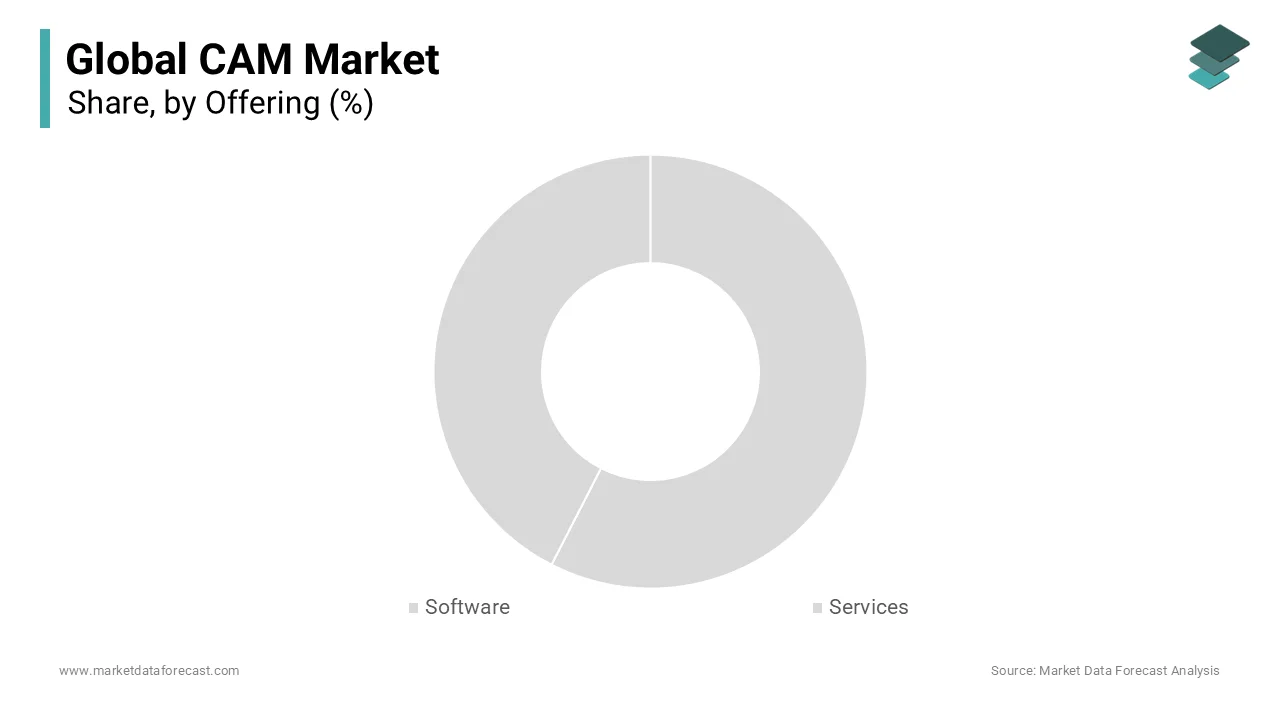
The services segment is projected to expand at a promising CAGR of 10.6% from 2026 to 2034 in the global CAM market. Factors such as the increasing complexity of CAM systems that necessitates specialized support, training, and integration services is propelling the growth of the services segment in the global market. As manufacturing processes become more sophisticated, there is a growing demand for customization and integration services to tailor CAM solutions to specific industry needs. Furthermore, the continuous need for software updates, maintenance, and technical support contributes to the rising demand for professional services in the CAM market.
By Application Insights
The machining & production segment captured the largest share of 60.2% in the global market in 2024. The growth of the machining and production segment in the global market primarily due to the extensive adoption of CAM software in CNC machining and sheet metal fabrication processes. The U.S. Department of Energy emphasizes that advanced manufacturing technologies including CAM have significantly enhanced production efficiency and precision in machining operations. The integration of CAM systems enables manufacturers to achieve higher accuracy, reduce material waste, and streamline workflows, thereby bolstering overall productivity in machining and production activities.
The product design & prototyping segment is anticipated to progress at a CAGR of 10.6% over the forecast period owing to the increasing utilization of simulation and 3D printing technologies in product development. The National Institute of Standards and Technology (NIST) shows that the adoption of additive manufacturing, a key component of this segment, has accelerated prototyping processes, allowing for rapid design iterations and reduced time-to-market. The ability to quickly simulate and prototype designs enhances innovation and flexibility, making this segment crucial for industries aiming to stay competitive in dynamic markets.
By Capability Insights
The 3D capability segment held the major share of 73.1% in the global market in 2024. The growth of 3D segment in the global market is majorly driven by the extensive adoption of 3D CAM software in industries such as aerospace, automotive, and medical devices, where complex geometries and precision are paramount. The U.S. Department of Energy emphasizes that advanced manufacturing technologies, including 3D CAM, have significantly enhanced production efficiency and precision in machining operations. The integration of 3D CAM systems enables manufacturers to achieve higher accuracy, reduce material waste, and streamline workflows, thereby bolstering overall productivity in machining and production activities.
The multi-axis capability segment is anticipated to showcase the fastest CAGR of 7.45% over the forecast period owing to the increasing demand for manufacturing complex parts with intricate designs, particularly in the aerospace and automotive sectors. The National Institute of Standards and Technology (NIST) revealed that multi-axis machining allows for the production of complex components in a single setup and is reducing lead times and improving precision. The ability to manipulate the workpiece from multiple angles enhances flexibility and efficiency, making multi-axis CAM systems essential for advanced manufacturing applications.
By Deployment Mode Insights
The on-premises segment held a commanding position by capturing 64.4% of the global market share in 2024. This preference is largely due to industries with sensitive data opting for on-premises solutions to maintain enhanced security and control over their manufacturing processes. Additionally, sectors with complex, high-volume production requirements often choose on-premises CAM systems for their robust performance and ability to handle intensive computational tasks without relying on external networks. The historical integration of on-premises solutions within existing infrastructure further solidifies their leading position in the market.
The cloud segment is projected to register the fastest CAGR of 11.9% over the forecast period in the global CAM market owing to the scalability and flexibility offered by cloud platforms, allowing manufacturers to adjust resources in response to changing demands. Lower initial capital expenditures and reduced need for on-site infrastructure make cloud solutions financially attractive across various business scales. The ability to facilitate remote collaboration aligns with evolving work patterns and distributed team structures. Automated updates and maintenance reduce IT overhead, ensuring consistent access to current features. Enhanced data security and disaster recovery protocols address critical concerns in manufacturing data management. Collectively, these attributes position cloud-based CAM solutions as a high-growth segment in the evolving manufacturing technology landscape.
By Organization Size Insights
The large enterprises segment dominated the market by holding 65.8% of the global market share in 2024 due to their substantial financial resources, enabling significant investments in advanced CAM solutions to enhance production efficiency and maintain competitiveness. According to the U.S. Census Bureau, large manufacturing firms, defined as those with 500 or more employees, contribute significantly to the industry's total value added, underscoring their capacity to invest in sophisticated manufacturing technologies. The integration of CAM systems in these enterprises facilitates streamlined operations, reduced lead times, and improved product quality, thereby reinforcing their market leadership.
The small and medium-sized enterprises (SMEs) segment is projected to showcase the highest CAGR of 10.5% over the forecast period. This surge is driven by the increasing accessibility of cost-effective CAM solutions and the rising awareness of automation benefits among SMEs. The U.S. Small Business Administration reports that SMEs comprise 99.9% of all businesses in the United States, highlighting a vast potential market for CAM providers. The availability of cloud-based CAM platforms has lowered entry barriers, allowing SMEs to enhance their manufacturing capabilities without substantial capital investment. This democratization of technology empowers SMEs to improve precision, reduce waste, and accelerate time-to-market, thereby bolstering their competitiveness in the global market.
By Vertical Insights
The automotive segment had a significant share of 63.6% in the global market in 2024. The growth of the automotive segment in the global market is attributed to the industry's high production volumes and stringent quality requirements, necessitating advanced CAM solutions for precision and efficiency. The U.S. Department of Energy emphasizes that the automotive sector's focus on reducing time-to-market and optimizing production costs aligns well with the benefits offered by CAM systems, contributing to their widespread implementation across the market. Additionally, the integration of CAM with other digital technologies, such as IoT and AI, has enabled more efficient supply chain management and predictive maintenance in automotive production. Moreover, the market’s push towards lightweight materials and complex geometries for improved fuel efficiency has intensified the need for advanced CAM tools capable of handling intricate machining processes.
The aerospace segment is estimated to progress at a CAGR of 9.8% over the forecast period owing to the increasing complexity of aerospace components and the demand for high precision in manufacturing. According to the National Institute of Standards and Technology (NIST), the aerospace industry relies heavily on advanced manufacturing technologies, including CAM, to produce intricate parts with stringent tolerances. The ability of CAM systems to facilitate complex machining processes and ensure adherence to exacting standards makes them indispensable in aerospace manufacturing, contributing to the sector's accelerated growth.
REGIONAL ANALYSIS
North America dominated the computer-aided manufacturing (CAM) market by capturing 34.1% of the global market share in 2024. The growth of North American market in the global market is primarily driven by the region's robust manufacturing base, particularly in industries such as aerospace, automotive, and healthcare, which have driven significant adoption of CAM technologies. The U.S. Department of Energy stated that advanced manufacturing technologies, including CAM, have significantly enhanced production efficiency and precision in these sectors. Additionally, substantial investments in research and development, coupled with government initiatives promoting smart manufacturing, have bolstered CAM implementation across various industries in North America.
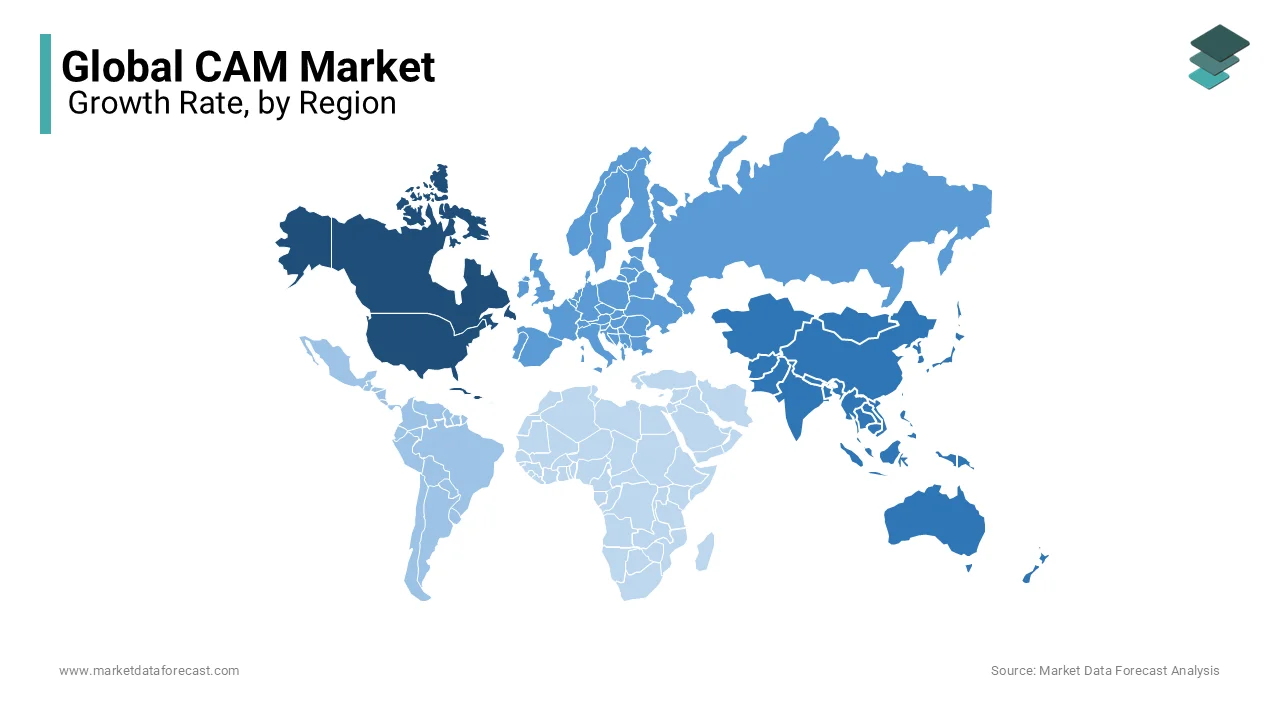
The Asia-Pacific region is projected to register a prominent CAGR of 10.04% over the forecast period. The rapid expansion of Asia-Pacific in the global market is driven by the region's expanding manufacturing sector, particularly in countries like China, India, and Southeast Asia, where increased adoption of CAM technologies is evident. The United Nations Industrial Development Organization (UNIDO) reports that industrial development in these countries has been accelerating, contributing to the heightened demand for advanced manufacturing solutions like CAM. Furthermore, government initiatives aimed at modernizing manufacturing infrastructure and enhancing production capabilities are fostering the integration of CAM systems in the region.
The European CAM market grew considerably in the past decade. This rise is driven by the region's strong focus on Industry 4.0 initiatives and digital transformation in manufacturing. Countries like Germany, France, and Italy are investing heavily in advanced manufacturing technologies to maintain their competitive edge in high-value industries such as automotive, aerospace, and precision engineering. The European Commission emphasizes the importance of advanced manufacturing technologies in maintaining the competitiveness of these sectors.
The Latin American CAM market is expected to grow at a decent rate in the coming. This growth is attributable to the increasing adoption of digital manufacturing technologies across various industries in the region. The software segment was the largest revenue-generating component in 2023, indicating a rising demand for advanced CAM solutions to enhance production efficiency and precision. Government initiatives aimed at modernizing manufacturing infrastructure and improving industrial productivity are also contributing to the market expansion in Latin America.
The Middle East and Africa (MEA) region is gradually recognizing the benefits of CAM systems with a steady increase in adoption observed in recent years. The World Bank notes that industrial activities in these areas are expanding, suggesting potential for future growth in CAM utilization as industries modernize and invest in automation technologies. The region's focus on diversifying economies beyond oil and gas, particularly in countries like the United Arab Emirates and South Africa, is fostering investments in advanced manufacturing technologies, including CAM, to enhance industrial productivity and global competitiveness.
KEY MARKET PLAYERS
The major players in the global CAM market include Autodesk (US), Siemens (Germany), Hexagon (Sweden), Dassault Systèmes (France), Hypertherm (US), SolidCAM (Israel), TopSolid (France), CAMWorks (US), and Mastercam (US).
RECENT HAPPENINGS IN THE MARKET
- In February 2025, EssilorLuxottica announced plans to boost its production capacity for smart glasses. The company aims to extend its collaboration with Meta to other brands, reflecting a strategic investment in integrating advanced manufacturing processes with wearable technology. This move underscores the growing convergence of CAM technologies with consumer electronics.
- In February 2025, Apptronik, based in Austin, Texas, raised $350 million in a funding round led by B Capital and Capital Factory, with participation from Alphabet's Google. The investment is directed towards scaling the production of AI-powered humanoid robots, highlighting a strategic push in robotics manufacturing. This development signifies a substantial investment in the application of CAM in robotics.
MARKET SEGMENTATION
This research report on the global CAM market is segmented and sub-segmented into the following categories.
By Offering
- Software
- Cad-Embedded Cam Software
- Independent Cam Software
- Services
- Implementation & Integration
- Consulting
- Training
- Support and Maintenance
By Application
- Product Design & Prototyping
- Simulation
- 3D Printing/Additive Manufacturing
- Tool & Die Manufacturing
- Machining & Production
- CNC Machining
- Sheet Metal Fabrication
- Quality Control & Inspection
By Capability
- 2D
- 3D
- Multi-Axis
By Deployment Mode
- On-Premises
- Cloud
By Organization Size
- Large Enterprises
- Small and Medium-Sized Enterprises
By Vertical
- Oil & Gas
- Food & Beverages
- Medical Devices & Pharmaceuticals
- Chemicals
- Energy & Power
- Metals & Mining
- Pulp & Paper
- Automotive
- Aerospace
- Electronics & Semiconductors
- Heavy Machinery
- Other Verticals
By Region
- North America
- Europe
- Asia-Pacific
- Latin America
- Middle East and Africa