- Product Description Description
- Table of Contents TOC
- List of Table & Figure LOT
- Get Free Sample PDF Sample PDF
Market Size, 2025
$19.96 BnMarket Estimate, 2026
$20.90 BnMarket Forecast, 2034
$30.18 BnCAGR, 2026–2034
4.7%Executive Summary: Global CBRN Security Market
- Market Scope: Comprehensive analysis of the global chemical, biological, radiological, and nuclear (CBRN) security market covering threat protection types, functional segments, application fields, end-users, and regional dynamics.
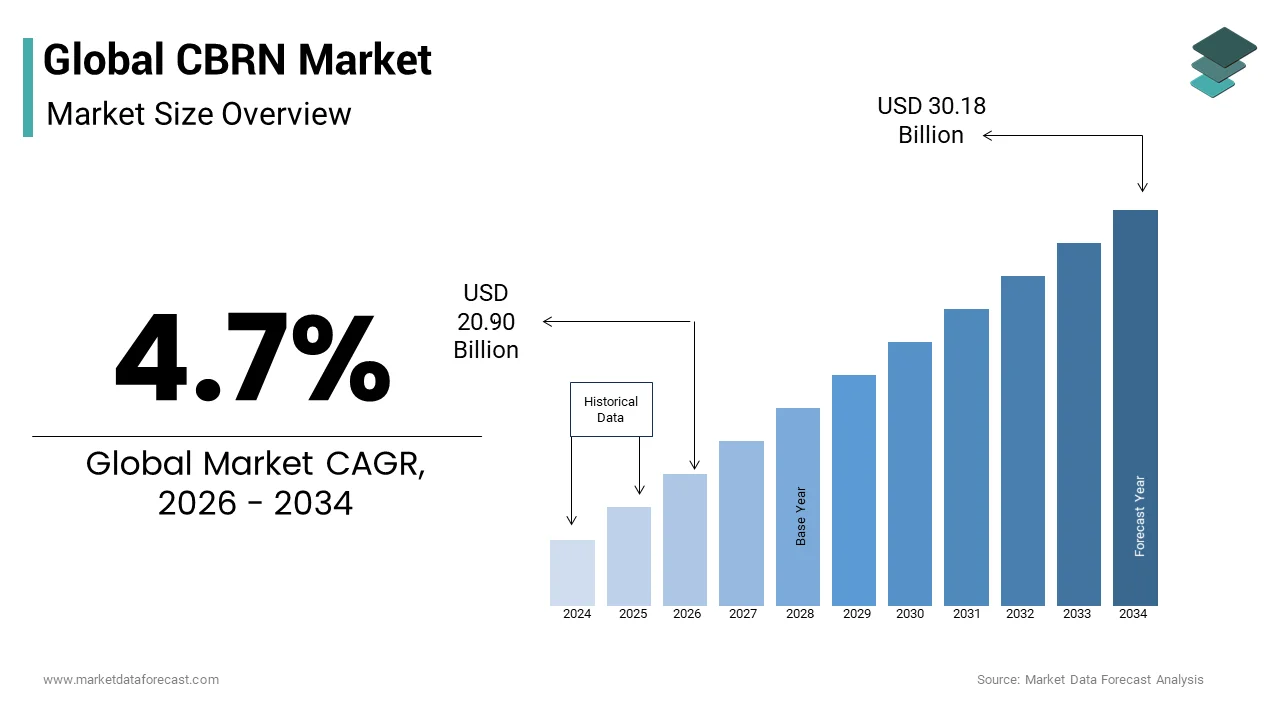
- Market Valuation: Valued at USD 19.96 billion (2025), estimated at USD 20.90 billion (2026), and projected to reach USD 30.18 billion by 2034, growing at a CAGR of 4.7% (2026–2034).
- Primary Growth Drivers: Rising demand for advanced CBRN surveillance systems across developing nations (Brazil, China, India), proactive government investments in defense R&D, and heightened global concern over preventing accidental or intentional hazardous material releases.
Key Market Segment Metrics (2026–2034)
| Category | Leading Segment (2025 Position) | Fastest-Growing Segment |
|---|---|---|
| By Type | Chemical Security (holding prominent deployment scale across industrial and defense facilities) | Nuclear & Biological Security (scaling rapidly due to severe contamination risks) |
| By Function | Protection Equipment / Portable Gear (holding the largest share via mandatory use by first responders and Hazmat teams) | Detection Systems & Decontamination Solutions |
| By Application / End-User | Military & Defense Government Agencies (primary consumers of integrated CBRN defense programs) | Critical Infrastructure Protection & Law Enforcement |
| By Region | North America (dominated by U.S. internal security measures, policy frameworks, and multi-billion-dollar R&D funding) | Asia-Pacific (expanding consistently through infrastructure growth in emerging economies) |
Major Market Players & Market Structure
Market Structure: Specialized and heavily regulated defense technology landscape driven by long-term government contracts, joint R&D initiatives, and compliance with stringent public safety mandates.
Key Companies: Elbit Systems, Thales Group, Alfred Kärcher GmbH & Co. KG, Rheinmetall AG, Bioquell, Battelle, AirBoss of America Corp, Smiths Detection, Cherming Group, and Bruker.
Global Chemical, Biological, Radiological, and Nuclear Security Market Size
The global chemical, biological, radiological, and nuclear (CBRN) security market size was valued at USD 19.96 billion in 2025 and is anticipated to reach USD 20.90 billion in 2026 to reach USD 30.18 billion by 2034, growing at a CAGR of 4.7% during the forecast period from 2026 to 2034.
Chemical, biological, radiological, and nuclear security instruments offer a comprehensive system for nuclear detection and identification, particularly designed to meet the requirements of the armed forces and civil security. Also, defense consists of passive protection, pollution prevention, and mitigation. An episode varies from an occurrence of hazardous material in two degrees, which can be a certain and mass loss circumstance. However, planned incidents occur when the materials are released into the environment with the intent of terrorism, when the hazardous elements are intentionally released into the environment.
MARKET DRIVERS
The main cause driving the worldwide market is the rising demand for CBRN security in evolving countries such as Brazil, China, India, among others.
In addition, African countries should continue to constantly spend on CBRN surveillance systems to mitigate growing threats, for example, Ebola in the region. Furthermore, the constant increase in technological advances and the increase in research initiatives around the world offer numerous growth opportunities to key players in the market for chemical, biological, radiological, and nuclear safety (CBRN). Once again, new age security equipment is launched, such as fire alarm and monitoring systems, which must be developed for government, military, and police organizations. Furthermore, growing global concern about CBRN attack prevention has spurred growth in the market for chemical, biological, radiological, and nuclear (CBRN) security. On the flip side, high setup and maintenance costs are estimated to slow the expansion of the global chemical, biological, radiological, nd nuclear safety (CBRN) market in the future.
MARKET TRENDS
The portable projector segment is expected to have the largest share of the global CBRN security market. Portable Protective Equipment is portable equipment designed primarily to protect first responders from exposure to CBRN materials, including firefighters and anti-terror teams. Portable equipment includes protective clothing, protective gloves, protective masks and hoods, and protective footwear. The mandatory rules for the use of such portable protection equipment by CBRN agents and Hazmat professionals are stimulating the CBRN security market worldwide.
REPORT COVERAGE
| REPORT METRIC | DETAILS |
| Market Size Available | 2025 to 2034 |
| Base Year | 2025 |
| Forecast Period | 2026 to 2034 |
| CAGR | 4.7% |
| Segments Covered | By Type, Function, Application, End-Use, and Region |
| Various Analyses Covered | Global, Regional & Country Level Analysis, Segment-Level Analysis, DROC, PESTLE Analysis, Porter’s Five Forces Analysis, Competitive Landscape, Analyst Overview on Investment Opportunities |
| Regions Covered | North America, Europe, APAC, Latin America, Middle East & Africa |
| Market Leaders ProfileThe d | Chemical, Biological, Radiological, and Nuclear (CBRN) Security Market comprises prominent players like Elbit Systems, Thales Group, Alfred Kärcher GmbH & Co. KG, Rheinmetall AG, Bioquell, Battelle, America Corporation, Smiths Detection, Cherming Group, and Bruker. |
REGIONAL ANALYSIS
The Market for Chemical, Biological, Radiological, and Nuclear (CBRN) Security has been categorized by region into North America, Asia Pacific, Europe, Latin America, the Middle East, and Africa. The North American region has a substantial portion of the global CBRN security market. CBRN security systems have grown in importance in the United States due to the increase in related attacks in the country, which has raised internal security concerns. As a result, many measures have been devised in terms of policy development and emergency responders to combat CBRN attacks by national security. The agency's strategy is the result of a process that involves the identification of ongoing research activities and performance evaluation. The country is also investing significantly in the development of R&D for CBRN security systems. In 2017, the US Army awarded $ 8.27 billion to 170 companies for ten years under a contract to improve R&D activities for CBRN security as part of joint research and development, acquisition, and production programs for supply programs.
Europe is the second leading region of the CBRN security market due to the imitation of various projects, the participation of the government through financing and assistance to SMEs. The ENCIRCLE addresses the difficulties faced by small and medium-sized companies that facilitate the development of new CBRN solutions for the growing market. Furthermore, CBRN defense and civil security have become an important industrial sector, contributing significantly to the market.
Leading Company
Alfred Kärcher GmbH & Co. KG had the largest share of the Chemical, Biological, Radiological, and Nuclear (CBRN) Security Market in terms of sales and revenue in 2019.
COMPETITIVE LANDSCAPE
KEY MARKET PLAYERS
A few of the market players in the global Chemical, Biological, Radiological, and Nuclear (CBRN) Security Market include
- Elbit Systems
- Thales Group
- Alfred Kärcher GmbH & Co. KG
- Rheinmetall AG
- Bioquell
- Battelle
- America Corporation
- Smiths Detection
- Cherming Group
- Bruker
RECENT MARKET NEWS
-
On February 12, 2019, FLIR Systems, Inc. announced the conclusion of a final agreement to acquire Endeavor Robotics Holdings, Inc. for global military and public security. Endeavor's highly mobile and easy-to-use ground robots act as advanced detection and actuation by providing explosive ordnance disposal (EOD), reconnaissance, inspection, and support of hazardous materials for troops, police, and remote industrial users.
MARKET SEGMENTATION
This research report on the global chemical, biological, and nuclear security market has been segmented and sub-segmented based on type, function, application, and region.
By Type
- Chemical Security
- Biological Security
- Radiological Security
- Nuclear Security
- Explosives Security
By Function
- Detection Systems
- Protection Equipment
- Decontamination Systems
- Simulation and Training
- Information Management Software
By Application
- Military
- Law Enforcement
- Border Protection
- Critical Infrastructure Protection
- Civilian Security
- Healthcare Facilities
- Industrial Facilities
By End User
- Defense & Government Agencies
- Homeland Security
- Civil & Commercial Sectors
- Healthcare Organizations
- Industrial Entities
By Region
- North America
- Europe
- Asia-Pacific
- Latin America
- The Middle East and Africa