- Product Description Description
- Table of Contents TOC
- List of Table & Figure LOT
- Get Free Sample PDF Sample PDF
Market Size, 2025
$6.92 BnMarket Estimate, 2026
$8.15 BnMarket Forecast, 2034
$11.32 BnCAGR, 2026–2034
11.50%Global Ceramic Matrix Composites Market Size
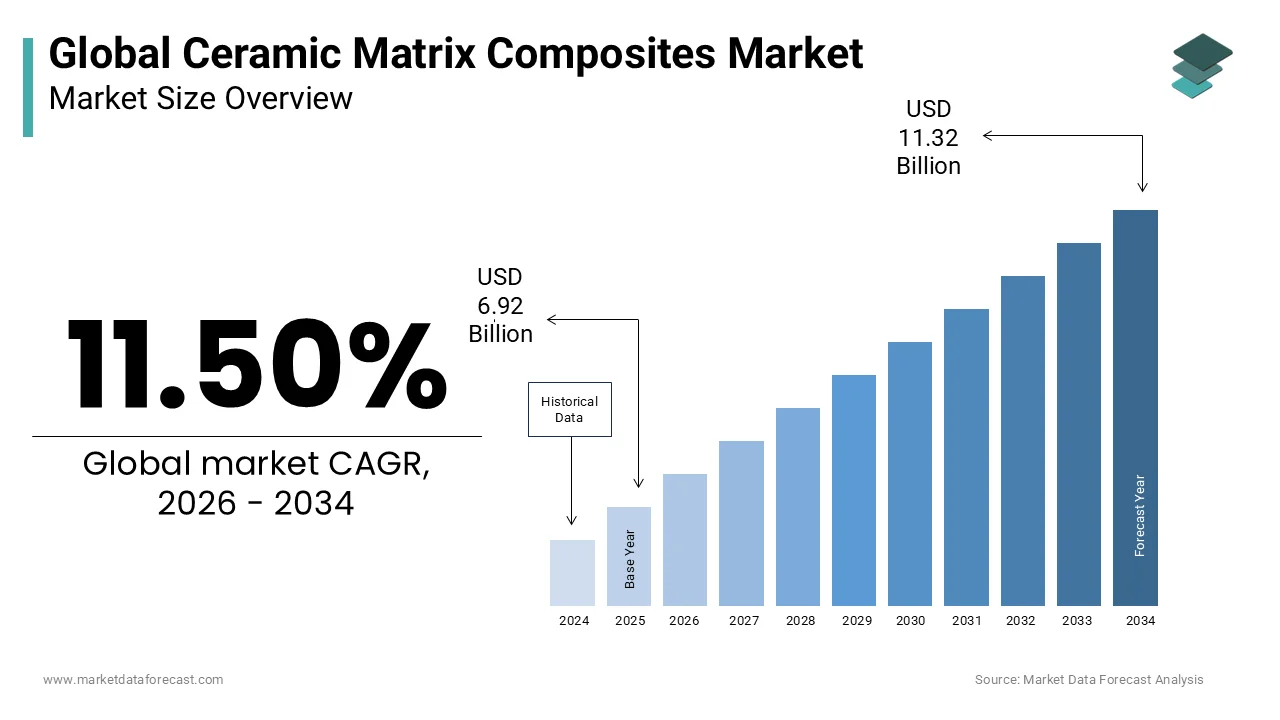
The global ceramic matrix composites market size was valued at USD 6.92 billion in 2025, and is expected to reach USD 11.32 billion by 2034 from USD 8.15 billion in 2026, growing at a CAGR of 11.50%.
MARKET OVERVIEW
Ceramic matrix composites (CMCs) are explained as a class of composite materials having ceramic fibers implanted in a ceramic matrix. Ceramic materials are inorganic and non-metallic solids that are crystalline in nature. CMCs show enhanced crack resistance, and they do not rupture easily under heavy loads when compared to traditional technical ceramics. Owing to improved properties of oxide, compounds having high fracturing toughness, no oxidation, and the less costly production procedure showcase high call from energy & power, aerospace, and defense applications. Ceramic matrix composites are materials involving ceramic fibers implanted in making a ceramic material. Nevertheless, carbon and carbon fibers are also known as ceramic materials.
Ceramic matrix composites are elements that include ceramic fibers inserted in a matrix and make ceramic matter. Nevertheless, carbon fibers are also termed ceramic matter. Ceramic matrix composites are utilized in several applications like aerospace, defense, thermal studies, and others in order to enhance execution and firm shape. They are estimated to return traditional alloys and additional metal components as they toil at a “no cooling” medium due to more thermal stability. The fare of ceramic matrix composites is very much affected by the unstable prices of ceramic fibers. So many multinational firms are highly funded in developing regions to meet the escalating call for these composites. GE Aviation is one of the huge makers of jet and marine engines that is highly spending on research & development of ceramic matrix composites for making aircraft engines.
MARKET DRIVERS
The key factors that are estimated to be driving the CMC market are strict government regulations relating to fuel efficiency, a high call from aerospace & defense, automotive, and energy & power end-use markets, and the ability to live at extreme temperatures. It is important for makers to lessen the load of automobiles to gain good efficiency. This, in turn, will support combatting the effect of inclining fuel costs and decrease carbon emissions. Also, the permeability to high temperatures and exceptional tensile strength curb the usage of cooling air in automobile engines can result in enhanced performance. Ceramic matrix composites are anticipated to substitute traditional alloys and metal components in vehicle engines as conventional alloys require highly dedicated cooling air while ceramic matrix components can work with little or no cooling
MARKET RESTRAINTS
The cost of ceramic matrix composites has been a challenge for this business over the last 100 years. It is observed that the prices of ceramic fibers have a direct impact on the expense involved in these composites. The expenses of carbon-ceramic matrix composites are consonantly lower than silicon carbide and oxide ceramic matrix composites owing to the huge-scale production of carbon fibers in the last some years. On the other side, the production of alumina and silicon carbide fibers is still very less. An alternative factor credited to the high expenses of ceramic matrix composites is the creation of the matrix; the production of a matrix requires very expensive heap procedures at extreme temperatures in a suitable aura.
MARKET OPPORTUNITIES
The customization requirement for ceramic matrix composites for specific uses involves higher expenses and has affected the industry development of ceramic matrix composites in the past years. The huge-scale manufacturing of easy shapes, like plates and pipes, would assist in getting rid of the laboring steps included in the processing of ceramic matrix composites. Apart from the standardization procedures in these composites, producers are now focusing on the development of novel compounds with the help of comprehensive techniques.
MARKET CHALLENGES
The increasing awareness associated with ceramic matrix composite repairing techniques and the rising number of skilled manpower will lower the effect in the coming years. In addition, the incapability to recycle the components irrespective of their long shelf life can be considered a severe threat to development.
REPORT COVERAGE
| REPORT METRIC | DETAILS |
| Market Size Available | 2025 to 2034 |
| Base Year | 2025 |
| Forecast Period | 2026 to 2034 |
| CAGR | 11.50% |
| Segments Covered | By Product, Application, and Region |
| Various Analyses Covered | Global, Regional & Country Level Analysis, Segment-Level Analysis, DROC, PESTLE Analysis, Porter’s Five Forces Analysis, Competitive Landscape, Analyst Overview on Investment Opportunities |
| Regions Covered | North America, Europe, Asia Pacific, Latin America, and Middle East & Africa |
| Market Leaders Profiled | General Electric, Rolls-Royce plc, COI Ceramics, Inc., SGL Group, UNITED TECHNOLOGIES, CeramTec, Lancer Systems, CoorsTek Inc., Ultramet, Thin Films Composites Horizons, Starfire Systems, Inc., GrafTech International, PYROMERAL SYSTEMS, and others. |
SEGMENTAL ANALYSIS
By Application Insights
The aerospace and defense sector is also subdivided into gas turbine engines, nozzles, and nose plugs. The automotive segment is also divided into brake discs and motors. The energy and energy sector are also subdivided into nuclear reactors and next-generation heat exchangers. The Electricity and Electronics segment is subdivided into electronic packaging systems. The Other segment is divided into industrial, marine, and biomedical sectors.
REGIONAL ANALYSIS
North America Ceramic Matrix Composites Market is the biggest and the quickest-advancing ceramic matrix composites industry. In this area, the aerospace and defense sector is the most considerable contributor to the ceramic matrix composites business. The proximity of a huge number of ceramic matrix composites makers builds the area as the key industry for ceramic matrix composites. The occupancy of an advanced ceramic matrix composites industry and the extreme call for ceramic matrix composites from the aerospace & defense employment in the United States are predicted to drive the ceramic matrix composites industry in North America. The United States is the major industry for ceramic matrix composites in the area, where makers are funding the latest matrix kinds and R&D activities. The expansion of the aviation sector in a positive way, funding for R&D activities, and the adoption of environmental rules would drive the ceramic matrix composites business in the US. The Asia Pacific is another area expanding at a rapid rate due to the rising funding for novel nuclear power plants, defense, power stations, and aerospace.
KEY MARKET PLAYERS
The key players in the global ceramic matrix composites market are General Electric, Rolls-Royce plc, COI Ceramics, Inc., SGL Group, UNITED TECHNOLOGIES, CeramTec, Lancer Systems, CoorsTek Inc., Ultramet, Thin Films Composites Horizons, Starfire Systems, Inc., GrafTech International, PYROMERAL SYSTEMS, and others.
RECENT HAPPENINGS IN THE MARKET
- Safran consolidates its research into ceramic matrix composites. The new inauguration of Safran Ceramics, a research center devoted to ceramic matrix composites (CMCs), underlines the Group's desire to raise its expertise relating to these materials, whose properties are especially interesting for the aerospace segment.
MARKET SEGMENTATION
This research report on the global ceramic matrix composites market has been segmented and sub-segmented based on type, application, and region.
By Type
- C/C ceramic matrix composite materials
- C/SIC ceramic matrix composites
- oxide/oxide ceramic matrix composites
- Matrix composite materials ceramic SIC/SIC
By Application
- Aerospace
- Defense
By Region
- North America
- Europe
- Asia Pacific
- Latin America
- Middle East & Africa