- Product Description Description
- Table of Contents TOC
- List of Table & Figure LOT
- Get Free Sample PDF Sample PDF
Market Size, 2025
$132 MnMarket Estimate, 2026
$145.46 MnMarket Forecast, 2034
$316 MnCAGR, 2026–2034
10.2%Executive Summary: Global Certificate Authority Market
- Market Scope: Comprehensive global analysis of the certificate authority market covering types, software/services components, organization sizes, vertical sectors, and regional market performance.
- Market Valuation: Valued at USD 132 million in 2025, estimated at USD 145.46 million in 2026, and projected to reach USD 316 million by 2034, growing at a CAGR of 10.20% (2026–2034).
- Primary Growth Drivers: Proliferation of IoT and cloud-based interconnectivity, tightening data protection regulations (GDPR, CCPA, HIPAA, PCI-DSS), and surging demand for automated enterprise security and cryptographic assurance.
Key Market Segment Metrics (2026–2034)
| Category | Leading Segment Focus | Fastest-Growing Segment Focus |
|---|---|---|
| By Type / Component | SSL/TLS Certificates & Software Solutions (68.5% share in 2025) | Certificate Lifecycle Services & Managed PKI (21.4% CAGR) |
| By Organization Size | Large Enterprises (64.4% revenue share in 2025) | Small and Medium-sized Enterprises (SMEs at 18.5% CAGR) |
| By Vertical Sector | IT & Telecommunications (28.3% share in 2025) | Healthcare & Life Sciences (19.8% CAGR) |
| By Region | North America (33.7% revenue share in 2025) | Asia-Pacific (fastest-growing regional market) |
Major Market Players & Market Structure
Market Structure: Highly consolidated at the top with strategic acquisitions (such as Sectigo acquiring Entrust's public certificate unit and DigiCert absorbing Symantec's TLS/SSL arm), balanced by automated free offerings like Let's Encrypt and specialized regional CAs.
Key Companies: DigiCert (United States), Sectigo / Comodo CA (United States), GlobalSign (GMO Internet Group, Japan/US), IdenTrust (United States), GoDaddy (United States), Entrust Datacard (United States), and SwissSign (Switzerland).
Global Certificate Authority Market Size
The global certificate authority market was valued at USD 132 million in 2025. The global market is predicted to reach USD 145.46 million in 2026 and USD 316 million by 2034, growing at a CAGR of 10.20% from 2026 to 2034.
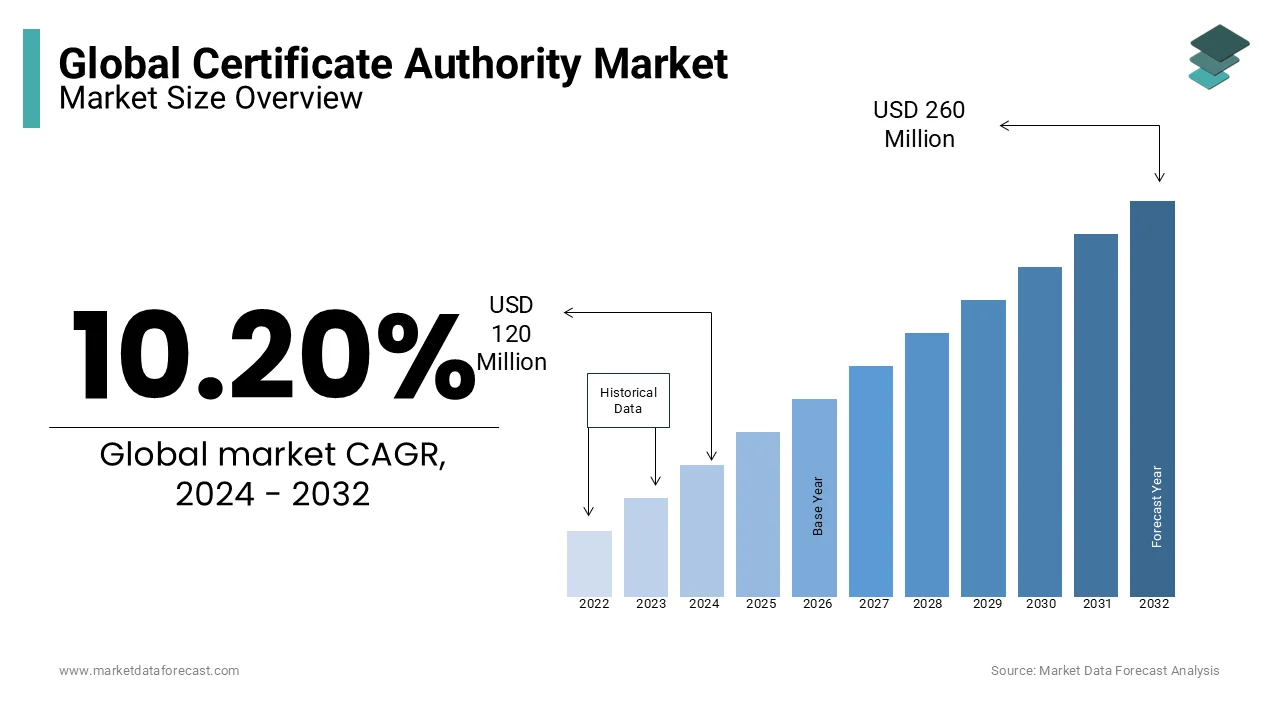
Certificate Authorities are organizations enabling digital trust by issuing and validating cryptographic credentials, such as SSL/TLS certificates, that authenticate identities and secure online communication. The layered complexity of cryptographic trust, evolving browser policies, and emerging compliance mandates all converge to define both the structure and speed of this market’s evolution.
MARKET DRIVERS
Explosion of IoT and Cloud-based Interconnectivity
The shift toward IoT proliferation and cloud migration is fueling demand for digital identities issued by certificate authorities. Simultaneously, the rise of cloud-based PKI and managed security services encourages organizations to externalize certificate lifecycle management. This dual expansion of endpoints and external trust infrastructure is dynamically reshaping CA demand.
Regulatory Pressure and Cybersecurity Mandates
Tightening data protection laws and mounting privacy regulations are elevating reliance on certificate authority services. Global enforcement of frameworks such as GDPR, CCPA, HIPAA, and PCI-DSS requires robust cryptographic assurance for digital data exchange. In addition, organizations are accelerating in adopting SSL/TLS certificates, digital signing, and identity validation services from trusted CAs to ensure regulatory alignment and reduce audit risk.
MARKET RESTRAINTS
Operational Overhead in Certificate Management
While essential, the operational burden of managing vast numbers of certs is a significant friction point. The recent policy shift by major browser vendors, reducing certificate trust lifespans from over a year to days, inflates renewal demands, escalating the administrative workload.
Centralization and Sovereignty Concerns
The highly consolidated nature of the CA industry, dominated by a few U.S.-based operators, raises digital sovereignty issues and systemic dependence risks. A recent academic analysis of SSL/TLS provisioning for domains in BRICS and EU regions found that over 75% of certificates issued originate from U.S.-based Certificate Authorities, pointing to potential geopolitical vulnerabilities and trust bottlenecks. This concentration may deter markets seeking local control and regulatory alignment, ultimately restraining CA adoption in jurisdictions wary of external reliance.
MARKET OPPORTUNITIES
Blockchain-Enabled Decentralized PKI
Emerging PKI models leveraging blockchain technology present a promising pathway to decentralize trust and reduce reliance on central authorities. Research into blockchain-based PKI within organizations suggests enhanced tamper-resistance, immutable audit trails, and greater transparency in certificate issuance and revocation. Such decentralized models can appeal to enterprises and governments aiming to bolster digital sovereignty and resilience against CA-level compromise. Adoption of these solutions, particularly in sectors with strict compliance governance, represents a growth opportunity for forward-looking CA providers.
Widespread Adoption of Free and Automated CAs
Let's Encrypt’s model, delivering free, automated domain-validated certificates at scale, has democratized HTTPS adoption globally. As of early 2025, W3Techs reports that Let's Encrypt powers 59.9% of websites among Alexa’s top million, reflecting 63.7% of usage share, undisputed dominance in automated certificate adoption. This opens opportunities for CA players to innovate around zero-cost offerings, automation, and developer-friendly workflows, expanding the market, particularly among SMEs and non-profit or emerging digital players.
MARKET CHALLENGES
Inefficient and Incomplete Revocation Mechanisms
The inherent difficulty in timely revoking compromised or misissued certificates remains a notable challenge. Studies of revocation mechanisms, like OCSP and Certificate Revocation Lists, highlight trade-offs between performance, privacy, and availability. Browsers often “fail-soft,” treating unknown or unresponsive revocation queries as valid, increasing risk exposure. Despite the criticality of revocation, there is no universally effective, scalable solution. As noted by technical sources, the revocation problem persists without a complete fix, undermining CA reliability when rapid invalidation is needed.
Reliance on a Fragmented Trust Ecosystem
Although the CA market exhibits some global consolidation, it remains fragmented at the regional levels with diverse trust root programs and audit regimes. Providers must navigate myriad accreditation standards, such as WebTrust, ETSI, or local legal digital signature frameworks, to gain browser trust and legal recognition. This fragmentation increases compliance costs and complexity, especially for new or regional entrants who must align with multiple trust ecosystems. As reported, the requirement to maintain audit compliance to be trusted in browsers makes market entry challenging and costly.
REPORT COVERAGE
| REPORT METRIC | DETAILS |
| Market Size Available | 2025 to 2034 |
| Base Year | 2025 |
| Forecast Period | 2026 to 2034 |
| CAGR | 10.2% |
| Segments Covered | By Type, Organization Size, Vertical Sector, and Region |
|
Various Analyses Covered | Global, Regional & Country Level Analysis, Segment-Level Analysis, DROC, PESTLE Analysis, Porter’s Five Forces Analysis, Competitive Landscape, Analyst Overview on Investment Opportunities |
| Regions Covered | North America, Europe, APAC, Latin America, Middle East & Africa |
|
Market Leaders Profiled | IdenTrust (United States), Comodo CA (United States), DigiCert (United States), GoDaddy (United States), GlobalSign (United States), Asseco Data Systems (Poland), ACTALIS (Italy), Entrust Datacard (United States), Trustwave (United States), SSL.com (United States), Network Solutions (United States), TWCA (China), SwissSign (Switzerland), WISeKey (Switzerland), OneSpan (United States), Buypass (Norway), Camerfirma (Spain), Hongkong Post (Hong Kong), EBG Information Technologies and Services (Turkey), Harica (Greece), Certigna (France), NETLOCK (Hungary), TURKTRUST (Turkey), certSIGN (Romania) and Disig (Slovakia) and Others. |
SEGMENTAL ANALYSIS
By Type Insights
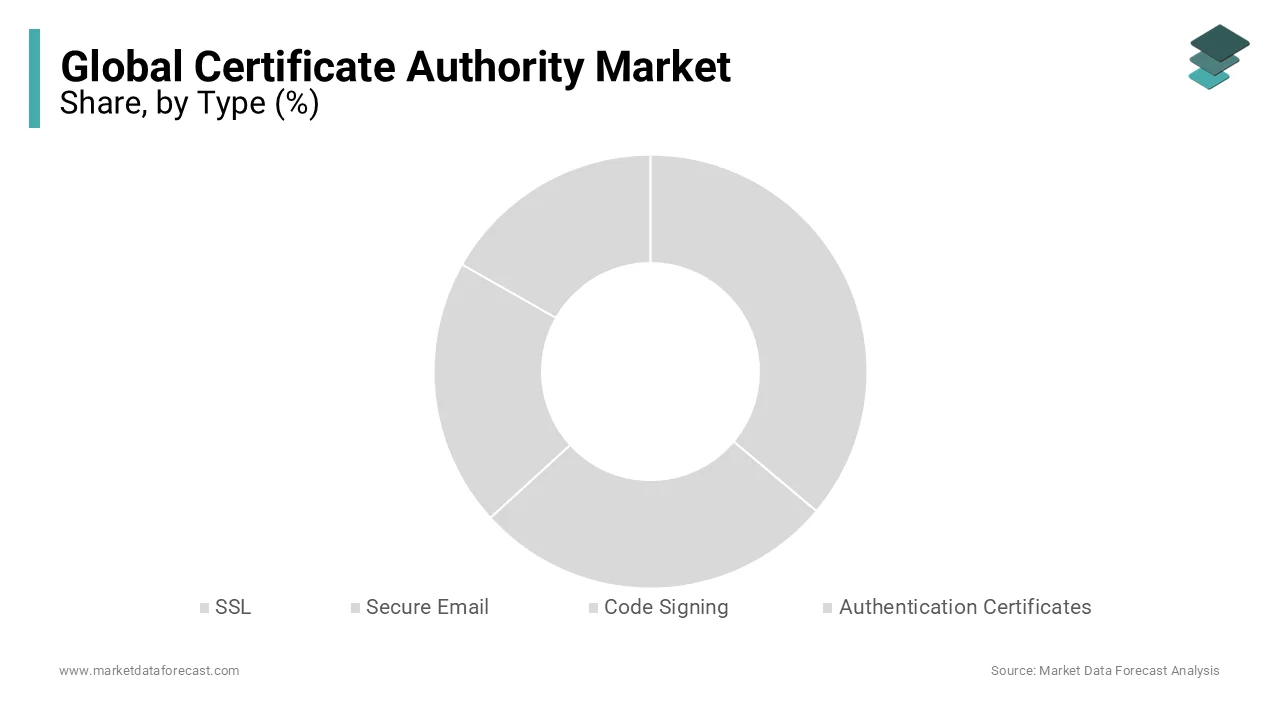
The SSL/TLS certificates segment emerged as the dominant category within certificate types and accounted for 68.5% of the total CA market share in 2025. SSL/TLS is by far the most prevalent certificate, with Domain Validation (DV) alone comprising 94.4% of all SSL certificates globally per Netcraft’s findings. This dominance stems from the ubiquitous need to secure web traffic: the sheer volume of websites (87.6% of websites now have a valid SSL certificate) underscores its foundational role in online trust and encryption. These figures reflect SSL’s centrality in digital security.
The Services segment rises fastest and is likely to grow at a 21.4% CAGR through 2033, compared to the Certificate Type segment’s slower expansion. This rapid pace is driven by the growing complexity of certificate lifecycles, increasingly stringent browser policies (like shortened TTLs), and demand for outsourcing certificate management capabilities.
By Component Insights
The Certificate Type (software component) segment led the market and accounted for 68.5% of the market share in 2025. This preeminence is rooted in foundational needs every digital interaction, from HTTPS connections to code signing, relies on certificate issuance. The pervasiveness of digital signing, encryption, and identity validation cements software-driven certificate issuance as essential infrastructure.
The Services vertical (such as managed PKI and automation) segment is projected to expand at a 21.0% CAGR to 2030, lifted by enterprises’ turn to cloud-based PKI, zero-trust models, and lifecycle automation to cope with renewal demands and security policies. not only supports certificate issuance but does so in an increasingly efficient and scalable way, making it the growth engine.
By Organization Size Insights
The large enterprises segment accounted for the biggest share of the CA market revenue of 64.4% in 2025. Their dominance is due to sheer scale: these organizations issue vast numbers of certificates across servers, devices, emails, code signing, and internal services, necessitating mature PKI frameworks, audit-ready issuance, and regulatory alignment. They also possess larger budgets to invest in enterprise-grade security infrastructure.
The Small and Medium-sized Enterprises (SMEs) segment is catching up quickly, forecasted to rise at an 18.5% CAGR through 2033. This acceleration reflects the democratization of digital trust: cloud services, SaaS platforms, and automated certificate offerings, like zero-cost or hassle-free issuance, enable SMBs to adopt secure communication affordably.
By Vertical Sector Insights
The IT & Telecom segment led vertical adoption with a 28.3% revenue share in 2025. This segment’s lead position owes to its dual role: both a provider and consumer of digital services. Telecoms and IT firms manage vast networks requiring secure endpoints, device authentication, encryption, and digital signature services, pushing certificate demand across infrastructure layers.
The Healthcare & Life Sciences segment is expanding at a rapid 19.8% CAGR through 2033. Driven by telemedicine, digital health records, connected medical devices, and stringent patient-data compliance regimes, there’s an escalating need for encryption, verified electronic signatures, and secure communications, spurring certificate adoption.
REGIONAL ANALYSIS
North America Certificate Authority Market Insights
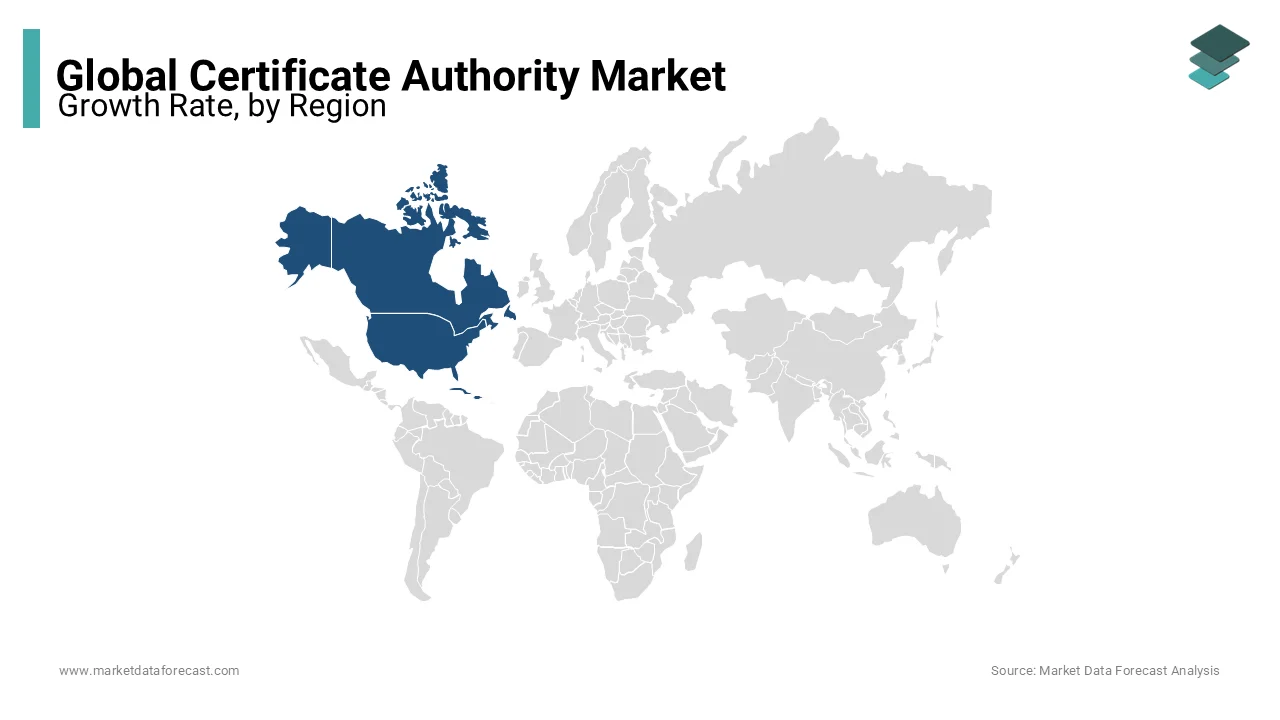
North America was the largest regional market, capturing 33.7% of global CA revenue in 2025. This commanding position reflects its mature cybersecurity landscape, high internet penetration, and regulatory mandates (e.g., HIPAA, CCPA). Enterprise-scale deployments and innovation in managed PKI further reinforce its lead.
Asia Pacific Certificate Authority Market Insights
Asia Pacific stands out as the fastest-growing region. Growth is fueled by expansive e-commerce activity, government-led digital identity initiatives, and rapidly increasing internet adoption across developing economies.
Europe Certificate Authority Market Insights
Europe ranks among the top regions, supported by GDPR and widespread regulatory compliance, though exact share data is not always specified. The emphasis on data protection and widespread digital signatures across public and private sectors maintains European prominence in CA adoption.
Latin America Certificate Authority Market Insights
Latin America’s CA adoption is growing steadily, buoyed by digital transformation in banking and commerce. While precise numbers are less visible, the region's digital acceleration and emerging PKI rollouts place it within the top five globally.
Middle East & Africa Certificate Authority Market Insights
The MEA region is accelerating CA demand, especially through government digital ID projects and growing e-government initiatives. Although trailing in absolute market share, its upward trend positions it as top-tier among regional markets.
KEY MARKET PARTICIPANTS
The main providers presented in the report are IdenTrust (United States), Comodo CA (United States), DigiCert (United States), GoDaddy (United States), GlobalSign (United States), Asseco Data Systems (Poland), ACTALIS (Italy), Entrust Datacard (United States), Trustwave (United States), SSL.com (United States), Network Solutions (United States), TWCA (China), SwissSign (Switzerland), WISeKey (Switzerland), OneSpan (United States), Buypass (Norway), Camerfirma (Spain), Hongkong Post (Hong Kong), EBG Information Technologies and Services (Turkey), Harica (Greece), Certigna (France), NETLOCK (Hungary), TURKTRUST (Turkey), certSIGN (Romania) and Disig (Slovakia).
TOP LEADING PLAYERS IN THE MARKET
DigiCert, Inc.
DigiCert, a seasoned innovator in digital trus,t has significantly shaped the Asia-Pacific landscape through the integration of high-assurance PKI services and IoT and post-quantum readiness. In 2017, it absorbed Symantec’s TLS/SSL arm, enabling a smooth transition for affected enterprises. More recently, it acquired Mocana for IoT security and DNS Made Easy for enhanced DNS reliability, signaling its intent to bolster Asia-Pacific deployments with edge-to-cloud encryption and infrastructure robustness. Its focus on collaborating with regional partners and elevating cryptographic standards demonstrates a sustained commitment to securing the rapidly expanding digital ecosystem across Asia-Pacific.
GlobalSign (GMO Internet Group)
GlobalSign has expanded its footprint in Asia-Pacific by delivering identity and encryption solutions tailored to enterprises and cloud providers. Its involvement includes automation of PKI issuance and support for IoT authenticity across regional telcos and government bodies. In partnerships such as those with the airSlate platform (though focused on Europe and Latin America in recent months), GlobalSign’s strategy of entering high-growth verticals like digital signatures continues to echo throughout APAC as well. Its scalable global PKI architecture and local trust anchoring enhance its relevance across Asia’s diverse markets.
Sectigo (formerly Comodo CA)
Sectigo’s leap forward in the Asia-Pacific arena stems from aggressive consolidation and automation. Following its acquisition of Entrust’s public-certificate unit in January 2025, Sectigo effectively doubled its enterprise clientele. The transaction, driven by browser distrust of Entrust's prior certificate, solidified its global reach, enabling easier engagement with APAC customers seeking compliance and lifecycle automation. Sectigo’s universal Certificate Lifecycle Management platform scales issuance across high-growth markets, including Asia-Pacific, where demand for managed PKI continues to surge.
TOP STRATEGIES USED BY KEY MARKET PARTICIPANTS
- Strategic Acquisitions & Integration: DigiCert and Sectigo have absorbed major CA units, Symantec’s and Entrust’s, respectively, to consolidate trust footprints and expand certificate offerings seamlessly.
- Advanced Automation and Managed PKI: All three prioritize cloud-native certificate lifecycle automation, helping organizations in Asia-Pacific and beyond manage renewals, compliance, and distributed issuance at scale.
- Vertical and Regional Partnerships: Peer strategic alliances (e.g., GlobalSign’s airSlate collaboration) and local infrastructure adoption deepen regional relevance, meeting the nuanced regulatory and IoT demands of Asia-Pacific markets.
COMPETITIVE LANDSCAPE
The certificate authority market thrives on a dynamic interplay of trust, technology, and regulation. Let’s Encrypt dominates in sheer usage, powering nearly 60% of the web, yet GlobalSign and Sectigo maintain compelling relevance through enterprise-grade offerings and automation. DigiCert’s high-assurance services and acquisitions have solidified its foothold among organizations managing sensitive credentials. In Asia-Pacific, competition is shaped less by absolute market share and more by how well companies embed trust into local ecosystems through IoT, government digital ID, and cloud-native PKI frameworks. Browser policy shifts and demand for agile lifecycle management tilt the competitive advantage toward firms offering robust automation, compliance alignment, and decentralized issuance models
RECENT MARKET DEVELOPMENTS
- January 2025, Sectigo acquired Entrust’s public certificate business, doubling its enterprise client base and strengthening its regional capacity to manage large-scale certificate portfolios.
- 2017 (August), DigiCert completed its acquisition of Symantec’s TLS/SSL and PKI business, including GeoTrust and Thawte, enabling seamless migration of millions of certificates globally.
- January 2022, DigiCert acquired Mocana, enhancing IoT security offerings critical to supporting Asia-Pacific’s expansive device networks.
- June 2022, DigiCert acquired DNS Made Easy, bolstering infrastructure resilience and DNS reliability in digital certificate dependencies across the region.
- 2015, IdenTrust cross-signed Let's Encrypt’s root certificate, enabling free, browser-trusted TLS issuance worldwide laying groundwork for massive HTTPS adoption across Asia-Pacific.
MARKET SEGMENTATION
This research report on the global certification authority market has been segmented and sub-segmented based on the type, component, size of organization, vertical sector, and region.
By Type
- SSL
- Secure Email
- Code Signing
- Authentication Certificates
By Component
- Software
- Services
By Organization Size
- Large Enterprises
- SMEs
By Vertical Sector
- Banking, Financial and Insurance Services (BFSI)
- Retail
- IT and Telecommunications
- Government and Defense
- Healthcare
By Region
- North America
- Europe
- Asia Pacific
- Latin America
- The Middle East and Africa