- Product Description Description
- Table of Contents TOC
- List of Table & Figure LOT
- Get Free Sample PDF Sample PDF
Market Size, 2025
$8.29 BnMarket Estimate, 2026
$8.53 BnMarket Forecast, 2034
$10.67 BnCAGR, 2026–2034
2.84%Global Chloroform Market Size, Growth, Trends & Forecast (2026–2034)
The global chloroform market size was valued at USD 8.29 billion in 2025, is anticipated to reach USD 8.53 billion in 2026, and is projected to scale up to USD 10.67 billion by 2034, registering a compound annual growth rate (CAGR) of 2.84% during the forecast period from 2026 to 2034. Driven by ongoing demand from pharmaceutical and agrochemical syntheses, the expansion of fluoropolymer (PTFE) manufacturing, and industrial growth in developing economies, the global chloroform sector continues to maintain its commercial relevance despite strict regulatory headwinds.
Key Executive Metrics (At-a-Glance)
- 2025 Base Valuation: USD 8.29 Billion
- 2026 Current Valuation: USD 8.53 Billion
- 2034 Forecast Valuation: USD 10.67 Billion
- Compound Annual Growth Rate (CAGR): 2.84% (2026–2034)
- Dominant Grade Segment: Technical Grade (captured 58.5% share in 2025 due to widespread industrial and chemical manufacturing utility)
- Fastest-Growing Grade Segment: Fluorocarbon Grade (projected at a 6.7% CAGR driven by fluoropolymer and PTFE synthesis)
- Dominant Application Segment: Solvent (held 51.5% market demand in 2025 owing to organic extraction, chromatography, and formulation processes)
- Fastest-Growing Application Segment: Reagent (registering a 5.9% CAGR fueled by expanding chemical synthesis and specialty material production)
- Dominant End-Use Segment: Pharmaceutical (accounted for 47.2% of consumption in 2025 via active ingredient synthesis and drug processing)
- Fastest-Growing End-Use Segment: Chemical Industry (expanding at a 6.3% CAGR driven by high-performance polymers and specialty resins)
- Dominant Region: Asia Pacific (contributed 38.5% of total volume in 2025 anchored by robust manufacturing bases in China and India)
Core Market Drivers
- Pharmaceutical & Agrochemical Expansion: Steady growth in generic drug production and rising global pesticide usage increasing consumption of chlorinated intermediates.
- Fluoropolymer Demand: Critical dependency on chloroform as a starting material for difluorocarbene in the production of PTFE (Teflon) for electronics, automotive, and aerospace applications.
- Emerging Market Industrialization: Rapid economic development and expanding chemical processing sectors across Southeast Asia, Latin America, and parts of Africa.
Primary Market Restraints & Challenges
- Regulatory Scrutiny & Toxicity: Strict classifications by agencies like the IARC, ECHA (SVHC under REACH), and EPA, leading to heavy compliance costs, occupational exposure limits, and workplace safety mandates.
- Safer Alternative Substitutions: Industry-wide adoption of greener solvents (such as MEK, ionic liquids, and acetone) and alternative catalytic synthesis pathways that bypass chloroform altogether.
Global Chloroform Market Segmentation Breakdown
| Segment Category | Largest Segment | Fastest-Growing Segment |
|---|---|---|
| By Grade | Technical | Fluorocarbon |
| By Application | Solvent | Reagent |
| By End-Use | Pharmaceutical | Chemical Industry |
| By Region | Asia Pacific | Asia Pacific |
Major Industry Players Profiled
Key enterprises shaping the competitive global chloroform market include BASF SE, Dow Inc., INEOS, Solvay, Honeywell International Inc., Tokuyama Corporation, Shin-Etsu Chemical Co., Ltd., Akzo Nobel N.V., Occidental Petroleum Corporation, and Olin Corporation.
Global Chloroform Market Size
The global chloroform market size was calculated to be USD 8.29 billion in 2025 and is anticipated to be worth USD 10.67 billion by 2034, from USD 8.53 billion in 2026, growing at a CAGR of 2.84% during the forecast period.
MARKET OVERVIEW
Chloroform, chemically known as trichloromethane, is a colorless, volatile liquid with a sweet odor and historically used as an anesthetic. Today, its primary applications lie in industrial and chemical synthesis processes, where it serves as a key reagent or solvent in the production of refrigerants, pesticides, pharmaceuticals, and specialty chemicals. Despite its declining use in medical settings due to health concerns, chloroform remains integral to various manufacturing sectors.
The chloroform market has experienced fluctuating dynamics over recent decades, shaped by regulatory scrutiny, evolving industrial needs, and environmental considerations.
Additionally, as per the U.S. Environmental Protection Agency (EPA), chloroform is a byproduct of water disinfection processes, further expanding its presence across diverse sectors. Despite growing awareness about its potential health risks, chloroform continues to hold relevance in niche industrial applications, reinforcing its position within the broader chemical market landscape.
KEY MARKET DRIVERS
Growth in Pharmaceutical and Agrochemical Industries
- One of the primary drivers fueling the Chloroform Market is the steady expansion of the global pharmaceutical and agrochemical industries, both of which utilize chloroform as a crucial intermediate in chemical synthesis.
- In pharmaceutical manufacturing, chloroform serves as a solvent and precursor in the production of active pharmaceutical ingredients (APIs), particularly for antihistamines, sedatives, and analgesics.
- The generic drug manufacturing, particularly in India and China, has surged over the past decade, increasing demand for industrial solvents like chloroform. Similarly, in the agrochemical sector, chloroform plays a role in synthesizing herbicides, insecticides, and fungicides.
- As per the Food and Agriculture Organization (FAO), global pesticide usage increased by approximately 20% between 2015 and 2023, driven by rising food demand and agricultural intensification. This trend directly correlates with higher consumption of chlorinated hydrocarbons, including chloroform, reinforcing its continued industrial relevance despite regulatory constraints.
Demand from Fluoropolymer Manufacturing Sector
- The significant driver of the Chloroform Market is its critical role in the production of fluoropolymers, particularly polytetrafluoroethylene (PTFE), commonly known by the brand name Teflon. PTFE is extensively used in aerospace, electronics, automotive, and industrial coatings due to its non-stick, heat-resistant, and insulating properties.
- Chloroform acts as a starting material in the synthesis of difluorocarbene, a key intermediate in fluoropolymer manufacturing.
- The shift toward high-performance materials in electric vehicles, semiconductors, and renewable energy systems has further amplified the need for fluoropolymers. While alternative production routes are being explored, chloroform remains a preferred input due to its availability and established industrial infrastructure.
- This ongoing dependency ensures sustained demand and supports the Chloroform Market’s resilience in the face of evolving regulatory landscapes.
MAJOR RESTRAINTS
Regulatory Restrictions and Health Hazard Concerns
- The major restraint affecting the Chloroform Market is the growing body of regulatory restrictions and health hazard concerns surrounding its use. Chloroform is classified as a suspected human carcinogen by multiple international health agencies, including the International Agency for Research on Cancer (IARC) and the U.S. National Toxicology Program (NTP).
- The European Chemicals Agency (ECHA), chloroform is listed under the REACH regulation as a substance of very high concern (SVHC) due to its potential to damage internal organs and cause long-term adverse effects upon exposure. As a result, stringent occupational safety standards have been imposed, limiting its use in consumer-facing applications and laboratory environments.
- The U.S. Environmental Protection Agency (EPA) has set strict permissible exposure limits for chloroform in workplace air and drinking water, prompting industries to seek safer alternatives.
- The Occupational Safety and Health Administration (OSHA), employers must implement rigorous monitoring and ventilation measures when handling chloroform, increasing operational costs.
- Many research institutions and pharmaceutical companies have phased out chloroform in favor of less toxic solvents such as ethanol, acetone, and newer synthetic alternatives. These regulatory pressures and health-related deterrents continue to constrain the Chloroform Market’s growth trajectory, particularly in developed economies.
Availability of Safer Alternatives in Industrial Applications
- The availability of safer and more environmentally friendly alternatives is another key factor restraining the growth of the Chloroform Market.
- Across pharmaceutical, chemical, and laboratory sectors, manufacturers are increasingly adopting substitutes that offer similar performance without the associated toxicity and regulatory burden.
- According to the Royal Society of Chemistry (RSC), modern solvent selection guidelines now prioritize greener options such as methyl ethyl ketone (MEK), dimethyl carbonate, and ionic liquids, which exhibit lower volatility and reduced health risks compared to chloroform.
- In academic and clinical laboratories, dichloromethane and hexane have gained traction as preferred solvents for extraction and chromatography applications.
- Furthermore, advancements in catalytic chemistry have enabled the replacement of chloroform-based synthesis pathways in fluoropolymer manufacturing. As per the American Chemical Society (ACS), some producers have shifted toward direct fluorination techniques that eliminate the need for chloroform-derived intermediates, reducing both environmental impact and compliance complexity.
- This transition is further supported by green chemistry initiatives promoted by organizations like the OECD and the EPA, which encourage industry-wide adoption of sustainable practices. As safer alternatives become more accessible and cost-competitive, the Chloroform Market faces mounting pressure to adapt or risk gradual decline in traditional application areas.
MARKET OPPORTUNITIES
Emerging Markets and Industrial Expansion in Developing Economies
- An emerging opportunity for the Chloroform Market lies in the rapid industrialization and economic expansion occurring in developing regions, particularly in Southeast Asia, Latin America, and parts of Africa.
- These regions are witnessing significant investments in pharmaceutical manufacturing, agrochemical production, and basic chemical synthesis—sectors that continue to rely on chloroform as an essential processing agent.
- According to the United Nations Conference on Trade and Development (UNCTAD), pharmaceutical production in countries like India, Indonesia, and Nigeria has grown by over 10% annually since 2020, largely driven by domestic demand and export-oriented manufacturing strategies. Many of these facilities still employ conventional chemical processes that incorporate chloroform as a solvent or intermediate, providing a stable base of demand.
- As per the Food and Agriculture Organization (FAO), pesticide usage in Sub-Saharan Africa is expected to increase by nearly 25% over the next five years, spurred by efforts to boost crop yields and ensure food security.
- Since chloroform remains a foundational ingredient in certain agrochemical formulations, this trend presents a viable growth avenue for market players.
- With regulatory enforcement in these regions often lagging behind that of Europe and North America, chloroform continues to find a foothold in industrial applications, offering market participants new opportunities for expansion and product diversification.
Utilization in Advanced Materials and Specialty Chemicals
- One more promising opportunity for the Chloroform Market is its utilization in advanced materials and specialty chemicals, particularly in the production of high-performance polymers, resins, and electronic-grade solvents.
- As industries shift toward specialized chemical applications requiring precision and consistency, chloroform’s unique solvency and reactivity profile make it a valuable component in niche formulations.
- The rise of additive manufacturing and nanotechnology has created demand for custom solvents capable of dissolving complex compounds without altering their molecular structure. These high-value applications, though limited in volume, provide a strategic growth pathway for the Chloroform Market, allowing suppliers to target premium segments where performance outweighs regulatory concerns.
MARKET CHALLENGES
Increasing Regulatory Scrutiny and Compliance Costs
- One of the foremost challenges facing the Chloroform Market is the escalating level of regulatory scrutiny and the associated compliance costs imposed by national and international agencies.
- Governments and environmental watchdogs have intensified monitoring of chloroform emissions and industrial usage due to its classification as a hazardous air pollutant and a persistent organic contaminant.
- The European Union’s REACH regulation mandates extensive documentation and exposure assessments for any industrial use of chloroform, significantly slowing down procurement and production cycles.
- In the United States, the Clean Air Act amendments require industrial users to install costly emission control technologies and conduct regular worker exposure assessments.
- These regulatory hurdles not only increase the financial burden on manufacturers but also deter small and medium-scale enterprises from entering or continuing operations in this space.
- As governments worldwide tighten environmental policies, the Chloroform Market must navigate an increasingly complex legal landscape to maintain viability.
Public Perception and Shift Toward Green Chemistry Initiatives
- Public perception and the growing emphasis on green chemistry initiatives pose a significant challenge to the Chloroform Market.
- Consumers, investors, and regulators are increasingly prioritizing sustainability and safety in industrial processes, pushing companies to abandon legacy chemicals perceived as harmful in favor of eco-friendly alternatives.
- According to the American Chemical Society (ACS), the principles of green chemistry advocate for the elimination of hazardous substances from manufacturing workflows, placing chloroform under heightened scrutiny due to its historical association with toxicity and environmental persistence.
- Educational institutions and research bodies are actively promoting curriculum changes that discourage the use of chlorinated solvents in laboratory settings.
- Moreover, multinational corporations are aligning their supply chains with environmental, social, and governance (ESG) goals, which often include phasing out substances like chloroform unless absolutely necessary. This cultural and institutional shift is gradually influencing purchasing decisions and R&D priorities, forcing chloroform suppliers to justify its continued use through improved safety protocols, cleaner production methods, and targeted marketing to niche applications where no viable substitutes exist.
SEGMENTAL ANALYSIS
By Grade Insights
Technical grade chloroform was the largest segment in the Chloroform Market, capturing 58.5% of total market share in 2025.
- This dominance is primarily attributed to its widespread use in industrial and chemical manufacturing applications that require high purity but do not necessitate food-grade or pharmaceutical-grade specifications.
- According to the American Chemistry Council (ACC), technical grade chloroform serves as a crucial intermediate in the synthesis of various industrial chemicals, including solvents, resins, and polymer precursors. It is extensively used in the production of polytetrafluoroethylene (PTFE), commonly known as Teflon, which finds application in aerospace, electronics, and automotive industries.
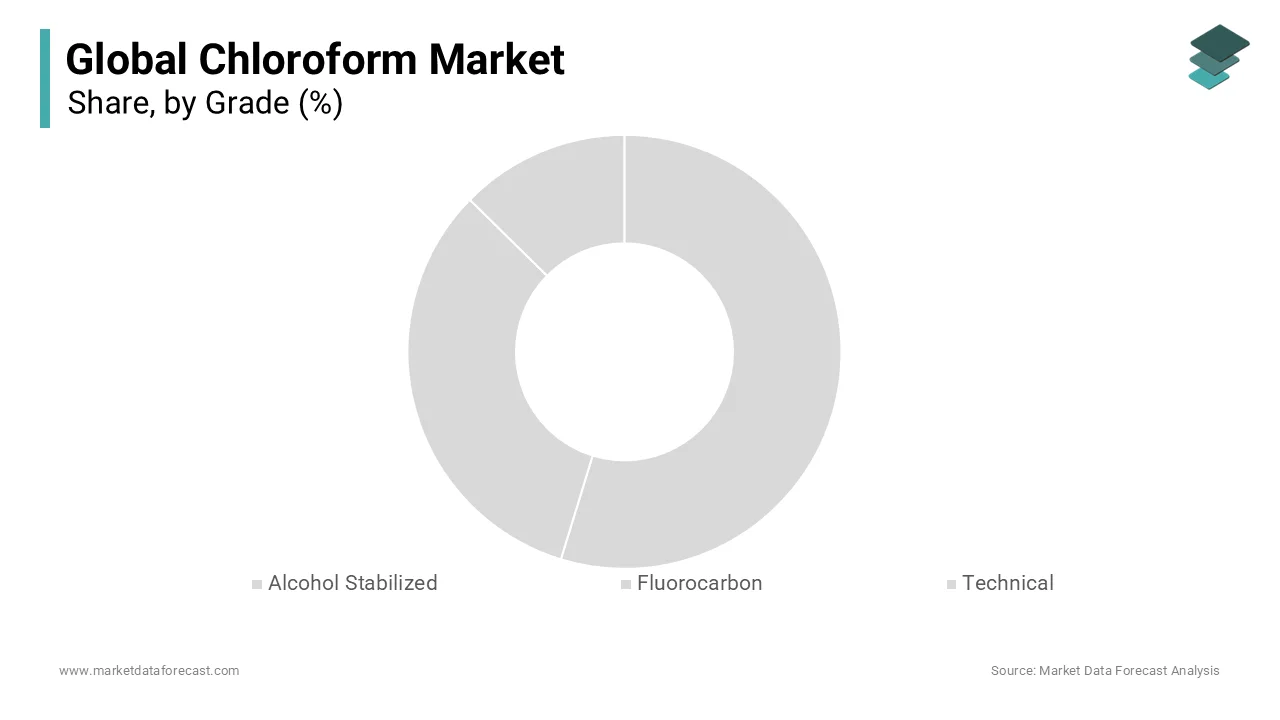
The continued demand from chemical processing, agrochemicals, and polymer manufacturing sectors, technical grade chloroform maintains a strong foothold, ensuring its leading position in the global market landscape.
- Fluorocarbon grade chloroform is the fastest-growing segment in the Chloroform Market, projected to expand at a CAGR of 6.7%, outpacing other grade categories due to its specialized role in fluoropolymer production and advanced material synthesis. This growth is driven by the expanding fluoropolymer industry, particularly in the manufacture of high-performance materials such as PTFE, PVDF (polyvinylidene fluoride), and HFP (hexafluoropropylene).
- Moreover, advancements in catalytic chemistry have improved the efficiency of chloroform-based fluorination pathways, making them more viable compared to alternative synthesis methods. These factors collectively contribute to the rising demand for fluorocarbon grade chloroform, positioning it as a key growth driver in the evolving Chloroform Market.
By Application Insights
The solvent application segment led the Chloroform Market, accounting for 51.5% of total demand in 2025.
- This is due to chloroform’s long-standing use as an effective organic solvent across pharmaceutical, chemical, and laboratory settings, despite growing regulatory scrutiny.
- According to the Royal Society of Chemistry (RSC), chloroform's ability to dissolve a wide range of non-polar compounds makes it particularly valuable in extraction, chromatography, and formulation processes. In pharmaceutical manufacturing, it is frequently employed in the purification of alkaloids, antibiotics, and synthetic drugs, especially in regions where alternative solvents are either cost-prohibitive or less effective.
- In industrial laboratories, chloroform is also used for resin dissolution, polymer testing, and thin-layer chromatography. Despite increasing substitution with greener solvents, its entrenched role in specific formulations ensures sustained demand, solidifying the solvent segment’s dominant position in the Chloroform Market.
Reagent application is the booming segment in the Chloroform Market, registering a CAGR of 5.9%.
- The Reagent application fueled by its expanding role in chemical synthesis, specialty material production, and controlled reaction environments.
- Chloroform functions as a critical reagent in organic synthesis, particularly in the generation of difluorocarbene intermediates used in the manufacture of fluoropolymers and specialty resins. According to the American Chemical Society (ACS), chloroform-based reactions are widely utilized in the synthesis of crown ethers, calixarenes, and other macrocyclic compounds essential in supramolecular chemistry.
- Moreover, the rise of nanotechnology and advanced materials science has further intensified demand for chloroform as a reagent. As per the Journal of Nanomaterials, chloroform is used in the functionalization of carbon nanotubes and graphene sheets, where its intercalating properties aid in dispersion without altering structural integrity.
- With ongoing research into novel chemical pathways and material applications, the reagent segment is gaining momentum, offering a strategic growth avenue for the Chloroform Market.
By End-Use Insights
The pharmaceutical industry held the biggest end-use segment in the Chloroform Market, accounting for 47.2% of total consumption in 2025.
- Despite regulatory restrictions and health concerns, chloroform continues to be used in select drug synthesis and formulation processes, particularly in developing markets where cost-effective production methods remain prevalent.
- Furthermore, the U.S. Pharmacopeia (USP) acknowledges that while direct medical use of chloroform has been phased out in developed countries, it persists as a residual component in some older drug formulations and quality control procedures. As per the European Directorate for the Quality of Medicines & HealthCare (EDQM), trace amounts of chloroform are occasionally detected in solvent residues of finished pharmaceutical products, indicating continued indirect usage.
- Despite increasing substitution with greener alternatives, the pharmaceutical sector remains a major consumer of chloroform, underlining its enduring presence in drug manufacturing ecosystems globally.
The chemical industry is the fastest-growing end-use segment in the Chloroform Market, expanding at a CAGR of 6.3%.
- The Chemicl industry driven by its expanding role in polymer synthesis, specialty chemical production, and industrial reagent applications.
- Chloroform plays a crucial role in the production of polytetrafluoroethylene (PTFE), a high-performance fluoropolymer used in aerospace, electronics, and industrial coatings. Moreover, the European Polymer Federation (EPF) reports that chloroform is increasingly being used in controlled polymerization reactions to produce specialty resins with enhanced thermal stability and mechanical strength. These resins find applications in semiconductor manufacturing, additive manufacturing, and high-temperature resistant components.
- These developments indicate that the chemical industry is leveraging chloroform’s unique chemical properties in niche, high-value applications, contributing to its accelerated growth within the broader Chloroform Market.
REGIONAL ANALYSIS
Asia Pacific dominated the Chloroform Market, contributing 38.5% of total market volume in 2025.
- The region’s dominance is primarily driven by robust industrial activity, particularly in China and India, where chloroform is extensively used in pharmaceutical manufacturing, agrochemical synthesis, and chemical processing.
- In addition, government policies promoting domestic chemical production have further reinforced market growth. With strong manufacturing bases and favorable regulatory environments, Asia-Pacific remains the central hub for chloroform consumption and production, shaping the trajectory of the global market.
North America is maintaining a stable yet regulated presence due to stringent environmental and occupational safety standards.
- While industrial applications have declined compared to past decades, the region continues to utilize chloroform in niche chemical synthesis and high-tech manufacturing processes.
- Moreover, the National Institute for Occupational Safety and Health (NIOSH) enforces strict exposure limits for chloroform in workplace environments, prompting industries to adopt safer handling protocols rather than complete phase-outs.
- As per the American Chemical Society (ACS), several U.S.-based research institutions still use chloroform in controlled laboratory settings for organic synthesis and analytical chemistry. Despite declining medical use and growing preference for green solvents, North America sustains a steady demand base in specialized applications, ensuring its continued relevance in the global Chloroform Market.
Europe accounts for a significant portion of the global Chloroform Market, with consumption gradually declining due to stringent regulations and a strong emphasis on sustainable chemical alternatives.
- The European Chemicals Agency (ECHA) classifies chloroform as a substance of very high concern (SVHC) under REACH legislation, imposing strict controls on its use in industrial and laboratory settings.
- According to the European Environment Agency (EEA), chloroform emissions from wastewater treatment plants and industrial sources have been significantly reduced since the early 2000s due to mandatory abatement measures. As part of the EU’s Green Deal strategy, member states are incentivizing the adoption of greener solvents, accelerating the shift away from chlorinated hydrocarbons.
- Nevertheless, niche applications persist in scientific research and specialty chemical production. As per the Royal Society of Chemistry (RSC), some European universities and chemical manufacturers still use chloroform in controlled synthesis processes where no viable alternatives exist.
- The Europe remains a significant player historically, its market influence is diminishing due to regulatory constraints and environmental policy priorities, signaling a gradual retreat from mainstream chloroform usage.
The Middle East and Africa together account for a notable share of the global Chloroform Market , with demand primarily concentrated in industrial and agricultural sectors.
- Although not a major consumer region historically, recent investments in chemical manufacturing and agrochemical production have spurred interest in chloroform-based applications.
- According to the Gulf Petrochemicals and Chemicals Association (GPCA), Saudi Arabia and the UAE are expanding their chemical processing capacities, particularly in polymers and specialty resins, creating opportunities for chloroform utilization in controlled synthesis environments.
- Moreover, Egypt and Morocco have launched initiatives to strengthen local pharmaceutical production, aligning with broader healthcare self-sufficiency goals. Although regulatory frameworks in the region are less stringent compared to Europe and North America.
- The MEA market is gradually evolving, presenting new avenues for chloroform suppliers seeking growth beyond mature markets.
Latin America is seeing gradually rising consumption in the global Chloroform Market.
- The market in Latin America characterized by modest yet consistent demand from pharmaceutical, agrochemical, and industrial sectors. Brazil and Mexico are the primary contributors, leveraging chloroform in selective chemical synthesis and formulation processes.
- Despite regulatory tightening in some areas, Latin America maintains a small but stable footprint in the Chloroform Market, reflecting the region’s transitional phase toward modernization and sustainability.
KEY MARKET PLAYERS AND COMPETITIVE LANDSCAPE
Dow, PRODUCTOS ADITIVOS, S.A., BASF SE, Solvay, Arihant Chemical, INEOS, Tokuyama Corporation, Shin-Etsu Chemical Co., Ltd., Akzo Nobel N.V., Nouryon, Sumitomo Chemical Co., Ltd., Khimprom, Occidental Petroleum Corporation, RIDHDHI SIDHDHI CHEMICALS, JIGCHEM UNIVERSAL, B JOSHI AGROCHEM PHARMA, Olin Corporation, Nike Chemical India, SWASTIK CHEM IMPEX, Life chemicals.cn, Chem Tik, and Meghmani Finechem Limited (MFL) are some of the notable companies in the global Chloroform Market.
Key Players in the Chloroform Market
BASF SE
- BASF is a leading global chemical manufacturer and a key supplier of chloroform, primarily used in industrial synthesis and specialty chemical applications.
- The company plays a vital role in supplying high-purity chloroform for fluoropolymer production and pharmaceutical intermediates.
- BASF’s extensive distribution network and commitment to sustainable chemical production ensure its strong presence in both developed and emerging markets.
Dow Inc.
- Dow is a major participant in the chloroform market, leveraging its expertise in chlorinated hydrocarbons and polymer manufacturing.
- The company supplies chloroform for use in solvent-based processes and as a precursor in the production of advanced materials.
- Dow's integration across the chemical value chain enables it to maintain consistent supply and support diverse industrial needs.
Honeywell International Inc.
- Honeywell contributes significantly to the chloroform market through its performance materials and chemical solutions division.
- The company provides specialized chloroform grades tailored for electronics, aerospace, and pharmaceutical applications.
- Honeywell’s focus on innovation and environmentally responsible production practices reinforces its competitive edge in niche and regulated markets.
Strategies Used by Key Players
- Chloroform Market is product diversification: One of the primary strategies employed by key players in the Chloroform Market is product diversification, where companies develop multiple chloroform grades—such as technical, fluorocarbon, and reagent-grade variants—to cater to distinct industrial, pharmaceutical, and specialty chemical applications. This approach allows suppliers to serve a broader customer base while optimizing pricing structures.
- partnerships and collaborations : Another crucial strategy is strategic partnerships and collaborations, wherein manufacturers align with downstream industries such as pharmaceutical firms, agrochemical producers, and polymer manufacturers to secure long-term supply agreements. These alliances help ensure stable demand and facilitate co-development of application-specific formulations that meet regulatory and performance requirements.
- expansion into emerging markets: Lastly, expansion into emerging markets has become a focal point for leading participants. Companies are strengthening their regional presence through localized production facilities, logistics networks, and compliance-focused sales teams in fast-growing economies like India, China, and Brazil. This expansion not only mitigates supply chain risks but also enhances accessibility for cost-sensitive yet high-demand sectors.
Chloroform Market Recent News
- In February 2023, BASF announced the launch of a new line of ultra-pure chloroform grades specifically designed for use in semiconductor manufacturing, targeting the growing demand for high-performance solvents in microchip fabrication and precision electronics cleaning.
- In June 2023, Dow expanded its chloroform production capacity at its Freeport, Texas facility, aiming to meet rising demand from fluoropolymer and specialty resin manufacturers while reinforcing its position as a reliable supplier in North America.
- In October 2023, Honeywell introduced an advanced purification technology for chloroform-based solvents, enhancing purity levels and reducing residual impurities to better serve the pharmaceutical and nanotechnology sectors where quality and consistency are critical.
- In March 2025, Gujarat Alkalies and Chemicals Limited (GACL), a prominent Indian chemical manufacturer, entered into a strategic partnership with European distributors to expand its chloroform exports, capitalizing on increasing demand from generic drug makers in Asia and Africa.
- In August 2025, Solvay S.A. launched a sustainability initiative aimed at minimizing chloroform emissions across its production sites, aligning with global environmental goals and reinforcing its reputation as a responsible supplier in the evolving chemical industry.
Chloroform Market Report Scope
| Metric | Value |
| Base Year | 2025 |
| Market Size Available | 2025 to 2034 |
| Forecast Period | 2026 to 2034 |
| Quantitative Units | Market Size in USD Billion and CAGR from 2026 to 2034 |
| Various Analyses Included | Global, Regional & Country-Level Analysis; Segment-Level Analysis; DROC; PESTLE; Porter's Five Forces; Competitive Landscape; Investment Opportunities |
| Segments Covered | Grade, Application, End-Use |
| Regions Analyzed | North America, Europe, APAC, Latin America, Middle East & Africa |
| Countries Covered | U.S, Canada, Mexico, UK, France, Spain, Germany, Italy, Russia, Sweden, Denmark, Switzerland, Netherlands, Turkey, Czech Republic, India, China, Japan, South Korea, Australia, New Zealand, Thailand, Malaysia, Vietnam, Philippines, Indonesia, Singapore, Brazil, Argentina, Chile, KSA, UAE, Israel, rest of GCC countries, South Africa, Ethiopia, Kenya, Egypt, Sudan and Other Countries |
| Report Format | PDF, Excel, PPT, BI |
| Customization | Report customization as per your requirements with respect to countries, region, and segmentation. |
MARKET SEGMENTATION
This research report on the global chloroform market has been segmented and sub-segmented based on grade, application, end-use, and region.
By Grade
- Alcohol Stabilized
- Fluorocarbon
- Technical
By Application
- Solvent
- Anesthetic
- Reagent
By End-Use
- Pharmaceutical
- Agrochemical
- Chemical Industry
By Region
- North America
- Asia Pacific
- Europe
- Latin America
- Middle East and Africa