- Product Description Description
- Table of Contents TOC
- List of Table & Figure LOT
- Get Free Sample PDF Sample PDF
Market Size, 2025
$6.92 BnMarket Estimate, 2026
$7.31 BnMarket Forecast, 2034
$11.32 BnCAGR, 2026–2034
5.62%Global Color Masterbatch Market Size
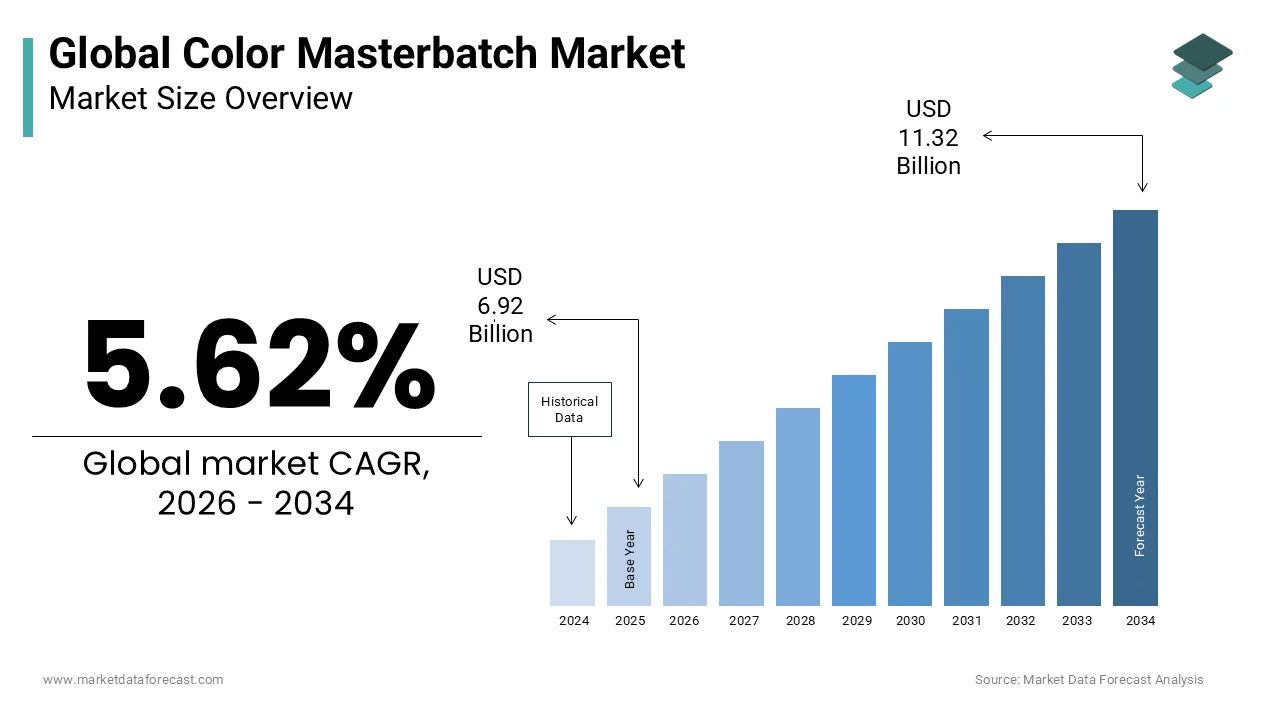
The global color masterbatch market size was valued at USD 6.92 billion in 2025, and is expected to reach USD 11.32 billion by 2034 from USD 7.31 billion in 2026, growing at a CAGR of 5.62%.
Color Masterbatch is a concentrated mixture of additives and pigments which is created by compressing it into a carrier resin through a heating process. It is then cooled and cut into granular form. The advantages of the color masterbatch are good dispersion and distribution through plastics, which are not prone to uneven colors and ensure better physical and mechanical properties of the applied material. Another advantage is that the mixing performance of the following requirements of the molding equipment is lower; such as the use of injection molding color tablets and the use of piston injection machines, which can get good quality products.
Innovative development in color masterbatch is the anti-fog masterbatch which helps reduce the harmful effects of water droplets on the packaging film. These anti-fog additives for smooth polyethylene films are well-known and widely used. The toy market grows faster based on customer demand, so it is important to understand the needs of toy designers to help them turn their ideas into high-quality products. Color Masterbatch is very important in the sales factor, along with good design and quality toys. From the precise selection of polymer and dye to finding the right combinations of parts and materials, color plays an important role in all decisions in the masterbatch manufacturing process. The toy industry faces particular challenges from manufacturers of color masterbatches. The product life cycle is extremely short, so suppliers must keep updating the latest color designs, as well as tomorrow's trends.
MARKET DRIVERS
The market for color masterbatches is driven by the increasing use by manufacturers of polymers in their own mixing procedures and by the increasing use of color masterbatches as a substitute for compounds in technical polymer markets. The demand for color masterbatches also appears to be increasing due to the increased use of special effects and colors to distinguish products. Their demand is also fuelled by the need for an advanced performance standard of polymeric materials with properties such as UV stabilization, flame retardancy, optical brightness, improved transparency, surface resistivity, electricity prevention static, and yellowing (oxidative or thermal degradation), scratch-resistant, etc. The European Union's concern about reducing greenhouse gases is leading to an increase in demand for light vehicles. As the plastic content of vehicles increases, their weight and carbon emissions are reduced, which also increases fuel efficiency. This leads to the replacement of metal parts by plastic parts in vehicles. This indicates growth opportunities in the color masterbatches market. The demand for color masterbatches is also driven by the need to improve the performance of polymeric materials which require properties such as flame retardancy, UV stabilization, optical brightness, surface resistivity, improved transparency, strength scratches, and prevention of yellowing (thermal or oxidative degradation).
MARKET RESTRAINTS
However, strict environmental regulations related to the non-biodegradability of plastics present a challenge for the market, as such regulations affect the rate of adoption of plastics, which in turn has implications for the demand for color masterbatch. Factors such as high cost and limited supply of raw materials are likely to slow the growth of the market.
REPORT COVERAGE
| REPORT METRIC | DETAILS |
| Market Size Available | 2025 to 2034 |
| Base Year | 2025 |
| Forecast Period | 2026 to 2034 |
| CAGR | 5.62% |
| Segments Covered | By Type, Carrier Resin, End User, and Region |
| Various Analyses Covered | Global, Regional & Country Level Analysis, Segment-Level Analysis, DROC, PESTLE Analysis, Porter’s Five Forces Analysis, Competitive Landscape, Analyst Overview on Investment Opportunities |
| Regions Covered | North America, Europe, Asia Pacific, Latin America, and Middle East & Africa |
| Market Leaders Profiled | Clariant AG (Switzerland), A. Schulman, Inc. (US), Polyone Corporation (US), Plastiblends India Ltd (India), Ampacet Corporation (India), Penn Color, Inc. (US), RTP Company (US), Tosaf Group (Israel), PolyOne Corporation (US), BASF SE (US). |
SEGMENTAL ANALYSIS
By Type Insights
On the basis of type, the standard colors segment is expected to register a moderate revenue share in the global color masterbatches market, due to its heat resistance, weather resistance, and strong mechanical properties. Standard color segment revenue is estimated to have the highest CAGR.
By Carrier Resin Insights
On the basis of carrier resin, the polyethylene segment is expected to dominate the global color masterbatches market. Owing to the increasing adoption of polyethylene resin in various end-use industries such as packaging bags, medical packaging, and plastic films in general, mulch films, films and pipes for tunnels and greenhouses. Polyethylene Resins segment revenue is supposed to post the highest CAGR during the outlook period.
By End-User Insights
Packaging has emerged as the main end-use segment, accounting for 46.71% of global revenue share in 2024. The packaging industry includes retail, industrial and consumer packaging, which also includes options flexible and rigid. The increase in the number of city dwellers requiring packaged products leads to increased demand for packaging. Consumers need convenient, durable and flexible packaging that offers protection and is easily traceable. Since plastic packaging meets all these needs, its demand is expected to increase, which is expected to lead to growing demand.
Plastics are widely used in the construction industry for interior and exterior applications such as domes, roofs, floors, storage containers, insulation, windows, pipes, cables, fittings, panels and guardrails. Plastics used in the construction and building industry are PVC, PU, PS, PE, PP, composites and others. They also offer increased aesthetics, durability, performance and cost savings. The energy savings over one year from the use of plastics in the building and construction industry are estimated to be sufficient to meet the average annual energy needs of approximately five million North American homes. With a greater emphasis on cost savings and increased durability, the use of plastics in this application is expected to increase, thus driving the demand for color masterbatches
REGIONAL ANALYSIS
In North America, the call for color masterbatches in the packaging industry is escalating because of the rising desire for convenience products. Special color masterbatches are used in packaging products and are available in liquid and solid forms. There has been a growing need for special colors due to the changes in consumer preferences and lifestyles which is conducive to the growth of the packaged food and personal care products market.
In Europe, the growing demand for light vehicles has had a positive impact on the consumption of color masterbatches in the automotive industry. The need for light vehicles is expected to increase during the forecast period owing to strict government regulations on carbon dioxide emissions and the need for fuel-efficient vehicles, which is expected to drive the demand for colored masterbatches in the regional market.
The Asia-Pacific region excluding Japan (APEJ) has also experienced considerable development in the global color masterbatches market. This region is expected to skyrocket at a CAGR of 5.4% between 2025 and 2033, due to the rapid increase in the use of color masterbatches in industries such as automotive and packaging. Plastics are widely used in the automotive industry, reducing vehicle weight, reducing carbon emissions, and improving overall vehicle performance and efficiency. This provides a good opportunity for the growth of the color masterbatches market in this area, as they are widely used to color plastics and improve their properties. In addition, research and development have taken a new turn in the APEJ region, where players are investing heavily in R&D to introduce new cost-effective methods for color masterbatches production and application techniques, as well as to improve product efficiency, operation, and quality, and energy efficiency. These factors are positively influencing the color masterbatches market in this region.
KEY MARKET PLAYERS
Clariant AG (Switzerland), A. Schulman, Inc. (US), Polyone Corporation (US), Plastiblends India Ltd (India), Ampacet Corporation (India), Penn Color, Inc. (US), RTP Company (US), Tosaf Group (Israel), PolyOne Corporation (US), BASF SE (US) are some of the notable companies in the global Color Masterbatch market.
RECENT HAPPENINGS IN THE MARKET
- In February 2021, Viba launched a new black PLA masterbatch. Viba has developed a range of concentrated color additives or combined masterbatches based on a PLA carrier material and designed for different processing technologies.
- In December 2021, BASF launched a new bio-based masterbatch for recycled polyethylene under the name “Sicolen” B which complements its “Colors and Effects” portfolio and contributes to the three solutions under development to make plastics more sustainable: compostable biopolymers, bio-based plastics, and recycled polymers. The BASF Color Solutions subsidiary will market the new masterbatch with its conventional Sicolen, its “Sicoversal” B, a product certified biodegradable for coloring compostable plastics, and “Sicovinyl” for coloring PVC.
- In December 2018, masterbatch and custom functional additive manufacturer Americhem Inc developed three new functional additive solutions for the fiber industry. Described by the company as “key innovations”, the new masterbatches target the dyeing and stain resistance of polyethylene terephthalate (PET) and polyamide (PA) fibers.
MARKET SEGMENTATION
This research report on the global color masterbatch market has been segmented and sub-segmented based on type, carrier resin, end-user, and region.
By Type
- Standard Color
- Specialty Color
- Tailor-Made Color
By Carrier Resin
- Polyethylene
- Polypropylene
- Polystyrene
- Others
By End-User
- Packaging
- Automotive
- Consumer Goods
- Building & Construction
- Agriculture
- Others
By Region
- North America
- Latin America
- Europe
- Asia Pacific
- Middle East & Africa