- Product Description Description
- Table of Contents TOC
- List of Table & Figure LOT
- Get Free Sample PDF Sample PDF
Market Size, 2025
$2.93 BnMarket Estimate, 2026
$3.14 BnMarket Forecast, 2034
$5.51 BnCAGR, 2026–2034
7.26%Global Computational Fluid Dynamics Market Summary
The global computational fluid dynamics (CFD) market was valued at USD 2.93 billion in 2025, is projected to reach USD 3.14 billion in 2025, and is expected to grow to USD 5.51 billion by 2034, expanding at a CAGR of 7.26% from 2026 to 2034. Factors such as the increasing adoption of simulation-driven product design, rising demand for aerodynamic analysis in automotive and aerospace, and expanding use of CFD in renewable energy, chemical processing, and healthcare applications are propelling the growth of the computational fluid dynamics market. Technological advancements in AI integration, cloud-based simulation, and high-performance computing are further boosting market adoption.
Key Market Trends
- Growing adoption of CFD software in electric vehicles and autonomous driving systems.
- Expansion of cloud-based CFD platforms for accessibility and scalability.
- Rising use of digital twins and multiphysics simulation to enhance product performance.
- Increasing application of CFD in wind energy, medical devices, and electronics cooling.
- Integration of AI and machine learning to accelerate simulation accuracy and reduce costs.
Segmental Insights
- By component, the software segment dominated the CFD market in 2025, supported by high demand for advanced simulation solutions.
- By deployment, the on-premise segment led with 59.3% share in 2025, driven by industries requiring security, control, and large-scale simulations.
- By industry, the automotive segment held the largest share at 28.3% in 2025, reflecting the need for aerodynamics optimization, thermal management, and emissions control.
Regional Insights
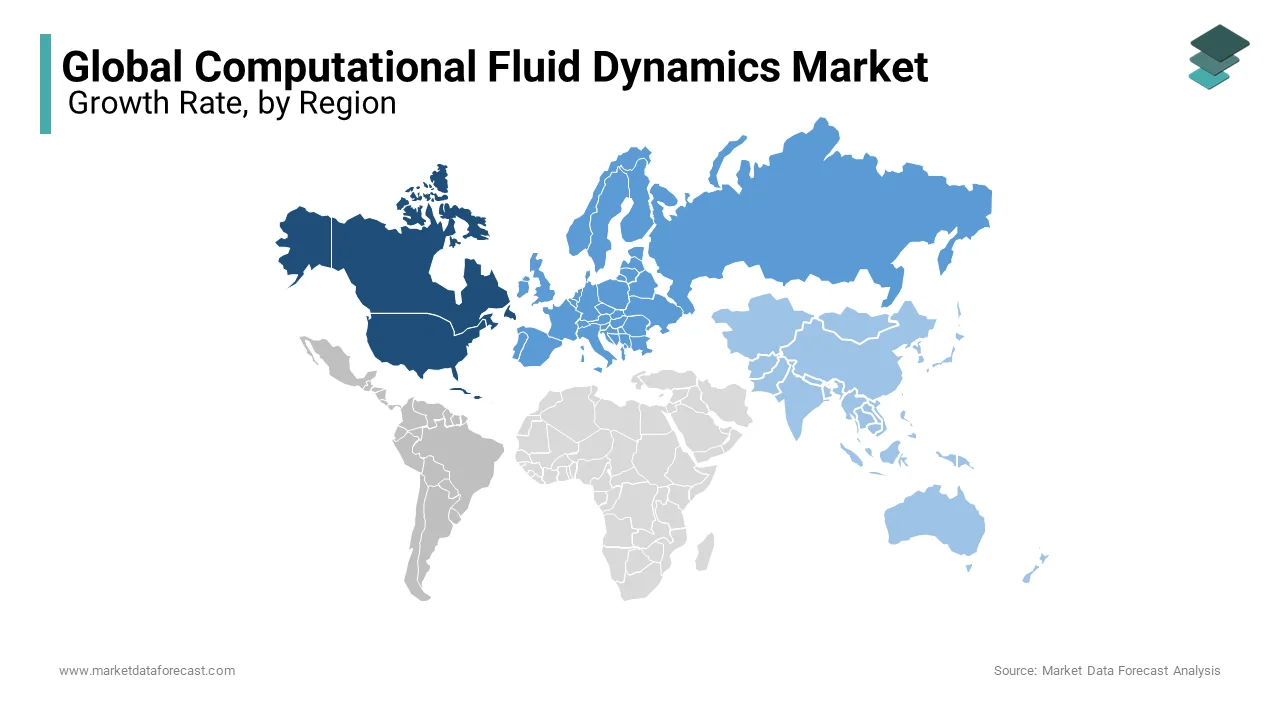
- North America was the leading region, capturing 37.1% of the global CFD market share in 2025, supported by advanced R&D facilities, strong automotive and aerospace industries, and widespread adoption of simulation technologies.
- Europe shows steady growth, driven by regulatory standards, innovation in automotive, and increasing adoption in industrial design.
- Asia-Pacific is projected to witness the fastest CAGR, supported by expanding automotive manufacturing, infrastructure development, and growing engineering outsourcing.
- Latin America and the Middle East & Africa are emerging markets, with adoption fueled by industrial projects and digital transformation.
Competitive Landscape
Key players in the global computational fluid dynamics market include Quest Consultants Inc., Hexagon AB, The MathWorks Inc., The AnyLogic Company, Autodesk Inc., Dassault Systèmes, EnginSoft SpA, Cadence Design Systems Inc., Altair Engineering Inc., Simulent Consulting Inc., PTC Inc., SimScale GmbH, M-Star Simulations LLC, Siemens AG, COMSOL AB, National Instruments, ANSYS Inc., Flow Science Inc., Maya HTT, and Tridiagonal Solutions. These companies focus on CFD software innovation, cloud simulation platforms, and integration with AI and digital twin technologies to expand their market presence.
Global Computational Fluid Dynamics Market Size
The Computational fluid dynamics market size was valued at USD 2.93 billion in 2025 and is anticipated to reach USD 3.14 billion in 2026 to reach USD 5.51 billion by 2034, growing at a CAGR of 7.26% during the forecast period from 2026 to 2034.
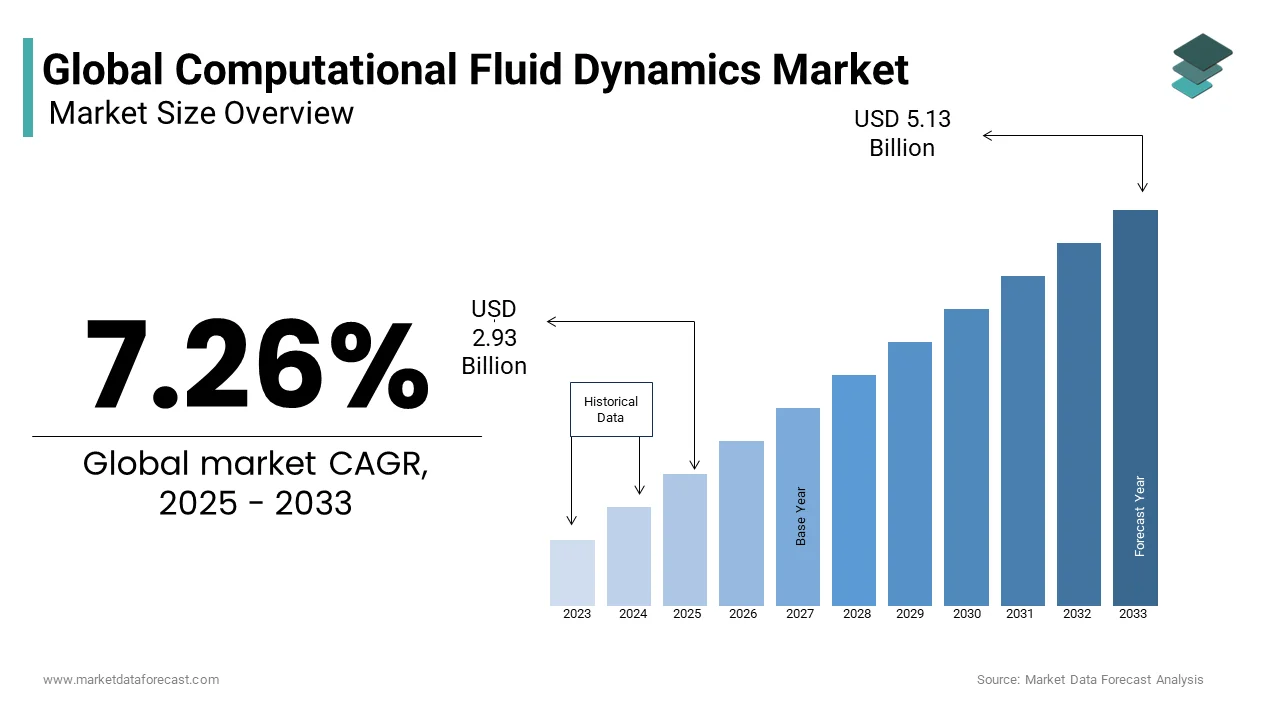
Computational fluid dynamics (CFD) is a software, high-performance computing infrastructure, and engineering services used to simulate fluid flow, heat transfer, and associated physical phenomena through numerical analysis. It is integral to industries where fluid behavior severely influences performance, safety, and efficiency. According to the U.S. Department of Energy, over 70% of national laboratory supercomputing time in 2023 was allocated to fluid dynamics and climate modeling simulations, supporting its scientific and engineering significance. The International Journal of Heat and Fluid Flow reported that CFD-driven design iterations reduced wind tunnel testing by 40–60% in aerospace firms between 2020 and 2023.
MARKET DRIVERS
The intensifying demand for energy-efficient product design across transportation and industrial sectors is propelling the growth of the computational fluid dynamics market. Automakers, aerospace firms, and HVAC manufacturers are leveraging CFD to optimize aerodynamics, reduce drag, and enhance thermal management, directly impacting fuel consumption and emissions. According to the International Council on Clean Transportation, CFD-enabled vehicle redesigns contributed to a 15% improvement in fuel efficiency for new passenger cars between 2018 and 2023. In aviation, Airbus reported that CFD simulations reduced the need for physical wind tunnel testing by 78% in the development of the A350 XWB, cutting development time and costs.
The integration of CFD into digital twin frameworks, where real-time simulation models mirror physical assets for predictive maintenance and performance optimization, is additionally enhancing the growth of the computational fluid dynamics market. Industries such as power generation, oil and gas, and urban infrastructure are deploying CFD-powered digital twins to monitor fluid systems like pipelines, turbines, and ventilation networks under dynamic operating conditions. According to the World Economic Forum, over 450 industrial facilities globally implemented digital twins in 2023, with fluid dynamics simulation forming the core analytical layer in 68% of cases. Siemens Energy, for instance, uses CFD-based digital twins to predict turbine blade erosion in gas plants, improving maintenance scheduling and reducing unplanned downtime by 32%.
MARKET RESTRAINTS
The high computational cost and infrastructure requirements for high-resolution simulations are restricting the growth of the computational fluid dynamics market. Accurate modeling of turbulent flows, multiphase systems, or combustion processes demands substantial processing power, often requiring access to supercomputers or cloud-based high-performance computing (HPC) clusters. According to the National Center for Atmospheric Research, a single high-fidelity CFD simulation for a full-scale aircraft can consume over 10 million CPU hours, translating to significant energy and financial expenditure. The U.S. Department of Energy estimates that HPC infrastructure costs for CFD applications average $1.2 million annually for mid-sized engineering firms.
The scarcity of skilled engineers proficient in both fluid dynamics theory and advanced CFD software operation is also expected to restrict the growth of the computational fluid dynamics market. Effective CFD analysis requires deep expertise in numerical methods, mesh generation, boundary condition setup, and result validation skills not commonly covered in standard engineering curricula. According to the American Society of Mechanical Engineers, only 12% of mechanical engineering graduates in the U.S. receive formal training in CFD, creating a talent gap that delays project timelines and increases reliance on external consultants. In Europe, the European Union of Engineers reported that 61% of manufacturing firms delayed CFD adoption in 2023 due to insufficient in-house expertise.
MARKET OPPORTUNITIES
The integration of artificial intelligence and machine learning to accelerate CFD simulations and reduce computational load is creating new opportunities for the growth of the computational fluid dynamics market. AI-driven surrogate models can predict fluid behavior based on historical simulation data, bypassing traditional solvers and reducing computation time from days to minutes. Companies like NVIDIA and Siemens are developing AI-CFD hybrid platforms such as SimNet and AI-Enhanced STAR-CCM+ to enable real-time design exploration.
The application of CFD in urban planning and environmental engineering to model air quality, wind comfort, and microclimates in smart cities is also expected to accelerate the growth of the computational fluid dynamics market. Municipalities are increasingly using CFD to assess the impact of high-rise developments on pedestrian-level wind patterns and pollution dispersion. According to the United Nations Human Settlements Programme, 38 major cities, including London, Singapore, and Melbourne, mandate CFD analysis for tall building approvals to ensure public safety and environmental sustainability. The World Health Organization notes that urban CFD models helped reduce localized PM2.5 concentrations by 18% in Seoul through optimized building orientation and green corridor design. Apart from these, CFD is being used to plan natural ventilation in underground transit systems, reducing reliance on mechanical cooling.
MARKET CHALLENGES
The lack of standardized validation protocols across industries, which is leading to inconsistent simulation accuracy and limited regulatory acceptance, is limiting the growth of the computational fluid dynamics market. While CFD is widely used, many regulatory bodies still require physical testing for certification, particularly in aerospace, medical devices, and nuclear engineering. According to the American Institute of Aeronautics and Astronautics, only 29% of CFD results are accepted as standalone evidence in FAA certification processes, with most requiring wind tunnel or flight test corroboration. The European Committee for Standardization has developed over 30 CFD validation guidelines since 2020, but implementation varies widely.
The complexity of simulating transient, multiphase, and reactive flows, which remain computationally intensive and prone to numerical instability, is also impeding the growth of the computational fluid dynamics market. Applications such as fuel injection, cloud cavitation, and chemical reactors involve interactions between gases, liquids, and solids under dynamic conditions, requiring advanced turbulence and interface-capturing models. According to the Journal of Computational Physics, simulations of cavitating flows in marine propellers can take over 15 million core hours to converge, with accuracy highly sensitive to mesh resolution and time-stepping schemes. The U.S. Nuclear Regulatory Commission reported that 42% of CFD models for reactor coolant systems in 2023 required multiple recalibrations due to convergence failures.
REPORT COVERAGE
| REPORT METRIC | DETAILS |
| Market Size Available | 2025 to 2034 |
| Base Year | 2025 |
| Forecast Period | 2026 to 2034 |
| CAGR | 7.26% |
| Segments Covered | By Component, Deployment, End-User and Region |
| Various Analyses Covered | Global, Regional, & Country Level Analysis; Segment-Level Analysis; DROC, PESTLE Analysis; Porter’s Five Forces Analysis; Competitive Landscape; Analyst Overview of Investment Opportunities |
| Regions Covered | North America, Europe, APAC, Latin America, Middle East & Africa |
| Market Leaders Profiled | Quest Consultants Inc.Hexagon AB, The MathWorks, Inc., The AnyLogic Company., Autodesk, Inc., Dassault Systemes, EnginSoft SpA, Cadence Design Systems, Inc., Altair Engineering Inc., Simulent Consulting, Inc., PTC Inc., SimScale GmbH, M-Star Simulations, LLC, Siemens A.G., COMSOL AB, National Instruments, ANSYS, Inc., Flow Science, Inc., Maya HTT, Tridiagonal Solutions |
SEGMENTAL ANALYSIS
By Component Insights
The software segment dominated the computational fluid dynamics (CFD) market by capturing a significant share in 2024. The growth of the segment is driven by the fundamental necessity of specialized simulation platforms to perform fluid flow, heat transfer, and multiphase modeling. Leading software suites such as ANSYS Fluent, Siemens STAR-CCM+, and COMSOL Multiphysics serve as the core analytical engines across engineering disciplines. A primary driver is the increasing complexity of product design, which demands high-fidelity simulations to replace costly physical testing.
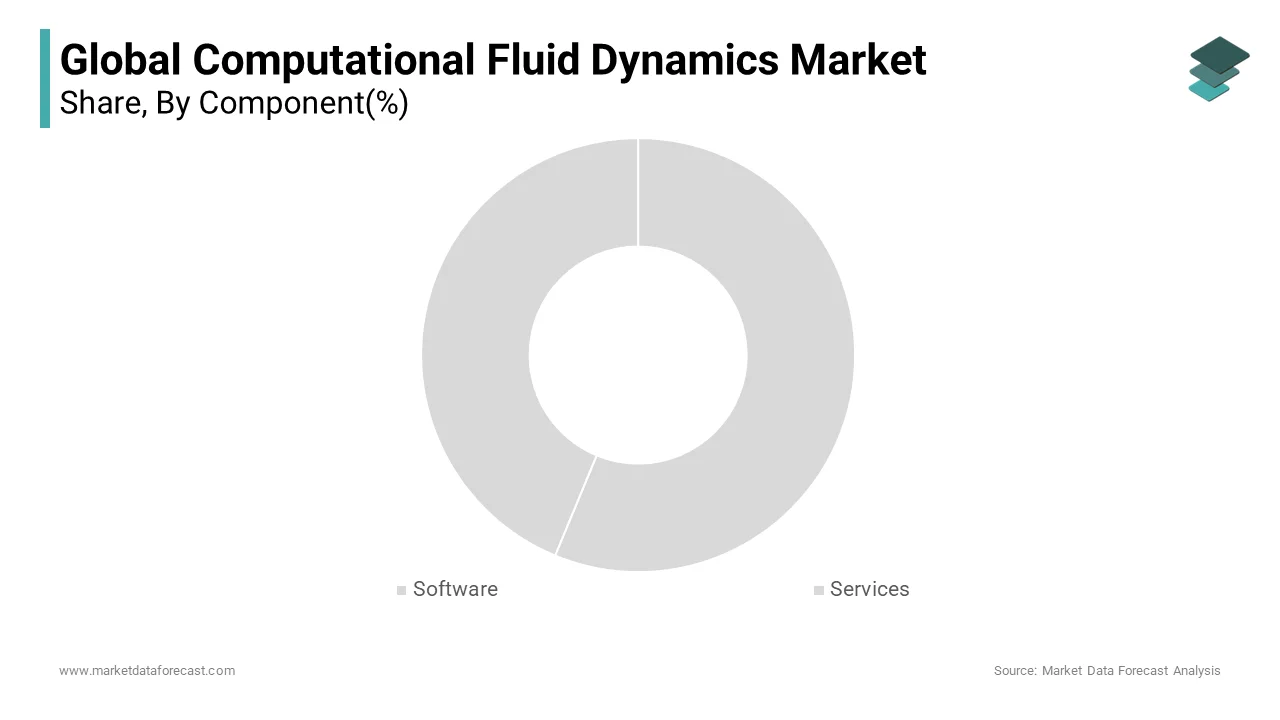
The services segment is estimated to register a CAGR of 14.2% from 2025 to 2033, owing to the rising demand for expert consulting, model validation, and training to bridge the gap between software capability and engineering expertise. Many organizations, particularly small and mid-sized enterprises, lack in-house specialists capable of setting up accurate simulations or interpreting complex results. According to the American Society of Mechanical Engineers, 61% of manufacturing firms in North America outsourced CFD analysis in 2023 due to a shortage of qualified personnel.
By Deployment Mode Insights
The on-premise deployment segment led the computational fluid dynamics (CFD) market by capturing 59.3% of the global market share in 2024. The growth of the on-premise deployment segment is driven by the need for data security, control over computing infrastructure, and compatibility with legacy engineering workflows. Industries such as defense, aerospace, and energy prioritize on-premise systems to protect sensitive design data and maintain compliance with national security regulations. According to the U.S. Department of Defense, 83% of CFD simulations for military aircraft and naval vessels are conducted on secure, air-gapped HPC clusters to prevent cyber intrusion.
The cloud deployment segment is predicted to witness a CAGR of 16.8% from 2025 to 2033 due to scalability, cost efficiency, and democratization of access. A primary driver is the ability to provision high-performance computing (HPC) resources on demand, eliminating the need for large capital expenditures on servers and cooling infrastructure. Small and mid-sized engineering firms, startups, and academic researchers are increasingly adopting cloud-based CFD platforms to run complex simulations without owning HPC clusters.
By End User Insights
The automotive segment led the computational fluid dynamics (CFD) market by capturing 28.3% of the market share. The growth of the automotive segment is driven by the industry’s relentless pursuit of aerodynamic efficiency, thermal management, and emissions reduction across internal combustion, hybrid, and electric vehicles. Automakers use CFD to optimize drag coefficients, cooling airflow, and cabin ventilation, directly impacting fuel economy and battery performance. Tesla, for example, eliminated traditional side mirrors in favor of camera systems, a decision validated through extensive CFD analysis that showed a 0.007 reduction in Cd.
The energy segment is emerging with a significant CAGR of 13.6% from 2025 to 2033, owing to the transformation of power generation and distribution infrastructure. A primary driver is the increasing complexity of renewable energy systems, particularly wind and solar thermal plants, where fluid dynamics govern efficiency and structural integrity. According to the International Renewable Energy Agency, CFD is now used in 85% of utility-scale wind farm developments to model wake effects, turbulence, and blade performance under varying atmospheric conditions. GE Renewable Energy reported that CFD-optimized turbine layouts increased annual energy production by 8–12% in offshore farms off the coast of Scotland in 2023.
REGIONAL ANALYSIS
North America Computational Fluid Dynamics (CFD) Market Analysis
North America was the top performer in the computational fluid dynamics (CFD) market in 2024 and accounted for 37.1% of the global market share in 2024. The domination of North America in the global market is primarily driven by the United States, which is serving as the epicenter of innovation and industrial application. The U.S. hosts the world’s largest concentration of aerospace, automotive, and technology firms that rely on CFD for product development and regulatory compliance. According to the National Science Foundation, over 40% of federally funded engineering research projects in 2023 involved CFD simulations, particularly in propulsion, climate modeling, and biomedical devices. The Department of Energy operates six national laboratories with dedicated CFD divisions, including Oak Ridge and Lawrence Livermore, which conduct some of the most advanced fluid simulations globally.
Europe Computational Fluid Dynamics (CFD) Market Analysis
Europe was positioned second in the computational fluid dynamics (CFD) market by holding 28.6% of the share in 2024 due to its deep integration of CFD into high-precision engineering and public infrastructure planning. Germany, France, and the UK are at the forefront, with automotive giants like Volkswagen, Airbus, and Rolls-Royce leveraging CFD for aerodynamic and thermal optimization. According to the European Commission, CFD is mandatory in the certification of all new aircraft under EASA regulations, ensuring widespread adoption. The UK’s Met Office uses CFD models to simulate urban airflow for flood and pollution forecasting, while cities like Copenhagen and Amsterdam require CFD analysis for building permits to ensure pedestrian wind comfort.
Asia Pacific Computational Fluid Dynamics (CFD) Market Analysis
Asia Pacific is expected to be the most lucrative region in the computational fluid dynamics (CFD) market, with China, Japan, and South Korea driving industrial and academic adoption. China is rapidly expanding its CFD capabilities through state-backed initiatives like the "Made in China 2025" plan, which prioritizes simulation-driven design in aerospace, automotive, and high-speed rail. According to the Chinese Academy of Sciences, over 120 supercomputing centers in China conduct CFD simulations, including the Sunway TaihuLight system used for atmospheric and hydrodynamic modeling. Japan’s automotive and robotics sectors rely heavily on CFD for thermal and fluid control, while South Korea’s shipbuilding industry uses it to optimize hull designs for fuel efficiency. The Indian Institute of Technology system has launched national CFD training programs, supported by ISRO and DRDO, to build domestic expertise.
Latin America Computational Fluid Dynamics (CFD) Market Analysis
Latin America grew steadily in the computational fluid dynamics (CFD) market, with Brazil and Mexico emerging as regional leaders in CFD application within aerospace, oil and gas, and academic research. Brazil’s aerospace manufacturer Embraer uses CFD extensively in aircraft wing and engine nacelle design, achieving certification through virtual testing validated by ANAC, the national aviation authority. Mexico’s automotive sector, integrated into North American supply chains, adopts CFD for thermal and aerodynamic validation of components exported to the U.S. and Canada.
Middle East and Africa Computational Fluid Dynamics (CFD) Market Analysis
Middle East & Africa are likely to grow in the computational fluid dynamics (CFD) market during the forecast period, due to government-led industrial diversification and infrastructure modernization. The UAE, particularly through Dubai and Abu Dhabi, has invested in smart city and renewable energy projects that rely on CFD for urban airflow, solar thermal efficiency, and HVAC optimization. According to the Dubai Electricity and Water Authority, CFD models helped reduce cooling energy consumption by 18% in new commercial buildings through optimized façade and ventilation design.
COMPETITIVE LANDSCAPE
The competition in the computational fluid dynamics market is intensifying as vendors shift from standalone software providers to integrated digital engineering partners. Position is increasingly determined by ecosystem strength, interoperability with CAD and PLM systems, and the ability to deliver validated, industry-specific workflows. Incumbents face a burden or push from open-source alternatives like OpenFOAM and agile startups offering AI-driven simulation accelerators. Differentiation is emerging through cloud scalability, real-time visualization, and embedded AI for predictive modeling. Regulatory acceptance and certification support are becoming important battlegrounds, particularly in aerospace and medical applications. Companies that combine high-fidelity solvers with user-friendly interfaces, training infrastructure, and sustainability analytics are gaining a strategic advantage.
KEY MARKET PLAYERS
- Quest Consultants Inc.
- Hexagon AB
- The MathWorks, Inc.
- The AnyLogic Company.
- Autodesk, Inc.
- Dassault Systemes
- EnginSoft SpA
- Cadence Design Systems, Inc.
- Altair Engineering Inc.
- Simulent Consulting, Inc.
- PTC Inc.,
- SimScale GmbH
- M-Star Simulations
- LLC
- Siemens A.G.
- COMSOL AB
- National Instruments
- ANSYS, Inc.,
- Flow Science, Inc.,
- Maya HTT,
- Tridiagonal Solutions
Top Players In the Market
- ANSYS has established a dominant presence in the Asia Pacific computational fluid dynamics (CFD) market through its comprehensive simulation suite, particularly ANSYS Fluent and CFX, which are widely adopted in aerospace, automotive, and electronics sectors. The company has expanded its regional footprint by collaborating with leading engineering institutions such as IIT Bombay and Tsinghua University to integrate CFD into academic curricula and research programs. In 2023, ANSYS launched a dedicated Asia Pacific Innovation Hub in Singapore, focusing on AI-enhanced fluid dynamics and digital twin applications for smart manufacturing. It also partnered with Japan’s New Energy and Industrial Technology Development Organization (NEDO) to support hydrogen storage system design using high-fidelity CFD.
- Siemens Digital Industries Software has strengthened its position in the Asia Pacific CFD market through the integration of STAR-CCM+ into its end-to-end digital enterprise portfolio, enabling seamless workflows from design to production. The company has prioritized industrial digitalization in key markets, including China’s automotive and South Korea’s shipbuilding industries, where STAR-CCM+ is used for aerodynamic, hydrodynamic, and thermal optimization. In 2023, Siemens collaborated with Hyundai Motor Company to implement real-time CFD simulations for electric vehicle battery cooling systems, reducing development cycles by 35%. It also established a Digital Factory Collaboration Center in Shanghai, providing hands-on training and co-engineering support for local manufacturers.
- Dassault Systèmes has expanded its influence in the Asia Pacific CFD market through its SIMULIA brand, which delivers advanced fluid dynamics capabilities within the 3DEXPERIENCE platform. The company has focused on high-value applications in aerospace, life sciences, and sustainable urban development, partnering with organizations such as the Indian Space Research Organisation (ISRO) and Singapore’s Agency for Science, Technology and Research (A*STAR). In 2023, Dassault launched a regional initiative called “Fluid Intelligence” to promote cloud-based CFD adoption among mid-sized engineering firms in India and Southeast Asia, offering modular licensing and remote support. It also integrated AI-driven meshing tools into SIMULIA PowerFLOW, reducing setup time for automotive aerodynamics by up to 50%.
Top Strategies Used by the Key Market Participants
Key players in the computational fluid dynamics market are leveraging platform integration, cloud transformation, AI augmentation, academic partnerships, and industry-specific solution bundling to strengthen their competitive positioning. Companies are embedding CFD tools within broader digital engineering ecosystems to enable multidisciplinary simulation and design continuity. There is a strategic shift toward cloud-native and hybrid deployment models to improve scalability and accessibility. Firms are incorporating machine learning for automated meshing, turbulence modeling, and result prediction to reduce simulation time and user dependency. Collaborations with universities and certification bodies are being used to expand talent pools and validate software for regulated industries.
MARKET SEGMENTATION
This research report on the global computational fluid dynamics market is segmented and sub-segmented into the following categories.
By Component
- Software
- Services
By Deployment Mode
- On-premise
- Cloud
By End-User
- Automotive
- Aerospace
- Manufacturing
- Energy
- Material and Chemical Processing
- Others
By Region
- North America
- Europe
- Asia-Pacific
- Latin America
- Middle East and Africa