- Product Description Description
- Table of Contents TOC
- List of Table & Figure LOT
- Get Free Sample PDF Sample PDF
Market Size, 2025
$1.08 BnMarket Estimate, 2026
$1.14 BnMarket Forecast, 2034
$1.78 BnCAGR, 2026–2034
5.76%Global Conformal Coatings Market Size
The global conformal coatings market size was valued at USD 1.08 billion in 2025 and is anticipated to reach USD 1.14 billion in 2026 and USD 1.78 billion by 2034, growing at a CAGR of 5.76% during the forecast period from 2026 to 2034.
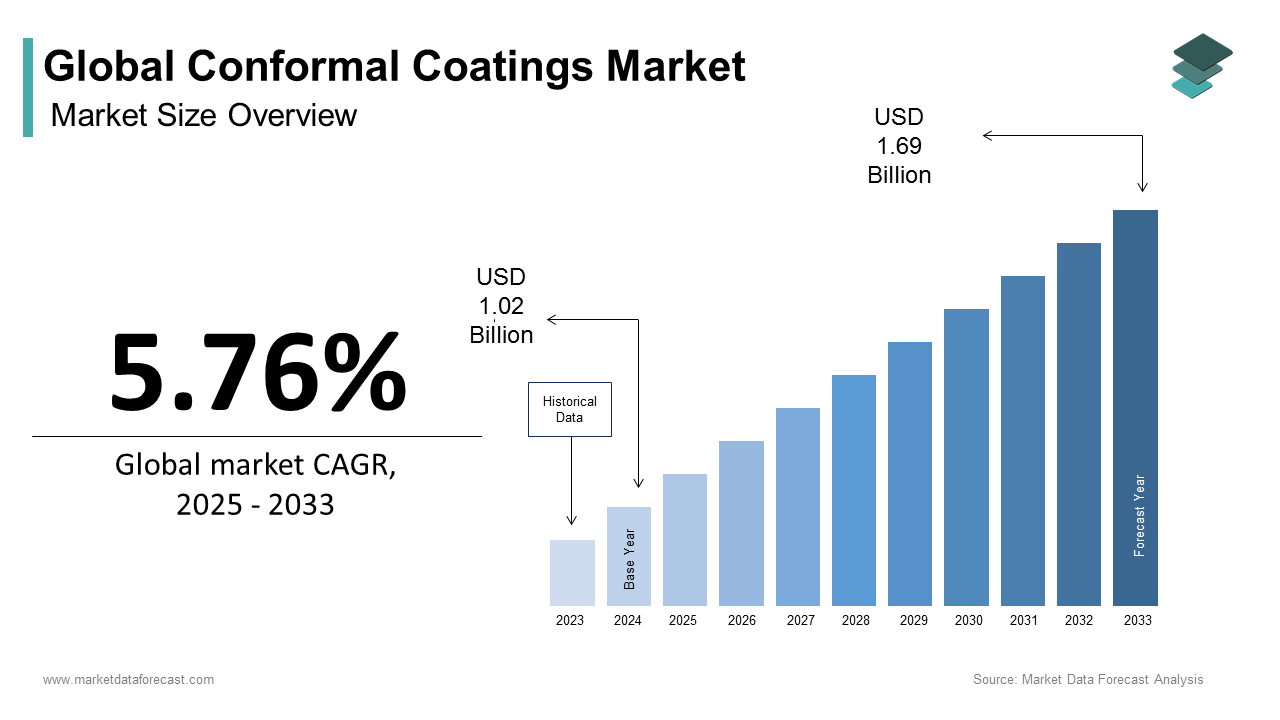
The Conformal Coatings are thin polymeric films applied to printed circuit boards (PCBs) and electronic components to protect against moisture, dust, chemicals, temperature extremes, and mechanical stress.
MARKET DRIVERS
Expansion of Automotive Electronics and ADAS Adoption
The advanced driver-assistance systems (ADAS) and electric vehicle (EV) platforms are significantly amplifying the growth of the conformal coatings market. Modern vehicles now contain over 100 electronic control units (ECUs), many operating in high-vibration, thermally fluctuating environments where protection against condensation and chemical exposure is important. Coatings such as silicone and parylene are increasingly specified for under-hood electronics, with manufacturers like Bosch and Continental enforcing stricter coating adherence standards.
Growth in Industrial Internet of Things (IIoT) and Smart Manufacturing
The global deployment of IIoT devices in manufacturing, energy, and logistics infrastructure is propelling the growth of the Cassava Flour Market. IIoT sensors and edge computing nodes are often deployed in corrosive, high-humidity, or electrically noisy environments where unprotected electronics face rapid degradation. These devices, particularly in oil and gas or chemical processing, require coatings resistant to hydrocarbons, sulfides, and thermal cycling. Silicone and fluoropolymer-based coatings have become essential, with manufacturers like Siemens reporting a 40% reduction in field failures after implementing conformal-coated sensor modules.
MARKET RESTRAINTS
Volatility in Raw Material Supply and Pricing of Resin Feedstocks
The production of conformal coatings, which relies heavily on petrochemical-derived resins such as acrylic monomers, silicones, and polyurethane prepolymers, is declining, hindering the growth of the Cassava Flour Market. Similarly, silicone resin feedstocks like dimethyldichlorosilane experienced a 32% price increase during the same period due to constrained polysilicon production amid energy shortages in Europe. This volatility disrupts formulation consistency and escalates manufacturing costs, particularly for small- and medium-sized coating applicators lacking long-term supply contracts.
Stringent Environmental Regulations on Solvent-Based Formulations
The environmental regulations are increasingly restricting the use of solvent-based conformal coatings due to their volatile organic compound (VOC) emissions, which additionally limits the growth of the Cassava Flour Market. In the European Union, the Solvents Emissions Directive (SED) mandates VOC emissions from industrial coating processes to remain below 30 grams per square meter, a threshold that many traditional acrylic and urethane coatings struggle to meet. As per the European Environment Agency, solvent-based coatings accounted for nearly 45% of industrial VOC emissions in 2021, prompting stricter enforcement and penalties. Additionally, workforce retraining and process validation delays hinder adoption, particularly among tier-2 and tier-3 electronics manufacturers in emerging markets lacking regulatory compliance infrastructure.
MARKET OPPORTUNITIES
Rising Integration of Conformal Coatings in Medical Electronics and Implantable Devices
The rising adoption of implantable and wearable devices, where biocompatibility and long-term reliability greatly influence the growth of the Cassava Flour Market. Parylene coatings, which are known for their pinhole-free deposition and ISO 10993 biocompatibility certification, are increasingly used in pacemakers, neurostimulators, and glucose monitors. According to the U.S. Food and Drug Administration, over 600,000 implantable medical devices were approved in 2023, a 12% increase from 2021, many requiring hermetic-level protection.
Advancements in Nanocoating Technologies and Atomic Layer Deposition (ALD)
Emerging nanocoating technologies are enabling sub-micron protective layers with exceptional uniformity and dielectric strength, which is also expected to escalate the growth of the conformal coatings market. Unlike traditional spray or dip methods, ALD allows for precise, molecule-by-molecule deposition of materials such as aluminum oxide or silicon dioxide, achieving conformal coverage even on complex 3D microelectronics. As per the Semiconductor Research Corporation, ALD-based protective films exhibit dielectric breakdown strengths exceeding 10 MV/cm, which is significantly outperforming conventional polymer coatings.
MARKET CHALLENGES
Difficulty in Achieving Uniform Coating Thickness on Complex PCB Geometries
Ensuring consistent coating thickness across densely populated PCBs hampers the growth of the conformal coatings market. Components such as ball grid arrays (BGAs), connectors, and stacked memory modules create shadow zones where spray-based methods fail to deliver uniform coverage. Manual brushing and selective coating systems improve precision but increase labor costs by up to 35%, as reported by the IPC. Automated robotic dispensing systems offer better control but require extensive programming and calibration for mixed-component boards.
Limited Recycling and End-of-Life Disposal Options for Coated Electronics
The Conformal coatings are complicated end-of-life recycling due to their strong adhesion and chemical resistance, also accelerating the growth of the conformal coatings market. Traditional delamination methods, such as thermal, chemical, or mechanical, often damage underlying components by reducing material recovery rates. The presence of fluorinated polymers and cross-linked silicones further inhibits decomposition, rendering many coated boards non-compostable and non-incinerable without releasing hazardous byproducts.
REPORT COVERAGE
| REPORT METRIC | DETAILS |
| Market Size Available | 2025 to 2034 |
| Base Year | 2025 |
| Forecast Period | 2026 to 2034 |
| CAGR | 5.76% |
| Segments Covered | By Product, End Use Industry, and Region |
| Various Analyses Covered | Global, Regional, and Country Level Analysis; Segment-Level Analysis; DROC; PESTLE Analysis; Porter’s Five Forces Analysis; Competitive Landscape; Analyst Overview of Investment Opportunities |
| Regions Covered | North America, Europe, APAC, Latin America, Middle East & Africa |
| Market Leaders Profiled | Henkel AG & Co. KGaA, Chase Corporation, H.B. Fuller Company, Dymax Corporation, Electrolube, Shin-Etsu Chemical Co., Ltd., Dow Inc., MG Chemicals, Chemtronics, Aalberts Surface Technologies, Altana AG, Europlasma NV |
SEGMENTAL ANALYSIS
By Product Insights
The acrylic-based conformal coatings segment held 32.2% of the conformal coatings market share in 2025. The widespread adoption of acrylics stems from their cost-effectiveness, ease of application, and excellent dielectric properties. These coatings offer strong moisture resistance and UV stability, making them ideal for consumer electronics and automotive applications. Their fast drying time significantly enhances production throughput; for instance, acrylics cure within 30 minutes under ambient conditions, reducing processing time by up to 40% compared to epoxy systems, as noted in a 2022 technical report by Henkel AG. Additionally, acrylics are reworkable using common solvents like isopropyl alcohol, which is an advantage in high-volume manufacturing environments where repair and rework are routine.
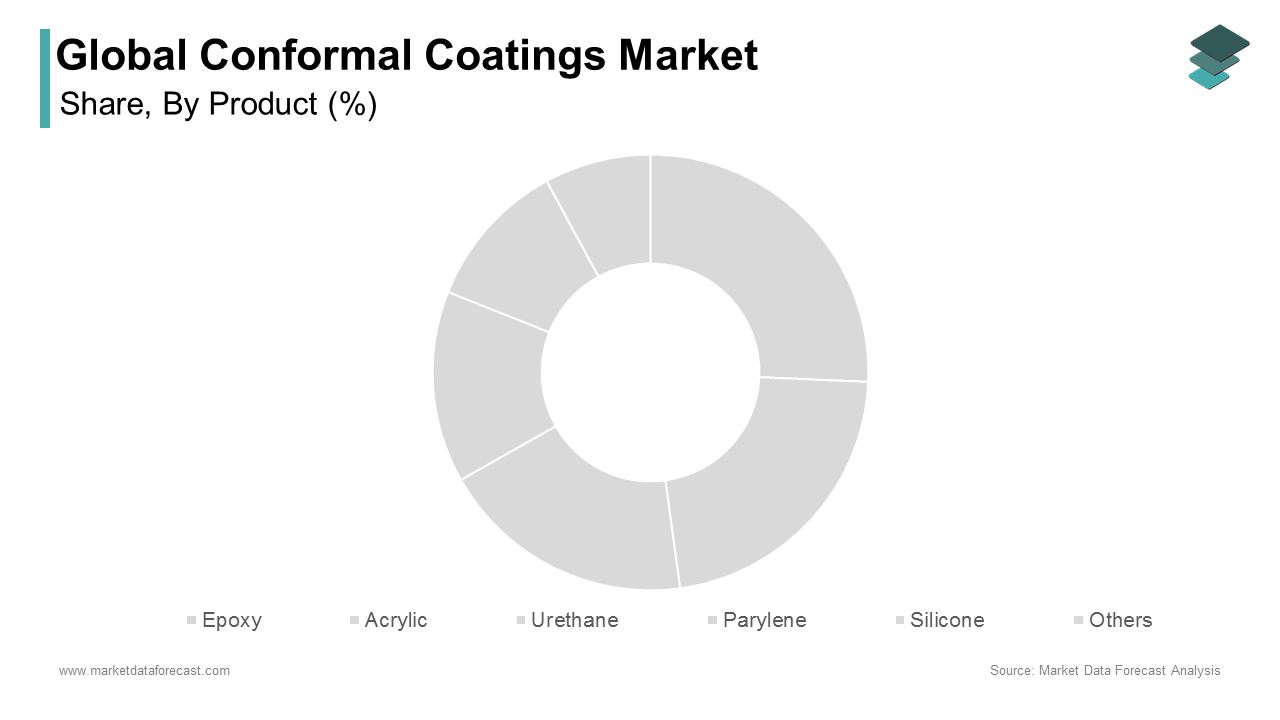
The parylene coatings segment is likely to grow with an expected CAGR of 13.8% during the forecast period, with their unmatched performance in extreme environments. Parylene is applied via vapor deposition, forming a pinhole-free, ultra-thin, and uniform film that provides superior moisture, chemical, and dielectric barriers.
By End-Use Industry Insights
The consumer electronics sector held 37.4% of the conformal coatings market share in 2025, with the massive scale of production and the increasing complexity of electronic devices. Smartphones, wearables, tablets, and IoT devices all require protection against moisture, dust, and thermal stress. Apple Inc. has publicly disclosed that all iPhone models since the iPhone 7 include internal conformal coatings to enhance water resistance, aligning with IP67 and IP68 ratings. Furthermore, the trend toward thinner, lighter, and more powerful devices reduces internal clearance, increasing vulnerability to environmental damage.
The medical devices segment is projected to grow at a CAGR of 12.6% from 2026 to 2034, with the rising demand for implantable and wearable medical electronics, which require ultra-reliable protection. Parylene, in particular, dominates this space due to its FDA approval and ability to form hermetic seals at micron-level thicknesses. The global market for implantable medical devices alone was valued at $67.8 billion in 2023, per Statista, and is expected to exceed $100 billion by 2030. Medtronic, a leading medical device manufacturer, reported in its 2023 sustainability report that over 90% of its implantable electronics utilize Parylene coatings to ensure device longevity and patient safety. Additionally, regulatory standards such as ISO 10993-5 for biocompatibility testing have made conformal coating an essential part of device design.
REGIONAL ANALYSIS
Asia Pacific Conformal Coatings Market Insights
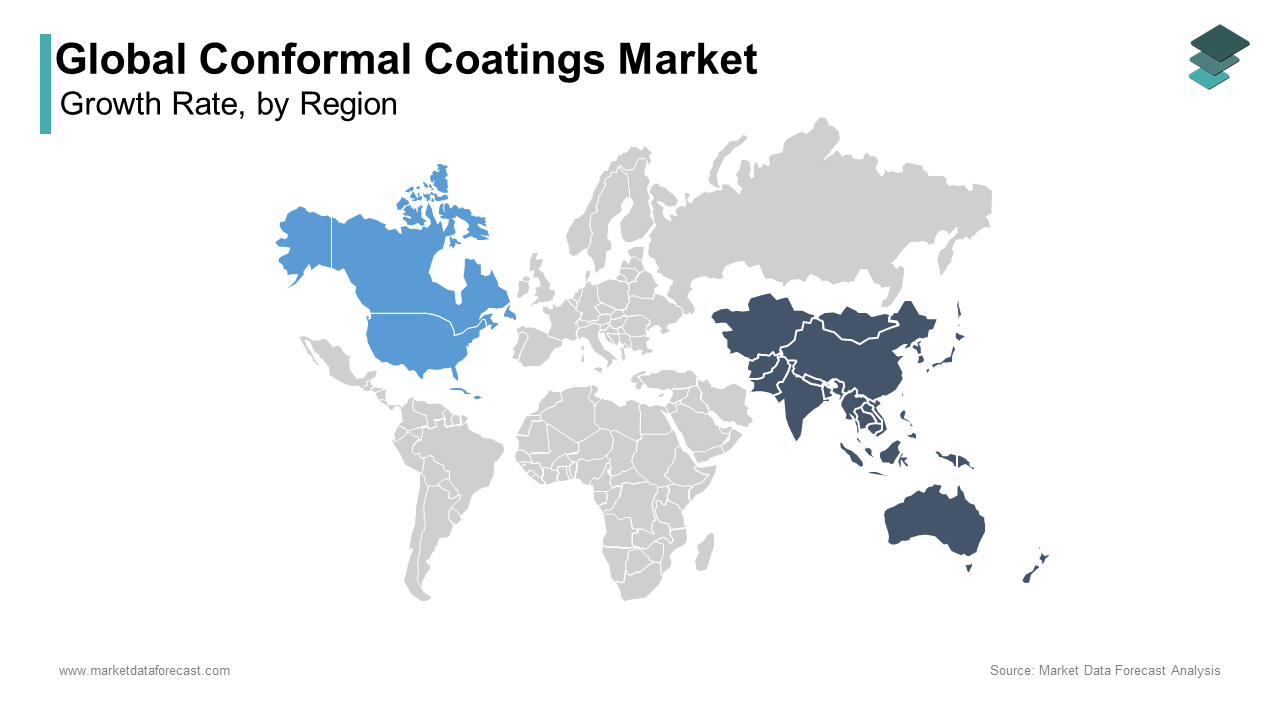
Asia Pacific was the largest contributor in the conformal coatings market with 41.3% of share in 2025, with its role as the world’s primary hub for electronics and automotive manufacturing. China alone produces over 60% of the world’s consumer electronics, as reported by the China Electronics Chamber of Commerce. South Korea and Taiwan are key producers of semiconductors and advanced PCBs, where conformal coatings are used for yield improvement.
North America Conformal Coatings Market Insights
North America was ranked second in holding 23.3% of the conformal coatings market share in 2025. The region’s strength lies in its advanced aerospace, defense, and medical technology sectors, where performance and reliability are non-negotiable. Companies like Boeing and Raytheon use parylene and urethane coatings in avionics to meet MIL-STD-810 and DO-160 standards. In the medical field, the U.S. Food and Drug Administration cleared over 4,500 new medical devices in 2023, many of which are electronic and require conformal protection. The rise of AI hardware and data centers also contributes. Intel and NVIDIA are incorporating conformal coatings in next-gen server boards to prevent corrosion in high-humidity environments.
Europe Conformal Coatings Market Insights
Europe's market is growing with a significant CAGR in the conformal coatings market and is expected to continue the same growth throughout the forecast period. The shift toward electric vehicles, which contain three times more electronics than internal combustion engine vehicles, is increasing coating demand. The European Commission estimates that EVs will account for 55% of new car sales by 2030 under the Fit for 55 initiative. Additionally, Europe’s stringent environmental regulations are pushing manufacturers toward low-VOC acrylic and UV-curable coatings. BASF and Covestro have launched eco-friendly conformal coating lines in response.
Latin America Conformal Coatings Market Insights
Latin America's market is likely to grow, with Brazil and Mexico being major contributors in the conformal coatings market. While smaller in scale, the market is gaining momentum due to growing electronics assembly and automotive production.
Middle East & Africa Conformal Coatings Market Insights
The Middle East and Africa market is likely to grow in the conformal coatings with an estimated growth opportunity during the forecast period. The UAE’s Vision 2030 and Saudi Arabia’s NEOM project are catalyzing investments in smart infrastructure, telecommunications, and defense electronics.
COMPETITIVE LANDSCAPE
KEY MARKET PLAYERS
Some of the companies that are playing a dominating role in the global conformal coatings market include
- Henkel AG & Co. KGaA
- Chase Corporation
- H.B. Fuller Company
- Dymax Corporation
- Electrolube
- Shin-Etsu Chemical Co., Ltd
- Dow Inc
- MG Chemicals
- Chemtronics
- Aalberts Surface Technologies
- Altana AG
- Europlasma NV
Top Strategies Used By Key Market Participants
Key players in the conformal coatings market are prioritizing product innovation, regional expansion, and strategic partnerships to gain a competitive advantage. Companies are investing heavily in R&D to develop eco-friendly, low-VOC, and fast-curing formulations that meet evolving environmental regulations and manufacturing speed demands. Expansion into high-growth regions like the Asia Pacific through localized production and technical centers enhances responsiveness. Collaborations with electronics OEMs and PCB manufacturers enable co-development of tailored solutions. Acquisition of niche technology firms strengthens capabilities in advanced coatings like parylene.
COMPETITION OVERVIEW
The conformal coatings market is characterized by intense competition driven by technological differentiation, application expertise, and regional presence. Major players compete on performance, reliability, and environmental compliance, particularly in high-stakes industries like automotive, medical, and aerospace. While established chemical giants leverage global infrastructure and R&D capabilities, regional and niche players focus on specialized formulations and cost-effective solutions. Innovation in water-based, UV-curable, and ultra-thin coatings is accelerating, with companies striving to meet the demands of miniaturized electronics and electric vehicles. Customer collaboration and technical support play a crucial role in securing long-term contracts.
LEADING PLAYERS IN THE CONFORMAL COATINGS MARKET
Dow Inc.
Dow Inc. is a leading innovator in specialty materials, offering a broad portfolio of silicone and acrylic-based conformal coatings tailored for electronics and industrial applications. In the Asia Pacific region, Dow has strengthened its presence through strategic collaborations with local electronics manufacturers in China, India, and South Korea. In 2023, the company launched its DOWSIL™ TC-4000 series, a thermally conductive silicone coating designed for electric vehicle power modules, enhancing thermal management and reliability. Dow has also expanded its technical service centers in Shanghai and Bangalore to support regional customers with faster R&D response and application testing.
Henkel AG & Co. KGaA
Henkel is a global leader in electronic materials, with its LOCTITE brand being a preferred choice for conformal coatings across automotive, industrial, and consumer electronics sectors in the Asia Pacific. The company has deep integration with major OEMs and contract manufacturers in Japan, South Korea, and Vietnam, providing tailored solutions for high-volume production environments. In 2023, Henkel introduced the LOCTITE UV3000 series, a fast-curing, low-VOC acrylic coating that supports sustainable manufacturing.
Shin-Etsu Chemical Co., Ltd.
Shin-Etsu Chemical is a dominant force in silicone and fluoropolymer-based conformal coatings, widely used in high-reliability applications across the Asia Pacific. The Japanese company supplies raw materials to the semiconductor, automotive, and telecommunications industries in Taiwan, South Korea, and Southeast Asia. In 2025, Shin-Etsu launched a new parylene derivative, Parylene AF-4, offering superior UV and thermal stability for outdoor electronics and aerospace components.
MARKET SEGMENTATION
This research report on the global conformal coatings market is segmented and sub-segmented into the following categories.
By Product
- Epoxy
- Acrylic
- Urethane
- Parylene
- Silicone
- Others
By End Use Industry
- Automotive
- Medical
- Aerospace & Defense
- Consumer Electronics
- Others
By Region
- North America
- Europe
- Latin America
- Asia Pacific
- Middle East & Africa