- Product Description Description
- Table of Contents TOC
- List of Table & Figure LOT
- Get Free Sample PDF Sample PDF
Market Size, 2025
$49.89 BnMarket Estimate, 2026
$57.55 BnMarket Forecast, 2034
$180.51 BnCAGR, 2026–2034
15.36%Global Connected Truck Market Size, Growth, Trends & Forecast (2026–2034)
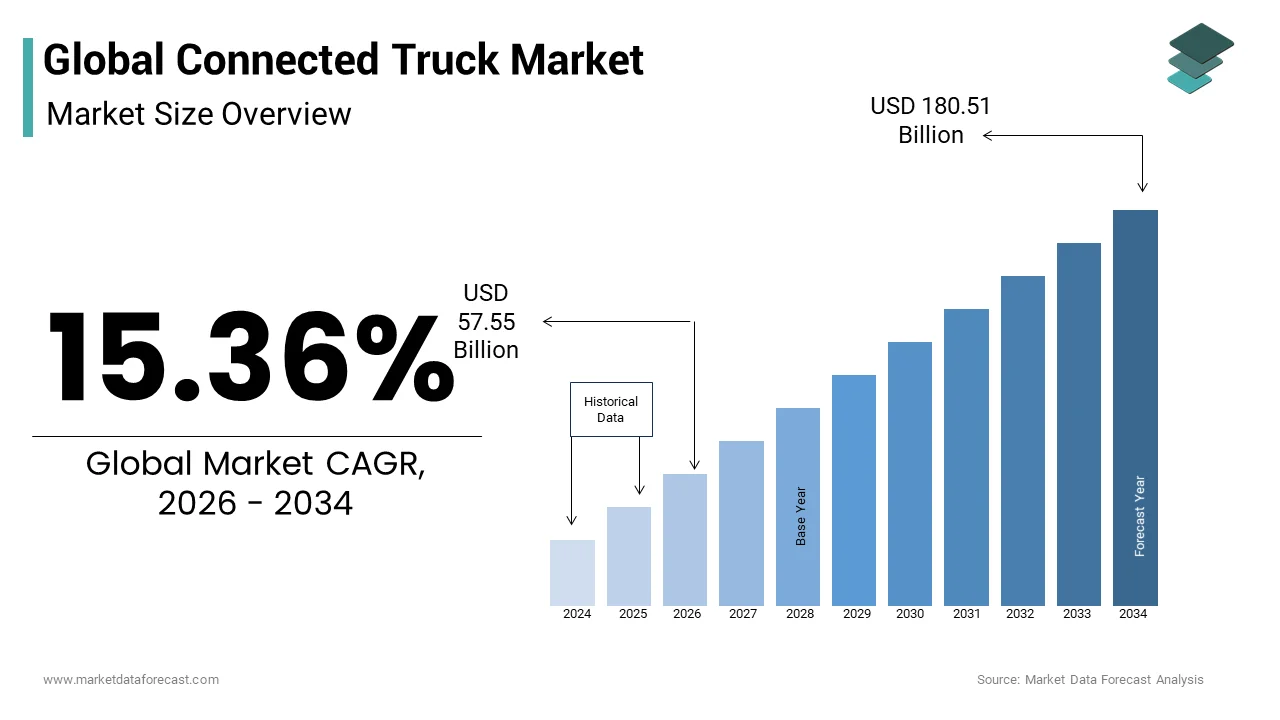
The global connected truck market size was valued at USD 49.89 billion in 2025, is anticipated to reach USD 57.55 billion in 2026, and is projected to scale up to USD 180.51 billion by 2034, registering a compound annual growth rate (CAGR) of 15.36% during the forecast period from 2026 to 2034. Driven by stringent government regulations on safety and emissions, surging demand for supply chain visibility, and the rapid expansion of 5G infrastructure, the connected truck industry continues to expand rapidly worldwide.
Key Executive Metrics (At-a-Glance)
- 2025 Base Valuation: USD 49.89 Billion
- 2026 Current Valuation: USD 57.55 Billion
- 2034 Forecast Valuation: USD 180.51 Billion
- Compound Annual Growth Rate (CAGR): 15.36% (2026–2034)
- Dominant Communication Type: Vehicle-to-Cloud (V2C) (holding the major market share supported by fleet management and data analytics)
- Dominant Vehicle Type: Heavy Commercial Vehicle (holding major market share due to long-haul freight demands and regulatory compliance needs)
- Fastest-Growing Communication Type: Vehicle-to-Infrastructure (V2I) (expanding at a CAGR of 26.6% driven by smart city initiatives)
- Dominant Region: North America (holding leading market share backed by early telematics adoption and advanced logistics infrastructure)
- Fastest-Growing Region: Asia-Pacific (expanding at a robust pace propelled by e-commerce growth and industrial modernization in China and India)
Core Market Drivers
- Safety and Emission Regulations: Stringent government frameworks mandating electronic logging, safety systems, and rigorous environmental compliance.
- Supply Chain Visibility: Escalating demand from shippers and consumers for real-time tracking, cargo monitoring, and operational transparency.
Primary Market Restraints & Challenges
- High Implementation Costs: Substantial upfront hardware, software, and subscription costs posing barriers for small and medium enterprises.
- Cybersecurity & Privacy Risks: Increasing vulnerabilities to cyber threats and strict compliance requirements regarding driver data protection.
Global Connected Truck Market Segmentation Breakdown
| Segment Category | Leading Sub-Segment (2025 Base) | Fastest-Growing Sub-Segment (2026–2034) |
|---|---|---|
| By Communication Type | Vehicle-to-Cloud (V2C) (dominant volume leader for telematics and central cloud analytics) | Vehicle-to-Infrastructure (V2I) (projected at a 26.6% CAGR driven by smart traffic deployments) |
| By Vehicle Type | Heavy Commercial Vehicles (dominant share supported by long-haul freight tracking and compliance) | Light Commercial Vehicles (LCVs) (fastest-growing category fueled by booming e-commerce and last-mile delivery demand) |
| By Region | North America (major market valuation base driven by advanced logistics and regulatory mandates) | Asia-Pacific (fastest-growing regional market propelled by digitalization and infrastructure investments) |
Major Industry Players Profiled
Key enterprises shaping the competitive global connected truck market include APTIV PLC, Continental AG, Denso Corporation, HARMAN International, Magna International Inc., NXP Semiconductors Netherlands B.V., Robert Bosch GmbH, Sierra Wireless, Inc., TomTom International BV, Trimble Inc., Verizon Connect, and ZF Friedrichshafen AG.
 Download Free Sample Report
Global Connected Truck Market Size
The global connected truck market size was valued at 49.89 billion in 2025 and is anticipated to reach USD 57.55 billion in 2026 to reach USD 180.51 billion by 2034, growing at a CAGR of 15.36% during the forecast period from 2026 to 2034.
Connected trucks represent a transformative segment within the commercial vehicle industry, where heavy-duty vehicles are equipped with advanced telematics communication modules and sensor arrays to enable real-time data exchange. These vehicles utilize cellular networks, satellite connectivity, and dedicated short-range communications to transmit critical information regarding location, performance, driver behavior, and cargo status to fleet managers and logistics platforms. The integration of Internet of Things (IoT) technology allows for predictive maintenance, route optimization, and enhanced safety protocols, which are essential for modern supply chain efficiency. In Europe, the push toward digitalization in transport is supported by robust infrastructure initiatives. According to the European Automobile Manufacturers Association, the European Union maintains a large fleet of commercial vehicles, highlighting the massive scale of potential connectivity adoption. As per the International Transport Forum, road freight accounts for approximately 75% of inland freight transport in Europe, underscoring the economic importance of optimizing these operations. Regulatory bodies, such as the European Commission, enforce strict driving time regulations through digital tachographs, which necessitate connected solutions for compliance. Data from the European Environment Agency indicates that heavy-duty vehicles contribute nearly 25% of total carbon dioxide emissions from road transport, driving the need for connected systems that monitor fuel consumption and promote eco-driving. The convergence of 5G networks and edge computing further enhances the capability of these vehicles to process vast amounts of data instantaneously. This technological evolution is reshaping the logistics landscape by enabling autonomous features and platooning capabilities that promise to revolutionize long-haul transportation efficiency and safety standards across global markets.
MARKET DRIVERS
Stringent Government Regulations on Safety and Emissions Compliance
Strict government regulations mandating enhanced safety standards and reduced emissions is primarily fuelling the expansion of the connected trucks market globally. Authorities worldwide are implementing rigorous frameworks that require commercial vehicles to monitor and report operational data to ensure compliance with environmental and safety laws. According to the European Commission, the revised General Safety Regulation mandates that all new heavy-duty vehicles be equipped with advanced driver assistance systems and event data recorders, which rely on connected technologies for functionality. In the United States, the Environmental Protection Agency has tightened greenhouse gas emission standards for heavy-duty engines, requiring precise monitoring of fuel usage and engine performance, which connected telematics facilitate. Data from the National Highway Traffic Safety Administration shows that large truck crashes contribute to a significant share of traffic fatalities, prompting regulations that enforce electronic logging devices to prevent driver fatigue. These devices automatically track driving hours and rest periods, ensuring adherence to legal limits. Furthermore, the European Green Deal aims to reduce transport emissions by 90% by 2050, compelling fleet operators to adopt connected solutions that optimize routes and reduce idle time. The implementation of digital tachographs across the European Union requires seamless data transmission to regulatory authorities for audit purposes. Connected trucks provide the necessary infrastructure to collect, verify, and transmit this data accurately, avoiding hefty fines and operational disruptions. As governments continue to tighten norms regarding noise pollution and urban access restrictions based on emission levels, the demand for compliant connected vehicles will remain robust. Fleet operators view these technologies not merely as regulatory burdens, but as essential tools for maintaining operational legality and avoiding penalties in an increasingly scrutinized industry.
Growing Demand for Supply Chain Visibility and Operational Efficiency
The escalating demand for end-to-end supply chain visibility and operational efficiency further boosts the connected trucks market expansion. Modern consumers and businesses expect real-time tracking of goods, leading to heightened pressure on logistics providers to offer transparent and accurate delivery updates. According to a study by Descartes Systems Group, approximately 85% of shippers consider real-time visibility a critical factor in selecting logistics partners. Connected trucks enable this by transmitting live location data, cargo conditions, and estimated arrival times to centralized management platforms. This transparency reduces uncertainty and allows for proactive decision-making in case of delays or disruptions. The rise of e-commerce has exacerbated this need, with global online retail sales continuing to grow significantly, as per the United Nations Conference on Trade and Development. Retailers require precise delivery windows to manage inventory and customer expectations effectively. Connected telematics also enhance operational efficiency by analyzing driver behavior and vehicle performance to identify areas for improvement. Data from the American Trucking Associations indicates that optimized routing through connected systems can reduce fuel consumption and lower maintenance costs by predicting component failures before they occur. Fleet managers utilize this data to schedule maintenance during off-peak hours, minimizing downtime. Additionally, the ability to monitor cargo temperature and humidity in real-time is crucial for pharmaceutical and food industries, ensuring product integrity. These operational benefits translate into significant cost savings and competitive advantages, driving widespread adoption of connected truck technologies across diverse industrial sectors.
MARKET RESTRAINTS
High Initial Implementation Costs and Infrastructure Limitations
High initial implementation costs and inadequate infrastructure present significant restraints to the widespread adoption of connected trucks, particularly for small and medium-sized enterprises. Equipping a fleet with advanced telematics hardware, software subscriptions, and integration services requires substantial capital investment, which can be prohibitive for smaller operators. According to research by the International Finance Corporation, many small transport companies operate with tight margins, making it difficult to justify the upfront expenses of connectivity solutions. The cost of installing onboard units, sensors, and communication modules varies depending on the technology suite, often involving additional ongoing data subscription fees. Additionally, the return on investment may take several years to materialize, discouraging immediate adoption. Infrastructure limitations further exacerbate this issue, as reliable high-speed connectivity is not uniformly available across all regions. In rural areas and developing countries, network coverage gaps hinder the continuous transmission of data, rendering some connected features ineffective. Data from the International Telecommunication Union indicates that a significant portion of the global population still lacks access to high-speed mobile broadband, which affects logistics operations in remote locations. The dependency on cellular networks also introduces vulnerability to signal loss in tunnels or mountainous terrains. Furthermore, the rapid evolution of technology means that hardware may become obsolete quickly, requiring frequent upgrades that add to the total cost of ownership. Lack of standardized protocols among different manufacturers complicates integration with existing fleet management systems, leading to additional customization costs. These financial and technical barriers slow down market penetration and limit the scalability of connected truck solutions for a significant portion of the global freight industry.
Cybersecurity Risks and Data Privacy Concerns
Cybersecurity risks and data privacy concerns act as major restraints for the connected trucks market, as increased connectivity exposes vehicles to potential cyber threats and unauthorized data access. As trucks become more integrated with digital networks, they become attractive targets for hackers seeking to disrupt logistics operations, steal sensitive cargo information, or even hijack vehicle controls. According to reports from cybersecurity firms monitoring the automotive sector, there has been a steady increase in cyberattacks against commercial vehicles due to their valuable cargo and critical role in supply chains. A successful breach can lead to significant financial losses, reputational damage, and safety hazards for drivers and other road users. The complexity of connected systems, which involve multiple entry points such as telematics units, infotainment systems, and diagnostic ports, creates numerous vulnerabilities that are difficult to secure comprehensively. Data privacy regulations, such as the General Data Protection Regulation in Europe, impose strict requirements on how personal and operational data is collected, stored, and shared. Non-compliance can result in severe penalties and legal liabilities for fleet operators. Many companies lack the specialized expertise required to implement robust cybersecurity measures, leading to hesitation in adopting fully connected solutions. The fear of data breaches involving driver behavior metrics and location history also raises ethical and legal questions regarding employee surveillance. Insurance providers are beginning to adjust premiums based on cybersecurity posture, adding another layer of financial consideration. Until standardized security protocols and insurance frameworks are established, the perceived risk of cyber threats will continue to inhibit the full potential of connected truck technologies.
MARKET OPPORTUNITIES
Integration of Artificial Intelligence for Predictive Maintenance and Autonomous Driving
The integration of artificial intelligence (AI) for predictive maintenance and autonomous driving presents a substantial opportunity for growth in the connected trucks market. AI algorithms analyze vast amounts of data generated by connected sensors to predict mechanical failures before they occur, enabling proactive maintenance scheduling. According to research from McKinsey & Company, predictive maintenance can reduce maintenance costs by up to 30% and decrease downtime by 45% for commercial fleets. This capability extends vehicle lifespan and improves overall fleet reliability, which is crucial for meeting tight delivery schedules. Furthermore, AI is the cornerstone of autonomous driving technologies, which rely on connected vehicles to communicate with each other and infrastructure. Industry experts predict that Level 4 autonomous trucks could eventually handle a notable share of long-haul freight miles, reducing driver shortage issues and enhancing safety. Connected trucks facilitate vehicle platooning, where multiple trucks travel closely together at high speeds to reduce aerodynamic drag and fuel consumption. Research from the Virginia Tech Transportation Institute indicates that platooning can improve fuel efficiency for heavy vehicles. AI also optimizes route planning by analyzing real-time traffic, weather, and road conditions to suggest the most efficient paths. Machine learning models continuously improve these recommendations based on historical data and driver feedback. The convergence of AI and connectivity enables smarter decision-making and automation, transforming traditional logistics into a highly efficient and data-driven industry. Companies that invest in these technologies gain a competitive edge through superior operational performance and cost savings.
Expansion of 5G Networks and Vehicle-to-Everything Communication
The expansion of 5G networks and Vehicle-to-Everything (V2X) communication technologies offers significant opportunities for the connected trucks market. 5G technology provides ultra-low latency, high bandwidth, and massive device connectivity, which are essential for real-time data transmission and complex applications such as remote driving and augmented reality diagnostics. According to GSMA data, 5G adoption is expanding globally, providing the necessary infrastructure for widespread V2X adoption. V2X communication allows trucks to exchange information with other vehicles, infrastructure, pedestrians, and networks, improving situational awareness and safety. For instance, trucks can receive signals from smart traffic lights to optimize speed and reduce idling, or warn nearby vehicles of hazardous road conditions. Research indicates that V2X technology has the potential to significantly reduce intersection accidents by enabling cooperative awareness. Enhanced connectivity also supports over-the-air (OTA) software updates, allowing manufacturers to deploy new features and security patches remotely without requiring physical service visits. This capability reduces maintenance downtime and ensures that fleets always operate with the latest technology. Additionally, 5G enables high-definition mapping and real-time video streaming, which are critical for autonomous driving systems. Logistics companies can leverage these advancements to create more responsive and resilient supply chains. As 5G coverage expands into rural and highway corridors, the feasibility of fully connected and autonomous freight operations increases, unlocking new levels of efficiency and safety in the transportation sector.
MARKET CHALLENGES
Standardization Issues and Interoperability Challenges
Standardization issues and interoperability challenges pose significant hurdles for the connected trucks market, as diverse proprietary systems hinder seamless communication and data exchange. The lack of universal protocols for telematics data formats, communication interfaces, and application programming interfaces creates fragmentation across the industry. According to the International Organization for Standardization, efforts to harmonize V2X communication standards are ongoing, but full global alignment remains elusive, leading to compatibility issues between vehicles from different manufacturers. Fleet operators often struggle to integrate data from mixed fleets into a single management platform, requiring costly custom solutions. Industry analysis indicates that inconsistent data standards increase integration costs for large logistics companies. This fragmentation limits the scalability of connected solutions and prevents the realization of network effects, such as cooperative platooning across different brands. Additionally, varying regional regulations regarding data sharing and spectrum allocation complicate the deployment of global connected truck strategies. Manufacturers must navigate a complex web of local requirements, which slows down innovation and increases development time. The absence of clear guidelines for third-party app developers also restricts the ecosystem of value-added services that could enhance truck connectivity. Without robust interoperability, the full potential of data analytics and collaborative logistics cannot be achieved. Industry stakeholders must collaborate to establish open standards that ensure seamless connectivity regardless of vehicle make or model. Until these standardization gaps are addressed, the market will remain siloed, limiting efficiency gains and user experience improvements.
Shortage of Skilled Workforce for Managing Connected Fleets
The shortage of a skilled workforce capable of managing and analyzing data from connected fleets represents a persistent challenge for the connected trucks market. As trucks generate terabytes of data daily, there is a growing need for professionals who can interpret this information to derive actionable insights. According to data from industry workforce reports, the demand for data analysts and IT specialists in the transportation sector is outpacing the availability of qualified candidates. Traditional fleet managers often lack the technical expertise to leverage advanced telematics tools effectively, leading to underutilization of connected features. The complexity of cybersecurity management also requires specialized skills that are scarce in the current labor market. Surveys from human resource management associations show that a majority of logistics companies report difficulties in hiring staff with digital literacy and data analysis capabilities. This skills gap hinders the ability of companies to maximize the return on investment from connected truck technologies. Training existing employees is time-consuming and expensive, while recruiting new talent involves intense competition from the broader tech industry. Additionally, the rapid pace of technological change means that skills become obsolete quickly, requiring continuous education and upskilling. The aging demographic of the trucking workforce further exacerbates the challenge, as older drivers may resist adopting new digital tools. Addressing this workforce deficit requires collaborative efforts between educational institutions, industry associations, and companies to develop targeted training programs. Until a sufficient pool of skilled professionals is available, the effective deployment and management of connected trucks will remain constrained.
REPORT COVERAGE
| REPORT METRIC | DETAILS |
| Market Size Available | 2025 to 2034 |
| Base Year | 2025 |
| Forecast Period | 2026 to 2034 |
| CAGR | 15.36% |
| Segments Covered | By Range, Component Type, Communication Type, Vehicle Type, and Region. |
| Various Analyses Covered | Global, Regional & Country Level Analysis, Segment-Level Analysis, DROC, PESTLE Analysis, Porter’s Five Forces Analysis, Competitive Landscape, Analyst Overview of Investment Opportunities |
| Regions Covered | North America, Europe, APAC, Latin America, Middle East & Africa |
| Market Leaders Profiled | APTIV PLC, Continental AG, Denso Corporation, HARMAN International, Magna International Inc., NXP Semiconductors Netherlands B.V., Robert Bosch GmbH, Sierra Wireless, Inc., TomTom International BV, Trimble Inc., Verizon Connect, ZF Friedrichshafen AG, and Others. |
SEGMENTAL ANALYSIS
By Communication Insights
The vehicle-to-cloud (V2C) communication segment accounted for the highest share of the global market in 2025 due to its critical role in fleet management, data analytics, and remote diagnostics. This segment enables the transmission of vast amounts of operational data from vehicles to centralized cloud platforms, where it is processed for actionable insights. As per industry insights, a large majority of commercial fleets globally utilize cloud-based telematics solutions to monitor vehicle location, fuel consumption, and driver behavior. The dominance of this segment is driven by the need for scalable storage and computing power, which onboard systems cannot provide. Cloud platforms allow fleet managers to access real-time information from any location, facilitating better decision-making and operational efficiency. Industry data indicates that most large logistics companies rely on cloud infrastructure for their digital transformation initiatives. The ability to integrate third-party applications, such as route optimization software and predictive maintenance tools, further enhances the value proposition of vehicle-to-cloud connectivity. Additionally, the lower cost of cellular data plans compared to dedicated short-range communication infrastructure makes this option more economically viable for widespread adoption. Manufacturers are increasingly embedding cloud connectivity modules directly into vehicle architectures, ensuring seamless data flow. The maturity of cloud security protocols also addresses privacy concerns, encouraging broader acceptance. As artificial intelligence and machine learning algorithms require large datasets for training, the reliance on cloud connectivity continues to grow, solidifying its market leadership.
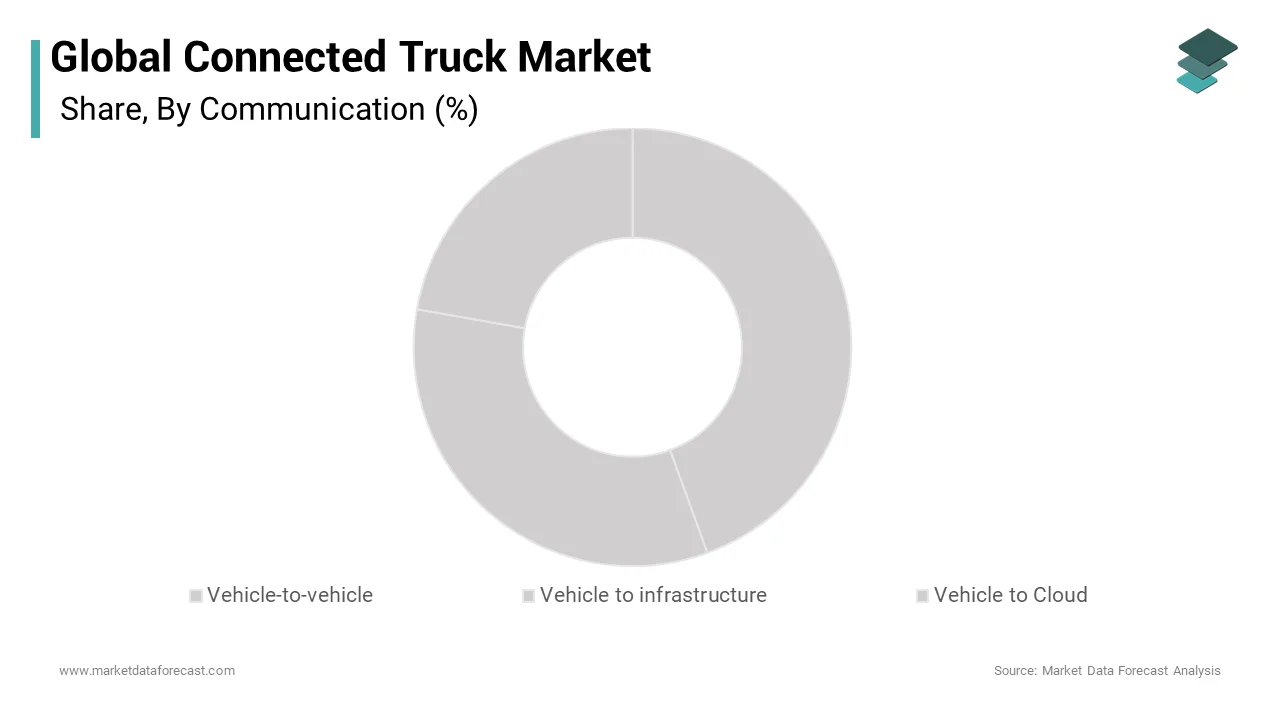
However, the vehicle-to-infrastructure (V2I) communication segment is expected to grow at a significant CAGR of 26.6% during the forecast period owing to the government investments in smart city infrastructure and the deployment of intelligent transportation systems. V2I technology allows trucks to communicate with traffic lights, road signs, and toll booths, enabling optimized traffic flow and reduced congestion. According to the European Commission, numerous major cities in Europe have implemented or are planning smart traffic management systems that support V2I communication. These systems provide real-time information about road conditions, weather hazards, and traffic signals, allowing drivers to adjust speed and routes proactively. Research from the US Department of Transportation shows that V2I-enabled intersections can reduce travel time and lower emissions by minimizing idling. The integration of V2I with autonomous driving features is another key driver, as self-driving trucks require precise infrastructure data to navigate safely. Governments are increasingly mandating the installation of V2I-compatible units in new public transport and freight vehicles to enhance safety and efficiency. The rollout of 5G networks further accelerates this growth by providing the low latency required for instant communication between vehicles and infrastructure. As urbanization increases, the demand for smarter traffic solutions will continue to drive the adoption of V2I technologies in the commercial vehicle sector.
By Vehicle Insights
The heavy commercial vehicle segment dominated the market in 2025 and is expected to maintain its dominant role in the coming years due to the high operational costs and regulatory pressures associated with long-haul freight transport. Fleet operators of heavy trucks prioritize connectivity solutions to optimize fuel efficiency, monitor cargo, and ensure driver compliance with strict hours-of-service regulations. According to the American Trucking Associations, heavy-duty trucks account for nearly 72% of all freight tonnage moved in the United States, highlighting their economic significance. The complexity of managing large fleets necessitates advanced telematics systems that provide comprehensive visibility into vehicle performance and location. Data from the European Transport Safety Council indicates that heavy commercial vehicles are involved in a notable share of fatal road accidents, prompting mandates for advanced safety systems that rely on connectivity. Predictive maintenance is particularly valuable for heavy trucks, as unexpected breakdowns can result in significant financial losses and supply chain disruptions. Connected solutions enable early detection of engine issues, transmission problems, and tire wear, reducing downtime and repair costs. Furthermore, the implementation of electronic logging devices is mandatory for heavy commercial vehicles in many regions, driving the adoption of connected hardware. The high value of cargo transported by these vehicles also necessitates real-time tracking and security monitoring. As global trade volumes increase, the demand for efficient and compliant heavy truck operations will sustain the dominance of this segment in the connected trucks market.
However, the light commercial vehicle (LCV) segment is projected to see significant adoption over the next few years and is predicted to expand at a CAGR of 20.3% during the forecast period owing to the booming e-commerce sector and the increasing demand for last-mile delivery services. Light commercial vehicles are essential for urban deliveries, where efficiency and flexibility are paramount. According to the United Nations Conference on Trade and Development, global e-commerce sales have reached trillions of dollars, creating immense pressure on logistics providers to optimize delivery routes and times. Connected solutions help small business owners and courier services track vehicles, monitor driver behavior, and manage schedules effectively. The lower cost of entry for connectivity solutions in light commercial vehicles makes them accessible to a broader range of users, including small enterprises and gig economy workers. Research indicates that the number of delivery drivers has increased significantly in major urban centers over the past few years. Urban congestion and emission zones also drive the adoption of connected features that help drivers navigate restricted areas and reduce idle time. Additionally, the rise of electric light commercial vehicles requires connected battery management systems to monitor charge levels and plan charging stops. As urbanization continues and consumer expectations for fast delivery rise, the demand for connected light commercial vehicles will accelerate significantly.
REGIONAL ANALYSIS
North America Market Analysis
North America led the market with 34.5% of the global market share in 2025 and is expected to see steady growth in connected fleet adoption over the next few years as logistics firms continue to prioritize operational data for efficiency. The United States serves as the primary market, with a highly developed logistics sector and early adoption of telematics solutions. According to the Federal Motor Carrier Safety Administration, the mandate for electronic logging devices has accelerated the installation of connected hardware in commercial fleets across the country. The presence of major technology providers and automotive manufacturers in the region fosters innovation and rapid deployment of new connectivity features. Data from the Bureau of Transportation Statistics shows that truck freight tonnage in the US remains high, reflecting robust demand for efficient transport solutions. Canada also contributes significantly, with its vast geography requiring reliable long-distance communication for freight operations. The region benefits from extensive 4G and emerging 5G coverage, ensuring consistent connectivity for trucks on major highways. Government initiatives promoting smart infrastructure and autonomous vehicle testing further support market growth. High labor costs in North America drive fleet operators to adopt automation and connectivity solutions to improve productivity and reduce dependency on manual processes. The strong emphasis on safety and environmental compliance also encourages the use of connected systems for monitoring and reporting. These factors collectively sustain North America's leadership in the global connected trucks landscape.
Europe Market Analysis
Europe is likely to see continued expansion of connected truck ecosystems as sustainability mandates push for more precise monitoring of transport operations. Europe represents a mature yet dynamically growing market for connected trucks, characterized by strict regulatory standards and a strong focus on sustainability. According to Eurostat, the European Union aims to reduce transport emissions significantly, compelling fleet operators to adopt connected solutions that optimize fuel efficiency and promote eco-driving. The mandatory installation of smart tachographs in new heavy-duty vehicles has created a baseline for connectivity across the region. Data from the European Automobile Manufacturers Association shows that a high percentage of new trucks sold in Europe are equipped with factory-installed telematics systems. Countries like Germany, France, and the Netherlands are leading in the deployment of intelligent transportation systems and V2X infrastructure. The high density of urban areas and cross-border trade necessitates efficient logistics management supported by real-time data. Consumer awareness regarding environmental impact also drives demand for green logistics solutions. Collaborative projects among European nations facilitate the harmonization of standards and interoperability of connected systems. The region's strong industrial base supports the development of advanced connectivity technologies. These dynamics ensure that Europe remains a critical market for sustainable and compliant connected truck solutions.
Asia Pacific Market Analysis
Asia-Pacific is poised to experience rapid technological integration in its freight sector as regional economies modernize their supply chains over the next few years. The Asia-Pacific region is emerging as the fastest-growing market for connected trucks, driven by rapid industrialization and expanding e-commerce activities. China, India, and Japan are key contributors, with China serving as the largest manufacturer and consumer of commercial vehicles globally. According to the Asian Development Bank, infrastructure investment in the region remains substantial, supporting the development of smart logistics networks. The booming e-commerce sector in countries like China and India drives demand for efficient last-mile delivery solutions using connected light commercial vehicles. Data from the China Association of Automobile Manufacturers indicates that sales of new energy commercial vehicles have surged, many of which feature advanced connectivity for battery management. Government initiatives in India, such as the National Logistics Policy, aim to reduce logistics costs and improve efficiency through digitalization. The rapid expansion of 5G networks in South Korea and Japan enables sophisticated V2X applications and autonomous truck testing. Rising fuel prices and labor shortages also prompt fleet operators to adopt connectivity solutions for cost optimization. The large young population and increasing smartphone penetration facilitate the adoption of mobile-based fleet management apps. These factors create a dynamic environment for sustained growth in the Asia-Pacific connected trucks market.
Latin America Market Analysis
Latin America is likely to see gradual but consistent growth in connected vehicle technology as logistics operators increasingly adopt digital tools to overcome geographical and operational challenges over the next few years. Latin America accounts for a notable share of the global connected trucks market, exhibiting steady growth driven by modernization efforts in the logistics sector and increasing foreign investment. Brazil and Mexico are the primary markets in the region, benefiting from large agricultural and manufacturing sectors that rely heavily on road freight. According to the Inter-American Development Bank, logistics costs in Latin America are among the highest in the world, prompting companies to invest in technology to improve efficiency. The adoption of telematics is growing among large fleet operators who seek to reduce theft, improve fuel management, and ensure driver safety. Data from the Brazilian National Confederation of Transport shows that the use of electronic tracking devices in freight trucks continues to increase. While infrastructure gaps remain a challenge, mobile network coverage is improving in urban and highway corridors, enabling basic connectivity solutions. Government regulations regarding cargo security and tax compliance also drive the installation of tracking devices. Local partnerships with global technology providers facilitate the introduction of affordable and robust solutions tailored to regional needs. The growth of e-commerce in major cities further stimulates demand for connected delivery vehicles. Despite economic volatility, the long-term trend toward digitalization supports gradual market expansion. International suppliers are increasingly focusing on this region to capture emerging opportunities.
COMPETITIVE LANDSCAPE
The competition in the connected trucks market is intense and characterized by the presence of established automotive manufacturers alongside specialized technology firms and telecom operators. Large truck makers leverage their deep understanding of vehicle engineering to integrate native connectivity solutions directly into chassis designs. They focus on offering end to end ecosystems that combine hardware software and services to lock in customers. Technology companies compete by providing superior data analytics platforms and artificial intelligence tools that enhance decision making for fleet managers. Telecom providers play a critical role by offering robust network infrastructure and low latency connections essential for real time applications. Price competition exists but differentiation is largely driven by feature richness reliability and ease of integration. Strategic alliances are common as no single entity possesses all necessary capabilities for fully autonomous and connected operations. Regulatory compliance acts as a barrier to entry ensuring that only reputable players with strong safety records can operate. Customer loyalty is driven by proven return on investment through fuel savings and reduced downtime. The market sees continuous innovation as participants race to deploy 5G enabled services and autonomous features. Emerging startups disrupt traditional models with agile software solutions forcing incumbents to accelerate digital transformation efforts.
KEY MARKET PLAYERS
The global connected truck market is concentrated with well-established players. Key players in the market include
- APTIV PLC
- Continental AG
- Denso Corporation
- Daimler Truck AG
- Volvo Group
- Paccar Inc
- HARMAN International
- Magna International Inc.
- NXP Semiconductors Netherlands B.V.
- Robert Bosch GmbH
- Sierra Wireless, Inc.
- TomTom International BV
- Trimble Inc
- Verizon Connect
- ZF Friedrichshafen AG.
Top Players In The Global Market
- Daimler Truck AG stands as a global leader in the connected trucks market leveraging its extensive portfolio of heavy duty vehicles and advanced digital services. The company integrates proprietary telematics systems into its Mercedes Benz and Freightliner brands to provide real time fleet monitoring and predictive maintenance capabilities. Recent initiatives include the expansion of its Torc Robotics subsidiary to accelerate the development of autonomous driving technologies for long haul logistics. Daimler actively collaborates with technology partners to enhance vehicle to cloud connectivity ensuring seamless data exchange for optimized route planning. By focusing on sustainability the company has developed digital tools that monitor fuel efficiency and reduce carbon emissions. These efforts reinforce its position as a pioneer in smart transportation solutions that improve operational efficiency and safety for commercial fleets worldwide.
- Volvo Group plays a pivotal role in the connected trucks market by offering comprehensive digital services through its Volvo Connect platform. The company utilizes advanced sensors and artificial intelligence to deliver actionable insights on driver performance vehicle health and cargo security. Recent actions include the launch of enhanced over the air update capabilities allowing remote software improvements without physical service visits. Volvo prioritizes interoperability by adhering to open standards facilitating integration with third party logistics management systems. The group also invests heavily in electric vehicle connectivity to manage battery life and charging infrastructure efficiently. By emphasizing safety and uptime Volvo strengthens its reputation as a trusted partner for fleet operators seeking reliable and innovative digital solutions. Their commitment to sustainable transport drives continuous innovation in connected technologies.
- Paccar Inc contributes significantly to the connected trucks market through its Kenworth and Peterbilt brands which feature advanced telematics and connectivity options. The company offers the Paccar MX engine with integrated digital diagnostics that provide real time performance data to fleet managers. Recent developments include partnerships with leading software providers to create customized fleet management applications tailored to specific industry needs. Paccar focuses on enhancing driver experience through intuitive dashboards and mobile apps that simplify compliance reporting and maintenance scheduling. The company also explores vehicle to infrastructure communication to support smarter traffic management and reduced congestion. By combining robust hardware with sophisticated software Paccar delivers value added services that optimize total cost of ownership. These strategic moves solidify its standing as a key provider of intelligent commercial vehicle solutions.
Top Strategies Used By Key Market Participants
Key players in the connected trucks market primarily focus on strategic partnerships and technological innovation to maintain competitive advantage. Companies collaborate with telecom providers and software developers to enhance connectivity speed and data analytics capabilities. Investment in research and development is crucial for creating advanced features such as autonomous driving and predictive maintenance algorithms. Manufacturers also prioritize interoperability by adopting open standards that allow seamless integration with diverse fleet management systems. Expansion into emerging markets through localized solutions helps capture new customer segments and drive growth. Additionally firms emphasize cybersecurity measures to protect sensitive data and build trust among fleet operators. Sustainability initiatives are increasingly important as companies develop tools to monitor and reduce emissions. These multifaceted strategies ensure sustained relevance and leadership in a rapidly evolving digital transportation landscape characterized by increasing demand for efficiency and safety.
MARKET SEGMENTATION
This research report on the global connected truck market has been segmented and sub-segmented based on range, component type, communication type, vehicle type, and region.n
By Range
- Dedicated short-range communication
- Adaptive cruise control
- Blindspot warning
- Lane departure warning
- Park assist system
- Emergency brake assist
- Long-range
- Telematics control unit
- Emergency roadside assistance
- Infotainment systems
- Others
By Component Type
- Hardware
- Radar and lidar sensors
- Microcontrollers
- Software
- Vehicle-to-vehiclele
- Vehicle to infrastructure
- Vehicle to Cloud
By Communication Type
- Vehicle-to-vehicle
- Vehicle to infrastructure
- Vehicle to Cloud
By Vehicle Type
- Light commercial vehicle
- Heavy commercial vehicle
By Region
- North America
- Europe
- Asia-pacific
- Middle East and Africa
- Latin America