- Product Description Description
- Table of Contents TOC
- List of Table & Figure LOT
- Get Free Sample PDF Sample PDF
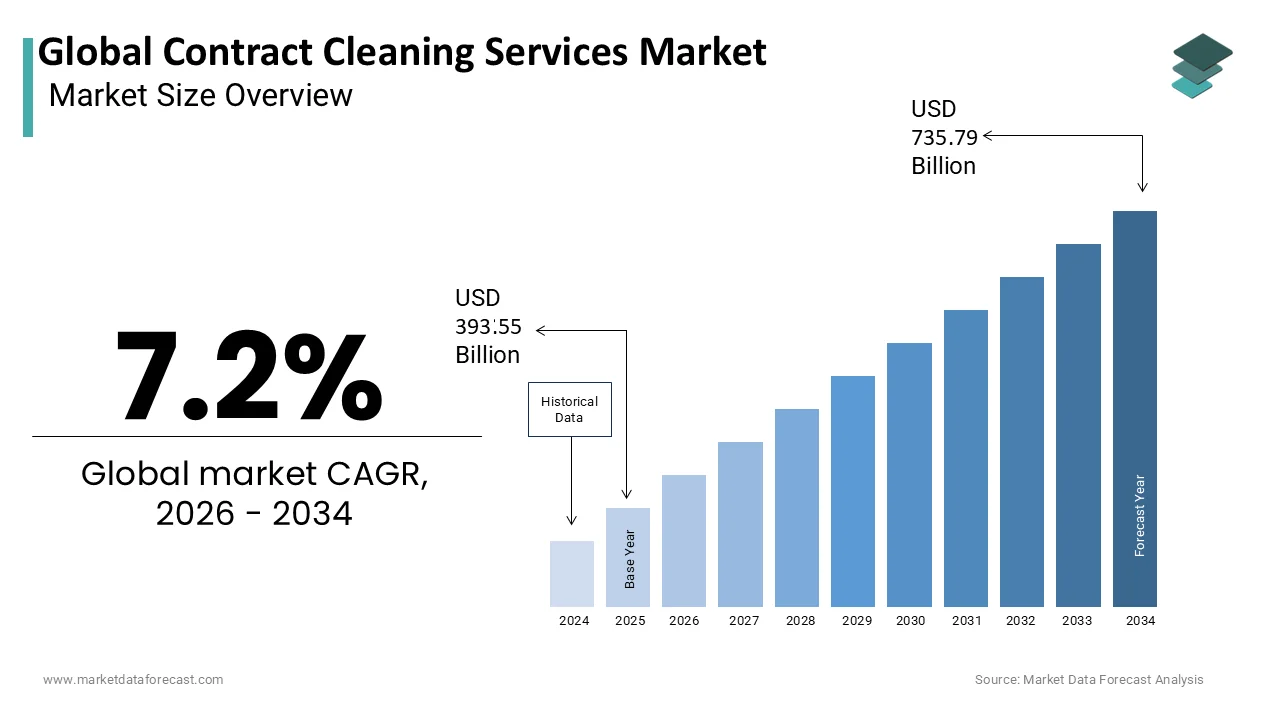
Market Size, 2025
$393.55 BnMarket Estimate, 2026
$421.89 BnMarket Forecast, 2034
$735.79 BnCAGR, 2026–2034
7.2%Executive Summary: Global Contract Cleaning Services Market
- Market Scope: Comprehensive global market evaluation of contract cleaning services covering end-user verticals, regional leadership frameworks, and hygiene outsourcing metrics.
- Market Valuation: Valued at USD 393.55 billion (2025), estimated at USD 421.89 billion (2026), and projected to reach USD 735.79 billion by 2034, registering a solid CAGR of 7.20% (2026–2034).
- Primary Growth Drivers: Growing awareness of hygiene in the wake of the COVID-19 pandemic (with 71% of people reporting heightened consciousness of public cleanliness), rising business trends toward outsourcing cleaning to focus on core competencies, and a surge in demand for eco-friendly and sustainable cleaning solutions.
Key Market Segment Metrics (2026–2034)
| Category | Leading Segment (2025 Position) | Fastest-Growing Segment |
|---|---|---|
| By End-User | Commercial (largest segment accounting for 54.8% of the global market share in 2025 driven by workplace hygiene) | Industrial (predicted to witness the fastest CAGR of 8.4% due to strict regulatory standards and automated/robotic cleaning adoption) |
| By Region | North America (dominated the market in 2025 with a 36.1% global share, led by specialized disinfection demands) | Asia-Pacific (projected to witness rapid growth driven by urbanization, disposable incomes, and healthcare/hospitality expansion) |
Major Market Players & Market Structure
Market Structure: Highly competitive global facility services and hygiene management landscape featuring major international janitorial enterprises competing intensely on service quality, green cleaning compliance, specialized disinfection, and operational cost-effectiveness.
Key Companies: ABM Industries Incorporated, Anago Cleaning Systems Inc., Duraclean International Inc., Jani-King International Inc., Pritchard Industries Inc., ISS AS, Sodexo Group, Vanguard Cleaning Systems Inc., Stanley Steemer International Inc., and The ServiceMaster Company LLC.
 Download Free Sample Report
Global Contract Cleaning Services Market Size
The Global Contract Cleaning Services Market is projected to grow from USD 393.55 billion in 2025 to USD 421.89 billion in 2026 and reach USD 735.79 billion by 2034, registering a CAGR of 7.2% from 2026 to 2034.
According to Eurostat, approximately 3000000 persons across 220000 individual enterprises are employed in the general cleaning of buildings within the European Union, constituting roughly 2.3% of non-financial business economy workforce totals. Contract cleaning services are professional outsourced sanitation, floor maintenance, surface disinfection, and specialized building upkeep delivered under ongoing service level agreements for private and public facilities. According to the United States Bureau of Labor Statistics, overall employment in building and grounds cleaning occupations generates over 730600 projected job openings each year to sustain commercial, institutional, and residential operations. Commercial facility managers rely on outsourced sanitation vendors to minimize internal operational overhead while maintaining compliance with stringent occupational health standards. Rapid urban real estate expansion, combined with structured corporate outsourcing paradigms, reinforces stable commercial demand for daily janitorial and specialized maintenance protocols across global markets.
MARKET DRIVERS
Expanding Commercial Real Estate Footprint
Growing commercial infrastructure development primarily drives the global contract cleaning services market growth. According to the United States Bureau of Labor Statistics, total domestic janitorial and building cleaning employment surpassed 2237882 personnel operating across diverse non-residential real estate portfolios. Expanding office complexes, retail centers, and logistics hubs require recurring sanitation routines to maintain asset value and operational hygiene. Commercial property owners increasingly transition internal facility management to third-party cleaning contractors to minimize fixed operational costs. Multi-tenant office towers and industrial parks require specialized floor care, window washing, and waste management services delivered on automated schedules. Managing large-scale property footprints demands specialized equipment investments that individual tenants rarely maintain internally. Consequently, rapid urban commercial construction directly accelerates recurring contract service procurements across regional business districts. As municipal planning authorities authorize new commercial building permits, the total square footage requiring structured cleaning grows, creating multi-year contract opportunities for commercial janitorial firms.
Strict Occupational Health and Safety Standards
Elevated institutional focus on workplace environmental hygiene fuels the global contract cleaning services market expansion. According to Eurostat, building cleaning services represent the fourth largest employment sector within the European Union non-financial business economy, trailing only food services, road freight, and temporary staffing. Regulatory mandates governing workplace safety compel enterprise facility managers to enforce documented, multi-point disinfection protocols. Organizations utilize specialized contract cleaners equipped with hospital-grade chemical delivery systems and certified environmental monitoring routines. Achieving compliance with international indoor air quality and surface cleanliness standards reduces employee absenteeism and corporate liability exposure. Outsourcing facility sanitation to certified vendors ensures access to trained personnel versed in hazardous waste handling and eco-friendly chemical application. Institutional regulatory compliance pressures remain a pivotal growth engine for specialized contract sanitation providers. Corporate governance frameworks increasingly evaluate vendor compliance during annual facility management reviews, guaranteeing long term renewal for contractors maintaining certified safety benchmarks.
MARKET RESTRAINTS
Chronic Labor Shortages and High Workforce Turnover Rates
Persistent labor availability constraints majorly hamper the contract cleaning services market growth. According to the Worldwide Cleaning Industry Association ISSA, annual workforce turnover rates within the commercial contract cleaning industry regularly fluctuate between 200% and 400% across standard service models. High turnover forces facility service managers to continuously allocate capital toward recruitment, background vetting, and basic safety onboarding for incoming personnel. Rapid worker churn disrupts established service schedules, damages client relationships, and causes inconsistent cleaning quality across contracted real estate portfolios. According to the United States Bureau of Labor Statistics, building cleaning occupations face over 730600 annual position openings caused by permanent worker departures from the labor pool. These ongoing staffing headwinds impede service contractors from fulfilling new commercial service contracts, limiting broader business expansion across key metropolitan territories. Service providers are frequently compelled to turn down prospective contracts or pay overtime wages to existing personnel, eroding operating profits and creating operational friction across client accounts.
Rising Wage Inflation and Compressed Profit Margins
Escalating minimum wage mandates and overhead expenses restrict operating profit margins for labor-intensive service vendors, which is another significant impediment to global market expansion. According to the United States Census Bureau County Business Patterns data, the annual payroll expenditure across verified domestic janitorial service establishments exceeds 22487810000 dollars. Increasing statutory minimum wages combined with rising mandatory healthcare insurance costs significantly raise baseline operational expenses for service firms. Because commercial contract cleaning relies heavily on manual labor, service vendors struggle to absorb rising employment expenses without increasing billing rates. Corporate clients, operating under strict corporate cost reduction mandates, frequently reject service price increases or seek alternative low-cost bidders. Tight competitive bidding dynamics combined with fixed contract pricing cycles impede service providers from passing elevated labor costs to clients, compressing overall profit margins across the industry. Service contractors operating on tight financial buffers risk operational insolvency when unexpected wage adjustments occur midway through long term facility contracts.
MARKET OPPORTUNITIES
Rapid Integration of Autonomous Robotic Cleaning Solutions
Adopting autonomous floor scrubbing hardware is a major opportunity in the global contract cleaning services market. According to the United States Bureau of Labor Statistics, janitorial and building cleaning personnel earn a median annual wage of 36840 dollars, representing a major recurring expenditure for commercial vendors. Deploying artificial intelligence-driven robotic sweepers allows facility service managers to automate large-surface floor care across warehouses, airport terminals, and shopping centers. Automated cleaning equipment operates continuously without human fatigue, addressing severe night shift labor availability bottlenecks. Labor forces can be redirected toward higher-margin detailed surface disinfection and specialized maintenance tasks. Implementing Internet of Things-connected cleaning fleets enables real-time tracking of completed square footage, providing verifiable service proof to facility managers. Integrating automation into daily cleaning workflows optimizes labor efficiency while unlocking premium service contracts across expansive commercial facilities. Early adopters of automated fleets report increased operational margins and enhanced client retention by delivering detailed analytics dashboards to facility managers.
Surging Enterprise Demand for Green Cleaning Protocols
Expanding corporate environmental sustainability mandates create a lucrative pathway for eco-friendly specialized cleaning services. According to Eurostat, over 220000 distinct enterprises operate within the general building cleaning sector in the European Union, creating strong competitive incentives for service differentiation. Corporate tenants actively seek cleaning contractors that utilize biodegradable, non-toxic chemical solutions and water-conserving microfiber technology to satisfy Leadership in Energy and Environmental Design facility certifications. Implementing sustainable green cleaning protocols reduces toxic chemical runoff, improves indoor air quality, and protects building occupants from volatile organic compounds. Service providers offering certified green cleaning lines command premium pricing structures compared to traditional chemical-based janitorial options. Establishing transparent, environmentally responsible service lines allows progressive cleaning firms to secure multiyear service contracts with major corporate accounts prioritizing environmental, social,andl governance compliance. Firms that publish audited sustainability metrics attract high-profile corporate clients seeking to lower their environmental impact across global real estate portfolios.
MARKET CHALLENGES
Severe Service Commoditization and Aggressive Price Wars
Low market entry barriers foster intense price competition that continuously challenges long term client retention and pricing power. According to the United States Census Bureau, over 28445 distinct commercial janitorial establishments operate within the domestic market, reflecting extreme vendor fragmentation. Small, localized service providers with minimal corporate overhead frequently undercut established service contractors on contract bidding prices. Corporate procurement departments increasingly treat general building sanitation as a generic, price-sensitive commodity rather than a specialized facility management asset. This commoditization pressures established contractors to cut service margins or trim personnel allocations to retain competitive bidding eligibility. Rapid client churn resulting from frequent rebidding cycles disrupts predictable recurring revenue streams for service providers. Competing strictly on low bid pricing hinders vendors from investing in advanced worker training or innovative cleaning equipment, creating a challenging operating environment across metropolitan markets. Large vendors must constantly demonstrate specialized value propositions to avoid being displaced by llower-costlocal operators.
Strict Chemical Safety and Environmental Compliance Frameworks
Evolving regulatory mandates regarding chemical storage and disinfectant application place complex operational burdens on service vendors. According to Eurostat, building cleaning enterprises employ over 2.3% of total non-financial business employees, subjecting the sector to intensive workplace safety inspections. Federal and municipal environmental agencies continuously revise exposure limits for industrial solvents, hazardous waste disposal, and surface sanitization chemicals. Service contractors must maintain detailed safety data sheets, supply specialized personal protective equipment, and conduct mandatory chemical handling certifications for large workforces. Non-compliance with evolving chemical safety laws leads to substantial regulatory fines, operational suspensions, and severe legal liability exposure. Training high-turnover labor forces to adhere strictly to complex chemical dilution and dwell time rules requires significant management oversight. Navigating complex multi-jurisdictional compliance landscapes increases administrative expenses, posing a persistent operational challenge for contract cleaning management. Small firms often struggle to maintain dedicated compliance teams, placing them at regulatory risk during unscheduled workplace safety audits.
REPORT COVERAGE
| REPORT METRIC | DETAILS |
| Market Size Available | 2025 to 2034 |
| Base Year | 2025 |
| Forecast Period | 2026 to 2034 |
| Segments Covered | By End User and Region |
| Various Analyses Covered | Global, Regional & Country Level Analysis, Segment-Level Analysis, DROC, PESTLE Analysis, Porter’s Five Forces Analysis, Competitive Landscape, Analyst Overview of Investment Opportunities |
| Regions Covered | North America, Europe, APAC, Latin America, Middle East & Africa |
| Market Leaders Profiled | ABM Industries Incorporated, Anago Cleaning Systems Inc., Duraclean International Inc., Jani-King International Inc., Pritchard Industries Inc., ISS AS, Sodexo Group, Vanguard Cleaning Systems Inc., Stanley Steemer International Inc., and The ServiceMaster Company LLC |
SEGMENTAL ANALYSIS
By End-User Insights
The commercial end user segment dominated the market by holding the leading share of the global contract cleaning services market in 2025 and is anticipated to maintain the primary market position over the forecast period due to extensive square footage requirements across corporate office networks, retail centers, and institutional facilities. According to Eurostat, approximately 3000000 workers across 220000 individual European Union enterprises are employed primarily in maintaining general building infrastructure. Commercial facility managers rely heavily on third-party cleaning vendors to maintain professional aesthetic standards and protect property valuations. According to the United States Bureau of Labor Statistics, over 2237882 workers deliver daily janitorial services across commercial buildings, highlighting the massive operational scale of non-residential maintenance. Corporate offices, educational institutions, and healthcare centers require continuous, multi-shift cleaning schedules to maintain daily operational hygiene. High daily foot traffic in commercial spaces accelerates surface contamination, mandating structured service contracts for floor care, restroom sanitation, and trash management. Commercial contracts generate steady long term cash flows for service providers, as enterprises prioritize clean work environments to boost employee productivity and support corporate branding goals. The sheer volume of commercial real estate space secures this segment as the dominant revenue generator across global service markets.
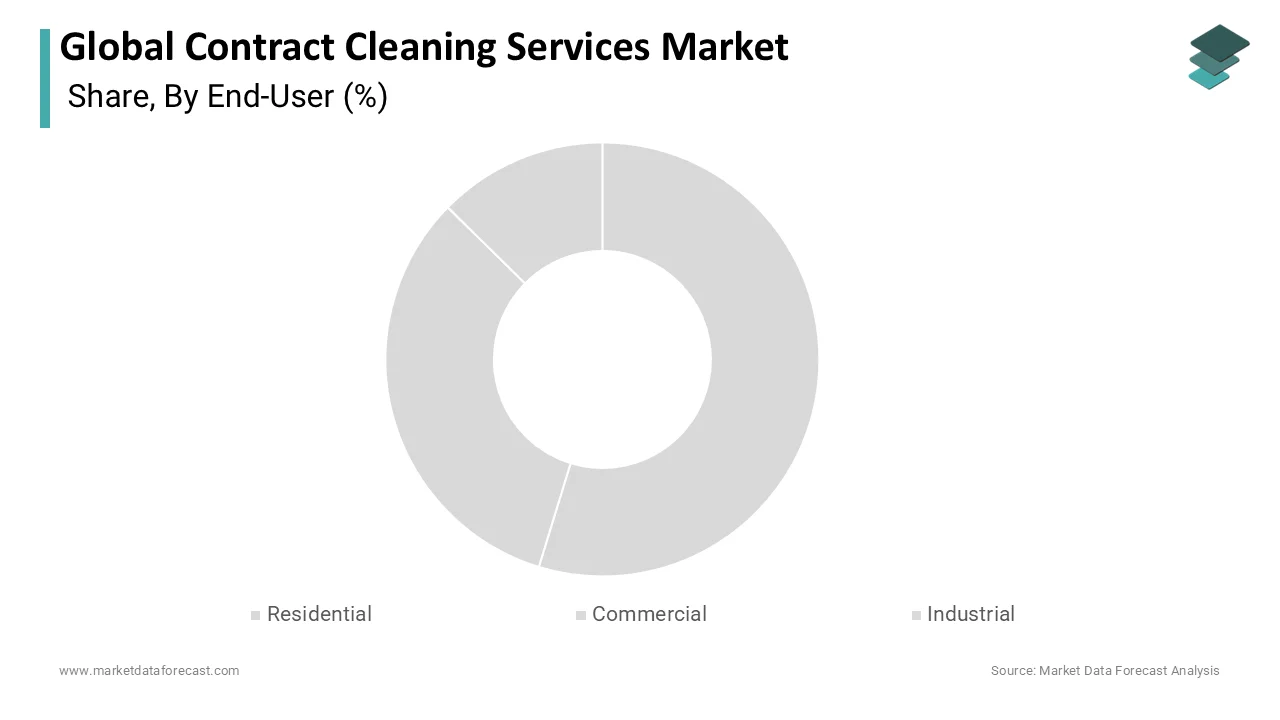
On the other end, the residential end-user segment is predicted to record a promising CAGR of 6.2% over the forecast period owing to rising dual-income household disposable earnings and shifting consumer lifestyle preferences. According to the United States Bureau of Labor Statistics, overall employment across building cleaning occupations faces over 730600 annual openings, partially sustained by surging consumer demand for residential home care services. Busy urban households increasingly outsource home cleaning tasks, such as carpet deep cleaning, window washing, and routine housekeeping, to save personal time. According to Eurostat, business services catering to building maintenance reflect sustained growth, driven by expanding multi-unit residential complex developments in urban centers. Property management companies managing large residential apartment towers partner with contract cleaning firms to maintain common areas, lobbies, and tenant turnover units. Surging urbanization, combined with expanding home care mobile applications, accelerates commercial residential contract cleaning growth across global urban markets. The rise of short term rental platforms creates recurring demand for rapid turnover cleaning services, expanding revenue potential for agile service contractors.
COUNTRY LEVEL ANALYSIS
North America Contract Cleaning Services Market Analysis
North America led the market with a major share of the global market in 2025 and is expected to command the leading position in the global contract cleaning services sector, driven by expansive commercial real estate footprints and structured corporate outsourcing trends. According to the United States Census Bureau County Business Patterns data, domestic janitorial service establishments exceed 28445 verified businesses generating over 50419827000 dollars in tracked annual revenue. High institutional emphasis on workplace environmental health and indoor air quality forces corporate landlords to hire specialized sanitation contractors. According to the United States Bureau of Labor Statistics, total domestic building cleaning employment exceeds 2237882 personnel, demonstrating the immense scale of regional service operations. Favorable corporate tax structures and large multinational corporate headquarters encourage long term facility management outsourcing. Widespread adoption of smart building technologies and autonomous floor care robotics across regional logistics hubs enhances operational efficiency. Aggressive expansion across retail complexes, healthcare systems, and tech campuses sustains steady demand for multi-year commercial cleaning contracts across the United States and Canada. Corporate facility managers in this region actively partner with certified vendors to meet zero landfill waste targets and stringent green building certifications.
Europe Contract Cleaning Services Market Analysis
Europe holds a significant share of the global market in 2025 due to the strict European Union environmental health regulations and high commercial facility density. According to Eurostat, nearly 3000000 persons across 220000 enterprises are employed in the general cleaning of buildings across European Union member states, representing 2.3% of the non-financial business economy workforce. Public and private institutions enforce stringent workplace safety mandates, driving consistent procurement of certified professional cleaning contractors. According to Eurostat, Western European nations including Belgium, Spain, France, and Luxembourg record high workforce concentrations in building cleaning, exceeding 3.1% of their total business economy personnel. Regional commercial property owners prioritize green cleaning certifications, encouraging service contractors to adopt eco-friendly chemical formulations and wwater-savingequipment. High historical preservation standards for older European architecture require specialized cleaning protocols, creating steady demand for expert restoration vendors. Robust labor protections and structured procurement frameworks support stable long-term cleaning service contracts across European commercial centers. Public sector tenders frequently mandate strict social and environmental criteria, driving service contractors toward sustainable operations.
Asia-Pacific Contract Cleaning Services Market Analysis
Asia-Pacific represents a rapidly expanding regional market, powered by massive urbanization, expanding industrial infrastructure, and surging commercial real estate investments. According to the United States Bureau of Labor Statistics, international demand for structured facility maintenance scales alongside rapid urbanization trends seen in emerging global economies. Accelerating construction of modern office skyscrapers, mega shopping malls, and transit hubs across China, India, and Southeast Asia creates immense demand for organized janitorial services. Expanding multinational corporate investments in regional manufacturing plants require specialized industrial cleaning contracts to maintain strict production sanitation standards. Rising middle-class disposable income levels across urban centers accelerate demand for residential housekeeping and specialized carpet cleaning services. Local governments increasingly enact workplace hygiene standards across public transit networks and government complexes, boosting institutional outsourcing contracts. The rapid transition from informal cleaning workers to organized professional contract service agencies drives high structural market growth across Asia-Pacific metropolitan centers. Enterprise clients in the region adopt modern management frameworks, driving service providers toward technology-enabled operational tracking.
Latin America Contract Cleaning Services Market Analysis
Latin America maintains a growing market position within the global industry, driven by expanding commercial property developments and shifting corporate facility management strategies. According to Eurostat baseline economic models, emerging regional economies experience steady growth in organized contract cleaning services as corporate real estate portfolios modernize. Expanding commercial office towers, banking networks, and international retail chains across Brazil, Mexico, and Chile increasingly replace in-house janitorial staff with specialized third-party vendors to lower fixed payroll overhead. According to the United States Bureau of Labor Statistics, commercial outsourcing trends reflect global patterns where enterprises optimize operational expenses by hiring contract facility services. Growing tourism and hospitality infrastructure drives demand for specialized hotel cleaning, resort sanitation, and floor care maintenance. However, regional economic volatility and informal labor competition present ongoing operational hurdles for organized service providers. Strengthening local workplace safety regulations and expanding multinational corporate investments continue to support long term growth for professional contract cleaning services across major Latin American cities. The expansion of regional trade zones encourages logistics providers to secure structured cleaning agreements for vast warehouse facilities.
Middle East and Africa Contract Cleaning Services Market Analysis
Middle East and Africa represents an emerging regional market fueled by mega infrastructure projects, expanding commercial real estate, and rapid tourism expansion. According to Eurostat facility management data models, high-density commercial hubs require continuous professional building sanitation to preserve infrastructure assets. Massive urban developments, luxury hospitality projects, and international airport expansions across the Gulf Cooperation Council nations drive high demand for specialized contract cleaning services. Extremely hot and dusty desert environments necessitate frequent interior and exterior building maintenance, including high-rise window washing and specialized ventilation cleaning. According to the United States Bureau of Labor Statistics, expansive commercial property footprints require continuous baseline janitorial staffing to maintain operational cleanliness. State sponsored economic diversification programs, such as large-scale tourism and financial district initiatives, boost long term commercial property management investments. Increasing corporate adoption of international facility management standards supports rapid market expansion for professional contract cleaning vendors across the region. Facility owners heavily prioritize exterior facade maintenance and HVAC duct cleaning to counter persistent harsh environmental conditions.
COMPETITIVE LANDSCAPE
The competitive landscape of the Contract Cleaning Services Market is highly fragmented, characterized by a small group of multinational facility service corporations competing alongside thousands of localized, independent service providers. Key competitors engage in intense rivalry based on service pricing, labor efficiency, technology integration, and safety compliance track records. Low capital entry barriers allow small regional operators to enter the market easily, creating persistent price competition for standard janitorial contracts. However, major multinational vendors maintain powerful competitive advantages when bidding for large enterprise portfolios due to their ability to provide integrated facility management, advanced robotic equipment, and comprehensive insurance coverage. The market experiences continuous consolidation as top players acquire regional firms to expand service capabilities and scale client accounts across commercial, healthcare, and industrial sectors.
KEY MARKET PLAYERS
Some of the companies that are playing a dominating role in the Global Contract Cleaning Services Market include:
- ABM Industries Incorporated
- Anago Cleaning Systems, Inc.
- Duraclean International, Inc.
- Jani-King International, Inc.
- Pritchard Industries, Inc.
- ISS A/S
- Sodexo Group
- Vanguard Cleaning Systems, Inc.
- Stanley Steemer International, Inc.
- The ServiceMaster Company LLC
TOP LEADING PLAYERS IN THE MARKET
- ISS World Services A/S contributes significantly to the market through its global integrated facility services portfolio, delivering specialized cleaning, hygiene, and workplace sanitation solutions. The company focuses on enhancing service delivery through digitized cleaning protocols, ssensor-drivendemand cleaning software, and sustainable green cleaning practices. To strengthen its commercial position, ISS World Services A/S expanded its multinational corporate contract agreements in early 2023, securing long term integrated facility service deals across major European and North American enterprise offices.
- ABM Industries Incorporated provides vital market contributions through its extensive janitorial, engineering, and specialized facility maintenance service lines. The firm specializes in delivering customized cleaning solutions for commercial office towers, aviation hubs, educational campuses, and industrial manufacturing sites. To reinforce its competitive market standing, ABM Industries Incorporated acquired RavenVolt in October 2022, expanding its facility infrastructure capabilities and integrating advanced enenergy-efficientperational technologies across its commercial client properties.
- Mitie Group plc contributes extensively to the market by offering technology-led cleaning solutions, robotic floor maintenance systems, and specialized healthcare hygiene services. The organization prioritizes zero-carbon cleaning operations by integrating eco-friendly chemical lines and electric service vehicle fleets. To solidify its market presence, Mitie Group plc acquired Linaker in April 2023, acquiring advanced engineering service capabilities and expanding its integrated contract cleaning presence across major United Kingdom healthcare and public sector accounts.
TOP STRATEGIES USED BY KEY MARKET PARTICIPANTS
Key participants in the Contract Cleaning Services Market prioritize strategic corporate acquisitions, digitized service integration, and sustainable green cleaning offerings to secure long term market growth. Leading service vendors allocate substantial capital toward acquiring specialized regional cleaning firms, enabling rapid geographic footprint expansion and immediate client portfolio acquisition. Companies actively integrate Internet of Things sensor technology and mobile management software into daily janitorial routines, enabling real-time, demand-based cleaning that optimizes staff productivity. Strategic partnerships with commercial property management groups and international enterprise accounts ensure predictable, multi-year recurring revenue streams. Furthermore, key players transition toward zero-carbon cleaning operations, utilizing non-toxic biodegradable chemical lines and autonomous robotic equipment to satisfy client sustainability goals and protect profit margins against rising manual labor costs.
GLOBAL CONTRACT CLEANING SERVICES MARKET NEWS
- In October 2022, ABM Industries Incorporated, a major facility services provider, acquired RavenVolt, a microgrid technology provider. This acquisition is anticipated to allow ABM Industries Incorporated to offer more comprehensive sustainable facility solutions and strengthen the Contract Cleaning Services Market.
- In April 2023, Mitie Group plc, a leading facility transformation company, acquired Linaker, a specialized nationwide facility engineering firm. This acquisition is anticipated to allow Mitie Group plc to offer expanded integrated building maintenance capabilities and strengthen the Contract Cleaning Services Market.
- In September 2023, ISS World Services A/S, a global facility management firm, expanded its strategic partnership with a leading global technology corporation. This contract expansion is anticipated to allow ISS World Services A/S to deliver digitized cleaning services across broader international sites and strengthen the Contract Cleaning Services Market.
- In January 2024, Sodexo, a multinational facility management company, launched its updated automated floor care fleet initiative across North American commercial accounts. This technological deployment is anticipated to allow Sodexo to offer enhanced operational cleaning efficiency and strengthen the Contract Cleaning Services Market.
- In May 2024, Rollins Inc., a commercial services enterprise, acquired WB Pest Control, a specialized commercial maintenance provider. This acquisition is anticipated to allow Rollins Inc. to offer broader facility sanitation services and strengthen the Contract Cleaning Services Market.
MARKET SEGMENTATION
This research report on the global contract cleaning services market has been segmented and sub-segmented based on end-user and region.
By End-User
- Residential
- Commercial
- Industrial
By Region
- North America
- Europe
- Asia-Pacific
- Latin America
- Middle East and Africa