- Product Description Description
- Table of Contents TOC
- List of Table & Figure LOT
- Get Free Sample PDF Sample PDF
Market Size, 2025
$246.17 BnMarket Estimate, 2026
$258.77 BnMarket Forecast, 2034
$385.83 BnCAGR, 2026–2034
5.12%.Global Corrugated Packaging Market Size, Growth, Trends & Forecast (2026–2034)
The Global Corrugated Packaging Market size was valued at USD 246.17 billion in 2025, is estimated to reach USD 258.77 billion in 2026, and is projected to expand to USD 385.83 billion by 2034, registering a compound annual growth rate (CAGR) of 5.12% during the forecast period from 2026 to 2034. Driven by rapid e-commerce proliferation, direct-to-consumer logistics expansion, and strict global sustainability mandates phasing out single-use plastics, the market continues to see robust adoption across diverse industrial verticals.
Key Executive Metrics (At-a-Glance)
- 2025 Base Valuation: USD 246.17 Billion
- 2026 Current Valuation: USD 258.77 Billion
- 2034 Forecast Valuation: USD 385.83 Billion
- Compound Annual Growth Rate (CAGR): 5.12% (2026–2034)
- Leading Region: Asia-Pacific (holding a dominant 45.1% share in 2025 driven by regional manufacturing, textile, and electronics hubs)
- Key Growth Hubs: Europe and North America (accelerating via strict circular economy regulations and high e-commerce parcel volumes)
Core Market Drivers
- E-commerce Proliferation: Surging online retail penetration necessitating lightweight, stackable, and damage-resistant protective shipping containers.
- Sustainability Mandates: Stricter global and regional regulations (such as the EU Single-Use Plastics Directive and EPR schemes) pushing industries away from plastic fillers toward 100% recyclable fiber alternatives.
Primary Market Restraints & Challenges
- Raw Material Volatility: Price fluctuations in recycled and virgin paperboard driven by international trade policies, energy costs, and forestry output shifts.
- Environmental Limitations: Strength degradation under prolonged high humidity conditions and intensifying competition from emerging biodegradable alternatives like molded fiber and seaweed films.
Market Segmentation: Largest and Fastest-Growing Segments
| Segment Category | Largest Segment | Fastest-Growing Segment |
|---|---|---|
| By Wall Type | Single-Wall Corrugated (55.2% share in 2025) | Triple-Wall Corrugated (CAGR of 7.1%) |
| By Box Style | Slotted Boxes (Dominant market share in 2025) | Self-Erecting Boxes (CAGR of 9.4%) |
| By End Use | Food & Beverages (41.8% share in 2025) | Medical Applications (CAGR of 8.6%) |
| By Region | Asia-Pacific (45.1% share in 2025) | Europe & North America |
Major Industry Players Profiled
Key market participants shaping the global corrugated packaging landscape include Cascades, CESCO, Danhil, DS Smith, Evergreen Packaging, Georgia-Pacific, International Paper, Lee & Man Paper Manufacturing, Mondi Group, Montebello Container, Packaging Corporation of America, Rengo, Smurfit Kappa Group, Sultana Packaging, and WestRock Company.
Global Corrugated Packaging Market Size
The global Corrugated packaging market size was valued at USD 246.17 billion in 2025 and is expected to reach USD 385.83 billion by 2034 from USD 258.77 billion in 2026. The market is projected to grow at a CAGR of 5.12%.
Corrugated packaging are multi-layered paper-based containers engineered for durability, shock absorption, and environmental sustainability. Composed of fluted paperboard laminated between flat linerboards, corrugated packaging serves as a primary solution for shipping, storing, and protecting goods across industries, particularly in e-commerce, food and beverage, and consumer electronics. As per the research, a notable share of all transported goods in Europe are protected by corrugated board, underlining its structural indispensability in logistics networks. As per a study, corrugated cardboard are a major part of all recovered paper packaging, reflecting its high recyclability.
MARRKET DRIVERS
E-commerce proliferation and direct-to-consumer logistics expansion is major driving factor for the growth of corrugated packaging market. The global e-commerce sales significantly surged, with online retail penetration in Western Europe increased compared to that in 2019. This shift has redefined packaging requirements, favoring lightweight, stackable, and damage-resistant solutions, qualities inherent to corrugated board. In Germany, it saw an increase in parcel volume, necessitating significant corrugated boxes annually. Furthermore, Amazon’s Frustration-Free Packaging program, adopted by large number of suppliers globally that promotes 100% recyclable corrugated materials, eliminating plastic fillers and promoting right-sized designs.
The sustainability mandates and regulatory pressure to phase out single-use plastics are significantly boosting the growth of the corrugated packaging market. The European Union’s Single-Use Plastics Directive, enforced since 2021, bans expanded polystyrene and promotes fiber-based alternatives for food containers and protective packaging. Many EU member states have implemented extended producer responsibility (EPR) schemes that impose higher fees on non-recyclable packaging, which is making plastic-based solutions economically unviable. Also, the requirement in France is part of a broader trend of regulations, primarily driven by the European Union and Extended Producer Responsibility (EPR) schemes, that push industries toward a circular economy.
MARRKET RESTRAINTS
Volatility in raw material supply and fiber cost fluctuations is restraining the growth of corrugated packaging market. The primary input, recycled and virgin paperboard, is subject to global trade dynamics, energy costs, and forestry output variability. The pCorrugated packaging of a commodity or material can significantly increase due to supply chain disruptions and changes in international trade policies. This instability directly impacts production economics, with paperboard accounting for a portion of total manufacturing costs, as per the research.
Geopolitical trade restrictions and shifting waste import policies further exacerbate supply chain vulnerabilities. China’s ban on mixed paper imports, enacted in 2021, redirected over substantial metric tons of recyclable fiber to Southeast Asian nations, many of which lack processing capacity. As per the study, Malaysia and Vietnam have since imposed partial bans, creating bottlenecks in the global fiber loop. As per the study, a reduced supply of a raw material on the open market can increase competition among manufacturers, which drives up the cost of that material. These structural imbalances undermine the economic stability of corrugated manufacturers, particularly smaller converters unable to secure long-term fiber contracts, thereby constraining market-wide scalability and innovation.
MARRKET OPPORTUNITIES
Development of lightweight, high-strength corrugated designs for premium applications is ascribed to boost the growth of corrugated packaging market. Advances in flute geometry, adhesive technology, and digital printing are enabling corrugated packaging to replace rigid plastics and molded pulp in high-value sectors such as electronics and pharmaceuticals. New micro-flute configurations (e.g., B-flute and N-flute) demonstrate an improvement in compression strength while reducing material use, making them ideal for protective packaging.
Integration of smart packaging technologies into corrugated substrates is unlocking new functional and commercial potential is also leveraging the growth of corrugated packaging market. Embedded QR codes, temperature-sensitive inks, and NFC tags are being applied to corrugated boxes to enable traceability, authentication, and consumer engagement. The EU-funded SMARTPACK project demonstrated that corrugated containers with printed humidity sensors could reduce food spoilage in cold chain logistics. Furthermore, companies like DS Smith and WestRock have launched augmented reality-enabled boxes that provide interactive unboxing experiences, enhancing brand loyalty.
MARRKET CHALLENGES
The performance limitations in extreme environmental conditions is likely to restrict the growth of corrugated packaging market. While highly effective in temperate climates, corrugated board experiences significant strength degradation under high humidity or prolonged moisture exposure. According to the Technical Association of the Pulp and Paper Industry (TAPPI), relative humidity above 75% can reduce the edge crush test (ECT) value of standard corrugated by up to 40%, compromising stackability and load-bearing capacity. In tropical regions like Southeast Asia, where ambient humidity frequently exceeds, this limitation necessitates additional protective coatings or hybrid designs, increasing costs.
The competition from alternative fiber-based and biodegradable materials is also to degrade the growth of corrugated packaging market. Molded fiber, mycelium-based composites, and seaweed-derived films are gaining traction in niche markets where moisture resistance or compostability is prioritized. According to the study, production capacity for bio-based packaging materials grew in recent years, with startups securing contracts with major retailers. In the UK, Waitrose introduced mushroom-based cushioning for fragile goods, reducing reliance on corrugated edge protectors. While corrugated maintains superior scalability and recycling infrastructure, these emerging materials offer functional advantages in specific contexts, which is compelling corrugated producers to innovate rapidly to retain market relevance in the evolving sustainability landscape.
REPORT COVERAGE
| REPORT METRIC | DETAILS |
| Market Size Available | 2025 to 2034 |
| Base Year | 2025 |
| Forecast Period | 2026 to 2034 |
| CAGR | 5.12 % |
| Segments Covered | By Wall Type, Box Style, End Use, Distribution Channel, and Region |
| Various Analyses Covered | Global, Regional, & Country Level Analysis; Segment-Level Analysis; DROC; PESTLE Analysis; Porter’s Five Forces Analysis; Competitive Landscape; Analyst Overview of Investment Opportunities |
| Regions Covered | North America, Europe, APAC, Latin America, Middle East & Africa |
| Market Leaders Profiled | Cascades, CESCO, Danhil, DS Smith, Evergreen Packaging, Georgia-Pacific, International Paper, Lee & Man Paper Manufacturing, Mondi Group, Montebello Container, Packaging Corporation of America, Rengo, Smurfit Kappa Group, Sultana Packaging, WestRock, and others |
SEGMENTAL ANALYSIS
By Wall Type Insights
The single-wall segment was the largest and held 55.2% of the global corrugated packaging market share in 2025 with its optimal balance between structural performance and material efficiency, making it ideal for light-to-medium duty applications. According to the study, Single-wall board with C-flute configuration is a common type of corrugated packaging material that offers a good balance of strength and cushioning by making it suitable for many standard shipping needs in e-commerce and retail.
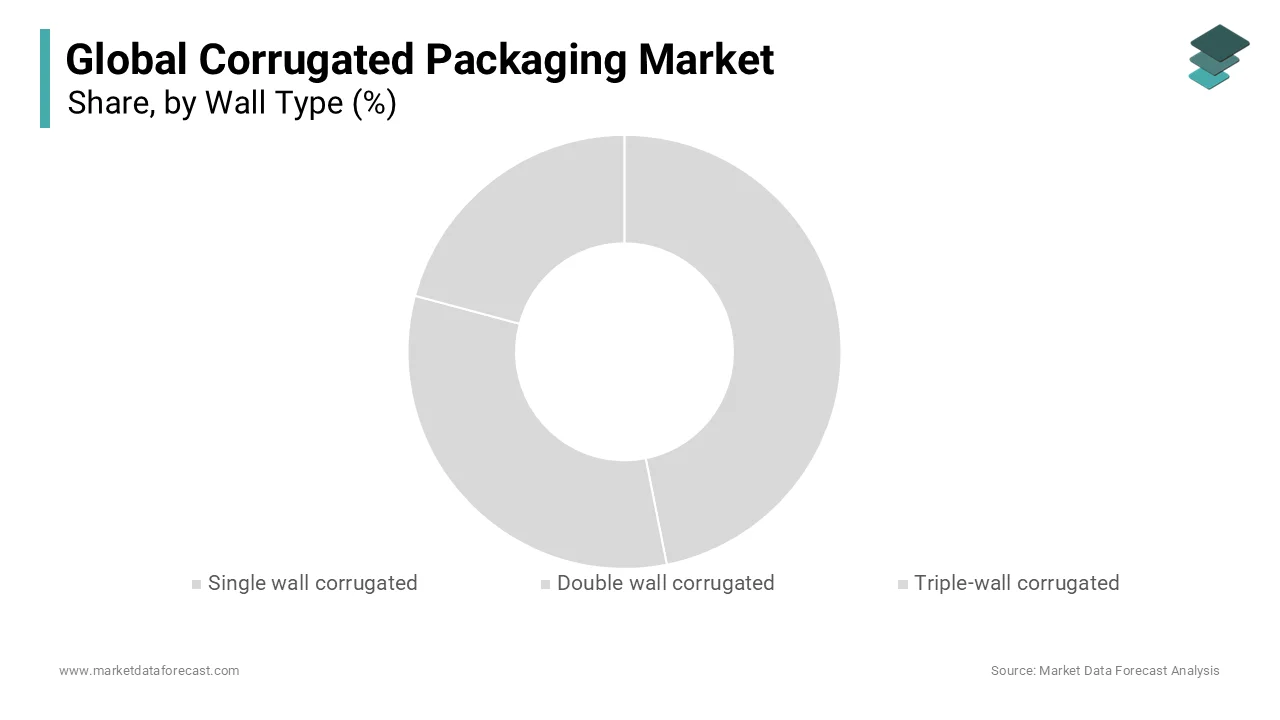
The triple-wall segment is swiftly emerging with an expected CAGR of 7.1% during the forecast period with the increasing demand for heavy-duty industrial packaging capable of withstanding extreme loads and long-distance transport. According to the research, triple-wall board can support stacking pressures exceeding 1,500 kg, making it essential for machinery, construction materials, and large appliances. In India, it reported a rise in shipments of heavy industrial goods, directly boosting demand for reinforced corrugated solutions. A further driver is the expansion of cold chain logistics for temperature-sensitive goods. Triple-wall corrugated, when combined with insulating liners, offers superior thermal resistance and structural integrity during extended transit.
By Box Style Insights
The slotted boxes segment dominated the corrugated packaging market share in 2025 with the unparalleled versatility, ease of assembly, and compatibility with automated fulfillment systems. The Regular Slotted Container (RSC), the most common variant, features flaps that meet at the center, enabling quick closure with minimal adhesive or tape. The design’s adaptability across industries further reinforces its market growth. Slotted boxes can be easily customized in size, flute type, and print quality to suit diverse products, from consumer electronics to frozen foods.
The self-erecting boxes segment is likely to grow with an expected CAGR of 9.4% throughout the forecast period. These boxes are pre-glued and designed to unfold automatically when removed from a magazine or conveyor, which is reducing manual labor in high-speed packaging environments. According to the study, self-erecting systems can increase packaging line efficiency, a critical advantage in automated fulfillment centers. Amazon’s fulfillment network in Germany has integrated self-erecting corrugated boxes into a portion of its robotic packing stations, reducing cycle time seconds per unit, as per the research. A different driving factor is the rising adoption of on-demand packaging systems that generate custom-sized boxes in real time. Companies utilize self-erecting blanks in their inline systems, minimizing material waste and eliminating the need for inventorying multiple box sizes.
By End Use Insights
The Food & Beverages sector was the largest by occupying 41.8% of global corrugated packaging market share in 2025 with the sector’s reliance on corrugated materials for primary transit packaging of perishable and non-perishable goods. Additionally, advancements in barrier coatings, such as water-resistant and grease-proof treatments, have expanded corrugated’s use in direct food contact applications. The European Food Safety Authority (EFSA) approved many new mineral oil-free barrier coatings, enabling safer packaging for baked goods and frozen foods.
The medical applications segment is likely to expand at a CAGR of 8.6% during the forecast period with the increasing complexity of medical device logistics and the global expansion of vaccine distribution networks. In India, there has been an increase in corrugated packaging use for diagnostic kits and surgical supplies, reflecting the growth of decentralized healthcare delivery. In Germany, many hospitals use corrugated containers for instrument sterilization trays, replacing rigid plastic cases to reduce cross-contamination risks. Furthermore, the rise of home healthcare and telemedicine has increased demand for patient-ready packaging that is lightweight, easy to open, and fully recyclable.
REGIONAL ANALYSIS
Asia Pacific Corrugated Packaging Market Insights
Asia Pacific led the global corrugated packaging market with a 45.1% share in 2025 with the explosive industrial growth and urbanization in China, India, and Southeast Asia. China alone accounts for a notable share of global corrugated production, with the millions of metric tons of corrugated board manufactured. The region’s dominance is anchored in its role as the world’s manufacturing hub, particularly for electronics, textiles, and consumer goods, all of which rely heavily on corrugated shipping containers. In addition, India saw e-commerce packaging demand grew annually in the coming years, fueled by platforms like Flipkart and JioMart. Additionally, government initiatives such as China’s “Dual Circulation” strategy are boosting domestic logistics, further increasing corrugated consumption.
North America Corrugated Packaging Market Insights
North America was positioned second by holding 23.5% of corrugated packaging market share in 2025 with the mature but resilient demand across e-commerce, food distribution, and industrial sectors. The U.S. Census Bureau reports that online retail sales generated substantial amount, with billions of parcel shipments, nearly all of which used corrugated packaging. A portion of American households recycle corrugated cardboard, supporting a circular economy model with a recovery rate high. Canada’s shift toward sustainable forestry, with many of its corrugated fiber sourced from certified forests, as per research, reinforces regional growth in environmentally responsible production.
Europe Corrugated Packaging Market Insights
Europe corrugated packaging market is likely to grow with the distinguished by stringent environmental regulations and advanced recycling infrastructure. According to research many of corrugated packaging in the EU was recovered, one of the key recycling rates for any packaging material. The EU’s Packaging and Packaging Waste Regulation (PPWR) mandates that all packaging be reusable or recyclable by 2030, accelerating the shift from plastic to fiber-based solutions. Germany, the largest national market, produces substantial metric tons of corrugated annually, as per the study, with a strong emphasis on lightweight, high-performance designs for automotive and pharmaceutical logistics.
Latin America Corrugated Packaging Market Insights
Latin America corrugated packaging market growth is likely to grow with the industrial expansion and rising consumer demand. As per study, Brazil saw an increase in corrugated usage in the food and beverage sector, linked to export growth in coffee, meat, and orange juice. The country’s vast agricultural output requires robust packaging for long-haul transport, with many exported perishables shipped in ventilated corrugated containers, as per research.
Middle East and Africa Corrugated Packaging Market Insights
Middle East and Africa corrugated packaging market is expected to have steady pace throughout the forecast period. Saudi Arabia’s Vision 2030 includes substantial investment in infrastructure and logistics projects, increasing demand for durable packaging in construction and retail. The UAE’s Emirates Industrial Bank reports a rise in corrugated imports, driven by e-commerce expansion in Dubai and Abu Dhabi. Corrugated cardboard recycling is successful in some parts of Africa due to strong collection networks and government support.
KEY MARKET PLAYERS AND COMPETITIVE LANDSCAPE
Cascades, CESCO, Danhil, DS Smith, Evergreen Packaging, Georgia-Pacific, International Paper, Lee & Man Paper Manufacturing, Mondi Group, Montebello Container, Packaging Corporation of America, Rengo, Smurfit Kappa Group, Sultana Packaging, and WestRock are the key players in the corrugated packaging market.
The competition in the corrugated packaging market is increasingly defined by technological innovation, sustainability credentials, and service integration rather than pCorrugated packaging alone. Multinational producers leverage scale, global supply chains, and R&D capabilities to offer advanced, compliant solutions, while regional players compete through agility and localized expertise. The shift toward circular economy models has intensified focus on fiber sourcing, recyclability, and carbon footprint transparency, with leading firms adopting digital product passports and blockchain traceability. Automation in converting and integration with e-commerce fulfillment systems have become critical differentiators. Companies are also competing on design intelligence by offering AI-driven packaging optimization and brand-enhancing print solutions.
TOP PLAYERS IN THE MARKET
International Paper
International Paper is a dominant force in the global corrugated packaging sector, with a substantial footprint across the Asia-Pacific region. The company has strategically expanded its manufacturing and converting operations in China, India, and Vietnam to meet rising demand from e-commerce and consumer goods sectors. The facility integrates advanced automation and AI-driven quality control systems to enhance production efficiency. The company has also partnered with Alibaba’s Cainiao Network to develop right-sized, recyclable packaging solutions that reduce material use.
WestRock Company
WestRock Company has established a robust presence in Asia-Pacific by aligning its product development with regional sustainability goals and supply chain modernization. The company operates multiple converting facilities in Thailand, Indonesia, and Australia, supplying high-performance corrugated packaging to food, beverage, and healthcare clients. The company also introduced digitally printed, brand-enhancing boxes for premium consumer brands in Japan and South Korea, integrating QR codes for consumer engagement and traceability. WestRock’s collaboration with the Australian Institute of Packaging on lifecycle assessment tools has strengthened its credibility in sustainable design by enabling clients to meet stringent EPR regulations across Southeast Asia.
Smurfit Kappa
Smurfit Kappa has intensified its engagement in the Asia-Pacific market through strategic investments and localized innovation. While historically strong in Europe, the company has expanded its footprint via joint ventures and technology transfers, particularly in fast-growing markets like India and the Philippines. The company also opened a new design center in Manila focused on developing moisture-resistant packaging for agricultural exports. Its Paper Not Plastic initiative has gained traction in Southeast Asian retail chains, replacing plastic packaging with fiber-based alternatives.
TOP STRATEGIES USED BY KEY MARKET PLAYERS
Key players in the corrugated packaging market are deploying integrated strategies to maintain competitive advantage. Companies are investing heavily in automation and digital converting technologies to enhance precision, reduce waste, and support on-demand packaging. Expansion into high-growth regions is being accelerated through greenfield projects, joint ventures, and localized R&D centers to ensure climate- and market-specific product relevance. Sustainability is a core focus, with firms developing recyclable, lightweight, and plastic-free solutions to comply with regulatory mandates and brand requirements. Strategic partnerships with e-commerce platforms and logistics providers are enabling co-engineering of optimized packaging systems.
MARKET SEGMENTATION
This research report on the global corrugated packaging market has been segmented and sub-segmented based on wall type, boxes style, end use, distribution channel, and region.
By Wall Type
- Single wall corrugated
- Double wall corrugated
- Triple-wall corrugated
By Boxes Style
- Slotted boxes
- Telescope boxes
- Rigid (bliss) boxes
- Self-erecting boxes
- Others (interior forms, die cut)
By End Use
- Food & beverages
- Personal care & home care
- Medical
- Home appliances & electronics
- Agriculture
- Industrial
- Chemical & plastics
- Paper & carton
- Others
By Distribution Channel
- Direct sales
- Indirect sales
By Region
- North America
- Europe
- Asia-Pacific
- Latin America
- Middle East and Africa