- Product Description Description
- Table of Contents TOC
- List of Table & Figure LOT
- Get Free Sample PDF Sample PDF
Market Size, 2025
$19.43 BnMarket Estimate, 2026
$21.01 BnMarket Forecast, 2034
$39.20 BnCAGR, 2026–2034
8.11%Global Cryogenic Equipment Market Size
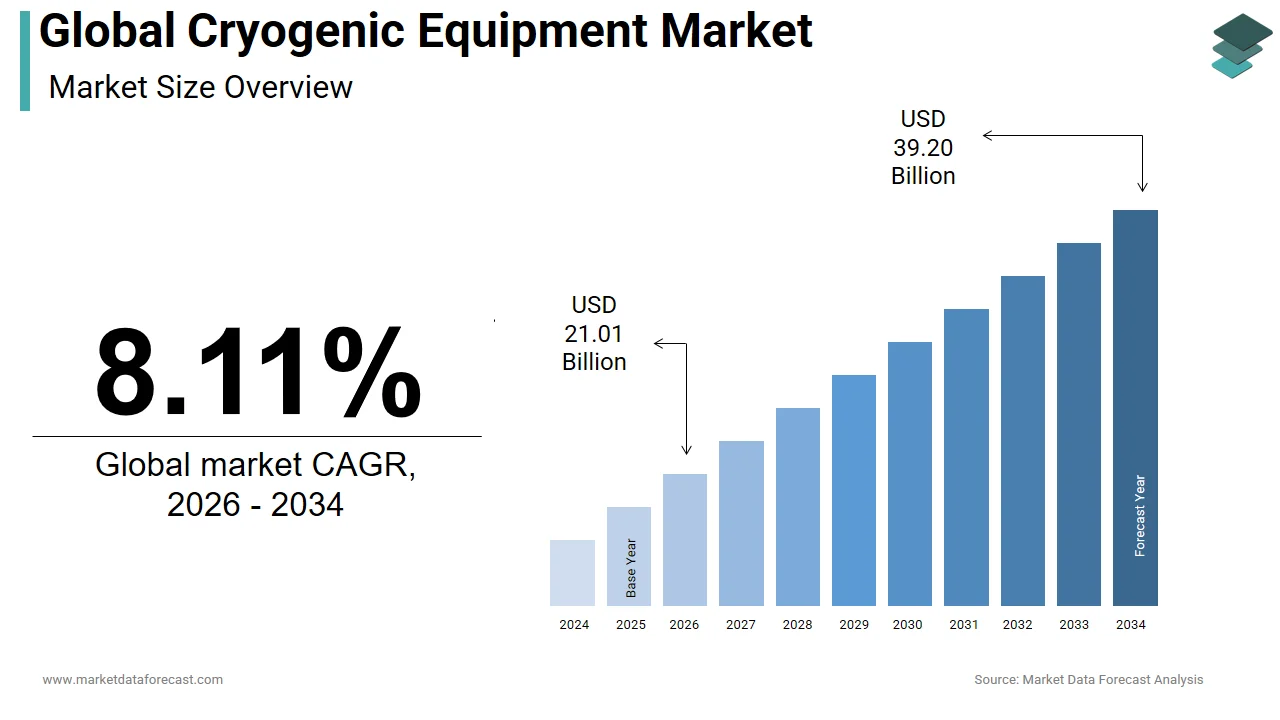
The global cryogenic equipment market was valued at USD 19.43 billion in 2025, is estimated to reach USD 21.01 billion in 2026, and is projected to reach USD 39.20 billion by 2034, growing at a CAGR of 8.11% from 2026 to 2034.
Cryogenics, the study of shallow temperatures, involves colder temperatures than those achieved with conventional refrigeration equipment. It includes cryogenic freezers for controlled cooling and transporting various products using liquid nitrogen. The sub-zero temperatures achieved in cryopreservation can be adjusted and customized according to different materials and used to preserve biological samples, rocket fuels, and in the manufacturing of superconducting electromagnets.
In general, the cryogenics equipment includes Freezers, consumables, storage solutions biological and clinical samples at ultra-low temperatures. They help maintain a cryogenic temperature of up to -150°C since this low temperature is required to produce and transport LNG, the storage of oxygen, helium, or liquid nitrogen cryogenic equipment using liquNitrogengen as the refrigerant is known as liquid nitrogen equipment. This can be safely transported and used as a refrigerant.
MARKET DRIVERS
The growing concerns regarding the development of healthcare systems and the increasing replacement of energy sources with natural gas are helping the market grow. In addition, there has been a growing scarcity of fossil fuels, because of which there have been growing concerns about emissions, transport, and massive demand for clean energy resources.
Growing demand for cryogenic equipment throughout the LNG value chain drives the market growth.
LNG-fired power plants present a significant market expansion as a clean energy source because of the increasing demand for LNG fuels used in automobiles. As a result, using oil tankers, valves, vaporizers, and pumps is expected to drive equipment sales.
Additionally, one of the supportive rules that aid in increasing the application of industrial gases and, consequently, the market growth is the encouragement and facilitation of investment policies. Another helpful regulation is the entry and establishment of international investors. Therefore, there has been a significant rise in investments in the petrochemical and chemical sectors because of the government's increasing emphasis on improvising regulations and policies to stabilize new industries. This is likely to increase growth.
Across this, the equipment increases fuel safety. Therefore, the growing demand for fuel storage and spending on space and satellite missions to store space specimens in cryogenic gases is mainly attributed to their static nature, thereby increasing market growth. Presently, many renovations are going on for the current healthcare infrastructure. Also, the usage in the healthcare industry for blood storage and drug packaging is likely to increase the demand for equipment.
MARKET RESTRAINTS
High costs associated with specialized materials for the maintenance of cryogenic equipment are one of the significant limitations to the growth of the cryogenic equipment market. Also, stringent greenhouse gas emission standards and fluctuating stainless steel prices can hamper the market progression. Furthermore, due to the use of highly specialized materials such as CAPEX and OPEX, the total cost of cryogenic construction becomes high, affecting the market's growth. Furthermore, cryogen leakage and loss are anticipated to hamper the market’s growth rate during the forecast period. In addition, the equipment is not entirely dependable as it can be unsuccessful in discharge resulting in a drawback for the cryogenic equipment market. Furthermore, prolonged exposure to these gases causes various lung disorders.
REPORT COVERAGE
| REPORT METRIC | DETAILS |
| Market Size Available | 2025 to 2034 |
| Base Year | 2025 |
| Forecast Period | 2026 to 2034 |
| Segments Covered | By Product, Cryogen Type, End-User & Region. |
| Various Analyses Covered | Global, Regional and Country-Level Analysis, Segment-Level Analysis, Drivers, Restraints, Opportunities, Challenges; PESTLE Analysis; Porter’s Five Forces Analysis, Competitive Landscape, Analyst Overview of Investment Opportunities |
| Regions Covered | North America, Europe, Asia Pacific, Latin America, Middle East & Africa |
| Market Leaders Profiled | Beijing Tianhai Industry Co.Ltd, Cryofab Inc., Emerson, Graham Partners, Herose GmbH, Linde Group AG, VRV S.P.A., Air Liquide, Chart Industries Inc., Cryoquip LLC, Flowserve Corporation, Parker Hannifin and INOX India Ltd. |
SEGMENTAL ANALYSIS
By Product Insights
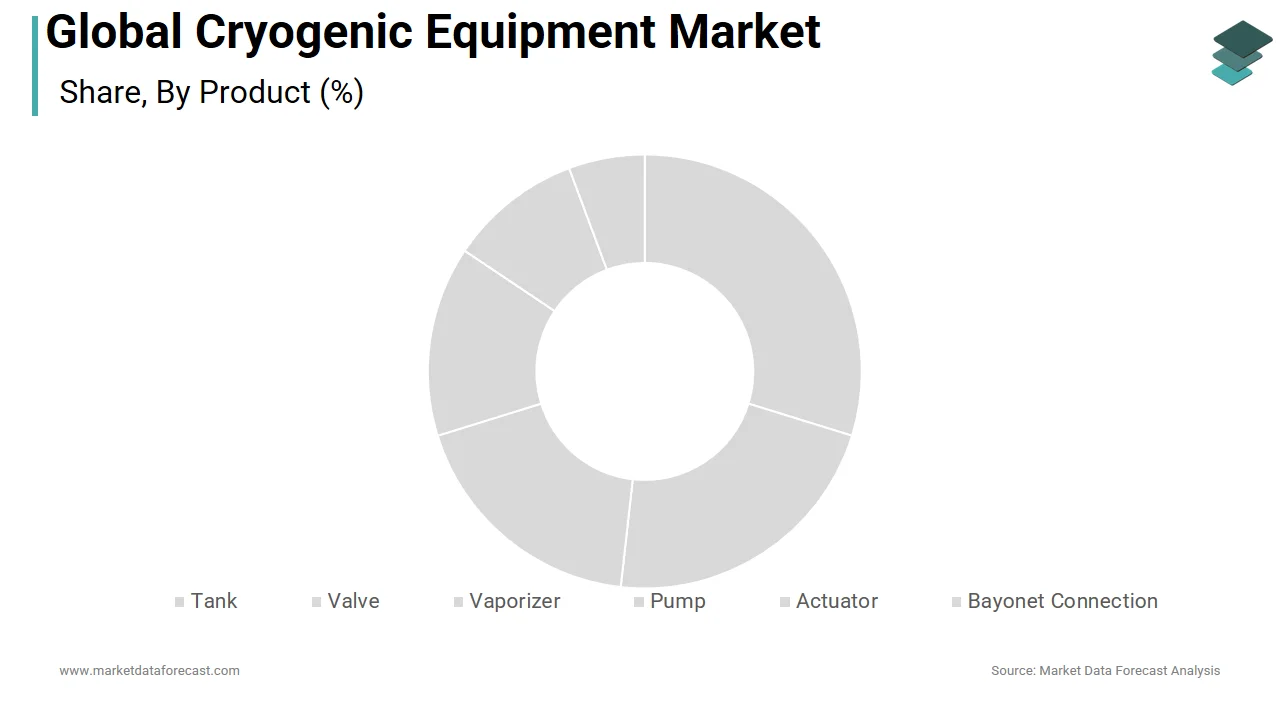
Based on the product, the tank segment accounted for the leading share of the market in 2024. The requirement to maintain gases for several critical industrial processes with less maintenance and superior insulation, along with increased durability, is expected to drive the demand for the tanks over the forecast period. Storing cryogenic liquids below -150°C is the primary purpose. Additionally, their versatility, purity, and stability with improved loading process through vaporizers increase their safety over other storage alternatives.
The valves segment is also anticipated to play a promising role in the market during the forecast period owing to its usage used in natural gas liquefaction plants and gas manufacturing facilities. In addition, due to the widespread use of smokers for LNG baseload evaporation, its application in extremely cold appliances and the advantage of its design to open under high-pressure conditions and to allow gases to flow freely until pressure is reduced, thereby preventing leaks further raises the chances of growth of this segment in the market.
By Type Insights
Based on the type, the nitrogen segment is expected to witness significant growth during the forecast period. This is mainly due to its many uses in the oil and gas and metallurgy industries. As an inert element, Nitrogen is mainly marketed in liquid and gaseous form; it can displace oxygen and is thus used by healthcare industries to destroy a particular diseased tissue. Moreover, Nitrogen is used to freeze biological samples to prevent damage during transport and storage processes.
On the other hand, the oxygen segment is forecasted to play a vital role in the market during the forecast period. A cryogenic oxygen plant creates molecular oxygen of higher purity. This high-purity product obtained is stored in liquid form, which can be filled in cylinders at a later stage. Such cylinders can then be distributed in the medical sector, welded, or used as breathing gas for diving.
By End-User Insights
Based on the end-user, the energy and power segment is anticipated to dominate the market owing to its use in cryogenic power plants. They use liquid air to store energy. Others include cryogenic energy, green hydrogen power plants, and energy storage in the form of liquid air.
The metallurgy segment is expected to accelerate at a prominent CAGR during the forecast period. Growing demand for energy and oil, extensive use of argon and nitrogen gas in the metallurgical industry, advancements in technology, and rising transport and storage of LNG for the oil and gas industry can fuel the market's growth.
REGIONAL ANALYSIS
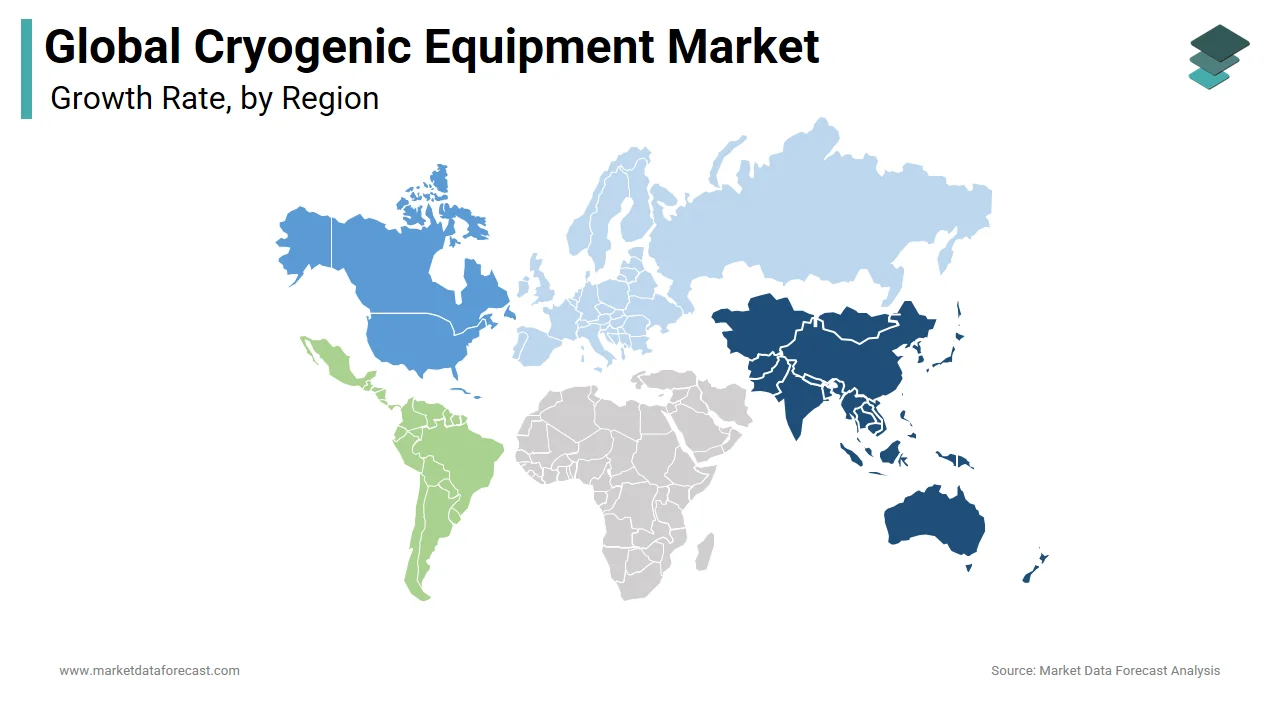
The cryogenic equipment market in Asia-Pacific could witness substantial growth, owing to rising concerns over greenhouse gas emissions and growing demand for natural gas. In addition, LNG power plants increase their market share by depleting coal resources. This not only represents a growth opportunity for cryogenic equipment but also enhances the quality of the environment.
North America is also anticipated to hold a significant market share for increasing consumer awareness, substituting conventional equipment, and adopting sustainable solutions. According to the International Energy Agency (IEA), between 2019 and 2025, there will be an average demand growth of 1.5% every year for natural gas.
Energy demand is predicted to increase significantly throughout Europe. A favorable economic environment will be created by increasing investments in the aerospace industry, including military, commercial, and space initiatives, along with the sustained use of gas-fired power plants. Therefore, the demand for industrial gases is rising across Europe due to their expanding use in the metallurgical, steel, oil and gas, manufacturing, processing, and mining industries.
With 50% of the world's proven reserves of conventional natural gas, the Middle East and Africa are the central regions engaged in oil and gas activities. The United Arab Emirates and Qatar's offshore gas initiatives, which need cryogenic pumps and equipment for LNG storage and transportation, primarily account for the surge. Other major LNG exporters include nations in the Middle East and Africa like Kuwait, Qatar, Saudi Arabia, and Oman.
KEY MARKET PLAYERS
Companies playing a pivotal role in the global cryogenic equipment market profiled in this report are
- Beijing Tianhai Industry Co. Ltd.
- Cryofab Inc.
- Emerson
- Graham Partners
- Herose GmbH
- Linde Group AG
- VRV S.P.A.
- Air Liquide
- Chart Industries Inc.
- Cryoquip LLC
- Flowserve Corporation
- Parker Hannifin
- INOX India Ltd.
GLOBAL CRYOGENIC EQUIPMENT MARKET NEWS
- In October 2022, the Activegrid LT was created by C3Nano, Inc., a performance leader in nanowire-based technologies and conductive inks. It offers the highest quality, lowest temperature, and fastest-curing conductive inks available on the market. In addition, it is a component of their platform for conductive materials.
- In March 2022, High-Temp Colorants from Avient were made available in polyphenyl sulfone (PPSU) resin, offering extremely high resistance and sterilizing temperatures up to 150°C for medical applications. In addition, they want to make sure that their patients feel comfortable and welcome.
MARKET SEGMENTATION
This research report on the global cryogenic equipment market has been segmented and sub-segmented based on product, cryogen type, end-user, and region.
By Product
- Tank
- Valve
- Vaporizer
- Pump
- Actuator
- Bayonet Connection
By Type
- Nitrogen
- Oxygen
- Argon
- Liquefied Natural Gas (LNG)
- Hydrogen
- Helium
By End-User
- Energy & power
- Chemicals
- Metallurgy
- Electronics
- Shipping
By Region
- North America
- Europe
- Asia-Pacific
- Latin America
- Middle East and Africa