- Product Description Description
- Table of Contents TOC
- List of Table & Figure LOT
- Get Free Sample PDF Sample PDF
Market Size, 2025
$20.05 BnMarket Estimate, 2026
$22.07 BnMarket Forecast, 2034
$47.59 BnCAGR, 2026–2034
10.08%Global Customer Engagement Solutions Market Size
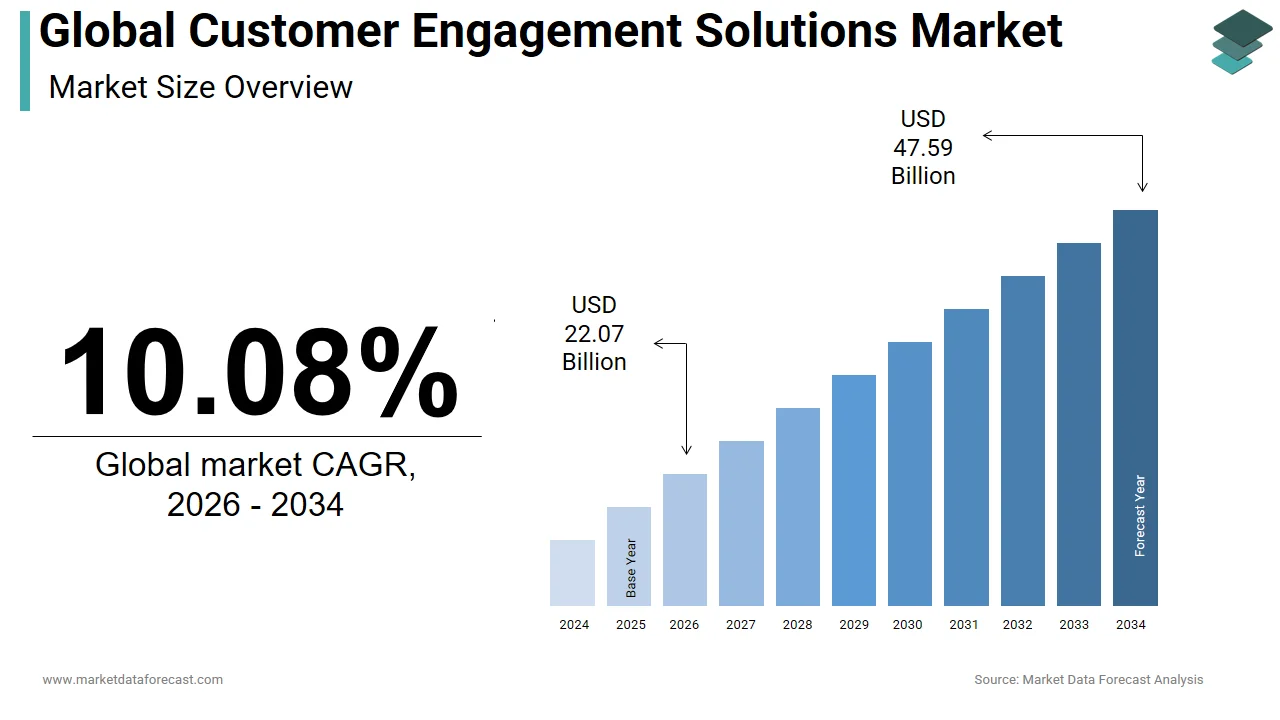
The customer engagement solutions market was worth USD 20.05 billion in 2025. The global market is predicted to reach USD 22.07 billion in 2026 and USD 47.59 billion by 2034, growing at a CAGR of 10.08% during the forecast period.
Customer engagement solutions are software platforms, analytics engines, and communication orchestration tools designed to enable enterprises to deliver personalized, context-aware, and emotionally resonant experiences across every customer touchpoint. This is not merely a technology stack but a strategic capability that fuses behavioral science, real-time data processing, and omnichannel delivery to transform transactional interactions into relational value. As per sources, organizations that deploy advanced engagement solutions report an increase in customer lifetime value and a reduction in churn compared to peers relying on legacy CRM systems. The sophistication of these platforms has evolved beyond email blasting and ticket routing. According to studies, a share of enterprises embed predictive behavioral modeling into their engagement workflows, which enables them to anticipate needs before customers articulate them. Deployment spans industries but is most mature in retail, financial services, and telecommunications, where real-time personalization directly correlates with revenue outcomes. Technological convergence is accelerating the capability. Regulatory and ethical guardrails are tightening. This market sells measurable emotional and economic loyalty.
MARKET DRIVERS
Rising Customer Expectations for Hyper Personalization Are Forcing Enterprises to Deploy AI-Driven Engagement Platforms
The intensifying demand from consumers for individually tailored, anticipatory, and frictionless brand interactions drives the growth of the customer engagement solutions market. This development is compelling organizations to abandon batch and blast communication models in favor of real-time and AI-powered engagement orchestration. As per Salesforce’s State of the Connected Customer Report, eighty-eight percent of consumers now consider the experience a company provides as important as its products or services, with seventy-six percent expecting consistent personalization across every channel. Failure to meet this threshold carries financial consequences. The technological response is sophisticated. In addition, retailers are leading adoption. Financial institutions are equally invested. This is not a trend but a permanent recalibration of the customer contract, where relevance is the price of entry and indifference is the trigger for defection.
Integration of Generative AI Is Enabling real-time content Creation and Conversational Depth at an Unprecedented Scale
The infusion of generative artificial intelligence into customer engagement workflows is fundamentally altering the economics and efficacy of personalized communication by enabling dynamic, contextually precise content generation and natural language interaction without human intervention, which further propels the expansion of the customer engagement solutions market. As per sources, enterprises using generative AI to auto-create product descriptions, email variants, and chat responses have reduced content production costs while increasing engagement velocity by threefold. The technology is not replacing humans but amplifying their impact. Retail applications are particularly transformative. Financial services are leveraging generative AI for compliance-safe advisory content. Ethical deployment remains important. This capability is operational, and its absence is increasingly interpreted as organizational obsolescence.
MARKET RESTRAINTS
Data Silos and Fragmented Identity Resolution Are Affecting the Coherence of Cross-Channel Engagement
The persistence of disconnected data repositories and inconsistent customer identity frameworks across departments and channels is systematically degrading the quality and continuity of engagement, which restricts the growth of the customer engagement solutions market. This is rendering personalization efforts superficial and often contradictory. As per the Boston Consulting Group, only a share of enterprises possess a unified, real-time view of customer behavior across web, mobile, call center, and in-store interactions, with the remainder relying on batch updated or channel-specific profiles. The consequence is jarring customer experiences. According to PwC, a share of consumers report receiving irrelevant or redundant messages within twenty-four hours of completing a purchase or support interaction, which directly erodes brand trust. Technical debt compounds the problem. Compliance risks are escalating. Hence, engagement will remain a series of disconnected monologues rather than a coherent conversation.
Consumer Distrust in Data Usage and Algorithmic Opacity Is Eroding Willingness to Share Behavioral Information
Growing skepticism toward how personal data is collected, stored, and leveraged by algorithms is causing consumers to withhold consent, falsify inputs, or abandon interactions entirely, which restrains the expansion of the customer engagement solutions market. As per Edelman’s 2024 Trust Barometer, only a portion of global consumers believe companies are transparent about how their data improves their experience, while a share actively avoid brands they perceive as overly intrusive or manipulative. The backlash is measurable. Financial consequences are material. Regulatory scrutiny is amplifying caution. According to the Electronic Privacy Information Center, enforcement actions against dark patterns and non-explainable AI in marketing increased. Rebuilding trust requires more than compliance. As per the Harvard Business Review, brands that allow customers to edit their preference profiles and see how data influences recommendations achieve retention rates higher than those that do not. So, even the most sophisticated engagement technology will falter on the rocks of consumer resistance without ethical transparency and user agency.
MARKET OPPORTUNITIES
Convergence of Engagement and Commerce Platforms Is Creating Unified Revenue-Generating Customer Journeys
The dissolution of boundaries between engagement orchestration and transaction execution is enabling brands to embed purchasing, support, and loyalty actions directly within conversational and content-driven experiences by collapsing the traditional funnel into a single continuous value exchange, which in turn creates new opportunities for the customer engagement solutions market. Retailers are leading this fusion. Also, financial services are equally transformative. Moreover, technology enablers are maturing. According to Gartner, composable commerce platforms now allow marketers to assemble checkout, loyalty, and service modules within engagement workflows without developer dependency. The economic impact is substantial. As per McKinsey, enterprises with unified engagement commerce stacks achieve customer lifetime values higher than those with siloed systems. This is not channel convergence but journey collapse, where every interaction is a potential moment of value creation and not just communication.
Expansion Into Employee and Partner Engagement Is Unlocking New Value Streams Beyond Consumer-Facing Use Cases
The adaptation of customer engagement technologies to orchestrate personalized as well as data-driven experiences for employees and channel partners opens fresh opportunities for the customer engagement solutions market. This is creating a structurally distinct and rapidly expanding market segment uncorrelated with B2C marketing cycles. As per Gallup’s Report, organizations deploying engagement platforms for internal talent report higher productivity and lower turnover, which directly correlates with profitability. The use cases are diverse. In addition, partner ecosystems are equally receptive. The technology stack is identical but repurposed. Besides, compliance and personalization coexist. This internalization of engagement principles is not ancillary but strategic, which transforms workforce and partner ecosystems into aligned, motivated, and data-responsive value networks.
MARKET CHALLENGES
Legacy Technology Debt Is Preventing Real-Time Responsiveness and Fragmenting Customer Experience Delivery
The continued reliance on outdated and monolithic engagement systems continues to be a key challenge for the customer engagement solutions market. These are incapable of processing real-time behavioral signals or integrating with modern API driven architectures is systematically degrading customer experience velocity and coherence. As per the Center for Information Systems Research, a percentage of enterprises still operate marketing and service automation on platforms over seven years old, with a latency of several minutes between behavioral trigger and response delivery. The business cost is severe. Integration failures compound the issue. As per Gartner, legacy systems in a portion of large enterprises cannot consume streaming data from mobile apps or IoT devices, which forces batch-based approximations that miss micro intent signals. Modernization is stalled by complexity. The competitive penalty is accelerating. Engagement will remain reactive, fragmented, and economically suboptimal. This will not change until technical debt is retired and event-driven architectures are adopted.
Lack of Cross-Functional Accountability for Customer Outcomes Is Fragmenting Ownership and Diluting Impact
The absence of unified metrics, shared incentives, and executive-level accountability for end-to-end customer experience is another major impediment to the customer engagement solutions market. This is causing engagement initiatives to remain siloed within marketing or service departments, which affects coherence and dilutes return on investment. The consequence is conflicting priorities. Budget allocation reflects the fracture. As per Gartner, over seventy percent of engagement technology spend is controlled by marketing, while service and product teams lack access to behavioral data needed to resolve issues or improve offerings. Performance measurement is equally disjointed. According to Forrester, fewer than fifteen percent of organizations tie executive compensation to unified customer health scores, instead rewarding channel-specific metrics like email open rates or call handle time. The financial impact is measurable. As per McKinsey, companies with cross-functional customer value teams achieve revenue growth up to three times higher than those with siloed ownership. The C-suite must reorganize around customer outcomes instead of functional outputs. Until this happens, engagement will remain a collection of tactics rather than a unified strategy.
REPORT COVERAGE
| REPORT METRIC | DETAILS |
| Market Size Available | 2025 to 2034 |
| Base Year | 2025 |
| Forecast Period | 2026 to 2034 |
| Segments Covered | By Component, Organization Size, Deployment Type, Vertical, and Region. |
| Various Analyses Covered | Global, Regional, and Country-Level Analysis, Segment-Level Analysis, Drivers, Restraints, Opportunities, Challenges; PESTLE Analysis; Porter’s Five Forces Analysis, Competitive Landscape, Analyst Overview of Investment Opportunities |
| Regions Covered | North America, Europe, APAC, Latin America, Middle East & Africa |
| Market Leaders Profiled | eGain Corporation, Genesys, IBM, Eptica, Freshworks, Microsoft, NICE Systems, Nuance Communications, BPMonline, CRMnext, OpenText, Oracle, Pegasystems, Pitney Bowes, Salesforce, Aspect Software, Avaya, Calabrio, SAP, ServiceNow, Verint Systems, Zendesk, IFS-mplsystems, SugarCRM, and others. |
SEGMENTAL ANALYSIS
By Component Insights
In 2024, the solutions segment captured the leading share of 63.3% of the global customer engagement solutions market. The foundational role that software platforms play in enabling real-time personalization, omnichannel orchestration, and behavioral analytics across enterprise functions has mainly contributed to the dominance of the solutions segment in the global market. As per sources, a notable portion of organizations cite deployment of integrated engagement platforms as the enabler of improved retention and conversion metrics, with services viewed as implementation or optimization layers. Investment prioritization reflects this hierarchy. Technological convergence further entrenches solution prowess. Regulatory compliance also drives software dependence. This software-centric paradigm ensures that solutions will remain the market’s gravitational center as capabilities evolve.
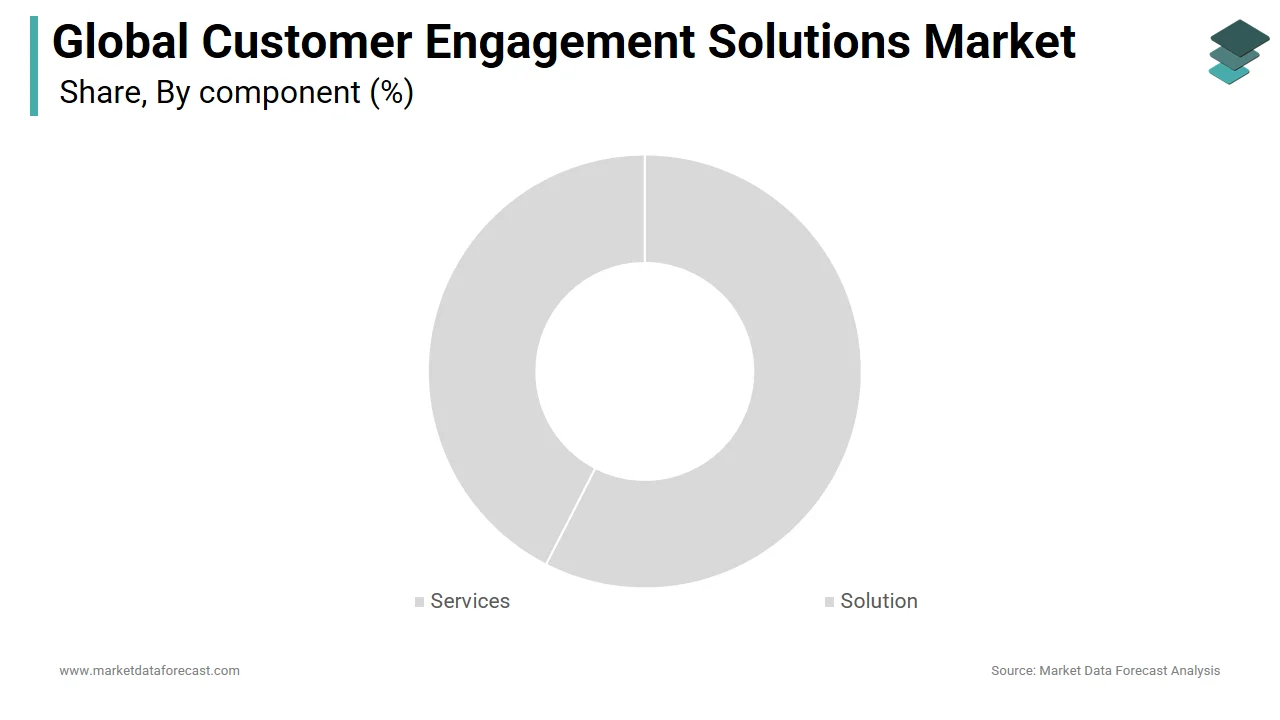
The services segment is on the rise and is expected to be the fastest-growing segment in the global market by witnessing a CAGR of 18.4% from 2025 to 2033 due to the increasing complexity of integrating engagement platforms with legacy enterprise systems, customizing AI models for industry-specific use cases, and managing ethical and compliance risks associated with algorithmic decisioning. As per studies, a portion of enterprises report insufficient in-house expertise to configure, tune, or govern AI-driven engagement workflows, which forces reliance on external specialists. Implementation barriers are acute. Also, regulatory complexity is amplifying demand. In addition, talent scarcity compounds the issue. This convergence of technical debt, regulatory burden, and skills shortage ensures services will grow faster than software as enterprises struggle to operationalize platform potential.
By Organization Size Insights
The Large Enterprises segment continued to dominate the global customer engagement solutions market by capturing a substantial share in 2024. The prominence of the large enterprises segment is because of the scale, complexity, and regulatory exposure of multinational organizations that require integrated, secure, and auditable engagement ecosystems spanning dozens of countries and millions of customers. As sources, enterprises with a significant number of employees deploy multiple distinct engagement platforms. Also, regulatory mandates further entrench reliance. Integration complexity is another driver. This trifecta of scale, compliance, and integration ensures large enterprises will remain the primary revenue engine for the foreseeable future.
The Small and Medium-Sized Enterprises segment is expected to exhibit a noteworthy CAGR of 22.7% during the forecast period, owing to the proliferation of cloud native, modular, and AI-enabled engagement platforms purpose-built for lean teams with limited technical resources. Cost structures have democratized access. Vertical-specific templates are accelerating deployment. Mobile-first design is vital. Funding access is improving. This convergence of affordability, simplicity, and funding is unlocking unprecedented growth in the underserved mid-market.
By Deployment Type Insights
The Cloud Deployment Mode segment was the largest segment of the customer engagement solutions market by occupying a significant share in 2024. The need for scalability, real-time updates, AI integration, and reduced operational overhead that only cloud native architectures can deliver at enterprise scale has largely contributed to the expansion of the Cloud Deployment Mode segment. As per research, a portion of engagement platform purchases were cloud-based, with on-premises deployments largely restricted to highly regulated sectors. Economic efficiency is decisive. Innovation velocity further entrenches cloud dominance. Regulatory compliance is increasingly cloud-aligned. Talent availability also favors the cloud. This structural alignment with cost, agility, compliance, and talent ensures cloud will remain the default deployment model.
The On-Premises Deployment Mode segment is predicted to witness the highest CAGR of 6.8% from 2025 to 2033. The growth of the on-premises deployment Mode segment is fuelled by organizations in defense, important infrastructure, and core financial services, where data sovereignty, air gapped security, and regulatory mandates prohibit cloud migration. Financial institutions face similar constraints. Data latency requirements also drive retention. Modernization is occurring within constraints. This niche but non-substitutable demand ensures that on-premises will persist as a compliance-driven, mission-essential segment.
By Vertical Insights
The Retail segment led the customer engagement solutions market by accounting for 24.7% share in 2024. The prominence of the retail segment is driven by the sector’s direct revenue dependency on customer retention, basket size, and lifetime value. These metrics are directly influenced by engagement quality. As per studies, retailers deploying real-time behavioral triggers such as cart recovery, dynamic bundling, and AI-generated product recommendations achieve conversion rates higher than peers using batch email campaigns. Omnichannel complexity further drives platform dependence. Competitive burden is acute. Generative AI is accelerating differentiation. Loyalty economics are decisive. This direct correlation between engagement sophistication and revenue performance ensures retail will remain the most aggressive and innovative adopter.
The Healthcare segment is estimated to register the fastest CAGR of 26.3% from 2025 to 2033. The expansion of the Healthcare segment is propelled by the convergence of patient experience mandates, regulatory digitization, and AI-enabled care coordination. As per sources, hospitals achieving notable patient experience ratings receive reimbursement bonuses for total claims by directly tying engagement quality to revenue. Chronic care management is a key driver. Interoperability regulations are accelerating adoption. Mental health applications are expanding rapidly. Privacy-compliant personalization is vital. This regulatory, clinical, and economic alignment is transforming patient engagement from an administrative function to a clinical outcome driver.
REGIONAL ANALYSIS
The Asia Pacific region holds a prominent share of the customer engagement solutions market due to factors such as increased adoption of cloud computing by different organizations in the region, especially in some of the countries such as India and China, which helps the growth of the market. Furthermore, increasing investments by small and medium-sized enterprises across various countries, such as Japan, Australia, and Singapore in information technology to compete, secure, and also capture digital opportunities.
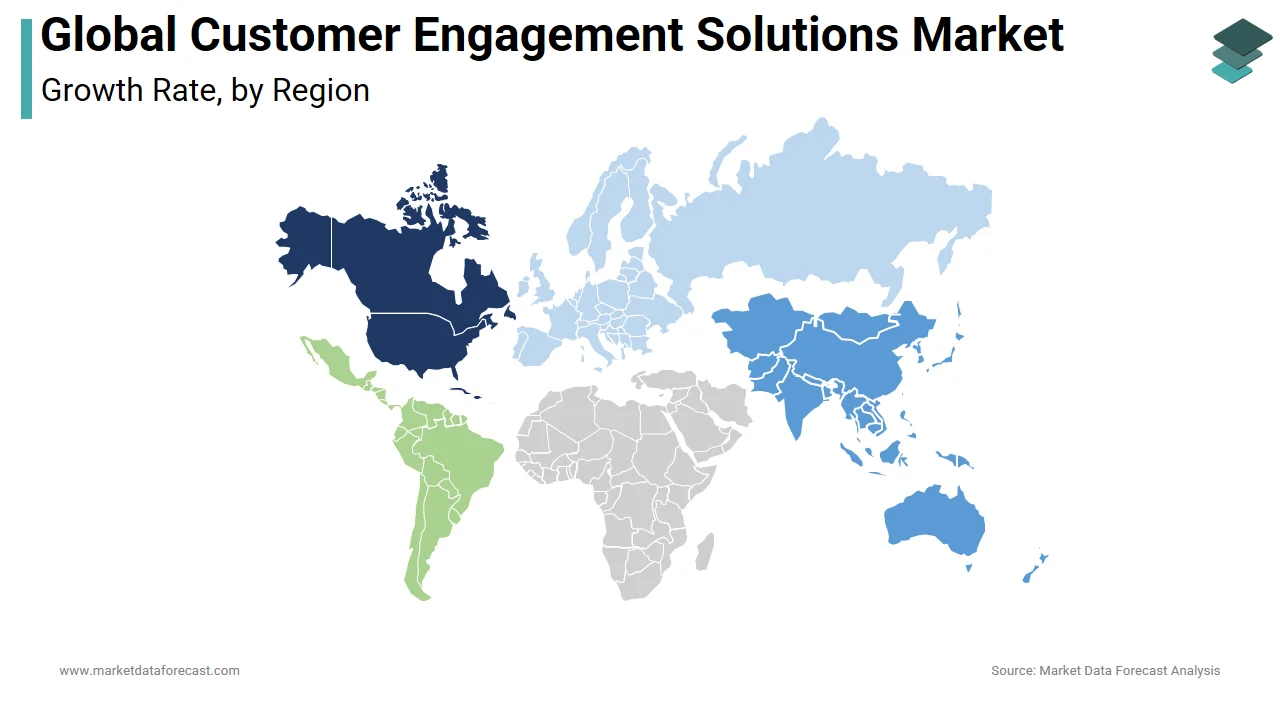
The North American region is also expected to increase the customer engagement solutions market growth due to the increasing focus on delivering enhanced customer engagement through the omnichannel.
The European region will also increase the market rate, followed by the Asia Pacific and North American regions, during the outlook period.
COMPETITIVE LANDSCAPE
Competition in the customer engagement solutions market is defined by technological depth, vertical specialization, and ethical differentiation rather than feature checklists or pricing alone. The market is led by enterprise platform vendors offering end-to-end suites, but increasingly challenged by agile specialists in AI personalization, real-time decisioning, and vertical compliance. Differentiation is achieved through proprietary data unification engines, industry-specific workflow templates, and transparent AI governance frameworks that rebuild consumer trust. Regulatory complexity acts as both a barrier and accelerator for vendors with certified compliance for GDPR, CCPA, HIPAA, and regional laws gain a decisive advantage in procurement. Talent concentration is important. Companies with in-house AI ethicists, behavioral scientists, and cross-channel orchestration engineers outperform those relying on generic automation. Mergers and acquisitions are frequent as leaders acquire AI startups and regional compliance specialists to fill capability gaps. Open architecture is becoming mandatory. Enterprises demand API first, modular platforms that integrate with legacy systems without and rip-and-replace. Innovation cycles are measured in weeks, not quarters, as generative AI forces continuous feature evolution. This environment rewards agility, specialization, and trust above all else.
KEY MARKET PLAYERS
Some of the companies that are playing a dominating role in the global customer engagement solutions market include
- eGain Corporation (US)
- Genesys (US)
- IBM (US)
- Eptica (France)
- Freshworks (US)
- Microsoft (US)
- NICE Systems (Israel)
- Nuance Communications (US)
- BPMonline (US)
- CRMnext (India)
- OpenText (Canada)
- Oracle (US)
- Pegasystems (US)
- Pitney Bowes (US)
- Salesforce (US)
- Aspect Software (US)
- Avaya (US)
- Calabrio (US)
- SAP (Germany)
- ServiceNow (US)
- Verint Systems (US)
- Zendesk (US)
- IFS-mplsystems (UK)
- Lithium Technologies (US)
- SugarCRM (US)
Top Players in the Market
- Salesforce Inc. delivers the most comprehensive suite of customer engagement solutions globally, unifying marketing, sales, service, and commerce workflows within its Customer 360 platform. The company embeds artificial intelligence through its Einstein Copilot to enable predictive engagement and automated personalization across industries. It also expanded its industry-specific clouds for healthcare and financial services to meet sectoral compliance needs. Globally, Salesforce licenses its engagement architecture to multinational corporations in many countries, which exports U.S.-developed AI governance and data unification standards while localizing for regional privacy laws and language requirements.
- Oracle Corporation provides enterprise-grade customer engagement platforms with deep integration into back-office ERP and supply chain systems, making it the preferred choice for complex global manufacturers and financial institutions. Its Responsys and Maxymiser platforms enable cross-channel orchestration with built-in regulatory guardrails for GDPR and CCPA. The company also enhanced its zero-trust data governance layer to meet EU and APAC sovereignty mandates. Internationally, Oracle deploys its engagement stack within sovereign cloud regions by ensuring compliance while maintaining feature parity with global releases.
- Adobe Inc. dominates the customer engagement market through its Experience Cloud, which unifies content creation, journey orchestration, and analytics for brands prioritizing digital experience and creative personalization. Its Sensei GenAI engine now auto-generates imagery, copy, and video variants tailored to individual user profiles. It also partnered with Microsoft to embed real-time co-browsing and collaborative cart features into Teams.
Top Strategies Used by the Key Market Participants
Leading participants in the customer engagement solutions market deploy a tightly integrated set of strategies to secure differentiation and sustain growth. First, they embed generative AI into every layer of the engagement stack to automate content creation and decision-making. Second, they develop vertical-specific modules to address compliance and workflow needs in regulated industries. Third, they invest in real-time identity resolution to unify anonymous and authenticated behavioral data. Fourth, they offer composable architecture so enterprises can assemble best-of-breed capabilities without vendor lock-in. Fifth, they expand into employee and partner engagement to unlock new revenue beyond B2C. Sixth, they localize AI models and compliance frameworks for regional data sovereignty laws. Seventh, they acquire niche AI and analytics startups to accelerate innovation cycles. Eighth, they integrate engagement workflows directly into collaboration platforms like Teams and Slack. Ninth, they certify platforms for ethical AI and algorithmic transparency to rebuild consumer trust. Tenth, they offer outcome-based pricing tied to retention lift or revenue growth rather than seat licenses.
MARKET SEGMENTATION
The global customer engagement solutions market is segmented based on organization size, component, deployment type, vertical, and region.
By Component
- Solutions
- Services
By Organization Size
- Small And Medium-Sized Enterprises
- Large Enterprises
By Deployment Mode
- On-Premises Deployment Mode
- Cloud Deployment Mode
By Vertical
- Government And Defense
- Financial Services
- Banking
- Insurance
- IT And Telecom
- Healthcare
- Travel And Hospitality
- Retail
- Education
- Power And Logistics
By Region
- North America
- Europe
- Asia-Pacific
- Latin America
- The Middle East and Africa